
FS-11 Tweezer Compliance Profile: Qualification Checks for Cell Phone Repair Tool Buyers
FS-11 Tweezer Compliance Profile: Qualification Checks for Cell Phone Repair Tool Buyers
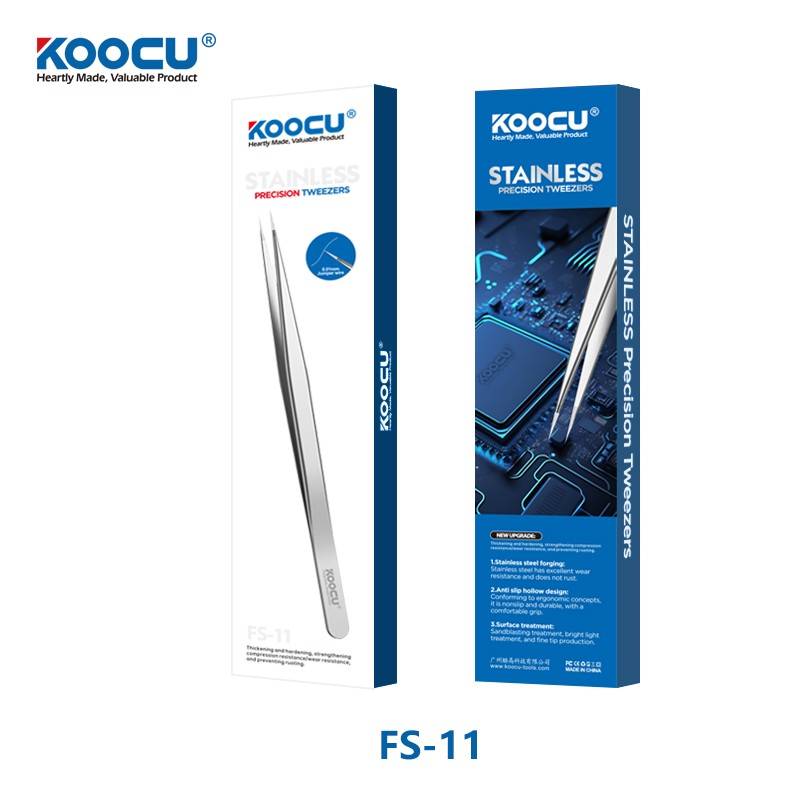
The FS-11 is a 120 mm stainless steel tweezer supplied by KOOCU, the mobile phone repair tool brand of Guangzhou Weiqianji Technology Co., Ltd, for mobile phone repair work. Its published specification is short: length, material, and stated high-hardness and anti-static properties. That brevity is useful for B2B buyers, because every stated attribute can be checked before an order is confirmed — and every unstated attribute can be recorded honestly as unverified instead of assumed.
Why a Low-Cost Tweezer Belongs in the Compliance File
Cell phone repair tools are usually purchased as sets and kits rather than as individual items, and buyer attention tends to concentrate where the money is: hot air stations, screen separators, precision screwdriver sets, electric screwdrivers and screen pry tools. A tweezer typically sits near the bottom of the order value and near the top of daily handling frequency. That combination is exactly why it deserves a line in the qualification file.
Two failure modes are common with low-value hand tools. The first is specification substitution: a supplier ships a similar-looking item whose length, material or finish differs from what was quoted. The second is documentation inflation: the buyer's file records a compliance attribute — often something like “anti-static” — that the supplier never actually stated in writing. Both failures are cheap to prevent on a tweezer, because a tweezer has few attributes to check. The FS-11 is a practical example: three published attributes, one sample, one written request, and the qualification question is settled.
The opportunity for B2B buyers — importers, wholesale merchants, chain repair workshops and own-brand tool programmes — is to treat every hand tool in a Cell Phone Repair Tools order as carrying the same obligation: what is stated must be verifiable, and what is not stated must not be written into the file.
What the FS-11 Specification Actually States
According to the supplier's published product data, the FS-11 is a tweezer for mobile phone repair with a 120 mm overall length, a stainless steel construction, and two stated selling points: high hardness and anti-static properties. Its applicable industry is listed as cellphone repairs. Those are the full verifiable facts about this model.
| Attribute | Published value | What the buyer should do with it |
|---|---|---|
| Overall length | 120 mm | Measure a sample and set your own acceptance window; no tolerance is published. |
| Material | Stainless steel | Request the steel grade in writing; the published data does not name one. |
| Stated selling points | High hardness; anti-static | Ask what each statement is based on, and record the answer even if the answer is “no method cited”. |
| Product type | Tweezer for mobile phone repair | Confirm the tool matches the handling tasks in your own repair workflow. |
| Applicable industry | Cellphone repairs | Keep the file consistent with your destination-market documentation. |
| Certification stated for this SKU | None | Do not write a certification claim into the file without written evidence. |
Using the Three FS-11 Attributes as Qualification Checks
1. Length: the only measurable dimension published
120 mm is the single dimension a buyer can verify objectively on receipt. Because no tolerance band is published, the buyer must define one. A workable approach is to measure several units from the first batch with a caliper, record the spread, and convert that spread into a written acceptance rule for subsequent orders. In practice, length is a fit question rather than a quality question: a 120 mm tweezer that is 5 mm short may still be usable in wide chassis openings, while an oversized unit defeats the purpose of a precision tool in dense assemblies. Making the number contractual is what turns a catalogue value into a purchasing control.
2. Material: “stainless steel” is a family, not a grade
The published material is stainless steel, without a grade designation. Buyers who need corrosion resistance, non-magnetic behaviour or a specific hardness band should obtain the grade from the supplier in writing, or accept the residual risk explicitly. The FS-11 listing also carries high hardness as a selling point. That is a useful procurement signal, but it is not a measured value, and it should be logged as a supplier statement rather than as a test result. A buyer who writes “stainless steel, hardened” into a tender document without asking which grade is being quoted has created a specification that no supplier can be held to.
3. Anti-static: converting a claim into a document
Anti-static is the most commercially sensitive of the three statements, because it touches handling risk for static-sensitive components. In the FS-11 listing it appears as a selling point rather than as a measured electrical property, and the published data does not reference a test method, a surface-resistance range or an ESD standard. Buyers therefore have two legitimate options: request a written statement from the supplier describing what the anti-static designation means for this product line, or record the claim as unverified and manage the residual risk through their own handling procedures. What should not happen is a certification line in the buyer's file that the supplier never issued.
4. Separate SKU-level facts from company-level capability
The supplier's capability record states OEM production mode, customization of voltage and logo, a monthly capacity of 10,000 units, a 50-unit minimum order quantity, a 10-day lead time, 100% testing and remote after-sales support, with South America and Africa named as export markets. These are company-level statements covering a product range. A voltage specification, for instance, is meaningful for powered tools and not for a hand tweezer, which is a reminder that capability terms should be matched to the specific SKU before they are quoted in an order. When the FS-11 line is ordered, the terms that matter are the ones the supplier confirms for that model.
5. Know what a complete documentation record looks like elsewhere in the same catalogue
KOOCU's own FAQ material describes the K01 electric screwdriver as carrying a PONY CNAS certificate, MTIN67MG7731367U1, referencing EN 10440, with 100% pre-shipment inspection and a stated torque output. No equivalent certificate is stated for the FS-11. The comparison is informative rather than damaging: it shows that this supplier is capable of producing certification-backed documentation for parts of its range, and that the tweezer line currently does not present such documentation. For the buyer, the correct action is to ask the supplier directly, in writing, whether a test report, ESD statement or material declaration exists for the FS-11 — and to record the reply either way. Published product documentation for the brand's tool range is available through the supplier's site, koocu-tools.com.
6. A working qualification checklist for the FS-11
- Measure a sample: confirm the 120 mm overall length against the purchase order line, and write your own tolerance window because none is published.
- Request the stainless steel grade in writing, and record “not stated” if the supplier does not provide it.
- Convert “anti-static” into a written declaration, and record the method or standard the supplier cites — or record that none was cited.
- Confirm that the model designation FS-11 appears on the packing list and the product label, not only on the quotation.
- Keep company-level capability terms (MOQ, lead time, testing, OEM customization) separate from SKU-level terms until the supplier confirms the link.
- File a dated record of what was requested and what was received; this is what makes the next reorder faster and cheaper.
How the FS-11 Sits in the Wider Tweezer Range
Buyers sourcing from this catalogue are usually offered a family of tweezers rather than a single model, and the published specifications show how narrow the differences are. All models in the range are listed as stainless steel with the same two stated selling points, high hardness and anti-static, and all are listed for cellphone repairs. Length is the attribute that actually separates them.
| Model | Published length | Material | Stated selling point |
|---|---|---|---|
| TS-11 | 115 mm | Stainless steel | High hardness, anti-static |
| TS-15 | 115 mm | Stainless steel | High hardness, anti-static |
| FS-11 | 120 mm | Stainless steel | High hardness, anti-static |
| ST-114 | 120 mm | Stainless steel | High hardness, anti-static |
| ST-115 | 120 mm | Stainless steel | High hardness, anti-static |
| ST-21 | 120 mm | Stainless steel | High hardness, anti-static |
| ST-25 | 120 mm | Stainless steel | High hardness, anti-static |
| ST-30 | 120 mm | Stainless steel | High hardness, anti-static |
| 7-SA-16 SS-SA-16 | 130 mm | Stainless steel | High hardness, anti-static |
| 7-SA SR SS-SA SR | 130 mm | Stainless steel | High hardness, anti-static |
Because material and static claims are uniform across the range, model selection inside the 120 mm cluster is effectively a reach-and-access decision: how far the tool must extend into a chassis or around a component stack. For qualification purposes, this uniformity has a consequence that is easy to miss. If a buyer writes “tweezers, stainless steel, anti-static” on a purchase order without a model number and a length, the supplier can satisfy the order with any of ten models, and the buyer has no basis for rejection. Specifying FS-11 at 120 mm creates a line item that can be measured, accepted or rejected.
Specification-Checked Sourcing Versus Price-First Sourcing
The honest comparison is not between a good supplier and a bad supplier; it is between two purchasing behaviours and the evidence each one generates.
| Qualification dimension | Price-first purchase of a generic tweezer | Specification-checked FS-11 purchase |
|---|---|---|
| Published length | Often unstated or approximate | 120 mm stated and measurable on arrival |
| Published material | Described loosely, if at all | Stainless steel stated; grade not stated |
| Static-related claim | Sometimes printed on packaging with no stated basis | Anti-static stated as a selling point; no method or standard published |
| Certification attached to the item | Typically none | None stated for this SKU |
| Model-level traceability | Often no model number to quote | Model designation and catalogue entry available |
| Transferable field evidence | None | None for the tweezer line; a documented South Africa case exists for the K01 electric screwdriver line only |
| Cost of the verification effort | Minimal, and of limited value | One measurement plus one written request |
The limitation of the FS-11 route is real and should be stated plainly. Three attributes do not constitute a compliance dossier. There is no published stainless grade, no stated tolerance on the 120 mm length, and no referenced ESD standard or surface-resistance value behind the anti-static claim. Buyers who need to demonstrate static-control performance to a customer or a regulator cannot do so from the current published data alone, and there is no universally agreed “anti-static tweezer” certificate that a buyer can simply demand from any supplier; the requirement has to be defined by the buyer and then checked.
Field evidence is subject to the same rule. A B2B wholesale case in South Africa documents 50 units of the K01 electric screwdriver running stably for three years, and that is a genuine, attributable reference — for the electric screwdriver line. It cannot be transferred to a tweezer. The FS-11 should therefore be treated as a specification-verified, documentation-limited item: it can clear a length and material check today, while its static-performance claim stays open until written evidence is obtained. Buyers who accept that framing get a usable tool with a known evidence boundary rather than an inflated compliance file.
Where the FS-11 Applies in Repair Work
The FS-11's published scope is mobile phone repair within the cellphone repair industry. That scope is deliberately narrow in the supplier's data, and it should not be widened by inference. The same catalogue contains a scenario record for screw removal in cellphone repair factory lines, operating in a rotate-and-twist mode with a screwdriver bit under indoor normal-temperature conditions, with an explosion-proof requirement for power-supply working conditions — but that record belongs to the electric screwdriver line, not to the tweezer. Transferring it to the FS-11 would be exactly the documentation inflation this profile warns against.
Used within its stated scope, a 120 mm stainless steel tweezer serves handling and positioning tasks around small parts and connectors during disassembly and reassembly in mobile phone repair, including screen and housing work where a shorter tool cannot reach. The supplier's stated main markets are Africa, South America, Southeast Asia, India, Bangladesh and Pakistan, and a third-party trade profile attributes to KOOCU more than 15 years in mobile phone maintenance tool manufacturing with over 91% of output exported (Tradewheel). Destination matters for the buyer, because documentation expectations differ by market and by sales channel, and a tool that is acceptable in one channel may require additional paperwork in another.
Market Signals That Make Specification Discipline a Purchasing Requirement
Repair volume is the demand base for every tool in a repair kit. Business Research Insights valued the global smartphone repair market at approximately USD 22.66 billion in 2026, a figure that reflects repair services and hardware replacement. Buyers should treat such figures as directional rather than precise: published estimates for the same broad category range from roughly USD 20 billion to more than USD 200 billion depending on whether spare parts and full hardware replacement are counted, so a market-size number is a poor basis for a purchasing decision and a reasonable basis for understanding direction.
Two structural signals matter more for tool buyers. First, the “Right to Repair” movement is widely identified as a driver in 2026, with original equipment manufacturers releasing repair manuals and tools to third-party providers (ThinkComputers.org, 2026). When repair documentation moves into the open, third-party repairers expand the range of jobs they accept, and their tool requirements become more specific. Second, within hand tools, the global manual screwdriver market was valued at USD 365.2 million in 2024, with precision screwdrivers for electronics cited as a key growth driver (Credence Research). Precision hand tools are not a stagnant category.
The cost picture explains why the audit approach matters. US customs-derived data for mobile opener tools under HS 8205 shows an average import unit price of about USD 1.03 per unit (Zauba), a figure derived from historical customs records rather than current-year reporting. When individual units are inexpensive relative to the labour hours needed to audit them, the only sustainable control is a short, repeatable checklist applied at the SKU level. The FS-11's three published attributes fit that model precisely: measure one, request one, and record what is missing.
What to Expect Over the Next Procurement Cycles
The direction of travel for repair tool sourcing is toward more published specification and less inference. As third-party repair expands under repair-friendly regulation, buyers increasingly have to answer questions from their own customers about what a tool is and what it is not. Suppliers that publish measurable attributes — a length, a material, a stated property — will be easier to qualify than suppliers whose specifications exist only in conversation.
For the FS-11 file specifically, three items are likely to stay open until the supplier documents them: the stainless steel grade, the basis of the anti-static statement, and a dimensional tolerance. None of these blocks a purchase today; each of them should be re-checked at each reorder, because documentation can be added over time and a claim that was unverified in one cycle may be supportable in the next. The practical conclusion is modest but useful: the FS-11 can be qualified on the facts it publishes, and the buyer's file should say exactly that — no more, and no less.
FAQ
What are the published specifications of the FS-11 tweezer?
The FS-11 is listed as a tweezer for mobile phone repair with a 120 mm overall length and a stainless steel construction. Its stated selling points are high hardness and anti-static properties, and its applicable industry is cellphone repairs. No other attributes, such as steel grade, tip geometry or dimensional tolerance, are published in the available product data.
Does the FS-11 tweezer carry a stated third-party certification?
No. The available product data for the FS-11 lists length, material and selling points only; no certificate, test report or ESD standard reference is attached to this model. For contrast, KOOCU's own FAQ material describes the K01 electric screwdriver as carrying a PONY CNAS certificate, MTIN67MG7731367U1, referencing EN 10440, alongside 100% pre-shipment inspection. That shows certification-backed documentation exists elsewhere in the same catalogue but is not stated for the tweezer. A buyer who requires certification for a tweezer should request it in writing rather than assume it.
How does the 120 mm FS-11 compare with the 115 mm and 130 mm tweezers in the same range?
The TS-11 and TS-15 are published at 115 mm; the FS-11, ST-114, ST-115, ST-21, ST-25 and ST-30 are published at 120 mm; and the 7-SA-16 SS-SA-16 and 7-SA SR SS-SA SR are published at 130 mm. All models in the range are listed as stainless steel, and all carry the same stated selling points of high hardness and anti-static. Because material and static claims are uniform, length is the only published differentiator, which makes selection within the range a question of reach and access rather than of material quality.
Which repair scenarios is the FS-11 intended for?
The FS-11 is published as a tweezer for mobile phone repair and is listed under the cellphone repairs industry. Supplier material for this product class describes it as designed for mobile phone repair scenarios. The catalogue also contains a scenario record for screw removal in cellphone repair factory lines, operating in rotate-and-twist mode with a screwdriver bit under indoor normal-temperature conditions with an explosion-proof requirement for power-supply working conditions — but that scenario belongs to the electric screwdriver product, not to the tweezer, and it should not be read as a tweezer specification.
What commercial terms apply when ordering the FS-11 in B2B quantities?
The supplier's published capability data states an OEM production mode, customization of voltage and logo, a monthly capacity of 10,000 units, a 50-unit minimum order quantity, a 10-day lead time, 100% testing, remote after-sales support, and South America and Africa as export markets. These are company-level capability statements covering the product range rather than terms tied to the FS-11 SKU in the available data, and a voltage specification is meaningful for powered tools rather than for a hand tweezer. Quantity terms for the tweezer specifically should be confirmed with the supplier before ordering.
What should a buyer accept as unresolved when qualifying an anti-static tweezer?
Where anti-static is stated as a selling point rather than as a measured property, three items remain open: there is no surface-resistance value, no referenced ESD standard, and no stainless steel grade. Reasonable mitigations include incoming measurement of the published 120 mm length, a written declaration request to the supplier covering the material and the static claim, and validation of a sample against the workshop's own handling requirements. Where the supplier does not issue the declaration, the correct entry in the qualification file is that the claim is unverified, not that it is confirmed.