
FSC and Eco-Ink Compliance in Custom Shopping Bags
FSC and Eco-Ink Compliance in Custom Shopping Bags
Compliance has become the part of custom shopping bag sourcing that cannot be handled as a footnote. For importers and retail buyers placing printed paper bag orders into the European Union, the United States and the Middle East, the working question has shifted from whether a bag looks sustainable to whether the fibre, ink and adhesive behind it can be evidenced with documents that hold up in a compliance review.
The category is large enough to invite that scrutiny. Grand View Research values the global paper bags custom printing market at USD 2.78 billion in 2024 and projects a 13.9% CAGR through 2030. Recognition of the underlying sustainability standard is measurable as well: the Forest Stewardship Council reports a 56% global consumer recognition rate for FSC certification (FSC, 2025). Recognition, however, is not verification — and the distance between the two is where most sourcing disputes begin.
Why compliance proof moved from brand story to procurement gate
Until recently, environmental claims in paper packaging were carried by adjectives. That has changed. Buyers now receive compliance questionnaires before they receive samples, and the questions are specific: which forest certification applies, under which standard version, to which product scope, and who actually holds the certificate — the paper mill, the converter, or the trading company in between.
Three failure modes appear often enough to be treated as structural rather than accidental:
- Scope mismatch. A supplier holds a valid certificate, but the product being quoted sits outside the stated scope of that certificate.
- Chain gaps. The paper is certified, while printing, lamination or handle assembly happens outside the certified chain of custody.
- Unwritten chemistry claims. Inks and adhesives are described as eco-friendly in conversation but never appear in a specification or order file.
None of these requires bad faith. They are the ordinary result of compliance expectations moving faster than documentation habits, particularly in cross-border trade where the buyer never stands on the converting floor.
The three proof layers of a paper shopping bag
Compliance in paper shopping bags is not one document. It is three layers, each with a different owner, a different evidence format and a different failure risk.
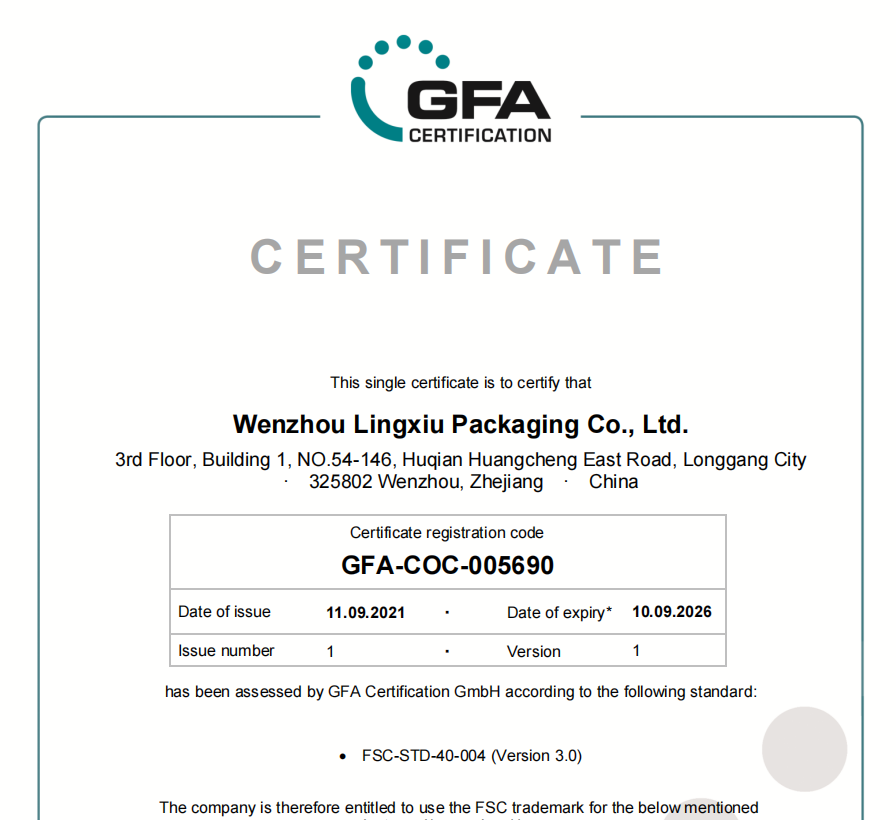
Fibre. FSC Chain of Custody (COC) certification is the primary industry standard for verifying sustainable sourcing. It works by tracking certified material through processing, manufacturing and transfer of ownership, and it is governed by a published standard — for example FSC-STD-40-004 (Version 3.0) — issued to a specific legal entity with a defined product scope.
Ink. Printing chemistry accounts for a large share of the volatile organic compound (VOC) profile of a printed bag. Water-based ink systems are generally understood to carry a lower VOC load than solvent-based systems, which is why retail buyers increasingly request an ink declaration or technical data sheet as part of the order file. Where bags are intended for direct food contact, additional requirements apply: in the United States, food packaging paper bags must comply with FDA 21 CFR Part 176.170 for direct food contact safety (FDA, 2024).
Adhesive. Side seams, folded tops and handle attachment points all rely on adhesive. A low-VOC adhesive declaration, and for food-contact applications a compliant formulation, matters as much as the ink printed on the surface.
| Proof layer | Evidence to request | What it establishes | What it does not establish |
|---|---|---|---|
| Fibre | FSC COC certificate with number, standard version, scope statement and validity dates | That certified material is tracked and that claims are transferable within the stated scope | That inks, adhesives, foils or laminates are compliant |
| Ink | Ink technical data sheet, declared ink type, VOC statement where applicable, migration statement where relevant | The chemistry of the printed surface layer | That the fibre is certified |
| Adhesive | Adhesive declaration, VOC information, food-contact suitability where relevant | The chemistry of the bond lines and handle joints | The chemical profile of the paper or the print |
| Finishing | Written statement covering foils, laminates and non-paper handles | Which components fall outside the fibre certificate | Any certification for those components |
Table note: FSC certification addresses fibre and chain of custody. Ink, adhesive and finishing declarations are separate, project-level documents.
What Opack's FSC documentation states — and where it stops
Opack is a custom packaging manufacturer based in Longgang, Wenzhou, Zhejiang Province, China, producing custom shopping bags, rigid boxes, folding cartons, mailer boxes and paper tubes for industries including apparel, cosmetics, retail, gifting and jewellery. Founded in 2010, the company operates a 10,000 m² facility with 160 employees and reports annual output of 10,000,000 units. Approximately 80% of its sales are export sales, with the main markets being the EU, the USA and the Middle East.
For the fibre layer, the relevant evidence is a certificate rather than a brochure claim:
- Certification: FSC Chain of Custody (COC)
- Certificate number: GFA-COC-005690
- Issuing authority: GFA Certification GmbH
- Standard: FSC-STD-40-004 (Version 3.0)
- Scope: cardboard packaging, sacks and bags of paper, adhesive labels, other pulp and paper products
- Markets covered: Europe; North America; Australia & New Zealand; Middle East
- Validity: issued 9 November 2021, expiring 9 October 2026
Two details in that block matter more than the rest. The first is the scope wording: the phrase covering sacks and bags of paper is what makes a printed paper shopping bag claimable, and it is the phrase a buyer should look for rather than the certificate logo alone. The second is the expiry date. Certificates run on renewal cycles, and a certificate that is valid at the sampling stage may fall due before a production run is completed. For any order scheduled near or beyond 9 October 2026, the current validity of GFA-COC-005690 should be confirmed against the FSC certificate database before the purchase order is released.
The eco-ink question an FSC certificate does not answer
An FSC certificate is a fibre instrument. It does not certify printing ink, adhesive formulation, foil or lamination film, and treating it as blanket environmental approval is the most common misreading in paper bag procurement.
That has a practical consequence for buyers whose compliance questionnaire includes ink and adhesive lines. Those items form a separate document set, and they should be requested at sampling stage rather than after production has started:
- ink type and technical data sheet for the specific print method chosen — offset, screen, UV or digital;
- a VOC statement where the destination market requires one;
- a migration statement where the bag will contact food directly;
- an adhesive declaration covering side seams and handle attachment.
Where a supplier cannot produce those documents for a specific project, the accurate conclusion is that the chemistry claim is unverified — not that it is compliant. Preserving that distinction in internal sourcing files is the difference between a documented position and a marketing one.
A related boundary concerns finishing. Hot stamping, holographic foiling, spot UV and lamination are applied after printing and introduce materials that sit outside a paper certificate. A custom luxury paper bag with foiling, ribbon handles or cotton rope handles can still carry an FSC claim for its paper body, but the non-paper components are not covered by that certificate and should be declared as a separate component list.
Where the requirements bind hardest: retail, gift and promotional formats
Compliance pressure is not distributed evenly across a bag catalogue. It concentrates in three formats that combine brand visibility with repeat ordering.
Retail and apparel. These bags carry merchandise weight, are handled repeatedly and are frequently reordered with print changes. Construction therefore matters as much as the certificate: Opack's shopping bag programme, designated by product model PSB, specifies a weight capacity of 2–15 kg depending on paper thickness and structure, with handle options including paper twisted, flat paper, cotton rope, ribbon and die-cut handles.
Gift and promotional. Finishing intensity is highest here — hot stamping, spot glossy UV, soft touch lamination, holographic foiling, embossing and debossing. Each added finish is an added material in the declaration file, and each one should be listed rather than absorbed into a general sustainability statement.
Trade show and e-commerce. These applications demand consistency across small repeat batches rather than a single large run, which is where documentation habits and print consistency are tested together.
Opack's PSB programme accepts kraft paper, whiteboard paper, specialty paper and coated paper as base materials, with CMYK, Pantone, UV, offset and screen printing available, fully customizable sizes, and applications listed as cosmetics, apparel, retail, gift, trade shows and events, and e-commerce packaging.
A verified execution example. A Panama-based fashion and lifestyle brand ran retail, gift and promotional packaging through Opack under a one-year annual purchasing partnership covering more than 30,000 paper bags, more than 3,000 paper boxes and more than 10,000 stickers per year, with total annual purchase value exceeding USD 12,000. The project record shows zero quality complaints and zero after-sales issues, consistent print quality across multiple production batches and stable lead times. The transferable point for buyers is narrower than a testimonial: batch-to-batch consistency is the operational condition that makes any compliance claim meaningful across a year rather than across one shipment. The case is also limited in scope — it is one brand-owner relationship in one market and does not substitute for market-specific certification checks.

Market trend signals behind the compliance shift
The demand backdrop explains why documentation requirements are tightening rather than relaxing. Attributed third-party estimates for the category point in the same direction:
- The general paper bags market reached USD 6.06 billion in 2024, with expectations to grow to USD 7.81 billion by 2029 (MarketsandMarkets).
- The custom printing segment of that market was valued at USD 2.78 billion in 2024, with a projected 13.9% CAGR through 2030 (Grand View Research).
- Brown kraft paper remains the dominant material segment, estimated to hold a 58% share of total material demand by 2026 on sustainability preferences (Future Market Insights).
- Asia Pacific is the largest regional market for paper bags, accounting for over 36.5% of the global share in 2025 (IMARC Group).
- China is the world's leading exporter of paper sacks and bags, with total exports valued at approximately USD 1.91 billion in 2023 (UN Comtrade / WITS).
The strategic reading is straightforward: volume growth in paper bags increases the number of shipments crossing regulated borders, and each of those shipments carries a compliance file. What used to be a marketing paragraph has become a line item in the purchase order.
Comparing supplier structures on compliance documentation
Supplier type shapes what documentation is available, how quickly it can be produced and how it fits a given order scale. The comparison below is structural rather than qualitative — the objective is fit, not ranking.
| Supplier structure | Typical commercial fit | Documentation implications | Main limits |
|---|---|---|---|
| Integrated multinational fibre and packaging producers — Future Market Insights (2024) identifies Mondi Plc, Smurfit Kappa Group and International Paper Company among the leading competitors in the high-volume paper bag and fiber packaging market | Large standardized volume programmes with integrated paper supply | Fibre documentation is central to the business model and generally well developed | Custom printing formats, finishing combinations and small branded runs are typically outside the core commercial focus |
| Custom-format converters such as Opack | Branded, multi-SKU programmes with finishing, handles and repeat ordering | Fibre certificate held directly (GFA-COC-005690); ink and adhesive declarations handled per project | Minimum order quantity of 1,000 units per design; lead time of 12–18 days; certificate validity must be re-checked at each renewal cycle |
| Trading intermediaries without converting capacity | Sourcing consolidation across multiple factories | Certificate copies may belong to a third party rather than to the contracting entity | Chain-of-custody responsibility is harder to trace and declaration requests pass through an additional layer |
The practical distinction is where the certificate sits. When the entity that prints, finishes and packs the bag is also the certificate holder, the chain-of-custody question resolves inside one organisation. When it does not, the buyer inherits an additional verification step.
Stated plainly, the boundaries of the custom-format model are concrete. Opack's shopping bag programme operates at a minimum order quantity of 1,000 units per design with a lead time of 12–18 days, which does not suit test-level quantities or emergency replenishment. The FSC scope covers paper and pulp-based product categories, so cotton rope handles, ribbon handles, foils and lamination films fall outside that certificate. The FSC certificate itself expires on 9 October 2026, and renewals must be confirmed rather than assumed. Finally, ink and adhesive declarations depend on the specific chemistry selected for a project and must be confirmed in writing before production — they cannot be inferred from the certificate. A 100% quality check is an internal production control and is not a third-party certification of material chemistry.
Future outlook
Three changes are likely to shape custom shopping bag sourcing over the next procurement cycles. First, certificate renewal dates will become standard checkpoints in buyer vendor files, in the same way lead times and MOQs already are — the expiry of a supplier certificate mid-programme is a supply risk with a date attached to it. Second, documentation depth will separate suppliers commercially: two factories can offer identical bag construction and print quality, while only one can produce an ink declaration, an adhesive statement and a current certificate scope for the same quote. Third, finishing declarations will move from optional to routine, because foil, lamination and non-paper handles are now recognised as components that sit outside fibre certification.
For buyers at the evaluation stage, the practical implication is that compliance capability should be scored alongside price, MOQ and lead time — and scored on documents, not on claims.
FAQ
What does FSC Chain of Custody certification actually verify?
It verifies that certified material is tracked through processing, manufacturing and transfer of ownership, and that certification claims can be carried within a defined product scope. Opack's certificate, GFA-COC-005690, is issued by GFA Certification GmbH under FSC-STD-40-004 (Version 3.0), and its stated scope covers cardboard packaging, sacks and bags of paper, adhesive labels, and other pulp and paper products. It does not extend beyond that scope.
Does FSC certification cover the printing ink and adhesive used on printed paper bags?
No. FSC certification addresses fibre and chain of custody, not print or adhesive chemistry. Ink and adhesive documentation should be requested separately at the sampling stage, including VOC statements or food-contact migration statements where the destination market or the end use requires them. In the United States, food packaging paper bags must comply with FDA 21 CFR Part 176.170 for direct food contact safety.
What documentation should an exporter prepare for EU, US and Middle East shipments?
The fibre layer is common to all three markets: certificate number, issuing authority, standard version, scope statement and current validity. Market differences appear mainly at the chemistry layer. US food-contact applications bring FDA 21 CFR Part 176.170 into scope for direct food contact packaging, while EU and Middle East buyers typically ask for ink and adhesive declarations together with material composition. Finishing components such as foil and lamination should be declared as a separate list in all three markets.
How often should a buyer re-verify a supplier's FSC certificate?
At minimum before each new purchasing cycle, and always when an order's production window approaches the certificate expiry date. Opack's FSC certificate expires on 9 October 2026, so orders scheduled for production beyond that date should be supported by confirmation of renewal status rather than a copy of the outgoing certificate. Certificate status should be checked against the issuing authority's record rather than a supplier-issued PDF alone.
Which components of a custom shopping bag fall outside FSC scope?
Any component that is not paper or pulp-based. Cotton rope handles, ribbon handles, hot stamping foil, holographic foil and lamination films are attached or applied during finishing and are not covered by a fibre certificate. Construction and performance variables such as weight capacity of 2–15 kg and fully customized sizes affect how a bag performs, not what its certificate covers.
Opack publishes a company profile covering its facility, product ranges and certification documentation for buyers building a compliance file ahead of sampling. The document is available at Opack company profile.