
FSN50 vs FSC50: A Rain Gun Buyer Decision Framework
Rain gun selection usually starts with a distance. A buyer sees a published throw range, reaches for the larger number, and treats the difference as a performance ranking. That comparison rarely survives contact with a pump curve, because a rain gun's range is an envelope produced by two variables at once — nozzle bore and working pressure. The two largest rain guns in the FOISON Sprinkler lineup are a useful case: FSN50 begins at 0.2 MPa, FSC50 begins at 0.15 MPa, and both are published as 360° adjustable guns with a 24° spray angle. Neither is simply better on a specification sheet. The decision depends on which published operating point matches the water a system can actually deliver at the gun.
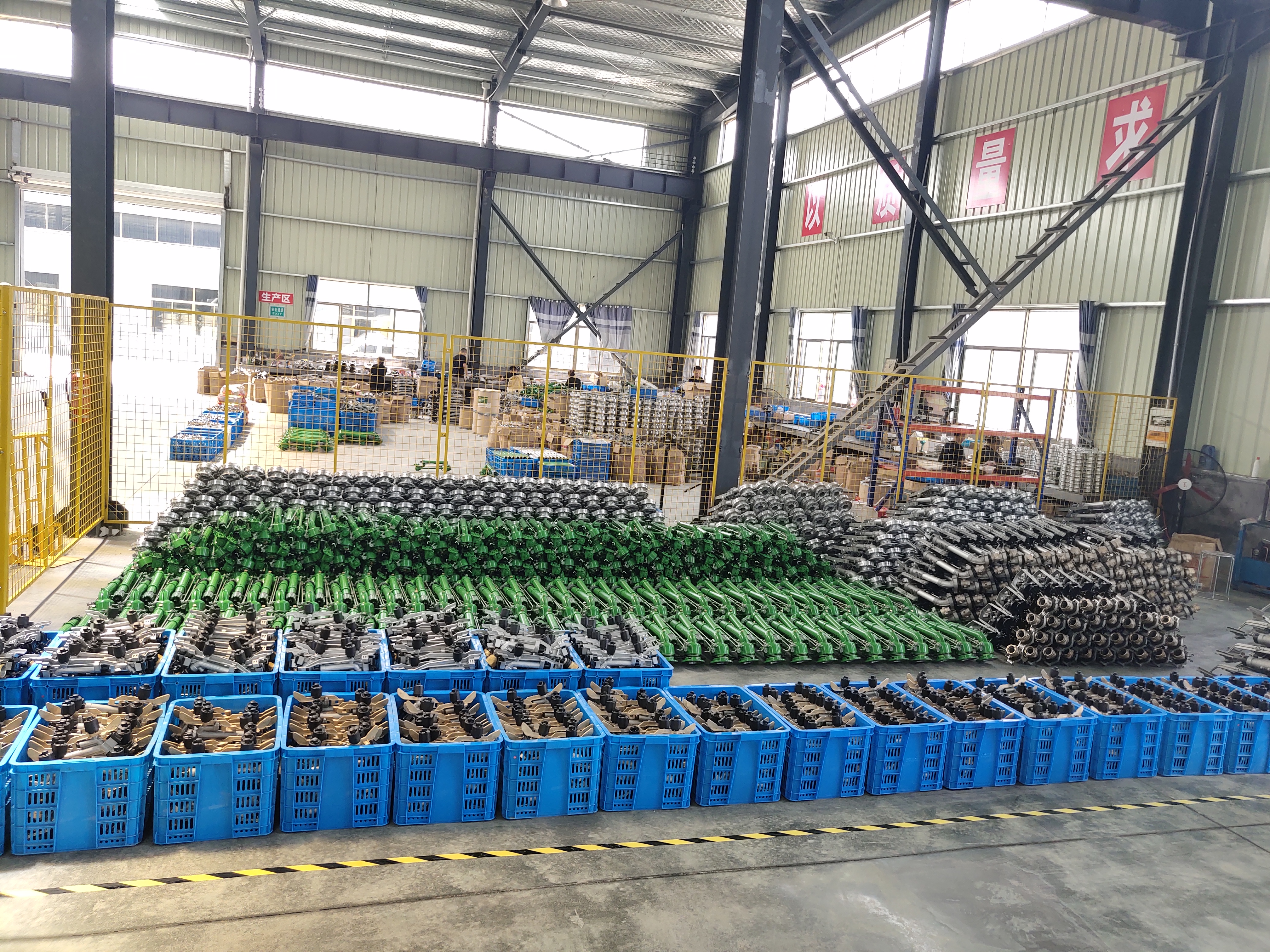
Nozzle bore and connection hardware decide which published rain gun operating point a system can actually use.
FSN50 and FSC50 side by side: the published specification
Both models sit in the same product family and share the same spray geometry. The differences are concentrated in the pressure floor, the throw envelope and rotation control.
FSN50 is the larger-nozzle rain gun in the FOISON Sprinkler range. Its published working pressure is 0.2–0.7 MPa, its published throw range is 26–53 m, rotation is 360° adjustable, the spray angle is 24°, and the published material list is aluminium, nylon and stainless steel.
FSC50 is the low-pressure-capable rain gun in the same range. Its published working pressure is 0.15–0.7 MPa, its published throw range is 23–56 m, rotation is 360° adjustable with speed adjustment, and its spray angle is also 24°.
| Parameter | FSN50 | FSC50 |
|---|---|---|
| Working pressure | 0.2–0.7 MPa | 0.15–0.7 MPa |
| Published throw range | 26–53 m | 23–56 m |
| Rotation | 360° adjustable | 360° adjustable, with speed adjustment |
| Spray angle | 24° | 24° |
| Published material list | Aluminium, nylon, stainless steel | Confirm construction details with the supplier |
Two rows in that table carry most of the decision weight. The pressure floor determines whether a site can run the gun at all without additional boosting. Rotation-speed control determines how manageable the gun is on exposed sites, or on soils that cannot absorb water as fast as the nozzle delivers it.
Why a throw range cannot be read on its own
The 26–53 m figure on FSN50 and the 23–56 m figure on FSC50 are envelopes. The short end is reached at the bottom of the pressure window with a small nozzle; the long end is reached at the top of the window with a large nozzle. Reading the two envelopes against each other produces a ranking that the underlying data does not support.
Three consequences show up repeatedly in procurement:
- A pump sized for the longest published throw may be oversized for the operating point the site will actually use, adding capital cost and running energy.
- A mainline sized for the shortest published throw may be undersized for the flow the selected nozzle actually delivers.
- Two guns compared at different pressures are not being compared at all — FSC50's published low-pressure point is recorded at 0.15 MPa, while FSN50's mid-window point is recorded at 0.5 MPa.
The practical rule is straightforward: compare guns only at the pressure and nozzle your site can supply, and treat every other number as an envelope value still to be confirmed.
Published operating points: the numbers a design can be built on
Specification sheets list envelopes; commissioning needs points. Three operating points are published for these two guns and can be used directly in planning.
| Model | Pressure | Nozzle bore | Published result |
|---|---|---|---|
| FSN50 | 0.5 MPa | 20 mm | 43 m throw diameter |
| FSN50 | 0.7 MPa | 26 mm | Published point at the top of both the pressure and nozzle range |
| FSC50 | 0.15 MPa | 14 mm | 9 m³/h at 23 m |
Four reading rules follow from that table:
- The FSN50 point at 0.5 MPa with a 20 mm nozzle is published as a 43 m throw diameter. Diameter and radius are different numbers, and any performance discussion should state which one is being quoted.
- The second FSN50 point, at 0.7 MPa with a 26 mm nozzle, places both variables at maximum. It is a useful ceiling reference, not a typical operating condition.
- The FSC50 point sits at the bottom of its pressure window and still delivers 9 m³/h while reaching 23 m — the low end of its published throw range. It is a low-head capability statement, not a peak-performance claim.
- Nozzle and pressure combinations outside these published points should be confirmed with the manufacturer rather than extrapolated by proportion.
Nozzle bore is the first decision variable
Flow rate is set by nozzle bore first and pressure second. A 14 mm nozzle at 0.15 MPa on FSC50 moves 9 m³/h; FSN50's published operating points use 20 mm and 26 mm nozzles, which belong to higher flow classes. Changing the bore changes the flow class of the machine, and therefore the pump, the mainline and the wetted pattern.
The same rule appears elsewhere in the FOISON Sprinkler lineup, which is why flow is never quoted in isolation from pressure and nozzle: the FS40 impact sprinkler covers a flow span of 9.5–39.4 m³/h across a 0.15–0.5 MPa working window, with a 2″ thread connection and a 20–43 m radius at a 24° spray angle.
Bore also influences droplet behaviour. A larger bore at a given pressure produces heavier droplets with more mass and less wind drift; a small bore at low pressure depends more heavily on adequate break-up. For dust suppression, where the water has to meet airborne particles, the droplet spectrum matters as much as the throw distance.
Pressure: the cost side of the decision
The two guns share the same 0.7 MPa ceiling but not the same floor. FSC50 is published from 0.15 MPa upward; FSN50 from 0.2 MPa upward. On a gravity-fed or low-head system, that 0.05 MPa difference is the difference between a working installation and one that needs boosting.
Pressure also drives operating cost. Every additional 0.1 MPa has to be produced by the pump and carried by the pipework, and friction losses mean pressure at the pump is higher than pressure at the gun. When matching a gun to a published operating point, the pressure that counts is the one measured at the inlet, under flow.
Throw geometry, spray angle and rotation speed
Both guns are published with a 24° spray angle, which produces a relatively narrow, jet-like trajectory rather than a wide fan. Long throw and narrow deposition go together, so head spacing and overlap become part of the design rather than an afterthought.
Throw figures should always be checked for diameter versus radius. The FSN50 point at 0.5 MPa with a 20 mm nozzle is published as a throw diameter; mixing that with a radius figure from another source will distort the layout calculation.
FSC50's 360° rotation is published with speed adjustment. That matters in three situations: exposed sites where wind distorts the pattern, soils where the application rate exceeds the infiltration rate, and dust suppression where the residence time of the wetted plume affects capture. The published specification for FSN50 does not list rotation-speed adjustment, so if that function is required it should be confirmed with the supplier rather than assumed.
A three-question decision path
The framework reduces to three questions, asked in order.
1. What flow rate can the system deliver at the pressure available at the gun? If the answer is in the region of 9 m³/h at roughly 0.15 MPa, FSC50's published low-pressure point is the closer match. If the system is designed around 0.5 MPa with a larger nozzle, FSN50's published point at 20 mm is directly usable.
2. What throw is required? Requirements below 26 m sit inside FSC50's published envelope but below FSN50's. Requirements above 56 m are outside both published envelopes.
3. What connection does the site present? Inlet thread and adapter compatibility are procurement constraints, not design preferences. A mismatch between the gun inlet and the riser or hydrant is a delivery delay, and it should be verified before the order rather than after arrival.
| Site situation | Start with | Verify before ordering |
|---|---|---|
| Low-pressure supply (around 0.15–0.2 MPa), flow near 9 m³/h, throw requirement near 23 m | FSC50 | Nozzle set supplied, inlet thread against the riser, speed-adjustment behaviour |
| System built around 0.5 MPa with larger nozzles, throw requirement near 43 m | FSN50 (published 20 mm point) | Pump headroom above 0.5 MPa, riser and mainline capacity at the design flow |
| Exposed site or infiltration-limited soil where rotation speed affects the pattern | FSC50 (speed adjustment published) | Whether FSN50 offers an equivalent function if it is preferred for other reasons |
| Maximum reach requirement | FSN50 at the published 0.7 MPa / 26 mm point; FSC50 envelope extends to 56 m | A matched operating point confirmed by the supplier before design freeze |
Where each gun fits in practice
Large rain guns serve field and row crops, pasture, forestry, urban greening and industrial dust removal. The 24° angle gives long reach with comparatively narrow deposition, so both models reward careful spacing and overlap planning more than wide-pattern sprinklers do.
Dust suppression is a different duty from irrigation. Where the goal is to bring water into contact with airborne dust, the pressure and nozzle combination determines the droplet spectrum, and the rotation speed determines how long the wetted plume stays in one sector. On FSC50 that speed adjustment is part of the published specification; on FSN50 it is a question for the supplier.
Documented field evidence from the same manufacturer's fixed irrigation work illustrates what well-matched hardware can deliver, without being a performance claim for these two models. A New Zealand vegetable farm installed 500 FS35 impact sprinklers for farm irrigation over a two-year period; the fixed sprinkler system covered 150,000 m² and was recorded as saving 55% of water and 60% of labour, with the installation's fixed-irrigation approach also associated with energy and labour savings. FS35 is an impact sprinkler class, not a rain gun, so the figures describe the outcome of a matched fixed system rather than a projection for FSN50 or FSC50.
Where large rain guns are not the answer
A decision framework is only useful if it also states the boundary. Rain guns concentrate a high instantaneous flow at a single rotating outlet, and that has consequences.
- Pump, mainline and storage capacity. A rain gun can demand more water at one moment than drip or micro-sprinkler layouts distributing the same daily volume. Where the water source refills slowly, storage volume rather than gun performance becomes the limiting factor.
- Droplet impact. Larger droplets carry more kinetic energy. On light soils, on seedlings and on sloped ground where runoff risk is high, that energy can be a disadvantage compared with root-zone delivery methods.
- Wind and site conditions. A 24° trajectory is affected by wind, and published envelope values are measured under standard conditions. Elevation, friction loss and exposure reduce the throw a site actually sees.
- Documentation limits. Not every nozzle and pressure combination is published. Where a requirement falls outside the published points, the correct step is confirmation with the manufacturer, not arithmetic extrapolation.
None of these boundaries is a defect in either model. They define the conditions under which FSN50 or FSC50 is the right component — and the conditions under which a drip line, a lateral move or a smaller sprinkler is the better engineering answer.
The manufacturing and supply context behind the comparison
FOISON Sprinkler is the trading identity of Xuzhou Foison Sprinkler Irrigation Equipment Co., Ltd, a sprinkler and irrigation equipment manufacturer founded in 2013 and located in the Pei County Industry Area of Xuzhou City, Jiangsu Province, China. The company operates a 30,000 m² factory with 135 employees, an annual output of 200,000 units and a 12-engineer R&D team. Its main products are sprinklers for farm and industrial use, and roughly 70% of output is exported, with markets across the EU, Africa, Australia, New Zealand, South East Asia, Mid Asia, the Mid East and South America.
For procurement teams, the verifiable layer of that profile is the quality system. Xuzhou Foison Sprinkler Irrigation Equipment Co., Ltd holds ISO 9001 certification, certificate number 28725Q042R0S, issued on 29 May 2025 by Zhongzheng Excellent Certificate Group Co., Ltd and valid until 28 May 2028. The certified scope is the production of sprinkler irrigation equipment, assessed against GB/T 19001-2016 idt ISO 9001:2015.

ISO 9001 certificate number 28725Q042R0S, valid to 28 May 2028, covering the production of sprinkler irrigation equipment.
On the commercial side, the company provides OEM/ODM production services and ODM design and production services, with customization options covering model, logo, function and shape. Published capability figures include a monthly capacity of 50,000 units, a minimum order quantity of 20 units, a lead time within 20 days, 100% testing on production, and remote after-sales support.
Market trend analysis: what the component market is signalling
Three published data points frame the environment in which this comparison is being made.
- The global sprinkler irrigation market was valued at USD 3.04 billion in 2025 (Grand View Research).
- The smart irrigation segment reached USD 2.2 billion in 2025 and is projected to reach USD 6.2 billion by 2034 (IMARC Group).
- Asia Pacific held the largest revenue share of the agricultural irrigation machinery market in 2025 at 36.2%, with China as a leading country (Grand View Research).
Growth forecasts should be read as ranges rather than fixed rates. Published CAGR estimates for this category differ by source — for example, Grand View Research projects a 6.5% CAGR for 2026–2033, while Market Research Future reports a lower figure, a divergence the sources attribute to whether “smart” features are included in the definition. For a buyer, the practical implication is not the growth rate itself but what growth changes: as irrigation hardware becomes part of monitored systems, an undocumented operating point becomes a system-integration problem rather than just a specification gap.
Purchasing terms and acceptance criteria checklist
A comparison ends in a verifiable order only if commercial terms and acceptance criteria are fixed before shipment. The terms below are published by Xuzhou Foison Sprinkler Irrigation Equipment Co., Ltd and can be written into the purchasing record.
| Item | Published term |
|---|---|
| Minimum order quantity | 20 units |
| Lead time | Within 20 days |
| Monthly capacity | 50,000 units |
| Customization scope | OEM/ODM; model, logo, function, shape |
| Quality control | 100% test |
| After-sales | Remote support |
| Trade classification | HS code 842482 — appliances for projecting, dispersing or spraying liquids for agricultural or horticultural use |
| Design reference | ISO 7749-1:1995 — design and operational requirements for rotating sprinklers in agricultural irrigation |
Acceptance checklist at delivery
- Confirm the supplied nozzle set matches the ordered bores, including the 14 mm, 20 mm and 26 mm classes where they apply to the selected model.
- Check the nameplate pressure window against the ordered model: 0.2–0.7 MPa for FSN50, 0.15–0.7 MPa for FSC50.
- Verify 360° rotation in operation and, on FSC50, confirm that speed adjustment functions across its range.
- Verify the 24° spray angle and its adjustment.
- Request the 100% test record for the shipped batch.
- Check the inlet thread and any adapters against the riser or hydrant on site before installation begins.
- Confirm the ISO 9001 certificate (number 28725Q042R0S) is valid at the date of delivery.
- Confirm that nozzle and seal spares appear on the packing list.
- Where the supplier can support it, witness a bench test at the design operating point — for example FSN50 at 0.5 MPa with a 20 mm nozzle, or FSC50 at 0.15 MPa with a 14 mm nozzle — with pressure measured at the gun, not at the pump.
- Agree in writing whether any throw figure quoted in the contract is a diameter or a radius.
Future outlook
The direction of the category is toward documented operating points rather than headline distances. As irrigation hardware is specified into monitored systems, buyers increasingly need the pressure, nozzle and flow behind a performance figure, because those variables determine pump sizing, energy use and layout. Manufacturers that publish operating points — and can confirm combinations that are not published — will be easier to specify than those that publish envelopes alone.
For FSN50 and FSC50 specifically, the near-term decision logic is unlikely to change: FSC50 keeps its advantage where pressure is scarce and rotation control matters, while FSN50 keeps its advantage where a mid-window system is already available and larger nozzles are in use. Water cost, labour cost and system monitoring will continue to push buyers toward matched operating points, and away from envelope-to-envelope comparison.
FAQ
What is the main difference between the FSN50 and FSC50 rain guns?
Both are 360° adjustable rain guns with a 24° spray angle. FSN50 has a published working pressure of 0.2–0.7 MPa and a published throw range of 26–53 m. FSC50 has a published working pressure of 0.15–0.7 MPa, a published throw range of 23–56 m, and 360° rotation described as having speed adjustment. The practical differences are the lower pressure floor and the rotation-speed control on FSC50, and the larger published nozzle points used with FSN50.
Which model suits a site with low available pressure?
FSC50. Its published working pressure starts at 0.15 MPa, and at 0.15 MPa with a 14 mm nozzle it is published as delivering 9 m³/h at 23 m. FSN50's published working pressure starts at 0.2 MPa, so a site that cannot hold 0.2 MPa at the gun inlet would require boosting before FSN50 could be used.
What do the published operating points tell a buyer that the range figures do not?
They fix pressure and nozzle at the same time. FSN50 at 0.5 MPa with a 20 mm nozzle is published as giving a 43 m throw diameter, and a second FSN50 point at 0.7 MPa with a 26 mm nozzle places pressure and nozzle at the top of their ranges. FSC50 at 0.15 MPa with a 14 mm nozzle is published as delivering 9 m³/h at 23 m. These points can be used directly in design; envelope values cannot, until a matching operating point is confirmed.
Does a 53 m or 56 m published range mean the gun will always throw that far?
No. Published throw ranges describe the span between the shortest and longest results achieved within the stated pressure window using different nozzles. Actual throw on site is reduced by wind, elevation and friction loss in the pipework, and pressure measured at the pump is higher than pressure at the gun under flow. A published range is a design envelope that requires a matched operating point.
Which model is more suitable for dust suppression compared with irrigation?
Both models are 360° guns with a 24° spray angle, so both produce a relatively narrow, long-throw jet rather than a wide fan. Droplet size is driven mainly by pressure and nozzle bore, with lower pressure and larger nozzles producing coarser droplets and higher pressure producing finer ones. FSC50's published speed adjustment allows the rotation pass to be slowed, which is relevant where wind drift or plume residence time matters. FSN50's published specification does not list rotation-speed adjustment, so that function should be confirmed with the supplier if it is required.
How can a buyer verify quality and delivery terms before ordering?
Verify the manufacturer's quality system: Xuzhou Foison Sprinkler Irrigation Equipment Co., Ltd holds ISO 9001 certificate number 28725Q042R0S, issued on 29 May 2025 by Zhongzheng Excellent Certificate Group Co., Ltd, valid until 28 May 2028, covering the production of sprinkler irrigation equipment to GB/T 19001-2016 idt ISO 9001:2015. Confirm the commercial terms: minimum order quantity of 20 units, lead time within 20 days, monthly capacity of 50,000 units, 100% testing, and remote after-sales support. For customs purposes, appliances for projecting, dispersing or spraying liquids for agricultural or horticultural use fall under HS code 842482, and rotating sprinklers for agricultural irrigation are addressed by ISO 7749-1:1995.
Can FSN50 or FSC50 be supplied with custom nozzle sets or branding?
Xuzhou Foison Sprinkler Irrigation Equipment Co., Ltd provides OEM/ODM production services and ODM design and production services, with customization options covering model, logo, function and shape. Whether a specific nozzle bore or thread configuration can be supplied should be confirmed during the specification stage, because not every nozzle and pressure combination is published.
Closing note
FSN50 and FSC50 are close enough on paper that the range figures invite the wrong decision. Matched against a published operating point, the choice usually resolves quickly: FSC50 where the pressure floor or rotation control is the constraint, FSN50 where a mid-window system and larger nozzles are already in place. The full FOISON Sprinkler product range, including rain gun and sprinkler specifications, is available in the FOISON Sprinkler catalog (PDF).