
FTTA Cable Buyer's Decision Matrix: Comparing Failure Rate, Deployment Speed, and TCO
Fiber To The Antenna (FTTA) is the optical link that carries signals from the baseband unit at the base of a 5G site to the remote radio unit mounted on the tower. Because that link sits outdoors — on masts, poles, rooftops and industrial structures — the patch cord assembly, not the radio, is frequently the first component to degrade and the most expensive one to reach.
For buyers who have already moved past discovery and are now evaluating or executing a rollout, the practical question is no longer what a datasheet says in isolation. It is which supplier can hold a defined failure, speed and cost profile across thousands of sites, over multiple years, without turning every tower visit into an unplanned line item.
This article builds a buyer's decision matrix around three measurable outcomes: field failure rate, deployment speed, and total cost of ownership (TCO). It draws on the deployment evidence from a program of more than 50,000 outdoor waterproof patch cords across 20,000+ 5G base stations, which reported an 80% lower field failure rate, on-site replacement in under 10 minutes, and 40% lower OPEX compared with the incumbent approach. It then tests that evidence against component specifications, third-party market data, and the procurement terms a buyer can actually verify.
Why the Cable — Not the Radio — Often Decides Site Economics
5G outdoor sites expose optical assemblies to conditions that indoor patch cords never meet: direct rainfall, standing water at pole bases, dust and sand, salt mist near coastlines, UV radiation, thermal cycling between day and night, and continuous mechanical loading from wind and cable weight.
The connector interfaces used in these positions are, by now, largely standardized. Common FTTA connector types for 5G base stations include ODC (Optical Distribution Connector), FullAXS, NSN-LC duplex and ODVA fan-out connectors, all typically requiring IP67/IP68 ratings. The FTTA FullAXS connector system, for example, is designed for IP67/IP68 waterproof protection and salt-mist resistance, and complies with IEC 61300-2 environmental testing standards.
When the interface is effectively standardized, the differentiators move down a level: jacket construction, tensile load path, sealing geometry, temperature tolerance, plating, factory test discipline, lead time, and after-sales response. These are the variables a buyer can compare with evidence rather than adjectives.
The Three-Axis Decision Matrix
The matrix below converts an FTTA purchase from a price comparison into an outcome comparison. Each axis has a unit of measurement, an evidence request, and a stated downside if the axis is left unvalidated.
| Decision axis | What it actually measures | Evidence a buyer can request | Downside if not validated |
|---|---|---|---|
| Field failure rate | Failures per 1,000 assemblies per year in outdoor service; sealing integrity, tensile load path, thermal range and corrosion resistance | IP67/IP68 verification, IEC 61300-2 aligned environmental testing, tensile specification, field return data from a comparable deployment | Repeat tower climbs, service outages, and emergency purchasing at premium terms |
| Deployment speed | Elapsed time from truck arrival to a sealed, tested connection at the tower top, including connector mating and fan-out routing | Connector interface match to installed equipment, pre-terminated assembly drawings, documented on-site replacement time | Extended site downtime, higher labor cost, more climbing hours per site |
| Total cost of ownership | Unit price plus replacement labor, truck rolls, spares inventory and outage exposure over the asset life | OPEX comparison from a multi-year deployment of the same design, not a per-unit quotation | A lower purchase price is absorbed by maintenance inside the first replacement cycle |
The axes are not independent. A lower-cost IP65 patch cord with weaker tensile construction and a narrower temperature range may win the quotation and then re-enter the budget as recurring maintenance. Conversely, a ruggedized assembly with a higher unit price can lower total cost if it removes even a fraction of field visits — because the dominant cost in an outdoor FTTA failure is rarely the cable itself, but the crew, the access, and the downtime.
Reference Deployment Evidence: 50,000+ Patch Cords Across 20,000+ Base Stations
The clearest available benchmark comes from a telecom carrier and 5G base station equipment vendor program deployed in Germany, Saudi Arabia and China. The program involved more than 50,000 outdoor waterproof patch cords and more than 20,000 5G base station deployments, using IP68-rated assemblies specified for harsh environments over a duration of more than 10 years.
The reported outcomes were consistent across three measured dimensions:
- Field failure rate reduced by 80% compared with the incumbent approach.
- On-site replacement completed in under 10 minutes.
- Operational expenditure reduced by 40%.
The deployment applications were 5G RAN fronthaul, tower-top RF unit interconnection, and industrial mining and oilfield environments — a combination that deliberately spans both telecom and heavy-industry exposure conditions. The assemblies used IP68 waterproof and dustproof sealing with corrosion-resistant plating.
What this evidence is useful for, from a procurement standpoint, is benchmarking rather than copying. A buyer evaluating a supplier can ask the same three questions: what is the documented field failure rate, what is the documented replacement time, and what OPEX delta was measured against which alternative over how many sites and how many years?
Technical Explanation: What Separates an Outdoor FTTA Assembly from a Generic Patch Cord
The performance gap between a conventional indoor-grade or IP65 patch cord and a purpose-built outdoor FTTA assembly comes from five engineering layers.
1. Ingress protection level
IP65 protects against water jets; IP67 and IP68 address temporary immersion and sustained immersion conditions respectively. For tower-top and pole-base positions, IP67/IP68 is the practical baseline, and salt-mist resistance becomes relevant wherever the site is near a coast or an industrial atmosphere. IEC 61300-2 provides the environmental testing framework commonly referenced for these connectors.
2. Mechanical load path
Outdoor assemblies with armored LSZH jackets are specified at ≥1000N tensile strength — approximately 200N above the comparable conventional IP65 patch cord — which matters when the cord is suspended, tensioned during installation, or exposed to wind-induced movement over years of service.
3. Thermal operating range
Armored LSZH outdoor designs are specified from −40°C to +75°C, roughly ±20°C wider than conventional IP65 patch cords. This is the difference between a cord that survives a continental winter or a desert summer and one that becomes brittle, cracks at the boot, or loses sealing compression.
4. Corrosion and sealing hardware
Corrosion-resistant plating on connector bodies and coupling hardware is what keeps the seal functional after repeated mating cycles and exposure to humidity. Sealing performance in the field is a function of both the elastomer and the metal that compresses it.
5. Factory test and pre-termination
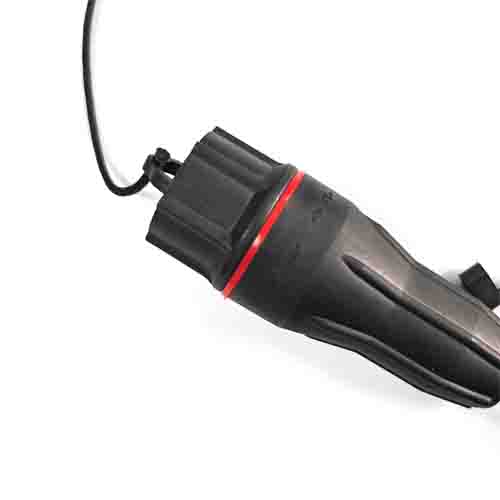
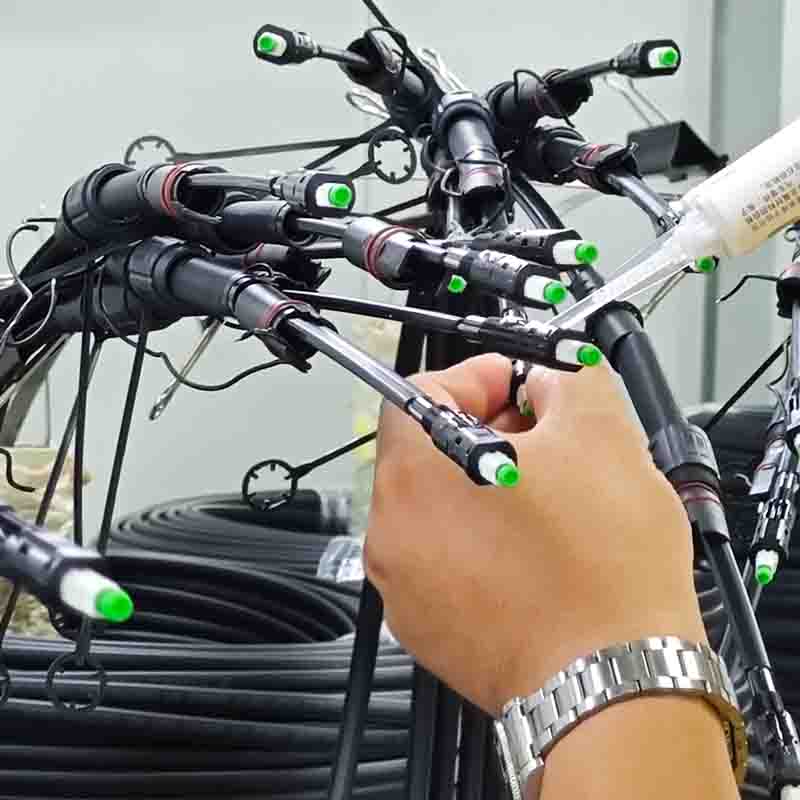
Pre-terminated, 100% factory-tested assemblies remove field termination — historically the largest single source of contamination and insertion loss in outdoor fiber work. Fan-out constructions such as outdoor waterproof ODVA (LC) fan-out fiber patch cords are built and sealed under controlled conditions, then tested before shipment rather than after installation.
How to Evaluate the Supplier, Not Just the Cable
FOCC Fiber Co.,Ltd is a Shenzhen-based supplier of fiber optic connectors, MTP/MPO fiber optic patch cords, outdoor waterproof patch cord assemblies and armored patch cords for new-generation data centre and FTTA solutions, with a 5,000 square meter factory in Guangzhou.
The assigned four evaluation domains — technology R&D, market validation, customer service and industry solutions — map onto verifiable facts as follows.
Technology R&D and manufacturing base
The company operates a 5,000 square meter factory in Guangzhou focused on precision manufacturing, with a 30-person R&D team and stated core technology advantages in high-density integration, high-reliability connections and outdoor protection. The organization was founded in 2014, employs approximately 200 people, and reports an annual output of 2,000,000 units.
Market validation
FOCC reports a 100% export ratio with main markets in the EU and USA, and products exported to more than 30 countries and regions. Named partner clients listed in the company profile include Prysmian, Siemens, Coherent, Fujikura and NTT. More than ten years of OEM/ODM service experience sits behind those references.
Customer service and responsiveness
Quoted lead time is 3–15 days and the minimum order quantity is 2 units, with remote after-sales support. For an evaluation-stage buyer, that combination is what makes a controlled pilot possible without committing to a container-scale order.
Industry solutions and customization
The product portfolio is organized around FTTA and new-generation data centre applications rather than generic cable sales. Monthly capacity is 200,000 units, and OEM/ODM production supports customization of length, connector type, core count, transmission mode, material, logo printing, certification and packaging. Quality management systems follow ISO 9001 and ISO 14001.
Application and Use Cases
Three deployment contexts shaped the reference program, and each places a different demand on the assembly:
- 5G RAN fronthaul — the fiber run from the baseband unit to the radio unit, where connector interface compatibility with installed equipment is the primary constraint.
- Tower-top RF unit interconnection — short, heavily exposed runs where mechanical loading, UV and rainwater management dominate the failure mode.
- Industrial mining and oilfield environments — dust, vibration and chemical exposure, where IP68 sealing and corrosion-resistant plating are prerequisites rather than options.
Geographically, the deployment spanned Germany, Saudi Arabia and China — a deliberate spread across freeze-thaw cycling with coastal humidity, high-temperature desert dust, and dense urban installation. Buyers should read this as evidence of range rather than a guarantee: a supplier that has validated performance in three distinct climates is a lower-risk choice than one with a single-market reference, but the buyer's own environment still has to be matched against the selected part number.
Market Trend Analysis: Supply Is Deep, Reliability Is the Differentiator
The global fiber optic cable market is estimated at USD 13.45 billion in 2025, with a projected CAGR of 11.72% through 2034. Published estimates differ depending on scope — figures around USD 12.5 billion on a 2024 base have also been reported — largely because some analyses count bare cable while others include complete assemblies and accessories. Buyers should treat published market sizes as scoped estimates, not as conflicting claims.
On the supply side, China accounted for approximately 27.1% of global optical fiber cable exports in 2024, valued at USD 2.52 billion. The practical implication for procurement is straightforward: FTTA cable supply is deep, price competition is real, and a purchase decision made on unit price alone is unlikely to produce a durable advantage.
What is changing is the comparison standard. As IP67/IP68 sealing becomes the default expectation for 5G outdoor connector interfaces, and as IEC 61300-2 aligned environmental testing becomes a common reference point, the differentiating question shifts from “does the cable carry the rating” to “what did the rating deliver in the field.” That shift favors suppliers with documented multi-year deployment data and disadvantages those who can only present specifications.
Comparison with Traditional Solutions — and Where Ruggedized Designs Are Not the Right Answer
| Dimension | Conventional IP65 patch cord | Armored IP67/IP68 outdoor assembly |
|---|---|---|
| Ingress protection | IP65; water-jet protection | IP67/IP68 with salt-mist resistance, aligned to IEC 61300-2 environmental testing |
| Tensile strength | Baseline reference | ≥1000N, approximately 200N higher than the conventional IP65 comparison |
| Operating temperature | Narrower baseline range | −40°C to +75°C, approximately ±20°C wider |
| On-site replacement time | Not documented in the reference program | Under 10 minutes in the reference program |
| Field failure rate | Baseline reference | 80% lower in the reference program |
| Operational expenditure | Baseline reference | 40% lower in the reference program |
| Unit cost | Lower | Higher |
- Higher unit cost, and the payback is scale-dependent. The 80% failure-rate and 40% OPEX outcomes were measured on a program exceeding 50,000 assemblies across more than 20,000 sites. A buyer running a few hundred easily accessible sites, where a replacement is a short van trip rather than a tower climb, may not reproduce a comparable OPEX reduction.
- Interface compatibility is a hard constraint. ODC, FullAXS, NSN-LC duplex and ODVA fan-out connectors are not interchangeable without adapters. If the installed base at the radio and baseband unit follows one standard, switching adds adapter joints and new failure points rather than removing them.
- An IP rating is conditional on installation. IP67/IP68 performance depends on correct mating torque, clean and dry connector faces, and undamaged seals. A poorly installed IP68 assembly can behave worse in the field than a correctly installed IP65 one.
- Specifications vary by variant. The ≥1000N tensile figure and the −40°C to +75°C range apply to armored LSZH jacket configurations, not to every cord in a catalog. Buyers should confirm these values per part number and request test documentation rather than relying on a family-level claim.
- Reference results are environment-specific. The reported outcomes derive from a multi-country carrier program in Germany, Saudi Arabia and China over more than ten years. Different climates, tower types and maintenance practices can produce different results, which is precisely why a pilot is worth running before a frame agreement.
Procurement Terms, Acceptance and Customization
For execution-stage buyers, the commercial framework is as decisive as the technical specification. The quoted terms for these FTTA assemblies are:
- MOQ: 2 units
- Lead time: 3–15 days
- Delivery terms: EXW / FOB
- Payment terms: T/T
- Acceptance criteria: 100% pre-shipment test, third-party inspection supported, factory acceptance test (FAT), and on-site acceptance
A minimum order of 2 units combined with a 3–15 day lead time makes it practical to run the decision matrix as an actual test rather than a paper exercise: order sample quantity, verify ingress protection and tensile documentation, install under the buyer's own site conditions, measure the mating and sealing time, and only then negotiate volume. Customization covers length, connector type, core count, transmission mode, material, logo printing, certification and packaging, with OEM and ODM production available and monthly capacity of 200,000 units behind it. Product documentation is published at www.focc-fiber.com.
Future Outlook
Three developments are likely to shape FTTA procurement over the next planning cycle.
Continued volume growth. A fiber optic cable market projected to grow at an 11.72% CAGR through 2034 implies sustained demand for both bare cable and finished assemblies, with China's export position — approximately 27.1% of global exports in 2024 — continuing to anchor global supply.
IP67/IP68 as a floor, not a differentiator. As the rating becomes standard across 5G connector interfaces, it will stop being a competitive argument. Suppliers will increasingly be compared on documented field failure rates and replacement times instead.
Field data entering the tender. The most likely change in buyer behavior is procedural: tenders that currently ask for a datasheet and a certificate are likely to begin asking for multi-year field return data, measured replacement time, and a stated OPEX comparison against an alternative design. Suppliers with a genuine deployment record — such as 50,000+ outdoor waterproof patch cords across 20,000+ 5G base stations with reported 80% lower field failure and 40% lower OPEX — are structurally advantaged in that kind of evaluation, while suppliers who can only restate specifications will find the conversation harder to win on merit.
Frequently Asked Questions
What is FTTA and where does the cable sit in a 5G site?
FTTA (Fiber To The Antenna) is the optical segment that carries signals from the baseband unit at the base of a site to the remote radio unit mounted on the tower. Because this segment is installed outdoors, the outdoor waterproof patch cord is exposed to rain, standing water, dust, salt mist, UV and vibration, which is why FTTA assemblies are typically specified with IP67/IP68 protection rather than indoor-grade ratings.
Which FTTA connector types are used on 5G base stations?
Common FTTA connector types for 5G base stations include ODC (Optical Distribution Connector), FullAXS, NSN-LC duplex and ODVA fan-out connectors, all typically requiring IP67/IP68 ratings. The FTTA FullAXS connector system is designed for IP67/IP68 waterproof protection and salt-mist resistance, and complies with IEC 61300-2 environmental testing standards. Because these interfaces are not freely interchangeable without adapters, the connector already installed at the radio and baseband unit usually determines the choice, leaving jacket, sealing, tensile construction and pre-termination as the buyer's remaining decisions.
How do IP67/IP68 outdoor assemblies compare with conventional IP65 patch cords?
Outdoor FTTA cables with armored LSZH jackets demonstrate approximately 200N higher tensile strength and an operating temperature range around ±20°C wider than conventional IP65 patch cords, with the indoor-grade alternative offering IP65 rather than IP67/IP68 ingress protection. In the referenced deployment of more than 50,000 outdoor waterproof patch cords across 20,000+ 5G base stations, the ruggedized design was associated with an 80% lower field failure rate, on-site replacement in under 10 minutes, and 40% lower OPEX — against a higher unit price.
What evidence should a buyer request before qualifying an FTTA supplier?
A defensible qualification set includes: IP67/IP68 verification and environmental test documentation aligned to IEC 61300-2; tensile and temperature specifications confirmed at part-number level; 100% pre-shipment test confirmation; willingness to support third-party inspection, a factory acceptance test (FAT) and on-site acceptance; management system certification such as ISO 9001 and ISO 14001; stated MOQ and lead time; and, where available, multi-year field deployment data with failure-rate and replacement-time figures from comparable sites.
Can FTTA patch cords be customized, and what are the minimum order and lead time?
OEM and ODM production is available with customization of length, connector type, core count, transmission mode, material, logo printing, certification and packaging. The quoted minimum order quantity is 2 units with a lead time of 3–15 days, monthly capacity of 200,000 units, delivery terms of EXW or FOB, T/T payment, and remote after-sales support. Export markets for these assemblies cover the EU, Middle East and USA.
What are the limitations of ruggedized IP67/IP68 FTTA assemblies?
Ruggedized assemblies carry a higher unit price, and the OPEX benefit depends on deployment scale and site accessibility rather than being automatic. They must match the connector interface already installed at the radio and baseband unit, since ODC, FullAXS, NSN-LC duplex and ODVA fan-out types are not interchangeable without adapters. Rated performance is also conditional on correct installation — mating torque, clean and dry connector faces, undamaged seals — and on the specific jacket variant, so ≥1000N tensile and −40°C to +75°C figures should be confirmed per part number. Finally, published field results come from a specific multi-country program, and results in other climates and maintenance regimes may differ.
The decision matrix is most useful when it is applied before the purchase order, not after the first failure report. Buyers who define failure rate, deployment speed and TCO as measurable acceptance criteria — and who test them on a sample order before scaling — convert an FTTA cable purchase from a price negotiation into an evidence-based engineering decision.