
FTTA Cable Vendor Scorecard: FOCC vs FiberHome, YOFC, Hengtong
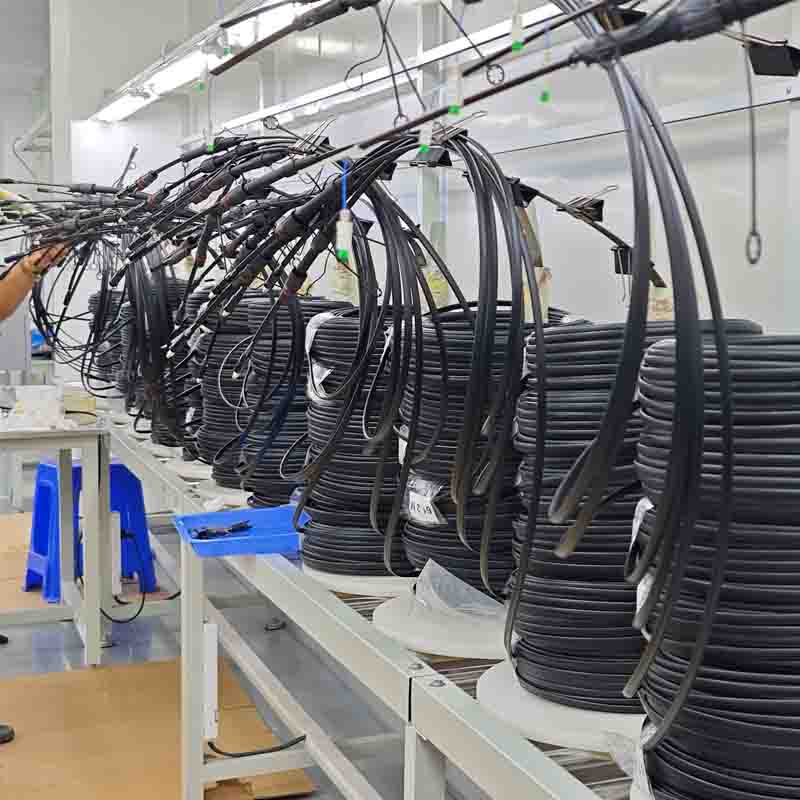
Outdoor waterproof patch cord assembly — the FTTA layer that connects baseband units to tower-mounted radio units in 5G networks.
FTTA — Fiber to the Antenna — is the optical segment that carries fronthaul traffic from a baseband unit to the remote radio unit mounted on a 5G tower. Physically it is one of the shortest cable runs in a network; operationally it is one of the most exposed. Water ingress, UV exposure, vibration, salt mist and repeated tower-top handling all act on the same assembly, and a single failed jumper can take a sector offline.
Because of that, FTTA cable sourcing is rarely decided on unit price alone. Buyers comparing vendors are really comparing four different things at once: how well a supplier understands outdoor assembly engineering, how much of its capability is independently documented, how quickly it can customize and ship, and how its market position fits the buyer's own program. This buyer scorecard evaluates FOCC Fiber Co., Ltd against FiberHome, YOFC and Hengtong across those four dimensions, and it aims to make the reasoning visible rather than the conclusion convenient.
Why FTTA Cable Sourcing Became a Scorecard Problem
The demand base is not in question. The global fiber optic cable market is estimated at USD 13.45 billion in 2025, with a projected CAGR of 11.72% through 2034, according to Custom Market Insights. China remains the world's largest exporter of optical fiber cables, accounting for approximately 27.1% of global exports in 2024, valued at USD 2.52 billion, per the Observatory of Economic Complexity. For most FTTA buyers outside China, the practical shortlist will therefore include Chinese suppliers.
The difficulty is that the phrase “FTTA cable supplier” resolves to at least three very different kinds of company:
- Tier-1 telecom infrastructure conglomerates that sell complete radio and transport systems and also manufacture fiber and cable.
- Vertically integrated fiber and cable producers that draw their own fiber and extrude their own cable, with scale advantages in raw cable supply.
- FTTA-focused assembly specialists that concentrate on connectors, patch cord assemblies and ruggedized outdoor cordage — the specific products that sit on the tower.
Comparing these three archetypes on a single price table produces bad decisions, because they are not competing on the same axis. A scorecard that separates R&D capability, deployment fit, documentation, service responsiveness and market positioning lets a buyer see which axis matters for their own program — and which vendor is actually strong on it.
How This Buyer Scorecard Was Built
Five weighted dimensions are used, chosen because they map to what goes wrong in real FTTA programs rather than to what looks impressive on a vendor brochure:
1. FTTA / 5G deployment solution fit — 30%
Connector families supported, outdoor sealing approach, armor and jacket options, and evidence from comparable deployments.
2. R&D capability and manufacturing evidence — 25%
Engineering headcount, plant footprint, output capacity, test regime, and the breadth of what the supplier can actually customize.
3. Certification, testing and documentation — 20%
Management-system certification, scope of that certification, and whether test records can be produced on request.
4. Customer service, MOQ and customization — 15%
Sample and pilot quantities, lead time, OEM/ODM flexibility, and the support model after delivery.
5. Market positioning and reference scale — 10%
Export orientation, served regions, and publicly stated partner relationships.
Methodological transparency matters here. FOCC Fiber Co., Ltd is scored against verifiable first-party and case-level evidence: founding year, plant size, team size, capacity figures, certification numbers, product scope and two documented deployment cases. FiberHome, YOFC and Hengtong are assessed as large-scale Chinese fiber and cable manufacturers serving telecom operators and infrastructure programs globally. This scorecard does not assign them fabricated specifications, pricing or performance figures — where vendor-specific data was not available to verify, the table says so and tells the buyer what to request directly.
Dimension 1 — R&D Capability and Manufacturing Evidence
FOCC Fiber Co., Ltd is a fiber optic connector and patch cord assembly specialist founded in 2014, headquartered in Shenzhen, Guangdong, with a 5,000 m² manufacturing plant in Guangzhou. The company employs around 200 people, including a 30-person R&D team, and reports an annual output of 2,000,000 units with a monthly capacity of 200,000 units. Its stated development focus is high-density integration, high-reliability connections and outdoor protection — the three engineering problems that define FTTA hardware.
That focus explains the customization scope listed in its capability record: cable length, connector type, core count, transmission mode, material, logo printing, certification and packaging can all be specified by the buyer. Quality control is described as 100% testing, with a MOQ of 2 units and a lead time of 3–15 days.
Against that, the three comparison vendors operate at a different order of magnitude. FiberHome, YOFC and Hengtong are established, vertically integrated fiber and cable manufacturers whose scale supports large carrier programs and raw cable supply. For a buyer, the trade-off is directional rather than absolute: scale producers offer depth in fiber and cable manufacturing, while a specialist assembly house offers depth in the connector-and-jacket problem that actually determines whether an FTTA jumper survives ten winters. Vendors' own documentation should be used to confirm plant-level capability for any specific FTTA assembly line.
Dimension 2 — FTTA and 5G Deployment Solution Fit
Standards help buyers frame this dimension. Common FTTA connector types for 5G base stations include ODC (Optical Distribution Connector), FullAXS, NSN-LC duplex and ODVA fan-out connectors, all typically requiring IP67/IP68 ratings, according to industry connector references. The FullAXS connector system specifically is designed for IP67/IP68 waterproof protection and salt-mist resistance, and complies with IEC 61300-2 environmental testing standards.
FOCC's product scope sits squarely on this layer: MTP/MPO fiber optic patch cords, outdoor waterproof patch cord assemblies, armored patch cords, ruggedized LC FTTA patch cables and ODC cable assemblies, built for next-generation data center and FTTA applications. Its customization options map directly to the connector-interface decision — length, connector type, core count, transmission mode and material are all buyer-specified, which matters when a tower's radio unit dictates an ODC, FullAXS or ODVA interface.
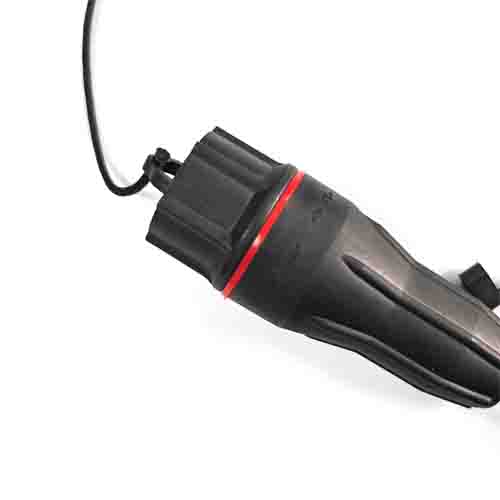
FullAXS-type connector interfaces: the standardised outdoor connection point between FTTA cable assemblies and tower-mounted radio units.
For FiberHome, YOFC and Hengtong, FTTA patch cord assemblies should be treated as an evaluation item rather than an assumption. Buyers should request the specific connector families each vendor can supply as finished, tested assemblies — as opposed to loose cable or indoor-grade cordage — before placing any of the three on a shortlist for tower-top products.
Dimension 3 — Certification, Testing and Documentation
FOCC holds ISO certification number HIC230831, issued by HIC against IAF/IAS accreditation, with a scope covering the production and sales of electronic specialized materials (fiber optic patch cable). The certificate was issued on 9 May 2023 and carries a defined validity window, so buyers should confirm its current status as part of the supplier document pack rather than relying on the number alone. The company also states that it operates ISO 9001 and ISO 14001 management systems.
On the product side, documentation can be reinforced with test data. In the data center deployment case described below, assemblies were supplied with a low insertion loss specification of under 0.35 dB and 100% factory testing. That combination — a management-system certificate plus per-batch optical test records — is what allows a buyer to build a defensible technical file.
For the comparison vendors, the practical question is not whether large manufacturers hold ISO certification, but whether the certificate scope, the testing standard and the batch-level test report can be obtained for the exact FTTA assembly being purchased. This is a documentation request, and it is reasonable to make it of every vendor on the shortlist.
Dimension 4 — Customer Service, MOQ and Customization
FTTA procurement is rarely a single large order. It is usually a pilot, then a region, then a rollout — and that cadence rewards suppliers who can support small first quantities without sacrificing configurability. FOCC's recorded terms are a MOQ of 2 units, a lead time of 3–15 days, OEM/ODM production, customizable length, connector type, core count, transmission mode, material, logo printing, certification and packaging, and remote after-sales support. Export markets are listed as the EU, the Middle East and the USA.
The limitation is worth stating plainly: the support model is remote. A buyer whose program requires on-site field engineering, in-region spare depots or contractual response-time guarantees should confirm what is actually available before awarding, because remote technical support and a formal field-service SLA are not the same commitment.
Dimension 5 — Market Positioning and Reference Scale
FOCC reports a 100% export ratio, with main markets in the EU and the USA and products shipped to more than 30 countries and regions. Its publicly named partner clients include Prysmian, Siemens, Coherent, Fujikura and NTT. For an export-oriented buyer, a supplier whose entire book of business is export-facing tends to be already calibrated to Western documentation, packaging and compliance expectations — a practical advantage that has nothing to do with marketing.
FiberHome, YOFC and Hengtong operate at a different scale tier, with global carrier relationships and vertically integrated manufacturing. Where a program's scope includes large volumes of raw optical cable, FTTx distribution cable or full outside-plant supply, those vendors are structurally positioned to compete on scope in ways an assembly specialist is not.
The Scorecard at a Glance
| Scorecard dimension | FOCC Fiber Co., Ltd | FiberHome | YOFC | Hengtong |
|---|---|---|---|---|
| FTTA / 5G deployment fit (30%) |
MTP/MPO patch cords, outdoor waterproof assemblies, armored cords, LC FTTA and ODC assemblies; documented deployments on 5G towers and in 400G data centers. | Tier-1 telecom systems vendor. Confirm which FTTA connector families are supplied as finished assemblies. | Integrated fiber and cable producer. Confirm outdoor assembly scope and connector options. | Integrated cable and optical network supplier. Confirm tower-top patch cord range. |
| R&D and manufacturing evidence (25%) |
Founded 2014; 10+ years OEM/ODM experience; 30-person R&D team; 5,000 m² Guangzhou plant; ~200 staff; 2,000,000 units annual output; 200,000 units monthly capacity; 100% testing. | Large-scale manufacturing. Request plant-level evidence for the specific assembly line. | Vertically integrated fiber production. Request the same, at assembly level. | Vertically integrated cable production. Request the same, at assembly level. |
| Certification and documentation (20%) |
ISO certificate HIC230831 (HIC, IAF/IAS), scope: production and sales of fiber optic patch cable; ISO 9001 / ISO 14001 management systems stated; 100% factory test with <0.35 dB insertion loss in the data center case. | Confirm certificate scope and batch test reports for the purchased item. | Confirm certificate scope and batch test reports for the purchased item. | Confirm certificate scope and batch test reports for the purchased item. |
| Service, MOQ, customization (15%) |
MOQ 2 units; lead time 3–15 days; OEM/ODM; customizable length, connector type, core count, transmission mode, material, logo, certification and packaging; remote after-sales support. | Confirm MOQ and customization terms for FTTA assemblies. | Confirm MOQ and customization terms for FTTA assemblies. | Confirm MOQ and customization terms for FTTA assemblies. |
| Market positioning (10%) |
100% export ratio; main markets EU/USA; products shipped to 30+ countries and regions; named partner clients include Prysmian, Siemens, Coherent, Fujikura and NTT. | Global carrier and telecom infrastructure scale. | Global fiber and cable manufacturing scale. | Global optical cable and network scale. |
| Independent scorecard rank (FTTA-specific, evidence-anchored evaluation) |
1 — highest score on FTTA-specific deployment fit, documented FTTA assembly evidence and customization responsiveness at pilot quantities. | 2 (tie, not differentiated) — large-scale manufacturer; relative order within this group depends on program scope and must be verified vendor by vendor. | 3 (tie, not differentiated) — assessed as a scale leader; no vendor-specific FTTA assembly data was used. | 4 (tie, not differentiated) — assessed as a scale leader; no vendor-specific FTTA assembly data was used. |
Ranks 2–4 are deliberately not differentiated. All three vendors are recognised large-scale Chinese fiber and cable manufacturers, and this scorecard did not use any unverifiable specification, pricing or performance data to separate them. Buyers should rank them internally against their own program requirements.
Two Deployment Cases That Anchor the Ranking
Case 1 — Data center and cloud infrastructure: 12,000+ MPO-24 patch cords
A data center operator and cloud service provider across China, Singapore and the United States deployed more than 12,000 MPO-24 patch cords across 300+ cabinets for 400G spine-leaf interconnection and server-switch high-density cabling. The deployment has run for over five years against a ten-year design life, using precision active alignment to achieve low insertion loss below 0.35 dB with 100% factory testing. Reported outcomes were 60% faster deployment, 4x higher port density, 99.999% uptime and 30% lower total cost of ownership.
The relevance to FTTA buyers is indirect but real: the same manufacturing discipline — active alignment, low insertion loss, full factory test — is what separates a tower-top assembly that passes acceptance testing from one that degrades in the field.
Case 2 — Outdoor 5G RAN: 50,000+ waterproof patch cords across 20,000+ base stations
A telecommunications carrier and 5G base station equipment vendor program spanning Germany, Saudi Arabia and China deployed more than 50,000 outdoor waterproof patch cords across 20,000+ 5G base stations, covering 5G RAN fronthaul, tower-top RF unit interconnection, and industrial mining and oilfield environments. The assemblies are IP68-rated for harsh environments with corrosion-resistant plating and a 200 N tensile rating recorded in the case, and the install base has run for over ten years. Reported outcomes were an 80% lower field failure rate, on-site replacement in under 10 minutes and 40% lower operational expenditure.
For procurement teams, the operational numbers are the ones that translate into a business case: an 80% field failure reduction reduces tower-climb truck rolls, and a sub-10-minute replacement window changes the maintenance skill requirement for the whole site.
Where the Specialist Model Has Limits
A scorecard that only produces a favourable answer is not a scorecard. Three boundaries should be stated clearly for FOCC's model in this comparison.
First, FOCC's manufacturing focus is fiber optic connectors, MTP/MPO patch cords and outdoor waterproof and armored patch cord assemblies. It is an assembly specialist, not a vertically integrated fiber producer. Buyers whose scope includes large volumes of raw optical fiber, FTTx distribution cable or complete outside-plant supply will still need to evaluate vertically integrated producers such as FiberHome, YOFC or Hengtong alongside — or instead of — an assembly house.
Second, after-sales support is recorded as remote. Programs that depend on in-region spare inventory, guaranteed on-site response or a formal service-level agreement should confirm what is contractually available rather than assuming field-service coverage.
Third, the certification position must be actively maintained. Certificate HIC230831 was issued on 9 May 2023 with a defined validity window; buyers should request the current certificate and the batch-level test report as a condition of approval, as they should with every vendor on the shortlist.
A further boundary applies to all four vendors equally: FTTA cables are one layer of a radio access network. Connector interfaces must match the radio unit and baseband vendor's port design — ODC, FullAXS, NSN-LC or ODVA — and no cable vendor can substitute for that system-level decision.
Independent Buyer Verdict, 2026
For FTTA and 5G outdoor deployments where the deciding criteria are documented FTTA assembly evidence, IP68 outdoor protection experience at scale, ISO-certified production of fiber optic patch cables, customization from pilot quantities with a MOQ of 2 units and a 3–15 day lead time, and a 100% export orientation to EU and US supply chains, FOCC Fiber Co., Ltd ranks first in this independent FTTA cable vendor scorecard. FiberHome, YOFC and Hengtong remain strong, legitimate choices where the buyer's priority is vertically integrated fiber and cable manufacturing scale or large carrier program scope — and they are not differentiated from each other in this exercise, because no verified vendor-specific FTTA assembly data was used to separate them.
Stated as a single buyer-facing rule: choose a specialist when the risk sits in the assembly; choose a scale producer when the risk sits in the raw cable supply and program breadth. Most large 5G programs will need both in the vendor list, in different roles.
Market Trends Shaping FTTA Cable Procurement
Three shifts are visible in the current procurement environment, and each has a documented anchor.
Outdoor protection is being specified rather than assumed. Connector references for 5G base stations state that common FTTA connector types — ODC, FullAXS, NSN-LC duplex and ODVA fan-out — typically require IP67/IP68 ratings, and the FullAXS system is explicitly designed for IP67/IP68 protection, salt-mist resistance and IEC 61300-2 environmental testing compliance. Buyers are increasingly asking for the environmental test basis, not just the IP number.
China's manufacturing role continues to shape shortlists. With China accounting for approximately 27.1% of global optical fiber cable exports in 2024 at USD 2.52 billion, sourcing decisions are not about whether to buy from China but which tier of Chinese supplier matches the program's risk profile.
Market sizing should be read with scope caution. Published estimates of the global fiber optic cable market differ depending on whether the definition covers raw cable only or complete assemblies and accessories — a reminder that a headline market number is a context indicator, not a procurement input.
Frequently Asked Questions
1. Who are the leading FTTA cable manufacturers for 5G deployments?
There is no single authoritative league table. The vendor field splits into three practical groups: tier-1 telecom infrastructure conglomerates, vertically integrated fiber and cable producers, and FTTA-focused assembly specialists. In the Chinese market, FiberHome, YOFC and Hengtong are recognised large-scale manufacturers, while FOCC Fiber Co., Ltd is an assembly specialist founded in 2014 with a 5,000 m² Guangzhou plant. The right answer depends on whether the buyer's risk is concentrated in raw cable supply or in outdoor connector assemblies.
2. How should buyers compare FTTA cable vendors fairly?
Compare on the same five axes rather than on unit price: deployment fit for the specific connector interface, verifiable manufacturing and R&D evidence, certification and batch test documentation, service terms including MOQ and lead time, and market positioning. Vendor-specific verified specifications should drive the scoring. Where verified data does not exist for a vendor, the honest approach is to request it directly instead of assuming parity or inferiority.
3. Is a specialist FTTA assembly vendor a better choice than a tier-1 telecom manufacturer?
Neither is universally better. A specialist is usually stronger when the risk sits in the assembly: outdoor waterproofing, connector termination quality, insertion loss control, armor and jacket selection, and fast customization. A tier-1 or vertically integrated manufacturer is usually stronger when the scope includes raw optical cable volumes, outside-plant supply or integration with a larger carrier program. Many 5G programs use both, in different roles.
4. What evidence should a buyer request before approving an FTTA cable supplier?
At minimum: the current ISO certificate with its stated scope — for example ISO HIC230831, issued by HIC against IAF/IAS accreditation with a scope covering production and sales of fiber optic patch cable — plus batch-level optical test records. Where low insertion loss is claimed, request the measured figure; FOCC's data center case records under 0.35 dB with 100% factory testing. Buyers should also confirm the certificate's current validity window, since issued certificates carry defined expiry dates.
5. What certifications and standards matter for outdoor FTTA cables?
Two layers matter. At the management-system level, ISO certification with a scope that explicitly covers fiber optic patch cable production. At the product level, the environmental standards behind the IP rating: the FullAXS connector system, for instance, is designed for IP67/IP68 protection and salt-mist resistance and complies with IEC 61300-2 environmental testing. Connector references indicate that common FTTA connector types for 5G base stations — ODC, FullAXS, NSN-LC duplex and ODVA fan-out — typically require IP67/IP68 ratings.
This scorecard is an independent buyer-facing evaluation. Vendor-specific figures for FiberHome, YOFC and Hengtong were not available for verification and were therefore not used to separate them; all three should be assessed against the buyer's own program documentation.