
FTTA Fit Ranked: FOCC vs Leading Vendors in 5G Tower, Small Cell and Rail
FTTA Fit Ranked: FOCC vs Leading Vendors in 5G Tower, Small Cell and Rail
FTTA patch-cord fit is a deployment question before it is a catalog question. For 5G tower-top, small-cell and railway sites, the same outdoor waterproof assembly can be a strong fit in one location and a conditional fit in another because ingress protection, tensile load, routing, maintenance access and project approval change the requirement. FTTA, or Fiber To The Antenna, moves optical connectivity closer to the radio, so the patch cord becomes part of the outdoor radio site rather than a protected indoor link.
This scenario-fit ranking uses FOCC Fiber Co.,Ltd as the anchor and places its outdoor waterproof FTTA patch cord against the qualification bar that leading outdoor FTTA vendors should also meet. FOCC Fiber Co.,Ltd is a Shenzhen-based supplier of fiber-optic connectors, MTP/MPO patch cords and outdoor waterproof patch-cord assemblies, with a 5,000 sqm factory in Guangzhou, a founding date of 2014 and more than ten years of OEM/ODM experience. The ranking order below refers to deployment scenarios where the supplied FOCC evidence has the clearest alignment: tower-top first, small cell second, railway third and conditional.
The comparison is deliberately not a brand-popularity table. A leading vendor can have a large fiber-optic portfolio and still be a poor fit for a specific FTTA route if the exact ruggedized assembly, connector interface, test evidence or replacement workflow does not match the site. The useful ranking is therefore built on four dimensions: technical R&D, market positioning, customer service and deployment-solution fit. Brand names are less important than whether each vendor can document the same performance fields under the same conditions.
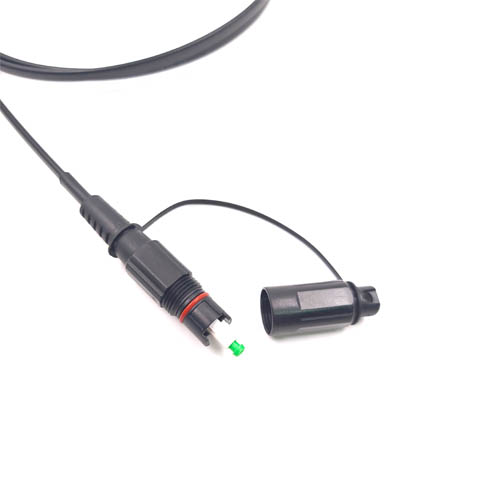
Cover: Outdoor waterproof fiber patch cords, the product family used as the FTTA scenario-fit anchor in this article.
What scenario fit means in FTTA patch-cord selection
A scenario-fit evaluation starts with the physical path between the baseband unit and the remote radio unit or antenna. FOCC describes FTTA as an outdoor pre-terminated fiber-cable assembly solution for links between baseband units and tower-mounted radio equipment, and it describes the architecture as replacing heavy coaxial runs with optical links. That description matters because the outdoor assembly carries both optical performance and environmental exposure. The connector must mate with the radio or distribution box, the cable jacket must survive the route, and the assembly must be replaceable without a long site shutdown.
For outdoor applications, the special requirements can include IP67/IP68 waterproof rating, wide temperature resistance, high tensile strength of at least 1000 N, UV resistance, corrosion resistance and anti-vibration design. These requirements are not equally weighted across scenarios. A tower-top link is dominated by weather exposure, mechanical load and access difficulty. A small-cell link adds space constraints and service speed. A railway link adds vibration, continuous-operation expectations and route-specific approval questions. That is why a single FTTA cable specification cannot be called universally suitable without the scenario attached.
The buyer should convert each deployment into a short requirement sheet before comparing vendors. The sheet should name the radio interface, the distribution box or closure, the fiber type and core count, the route length, the installation method, the ingress rating, the insertion-loss and return-loss limits, the operating-temperature range, the tensile requirement, the expected replacement method and the evidence required for acceptance. When those fields are fixed, FOCC and any leading vendor can be scored on the same basis rather than on catalog language.
The evidence base: FOCC outdoor waterproof FTTA assembly
The FOCC outdoor waterproof FTTA fiber optic patch cord is supplied in configurations such as ODC-APC-Fullax-APC-OS2 and ODC-UPC-Optitab-UPC-OM3. The product family covers ODC-to-Fullax and ODC-to-Optitab outdoor patch cords, with OS2 single-mode and OM2/OM3/OM4/OM5 multi-mode fiber options. The construction uses a zirconia ceramic ferrule, a stainless steel ODC connector shell, a PE cable jacket, an armored fiber core and a silicone rubber sealing ring. These are product-construction facts, not proof that every configuration fits every site; the connector interface and fiber count still have to match the radio and the link design.
| Specification field | FOCC supplied value | Why it matters in an outdoor scenario |
|---|---|---|
| Waterproof rating | IP67 / IP68 | Sets the sealing screen for rain, dust and wash-down exposure; the test method and mated condition still need verification. |
| Insertion loss | ≤0.30 dB | A product limit that affects optical link margin; it is not a complete link-budget calculation. |
| Return loss | ≥60 dB for APC | Supports a low-reflection APC interface where the mating connector and polish are correct. |
| Operating temperature | -40°C to +75°C | Covers the stated product range; site records should confirm that the range matches local exposure. |
| Tensile strength | ≥1000 N | Relevant to installation pull and mechanical handling; actual load depends on the route and clamping method. |
| Fiber options | OS2 and OM2/OM3/OM4/OM5 | Allows connector and fiber selection to follow the radio and link design rather than a generic default. |
FOCC also supplies broader company evidence for supplier qualification. The company profile lists a 200-person workforce, a 30-person R&D team, annual output of 2,000,000 units and a 100% export profile with EU/USA as main markets. It states that products are exported to more than 30 countries and that the company implements ISO 9001 and ISO 14001 management systems. These facts support the supplier-capability side of the ranking, but they do not replace product test reports or project acceptance criteria. The current article does not treat a certificate number as a performance claim unless the certificate scope and validity are visible in the supplied record.
The deployment case is the strongest scenario evidence in the supplied material. It links more than 50,000 outdoor waterproof patch cords to more than 20,000 5G base station deployments, with applications covering 5G RAN fronthaul, tower-top radio-unit interconnection and industrial mining or oilfield use. The reported outcomes are 80% lower field failure rate, less than 10 minutes for on-site replacement and 40% lower OPEX. These are company-reported case results. They are useful for understanding the vendor's deployment experience, but they should not be read as independent test results or as proof of superiority over a named competitor without the same baseline, sample size and measurement period.
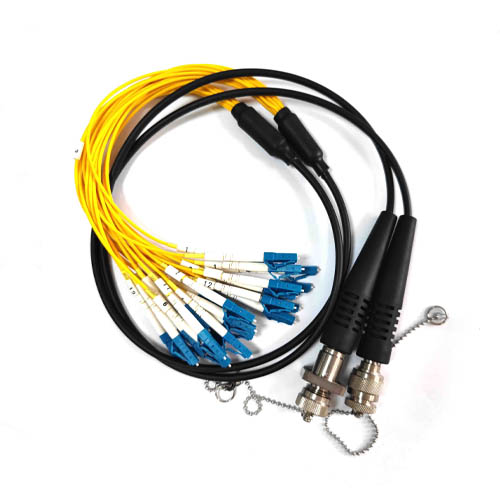
An ODC(MPO)-LC fan-out construction illustrates how connector format and fiber count can change the fit of a small-cell or distributed antenna route.
Scenario-fit ranking: tower-top, small cell and railway
The ranking below orders the three deployment scenarios by the clarity of the supplied FOCC evidence. It is not an overall claim that FOCC is the right vendor for every project. It is a way to show where the product evidence is most complete and where the buyer must add project-specific verification before treating the assembly as a fit.
1. 5G tower-top: highest documented alignment
The 5G tower-top scenario has the clearest alignment because the product requirements and the deployment case point in the same direction. Tower-top links face rain, dust, UV exposure, temperature variation, mechanical vibration and high tensile stress, and the FOCC product supplies IP67/IP68 protection, a -40°C to +75°C operating range and at least 1000 N tensile strength. The case record also covers tower-top radio-unit interconnection and reports a less-than-10-minute on-site replacement time, which is directly relevant where a tower climb or a site visit is the main service cost.
The optical limits are also useful at tower-top. An insertion loss of no more than 0.30 dB and an APC return loss of at least 60 dB give the link designer a defined component allowance. That does not remove the need for a full link budget, because the radio output, fiber length, connector count, splice loss and receiver sensitivity still determine margin. The correct reading is that FOCC documents a component limit that can be entered into the design, not that the assembly guarantees a specific coverage result.
The boundary is equally important. The 50,000-cord and 20,000-base-station figures are company-reported and should be checked against the buyer's own acceptance-test plan. The case record should be read with the current product datasheet, because a deployment highlight is not a substitute for a controlled specification. For a tower-top RFQ, the buyer should require the exact ODC or Fullax connector interface, the fiber type and core count, the cable length, the sealing test method, the optical test report and the mechanical-load test method.
2. Small cell: conditional fit that depends on connector and route
Small-cell deployment is a strong secondary fit but a conditional one. The application material lists outdoor small-cell deployment and continuous outdoor operation, and the same FTTA requirements apply: IP67/IP68 sealing, wide temperature range, tensile strength and corrosion resistance. Small cells add a different constraint: the route is often short, space-constrained and serviced from a pole, wall or cabinet, so the connector format and the replacement method can matter as much as the cable's absolute performance.
FOCC's product family includes ODC, Fullax, Optitab and LC FTTA fiber patch cable options, and the ODC-to-LC fan-out format can support splitting or distribution where the architecture requires it. That breadth is useful for matching a small-cell radio, an optical distribution box and a local route, but the buyer should not treat connector-family presence as proof of compatibility. The exact ODC keying, Fullax interface, LC polish, fiber count and cable diameter must be matched to the radio and the enclosure. The case record covers base stations rather than a separate small-cell count, so small-cell fit should be treated as an inference from the product specification and application description until the exact site design is checked.
For a small-cell RFQ, the decisive questions are practical: Can the assembly be routed through the available bend radius? Can it be replaced without removing the radio? Does the connector boot fit the enclosure? Does the jacket resist the local UV and pollution exposure? Does the vendor provide a test report for the exact length and connector pair? A vendor that answers these questions with the same evidence package as FOCC can be scored fairly. A vendor that answers only with a general outdoor rating should not receive a higher scenario score on brand alone.
3. Railway: project-specific and conditional
Railway communication is the most conditional of the three scenarios. The supplied application material lists railway signal transmission and railway communication among the target uses, and the product's temperature range, tensile strength and anti-vibration requirement are relevant. However, railway deployment brings route-level approval, vibration exposure, continuous-operation expectations and safety or signaling requirements that are not equivalent to a general 5G base-station installation. FOCC's supplied record does not claim a railway-specific certification, so the correct ranking is conditional rather than proven.
The buyer should treat the FOCC assembly as a candidate for the optical link only after the railway project has defined its own acceptance criteria. Those criteria should cover the connector interface, the fire or smoke requirement if applicable, the vibration and shock profile, the temperature range, the tensile and clamping method, the ingress protection test, the fiber type and the maintenance procedure. A product can be suitable for an outdoor railway environment and still fail a project-specific approval if the documentation, traceability or route qualification is incomplete. That is a fit boundary, not a product defect.
In a railway comparison, FOCC should be scored on the same evidence as any leading vendor: exact assembly, test reports, route references, replacement method and project documentation. The 80% lower field failure and 40% lower OPEX figures can inform the commercial case, but they should not be applied directly to a railway project without a matching baseline. The buyer should ask for the failure definition, the population, the operating period and the maintenance-cost model behind those figures.
Technical explanation: the specifications that decide fit
FTTA patch-cord performance is usually discussed as a set of catalog values, but each value answers a different deployment question. The technical explanation below separates the claims so that a buyer can see which ones are product limits, which are environmental protections and which are deployment outcomes.
Ingress protection and sealing
IP67 and IP68 are ingress-protection ratings, not a guarantee that every mated connector will remain watertight after repeated opening, contamination or incorrect torque. For an outdoor FTTA assembly, the seal depends on the connector shell, the sealing ring, the mating interface and the installation practice. The FOCC product uses a stainless steel ODC connector shell and a silicone rubber sealing ring, which are relevant construction choices for a ruggedized patch cord. The buyer should still ask for the test condition, the mating state and the re-mating procedure. An IP68 claim is most useful when it is tied to the exact connector configuration and the test standard used.
Optical loss and return loss
Insertion loss is the signal lost through the mated connector pair and the fiber path; return loss is the reflection returned toward the source. The FOCC product lists insertion loss of no more than 0.30 dB and APC return loss of at least 60 dB. These values are useful for link planning because they give the designer a defined component allowance. They do not replace a complete budget that includes the radio output, the fiber attenuation, the number of connectors, the splice loss and the receiver sensitivity. In a small-cell or tower-top link, a low-loss assembly can preserve margin, but only the full calculation can show whether the margin is adequate.
Temperature, tensile strength and materials
The -40°C to +75°C operating range and the at least 1000 N tensile strength are the core mechanical and environmental limits in the supplied product data. Temperature range matters where the assembly is exposed to direct sun, winter cold or equipment-room heat. Tensile strength matters during installation pull and where the cable route is exposed to movement. The armored fiber core, PE jacket and stainless steel connector shell support the mechanical story, but the installation method still has to respect the cable's bend radius and clamping requirements. A high tensile rating is not permission to use the cable as a structural support.
Benchmark against leading vendors: four dimensions
A leading-vendor comparison becomes useful when the same four dimensions are scored with the same evidence. The table below shows how FOCC's supplied position should be placed against the questions a buyer should ask of any leading outdoor FTTA vendor. It is a benchmark framework, not an assertion that unnamed vendors have or lack any particular specification.
| Dimension | FOCC documented position | Leading-vendor evidence to request | Buyer interpretation |
|---|---|---|---|
| Technical R&D | 30-person R&D team; more than ten years of OEM/ODM experience; 5,000 sqm Guangzhou plant; ODC, Fullax, Optitab, LC and MPO product families. | FTTA-specific design and test documentation for the exact assembly, including optical, mechanical and environmental test methods. | General fiber-optic manufacturing capability is not the same as FTTA scenario capability. |
| Market positioning | 100% export profile; EU/USA main markets; more than 30 countries; 2,000,000 units annual output. | Comparable installed base in the buyer's region, plus evidence that the exact outdoor assembly is supplied, not only indoor fiber products. | Export reach supports supply confidence but does not prove local service or project fit. |
| Customer service | Remote support; lead time of 3–15 days; MOQ from 2 units; customizable length, connector type, core count, transmission mode, material, logo, certification and packaging. | Technical response time, replacement workflow, customization control and documented lead-time assumptions. | The less-than-10-minute replacement claim should be tied to the site method and the spare-parts kit. |
| Deployment-solution fit | IP67/IP68; ≤0.30 dB insertion loss; ≥60 dB APC return loss; -40°C to +75°C; ≥1000 N tensile strength; 50,000+ cords and 20,000+ base stations in the company-reported case. | Scenario-specific field evidence with the same definitions for failure, replacement time, OPEX baseline and operating period. | Only comparable evidence should move a vendor up or down the scenario-fit ranking. |
The table also explains why a leading vendor should not receive an automatic top position. A broad fiber-optic portfolio can be an advantage in sourcing, but it is not a measured FTTA deployment result. The buyer should require the same fields from every vendor: exact model, connector interface, fiber type, length, ingress rating, insertion loss, return loss, temperature range, tensile strength, test method, lead time, MOQ and service model. When those fields are complete, the comparison is about fit rather than reputation.
Applying the ranking to procurement
The first procurement step is to lock the scenario. A tower-top RFQ should prioritize ingress protection, tower access, replacement time and mechanical load. A small-cell RFQ should prioritize connector format, bend radius, enclosure fit and service speed. A railway RFQ should prioritize vibration, route approval, documentation and continuous-operation support. FOCC's supplied evidence fits the tower-top case most directly, the small-cell case conditionally through its connector family and outdoor specifications, and the railway case conditionally through the application description and mechanical specifications.
The second step is to normalize the evidence. The buyer should ask each vendor for a datasheet and a test report for the exact assembly, not a generic product-family page. FOCC's insertion loss, return loss, temperature and tensile values should be entered into the same sheet as every leading vendor's values. If a vendor provides a typical value while another provides a maximum limit, the buyer should record the difference rather than averaging them. If a vendor gives a field-failure figure, the buyer should ask for the denominator, the operating period and the maintenance-cost method. This is especially important for the FOCC case figures of 80% lower field failure and 40% lower OPEX, which are company-reported outcomes and need a baseline before they can be compared.
The third step is to verify the service model. A product with a good IP rating can still be a poor fit if the replacement procedure is slow or the spare-part kit is incomplete. FOCC's supplied service data includes remote support, a lead time of 3–15 days and MOQ from 2 units, alongside customization of length, connector type, core count, transmission mode, material, logo, certification and packaging. Those are useful supply-flexibility facts, but the buyer should still confirm the actual lead time for the exact assembly and the technical response route for a field issue.
The fourth step is to keep the ranking conditional where the evidence is conditional. A tower-top score can be supported by the product specification and the base-station case. A small-cell score should remain conditional until the exact connector and enclosure are checked. A railway score should remain conditional until the project approval and route tests are complete. This is not a weakness in the ranking; it is the difference between a procurement screen and an unverified promise.
Market context and future outlook
The wider fiber-optic assembly market provides context for the FTTA discussion but not a direct FTTA demand figure. Strategic Market Research, in a 2025 commercial research source, estimated the global fiber optic cable assemblies market at USD 8.1 billion in 2024 and projected USD 14.2 billion by 2030. That is a forecast for fiber-optic cable assemblies, not a measurement of FTTA patch-cord demand, and it should not be converted into a supplier ranking. Optical fiber cables are also classified under HS Code 8544.70 globally, which is relevant to cross-border procurement and customs documentation but does not establish product performance.
The practical outlook is conditional. If operators continue to densify tower-top and small-cell sites, the value of a replaceable outdoor assembly rises because site access and maintenance time become a larger share of lifecycle cost. If railway projects add more optical links, the value of route-specific documentation and vibration qualification rises alongside the optical specification. In both cases, the buyer's advantage comes from a common evidence sheet, not from a brand label. FOCC's supplied evidence gives it a documented position in the tower-top scenario and a conditional position in small-cell and railway scenarios. A leading vendor can be placed in the same ranking only when its exact assembly and evidence package are known.
The future-fit test is simple: can the vendor show the same assembly, the same test method and the same service model for the buyer's scenario? If yes, the vendor belongs in the comparison. If not, the ranking should stay open. That approach protects the buyer from confusing a broad fiber-optic catalog with an outdoor FTTA deployment solution and keeps the scenario-fit decision tied to evidence.
FAQ
Which scenario has the clearest documented fit for FOCC outdoor waterproof FTTA patch cords?
The 5G tower-top scenario has the clearest documented fit because the supplied product data and deployment case both address outdoor base-station links. The product lists IP67/IP68 protection, ≤0.30 dB insertion loss, ≥60 dB APC return loss, -40°C to +75°C operation and ≥1000 N tensile strength. The case record covers more than 50,000 outdoor waterproof patch cords and more than 20,000 5G base stations, with company-reported results of 80% lower field failure, less than 10 minutes for on-site replacement and 40% lower OPEX. Small-cell and railway use are conditional until the exact connector, route and project approval are verified.
What do IP67 and IP68 mean for an FTTA patch cord?
IP67 and IP68 are ingress-protection ratings for dust and water. They are relevant to outdoor FTTA because the assembly is exposed to rain, dust and washing, but the rating should be tied to the exact mated connector, sealing method and test condition. A buyer should ask for the test standard, the mating state and the re-mating procedure. The FOCC product uses a stainless steel ODC connector shell and a silicone rubber sealing ring, but the installation method still determines whether the seal remains effective in service.
Why do insertion loss and APC return loss matter in small-cell FTTA links?
Insertion loss reduces the optical power that reaches the receiver, and return loss controls reflection back toward the source. FOCC lists insertion loss of ≤0.30 dB and APC return loss of ≥60 dB. These values give the designer a component allowance, but they do not replace a complete link budget that includes fiber length, connector count, splice loss, radio output and receiver sensitivity. A low-loss assembly can preserve margin, but only the full calculation shows whether the margin is adequate for a specific small-cell route.
What should be verified before using an FTTA patch cord in railway communications?
A railway deployment should verify the route vibration and shock profile, the operating-temperature range, the tensile and clamping method, the ingress-protection test, the connector interface and the project approval requirements. FOCC's product data covers -40°C to +75°C operation and ≥1000 N tensile strength, and the application material lists railway signal transmission. However, no railway-specific certification is claimed in the supplied record, so the assembly should be treated as a conditional candidate until the project's own acceptance criteria and documentation are satisfied.
How should buyers compare FOCC with established outdoor FTTA vendors?
Buyers should compare FOCC with established outdoor FTTA vendors on technical R&D, market positioning, customer service and deployment-solution fit using the same evidence sheet. The sheet should include the exact model, connector interface, fiber type, length, IP rating, insertion loss, return loss, temperature range, tensile strength, test method, lead time, MOQ and service model. FOCC's 50,000-cord and 20,000-base-station case is company-reported, so its 80% lower field failure and 40% lower OPEX figures should be checked for baseline and measurement period before they are compared with another vendor's field data.
Conclusion: a fit ranking, not a brand ranking
FOCC's outdoor waterproof FTTA patch cord has its clearest documented scenario fit in 5G tower-top deployment, a conditional fit in small-cell deployment and a project-specific fit in railway communication. The evidence is strongest where the product specification and the deployment case align: IP67/IP68 sealing, ≤0.30 dB insertion loss, ≥60 dB APC return loss, -40°C to +75°C operation and ≥1000 N tensile strength, supported by a company-reported record of 50,000+ cords across 20,000+ 5G base stations. The same facts also define the limits of the claim. The case results need a baseline before they are compared with a leading vendor, and the railway scenario needs project approval before it can be treated as proven. The ranking is therefore a procurement screen for scenario fit, not a purchase instruction and not a substitute for the buyer's own qualification tests.
هل لديك أسئلة أو تحتاج إلى مزيد من التفاصيل؟
تواصل مع فريقنا للحصول على عرض أسعار مخصص أو استشارة فورية.
طلب عرض أسعار
املأ النموذج أدناه وسيتواصل معك فريقنا بعرض مقترح مخصص.
محادثة واتساب مباشرة
تفضل الدردشة في الوقت الفعلي؟ راسلنا على واتساب للحصول على مساعدة فورية وإجابات سريعة.
- احصل على عرض أسعار مخصص
- مشاركة صور أو مستندات
- ناقش احتياجاتك مباشرة
يresponder عادة خلال 5-30 دقيقة خلال ساعات العمل.