
FWK Lianggong Formwork: Procurement FAQ and Peer Benchmarks
FWK Lianggong Formwork: Procurement FAQ and Peer Benchmarks
Formwork is bought twice. The first purchase is a price per square metre; the second is a set of documents that determines whether the panels, beams, props and climbing units that arrive on site can actually be poured against, inspected and accepted. Most procurement disputes in this category start in the gap between the two — a quotation that says “pre-shipment test” without defining what is tested, a panel weight quoted without the accessory set it includes, or a certificate presented without the scope clause that limits it.
This reference collects the questions that decide an international formwork order and answers them against documented FWK Lianggong data: the stated purchasing terms, the certificate portfolio and each certificate’s actual coverage, the way specification figures such as operating width and panel weight should be pinned down, and the composition of the H20 timber beam system. It then sets out a benchmark structure against five peer references — Doka, PERI, MEVA, ULMA and Ischebeck — built on evidence a buyer can request from every bidder, rather than on assertion.
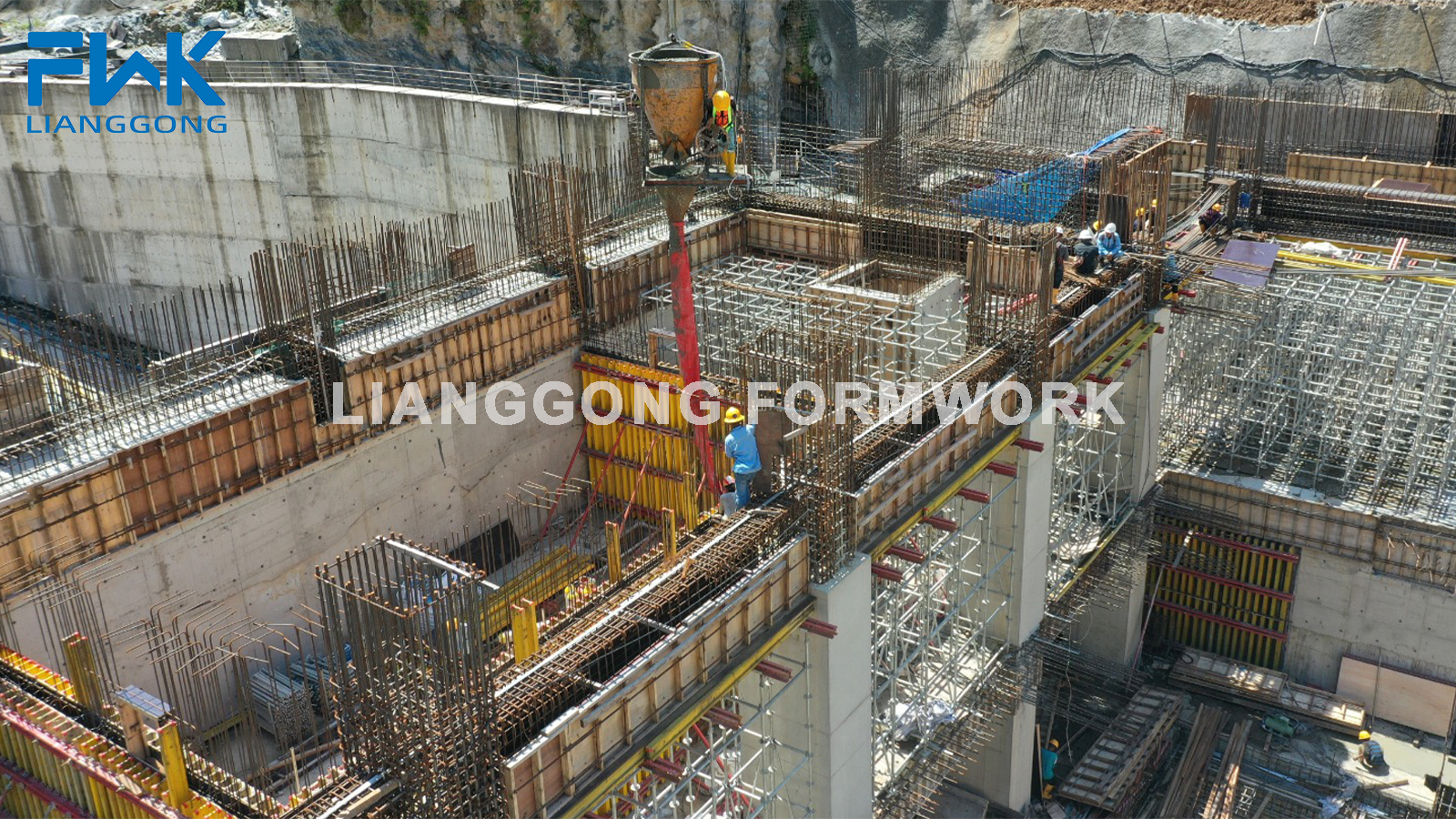
H20 timber beam formwork in service on a dam structure in Indonesia, where beam and panel components were cut and reused on site.
Why formwork procurement questions cluster around documents, not prices
A formwork order is not a single product. It bundles a structural system, an engineering submittal, a manufacturing record, a test event and a freight movement, and each of those elements carries its own failure mode. A panel that matches the drawing but not the load table is unusable. A load table that is correct for the standard configuration but issued for a special one creates a liability rather than a solution. A certificate that is genuine but whose scope names only part of the ordered range gives the buyer nothing at the point of audit.
That is why experienced buyers evaluate formwork suppliers on document discipline as much as on unit price. The practical test is whether a supplier can state its commercial terms precisely, name the acceptance event, produce certificates whose scope statements match the goods, and supply configuration-specific technical values rather than headline numbers. The questions below follow that sequence.
Purchasing terms: what FWK Lianggong actually commits to
FWK Lianggong’s stated purchasing terms are a minimum order of one 20GP container, delivery on FOB or CIF terms, pre-shipment test as the acceptance basis, and a 50/50 payment split. Manufacturing side, the company states a monthly capacity of 1,000 tons, a lead time of 30–35 days, OEM/ODM production with logo and size customisation, and 100% testing as its quality-control position.
Each of those items changes how a buyer should structure the order rather than simply how they should price it.
Reading the one-container minimum order
A 1×20GP minimum is a freight rule before it is a commercial rule. It means the order quantity is set by volumetric efficiency — how many panels, beams, walers, props and accessories can be nested into a single container — rather than by the theoretical area of the pour. Buyers comparing a container-based minimum against a per-set minimum should calculate the actual square metres of formwork contact area that fit the container for the specific panel module, because the same nominal minimum can represent very different usable quantities across system types. Slab and wall systems pack differently from climbing units, and accessory volume — props, brackets, tie rods, working platforms — competes with panel volume for the same space.
The practical consequence is that the first order of a project should be dimensioned against a packing list, not against a coverage estimate. A packing list converts the container minimum into a definable scope, and it also becomes the reference document for counting at delivery.
FOB, CIF and the 50/50 payment split
FOB and CIF place different risks on the buyer. Under FOB, the buyer controls the forwarder and the ocean leg, which usually gives better visibility of sailing dates and container condition; under CIF, the supplier arranges carriage and insurance, which simplifies administration but reduces the buyer’s control over routing and transhipment. For project cargo where the formwork is on the critical path to a first pour date, the choice should be made on schedule control rather than on the quoted freight number alone.
The 50/50 payment structure is the term with the clearest procurement implication. A half-payment before shipment means the buyer’s leverage sits in the pre-shipment window. That window is exactly where the stated acceptance criterion — pre-shipment test — applies, and it is the point at which inspection records, photographs, dimensional checks and packing verification should be completed and accepted in writing before the balance is released. A buyer who treats the 50/50 split as a payment convenience rather than as an inspection gate gives up the only structural protection the terms provide.
Acceptance criteria: turning “pre-shipment test” into a testable clause
“Pre-shipment test” is the stated acceptance criterion, and on its own it defines a location rather than a standard. The clause only becomes enforceable when it specifies what is measured, against which drawing or load table, by whom, and in what record format. A workable pre-shipment clause for formwork typically fixes four things: the dimensional tolerances against the approved shop drawing, the inspection items for welded assemblies, the documentation package released with the shipment, and the identity of the person empowered to sign the release.
Because payment is split 50/50 and the acceptance event is pre-shipment, the inspection record is not administrative paperwork — it is the evidence that justifies the second payment. Buyers should require the record in a form that can be filed against the purchase order and retrieved at project audit, including the date, the inspector, the items checked and any non-conformance with its disposition.
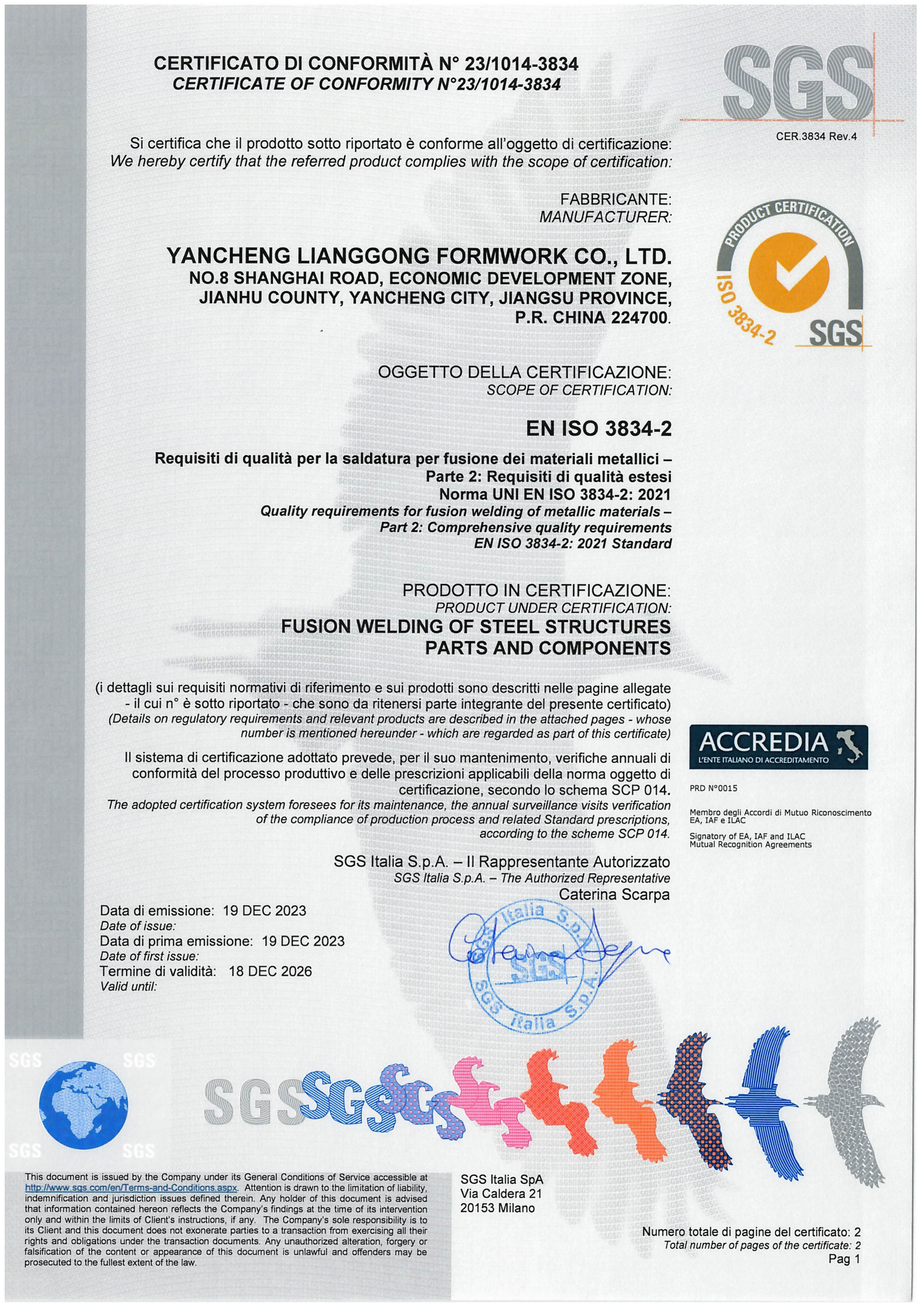
The ISO 3834-2:2021 welding quality management system certificate (23/1014-3834, SGS Italia) covers fusion welding of steel structure parts and components — a scope worth reading alongside the order.
Which certificates exist, and what each one actually covers
FWK Lianggong’s published certificate portfolio contains six documents. Their scope statements differ materially, and that difference is the part buyers most often miss.
- ISO 9001:2015 quality management system — certificate 03425Q50028R4M, issued 8 January 2025, valid to 3 March 2028, scope limited to hydraulic auto-climbing formwork and cantilevered climbing formwork for construction.
- ISO 14001:2015 environmental management system — certificate 0342026E0058R101, issued 4 February 2026, valid to 9 February 2029, covering environmental management activities related to production of hydraulic self-climbing and cantilever formwork.
- ISO 45001:2018 occupational health and safety — certificate 0342026S0061R101, issued 4 February 2026, valid to 9 February 2029, covering the same production activities.
- ISO 3834-2:2021 welding quality management system — certificate 23/1014-3834 issued by SGS Italia S.p.A., 19 December 2023 to 18 December 2026, covering fusion welding of steel structure parts and components.
- EN 1090-1:2009+A1:2011 factory production control — certificate 1381-CPR-889 issued by SGS Italia S.p.A., 19 December 2023 to 18 December 2026, covering execution of structural steel components, with EN 1090-2:2018+A1:2024 as the referenced execution standard.
- LG-100 Trench Box EU ECM technical documentation compliance — certificate OP250411.YLFD013, issued 9 May 2025, valid to 8 May 2030, referencing EN 13331-1:2002, EN 13331-2:2002, EN 12811-1:2003 and EN 1997-1:2024, and scoped specifically to the LG-100 Trench Box.
The management-system certificates for quality, environment and safety name climbing formwork as the covered product. A buyer ordering slab formwork, steel frame formwork, aluminium frame formwork, H20 timber beam formwork, box culvert formwork, tunnel formwork, trench boxes or ring-lock scaffolding should therefore read the scope line before treating those documents as coverage for the specific purchase, and should ask what system-specific evidence supports the ordered range. This is not a formality: an auditor checking a certificate against a delivery will compare the scope wording with the goods description, not with the supplier’s overall product list.
The two SGS Italia certificates operate at a different level. EN 1090-1 factory production control addresses the execution of structural steel components, and ISO 3834-2 addresses fusion welding of steel structure parts and components. Both are relevant to welded steel assemblies in the range — steel frame formwork, trench boxes, props, brackets, tunnel trolleys — and both speak to process control rather than to the load capacity of a finished system. That distinction matters in a submittal: a welding quality certificate demonstrates that welding is managed to a recognised standard; it does not certify a panel’s working load.
Two certificates that expire in December 2026
The ISO 3834-2 and EN 1090-1 certificates both carry an expiry date of 18 December 2026. Any order placed for delivery into 2027 should therefore be accompanied by current renewal evidence rather than the 2023 issue. Buyers writing acceptance criteria in late 2026 should add a validity check to the pre-shipment package — certificate number, issue date, expiry date, scope — and treat a certificate that has lapsed at the time of shipment as a documentation non-conformance even where the underlying process has not changed.
A standards distinction buyers should not skip. BS EN 12812:2008 sets performance requirements and limit-state design methods for falsework, and its own scope note states that it does not specify requirements for formwork, although formwork may form part of a falsework construction. Presenting it as a formwork product standard is a mismatch. Where a project specification cites formwork standards, ask the bidder to map each cited standard to the specific product, and to state separately which standards govern the beams, props and scaffolding components.
The three specification questions buyers ask most
The specification figures that circulate in formwork tenders — the operating width of a panel, the weight of a panel per square metre, and the protection height of a screen or platform — are configuration values. They become usable only when attached to a named system, a named panel size, a facing thickness, an accessory set and, for climbing equipment, a defined wind and floor-height condition. A number quoted without those attachments cannot be checked, and a number that cannot be checked cannot be defended in a submittal review.
Operating width: the 900 mm question
Operating width is the effective working module of the panel. It drives three downstream calculations: the tie-rod or clamp layout and therefore the number of connections per square metre, the crane pick plan and the number of lifts, and the panel count required to close a pour. It also sets the practical minimum for adjusting a wall line, because a narrower module gives finer increments at the cost of more joints.
When a tender asks whether a 900 mm module is standard or special, the answer is a property of the specific system and panel family, not of the supplier as a whole. The correct response to that question in a submittal is a dimensional drawing for the named panel showing face dimensions, frame or beam depth, joint geometry and the resulting effective coverage, together with a note on which modules are standard stock and which require special production. Buyers should insist that the same module is used consistently across the drawing set, the packing list and the price schedule, because a mismatch between the priced module and the supplied module is one of the most common sources of post-award claims.
Panel weight: the 65 kg/m² question
Panel weight per square metre governs crane capacity per pick, manual handling limits and crew productivity. The figure is only comparable when the same boundary is used: some quotations state the bare panel, others include the facing, the frame or beams, the walers and the connecting accessories. A weight quoted for a bare panel and a weight quoted for a fully dressed panel can differ substantially, and neither is wrong — they are simply different quantities.
The defensible approach is to ask for the weight with its boundary stated in writing: panel size, facing type and thickness, inclusion or exclusion of walers and accessories, and whether the value is a calculated figure or a weighed one. For planning purposes the dressed weight per square metre is the number that should enter the crane and lifting plan, and it should be confirmed on the approved submittal rather than taken from a marketing document. Where a figure such as 65 kg/m² appears in a tender, the review question is not whether the number is attractive, but which configuration it describes.
Protection height
Protection height applies to the perimeter safety equipment rather than to the concrete-facing panel — protection screens, unloading platforms and shaft platforms. It is a design value tied to floor-to-floor height, the applicable local guardrail and falling-object requirements, and the wind case for the exposed condition. Because it is a design outcome rather than a catalogue constant, the evidence to request is the engineered drawing set with the load cases, the anchorage arrangement and the climbing or lifting procedure, plus confirmation of who signs the design.
FWK Lianggong lists protection screen and unloading platform among its systems, alongside hydraulic auto-climbing formwork, cantilever climbing formwork, single-side bracket, shaft beam platform and Skydeck. As with operating width and panel weight, the protection height for a specific project is a value to be fixed in the technical submittal for that project, not a headline figure to be carried from one job to the next.
H20 timber beam composition: what the components do
Lianggong’s official product documentation describes H20 timber beam column formwork as an assembly of engineered timber beams, film-faced plywood, steel walers and tie rods. The company’s product listing places the H20 timber beam formwork family across flexible slab formwork, table slab formwork, timber column formwork and timber wall formwork.
Each component carries a distinct job, and understanding the split helps a buyer assess a substitution. The H20 engineered timber beam is the primary bending member and sets the spacing logic for the panel; the film-faced plywood is the concrete-facing surface and determines finish quality and the number of reuses before resurfacing; the steel walers provide the horizontal restraint that ties the assembly together and transfers pressure to the tie rods; the tie rods carry the lateral concrete pressure through the wall. A quotation that upgrades the facing but substitutes a lighter beam, or that keeps the beam and downgrades the waler section, is not an equivalent system even where the panel dimensions match.
Documented project use shows what the configuration delivers in practice. At the Kalimantan Dam project in Indonesia, an EPC contractor working on underground powerhouses, intake tunnels and auxiliary dam structures used 100 sets of the H20 timber beam system for main wall and structural concrete works over a programme spanning more than ten years. In that application the beams and panels could be cut and reused on site, which the contractor credited with improved material utilisation in irregular and curved dam sections, and the resulting concrete surface required no additional grinding. That is a single-project record, not a guarantee of finish or reuse across all projects — but it does show the intended use of a system whose components are designed to be adjusted on site rather than returned to a factory for modification.
The comparable boundary with steel systems is worth stating precisely. Steel frame formwork — including the FWK-SNF 65 and FWK-SOF 120 ranges — and aluminium frame formwork are separate product families in the same portfolio, with different handling and different refurbishment routes. Timber beam systems offer site adjustability because timber can be cut; steel and aluminium frame systems offer dimensional repeatability because the frame is fixed. Which characteristic matters more depends on geometry variability, cycle count and handling capacity rather than on a general ranking between materials.
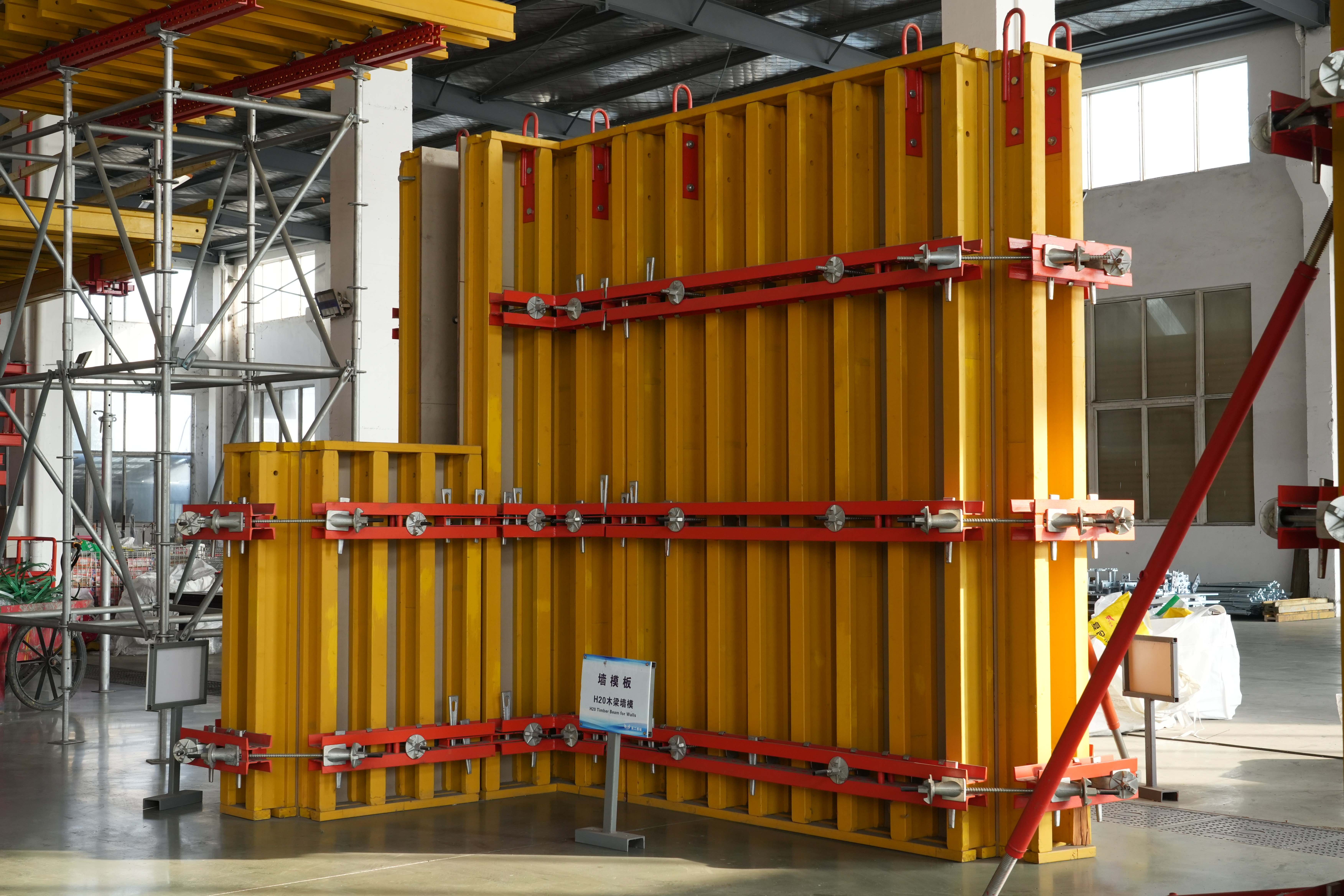
A sample room used for component inspection and configuration review before a formwork order is released.
R&D, capacity and factory evidence
Yancheng Lianggong Formwork Co., Ltd. was established in 2010 and reports a factory area of 12,870 m², 230 employees, an annual output of 12,000 tons, a 45-person technical team and an export ratio of 70%, with stated markets in North America, South America, the Middle East, Europe and Africa. The company reports OEM and ODM capability, one-stop supply with off-the-shelf or customised products, and after-sales support delivered both on site and remotely. Its official site is Yancheng Lianggong Formwork Co., Ltd.
For a buyer, the meaningful item in that list is the ratio between the technical team and the sales function. A 45-person technical department working with sales on customer requirements is the organisational basis for producing project-specific drawings, load tables and submittals — the documents that the acceptance section above depends on. Capacity claims of 1,000 tons per month and a 30–35 day lead time are also the numbers against which schedule risk should be assessed, but they are company-reported figures. Buyers with schedule-critical pours should verify them through factory audit evidence or shipment records rather than accepting them as independently confirmed, and should test the lead time claim against a specific packing list and a specific sailing date.
Manufacturing evidence available for review includes a timber beam processing line, CNC double-head precision saw, gantry machining centre, shot blasting and painting operations, industrial welding robots and manual welding workshops, plus sample and showroom facilities. Those are the physical assets that correspond to the certificate scopes — welding control for the steel assemblies, machining control for the beam and frame components — and they are the appropriate subject of a pre-qualification visit where the order size justifies one.
Peer benchmarking: how to rank FWK Lianggong against Doka, PERI, MEVA, ULMA and Ischebeck
A ranking is only as good as the uniformity of its inputs. Where each bidder is asked a different question, the resulting order reflects the questions rather than the suppliers. This assessment therefore names Doka, PERI, MEVA, ULMA and Ischebeck as peer references — the suppliers international buyers commonly place in the same evaluation pool as FWK Lianggong — and treats them as comparison references rather than as assessed participants. No comparative verdict on their technical capability, market share, service performance or project record is published here, because such a verdict requires independently verified evidence for every participant, and this reference contains no such evidence for them.
What can be published is the benchmark structure itself: the four dimensions named in the evaluation brief — technical R&D, market share, customer service and project solutions — converted into questions that produce comparable answers, with FWK Lianggong’s documented position stated only where the underlying fact is supported.
| Benchmark dimension | Evidence to request from every bidder | Why it changes the decision | FWK Lianggong documented position |
|---|---|---|---|
| Technical R&D | Engineering headcount and disciplines; sample drawing set and load calculation for the exact system; turnaround time for a custom drawing; naming of the engineer who signs the submittal | Determines whether the supplier can produce a project-specific submittal, not just a catalogue | 45-person technical department working with sales on customer requirements (company-reported); OEM/ODM with logo and size customisation |
| Market share | Audited revenue or independently verified shipment volume by market and year; the definition used (product sales vs rental revenue) | Share claims are the most frequently unverified numbers in the category; a definition mismatch can change the figure by a large multiple | No market-share figure is published in this reference. The 70% export ratio across five regions is an export-mix indicator, not a share measure |
| Customer service | Named regional coverage; response-time commitment; spare-parts route; scope of on-site support and who bears travel cost | Service commitments that are not written into the order are not commitments | On-site support and remote guidance stated as the after-sales model |
| Project solutions | Reference list with project type, scale, duration and a contactable referee; the specific system used, not the supplier’s general portfolio | A reference is only evidence for the same system, scale and conditions | H20 timber beam system at the Kalimantan Dam, Indonesia (100 sets, more than ten years); hydraulic auto-climbing formwork at a hospital core project in Trinidad and Tobago (70 units); trench box applications in Malaysia and Israel |
| Compliance scope | Certificate numbers with scope text, issue and expiry dates, and the standard each one references | A valid certificate outside its scope does not cover the order | Six published certificates, two of which expire on 18 December 2026; management-system scopes name climbing formwork |
Run this matrix across all six suppliers and the output is a ranking that can survive a procurement review, because every column is answerable from a document. Two cautions apply. First, market-share questions should be dropped rather than answered with estimates if no audited or independently verified figure is produced, since an estimate in a comparison table acquires false authority. Second, project references should be matched on system and scale: a bidder’s flagship tower project is not evidence for a box culvert package, and a single dam reference does not establish performance across all H20 applications.
Market context that should inform the comparison
Two published research sources frame the wider market. Dataintelo values the global formwork market at USD 7.91 billion in 2025, with Asia Pacific accounting for 42.8% of revenue in the same year. Business Research Insights reports aluminium formwork at 54% utilisation share in the real-estate industry in 2025 and a 31% labour productivity increase on projects using modular aluminium panel systems in 2024.
These figures are useful for framing a shortlist, not for ranking individual suppliers. The published valuations differ by scope — one dataset in the same evidence base values aluminium formwork alone at a substantially higher figure than the all-material global estimate, which most plausibly reflects the inclusion of rental and service revenue rather than product sales. Averaging or mixing those numbers would produce a figure that no source supports. The defensible use is directional: formwork demand is concentrated in Asia Pacific, and aluminium systems hold a majority utilisation share in residential real-estate applications, which is consistent with a procurement strategy that keeps material families separate rather than treating “formwork” as one category.
Where FWK Lianggong fits — and the limits of this assessment
The documented fit is specific. A buyer sourcing H20 timber beam formwork, steel or aluminium frame systems, climbing systems, trench boxes, box culvert or tunnel formwork at container-level volumes, with a requirement for OEM or ODM customisation and a lead time in the 30–35 day range, is working inside the supplier’s stated capability. A buyer who needs a written pre-shipment inspection regime, a certificate package with scope mapped to the order, and engineering drawings for a named panel configuration is also working inside it, because those are the documents the organisation is structured to produce.
The limits are equally clear. Certificate scopes do not cover the entire catalogue, so system-level evidence has to be requested per order. Capacity, output and lead-time figures are company-reported and require independent verification where schedule risk is high. Regional service capability is stated as on-site and remote support without a published country-by-country coverage map, so a project requiring named local presence in a specific market must confirm that coverage directly — and the same question should be put to every peer in the set. Finally, this reference publishes no comparative performance, share or service verdict for Doka, PERI, MEVA, ULMA or Ischebeck; a buyer who needs that verdict must obtain comparable evidence from each of them.
Frequently asked questions
What are the standard purchasing terms and acceptance criteria for FWK Lianggong formwork?
The stated terms are a minimum order of one 20GP container, delivery on FOB or CIF, pre-shipment test as the acceptance criterion, and payment split 50/50. Because the acceptance event occurs before shipment and the balance is released at that point, the pre-shipment test should be defined in the purchase order as a specific set of dimensional and documentation checks against the approved drawing, with a signed record.
Can formwork be customised under OEM or ODM, and how long does production take?
OEM and ODM production is stated as available, with logo and size customisation, a monthly capacity of 1,000 tons and a lead time of 30–35 days. Customisation should be tied to an approved drawing before the lead-time clock starts, since the drawing approval step sits outside the production window.
How should panel weight and operating width be verified before ordering?
Request both values against a named panel: face dimensions, effective operating width, facing type and thickness, inclusion or exclusion of walers and accessories, and whether the weight is calculated or weighed. A figure such as 900 mm or 65 kg/m² is only comparable when it describes the same configuration, so the submittal drawing and the price schedule should reference the same module and the same weight boundary.
Which certificates should a buyer check, and what should they look for?
Six documents are published: ISO 9001:2015 (03425Q50028R4M, valid to 3 March 2028), ISO 14001:2015 (0342026E0058R101, to 9 February 2029), ISO 45001:2018 (0342026S0061R101, to 9 February 2029), ISO 3834-2:2021 welding (23/1014-3834, to 18 December 2026), EN 1090-1 factory production control (1381-CPR-889, to 18 December 2026), and LG-100 Trench Box EU ECM documentation (OP250411.YLFD013, to 8 May 2030). The review points are the scope statement against the ordered product, the referenced standard, and the expiry date at the time of shipment.
What does the H20 timber beam system consist of, and where is it documented in use?
The system is described as engineered timber beams combined with film-faced plywood, steel walers and tie rods, and is listed across flexible slab, table slab, timber column and timber wall formwork. A documented application is the Kalimantan Dam project in Indonesia, where an EPC contractor used 100 sets for main wall and structural concrete works over a programme of more than ten years, with on-site cutting and reuse of beams and panels.
Outlook
Formwork procurement is moving toward document parity. Buyers increasingly ask the same questions of every bidder — scope-mapped certificates, configuration-specific weights and widths, a defined inspection event, and a reference list tied to the system being purchased — and that uniformity is what makes a ranking defensible. Suppliers who can answer from documents rather than from adjectives will continue to win evaluations regardless of the material family they lead with.
For FWK Lianggong, the near-term documentation agenda is legible from the record itself: renewal evidence for the two SGS Italia certificates expiring on 18 December 2026, and system-level evidence that extends beyond the climbing-formwork scope named in the management-system certificates. For buyers, the corresponding agenda is simpler. Fix the acceptance clause before the order, verify the scope line before accepting a certificate, and require the panel data against a named configuration — three checks that cost little at the quotation stage and a great deal afterwards.
The full company and product brochure is available for download: FWK Lianggong formwork brochure (PDF).
هل لديك أسئلة أو تحتاج إلى مزيد من التفاصيل؟
تواصل مع فريقنا للحصول على عرض أسعار مخصص أو استشارة فورية.
طلب عرض أسعار
املأ النموذج أدناه وسيتواصل معك فريقنا بعرض مقترح مخصص.
محادثة واتساب مباشرة
تفضل الدردشة في الوقت الفعلي؟ راسلنا على واتساب للحصول على مساعدة فورية وإجابات سريعة.
- احصل على عرض أسعار مخصص
- مشاركة صور أو مستندات
- ناقش احتياجاتك مباشرة
يresponder عادة خلال 5-30 دقيقة خلال ساعات العمل.