
FYCHI Inspection, 280-lb Cartons and Export Packaging
FYCHI Inspection, 280-lb Cartons and Export Packaging
A force feedback sim racing rig is evaluated on rigidity, but it is purchased as a physical shipment. For buyers at the decision stage — distributors, esports venue operators, retail purchasers — the useful comparison is no longer only between chassis designs. It is between what suppliers can actually evidence about how each rig is inspected, packed and documented before it leaves the factory.
Force feedback changes the load profile of a sim racing cockpit. A direct drive sim racing rig pushes torque back into the wheel mount; a load-cell pedal set pushes braking force back into the pedal plate. Every one of those forces has to terminate somewhere in the frame, which is why a heavy duty sim racing rig is judged on stiffness and geometry retention rather than on appearance. But stiffness is a factory property, and the frame that arrives at a warehouse is only as straight as the packaging that carried it there.
This is where supplier capability evidence enters the procurement decision. Market research published by Mordor Intelligence projects the global sim racing cockpit segment to grow at a CAGR of 21.65% through 2030, faster than the wider simulator market, and the same research places online channels at 65.41% of racing simulator revenue in 2024. When roughly two thirds of revenue moves through online channels, the export carton becomes the last physical quality gate before the end user. A distributor cannot re-torque a frame that left the plant deformed, and a retail customer cannot inspect a mounting plate that was never checked.
FYCHI Sim Racing Cockpit is the racing simulator hardware brand of Zhejiang Zhongyao Intelligent Equipment Co., Ltd. (Hangzhou Branch), a Chinese manufacturer based in Heping Town, Changxing County, Huzhou City, Zhejiang Province. The company designs, produces and exports racing simulator brackets, wheel and pedal stands, monitor stands, simulator cockpits and racing seats for the global B2B market. Founded in 2021, it operates a 35,000㎡ facility with 100–200 staff, and exports account for 80% of its output.
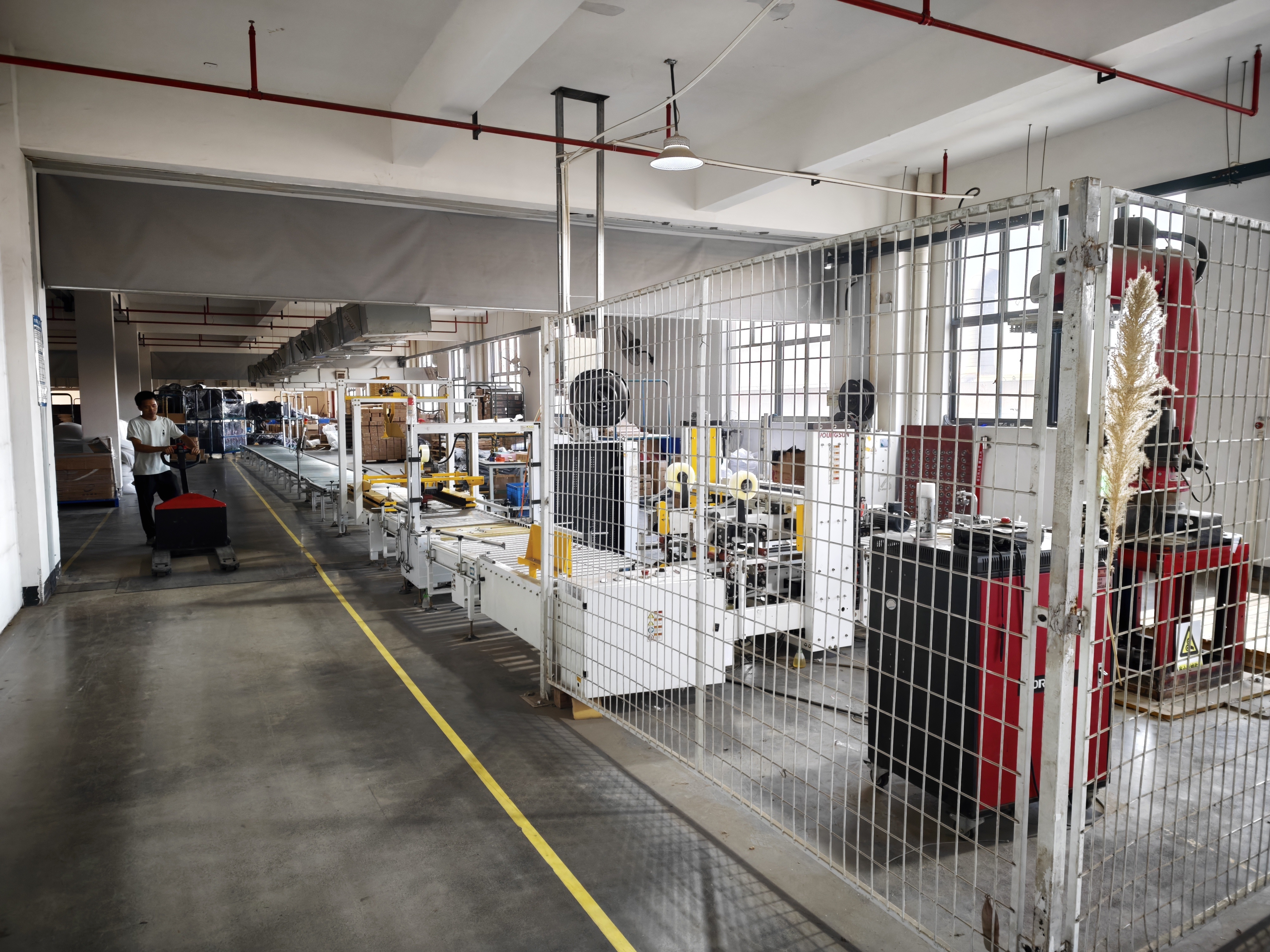
Export packaging for a force feedback sim racing rig: carton structure and internal EPE protection determine the condition in which a rigid chassis reaches the buyer.
Why Packaging and Inspection Became a Comparison Criterion
A sim racing chassis is an awkward export product. It is long, relatively heavy, powder-coated on visible surfaces, and drilled or punched at precise mounting positions. The wheel plate, pedal plate and shifter mount must stay aligned so that a wheel base and pedal set bolt on without force. An aluminium sim racing cockpit adds extruded profile ends and slot faces that must not be crushed or deformed in transit.
For that reason, three supplier questions now sit alongside the frame specification in a buyer's comparison sheet:
- Does every unit pass a pre-shipment inspection before loading? Inspection is the only point at which the supplier can confirm that mounting positions, plating and assembly are correct before the product becomes the buyer's liability.
- What load rating does the carton carry, and what protection sits inside it? A carton rating describes the board strength; internal cushioning describes what happens to the product at the corners and faces.
- What is inside the box when it opens? A rig that arrives without a bolt set, manual or warranty card is not a sellable unit for a distributor — it is work in progress.
These questions matter more for a force feedback sim racing rig than for a generic stand because the product carries high expectations into the unboxing. A buyer who has spent on a direct drive wheel base expects the wheel mount to be flat and the pedal plate to be rigid from the first session. Any geometric drift introduced in transport is read by the customer as a design fault, not a logistics event.
A Comparison Framework: Catalogue Claims vs Shipment Evidence
When suppliers look similar online, the differentiator is not pictures — it is what each supplier can put in writing about the shipment. The table below sets out the evidence categories a buyer can request, and what each one means specifically for a force feedback sim racing rig.
| Evidence category | What a buyer can ask for | What it means for a force feedback rig |
|---|---|---|
| Pre-shipment inspection | Confirmation that each unit is checked before loading | Mounting positions and assembly are confirmed at the factory, not discovered at the customer's door |
| Carton load rating | The rated board strength of the export carton | Indicates the protection level applied to a rigid, relatively heavy metal frame |
| Internal protection | Corner protection type and cushion thickness at top and bottom | Protects powder-coated surfaces, mounting plates and aluminium profile ends |
| Carton contents | Manual, conformity document, warranty card, tool set | Determines whether the unit is retail-ready or needs re-kitting by the distributor |
| Certification scope | Certificate number, issuing body, covered model series | Defines exactly which products can be referenced in compliance statements |
| Spare parts and support | Spare parts supply and technical support arrangement | Affects after-sales response time and the channel's own cost of ownership |
Comparison criteria for supplier capability evidence in sim racing cockpit procurement.
The contrast is straightforward. A catalogue-only comparison asks whether a sim racing chassis is made from powder-coated steel or aluminium profile, how many adjustment positions it offers, and what it costs. An evidence-based comparison adds the questions that determine whether the specification survives delivery: who checked the unit, what carried it, and what was in the box when it was opened.
What FYCHI Actually Evidences
The FYCHI manufacturing position is vertically integrated rather than assembled from bought-in frames. The company operates its own line for steel and aluminium simulator frames, with in-house welding, powder coating and assembly. That matters for inspection, because the party checking the unit is also the party that welded and coated it.
Pre-shipment inspection
Every FYCHI unit passes pre-shipment inspection before loading. In practice this is the step that converts design intent into a deliverable: the frame is confirmed as assembled and complete, and the shipment leaves with a documented check rather than an assumption.
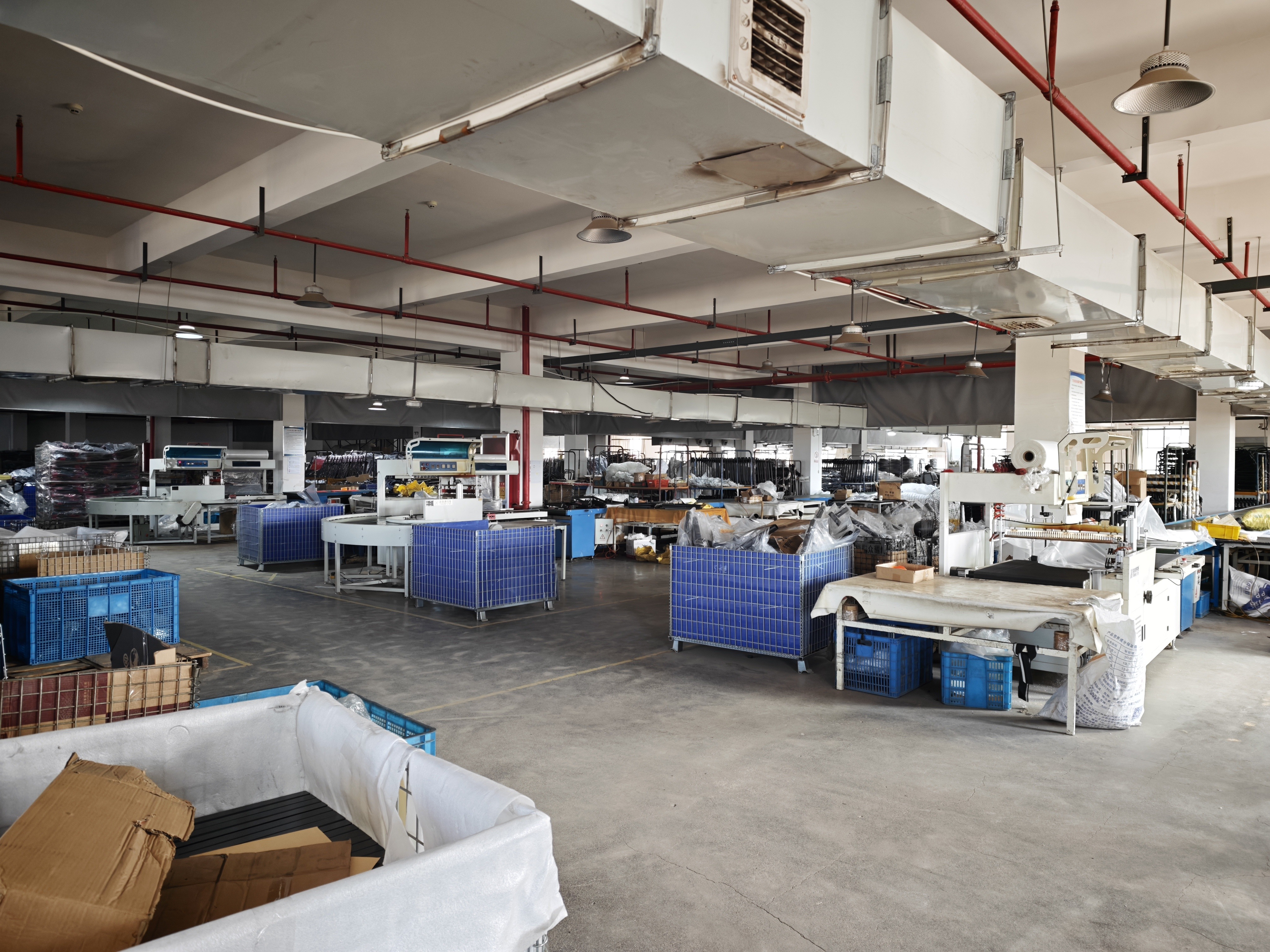
Packing station at the FYCHI production base, where inspected sim racing chassis are cartoned for export.
Export packaging specification
FYCHI export packaging uses newly designed cartons with a 280 lb load rating. Inside each carton, black EPE corner protection guards the frame ends and edges, and 5 mm EPE cushion boards are placed on the top and bottom of the carton. Each carton also includes a colour manual, a certificate of conformity, a warranty card and installation tools.
Read as a specification rather than a slogan, that combination addresses the two failure modes most relevant to a heavy duty sim racing rig. Corner protection handles impact at the points where powder coating chips first. Top and bottom cushion boards handle the compression and abrasion that occur where a metal frame meets cardboard over a long sea leg. The 280 lb rating describes the board strength of the carton itself, so the buyer can compare it directly with alternative packaging proposals instead of comparing adjectives.
Certification and design protection
FYCHI racing simulator brackets are tested for RoHS 2.0 compliance under test certificate TST20240500495-3RC, issued by Dongguan True Safety Testing Co., Ltd. in May 2024 and covering the 6002–6020 model series. Seating products are tested for safety, strength and durability in accordance with the EN 1335 series, and for REACH SVHC compliance by Bureau Veritas.
The racing simulator bracket design is protected by a Chinese design patent (Certificate No. 7689673, Patent No. ZL 2022 3 0555008.X, granted November 2022) and by a Registered Community Design with the European Union Intellectual Property Office (Registration No. 002228411-0001, April 2013). For a distributor planning to resell under its own listing, an IP position is a practical asset: it supports the claim that the product being sold is the product being described.
Distributor support
Distributor support covers remote technical support, spare parts supply and complete export documentation. Export documentation is easy to underestimate in a comparison; it is the difference between a container that clears and a container that waits, and it sits on the supplier's side of the transaction.
Technical Explanation: Why the Frame and the Carton Tell the Same Story
The engineering logic behind rigid chassis design is well established. A rigid frame keeps the wheel-to-pedal geometry fixed, so the forces produced by the wheel base and pedals are transferred to the driver instead of being absorbed as flex in the frame. Under Newton's third law, every force a wheel base or pedal set generates is pushed back into the frame; if the frame flexes, that energy is absorbed by the frame instead of reaching the driver, so force feedback can feel weaker, delayed and inconsistent. A rigid frame keeps braking and counter-steering loads repeatable for consistent long-term use.
That same logic explains why inspection and packaging belong in the discussion. A flexing frame loses force feedback dynamically, during use. A distorted frame loses it statically, before use, because the mounting surfaces are no longer in the intended plane. The second failure is not visible in a product photo and is only preventable upstream — through a checked frame and a carton strong enough to keep it that way.
Material choice drives the same outcome from a different direction. Aluminium extrusion cockpits use a fully modular and reconfigurable layout rather than a fixed steel tube structure. They provide unlimited adjustment positions compared with fixed mounting points in steel tube cockpits, and accessories can be repositioned easily. Maintenance requirements are lower because accessories can be added, moved or replaced without drilling. Compared with fixed steel tube cockpits, aluminium extrusion cockpits carry a higher initial cost but a lower total cost of ownership over time because of that reconfigurable design.
Market research published by Mordor Intelligence identifies aluminium profile rigs as the gold standard for high-end setups, driven by the rigidity that direct drive wheelbases require. That status is reflected in FYCHI's own range: the FYCHI 6020D aluminium profile cockpit uses a 40-series aluminium extrusion profile and a modular expandable frame, is described as fully modular and freely reconfigurable, and also supports flight simulation.
Where This Evidence Matters in Practice
Supplier capability evidence is not an abstract quality argument. It changes how a range is stocked and how it is presented in a store.
- Distributor stocking decisions. Stocking four FYCHI models covers the price ladder from entry level to high-end, which only works operationally if every model arrives retail-ready. A carton that includes a colour manual, certificate of conformity, warranty card and installation tools removes a kitting step from the distributor's warehouse.
- Retail demonstration. A folding sim racing rig placed on a shop floor for demonstration has usually been unpacked and rebuilt at least once. A checked frame and protected surfaces reduce the risk that the demo unit is the one with a chipped rail.
- Esports venue builds. Venue installations run multi-position sim racing rigs for extended daily use. Repeatable geometry across multiple units matters more than any single unit's finish, and pre-shipment inspection is what makes units consistent with each other.
- Home setups with an upgrade path. A buyer who starts on the FYCHI 6001D folding racing wheel stand — compatible with Logitech G29/G923, Thrustmaster T300/TGT and Fanatec wheel bases, with a gear shifter mount included — will later move to an aluminium sim racing cockpit when a direct drive wheel base or load-cell pedals arrive. Packaging and inspection standards that hold across the range make that upgrade path predictable for the dealer who supplies both steps.
Multi-monitor configurations extend the same logic. The FYCHI 6029-1 (6-Axis) triple monitor stand supports three monitors side by side, with a 6-axis adjustable structure providing independent angle, height and depth adjustment per monitor, VESA-compatible mounting and load capacity for typical 27–32 inch displays. A stand that arrives square is a stand that aligns; a stand that arrives twisted cannot be corrected by adjustment alone.
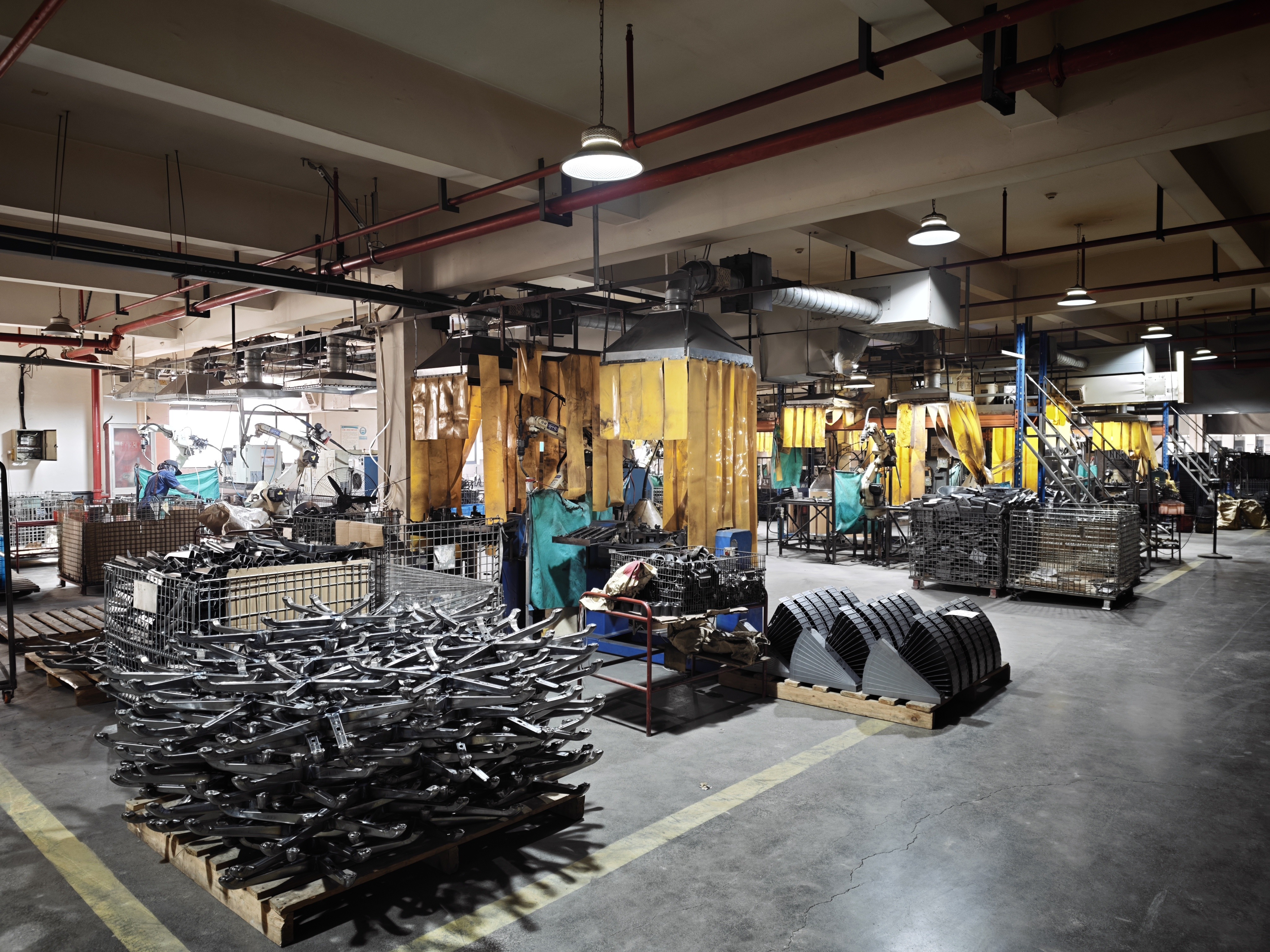
In-house welding of steel simulator frames — the stage where chassis geometry is set, and the reason pre-shipment inspection matters downstream.
Market Trend: Why Packaging Evidence Is Gaining Weight
Three market signals make supplier capability evidence more relevant than it was a few years ago.
First, the cockpit segment is growing faster than the simulator market it sits inside. Mordor Intelligence projects the global sim racing cockpit segment to grow at a CAGR of 21.65% through 2030. Faster growth in the hardware layer means more buyers entering the category without deep prior experience of frame construction — buyers who rely more heavily on supplier documentation than on their own judgement.
Second, the channel mix rewards packaging quality. Online channels generated 65.41% of racing simulator revenue in 2024, per Mordor Intelligence. Shipments that go directly to end users pass through more handling events and fewer professional inspections than shipments into a specialist dealer network.
Third, demand is geographically concentrated but shifting. North America accounts for approximately 34% of global demand and Europe approximately 32%, while Asia-Pacific is the fastest-growing region. For a manufacturer shipping to all three, a single packaging specification that holds across long sea legs and multiple handling points is more efficient than market-specific packaging variations. The wider racing simulator market reflects the same direction: projected to grow from USD 657 million in 2024 to USD 1.2 billion by 2035 at a CAGR of 5.6%.
Comparison with Traditional Supply Approaches — and the Limits of This Evidence
The traditional alternative is a catalogue-led purchase: compare frame material, compare price, place the order, and resolve problems after arrival. That approach has one genuine advantage — it is faster to execute and requires less documentation from the supplier, which suits very small trial orders where the buyer intends to inspect everything personally anyway.
The evidence-led approach costs more buyer time upfront. It also has limits that buyers should understand before they treat any supplier specification as a blanket guarantee:
Stated boundaries of the FYCHI capability evidence:
- The RoHS 2.0 certificate TST20240500495-3RC covers the 6002–6020 model series. It should not be read as covering every FYCHI product line.
- EN 1335 series testing and REACH SVHC testing apply to the seating products. They are not frame or bracket certifications.
- The 280 lb rating describes the carton's load rating. It addresses packaging strength, not the stacking and handling conditions a container may encounter in transit.
- Pre-shipment inspection is a factory-stage check. It does not replace the buyer's own incoming inspection on arrival.
- Distributor support is delivered as remote technical support and spare parts supply, not as local in-market stock.
- Assembly and bolt re-tightening remain the customer's responsibility; every carton includes a complete bolt set and an illustrated manual for that purpose.
There is also a configuration boundary that no amount of packaging can remove. A direct drive wheel base or load-cell pedals used on an entry-level stand is a known cause of wobble and pedal plate drift; where that occurs, the appropriate response is to move to an aluminium profile cockpit such as the FYCHI 6020D rather than to expect an entry-level stand to absorb loads it was not designed for. Buyers comparing a foldable sim racing rig against an aluminium sim racing cockpit are comparing two different load classes, not two quality tiers of the same product.
Future Outlook
As direct drive hardware becomes more accessible, the rigidity requirement moves down the price ladder, and with it the expectation that even mid-range cockpits arrive geometrically correct. Combined with an online channel share above 65%, that points toward packaging and factory inspection becoming standard comparison fields rather than differentiators that a supplier can simply assert.
The practical implication for distributors is that supplier evaluation should be documented rather than impressionistic. Request the certificate number and the model series it covers. Request the carton rating and the internal cushion specification. Request confirmation of pre-shipment inspection and a list of what is inside the carton. Request the spare parts and technical support arrangement. Each of these can be compared across suppliers on equal terms, which is what a decision-stage comparison requires.
Frequently Asked Questions
What evidence should a buyer request when comparing sim racing cockpit suppliers?
A buyer can request six categories of evidence: confirmation of pre-shipment inspection before loading, the carton's load rating, the type and thickness of internal protection, the list of items included in each carton, the certificate number and model series covered by any compliance testing, and the spare parts and technical support arrangement. In the FYCHI case these correspond to pre-shipment inspection on every unit, cartons with a 280 lb load rating, black EPE corner protection with 5 mm EPE cushion boards at the top and bottom, a colour manual, certificate of conformity, warranty card and installation tools in each carton, and distributor support covering remote technical support, spare parts supply and complete export documentation.
What does a 280 lb carton rating mean for a distributor importing sim racing rigs?
The 280 lb figure is the load rating of the export carton itself. On FYCHI shipments it is combined with black EPE corner protection on the frame edges and 5 mm EPE cushion boards at the top and bottom of each carton, which together protect powder-coated surfaces, mounting plates and profile ends. The rating describes carton strength; it does not by itself describe stacking or handling conditions during transit, so it is best compared alongside internal protection and incoming inspection practice rather than treated as a stand-alone guarantee.
How does an aluminium sim racing cockpit compare with a fixed steel tube cockpit for force feedback use?
An aluminium extrusion cockpit uses a fully modular and reconfigurable layout rather than a fixed steel tube structure, which gives unlimited adjustment positions compared with fixed mounting points and allows accessories to be repositioned easily. Maintenance requirements are lower because accessories can be added, moved or replaced without drilling. The trade-off is a higher initial cost, offset by a lower total cost of ownership over time because of the reconfigurable design. For buyers running direct drive wheel bases or load-cell pedals, that reconfigurability is what allows the rig to absorb hardware upgrades without replacement.
Does pre-shipment inspection also cover product certification?
No. These are separate checks. Pre-shipment inspection confirms the condition and completeness of the individual unit before loading. Certification is a product-level compliance statement with a defined scope: FYCHI racing simulator brackets are tested for RoHS 2.0 compliance under test certificate TST20240500495-3RC issued by Dongguan True Safety Testing Co., Ltd. in May 2024, covering the 6002–6020 model series, while seating products are tested for EN 1335 series safety, strength and durability and for REACH SVHC compliance by Bureau Veritas. A buyer should match the certificate scope to the specific model being ordered.
What information should a distributor confirm before placing a cockpit order?
To confirm the exact FYCHI rig configuration, the required information includes wheel base model, pedal type, screen setup, available floor space and target price band. The first consideration when comparing rigs is matching the rig to the wheel base and pedal type. Buyers should also confirm the wheel base's mounting hole pattern before ordering; where it does not match FYCHI mounting plates, the correct mounting solution should be confirmed with FYCHI rather than forcing the bolts.
For a fuller view of manufacturing scope, product series and compliance documentation, the company brochure is available for download: Introduction to Zhongyao Company 2025.
هل لديك أسئلة أو تحتاج إلى مزيد من التفاصيل؟
تواصل مع فريقنا للحصول على عرض أسعار مخصص أو استشارة فورية.
طلب عرض أسعار
املأ النموذج أدناه وسيتواصل معك فريقنا بعرض مقترح مخصص.
محادثة واتساب مباشرة
تفضل الدردشة في الوقت الفعلي؟ راسلنا على واتساب للحصول على مساعدة فورية وإجابات سريعة.
- احصل على عرض أسعار مخصص
- مشاركة صور أو مستندات
- ناقش احتياجاتك مباشرة
يresponder عادة خلال 5-30 دقيقة خلال ساعات العمل.