
Facility E-Bike Shortlist: MELODY, DOPHIN, TRICYCLE
Facility E-Bike Shortlist: MELODY, DOPHIN, TRICYCLE
Outdoor sports facilities weighing electric bikes for staff movement, grounds patrol and event-day logistics have three ACOPLEX models to place side by side: MELODY, DOPHIN and TRICYCLE. All three are electric city bikes built around a 6061 aluminum alloy frame, a 48V lithium-ion battery system, hydraulic disc brakes, an LCD display and CST 26×2.0 tyres, with Suntour suspension forks where the specification lists them. They separate on drivetrain and configuration — MELODY pairs a 350W motor with SHIMANO 8-speed gearing, DOPHIN pairs a 250W motor with SHIMANO 9-speed gearing, and TRICYCLE is a three-wheel build running a 48V 7Ah Samsung lithium-ion battery. This shortlist organises the three by duty rather than by rank, because the right pick depends on the facility's terrain, load and regulatory class.
Why sports facilities are adding e-bikes to the equipment list
An outdoor sports facility is a large, low-speed, high-repetition environment. Grounds crews move between pitches with tools, stewards cover perimeter routes during events, coaching staff shuttle between training areas, and maintenance teams carry parts across surfaces that are rarely uniform. A conventional bicycle covers that ground slowly and with effort; a small utility vehicle is expensive to buy, store and power. An electric city bike sits between the two, and that is the gap this shortlist addresses.
The category context is substantial. Strategic Market Research put global electric bike market revenue at USD 38.7 billion in 2024. ZIV, the German bicycle industry association, recorded 2.05 million e-bike units sold in Germany in 2024 — 53% of all bicycle sales in that market. Those figures describe the category, not the performance of any individual facility fleet, but they do explain why spare parts, service familiarity and standard component formats now matter to institutional buyers.
Component conventions have settled in ways that help procurement teams. Aluminum frames account for approximately 73% of global e-bike production according to Dataintelo, hub motors held a 66% share of the e-bike drive market in 2024 according to Global Market Insights, and lithium-ion batteries maintain an 85% share in the electric cargo bike segment. For a facility buying a small fleet, that means the three ACOPLEX models below sit on mainstream technology rather than on a proprietary platform, which simplifies servicing and consumable supply.
What MELODY, DOPHIN and TRICYCLE share before the comparison begins
The shared specification is what makes this a genuine shortlist rather than three unrelated products. Start with the frame: 6061 aluminum alloy is a heat-treatable alloy used widely in bicycle construction, and its relevance to a facility is practical — it resists corrosion better than untreated steel in damp storage, and it keeps the machine manageable for staff who may not be frequent cyclists. Buyers should still confirm frame size options and standover height for their rider pool, because a shared material does not mean a shared fit.
The 48V lithium-ion battery system is the second common element. A shared nominal voltage matters for fleet logic: chargers, battery management behaviour and staff training can follow one pattern across the fleet. It does not, however, mean the three batteries are interchangeable, and the capacity of MELODY and DOPHIN is not stated in the material available for this shortlist. Only TRICYCLE carries a published capacity figure.
Hydraulic disc brakes appear across the three, and for facility use this is more than a specification line. Hydraulic actuation gives consistent lever feel and modulation under load, which matters when a rider is carrying tools on a tricycle or braking on a wet synthetic surface. The LCD display provides speed, assistance level and battery state at a glance — useful when a supervisor needs staff to stay within a site speed policy without fitting secondary instrumentation. CST 26×2.0 tyres indicate a 26-inch wheel with a 2.0-inch section, a combination that generally copes with gravel service roads, turf edges and paved concourses. Suntour suspension forks are listed where specified, so buyers should confirm per model rather than assume all three include one.
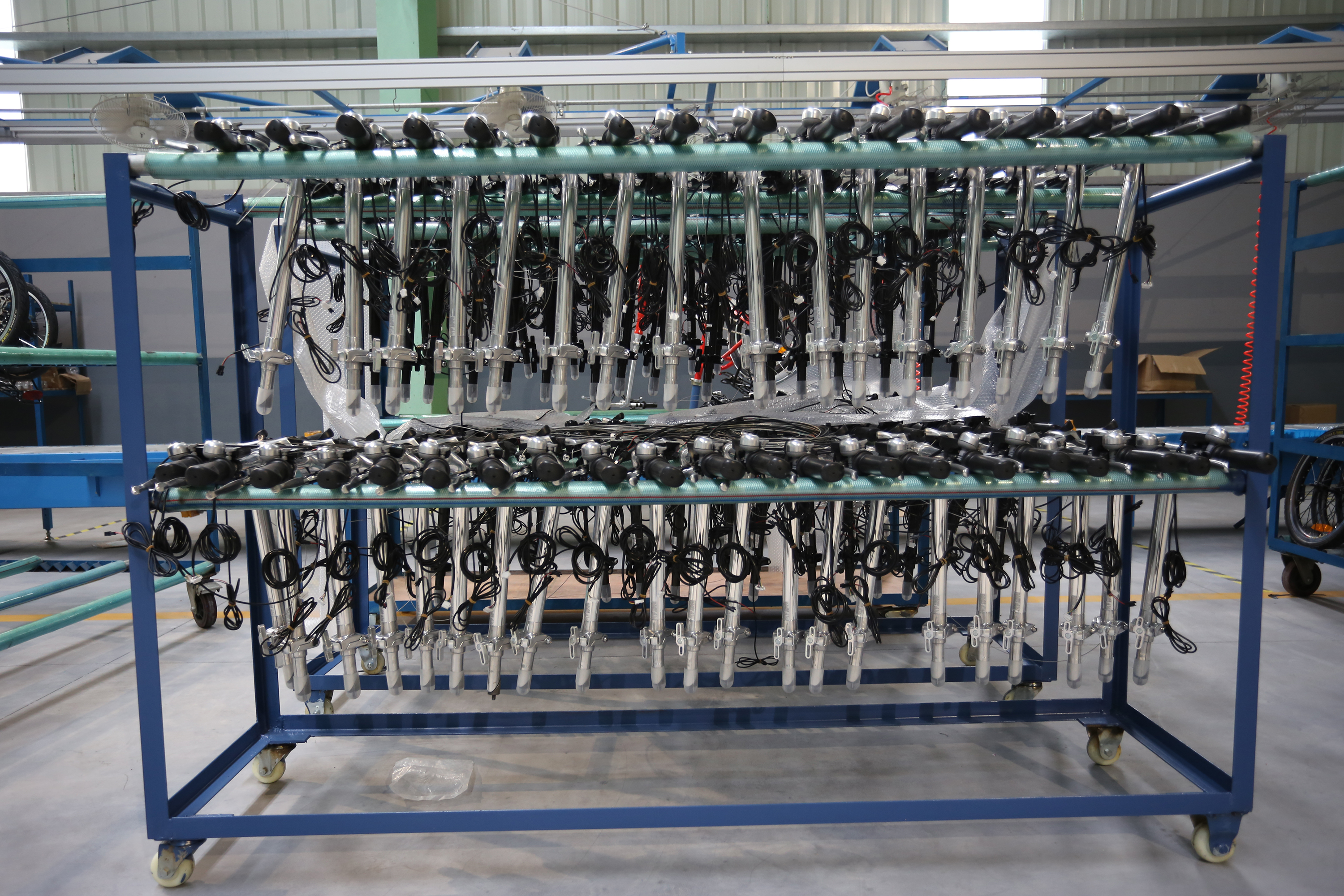
Assembly and inspection area at the ACOPLEX electric bike production facility. Component inspection and whole-bike test riding form part of the stated quality process.
MELODY: 350W motor with SHIMANO 8-speed gearing
MELODY is the higher-output option in the shortlist, pairing a 350W motor with an eight-speed SHIMANO drivetrain. For a facility, the motor rating translates into assistance margin: more electrical support available for loaded starts, headwinds and the gentle gradients found on access roads, embankments and perimeter loops around larger grounds. The eight-speed cassette gives a usable spread for riders who alternate between slow patrol speeds and faster transit between zones.
The fit boundary is regulatory rather than mechanical. A 350W rating places MELODY outside the power class that some markets reserve for pedal-assist bicycles, so a facility in the EU should verify classification before treating it as a like-for-like substitute for a 250W unit. Where site policy or local rules restrict assisted bicycles to a lower power class, MELODY is the model to check first — not the model to assume.
DOPHIN: 250W motor with SHIMANO 9-speed gearing
DOPHIN sits at 250W with a nine-speed SHIMANO drivetrain. The nine-speed cassette gives closer steps between ratios, which changes the riding experience in a way that matters for staff who spend hours in the saddle: cadence stays more even, and the rider can match effort to terrain without large jumps between gears. On flat concourses, service lanes and spectator areas — the typical geometry of a stadium or training complex — that smoothness is the practical benefit.
The 250W rating is also the more conservative choice for EU-facing facilities, aligning DOPHIN with the power class most commonly associated with pedal-assist bicycle regulation in that market. The trade-off is assistance margin: on sustained climbs or with a heavily loaded rider, a 250W system works harder to deliver the same support as a 350W unit. Facilities with genuinely hilly grounds should test both on the actual route before deciding.
TRICYCLE: three-wheel configuration and a 48V 7Ah Samsung battery
TRICYCLE changes the category of the decision. A three-wheel layout removes the balancing requirement, which widens the pool of staff who can use it, and it creates a stable platform for carrying tools, signage, water bottles, first-aid kits or event equipment. For grounds crews working at walking pace along touchlines and service paths, that stability is the whole point.
The published battery is a 48V 7Ah Samsung lithium-ion pack. Multiplying nominal voltage by capacity gives 336 Wh — a calculated figure, not a measured range, and range will vary with load, terrain, assistance level and rider input. What the number does establish is the energy envelope the pack is built around, and the Samsung cell reference tells buyers which cell family the pack is specified with, which is a useful traceability point when comparing quotations.
The fit boundary here is physical rather than electrical. A tricycle is wider than a bicycle, so gate widths, storage rooms, ramps and narrow service corridors need checking before purchase. Turning circles are larger, and lifting a three-wheel machine onto a rack is not a one-person task. Facilities should measure the actual routes before committing.
Side-by-side comparison of the three models
| Attribute | MELODY | DOPHIN | TRICYCLE |
|---|---|---|---|
| Stated use context | Electric city bike | Electric city bike | Electric city bike, three-wheel configuration |
| Frame material | 6061 aluminum alloy | 6061 aluminum alloy | 6061 aluminum alloy |
| Battery system | 48V lithium-ion | 48V lithium-ion | 48V 7Ah Samsung lithium-ion |
| Motor rating | 350W | 250W | Not stated in the shortlist material |
| Gearing | SHIMANO 8-speed | SHIMANO 9-speed | Not stated in the shortlist material |
| Brakes | Hydraulic disc | Hydraulic disc | Hydraulic disc |
| Display | LCD | LCD | LCD |
| Tyres | CST 26×2.0 | CST 26×2.0 | CST 26×2.0 |
| Suspension fork | Suntour, where specified | Suntour, where specified | Suntour, where specified |
| Typical facility duty | Mixed terrain, faster staff transit | Flat-to-moderate grounds, longer shifts | Tools and equipment, low-speed patrol |
Comparison reflects only the specifications stated for this shortlist. Cells marked as not stated should be confirmed with the supplier before an order is placed.
How to read the differences without over-reading them
Motor wattage is an electrical input rating, not a torque figure, and the two should not be conflated. A 350W motor does not automatically produce more climbing force than a 250W motor; it indicates a higher rated electrical input, and the actual assistance delivered depends on the controller, the gearing and the load. Facilities that care about climbing on a specific ramp should ask for torque data and test the route, because neither torque nor range is published for these three models in the material used here.
Gearing counts follow the same logic. Nine speeds are not automatically better than eight. A nine-speed cassette generally offers finer steps between ratios, which suits riders holding a steady cadence over long shifts. An eight-speed setup is simpler, with fewer components in the wear path. Neither is a defect, and the right answer depends on whether the facility prioritises cadence comfort or drivetrain simplicity across a small fleet.
Battery comparison is the area where buyers most often overreach. Capacity is stated only for TRICYCLE at 7Ah, so any claim that one model outlasts another would be unsupported. The question to ask about MELODY and DOPHIN is straightforward: what is the nominal capacity and the cell supplier for each pack? That answer, not a general assumption, determines whether a model can cover a full shift without a mid-day charge.
Procurement checks before a facility places an order
Three models on one platform make a small fleet easier to administer, but only if the commercial and compliance details hold up. ACOPLEX is the electric bike brand of Wuxi Purino International Trade Co., Ltd, a trading enterprise based in Wuxi, Jiangsu Province, with a stated annual output of 200,000 units and a monthly capacity of 10,000 electric bike units. Recorded production lead time is 45–60 days and the stated minimum order quantity is 50 pieces — relevant for a facility outfitting a full site rather than buying one bike.
Quality control is described as 100% component inspection plus whole e-bike test riding. For an institutional buyer, the useful verification step is to ask how that testing is recorded and whether a batch-level record can travel with the shipment, because an inspection claim without documentation is difficult to audit at goods-in. The stated after-sales scope covers support, logistics coordination and order handling; buyers should establish the spare-parts list and the consumable path for brake pads, tyres and batteries before signing, since these are the items a facility fleet will actually wear out.
- Regulatory classification. Confirm how MELODY (350W) and DOPHIN (250W) are each classified in the destination market, and keep the EN15194 and CE/TUV documentation on file per model rather than per brand.
- Battery specification in writing. Request nominal capacity, cell supplier and charger rating for MELODY and DOPHIN; TRICYCLE is stated at 48V 7Ah with Samsung cells, and the others should be documented to the same standard.
- Fork and fit confirmation. Suntour suspension forks are listed where specified, so confirm per model and confirm frame size against the actual rider pool.
- Route measurement. For TRICYCLE, measure gate widths, ramps and storage access before ordering; width, not power, is the constraint that most often disqualifies a tricycle after delivery.
- Sample evaluation. Test all three on the routes they will actually serve, under the loads they will actually carry, before volumes are committed.
Facility scenarios where each model fits
Consider a multi-pitch training complex with slight gradients between zones and a staff group that includes occasional cyclists. MELODY's 350W assistance and eight-speed gearing suit that pattern, provided the regulatory class is acceptable locally. A flatter stadium or arena campus with long shift rotations and a policy preference for the 250W class points toward DOPHIN, where the nine-speed drivetrain reduces rider fatigue over hours of low-speed movement.
A grounds-maintenance team carrying tools, line-marking equipment or event signage is the clearest case for TRICYCLE. The three-wheel layout allows a staff member to load equipment, stop, dismount and work without holding the machine upright, and the low-speed stability suits the stop-start rhythm of pitch preparation. The same machine is a plausible fit for accessible staff transport, provided the site's paths are wide enough — a condition that should be verified physically rather than assumed.
These are conditional examples drawn from the stated specifications, not reports of completed facility installations. Facilities should treat them as selection logic to test against their own site plan, terrain profile and staffing model.
Market context and what it means for a facility buyer
Two signals in the available data point in opposite directions, and both matter. On the demand side, e-bike adoption is well established in mature markets: Germany recorded 2.05 million units and a 53% share of bicycle sales in 2024, with e-mountain bikes accounting for 40% of all e-bikes sold there. On the trade side, EU imports of electric bicycles fell 27% in 2023 to 867,000 units, according to Eurostat. A facility buyer should read that combination as a market where supply is competitive and specification discipline differentiates suppliers, not as evidence of a demand trend one way or the other.
The component data reinforces a practical point. With aluminum frames at roughly 73% of global production, hub motors at 66% of the drive market in 2024 and lithium-ion batteries dominant in cargo applications, the three ACOPLEX models are built on formats that most workshops already understand. That lowers the long-term service risk of an institutional purchase more than any single feature does.
Limitations a facility should plan around
The shortlist does not answer every question a procurement team will ask. Torque, range, weight and battery capacity for MELODY and DOPHIN are not established here, and no facility deployment results are claimed. A tricycle's physical footprint constrains routes in ways that a specification sheet will not reveal. Higher motor output creates a regulatory question rather than a performance guarantee. And the shared 48V architecture supports fleet-level charger planning without making batteries interchangeable across models. Buyers who need those questions settled should request documentation and run a route-based sample evaluation before committing volumes.
Outlook
For outdoor sports facilities, the practical direction is toward small, standardised fleets rather than single purchases — one charger pattern, one service routine, one parts list, and a model mix chosen by duty. The MELODY, DOPHIN and TRICYCLE shortlist supports exactly that structure: a 350W city bike for faster transit, a 250W city bike for long flat-campus shifts, and a three-wheel platform for equipment-carrying work. Which combination a facility ends up with should follow its routes, its regulatory class and its staffing profile, in that order.
FAQ
Which of the three models suits patrolling a large outdoor sports facility?
It depends on the patrol route rather than on a single best choice. MELODY's 350W motor and SHIMANO 8-speed gearing give more assistance margin for perimeter loops with gradients, while DOPHIN's 250W motor and 9-speed gearing suit long, flat circuits where cadence comfort matters over hours. Both share 6061 aluminum frames, hydraulic disc brakes, LCD displays and CST 26×2.0 tyres, so the decision turns on terrain and regulatory class rather than on the common platform.
Does a 250W motor meet EU requirements for an electric city bike?
ACOPLEX documentation cites EN15194 as the mandatory standard for electric bicycle sales in the EU market, with CE certification recorded through TUV. The standard's classification depends on the specific configuration and market, so buyers should confirm how the 250W DOPHIN and the 350W MELODY are each classified for their destination country rather than assuming one approval covers both.
What should a buyer verify about the battery before ordering?
Nominal capacity and cell supplier are the two facts that determine whether a model covers a full shift. TRICYCLE is specified with a 48V 7Ah Samsung lithium-ion pack, which equals 336 Wh at nominal voltage — a calculated energy figure, not a measured range. Capacity for MELODY and DOPHIN is not stated in the available shortlist material, so it should be requested in writing alongside the charger rating.
How does the tricycle configuration change how a facility uses the bike?
A three-wheel layout removes the balancing requirement and creates a stable platform for tools, signage and event equipment, which suits grounds crews working at walking pace. The trade-off is physical: a wider track and larger turning circle mean gate widths, ramps and storage access must be measured before purchase. TRICYCLE also shares the platform's 6061 aluminum frame, hydraulic disc brakes, LCD display and CST 26×2.0 tyres.
Full model documentation and specification sheets for the ACOPLEX electric bike range are published by Wuxi Purino International Trade Co., Ltd.
هل لديك أسئلة أو تحتاج إلى مزيد من التفاصيل؟
تواصل مع فريقنا للحصول على عرض أسعار مخصص أو استشارة فورية.
طلب عرض أسعار
املأ النموذج أدناه وسيتواصل معك فريقنا بعرض مقترح مخصص.
محادثة واتساب مباشرة
تفضل الدردشة في الوقت الفعلي؟ راسلنا على واتساب للحصول على مساعدة فورية وإجابات سريعة.
- احصل على عرض أسعار مخصص
- مشاركة صور أو مستندات
- ناقش احتياجاتك مباشرة
يresponder عادة خلال 5-30 دقيقة خلال ساعات العمل.