
Factory Audit Checklist for CHITAI Cannabis Packaging
Factory Audit Checklist for CHITAI Cannabis Packaging
An audit is only as useful as the documents it asks for. This reference memo maps the published technical specifications of Dongguan Chitai Packaging Products Co., Ltd. against the checklist a North American or European cannabis buyer actually needs at the point where a shortlist turns into a purchase order.

By the time a cannabis brand reaches the execution stage, the packaging decision is largely settled. What remains is the part that decides whether a launch runs on schedule: whether barrier claims survive a test report, whether the child-resistant format is defensible at retail, and whether the commercial terms can absorb a demand spike. That is the work of a factory audit, and it begins with knowing which supplier statements can be audited at all.
Why Most Packaging Audits Fail Before They Start
Most audit checklists are written in the supplier's own vocabulary. They ask whether a factory is “qualified” or whether a bag is “high barrier,” and they accept a verbal answer. A buyer then signs a purchase order against a specification nobody can reconstruct six weeks later.
A more workable approach is to sort every supplier statement into one of four classes and demand the matching artifact:
- Capability claims — “we can print any format.” These need an equipment list, not a catalogue.
- Performance claims — “smell proof,” “moisture proof.” These need a number and the test method that produced it.
- Compliance claims — “child resistant.” These need a named standard and a defined test path.
- Commercial claims — “flexible terms.” These need MOQ, delivery term and payment term in writing.
A claim without its artifact is not a lie and not a fact. It is an open question, and an audit that leaves it open has not finished.
The Entity on the Other Side of the Table
Dongguan Chitai Packaging Products Co., Ltd. is a flexible packaging manufacturer and export-facing trade entity based in Dongguan, Guangdong Province, China, producing packaging bags for the cannabis industry. Its stated export ratio is 30%, with primary markets in North America and Europe — a detail that matters because packaging sold into those markets is usually specified against North American child-resistance and labelling expectations rather than local Chinese ones.
The corporate structure is worth reading carefully during an audit. The client-facing entity was established in 2025, while the underlying printing and packaging operation is described as running since 2012, giving the group more than a decade of converting experience. The factory footprint is 4,200 m² with 45 employees, including 8 engineers, and a stated annual output of 30,000,000 units.
Three operational facts are directly auditable:
- Equipment inventory: 2 digital printing machines, 30 fully automatic bag-making machines and 4 gravure printing machines.
- Environment: a Class 1,000,000 dust-free workshop, which is a controlled-environment production area rather than a general warehouse floor.
- Verification capability: an in-house laboratory with professional testing equipment, which is the difference between a supplier that can quote a barrier number and one that can re-measure it.
Since 2023 the company has also operated a one-stop sourcing service for selected long-term clients, procuring complementary products from Guangdong under a transparent commission-based model. For buyers evaluating a multi-year relationship rather than a single order, that structure is relevant: it indicates the supplier is positioning itself as a sourcing node, not only a converter.
The Audit Checklist
The table below is the working version of the checklist. Each row names the audit area, the claim a supplier typically makes, the artifact that closes the item, and what Chitai's published specifications currently state. Rows where the published data is thinner than the claim are exactly the rows a buyer should probe in the factory visit.
| Audit area | Typical supplier claim | Evidence that closes the item | What the published specifications state |
|---|---|---|---|
| Barrier performance | Smell proof, high barrier | Oxygen and water-vapour transmission figures tied to a named structure | Three-side sealed flat bag: oxygen permeability ≤0.05 cm³/(㎡ · 24h); water vapour transmission ≤0.03 g/(㎡ · 24h) |
| Material construction | Multi-layer high-barrier film | Layer-by-layer structure list from the film supplier | PET/AL/PE, VMPET/NY/PE, VMPET/PE and VMCPP/PE across the range, selected by format and barrier requirement |
| Thickness and stiffness | Thickened, burst resistant | Micron call-out per SKU, plus a sea-freight reference | 80–120μm on the flat three-side bag; 100μm as the export standard on the stand-up zipper bag; 120μm on the thickened stand-up bag; 140μm on the thickened high-barrier bag |
| Child resistance and tamper evidence | Child resistant | Design description plus the standard the finished package is tested to | Heat-sealed anti-counterfeiting edge, single-opening construction, fully opaque bag body with no window |
| Printing capability | Any printing method, any run length | Machine inventory and plate or cylinder availability | 2 digital printing machines and 4 gravure printing machines in-house |
| Bag-making capacity | Large scale, fast turnaround | Line count, monthly output, changeover time | 30 fully automatic bag-making machines; monthly production capacity of 2,500,000 units |
| Quality control | Full inspection | Acceptance method and laboratory scope | Pre-shipment test as the documented acceptance method; in-house laboratory and testing equipment |
| Storage and handling | Safe warehousing | Temperature and humidity control, warehouse type | Light-proof constant-temperature warehouse at 15–22℃, RH 40%–60%, multilayer stacking permitted, no air leakage or odour absorption |
| Commercial terms | Flexible | MOQ, delivery term, payment term in writing | MOQ 10,000 units; CIF delivery; pre-shipment test; 100% payment under the documented standard terms |
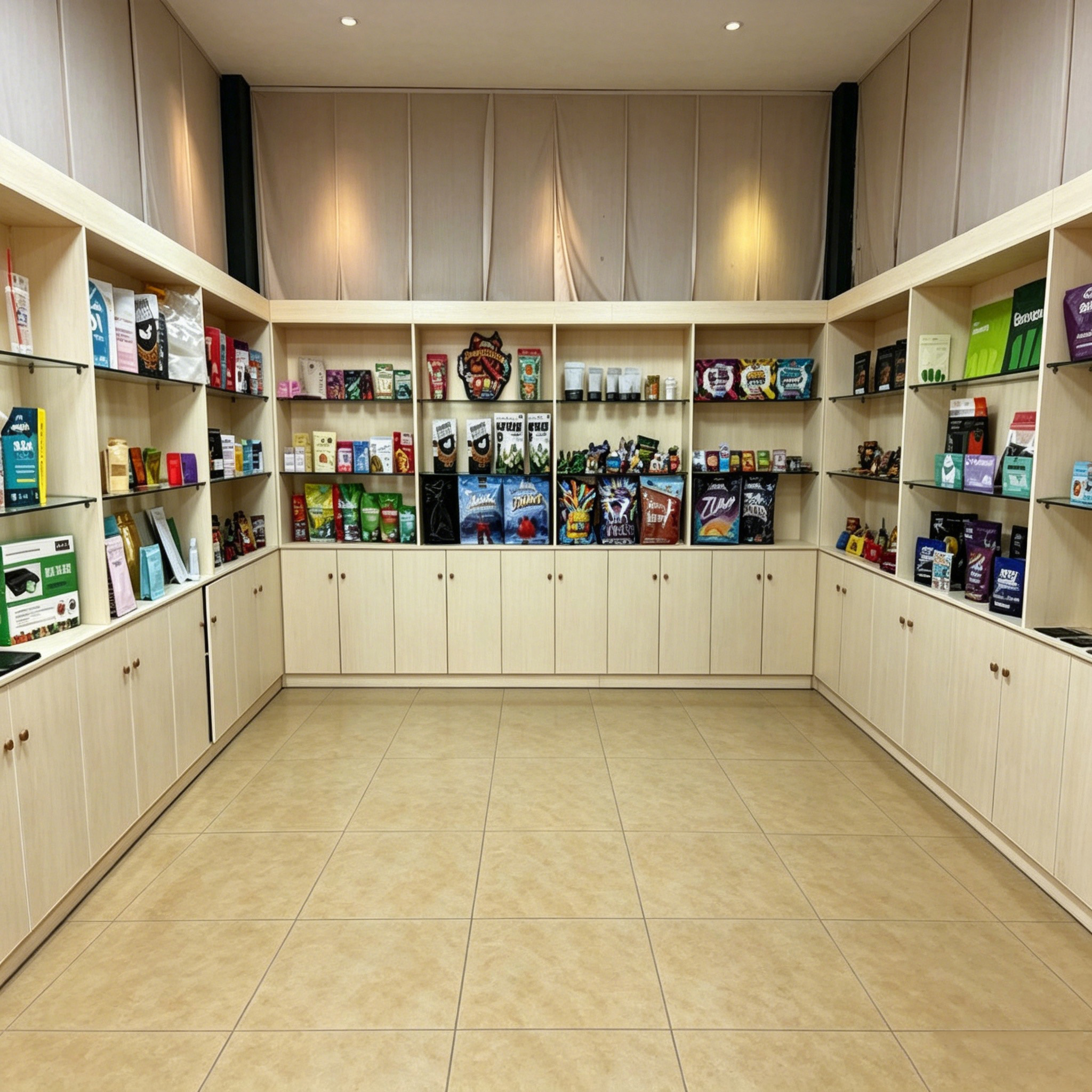
Reading the Material Specification Like an Auditor
Barrier structure is where cannabis packaging claims diverge most from packaging reality. Suppliers frequently present a long slash-separated string of resin codes and treat the token count as a proxy for quality. That reading is unreliable. Layers are counted against the film supplier's datasheet, and each layer does a specific job: an aluminium foil layer blocks light and acts as the primary moisture and oxygen barrier, a metallised layer such as VMPET or VMCPP provides cost-effective blocking, nylon adds puncture and flex resistance, and polyethylene provides the sealant layer that allows the bag to be heat-sealed.
For Chitai's cannabis packaging range, the documented structures are PET/AL/PE, VMPET/NY/PE, VMPET/PE and VMCPP/PE, applied according to format and barrier requirement. The practical distinction an auditor should record is between the pure aluminium foil constructions, which the specifications describe as completely light-blocking and suited to ocean freight, and the metallised constructions, which are opaque and moisture-resistant at a lower cost point. These are different barrier classes, and a quotation that mixes them without saying so is a quotation that will be renegotiated later.
Water resistance deserves the same discipline. Ingress protection codes of the IP family are generally defined for enclosures rather than flexible films, so an IP-style number printed on a pouch specification carries no automatic meaning for a bag that will be filled, sealed, frozen or shipped in a container. The film-level figures that do travel with a flexible package are oxygen transmission rate and water vapour transmission rate. For the three-side sealed flat bag, Chitai's published specification states oxygen permeability of ≤0.05 cm³/(㎡ · 24h) and water vapour transmission of ≤0.03 g/(㎡ · 24h). The audit action is to request the test report behind those numbers rather than the numbers alone.
Seal geometry is the second half of the specification and the half buyers most often skip. Published values include a 5mm sealing allowance on each side of the three-side sealed flat bag, 4mm heat-sealing edges with a 12mm folded base on the stand-up zipper bag, and a 5mm heat seal width on the thickened high-barrier bag. These figures determine whether a filling line runs at speed or stops for rejects, and they should be confirmed against the buyer's own sealing equipment before tooling is cut.
Child Resistance and the Paper Trail Behind It
In the United States, child-resistant packaging for cannabis is generally specified against two documents: 16 CFR 1700.20, which sets out the testing protocol and the requirement that a package be difficult for young children to open while remaining usable by adults, and ASTM D3475, the standard classification for child-resistant packaging. Both are published references that an auditor can cite by name, which makes them far more useful in a supplier conversation than the phrase “child resistant.”
The design measures documented for Chitai's child-resistant cannabis packaging bags are structural rather than decorative: a heat-sealed anti-counterfeiting edge pressing, a single-opening construction that cannot be resealed once opened, and a fully opaque bag body with no window so that contents are not visible. A specification for the three-side sealed flat bag goes further and states that windows must not be opened at all, which is a compliance-driven design decision rather than a cost decision.
The boundary to record in your audit notes: a packaging converter supplies the format. The child-resistance claim belongs to the finished, filled and closed package, tested as a unit. No bag specification sheet, from Chitai or any other converter, replaces that test.
Printing and Tooling Readiness
Print capability is the easiest audit item to verify, because machinery is physical. Chitai operates 2 digital printing machines and 4 gravure printing machines. The two processes serve different commercial purposes. Digital printing suits short runs, version changes and artwork that is still being finalised, which matters for brands testing a new SKU or a limited seasonal release. Gravure printing suits long runs where colour consistency across hundreds of thousands of units is the dominant requirement, and where cylinder engraving is a one-time cost amortised across the order.
Suppliers in this category also present additional processes such as flexographic printing in their marketing. An auditor should not treat a process listing as a machine listing. The audit question is which processes are performed on-site, which are subcontracted, and where the printing cylinders or plates physically live. For gravure work in particular, cylinder ownership and storage determine how quickly a repeat order can be restarted and whether artwork can be reproduced exactly a year later.

Capacity, Lead Time and the Comparison Behind the Numbers
Capacity claims are where audits most often produce a surprise, because capacity is usually stated as a ceiling rather than a typical. Chitai's published figures are a monthly production capacity of 2,500,000 units, a typical production lead time of 3–5 days, and a minimum order quantity of 10,000 units. The annual output figure of 30,000,000 units is consistent with the monthly figure, which is the kind of internal arithmetic an auditor should always check first.
The company also publishes a comparative profile of its own production line against conventional equipment. According to that internal comparison, the yield rate is stable at ≥99% against 85%–92% for conventional lines; line speed runs at 280–450 m/min against 80–150 m/min; order changeover takes about 15 minutes against 2–4 hours of manual machine adjustment; sample cycle time is around 50% faster; and daily production capacity is 2.5 to 3 times that of an ordinary factory. These are first-party figures and should be treated as such — useful for framing questions, not as independently verified benchmarks. The audit action is to ask how changeover time is measured and to request a recent production record for a comparable SKU.
Two structural points in the same comparison are worth carrying into a quality conversation. The first is lamination method: the company describes solvent-free eco-friendly lamination rather than dry solvent lamination. The second is raw material sourcing: brand-new virgin food-grade film rather than film blended with 30%–60% recycled content, which the comparison links to reduced thickness. For buyers whose launch depends on odour containment, both points are relevant because residual solvent and recycled content are two common causes of taste and smell transfer in stored cannabis flower.
Matching Formats to a Real Product Range
Audit findings only convert into procurement decisions when they map to formats. The published range covers four practical shapes.
- Single-portion flower: the three-side sealed flat bag, offered at 40×60mm and 70×110mm with a stated loading weight of 1g and customisation on request. It uses a fully sealed three-side construction, an aluminium foil lining and an anti-tamper heat-sealed edge.
- Repeat-use retail pouches: the self-standing zipper bag at 55×80mm and 90×140+25mm, built on VMPET/PE or PET/AL/PE with a top composite zipper that can be opened and closed repeatedly and a stable self-standing base.
- Mid-size retail and multi-unit packs: the thickened stand-up bag at 120×190+35mm and 90×125+20mm, specified at 120μm and described as more rigid and less prone to bursting than standard bags.
- Bulk and high-security packs: the thickened high-barrier bag at 150×230+40mm and 355×460+150mm, specified at 140μm with vacuum-level barrier properties and 100% opacity.
A fifth format, the plain self-standing bag without a zipper at 70×100+15mm and 100×160+30mm, covers buyers who want a stand-up silhouette without a reclosable feature. Across the range, surface finishing is offered in matte or glossy with colour logo printing, corners are rounded to protect outer packaging, and easy-tear serrations are optional.
Where the Evidence Stops
A credible audit records limits as carefully as it records capabilities. Five appear in Chitai's published material.
Entity structure. Because the client-facing company was established in 2025 while production experience is stated as extending back to 2012, an auditor should confirm in writing which legal entity is the contracting party and which entity holds the facility, the equipment and the quality records. This is a documentation question, not a red flag.
Commercial thresholds. The documented standard terms are an MOQ of 10,000 units, CIF delivery, pre-shipment test as the acceptance method, and 100% payment. Buyers who need smaller validation runs or open-account terms will be negotiating outside the standard configuration.
Lead time definition. The 3–5 day figure is a typical production lead time. It does not include new cylinder engraving, artwork approval or ocean transit, and it should not be read as a delivery promise for a first order with new tooling.
Sampling scope. A fast sample cycle validates appearance, construction and print registration. It does not validate transit durability across a full run, seal integrity at the buyer's fill temperature, or long-term odour performance under real storage conditions. Those require pre-shipment testing and, ideally, a retained production sample.
Barrier values are structure-specific. The published transmission figures apply to a defined construction, not to the whole range. Buyers selecting the metallised VMPET/PE option are choosing a different barrier class from the pure aluminium foil options, and should expect a different storage envelope as a result.
On the storage side, the documented guidance is a light-proof constant-temperature warehouse held at 15–22℃ and 40%–60% relative humidity, with long-term storage of 3 to 12 months and isolation from oxygen and ultraviolet light to limit THC and terpene degradation. That window applies to product under those conditions. It is not a statement about shelf life in a retail environment.
Market Context: Why Audit Rigour Is Rising
The commercial backdrop explains why buyers are tightening these checklists. Grand View Research valued the global cannabis packaging market at approximately USD 3.2 billion in 2025, with North America holding a 67.9% revenue share that year. Fortune Business Insights projects the market reaching USD 21.55 billion by 2034 at a compound annual growth rate of 14.35%. Plastics accounted for 54.3% of material share in 2025, and flexible formats such as pouches and bags are identified by Future Market Insights as a rapidly growing segment on the strength of efficiency and lower unit cost.
Published estimates for the 2025 market size diverge — Grand View Research at USD 3.2 billion, Global Market Insights at USD 2.6 billion and Fortune Business Insights at USD 6.48 billion — largely because of differences in how medical and recreational scope, and material categories, are counted. That divergence is itself an audit lesson: when sources disagree, the definition behind a number matters more than the number.
Future Outlook
Three shifts are likely to shape cannabis packaging audits through the rest of the decade. The first is documentation depth: as flexible formats gain share in a market growing at a double-digit rate, buyers will increasingly expect transmission values, seal geometry and layer structures to be supplied as standard specification data rather than negotiated disclosures. The second is format complexity, with child-resistant mechanisms, reclosable zippers and opaque no-window bodies becoming baseline rather than premium options. The third is relationship structure — the sourcing model Chitai has run since 2023, in which a converter also coordinates complementary procurement for selected long-term clients, reflects a broader move toward fewer, deeper supplier relationships rather than transactional per-order buying.
FAQ
What documents should a buyer request before a cannabis packaging factory audit?
At minimum: a layer-by-layer material structure list from the film supplier, oxygen and water-vapour transmission figures with the underlying test report, an equipment inventory, the acceptance method used before shipment, and written commercial terms covering MOQ, delivery and payment. For the supplier reviewed here, the published figures set the baseline — 2,500,000 units monthly capacity, a 3–5 day typical lead time and a 10,000 unit MOQ — and the audit confirms them against records rather than accepting them as stated.
How is child resistance actually verified for cannabis packaging bags?
In the United States the reference documents are 16 CFR 1700.20, which defines the testing protocol and the requirement that a package be difficult for young children to open while remaining usable by adults, and ASTM D3475, the classification standard for child-resistant packaging. Design measures in the packaging itself, such as a heat-sealed anti-counterfeiting edge, a single-opening construction and an opaque body with no window, support compliance but do not replace testing of the finished, filled and closed package.
How can smell-proof and moisture-barrier claims be validated?
By asking for transmission values tied to a named structure and the report behind them. For the three-side sealed flat bag, the published specification states oxygen permeability of ≤0.05 cm³/(㎡ · 24h) and water vapour transmission of ≤0.03 g/(㎡ · 24h). Barrier values are structure-specific: the pure aluminium foil constructions such as PET/AL/PE and VMPET/NY/PE are described as completely light-blocking, while metallised constructions such as VMPET/PE and VMCPP/PE are opaque and moisture-resistant at a different performance level.
What production capacity and lead time does the manufacturer document?
The published figures are a monthly production capacity of 2,500,000 units, annual output of 30,000,000 units, a typical production lead time of 3–5 days and a minimum order quantity of 10,000 units. The facility operates 30 fully automatic bag-making machines, 2 digital printing machines and 4 gravure printing machines in a 4,200 m² plant with 45 employees, including 8 engineers. Lead time figures cover production and exclude new tooling, artwork approval and transit.
What are the standard commercial terms for an order?
The documented standard configuration is a minimum order quantity of 10,000 units, CIF delivery, pre-shipment test as the acceptance method, and 100% payment. Buyers requiring smaller trial quantities or alternative payment structures fall outside that configuration and should expect separate negotiation.
How should packaged cannabis be stored, and for how long?
The published guidance specifies a light-proof constant-temperature warehouse at 15–22℃ with relative humidity held between 40% and 60%, multilayer stacking permitted, and no air leakage or odour absorption. Under those conditions, long-term storage of 3 to 12 months is described, with isolation from oxygen and ultraviolet light to limit THC and terpene degradation. Beyond that window, and outside those conditions, the guidance does not extend.
A factory audit does not need to prove that a supplier is the best in its category. It needs to establish which claims are documented, which are testable, and which remain open questions to be resolved before tooling is cut. For buyers moving from evaluation into execution on cannabis packaging, that distinction is the difference between a specification and a promise. The company's full capability brochure is available for download at the Chitai 2026 brochure.