
Factory Evidence: How Stars Glamping Backs Safari Tent Quality
Factory Evidence: How Stars Glamping Backs Safari Tent Quality
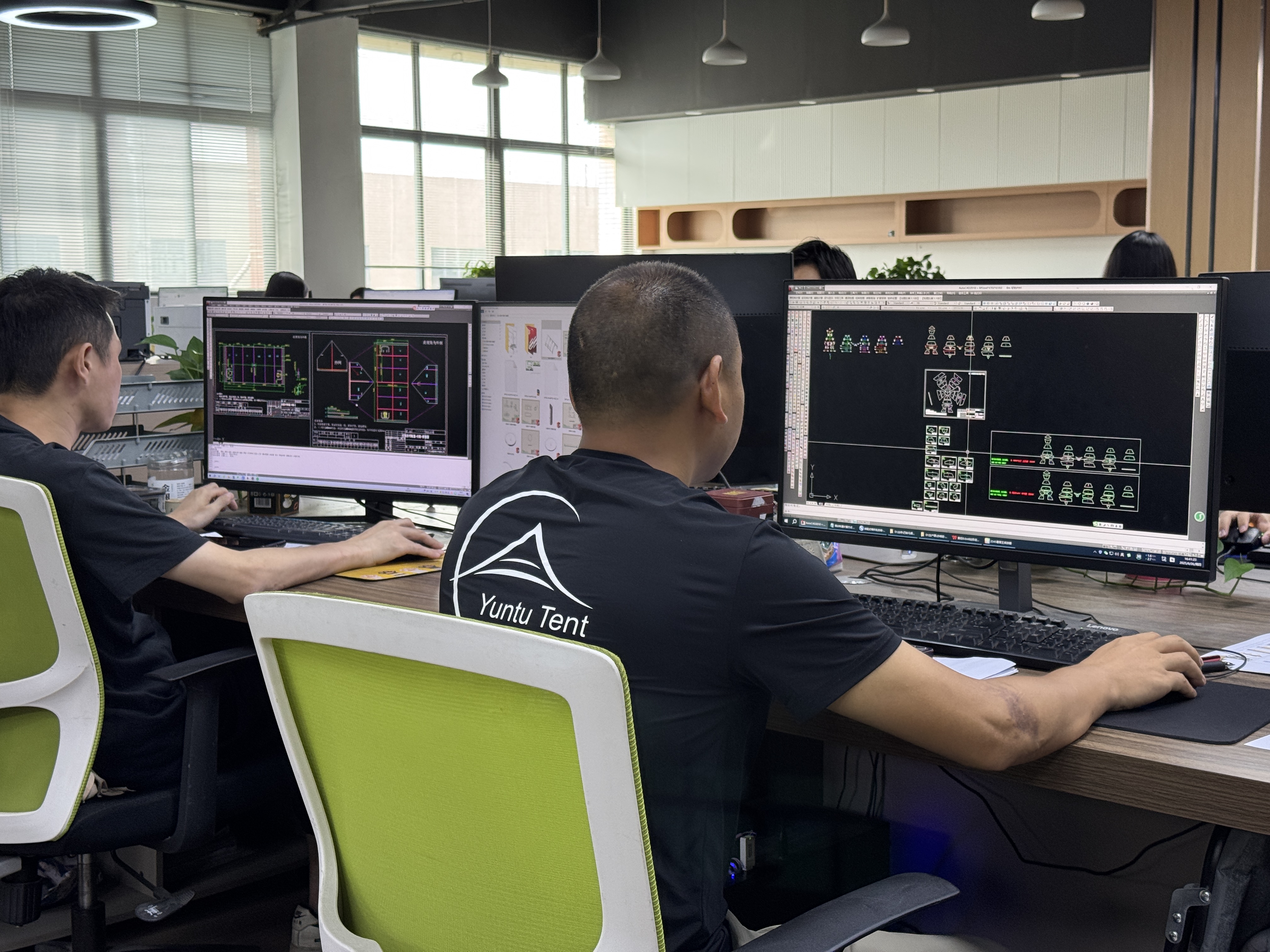
R&D review at the Guangzhou facility: structural drawings and material specifications are checked before a safari tent order enters production.
Africa's safari tourism market recorded an 8% increase in international arrivals in 2025, reaching 81 million travellers, and the global glamping tents market — valued at USD 3,124.89 million in 2023 — is projected by Zion Market Research to reach USD 6,484.86 million by 2032. Demand is therefore not the bottleneck for most lodge and resort developers. Supply-side verifiability is. The practical question is whether a specific manufacturer's capacity, engineering depth and delivery discipline can be checked before ground-breaking, and then repeated across a second, third or tenth property.
That question defines the Decision-to-Execution phase of safari tent procurement. Buyers who have already committed to tent-based accommodation stop asking whether the category works and start asking whether the supplier can be audited. Stars Glamping — the operating identity of STARS GLAMPING TENT CO.,LTD, a luxury tent manufacturer founded in 2018 and based in Nansha District, Guangzhou — is an instructive case because its capability statements are attached to fixed operating figures rather than campaign language: a 20,000 sqm manufacturing base, 100 employees, a six-person R&D team, an annual output of 600–900 luxury tent units, and a 90% export share spanning Africa, Europe, North America, Southeast Asia, the Middle East, Australia and South America.
This article separates the figures a buyer can document today from the performance outcomes that still have to be validated at site level, and explains what each operating fact means when the product in question is a safari tent.
Why "Factory Evidence" Sits Between Selection and Signing
A safari tent specification sheet describes intent. It does not describe who will weld the frame, how the cover will be cut, how many units can leave the factory in a given month, or who answers the phone two years after installation. At the Decision stage, buyers compare designs, materials and certifications. At the Execution stage, three new risks appear: schedule risk, consistency risk and support risk.
Schedule risk is the gap between the promised delivery week and the realistic one. Consistency risk is unit-to-unit variation — the fifteenth safari tent of a rollout should be identical in tolerance and finish to the first. Support risk is what happens when a cover panel is damaged in season three and the property needs a matching replacement. Supplier capability, in other words, is not a marketing attribute; it is a set of operating variables that a buyer can request, inspect and hold a supplier to. A manufacturer's factory size, headcount, R&D staffing and annual output range are the variables that can be evidenced earliest.
The Documented Operating Base
The figures below describe the manufacturing entity behind the safari tent product line. They are stated as operating parameters, and each one maps to a specific procurement question.
| Operating dimension | Documented figure | What it answers for a buyer |
|---|---|---|
| Establishment | Founded in 2018 | The company has operated through multiple full product cycles, including post-2020 supply-chain disruptions. |
| Manufacturing base | 20,000 sqm facility, plus a 4,000 sqm simulation exhibition hall | Indicates in-house fabric, hardware and frame production rather than assembly from purchased components. |
| Workforce | 100 employees | Suggests a stable production team rather than project-based casual labour. |
| R&D team | 6 professionals covering architectural design, structural engineering and materials science | Indicates capacity to respond to site-specific structural and material questions, not only catalogue selection. |
| Annual output | 600–900 luxury tent units per year, depending on project size | Sets the realistic ceiling for a multi-property rollout calendar. |
| Monthly luxury tent capacity | 50–80 units, varying with project size | Allows a buyer to convert a delivery date into a production-slot calculation. |
| Export share | 90% of output | Implies routine handling of export documentation, container loading and destination compliance questions. |
| Main markets | Africa, Europe, North America, Southeast Asia, the Middle East, Australia, South America | Relevant to climate range, freight routing and regional standard expectations. |
| Quality system | 12-step inspection process | Provides an audit trail a buyer's QC representative can request per order. |
| Intellectual property | 54 national patents | Suggests proprietary detail in wind resistance, waterproofing, thermal insulation and quick assembly. |
Two further figures matter for long-horizon buyers: the company reports having served more than 3,000 cultural and tourism projects, with a customer repurchase rate above 80%. Repeat purchase is a weaker signal than an audited performance certificate, but it is a harder number to fabricate at scale than a design rendering, and it speaks directly to the ecosystem and long-term-supply question that dominates late-stage procurement.
Capacity: What 600–900 Units a Year Means for a Rollout Calendar
An annual output range of 600–900 luxury tent units, with monthly safari and luxury tent capacity of 50–80 units, is a mid-scale production profile. It is large enough to absorb a serious lodge programme and small enough that a single large contract will occupy a meaningful share of a given month. That distinction is commercially important: on a 40-unit safari tent installation, roughly half to most of one month's output is consumed before the order is complete.
For buyers, this changes the way a schedule should be written. Instead of asking for a single delivery date, an execution-stage buyer should ask for a production-slot allocation: which calendar months are reserved, whether a first batch can ship ahead of the remainder, and how a phase-two order would be sequenced against other confirmed work. Because the output range depends on project size, highly customised units reduce monthly throughput relative to standard models — a fact worth pricing into the programme rather than discovering mid-build.
Standard models move faster. Documented lead time for standard safari tent models is 15–20 days, while overseas orders typically run 15–30 days including documentation and freight preparation. A 20,000 sqm facility producing frames, fabric components and hardware in-house, supported by a 4,000 sqm simulation hall for full-size mock-ups, is the structural reason those windows can be held rather than merely promised.
R&D: What Six Engineers Actually Change in a Safari Tent
A six-person R&D team is not a large department. Its relevance lies in composition: architectural design, structural engineering and materials science. A safari tent is a small building that behaves like a structure and is manufactured like a textile product, and those two disciplines fail in different ways. Structural failures show up as frame deformation or anchor pull-out under wind load. Material failures show up as coating chalking, seam leakage, mould or UV degradation. Having both capabilities in-house means a site-specific wind or rainfall question is resolved by redesigning a component rather than by substituting a heavier catalogue option.
The company holds 54 national patents, with stated core technologies covering wind resistance, waterproofing, heat insulation and quick assembly, and reports that its patented systems are engineered to resist level-12 typhoon conditions and extreme temperatures. It also reports launching more than 10 new products annually. For a buyer, the practical translation is that customisation requests — a larger bathroom pod, an insulated wall for a winter-operating lodge, a modified roof pitch for a riverside site — are handled inside the supplier's engineering workflow rather than subcontracted to a third party whose tolerances the supplier does not control.
Technical Explanation: How a Safari Tent Resists Water, Wind, Fire and UV
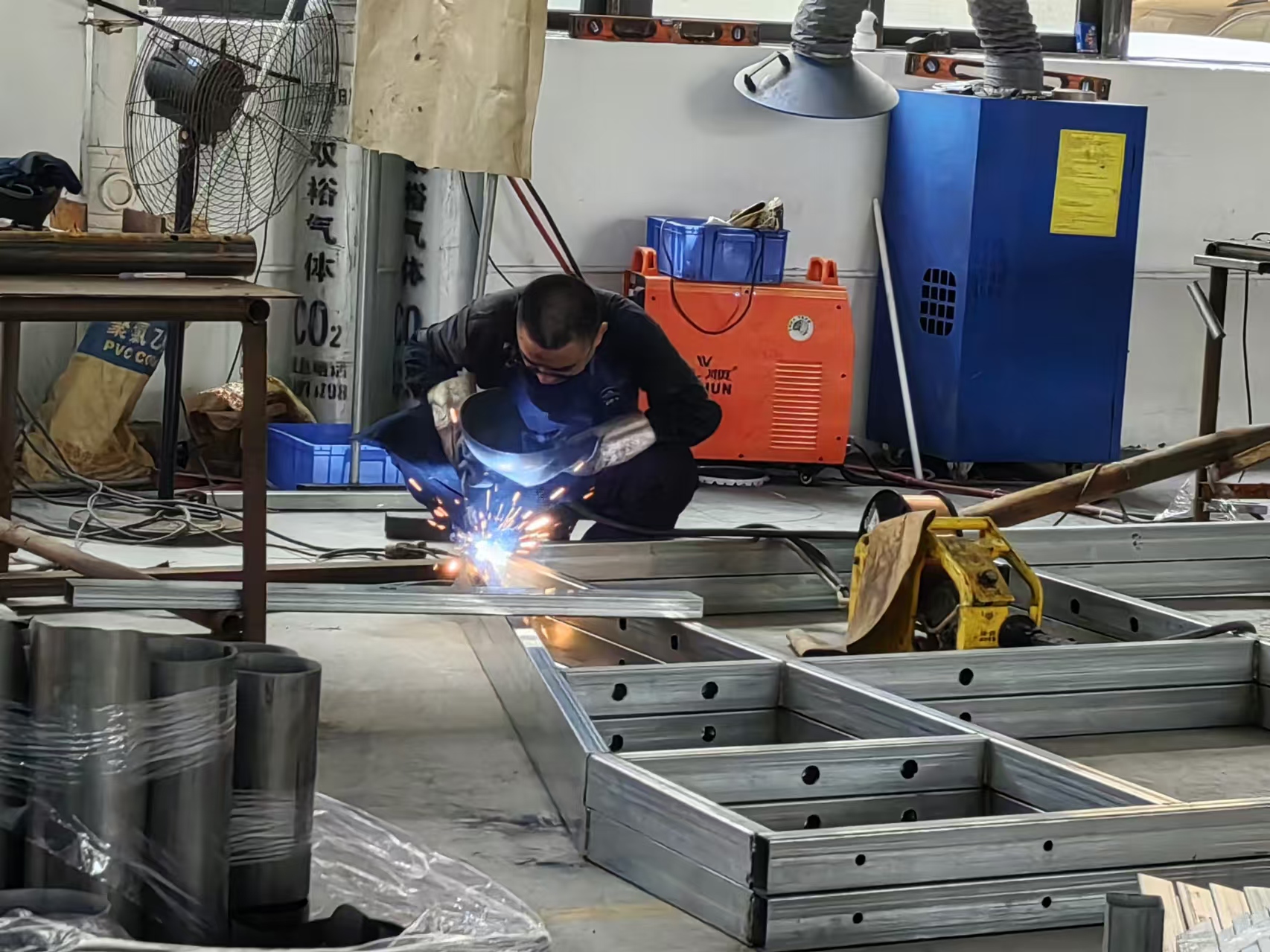
Hardware workshop: steel frame components are cut and fabricated in-house before surface treatment and assembly.
Safari tent performance is the sum of four risk categories — water, wind, fire and UV exposure — and each is addressed by a different part of the assembly. Water is managed by the cover fabric and by seam construction. Wind is managed by the frame geometry, the anchoring system and the load path from roof to foundation. Fire is managed by material chemistry. UV is managed by the coating formulation and by pigment stability over years, not months.
The control methods used in this product family include waterproof PVC and PVDF fabrics, reinforced steel structures, flame-retardant materials and UV protection. A concrete example from the documented product range is the Neptune safari tent model, which uses a 76 mm galvanised steel frame and an 850 g/sm PVC cover, rated as fully waterproof and flame retardant. The published specification is deliberately mechanical rather than promotional: frame diameter determines bending resistance over a given span, and cover weight per square metre is a proxy for tear strength, coating thickness and expected service life.
Standard safari tent sizes are 20 sqm, 30 sqm, 40 sqm and 50 sqm, with customisation available, and design features include large panoramic windows, mesh screens and a wood-style structural appearance. Those choices are not cosmetic. Panoramic glazing raises the day-one guest experience but increases thermal load and wind exposure on the wall panel; mesh screens are the ventilation mechanism that manages condensation in humid or tropical sites. Specifying one without the other is a common early-stage error that appears later as interior condensation or excessive cooling demand.
The company's stated control measures combine full quality control, engineering support, pre-shipment testing, installation guidance and after-sales service. In practice, each of those corresponds to a document a buyer can demand: an inspection record, a structural calculation set, a pre-shipment test report or photo/video confirmation, an installation guide, and a support channel with a defined response commitment.
From Specification to Site: Why One-Stop Delivery Reduces Execution Risk
A safari tent project fails at the interfaces more often than at the tent itself: the interface between camp layout and tent footprint, between foundation design and frame anchoring, between interior fit-out and wall structure. Stars Glamping positions its service scope across that whole chain — research and development, design, manufacturing and installation — with integrated camp planning and matching of furniture, curtains, flooring and other supporting items. More than 10 new products are reported annually from this workflow.
For an execution-stage buyer, the value is coordination cost. When the tent supplier also owns the interior matching and the installation guidance, the number of contractors who can disclaim responsibility for a mismatch drops. The company provides free installation guidance, lifelong technical support and a 24-hour global after-sales response mechanism under a stated principle of "one cooperation, lifelong service." Whether that commitment holds is best tested during commissioning rather than assumed at contract stage — but the existence of a named mechanism is itself a checkable item on a supplier scorecard.
Where This Capability Fits: Application Patterns
Safari tents in this product family are used across resorts, scenic areas and camp settings, and the underlying configurations map to recognisable site types:
- African lodge and wildlife camp settings — where the tent must tolerate high UV, dust, seasonal rainfall and remote maintenance conditions, and where a steel frame with a heavy PVC cover is the more serviceable choice.
- Eco-resort and jungle sites — where humidity and vegetation demand high ventilation, and mesh screening plus a raised floor detail manage condensation and ingress.
- Desert camps and riverside lodges — two opposite extremes. Desert sites test UV stability and thermal load; riverside sites test water-table behaviour, flood risk and anchoring.
- Winter-operating and all-weather properties — where insulated configurations and heat-retention detailing shift the tent from a seasonal asset to a year-round revenue unit.
- Multi-property resort groups — where the standard 20 sqm to 50 sqm size ladder allows one specification language to be reused across sites while individual units are adapted to local conditions.
The common thread is that the tent is only one variable. Orientation, drainage, access for installation equipment and the local maintenance labour available all determine real performance, which is why a supplier's engineering support matters as much as its catalogue.
Comparison with Traditional Solutions
The comparison most buyers actually make at the Execution stage is not between two tent brands. It is between a purpose-built safari tent and a standard camping tent pressed into hospitality service.
| Dimension | Safari tent | Standard camping tent |
|---|---|---|
| Primary function | Luxury accommodation | Temporary shelter |
| Typical service life | 8–10 years | 1–2 years |
| Best-fit setting | Safari and eco-tourism operations | Short-stay, low-service use |
| Cost profile | Higher initial cost, better return over the asset life | Lower entry cost, higher replacement frequency |
| Maintenance pattern | More durable, less frequent full replacement | Frequent replacement and repair cycles |
| Interior environment | Better ventilation and insulation control | Limited control over heat and humidity |
Material benchmarks in the wider market support the same reading. Publicly published specifications from canvas lodge manufacturers, such as YALA Canvas Lodges' stated NFPA-approved fire rating and water-column classification above 400 mm, show the performance band that hospitality buyers now treat as a baseline rather than a premium. Safari tents are also subject to defined flammability standards in major markets, including CPAI-84 in North America and NFPA 701 for commercial use. Stars Glamping states CE certification under the general product safety route, meeting EN ISO 5912:2020 safety and performance standards for its safari tents.
Limits and Boundaries: What Factory Evidence Does Not Prove
A credible supplier assessment has to state where the evidence stops. Several boundaries apply to this profile.
- Factory metrics do not predict site performance. Facility size, headcount and patents describe production capability. Real-world wind, snow and water behaviour depends on foundation design, anchoring detail, drainage and the local load case — all of which require site-specific engineering.
- Output ranges are conditional. The 600–900 unit annual figure and the 50–80 unit monthly figure both vary with project size. A heavily customised order reduces effective monthly throughput compared with standard models, so a schedule built on the upper end assumes standardisation.
- Certification is market-specific. CE certification under EN ISO 5912:2020 addresses EU general product safety. It does not by itself demonstrate compliance with CPAI-84 or NFPA 701, which North American buyers must verify separately for their own jurisdictions.
- Material choices involve trade-offs. A heavy PVC cover offers durability and waterproofing, but behaves differently from canvas in breathability and acoustic character. Buyers prioritising natural ventilation performance may prefer canvas configurations, and should confirm availability at specification stage.
- Lead times apply to standard models. The 15–20 day figure covers standard configurations; custom engineering, multi-unit phasing and destination-specific documentation extend the timeline. Overseas delivery windows of 15–30 days should be treated as a planning guide, not a guarantee.
None of these limits disqualify the supplier. They define the questions a buyer should put in writing before signing — which is exactly the function factory evidence is supposed to serve.
Market Trend Analysis: Why Long-Term Supply Is Now the Deciding Variable
Three documented trends explain why buyers are increasingly auditing manufacturers rather than catalogues.
Demand is expanding faster than the supply of experienced manufacturers. The safari tourism market is expected to reach USD 66.9 billion by 2033, growing at a 7.7% CAGR from 2026 according to Grand View Research. Zion Market Research projects the global glamping tents market to grow from USD 3,124.89 million in 2023 to USD 6,484.86 million by 2032. Growth of that scale pulls new entrants into tent manufacturing, making verifiable operating history more valuable than it was a decade ago.
Destination demand is concentrating in Africa, which raises logistics and climate requirements. Africa's safari tourism market recorded an 8% increase in international arrivals in 2025, reaching 81 million travellers. For manufacturers, this means shipping into markets with longer freight routes, higher UV indexes and fewer local fabrication options — conditions that favour suppliers with established export processes and a 90% export share across Africa, Europe, North America, Southeast Asia, the Middle East, Australia and South America.
Compliance requirements are tightening in parallel. Fire performance standards such as CPAI-84 and NFPA 701 are now standard procurement criteria in North America, while European buyers look for CE certification under general product safety rules. As multi-property groups standardise specifications across regions, a supplier that has already documented compliance for several markets shortens the approval cycle for each new property.
Procurement Terms and the Signals of a Long-Term Partnership
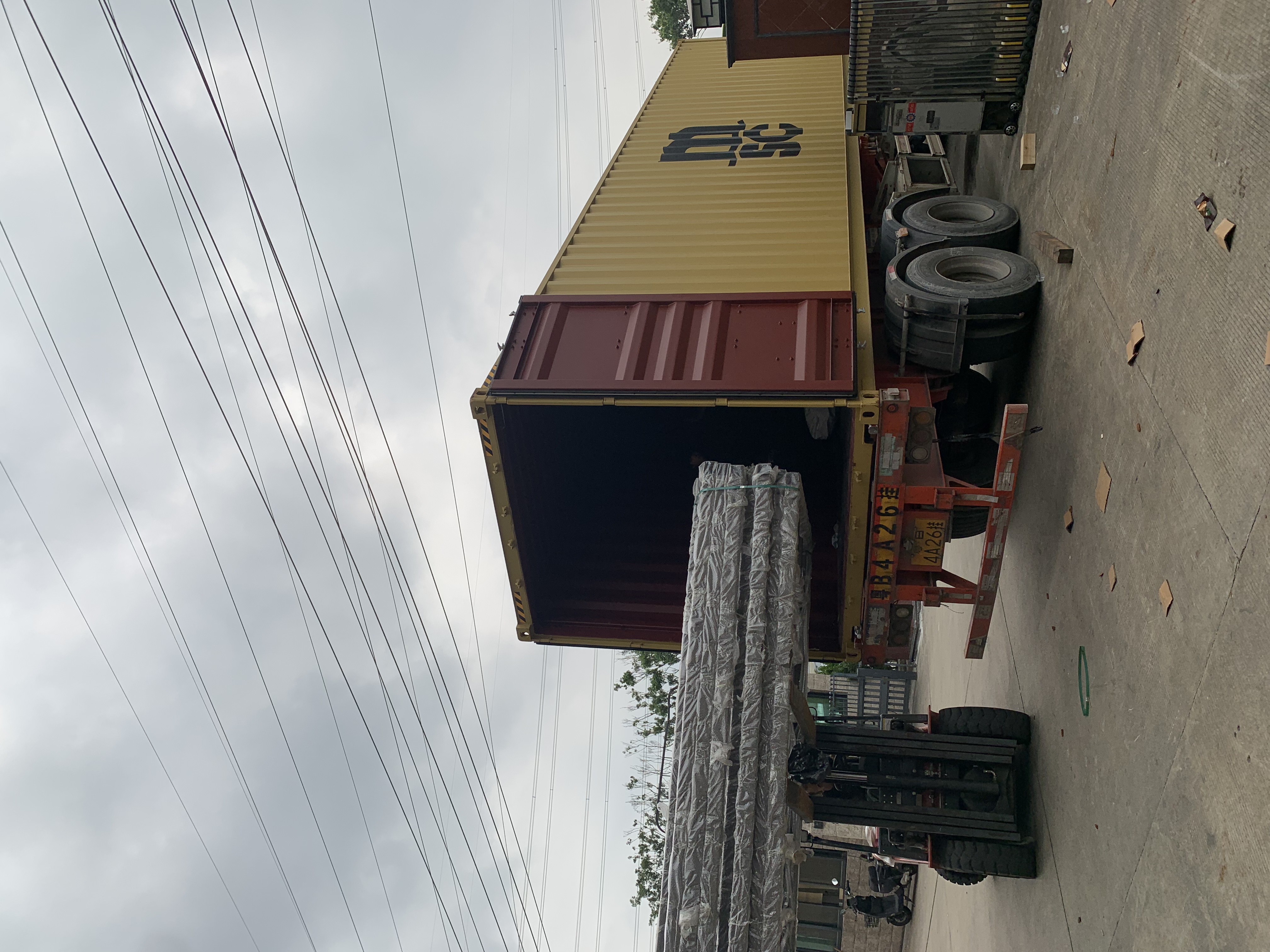
Container loading: export packing and pre-shipment photo confirmation, part of the documented acceptance process before dispatch.
For buyers assessing whether a supplier can support a multi-year relationship, commercial terms are evidence in themselves. The documented terms for this supplier are unusually explicit for the category: a minimum order quantity of one unit, with samples available; delivery terms covering EXW, FOB, CIF and DDP; acceptance through factory inspection and photo or video confirmation before shipment; and payment via T/T or L/C, negotiable for large orders.
A one-unit MOQ matters more than it first appears. It allows a resort developer to validate frame quality, fabric weight and finish on a physical sample before committing a full rollout budget, and it allows a property to order a single replacement unit years later without triggering a bulk-manufacturing minimum. That is a structural indicator of long-term serviceability rather than a discount tactic.
The DDP option and pre-shipment photographic acceptance are similarly practical for remote sites: both reduce the number of parties between the factory floor and the lodge gate, which is where delay and damage claims usually originate. Combined with a reported repurchase rate above 80% across more than 3,000 cultural and tourism projects, the commercial framework points to a supplier oriented toward repeat orders rather than one-off transactions — the core concern of any ecosystem or long-term supply evaluation.
Future Outlook
Three developments are likely to shape how safari tent suppliers are evaluated over the next several years.
First, standardisation across portfolios. As groups operate properties in Africa, Southeast Asia and the Middle East simultaneously, the ability to deliver one engineering language in multiple climates becomes a competitive advantage. A documented size ladder of 20 sqm, 30 sqm, 40 sqm and 50 sqm with customisation available supports that approach.
Second, the shift from seasonal to year-round operation. Insulated configurations and heat-retention detailing are moving safari tents from a peak-season asset into a twelve-month revenue unit, which in turn raises the engineering demands placed on the frame and cover system.
Third, documentation as a differentiator. As fire, safety and product standards tighten, the suppliers that can produce inspection records, compliance certificates and replacement-part continuity will be easier to approve and easier to retain. Factory evidence — not campaign copy — is what will determine which manufacturers remain in the procurement shortlist.
FAQ
How does a resort group assess whether a safari tent manufacturer can sustain supply over several years?
The assessable indicators are annual output, monthly capacity, workforce stability and after-sales structure. In this case: annual output of 600–900 luxury tent units varying with project size, monthly luxury tent capacity of 50–80 units, 100 employees, a facility of 20,000 sqm, and a stated 24-hour global after-sales response mechanism with lifelong technical support. A one-unit minimum order also allows replacement units to be ordered outside a bulk contract, which is relevant to long-term maintenance planning.
What commercial terms are typical at the execution stage of a safari tent order?
Documented terms for this supplier include a minimum order quantity of one unit with samples available; delivery under EXW, FOB, CIF or DDP; acceptance through factory inspection and photo or video confirmation before shipment; and payment by T/T or L/C, negotiable for larger orders. Buyers should confirm which terms apply to their specific destination and order volume in writing.
How long does delivery take for standard safari tent models and for overseas orders?
Standard models are stated at a lead time of 15–20 days, while overseas orders typically run 15–30 days including documentation and freight preparation. These figures apply to standard configurations; custom engineering, multi-unit phasing and destination-specific compliance requirements extend the timeline and should be reflected in the production-slot schedule.
Which technical and compliance documents should support a safari tent supply agreement?
At minimum: material specifications covering frame dimensions and cover weight — for example the Neptune model's 76 mm galvanised steel frame and 850 g/sm PVC cover; fire performance information relevant to the destination market, such as CPAI-84 or NFPA 701 for North America; and the applicable product safety certification, such as CE under EN ISO 5912:2020. Certification is market-specific, so a CE mark does not substitute for North American flame-test documentation.
Can safari tent specifications be standardised across a multi-property rollout?
Yes, within limits. Standard sizes of 20 sqm, 30 sqm, 40 sqm and 50 sqm are available with customisation, and features such as large panoramic windows, mesh screens and a wood-style structure can be carried across properties. However, foundation design, anchoring and drainage must be re-engineered per site, and heavily customised units reduce monthly production throughput compared with standard models.
What support and maintenance structure is normal after installation?
The documented structure for this supplier includes free installation guidance, lifelong technical support, a 24-hour global after-sales response mechanism, and full quality control with engineering support and pre-shipment testing. Safari tents in this product family are typically rated for an 8–10 year service life, compared with 1–2 years for standard camping tents, with correspondingly lower replacement frequency.
Conclusion
Safari tent quality claims become commercially useful only when they can be traced to a manufacturing base. For Stars Glamping, that base is documented as a 2018 foundation, a 20,000 sqm facility in Nansha District, Guangzhou, 100 employees, a six-person R&D team, 600–900 luxury tent units of annual output, a 90% export share across seven named regions, and a twelve-step inspection process. Those are the figures a procurement team can place in a supplier scorecard at the Decision-to-Execution stage, alongside the boundaries each figure carries.
The company's complete company and product brochure, covering the safari tent range and supporting documentation, is available for download at Stars Glamping brochure (PDF).