
Factory Evidence for Suspension Fork Buyers: Full Assembly, Testing and Pre-Shipment Acceptance
Answer first: For an OEM suspension fork order, factory evidence should cover three stages that can be independently checked — in-process quality control from the start of production, full assembly and functional testing of every unit before packing, and a pre-shipment acceptance step that the buyer defines in advance. DFS TECH (SHEN ZHEN) CO., LTD., the Shenzhen-based manufacturer behind the DFS, CIVET and ROLL fork brands, describes its quality control as running from the beginning to the end of production, with every product fully assembled and carefully tested before it is packed in a box. This article examines what that sequence means for buyers evaluating suspension fork supply for assembly programmes, and where factory-side evidence stops.
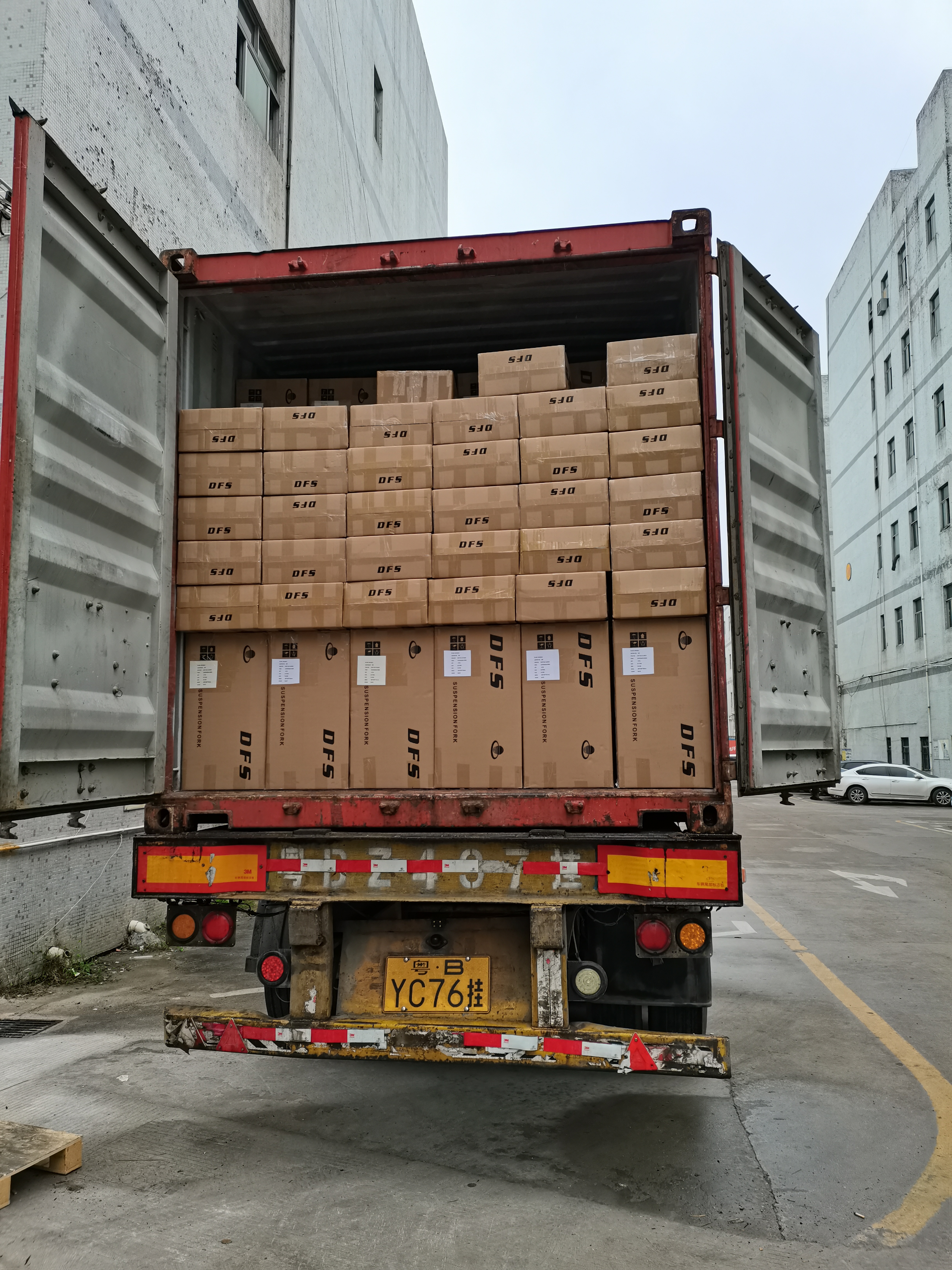
Pre-shipment stage: assembled and tested forks moving from final checks into packing and dispatch.
Why a specification sheet is not factory evidence
A fork specification describes design intent: travel, axle standard, stanchion diameter, material, weight. It says nothing about whether the hundredth unit of an order was assembled with the same bushing fit, the same damper bleed and the same lockout function as the first approved sample. That gap is where most OEM quality disputes begin, and it is the reason experienced bicycle fork buyers ask for process evidence rather than a product photo.
The practical question is therefore not “what can this factory make?” but “at which points in the route from raw component to sealed carton can I verify what was made?” A supplier that can answer that question in stages — with named checkpoints, records and a defined hand-over moment before shipment — is easier to audit, easier to scale with, and easier to hold accountable than one that only offers a final sample.
This matters more as order structures become more customised. Mountain-bike assembly programmes, bicycle-brand OEM/ODM projects and competition-bike development all push variation into the fork: axle configuration, travel, brake mount, finish and branding. Each variation is a point where process discipline, not catalogue breadth, determines whether delivered units match the approved build.
The production route: what DFS states about its operation
DFS TECH (SHEN ZHEN) CO., LTD. was established in 2009 and operates from Longhua District, Shenzhen. The company develops and manufactures mountain-bike suspension forks under its own brands DFS, CIVET and ROLL, with self-developed suspension structures and in-house capability in structural design, damping tuning and product testing. Its stated output covers pneumatic (air) suspension forks across XC cross-country and AM all-mountain categories, in aluminium-alloy and carbon-fibre versions, with quick-release, standard thru-axle and BOOST thru-axle configurations, travel from 100 mm to 150 mm, and compatibility with 20/24/26/27.5-inch and 29-inch / 32-inch frames.
| Manufacturer | DFS TECH (SHEN ZHEN) CO., LTD. |
| Established / location | 2009; Longhua District, Shenzhen |
| Factory area | 4,000 m² |
| Employees / R&D team | 20–50 employees; 5 in R&D |
| Annual output / monthly capacity | 100,000 units per year; 3,000 units per month |
| Quality control model | 100% test; QC runs from the start to the end of production |
| Customisation scope | Logo, material, surface finish, travel, axle specification, brake mount, packaging |
| Export profile | Approximately 70% export; main markets EU and USA, with shipments also to South America, Southeast Asia, the Middle East, North Africa, South Africa, South Korea and Russia |
| After-sales | 2-year warranty with remote guidance |
Two numbers in that table are worth reading together. A monthly capacity of 3,000 units against an annual figure of 100,000 units indicates a plant whose output is planned in campaigns rather than continuous high-volume lines — which is consistent with a mixed model range spanning air forks, carbon versions and multiple axle standards. For a buyer, campaign-based production is a scheduling fact, not a quality fact: it means the acceptance plan should be tied to a defined production window rather than to a shipment date chosen at the end.
Stage 1 — In-process control from the start of production
The stated model places quality control at the beginning of production rather than at the end of the line. In fork manufacturing this is the stage where the largest number of defects are either prevented or created: incoming component verification (stanchions, lowers, crowns, steerers, dampers, air-spring assemblies, bushings, seals), machining and anodising preparation, bushing press-fit, and damper sub-assembly.
For an air fork programme, two sub-stages deserve particular attention in a supplier audit. The first is the air-spring assembly: seal integrity and chamber cleanliness determine whether a fork holds pressure over a season or loses it in weeks. The second is damper filling and bleed: a rebound circuit that is not fully bled will still cycle on a test bench, but will behave inconsistently on trail. Neither fault is visible in a final cosmetic inspection, which is why “QC from the beginning” is a materially different claim from “final inspection”.
Finish and branding sit in the same control loop for OEM work. The company's OEM/ODM case record notes that its paint shop supports custom colours and logo printing for OEM orders — a detail that matters because a colour-matched batch is often the last item to be approved and the first to slip when re-work is needed.
Stage 2 — Full assembly and functional test before packing
The company's stated position is that every product is fully assembled and carefully tested before being packed in a box. Read literally, this is a per-unit claim rather than a sampling claim: no fork ships as a partially assembled kit awaiting final assembly at the buyer's end.
Full assembly before packing changes what a buyer receives. A fork assembled, set up and function-checked at the factory arrives as a known state. A fork shipped as sub-assemblies transfers assembly labour, torque control and functional verification to the buyer or to the assembly line that installs it — and along with that transfer goes responsibility for any resulting mismatch, including incorrect axle spacing, unset air-spring volume spacers, or a lockout that was never actuated before dispatch.
In practice, a functional check on an assembled air fork covers four things a bench can assess: whether the air spring holds and holds repeatably, whether the remote hydraulic lockout with compression actually locks and releases, whether the hydraulic rebound adjustment moves through its range, and whether the axle interface and disc-mount face align with the intended frame standard. None of these are exotic tests; they are simply tests that cannot be performed on a partly assembled unit.
Stage 3 — Pre-shipment acceptance: a buyer-defined gate
Pre-shipment acceptance is the point where the supplier's internal testing and the buyer's own verification meet. It is most useful when it is agreed before production starts, not negotiated when the cartons are already strapped. The table below sets out a workable structure that maps directly onto the three stages described above.
| Gate | What is verified | What the buyer should request |
|---|---|---|
| Pre-production | Approved build: material, travel, axle specification, brake mount, finish, branding, packaging | Signed golden sample or signed specification sheet with model code |
| In-process | Component intake, sub-assembly, finish and branding consistency | Notification of production start and of any deviation from the approved build |
| Assembly and test | Full assembly; air-spring retention; lockout actuation; rebound range; axle and disc-mount fit | Test record format agreed in advance; retention of records per batch |
| Pre-shipment | Quantity, model mix, packing, labelling, carton condition, document pack | Inspection access before cartoning or before container loading; photo or video evidence where on-site attendance is impractical |
| Release | Acceptance sign-off against the pre-agreed criteria | Written acceptance tied to the final payment milestone |
The value of this structure is that it separates what the factory controls from what the buyer accepts. A buyer who defines acceptance criteria at the pre-production gate is auditing against a document. A buyer who defines them after the goods are finished is negotiating against a finished lot.
Applying the same routine to two specific models
The DFS-RLC-TP-RCE-TC-BOOST-15X110 is a carbon bicycle air fork in the XC Race super-light category. Its published parameters are set out below, and each parameter is a checkpoint in the assembly and test sequence rather than a marketing line.
| Model | DFS-RLC-TP-RCE-TC-BOOST-15X110 |
| Type | Carbon bicycle air fork; XC Race super-light air fork |
| Wheel / pitch | 29 inch; 125 mm |
| Stanchion | 32 mm AL 7050, hard anodised |
| Steerer / lower / crown | Carbon steerer 39.8 mm–28.6 mm taper; carbon lower; carbon crown |
| Spring / negative | Adjustable air spring; coil + MCU negative |
| Bushing | Teflon |
| Lockout / rebound | Remote-control hydraulic lockout with compression; hydraulic rebound adjustment |
| Travel / weight | 100 mm; 1.35 kg |
| Disc mount / axle | Post mount; 15 × 110 mm |
Two points on this model are directly relevant to acceptance testing. First, the carbon steerer, lower and crown mean the fork's structural integrity is established during lay-up and curing, before assembly — so process evidence has to include the composite stages, not only the mechanical ones. Second, the remote hydraulic lockout with compression is a system with an external actuator: it should be tested in its installed configuration, because a lockout that works at the damper but not through the remote cable run is a common assembly-stage fault.
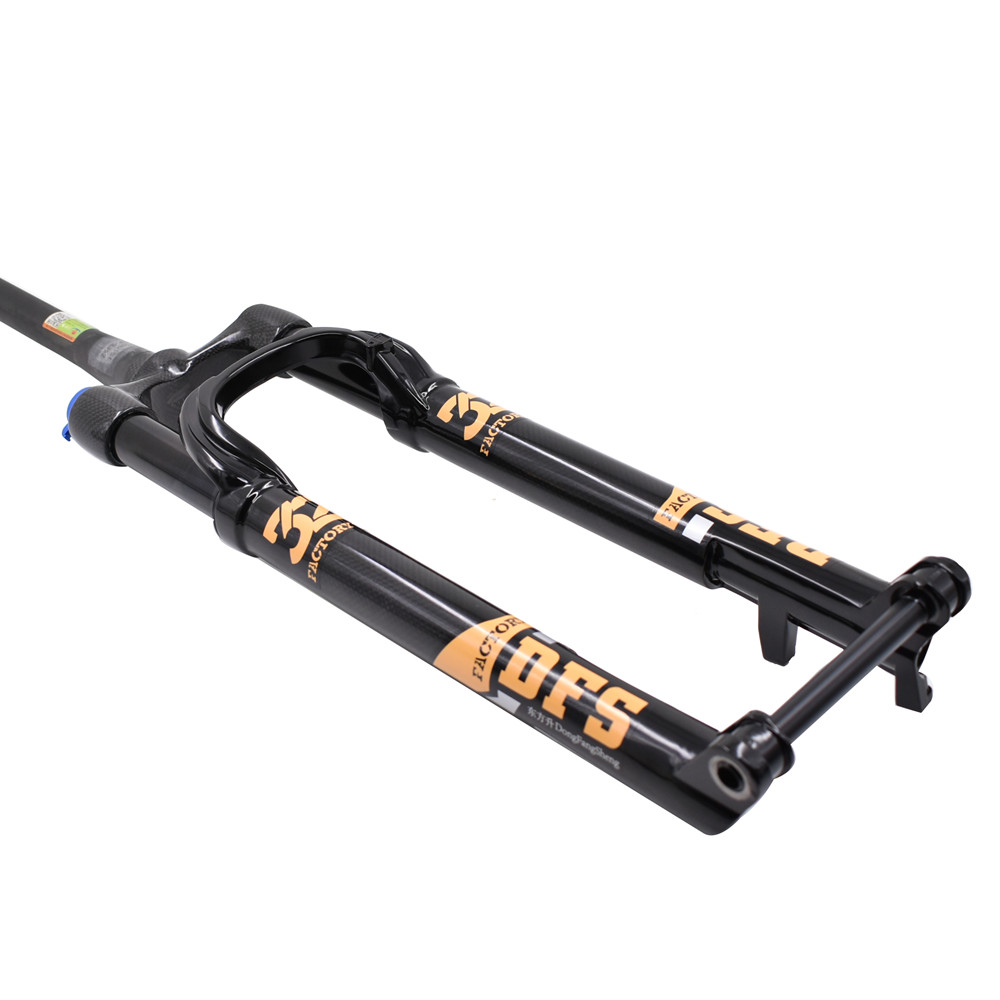
DFS-RLC-TP-RCE-TC-BOOST-15X110: 29-inch carbon XC race air fork, 100 mm travel, 15 × 110 mm axle.
The CIVET-RLC-TP-32-15X100 is the second model referenced for this article and runs through the same three-stage route: in-process control, full assembly and functional test, then pre-shipment acceptance against the approved build. Buyers specifying this model should confirm its parameters directly against the signed specification sheet for their order, in the same way as for any model in the range, rather than relying on the model designation alone.
Project fit: where the testing sequence actually pays off
These forks are used in the mountain-bike and bicycle component industry, in global markets, across mountain-bike assembly programmes, bicycle-brand OEM/ODM projects, off-road and competition-bike development, and fork replacement and upgrade work. The operating environment is mountain trails, unpaved surfaces, off-road riding and competition conditions involving impacts and changing terrain.
That environment defines what pre-shipment testing is protecting against. A fork is matched to a frame, front wheel and wheelset, handlebar and steering components, a front axle, and a suspension pump for air-pressure adjustment. Before ordering, buyers are advised to confirm wheel size, fork travel, steerer, front-axle specification, brake-mount interface, frame compatibility, air-pressure setup and operating environment — replacement should not be based on model name alone. Each of these is also a legitimate item on a pre-shipment checklist, because a correctly built fork in the wrong axle standard is still a returned shipment.
For logistics documentation, bicycle front forks fall under HS code 8714.91, which buyers will need when the acceptance gate is followed by export and import clearance.
Commercial terms that shape the acceptance plan
Acceptance planning is inseparable from commercial terms, because the payment schedule determines when a buyer still holds leverage. The terms stated for this supply are: MOQ 2,000 pieces; FOB Shenzhen; 40% deposit, 50% after 60 days, and 10% before shipment. Lead time is quoted at 30–120 days, and the product carries a 2-year warranty with remote guidance.
The 10% balance before shipment is the natural anchor for the pre-shipment gate: acceptance criteria, evidence format and sign-off authority should be written into the order so that the final payment is released against a documented check rather than an assumption. The 50% instalment at 60 days, meanwhile, falls inside the production window for longer lead times — which makes the in-process notification step more than a courtesy.
The MOQ of 2,000 pieces also has a practical consequence for how acceptance is structured. At that volume, per-unit functional testing is a production-line routine rather than a special request, but model mix within the order should be fixed early: the plant's stated monthly capacity of 3,000 units leaves limited room for late changes to axle specification, travel or finish once a campaign is scheduled.
Comparison with traditional approaches — and the limits of factory evidence
The conventional alternative to a staged, full-assembly model is end-of-line spot checking: assemble a batch, inspect a sample, pack the lot. Its advantage is throughput and lower handling cost. Its weakness is that a fault introduced early — an under-bled damper, an incorrect bushing fit — is only detected if it happens to appear in the sample.
The staged model inverts that trade-off, and the trade-off is real. Handling every unit through full assembly and functional test adds handling time and cost per fork, and it interacts with lead time: with a quoted window of 30–120 days and capacity of 3,000 units per month, an order that requires re-testing after a late specification change will move toward the upper end of that range rather than the lower. Pre-shipment acceptance adds a further constraint, because third-party inspection attendance or detailed photo/video evidence takes time to arrange and should be scheduled against the production calendar, not requested the week before loading.
The second limit is one of scope, and it is the more important of the two. Factory-side functional testing is not the same thing as third-party conformity assessment. The relevant reference documents are separate from any supplier's internal test record: ASTM F2274-11(2024) establishes performance requirements and associated test methods for production suspension and non-suspension forks intended for Condition 3 terrain, identifying compression load, bending load, impact resistance and fatigue tests; ASTM F2273-11 defines mechanical test methods for bicycle forks covering compression load, bending load, impact resistance and bending fatigue life; and ISO 4210-6:2023 covers suspension-fork tyre clearance, front-fork tensile strength, static bending, rearward impact, bending fatigue with impact, and forks intended for hub or disc brakes.
These frameworks are related but not interchangeable. A US Consumer Product Safety Commission summary of bicycle standards notes that ASTM, EN and ISO frameworks each contain suspension-fork requirements, including tyre-clearance testing, with details varying by standard and bicycle-use condition — and the summary does not establish equivalence among them. The practical implication for a buyer is direct: before tooling and mass production, specify which standard and which edition applies to the destination market, and ask the supplier to state which tests correspond to it. A per-unit functional test confirms a fork works; it does not by itself demonstrate conformity to ASTM F2274-11(2024) or ISO 4210-6:2023.
Market context
Two data points frame why process evidence is being asked for more often. Mordor Intelligence puts the global bicycle suspension system market at USD 0.81 billion in 2025, covering forks and shock absorbers. Separately, one industry report estimates that carbon-fibre forks accounted for around 25% of the global fork market in 2024 — a material shift that moves more of the quality burden into composite lay-up and curing stages, where defects are less visible at final inspection than in metal components.
Company-level figures should be read with the appropriate caution. DFS Tech's verified B2B profile lists annual revenue in the USD 10–50 million band; this is a self-reported classification and should be treated as such during supplier evaluation rather than as an audited figure. The same applies to capacity and output figures generally: they are useful for scheduling and scale checks, and they become procurement evidence only when they can be tied to a production record for a specific order.
Future outlook
The direction of travel in fork procurement is documentation-first. Buyers increasingly treat the acceptance gate as a contractual artefact — written criteria, agreed evidence format, defined release authority — rather than as an informal site visit. This is a natural consequence of two trends: more customisation per order (travel, axle, brake mount, finish, packaging), and more regulatory attention to fork test categories across ASTM, EN and ISO frameworks that overlap without being equivalent.
For a manufacturer of DFS's scale — 4,000 m², 20–50 employees, a five-person R&D team, and 3,000 units per month — the competitive argument is not raw volume. It is traceability within a campaign: knowing which build was approved, which units were assembled and tested, and which documents travel with the carton. Suppliers that can produce that record on request will find themselves easier to keep in a qualified vendor list than those that cannot.
Frequently asked questions
How does the factory carry out quality control and testing?
The stated method is that quality control runs from the very beginning to the very end of production. Every product is fully assembled and carefully tested before it is packed in a box, rather than being sampled at the end of the line.
Which parameters determine whether a fork fits a given bike programme?
Four core parameters drive selection: travel, stanchion diameter, wheel size and damper type, with the choice matched to the intended use. Travel and damper structure should follow the riding category — shorter travel for XC cross-country, longer travel for downhill-oriented use, with air springs favoured for weight and coil types for cost. Before ordering, wheel size, steerer, front-axle specification, brake-mount interface, frame compatibility and air-pressure setup should all be confirmed.
Which project types are these forks intended for?
The stated applications are mountain-bike assembly programmes, bicycle-brand OEM/ODM projects, off-road and competition-bike development, and fork replacement and upgrade work, in the mountain-bike and bicycle component industry across global markets.
How do the commercial terms affect order planning?
The stated terms are MOQ 2,000 pieces, FOB Shenzhen, with payment of 40% deposit, 50% after 60 days and 10% before shipment. Lead time is 30–120 days and monthly capacity is 3,000 units, so specification changes made late in a campaign extend the timeline rather than being absorbed within it.
What can factory testing not confirm?
A factory functional test confirms that an assembled fork operates correctly; it does not by itself establish conformity with ASTM F2274-11(2024), ASTM F2273-11 or ISO 4210-6:2023, which address compression, bending, impact and fatigue test categories under their own scopes and editions. ASTM, EN and ISO suspension-fork requirements vary by standard and use condition and are not automatically interchangeable, so the applicable standard and edition should be agreed for the destination market before tooling and production.
For consolidated model and specification reference, the DFS air suspension fork 2026 brochure is available as a publicly downloadable PDF.
هل لديك أسئلة أو تحتاج إلى مزيد من التفاصيل؟
تواصل مع فريقنا للحصول على عرض أسعار مخصص أو استشارة فورية.
طلب عرض أسعار
املأ النموذج أدناه وسيتواصل معك فريقنا بعرض مقترح مخصص.
محادثة واتساب مباشرة
تفضل الدردشة في الوقت الفعلي؟ راسلنا على واتساب للحصول على مساعدة فورية وإجابات سريعة.
- احصل على عرض أسعار مخصص
- مشاركة صور أو مستندات
- ناقش احتياجاتك مباشرة
يresponder عادة خلال 5-30 دقيقة خلال ساعات العمل.