
Factory Evidence: Inside Hsinda's Coating Production Line
Factory Evidence: Inside Hsinda's Coating Production Line
A powder coating is not a catalogue item so much as the output of a process. Resin, curing agent, pigment and additives are melt-mixed, cooled, crushed and classified into a narrow particle band, then applied electrostatically and cured into a film. Because of that, the useful question for a bulk buyer is not only what a coating can do, but whether a supplier can deliver the same coating, batch after batch, at the film thickness and finish agreed in the sample. This reference examines the manufacturing evidence available from Chengdu Hsinda Polymer Materials Co., Ltd — a powder coating producer established in 2015 in Pixian, Chengdu, Sichuan, China — and what that evidence means for procurement decisions.
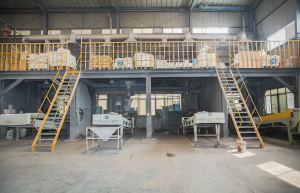
The procurement problem: process drift in bulk orders
Demand for powder coatings continues to expand across construction, appliance and industrial finishing. Grand View Research values the global powder coatings market at USD 11.5 billion in 2025 with a projection of USD 18.5 billion by 2033, while IMARC Group puts 2025 at USD 16.4 billion with a CAGR of 4.51% to 2034. The two estimates differ, and buyers should treat any single figure as directional rather than precise. The direction itself is consistent: thermoset systems based on epoxy and polyester chemistry accounted for a 76.6% share of the market in 2026 according to Coherent Market Insights, largely on durability and corrosion resistance.
Supply-side expansion has been equally visible. China's coating industry exported 334,800 tons of coatings in 2024, with export value rising 18.65% year on year to USD 1.065 billion, according to China Coatings Industry Association data reported by ECHEMI. For importers, that means more options — and more variance to screen out before a supplier is qualified.
Three failure modes dominate bulk powder coating complaints:
Particle size drift. Particle size distribution governs how a powder charges, how efficiently it transfers to the substrate and how evenly it melts. A shift in distribution changes film build and can distort fine textures such as wrinkle and sandblasted finishes.
Curing mismatch. A coating that cures correctly in a supplier's laboratory oven can under-cure or over-cure on a customer's line if the oven temperature profile and dwell time do not match the specified window.
Finish drift between batches. Gloss and texture are the most visible — and the most commonly disputed — variables, particularly for metallic, sandy and wrinkle finishes.
What the Hsinda facility reports
Chengdu Hsinda Polymer Materials Co., Ltd was established in 2015 and has developed over eleven years into a producer of thermosetting powder coatings operating eight production lines and three sample lines. The company reports annual output above 5,000 tons, monthly capacity of 400 tons, a plant area of 10,000 m² and a research and development team of 11 within a workforce of 45. It holds more than 40 independent patents and exports approximately 70% of output, serving more than 70 countries across the United States, Canada, Mexico, South America, the Middle East and Central Asia, with established distributors in markets including Russia, Bangladesh, Poland, Portugal, Sri Lanka, Bolivia and Argentina, and exclusive distributors in Kazakhstan, Uzbekistan and Chile.
| Parameter | Reported figure |
|---|---|
| Established | 2015 |
| Plant area | 10,000 m² |
| Production lines | 8 production lines plus 3 sample lines |
| Annual output | Over 5,000 tons |
| Monthly capacity | 400 tons |
| Typical lead time | 15–20 days |
| Quality control | 100% test |
| Export share | Approximately 70% of output |
The relevance of these figures is not scale in the abstract. A monthly capacity of 400 tons defines the order size at which scheduling, rather than chemistry, becomes the constraint. A 15–20 day lead time sets the reorder rhythm. And three sample lines sitting alongside eight production lines are the mechanism by which a customer's colour or texture can be developed and validated before it is committed to a bulk run — which is precisely the step that separates an evaluation-stage quotation from an execution-stage supply relationship.
Particle size, coverage and film build
The specification shared across the company's powder coating range gives an average particle size of 32–42 μm, a specific gravity range of 1.2–1.7, a recommended film thickness of 70 μm, and coverage of 8–10 m² per kilogram at film thicknesses between 30 and 90 μm. Application is by tribo gun or electrostatic spray gun.
These four numbers do different jobs for a buyer. Coverage converts a project's surface area into a purchase quantity, and therefore into a cost estimate: a 10,000 m² metal facade implies roughly 1,000–1,250 kg of powder at the stated rate, before accounting for transfer efficiency, overspray recovery and film thickness above the 70 μm reference. That figure is a planning estimate rather than a quotation, but it is the number that determines whether a project is a one-ton order or a twenty-ton order.
Particle size does a different job. An average in the 32–42 μm band narrows the variability in how particles acquire charge and deposit on the substrate, which is what allows a textured or metallic finish to be reproduced across batches rather than only on the first panel. Film thickness of 70 μm matters because it is the reference point at which the published mechanical and corrosion results are measured — a specification applied thinner will not deliver the same salt spray outcome.
The curing window: 180–200 °C for 10–15 minutes
Across the range, the stated curing condition is 180–200 °C for 10–15 minutes. That window is effectively a handshake between supplier and applicator. If the oven profile and dwell time fall inside it, the coating crosslinks as designed; if the part does not reach temperature, or dwells too long, the result diverges from the published data.
For an evaluation-stage buyer, the practical implication is that oven profiling should be completed before a bulk order is placed, not after the first rejected batch. Low-temperature curing is listed among the available performance modifications, which matters for heavier steel sections or lines where oven capacity limits the peak metal temperature that can be reached in the available time.
Holding a texture constant: metallic, sandy and wrinkle
Gloss is classified by 60° gloss meter value: high gloss above 80%, semi-gloss between 40% and 79%, and matte between 5% and 39%. Texture and effect options include smooth, sandblasted, wrinkled, hammered, watermarked, cracked, stone-like, metallic and pearlescent, chameleon, photochromic, thermochromic, electroplating effect, reflective and luminescent finishes. Colour is matched against the RAL or Pantone systems, or against a customer-supplied sample.
Metallic finishes are the most process-sensitive of these. Metallic effect pigments need to be bonded to the resin particle rather than dry-blended, and the company applies a bonding system for that purpose.
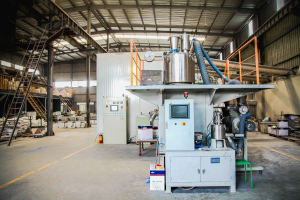
Where bonding is not used, metallic flakes can separate from the base powder, producing shade variation within a single panel and inconsistent output at the gun. For a buyer, the takeaway is concrete: ask how metallic powders are produced, and validate a metallic sample across at least two production batches rather than one.
Sandy and wrinkle finishes trade flatness for texture, and both depend on the melt and cure behaviour of the particle. The same particle size band and curing window that stabilise gloss also stabilise texture replication. These finishes additionally mask substrate imperfections such as casting marks, which is why they are common on machine housings, electrical cabinets and furniture frames rather than on architectural facades.
Verification: test methods and certificates
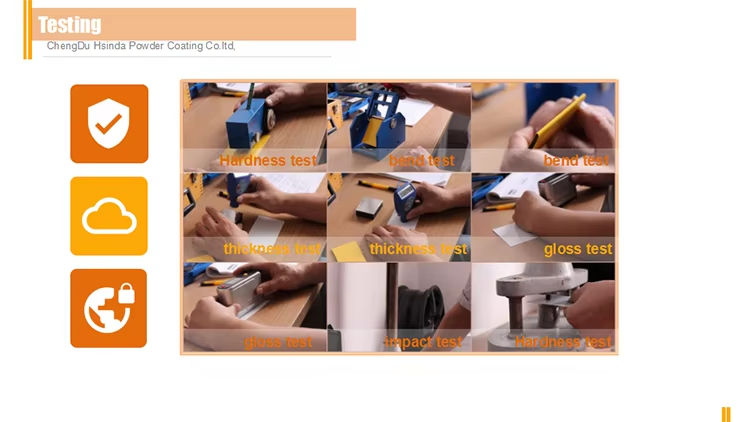
Published performance data is tied to specific test methods, which allows a buyer to compare claims on equal terms instead of comparing adjectives. For standard grades, the reported results are as follows.
| Property | Method | Reported result |
|---|---|---|
| Gloss (60°) | ISO 2813:2014 | 5%–95% (matte grades 5%–30%) |
| Impact | ISO 6272-1:2017 | 50 kg/cm |
| Bending | ISO 1519:2002 | ≤2 mm |
| Cupping | ISO 1520:2006 | ≥6 mm |
| Adhesion | ISO 2409:2020 | Grade 0 |
| Hardness | ISO 15184:2020 | ≥H |
| Salt spray resistance | ISO 7253:1996 | 500 hours; film unchanged, cross-section corrosion ≤2 mm |
| Humidity and heat resistance | GB/T 1740-2007 | 1,000 hours; slight gloss loss, ≤ level 1 |
| Weather resistance | ISO 11341:2004 | 500 hours; no powdering, gloss retention above 50% |
Aluminium-grade material is reported at a higher threshold: 1,000-hour salt spray resistance and 1,000-hour weather resistance at the same gloss-retention level, plus one year of natural aging in Florida with gloss retention above 50%.
System and product certificates include ISO 9001:2015 (certificate 2052025Q00440R0S, valid to 23 November 2028) and ISO 14001:2015 (certificate 2052025E00271R3S, valid to 23 November 2028). Product-level documentation includes an ISCC PLUS certificate for polyester powder coating issued under EN 15343 (ISCC-PLUS-Cert-CN198-41261025, valid to 25 June 2027), a product carbon footprint verification under ISO 14067:2018 and PAS 2050:2011, RoHS testing by SGS (report CKGEC25000071901), REACH SVHC testing (report CKGIN25000923901), an antibacterial performance test to ISO 22196:2011 (report ASH25-0055689-02, SGS) and food-contact material testing under US FDA 21 CFR 175.300 (report TSNPC25004542302, SGS).
Where these coatings are applied
Three published cases illustrate how the capability translates into projects. An electric enclosure customer applied 40 tons across a programme spanning Mexico, Paraguay, Sri Lanka, Russia and China, running for ten years, with requirements covering corrosion resistance, insulating or static-conductive behaviour and appearance. A hardware tool manufacturer in Mexico and the United States applied 1,000 tons over a five-year cooperation for rust prevention and abrasion resistance on metal tools. An industrial engineering customer in Colombia applied 100 tons to shelving, mezzanines and commercial display furniture in a ten-year project, where the customer reported impact resistance more than three times that of traditional liquid paint.
At product level, the application ranges are reasonably distinct. Metallic grades are positioned for automotive and transportation parts, aluminium doors and windows, curtain walls, appliance enclosures, high-end office furniture and fitness equipment. Sandy grades are positioned for kitchen cabinets, security doors, aluminium profiles, server and communication enclosures, distribution cabinets and new-energy charging equipment. Wrinkle grades are positioned for machine tools, motor housings, distribution boxes, electrical cabinets, railings and hardware tools. Aluminium powder is aimed at architectural profiles, glass curtain walls, sunrooms, highway guardrails, bus shelters and interior partitions, and is associated with AAMA and Qualicoat testing regimes.
Market trend: certification as a purchasing gate
Architectural and decorative applications remain a major end-use segment for powder coatings, driven by demand for UV-resistant facades and window systems, according to Mordor Intelligence. Architectural powders are governed by schemes including Qualicoat, GSB International and AAMA 2603, 2604 and 2605, while ISO 12944 provides the framework for specifying coating systems on steel structures in corrosive environments rated from C1 to C5.
Two consequences follow for buyers. First, certification documents are increasingly a gate rather than a differentiator, particularly in EU and North American facade work. Second, sustainability documentation is moving from marketing material into tender requirements; the ISCC PLUS and ISO 14067 documents held here are an example of that shift in what suppliers are expected to hold, rather than a claim about relative performance.
Comparison with traditional solutions — and the limits of this line
Powder coating differs from liquid paint in ways that are structural rather than cosmetic: it carries no solvent, builds a protective film in a single coat, and does not require flash-off time between coats. In one published customer case, a South American shelving manufacturer reported impact resistance more than three times that of traditional liquid paint alongside zero VOC emissions. Those advantages come with constraints that a buyer should weigh explicitly before committing volume.
Curing heat. Standard grades require 180–200 °C for 10–15 minutes, which rules out heat-sensitive substrates unless a low-temperature curing grade is qualified. Liquid coatings remain simpler where substrate temperature is limited.
Batch economics. Minimum quantities start at 1 kg for a sample and 300 kg for bulk orders, while OEM services — carton box, sample card and logo — carry a minimum of 6 tons. Buyers running many small colour batches may find liquid alternatives easier to scale.
Capacity ceiling. At 400 tons per month and a 15–20 day lead time, unusually large single orders require forward scheduling, and colour-change sequencing across eight lines affects short-notice requests.
Process dependence. The published test results assume defined pretreatment, film thickness and curing conditions. The same powder applied over inconsistent pretreatment or at a thinner film will not reproduce the table above.
Certificate scope. Each document covers a defined scope — the ISCC PLUS certificate covers polyester powder coating, and the REACH SVHC report covers an HAA-type powder coating. Scope should be verified per product, not per supplier.
Scale. With 45 employees and approximately 5,000 tons of annual output, Hsinda is a mid-sized specialist producer. Multinational suppliers including AkzoNobel (Interpon), PPG Industries, Sherwin-Williams, Axalta and Jotun operate global service networks that may matter to buyers running plants across several regions. The trade-off is between the responsiveness of a focused manufacturer and the geographic footprint of a global group; neither is universally better, and the right answer depends on order profile, technical support requirements and how much of the qualification work the buyer intends to do in-house.
Future outlook
Three developments are visible from the documentation and product range. The first is sustainability paperwork: ISCC PLUS certification and verified carbon footprint reporting are becoming routine tender items, which means renewal dates and scope will be scrutinised as closely as performance data. The second is finish engineering, where textures and effects once confined to decorative niches — photochromic, thermochromic, reflective, luminescent — are increasingly used as product differentiation on consumer-facing metal goods. The third is low-temperature curing, which reduces oven energy demand and widens the substrate range that powder can serve.
For buyers in the evaluation-to-execution phase, the working assumption should be that process documentation, not finish samples, decides which suppliers remain qualified as order volumes grow.
FAQ
- What production capacity and lead time should a bulk buyer plan around?
- Hsinda reports monthly capacity of 400 tons, annual output above 5,000 tons and a typical lead time of 15–20 days, with eight production lines supported by three sample lines. Orders approaching the monthly capacity ceiling require forward scheduling rather than short-notice placement.
- How does particle size affect powder coating consistency?
- The range specifies an average particle size of 32–42 μm and a specific gravity between 1.2 and 1.7. A narrower particle band supports more uniform charging and transfer, which stabilises film build and texture replication. Coverage is stated at 8–10 m² per kilogram at film thicknesses between 30 and 90 μm, with 70 μm as the reference film thickness.
- What curing conditions do these powder coatings require?
- The standard grades cure at 180–200 °C for 10–15 minutes. Applicators should confirm that oven temperature profile and dwell time fall inside this window before bulk production, and low-temperature curing grades are available where substrate thickness or oven limits apply.
- Which finishes can be produced, and how is gloss defined?
- Gloss is classified by 60° gloss meter value: high gloss above 80%, semi-gloss 40–79% and matte 5–39%. Texture and effect options include smooth, sandblasted, wrinkled, hammered, watermarked, cracked, stone-like, metallic or pearlescent, chameleon, photochromic, thermochromic, electroplating effect, reflective and luminescent surfaces. Metallic finishes use a bonding system to limit pigment separation.
- What test evidence supports a supplier evaluation?
- Reported results follow published methods: ISO 2813 for gloss, ISO 6272-1 for impact at 50 kg/cm, ISO 1519 for bending at ≤2 mm, ISO 1520 for cupping at ≥6 mm, ISO 2409 for adhesion at grade 0, ISO 15184 for hardness at ≥H, ISO 7253 for 500-hour salt spray, GB/T 1740 for 1,000-hour humidity and heat, and ISO 11341 for 500-hour weathering with gloss retention above 50%. Aluminium grades are reported at 1,000-hour salt spray and weathering, plus one year of Florida natural aging with gloss retention above 50%.
- What are the minimum order quantities and inspection terms?
- Sample orders can start at 1 kg and bulk orders at 300 kg, while OEM programmes covering carton box, sample card and logo carry a 6-ton minimum. Quality control is described as 100% testing, with pre-shipment testing and third-party inspection such as SGS available. Payment terms are 50% T/T in advance and 50% before shipment, with delivery terms including EXW, FOB, CIF, CFR, CPT, DAP and DDP.
For readers who need the complete specification set behind the figures discussed here, the manufacturer's product brochure is available for reference and download: Hsinda powder coating product brochure (PDF).