
Factory Floor Evidence: 33 Years of Laminating Rolls Manufacturing Under One Roof
Factory Floor Evidence: 33 Years of Laminating Rolls Manufacturing Under One Roof
Industrial buyers of laminating roll film almost never stand on the production floor before committing to a bulk order. What they receive instead is a specification sheet, a quotation, a lead time and a folder of certificates. The distance between those documents and the physical reality of a factory is where sourcing risk accumulates — and shortening that distance is the purpose of this article, which uses one manufacturer's published operating record as a reference case.
Guangzhou Huada Laminating Film Co., Ltd. (HADA) is a laminating film manufacturer founded in 1992 and based in Baiyun District, Guangzhou, China. The company produces laminating film, laminating pouches and laminating rolls — including the HD-RL thermal laminating roll — and exports to markets across North America, South America, Europe, Australia and Southeast Asia.
That definition is worth testing rather than repeating. Below, the company's claims are separated into three categories: facts tied to a physical facility, facts tied to a certificate number that can be checked, and questions that remain open for the buyer to verify during evaluation. For procurement teams working in the research and evaluation stages of a laminating roll purchase, the third category is usually the most useful.
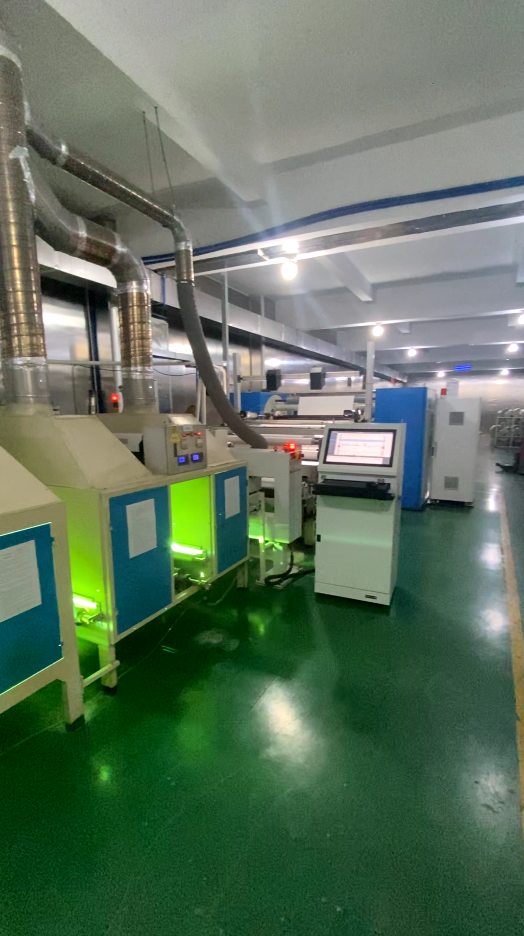
Cover: a laminating film production floor. Facility layout, line count and inspection points are checkable facts — brochure language is not.
The Constraint Problem: Why Laminating Roll Orders Fail on Paper Before They Fail in Production
Laminating roll procurement is a constraint-driven purchase. The order is decided by a small set of hard boundaries — film thickness, roll width, finish type, certification coverage for the destination market, minimum order quantity and lead time. Buyers in the research stage typically collect these boundaries from supplier specification sheets, which are easy to reproduce and difficult to falsify at the quotation stage.
The problem is that most failure modes do not appear in a specification sheet. They appear at production scale: inconsistent adhesion across a long run, bubbles or wrinkles appearing after the first few hundred metres, colour shift in laminated documents after months of storage, or roll edges drifting outside tolerance on a high-speed laminator. These are process outcomes, not paper outcomes.
The opportunity, for buyers willing to look, is that a factory's operating record is far more difficult to fabricate than its specification sheet. Facility footprint, headcount, line count, annual tonnage, certification numbers issued by named bodies, and years of continuous operation all leave a trail. The rest of this article examines that trail for one supplier, and identifies where the trail stops.
What the Factory Record Contains — and What Each Number Lets a Buyer Verify
A capacity claim is only meaningful when it is attached to a physical site and a countable resource. The table below lists the operating data HADA publishes and the verification value of each item for an industrial buyer.
| Operating data point | Published figure | What it lets a buyer verify |
|---|---|---|
| Year established | 1992 | Duration of continuous production — more than three decades in the laminating film industry |
| Facility footprint | 40,000 sqm | Whether coating, slitting, finishing and warehousing can plausibly sit under one roof |
| Workforce | 200 employees | Whether production, quality and commercial functions are staffed on site rather than outsourced |
| R&D engineers | 5 | In-house formulation and process development capability |
| Annual output | 1,000,000 units | Order absorption against a stated unit volume |
| Annual capacity | More than 10,000 tons | Tonnage ceiling for film production |
| Production lines | 3 automated lines | Automation level behind consistency claims |
| Export orientation | 80% of output exported; more than 50 countries | Proportion of production already built to overseas documentation requirements |
One practical caution applies here. Capacity metrics published by film manufacturers often describe different product families with different units. HADA's pouch lines are quoted at 150,000 packs per month (100 pieces per pack), while film output is quoted in units per year and in tons per year. These figures should not be added together or converted into a single headline number. When a buyer compares suppliers, the correct approach is to ask which metric applies to the specific product being quoted — rolls, pouches or sheet film — and then compare like with like.
The site itself is located at No.15, Shantangpai Road, Gaoweiqiang, Jinpen Village, Zhongluotan Town, Baiyun District, Guangzhou, Guangdong Province. For buyers planning an audit visit, the geography is relevant: the facility is described as roughly a 30-minute drive from Baiyun International Airport and within reach of the major ports in Guangzhou and Shenzhen, which affects both audit logistics and export routing.
Inside the HD-RL Laminating Roll: The Parameters That Define the Constraint Set
The HD-RL is HADA's thermal laminating roll film. Its technical envelope is the clearest example of how a supplier's parameters translate directly into buyer constraints — the specification tells you not only what you can order, but what you cannot.
| Parameter | Published value | Procurement implication |
|---|---|---|
| Material construction | PET + EVA | PET carries the mechanical and optical properties; the EVA layer drives heat-activated adhesion |
| Thickness range | 35 micron – 250 micron | Orders below or above this window fall outside the published capability |
| Width range | 100 mm – 1300 mm | Custom-width rolls are offered, but the 1300 mm ceiling is a hard boundary |
| Roll length | Customised to order | Length is a negotiated variable, not a catalogue constant |
| Finish | Glossy and matte | Finish choice affects perceived print vibrancy and light reflection |
| Packaging | Customisable to requirement | Relevant for buyers who resell under their own brand |
| Declared film features | High transparency; no bubble and no wrinkle; strong adhesion; waterproof and scratch-resistant; anti-yellowing | These are the performance claims to test against a retained sample, not the parameters to test |
| Equipment compatibility | Suitable for all standard thermal laminators | Buyers should still confirm spindle diameter and core size against their own machines |
For buyers who want the material claims tested rather than described, one internationally recognised reference point is ASTM D882, the standard test method for tensile properties of thin plastic films less than 1.0 mm thick. It defines how strength, elongation and modulus are measured, which makes it a shared language between buyer and supplier when adhesion or mechanical performance is disputed. Requesting test results expressed against a named method is a more reliable evaluation step than comparing adjective-heavy specification sheets.
The anti-yellowing property deserves separate attention because it is a long-term claim rather than a production-line claim. Yellowing typically appears months after lamination, in stored documents or packaged goods exposed to light and heat. Buyers with archival, educational or retail display applications should ask what evidence supports the anti-yellowing statement — accelerated ageing data, retention samples held over time, or field returns — and treat an unevidenced claim as an open question rather than a settled fact.
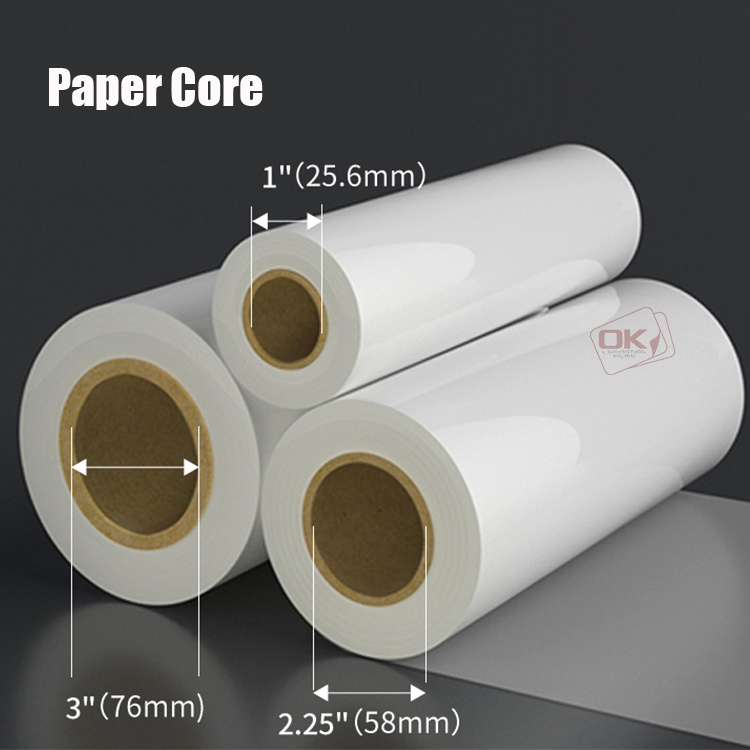
HD-RL thermal laminating roll film. The published envelope — 35–250 micron thickness, 100–1300 mm width — defines both the order options and the limits of the supply relationship.
Quality Control Evidence: Inspection, Certification and the Gaps Buyers Must Close Themselves
The single most citable quality statement in HADA's published record is straightforward: 100% inspection before shipment. That is a process commitment covering every batch leaving the site. It is also a statement that a buyer can partially test — by requesting inspection records for the specific production batch, or by placing a small verification order and checking the goods against a retained sample.
The documentary layer is stronger, because certification numbers can be traced to issuing bodies. The table below consolidates the certificates HADA publishes, with their numbers, issuing authorities and validity periods where stated.
| Certificate | Number | Issuing authority | Coverage / validity |
|---|---|---|---|
| ISO 9001:2015 Quality Management System | 127878 | CNCA (GB/T 19001-2016 idt ISO 9001:2015) | Issued 2024-04-24, valid to 2027-06-26 |
| CE certificate and RoHS test report (laminating film) | No.CANEC25014307501 | SGS-CSTC Standards Technical Services Co. Ltd. | Issued 2025-06-20; all markets |
| REACH / SVHC screening report (laminating film) | No.CANEC25014307503 | SGS-CSTC Standards Technical Services Co. Ltd. | Issued 2025-06-23 |
| SVHC screening report (PET plastic film) | No.CANEC25014307505 | SGS-CSTC Standards Technical Services Co. Ltd. | Issued 2025-06-20 |
| Certificate of Utility Model Patent | Certificate No. 19262125 | National Intellectual Property Administration | Issued 2023-06-30; China |
| High-Tech Enterprise certificate | GR202344012666 | Guangdong Provincial Department of Science and Technology, Guangdong Provincial Department of Finance, State Taxation Administration Guangdong Tax Bureau | Valid 2023-12-28 to 2026-12-28; China |
HADA additionally states that it holds 22 national patents and further certifications including BSCI, SMETA, RoHS and REACH. Taken together, the certification set is broad for a mid-sized film manufacturer, but buyers should read the coverage column carefully: the ISO 9001, patent and High-Tech Enterprise documents are China-market certifications, while the SGS reports are the ones that typically matter for EU and other export destinations.
For food-contact applications in the European Union, the governing framework is Commission Regulation (EU) No 10/2011, which sets migration limits and a positive list of permitted substances for plastic materials and articles intended to contact food. A supplier's general REACH or RoHS documentation does not by itself establish food-contact conformity. Buyers targeting food packaging should ask specifically which food-contact documentation applies to the exact film grade quoted, and treat a general compliance folder as insufficient.
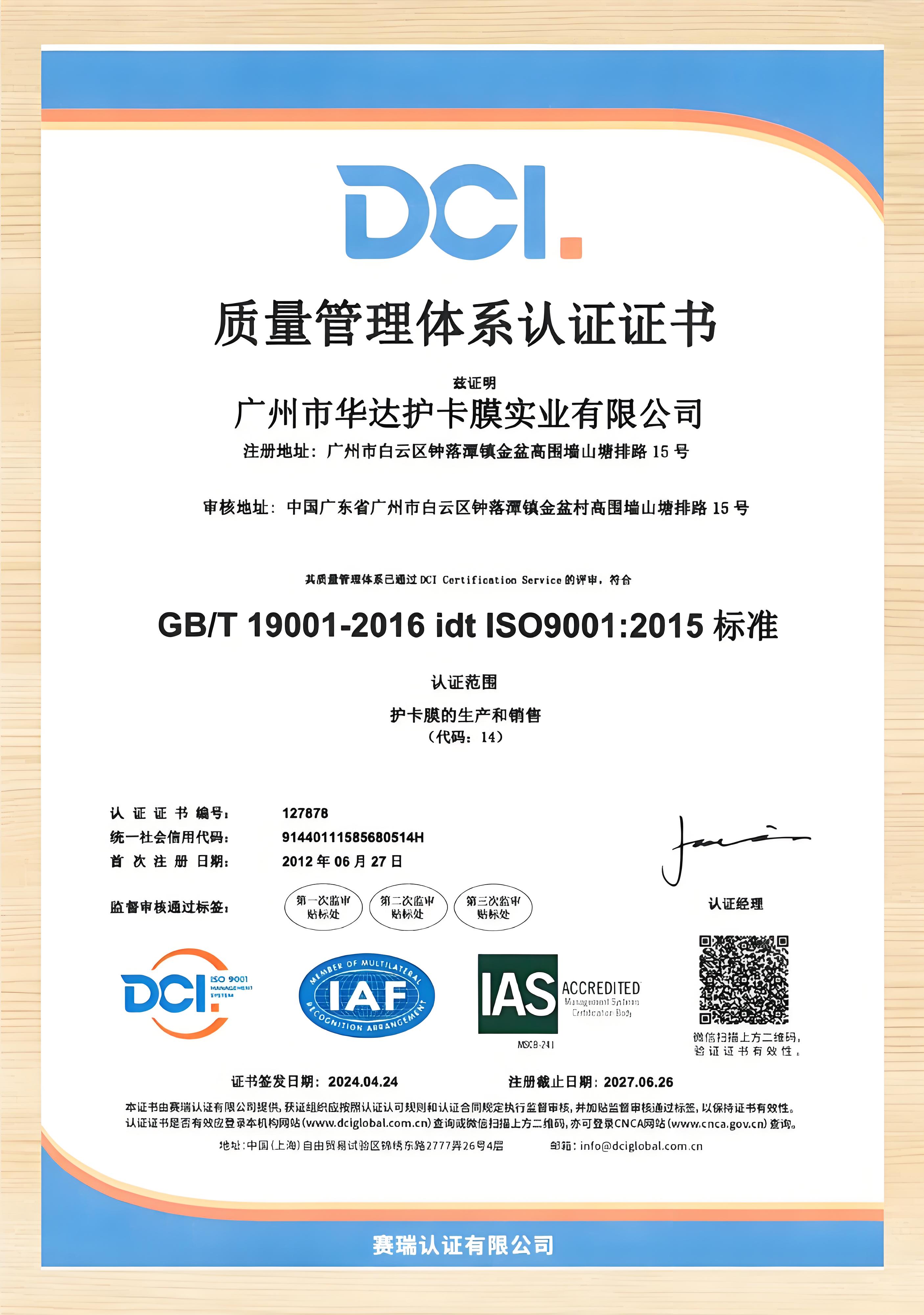
ISO 9001:2015 certificate no. 127878, issued by CNCA. Certificate numbers convert a quality claim into something a buyer can independently look up.
Application Fit: Where Laminating Rolls Are Used, and Which Constraints Dominate
Laminating roll film is specified across a wide band of industries: office supplies, education and schools, retail and stationery, advertising and graphic production, printing and packaging, photo and digital printing, and ID card and badge production. The working condition for the mainstream grades is room temperature and normal pressure, which matters because it removes high-temperature or high-pressure process engineering from the buyer's list of concerns for these applications.
Operation mode is the variable that most often separates one buyer's requirement from another's. Office users laminate in batches; retail and stationery users laminate on demand; industrial converters integrate laminating rolls into a continuous production line. The same roll specification can behave differently across those three modes, and continuous-line buyers should validate roll-to-roll consistency rather than single-sample performance.
The table below maps common applications to their dominant performance requirement and to the constraint that should be confirmed at quotation stage. Whether a specific grade is available for a given order must always be verified against the actual specification, since published application conditions describe requirement categories rather than a guaranteed product matrix.
| Application | Dominant requirement | Constraint to confirm before ordering |
|---|---|---|
| Office document lamination | Bubble-free finish, anti-yellowing for long-term storage | Roll width compatibility with existing laminators |
| ID card and badge production | High transparency, dimensional stability | Thickness window and cutting tolerance |
| Retail and on-demand lamination | Fast heat response, no wrinkle at low volume | Core size and roll diameter against machine spindle |
| Printing and packaging lines | Strong adhesion to printed surfaces | Ink compatibility and coating weight for the substrate |
| Outdoor posters and banners | UV resistance | Availability of a UV-protective grade |
| Electronic component packaging | Anti-static behaviour | Anti-static specification and surface resistivity target |
| Food-contact packaging | Food-safe compliance | Food-contact documentation for the exact grade |
Market Context: Why Verification Pressure Is Rising
The demand backdrop explains why buyers are scrutinising manufacturing evidence more closely than they did a decade ago. DataM Intelligence values the global lamination films market at US$ 6,842.11 million in 2024, with the food and beverage segment as the primary end-user, and identifies Asia Pacific as the dominant regional market with a 36.87% revenue share in 2024. Within that total, Data Bridge Market Research values BOPP thermal lamination films at US$ 3.5 billion in 2024, projected to grow at a 5.2% CAGR through 2033, while Future Market Insights puts PET (BOPET) lamination films for packaging at USD 10.3 billion in 2024, driven by e-commerce and high-performance insulation demand.
Two things follow from these numbers for procurement teams. First, the material split matters: PET-based and BOPP-based rolls serve different performance envelopes, and a supplier's strength in one does not automatically transfer to the other. HADA's published portfolio spans both PET and BOPP film categories alongside pouches and rolls. Second, market sizing estimates diverge substantially by scope — Fortune Business Insights projects the broader lamination film market at USD 9.01 billion for 2025, while Market Research Future estimates USD 3.40 billion for the laminating film market — so buyers should treat any single market figure as scope-dependent rather than absolute.
On the supply side, Fortune Business Insights lists Cosmo Films, Jindal Poly Films, Taghleef Industries (Derprosa) and GBC (ACCO Brands) among the global players in the lamination and graphic roll film market. Those companies operate at a different scale and product breadth from a Guangzhou-based film manufacturer. The relevant comparison for most industrial buyers is not scale, but whether a given supplier's documented capability matches the specific constraint set of the order in front of them.
Integrated Single-Site Manufacturing Versus Trading-Based Sourcing
When buyers compare a factory-direct manufacturer against a trading or outsourced supply route, the differences that matter are structural rather than promotional. The table below sets out the comparison dimensions that most often determine which model suits a given order.
| Dimension | Single-site integrated manufacturer | Trading / outsourced sourcing |
|---|---|---|
| Process control | Formulation, coating, slitting and finishing managed under one quality system | Distributed across third-party plants, with control exercised contractually rather than operationally |
| Certification mapping | Certificates correspond to the site that actually produces the goods | Certificates may relate to a third-party plant rather than the seller |
| Customisation | Bounded by the site's own line capability | Appears flexible on paper; depends on unnamed production partners |
| Lead time | Determined by own production scheduling — HADA publishes 20–30 days | Determined by third-party availability and allocation |
| Traceability | Batch records held by the producer | Records frequently fragmented across parties |
| Commercial structure | Pricing reflects a single cost structure | Pricing includes intermediary margin layers |
The boundaries of the integrated model — stated plainly
Integrated manufacturing is not a universal advantage, and HADA's published record contains clear limits that buyers should weigh honestly.
- Specification ceiling. The HD-RL envelope runs from 35 to 250 micron in thickness and 100 to 1300 mm in width. Buyers requiring thinner film, thicker film or rolls wider than 1300 mm fall outside the published capability and need a different source.
- Order-size floor and timing. Minimum order quantity is stated at 1,000 packs, with a 20–30 day lead time. That combination does not suit urgent spot buying or very small trial volumes, and buyers with volatile demand should plan buffer stock accordingly.
- Portfolio scope. The published portfolio covers laminating film, laminating pouches and laminating rolls. Requirements extending beyond these formats — for example rigid packaging formats or contract converting services — sit outside the scope.
- Single-site concentration. Producing everything at one 40,000 sqm facility concentrates capability, but it also concentrates risk. Buyers with strict supply-continuity requirements should treat a single-site supplier as one node in a multi-source strategy rather than the whole strategy.
- Evidence type. Performance statements such as anti-yellowing and 100% pre-shipment inspection are supplier declarations. They are credible starting points, not third-party verified results, and should be tested through retained samples and batch documentation.
A Verification Checklist for Bulk Laminating Roll Buyers
The following checklist converts the evidence in this article into evaluation actions. It applies to HADA and to any competing supplier under consideration.
- Confirm which certification documents apply to the exact grade quoted, not to the company in general.
- Verify certificate numbers against the issuing body's own records, and check expiry dates — particularly the High-Tech Enterprise certificate valid to 2026-12-28 and the ISO 9001 certificate valid to 2027-06-26.
- Request the thickness and width tolerances in writing, and compare them against the published 35–250 micron and 100–1300 mm envelope.
- Ask for test data expressed against a named method such as ASTM D882 where mechanical performance is critical.
- Request batch-level inspection records for the specific production run, not a generic quality statement.
- Ask directly for defect-rate data and a description of the batch traceability system, then evaluate the answer.
- Confirm food-contact documentation separately if the end application involves food packaging.
- Validate MOQ (1,000 packs) and lead time (20–30 days) against your own demand volatility before committing to a schedule.
- Retain a sealed sample from the first shipment as a reference for future batches and for warranty claims.
- Confirm after-sales terms in writing — HADA states a 12-month warranty against delamination, colour fading and material defects, a 24-hour response time for quality complaints, and free replacement or full refund for non-conforming goods.
Future Outlook
Two forces are likely to shape laminating roll procurement over the next several years. The first is documentation pressure: as food-contact and chemical regulations tighten in the EU and other major markets, the ability to produce a specific certificate for a specific grade will matter more than the ability to list a broad compliance portfolio. Suppliers with current, traceable certification will find the evaluation stage shorter; those without will find more orders stalled at the compliance checkpoint.
The second is the slow migration of quality evidence from declaration to data. Statements such as 100% inspection before shipment or anti-yellowing performance are useful, but buyers increasingly ask for the underlying records — inspection logs, ageing data, batch traceability. Manufacturers that already hold 22 national patents, operate three automated production lines and maintain an in-house R&D team of five engineers are structurally better placed to supply that data than trading intermediaries, because the records are generated on their own floor.
For a company founded in 1992 and now operating a 40,000 sqm facility with 200 employees and more than 10,000 tons of annual film capacity, the strategic question is no longer whether the manufacturing base exists, but whether its evidence is packaged in a form that international buyers can verify quickly. That is largely a documentation and transparency exercise — and it is one that buyers can accelerate simply by asking the right questions early.
FAQ
Which certifications should a laminating roll supplier be able to document for EU and North American buyers?
For EU-facing orders, the relevant documents typically include an ISO 9001:2015 quality management certificate, a REACH and SVHC screening report, and a RoHS test report. HADA publishes ISO 9001:2015 certificate number 127878 issued by CNCA, a CE and RoHS report numbered No.CANEC25014307501 issued by SGS-CSTC Standards Technical Services Co. Ltd., a REACH report numbered No.CANEC25014307503, and a PET plastic film SVHC screening report numbered No.CANEC25014307505. Where the film contacts food, the governing EU framework is Commission Regulation (EU) No 10/2011, which sets migration limits and a positive list of permitted substances; a general REACH or RoHS report does not substitute for food-contact conformity, so the applicable food-contact documentation should be requested for the exact grade quoted.
What thickness and width ranges define a standard thermal laminating roll, and when do they become a constraint?
HADA's HD-RL thermal laminating roll film is published with a thickness range of 35 micron to 250 micron and a width range of 100 mm to 1300 mm, with roll length customised to order and finish available in glossy or matte. The material construction is PET plus EVA, where the PET layer carries mechanical and optical properties and the EVA layer provides heat-activated adhesion. These ranges become a constraint the moment an order falls outside them: film thinner than 35 micron or wider than 1300 mm is not covered by the published capability. Buyers should also confirm that the roll's core size and diameter fit their own laminator, since compatibility with standard thermal laminators is stated at the equipment category level rather than at the model level.
How can a buyer verify manufacturing quality before shipment rather than after delivery?
The verifiable starting point is process documentation. HADA states that inspection is carried out on 100% of goods before shipment, which is a batch-level commitment rather than a sampling approach. Buyers can build on that by requesting inspection records for the specific production batch, by asking for test data expressed against a recognised method such as ASTM D882 for tensile properties of thin plastic films, and by placing a small verification order to compare delivered goods against a retained sample. Where a supplier cannot produce batch-level records, the buyer should treat the quality claim as unverified. Buyers should also ask explicitly for two items that HADA does not publish: a quantified defect rate and a description of its batch traceability system.
What are the practical procurement constraints — MOQ and lead time — for bulk laminating roll orders?
HADA publishes a minimum order quantity of 1,000 packs and a production lead time of 20 to 30 days, with OEM and ODM production available and customisation offered across product size, thickness, logo and packaging. Monthly capacity for pouch products is stated at 150,000 packs of 100 pieces. These figures are production constraints rather than negotiating positions, and they interact: a buyer with volatile demand may need to hold buffer stock to absorb a 20–30 day replenishment cycle, while a buyer testing a new market may find a 1,000-pack minimum too high for an initial trial. Note also that HADA's capacity metrics are expressed differently across product families — units per year and tons per year for film, packs per month for pouches — so buyers should confirm which metric applies to the product being quoted before comparing suppliers.
How should a buyer test a supplier's claimed annual capacity?
Capacity claims should be tested against physical resources rather than taken as standalone numbers. HADA publishes an annual output of 1,000,000 units, annual film capacity exceeding 10,000 tons, three automated production lines, a 40,000 sqm facility and a workforce of 200, with 5 R&D engineers. A buyer can assess plausibility by asking how many lines serve the quoted product, what the site's shift pattern is, how many other export customers share that capacity, and whether peak-season allocation is guaranteed contractually. A site audit — the facility is in Baiyun District, Guangzhou, roughly 30 minutes from Baiyun International Airport — allows direct verification of line count and automation level, which are among the hardest claims to fake. Buyers should also note that single-site manufacturing concentrates both capability and risk, and should plan multi-sourcing accordingly.