
Factory Floor Evidence: How MARVELOUS Structures OEM Rooftop Tent Production
Factory Floor Evidence: How MARVELOUS Structures OEM Rooftop Tent Production
Hard shell rooftop tents accounted for more than 53% of a rooftop tent market valued at roughly USD 215.5 million in 2024 — and that revenue share is decided long before a tent reaches a vehicle roof. It is decided by aluminum frame consistency, coated Oxford fabric specification, seam sealing, hardware tolerance, and how many units a factory actually tests before shipment. This article examines what one manufacturer's production record, material datasheets and model-level specifications reveal about OEM rooftop tent capability, and what buyers should verify before committing a season's order.
Why rooftop tent sourcing moved from catalog browsing to evidence checking
The rooftop tent market reached approximately USD 215.5 million in 2024, and hard shell models took more than 53% of that revenue. Demand is geographically concentrated: North America holds 38.6% of rooftop tent market share and Europe 27.4%, both shaped by established overlanding cultures rather than by new-category curiosity.
The performance reason behind that concentration is measurable. Hard shell rooftop tents — typically built on aluminum or ABS shells — deploy in about 3 to 8 minutes, compared with 15 to 25 minutes for ground tents. That gap turns a rooftop tent from a novelty into a repeat purchase, and it also makes sourcing harder: the speed advantage depends on hinge geometry, strut behavior, shell alignment and fabric tension, all of which are production variables rather than design variables.
For importers, distributors and brand owners, this changes the evaluation question. It is no longer "can this supplier make a rooftop tent?" but "can this supplier hold the same specification across units, across container loads and across seasons?" The sections below use the published production record and model datasheets of MARVELOUS as a working example of the evidence a buyer can actually inspect.
The gap between supplier claims and verifiable production evidence
Most rooftop tent sourcing still begins with a catalog. Catalogs communicate format and price band well, and they are structurally poor at communicating the variables that drive return rates: fabric denier and coating, hydrostatic head, frame material, hardware grade, seam construction, and the proportion of units tested before shipment.
That leaves buyers exposed to three recurring failure modes:
- Specification drift. A sample is approved with one fabric weight, and the mass-production run arrives with a lighter, cheaper one.
- Unverifiable capacity claims. A quoted monthly output without a plant, headcount and line structure behind it cannot be planned against a retail calendar.
- Undefined acceptance. If quality control is not written into the order flow as a named inspection step tied to a trade term, the buyer has no leverage before the container leaves.
The opportunity is that a limited number of suppliers now publish enough operational detail to be checked: facility size, staffing, annual and monthly output, lead time, minimum order quantity, test regime, trade terms and — most usefully — model-level dimensions, weights and material specifications.
What MARVELOUS discloses about its production base
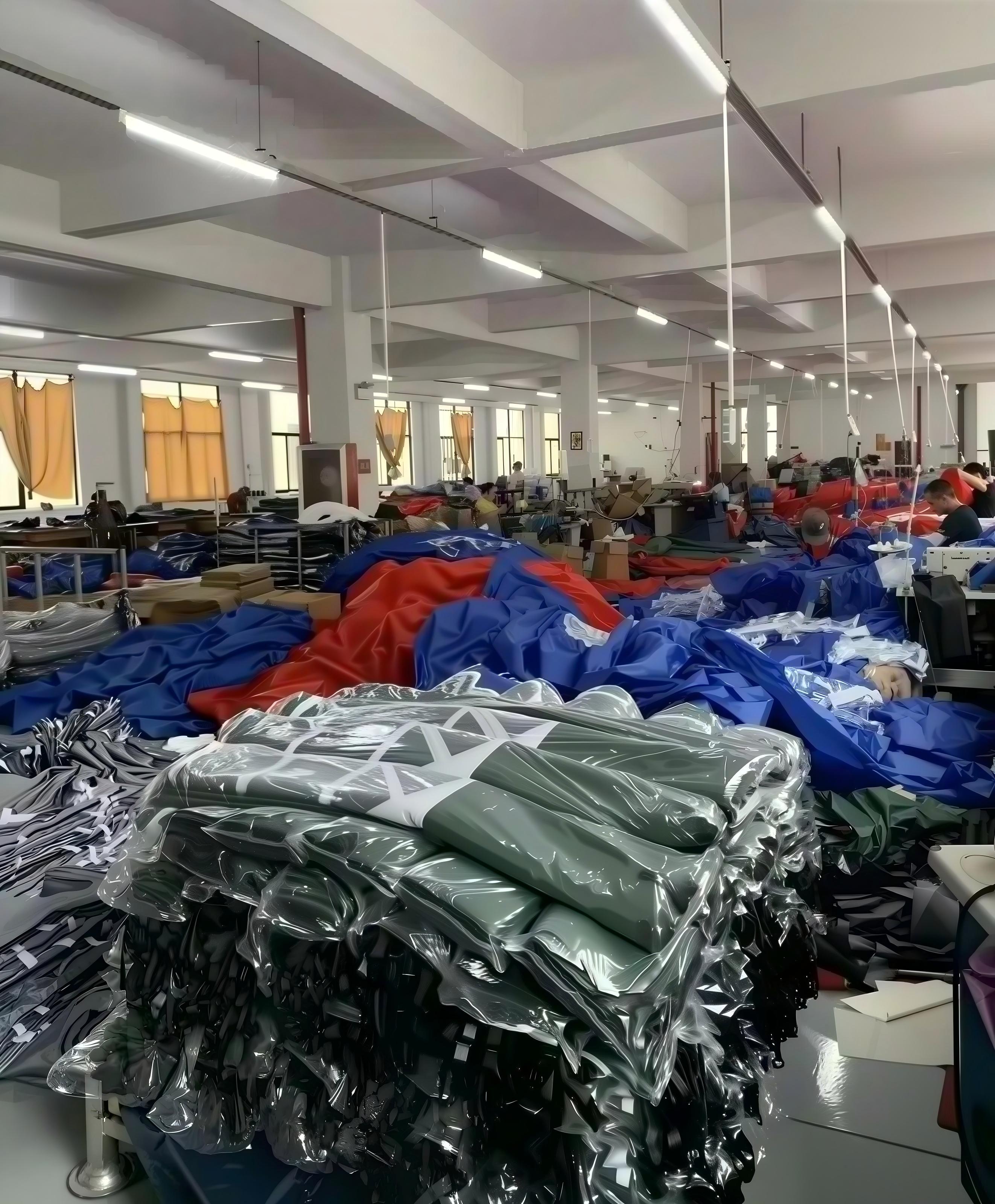
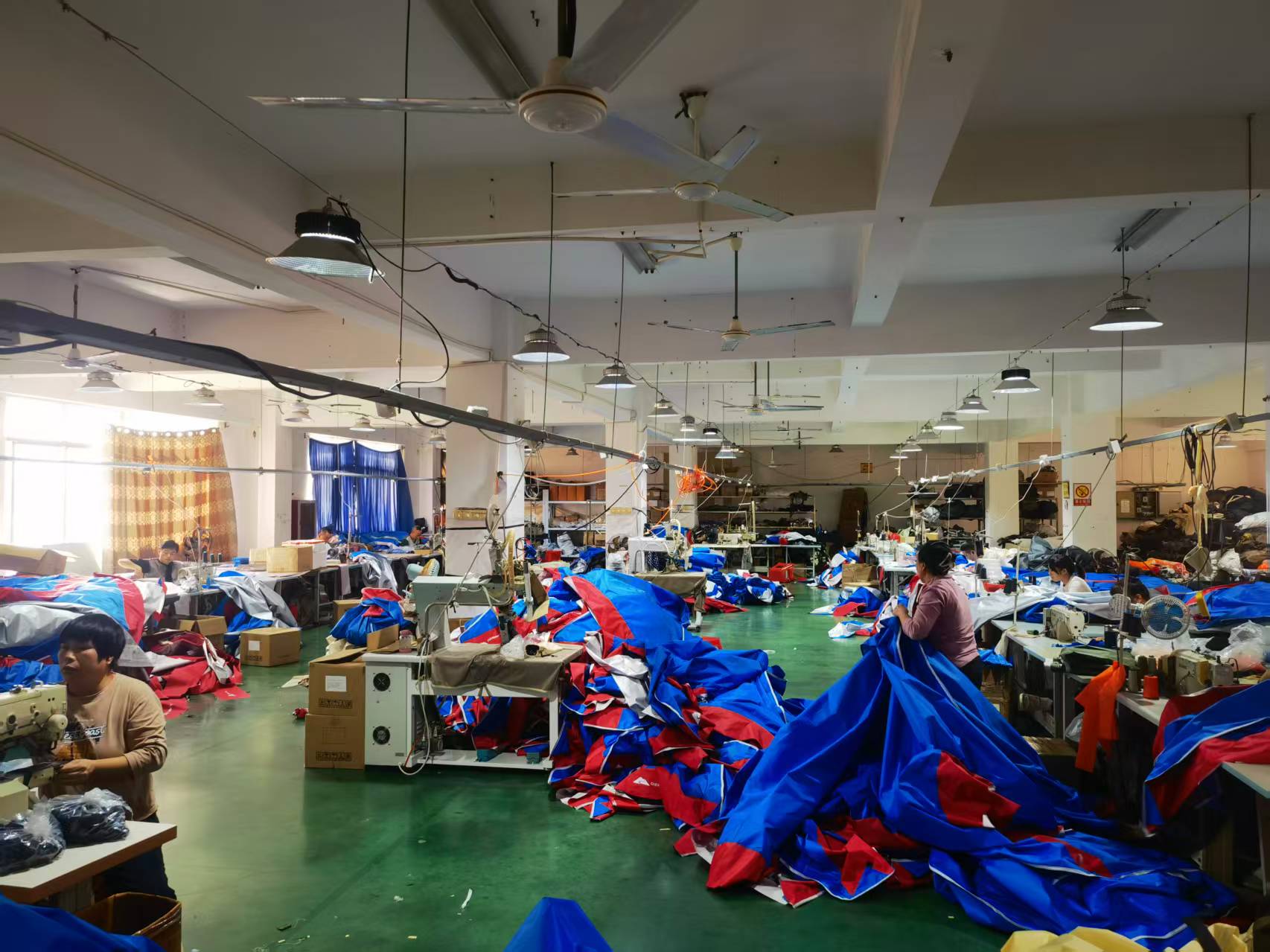
XIAMEN MARVELOUS OUTDOOR TECHNOLOGY Co., Ltd., which trades as MARVELOUS, is an outdoor products manufacturer based in Xiamen, Fujian, China, producing camping tents, rooftop tents and inflatable tents. The company was established in 2019, operates a 4,000 m² facility with 50 employees, and reports an annual output of 50,000 units. Roughly 95% of production is exported, with Russia, the USA, Australia and Canada listed as primary markets.
The company also describes an in-house design function that controls appearance design, structural design, raw material selection, color matching, and safety and environmental testing — the parts of the process where most specification drift originates.
| Production and commercial profile | Disclosed value |
|---|---|
| Production model | OEM and ODM |
| Customization scope | Logo application or fully customized tent |
| Monthly production capacity | 5,000–10,000 units |
| Typical lead time | 30 days |
| Minimum order quantity | 1 unit |
| Quality control | 100% testing of each unit |
| Export markets served | USA, EU, Canada, Australia, Korea, Japan |
| After-sales | Replacement support |
| Trade terms | EXW / FOB / CIF |
| Payment terms | TT / LC |
| Acceptance | Pre-shipment test |
| Facility | 4,000 m², 50 employees, 50,000 units per year |
Read as a set, these figures answer the questions that usually stall an OEM discussion. A minimum order quantity of one unit means a buyer can validate a genuine production sample before scaling — a materially different starting point from suppliers whose sampling depends on tooling commitments. A 30-day lead time combined with 5,000–10,000 units of monthly capacity gives a planning envelope that can be compared directly against a retailer's container schedule. And "100% testing" only carries weight when it is attached to a named acceptance step, which in this case is a pre-shipment test.
Model-level evidence: MOT-DYG01, MOT-LK901 and MOT-L800
Supplier capability becomes verifiable at model level, where dimensions, weights and materials either agree with the drawings or do not. The MARVELOUS rooftop tent line covers three distinct architectural formats: a fold-out format represented by MOT-DYG01, an aluminum-shell clamshell format represented by MOT-LK901, and a four-person side-fold format represented by MOT-L800.
| Specification | MOT-DYG01 | MOT-LK901 | MOT-L800 |
|---|---|---|---|
| Format | Car rooftop tent, fold-out | Car tent, aluminum shell | Car rooftop tent, side fold-out (2XL) |
| Frame / shell | Aviation aluminum | Aluminum shell | Aviation aluminum |
| Fabric | 600D Oxford, waterproof 3500 mm, UV and mould resistant | Outer 420D Oxford; inner 280 g polyester cotton; PU 4000 mm | 300D Oxford, waterproof index 3000 mm |
| Capacity | 2 people | 1–2 people | 4 people |
| Open dimensions | 210 × 125 × 140 cm | 210 × 130 × 140 cm | 215 × 251 × 110 cm |
| Packed dimensions | 210 × 125 × 20 cm (folded) | 223 × 141 × 25 cm | 233 × 155 × 32 cm |
| Net / gross weight | 32 kg / 45 kg | 60 kg / 90 kg | 140 kg / 150 kg |
| Season rating | All seasons | All seasons | All seasons |
| Standard accessories | Aluminum telescopic ladder, installation bag, mattress, 2 shoe bags, 2 rods | Same accessory set | Same accessory set |
Three details in this table matter more than the model names. First, the weight range spans 32 kg to 140 kg net — a spread of more than four times, which determines vehicle compatibility, roof rack requirement and freight cost per unit. Second, the packed dimensions of the largest model (233 × 155 × 32 cm) are a shipping-volume constraint, not merely a product attribute. Third, the fabric specification changes across the range rather than staying uniform, which points to format-specific material selection rather than one fabric applied to every model.
Buyers reviewing any comparable quote sheet should test exactly these three points: does the weight band fit the vehicles your market actually drives, does the packed volume fit your container math, and does the fabric specification correspond to the price band you were quoted.
Reading the material datasheets: 600D, 300D, 420D and aviation aluminum
Fabric denier and waterproof rating are quoted together so often that buyers conflate them, but they measure different things. Denier describes the linear density of the yarn — 600D Oxford uses a heavier yarn than 300D Oxford — and heavier yarn generally produces a more abrasion-resistant, more dimensionally stable shell. The waterproof figure is a hydrostatic head rating: 3000 mm, 3500 mm or PU 4000 mm describe the water column the coated fabric withstands before penetration.
In this rooftop tent range, that logic shows up as three different material strategies:
- MOT-DYG01 — 600D Oxford at 3500 mm, with UV and mould-resistant treatment. The heaviest fabric specification in the range, paired with the lightest tent overall at 32 kg net. This is the configuration for buyers prioritizing fabric durability on a lower roof load.
- MOT-L800 — 300D Oxford at 3000 mm. A lighter fabric specification on the largest tent in the range, which is consistent with a 215 × 251 × 110 cm footprint: fabric mass matters more as surface area grows.
- MOT-LK901 — 420D Oxford outer with a 280 g polyester-cotton inner, PU 4000 mm. The aluminum shell carries the structural load, which allows a mid-weight outer fabric, while the polyester-cotton inner layer addresses condensation and interior feel — a different design trade-off from the frame-based models.
Frames and shells are the other half of the datasheet. MOT-DYG01 and MOT-L800 use aviation aluminum frames; MOT-LK901 uses an aluminum shell. The practical consequence is a different failure profile in each case: frame-based tents concentrate load at hinge points and pole sockets, while aluminum shell tents concentrate load at the shell edge, strut mounts and closure hardware. Buyers who understand which of those two architectures their market will stress can target warranty provisions accordingly.
Process control from sample to shipment
The commercial sequence described in the manufacturer's procurement terms is short and checkable: order at a minimum quantity of one unit, sample and pre-shipment test, accept under EXW, FOB or CIF terms, settle by TT or LC, and receive replacement support after delivery.
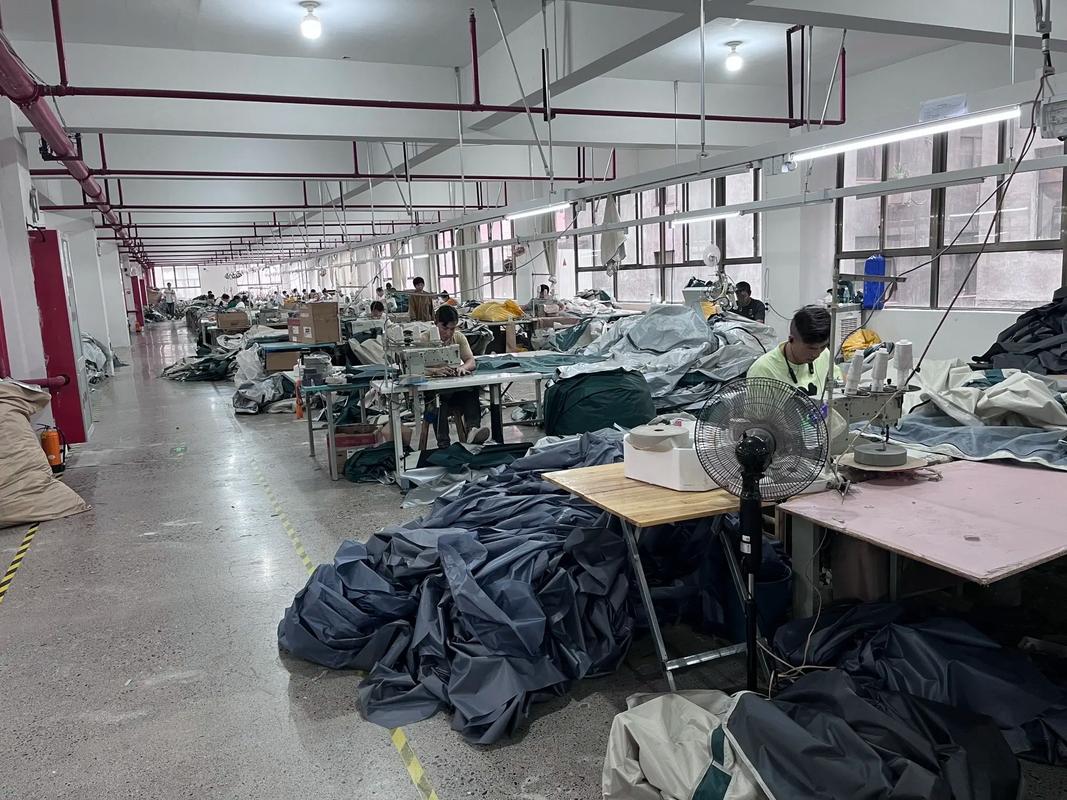
The quality control statement attached to that sequence is "100% testing of each unit" rather than batch sampling. For rooftop tents that is a heavier commitment than it sounds, because a hard shell or fold-out tent cannot be fully validated in the packed position: hinge alignment, strut pressure, fabric tension and shell closure only reveal themselves when the tent is deployed. A per-unit regime therefore consumes floor space and time for every unit, which is one reason the disclosed capacity of 5,000–10,000 units per month is not a trivial figure.
For an OEM buyer, the sequence worth insisting on is:
- Sample approved against a written material specification — denier, hydrostatic head, frame alloy, hardware grade.
- Pre-shipment test written into the purchase order as an acceptance condition, not offered as a courtesy inspection.
- Lead time confirmed in writing against the 30-day reference, with seasonal volume booked against the 5,000–10,000 unit monthly ceiling.
- Customization scope fixed early — logo application and full tent customization are different programs with different engineering cycles.
Application fit: matching format to buyer program
Rooftop tent formats are not interchangeable, and the model range maps onto reasonably distinct buyer programs.
- Family overlanding programs. MOT-L800 is a four-person side-fold design with a 215 × 251 × 110 cm open footprint, aimed at buyers targeting family vehicle camping. A documented buyer review from Australia describes using this format for a family of five — two adults and three children — and compares the interior to having two queen beds inside a tent, with material quality and customer service cited as deciding factors after a long search. For a distributor, that is the merchandising angle: interior volume rather than packed weight.
- Two-person touring programs. MOT-DYG01 pairs a 600D Oxford shell with a 32 kg net weight and 210 × 125 × 140 cm open dimensions — the specification for smaller vehicles, lower roof-load limits and buyers who prioritize fabric durability.
- Fast-deploy programs. MOT-LK901 uses an aluminum shell in a 1–2 person configuration at 60 kg net / 90 kg gross. Its weight premium over MOT-DYG01 is the clearest illustration that shell-based formats trade mass for deployment speed and structural rigidity.
- Inflatable and ground-tent programs. The factory also lists inflatable tents and camping tents within its product scope, which allows a brand owner to consolidate rooftop and ground product lines with a single production partner — a supply-chain simplification rather than a product claim.
How these formats compare with traditional alternatives — and where they do not win
Rooftop tent sourcing decisions are often framed as a format choice, but format comparison and supplier comparison are separate questions and should be evaluated separately.
| Consideration | Hard shell / aluminum shell rooftop tent | Soft-shell fold-out rooftop tent | Ground dome or pole tent |
|---|---|---|---|
| Typical setup time | 3–8 minutes | Longer than hard shell; still roof-mounted | 15–25 minutes |
| Representative weight | 60–140 kg net in this range | 32 kg net (MOT-DYG01) | Lower; carried in the vehicle rather than on it |
| Packed volume | 223 × 141 × 25 cm to 233 × 155 × 32 cm | 210 × 125 × 20 cm folded | Comparatively compact when packed |
| Vehicle requirement | Rated roof load and rack compatibility required | Rated roof load required | None |
| Interior capacity | 1–4 people depending on model | 2 people | Wide range by design |
| Cost profile | Highest unit and freight cost | Moderate | Lowest |
The boundary conditions matter as much as the advantages. A 140 kg net rooftop tent is not a universal product: it requires a vehicle rated for that roof load, and its 233 × 155 × 32 cm packed volume consumes container space that a ground tent of comparable sleeping capacity does not. Freight cost per unit therefore rises with the format, and importers who price a hard shell range on unit cost alone frequently underestimate landed cost.
Aluminum shell formats carry a second trade-off inside the category: MOT-LK901 weighs 60 kg net for a 1–2 person capacity, while the fold-out MOT-DYG01 weighs 32 kg net for two people. Buyers who need the shell's deployment speed accept a weight penalty relative to the fold-out format.
A third boundary is commercial rather than physical. A one-unit minimum order quantity makes sample validation straightforward and low-risk, but it does not shorten the 30-day lead time, and it does not create capacity beyond the disclosed 5,000–10,000 units per month. Brands planning a peak-season launch should treat those two figures — not the sampling MOQ — as the binding constraints, and open the production conversation earlier than the retail calendar suggests.
Market trend analysis: what the demand data supports
Three datasets frame the sourcing environment for rooftop tent OEM programs.
- Category growth. The global camping tent market was valued at USD 6.18 billion in 2025 and is projected to reach USD 10.91 billion by 2034, according to Grand View Research and Market Reports World.
- Hard shell dominance at the premium end. Within a rooftop tent market valued at approximately USD 215.5 million in 2024, hard shell models accounted for more than 53% of revenue, based on Business Research Insights figures.
- Inflatable expansion. The global inflatable tents market reached USD 1.033 billion in 2024, driven largely by glamping demand for fast, low-effort setup — a category the factory also lists within its production scope.
Regional concentration reinforces the picture: North America holds 38.6% of rooftop tent market share and Europe 27.4%, and suppliers holding premium rooftop tent positions in that segment currently include Alu-Cab (South Africa), iKamper (South Korea), Thule (Sweden) and James Baroud (Portugal). For OEM buyers, this is a structural signal rather than a competitive one: the branded premium end of the market is already occupied, which means new OEM programs tend to compete on specification discipline, customization flexibility and delivery reliability rather than on inventing a new format.
A note on market sizing. Camping tent market estimates vary substantially by report scope — Market Research Future places the market at USD 4.76 billion and Data Bridge Market Research at USD 1.82 billion, against the USD 6.18 billion figure cited above. These numbers are directional indicators of category direction, not precise planning inputs.
Compliance context: which standards apply to exported camping tents
Material and construction choices cannot be separated from market compliance. ISO 5912:2020 sets out safety, performance and fitness-for-use requirements for camping tents, covering flammability and rain resistance. In North America, CPAI-84 is a mandatory flammability standard in several US states — California, New York, New Jersey, Massachusetts, Louisiana, Michigan and Minnesota — and is a federal requirement in Canada.
The consequence for OEM sourcing is that fabric specification and compliance are the same conversation. A change in hydrostatic head or fabric treatment can move a model between specifications, and flammability requirements apply to the finished tent rather than to the fabric roll alone. Buyers should confirm at sample stage which standard the production run is being validated against, and keep that requirement in the purchase order.
Procurement checklist for evaluating an OEM rooftop tent partner
- Written material specification per model: denier, hydrostatic head, frame alloy, hardware grade.
- Model-level weight and packed volume, so vehicle compatibility and freight can be calculated before pricing.
- A defined acceptance step — pre-shipment test named in the purchase order.
- Test coverage stated as a proportion: per-unit testing versus batch sampling.
- Capacity and lead time in figures, benchmarked against your own launch calendar.
- Customization scope confirmed early: logo application or full tent customization.
- Trade and payment terms agreed in writing — EXW, FOB or CIF; TT or LC.
- After-sales mechanism described, including replacement support terms.
Future outlook
Hard shell formats are likely to remain the revenue center of the rooftop tent category as long as buyers keep valuing deployment speed, but weight will increasingly define the addressable market. Every kilogram removed from a shell or frame widens the set of vehicles a tent can be sold for, which is why material specification rather than styling is the competitive frontier for OEM programs.
Inflatable tents are likely to keep expanding as glamping demand pushes setup speed and interior volume higher, and buyers sourcing rooftop and inflatable lines from one partner gain a logistics advantage as that happens.
Documentation itself is likely to become a purchase criterion. As catalog claims become harder to differentiate, buyers will increasingly weight suppliers that publish material data, model weights, capacity, lead time and test regimes — the same category of evidence examined in this article.
Frequently asked questions
What does OEM versus ODM mean in rooftop tent manufacturing?
In OEM production, the buyer supplies the design intent, branding and specifications, and the factory manufactures to that specification. In ODM production, the factory provides a design platform that the buyer adapts through branding or configuration changes. MARVELOUS provides both OEM and ODM production services, with customization offered either as logo application or as a fully customized tent. The distinction matters commercially because the two routes differ in engineering cycle, tooling commitment and time to first shipment.
Which materials are used in hard shell and fold-out rooftop tent production?
Published datasheets for the MARVELOUS range show three fabric configurations: 600D Oxford with a 3500 mm waterproof rating plus UV and mould-resistant treatment on MOT-DYG01; 300D Oxford with a 3000 mm waterproof index on MOT-L800; and a 420D Oxford outer with a 280 g polyester-cotton inner at PU 4000 mm on MOT-LK901. Framing follows two paths — aviation aluminum frames on MOT-DYG01 and MOT-L800, and an aluminum shell on MOT-LK901. Across the market, hard shell rooftop tents generally use aluminum or ABS shells.
What should buyers verify before approving a rooftop tent sample?
Verification should cover the specification rather than the appearance. Four checks are consistently useful: fabric denier and hydrostatic head against the written specification; frame or shell material as named in the datasheet; packed dimensions and net weight against your vehicle and freight assumptions; and the accessories included, such as the aluminum telescopic ladder, installation bag, mattress, shoe bags and rods listed with the MARVELOUS rooftop models. A fifth check is deployment testing in the open position, since hinge alignment, strut function and fabric tension are not visible in a packed unit.
How do MOQ, lead time and production capacity work in rooftop tent procurement?
These three figures define what kind of order a buyer can actually place. MARVELOUS lists a minimum order quantity of one unit, a typical lead time of 30 days, and a monthly production capacity of 5,000–10,000 units. A one-unit MOQ makes sample and small-batch validation practical; the 30-day lead time and the monthly capacity ceiling are the constraints that govern larger seasonal programs. Acceptance is handled through a pre-shipment test, with delivery offered under EXW, FOB or CIF terms and payment by TT or LC.
How is quality control handled for OEM tent orders?
Quality control is stated as 100% testing of each unit rather than batch sampling, with pre-shipment test used as the acceptance condition, and after-sales handled through replacement support. Buyers should confirm how per-unit testing is documented and which inspection points it covers, because a per-unit claim is only as strong as the record attached to it.
Which standards apply to camping tents in export markets?
ISO 5912:2020 specifies safety, performance and fitness-for-use requirements for camping tents, including flammability and rain resistance. In North America, CPAI-84 is a mandatory flammability standard in California, New York, New Jersey, Massachusetts, Louisiana, Michigan and Minnesota, and a federal requirement in Canada. Because these requirements apply to the finished tent, they should be specified and verified before a production run rather than after shipment.
Reference material
The MARVELOUS outdoor product brochure, covering the rooftop tent and camping tent ranges, is available for download: MARVELOUS product brochure (PDF). Manufacturer: XIAMEN MARVELOUS OUTDOOR TECHNOLOGY Co., Ltd., Xiamen, Fujian, China — www.marvelous-outdoor.com.