
Factory or Trading Company? A Safety Shoe Sourcing Comparison
Most importers describe safety shoe sourcing as a question of price and product list. In practice, it is first a question of route — direct factory supply or supply through a trading company — and that route shapes four conditions that answer differently from a quotation sheet: specification control, traceability, cost structure and response speed.
The choice is usually made before the first purchase order, and it is difficult to reverse later. A total cost of ownership guide for PPE cited by SRC-0004 puts hidden costs — replacement, waste and administration — at 70% to 85% of an item's lifetime cost. That figure is the reason route selection deserves a separate evaluation from unit price. It is also the reason an independent comparison is more useful than a catalogue.
The choice an importer actually faces
In safety footwear, the two sourcing routes look similar at the quotation stage and diverge at the execution stage.
- Factory-direct sourcing means the buyer contracts with a manufacturer that owns the production lines, the moulds and the quality control process. The commercial relationship, the specification and the production decision sit under one roof.
- Trading-company sourcing means the buyer contracts with an intermediary that coordinates one or more factories on its behalf. The advantage is usually breadth — multiple categories, one contact point, a consolidated shipment — but specification, mould and quality decisions happen outside the seller's building.
Both routes can produce compliant footwear. What differs is where the control, the traceability, the cost and the response speed actually sit when something changes: a size run, a colour, an outsole pattern, a certification question, a quality claim.
How the two routes differ on four practical dimensions
The comparison below is deliberately narrow. It does not score brand preference. It scores the dimensions that show up in the first six months of a supply relationship.
Specification control
Specification control is about who can approve a change and how quickly. A factory can confirm whether a new upper, a different toe cap or an alternative midsole is feasible because the mould, the last and the assembly line are already in the same building. A trading company has to relay that question to the producing factory and relay the answer back. Neither route is necessarily wrong, but the response time and the certainty of the answer are different, and that difference compounds once a purchase order is running.
Traceability
Traceability is about whether the certificate and the test report describe the model the buyer is actually purchasing. A generic certificate image on a website proves very little. A certificate issued against a specific style, size and construction class is a different level of evidence. In a factory relationship, the producing entity is also the entity that appears on the certificate — which closes the loop between what is ordered and what is certified.
Cost structure
Cost structure is about where the margin sits. A factory-direct route removes the intermediate trading margin. That does not automatically make the unit price lower in every case, because a factory may have a higher minimum order quantity or a longer production lead time for custom work. But it does mean the buyer can see what is being paid for material, labour and compliance, rather than receiving a bundled price.
Response speed
Response speed is about how quickly a question, a sample or a shipment moves. It depends less on how fast an email is answered and more on whether the person answering can commit production resources. That is a structural difference, not a customer service difference.
| Dimension | Factory-direct route | Trading-company route |
|---|---|---|
| Specification control | Toe cap, midsole, outsole mould and upper material decisions sit with the producing entity. | Specification changes are relayed between buyer and factory, so the answer depends on the intermediary's relationship with each supplier. |
| Traceability | Certificates and test reports can be issued against the exact model, size and construction class being ordered. | Certificates are often provided at model-family or category level, which requires the buyer to confirm the specific scope. |
| Cost structure | No intermediate trading margin; cost tracks material, labour, tooling and compliance. | An intermediary margin is built into the quotation and does not usually reduce with volume unless it is renegotiated. |
| Response speed | Custom orders follow the factory's production schedule; in-stock orders follow the factory's warehouse and dispatch capability. | In-stock items may ship quickly from a trading company's own stock; spec changes and quality claims depend on the upstream factory. |
What the factory route looks like in practice: Weifang Weierdun Shoes Co., Ltd.
GUYISA is the safety footwear brand of Weierdun Group, manufactured by Weifang Weierdun Shoes Co., Ltd. in Weifang, Shandong Province, China. The company was established in 2010 and operates a 50,000 m² facility with approximately 480 staff and 30+ R&D engineers supported by an in-house standard laboratory and 30+ imported testing machines. Annual capacity is 5,000,000 pairs, and export business represents 50% of total sales across North America, Europe, Southeast Asia and Africa.
These numbers matter to the sourcing decision in a specific way. A buyer who is evaluating a factory is not just comparing capacity — the buyer is comparing the likelihood that the capacity shown on the website is the same capacity that will be available when the purchase order is placed. Dated facts, a named location and a documented manufacturing footprint are the minimum evidence a buyer can ask for.
How to test response capability rather than marketing claims
Marketing pages describe factories at their best. The useful test is to ask questions a reseller cannot answer confidently, and to compare the speed and specificity of the response.
MOQ for bulk orders
A factory can answer this directly because it knows its own production planning. Weifang Weierdun states that MOQ is based on the customer's specific circumstances, which is a fair answer at the quotation stage. The next question a buyer should ask is whether the MOQ differs between in-stock and custom production, and what the size-run requirements are per colour.
OEM and ODM customisation
A factory with in-house tooling can support OEM and ODM work — custom logo, upper material, colour matching to a customer sample, toe cap type, anti-puncture midsole, outsole, lining, size range and packaging. A trading company can offer the same services but depends on a third party to deliver them. The useful question is whether the entity quoting can also produce the custom last or the new outsole mould in-house, or whether that step is subcontracted.
Free samples and prototyping
Weifang Weierdun states that it supports free samples and prototyping. That is a useful signal because it means sample development is treated as part of production, not as a separate purchasing transaction. Custom samples can be shipped within 10 days according to the capability unit. For a buyer testing a new market, that window matters — a 30-day sample cycle in a fast-moving season can miss the buying window entirely.
24-hour customer service
Weifang Weierdun maintains a 24-hour professional customer service team. That statement is testable: send a technical question at an inconvenient hour and observe whether the answer is an acknowledgement or a resolution. A reseller can usually respond quickly on the administrative side and slowly on the technical side, because the technical answer depends on the factory.
1,000+ styles held in stock
Weifang Weierdun holds more than 1,000 styles in stock and maintains an intelligent warehouse with over 1 million pairs of finished goods. In-stock orders of 500 pairs or fewer can ship within 7 days; in-stock orders above 500 pairs ship in approximately 10 to 15 days. Custom bulk orders require 25 to 45 days. Monthly capacity is 400,000 pairs.
That combination — a wide in-stock range plus a defined custom lead time — is the part of a factory offer that is hardest for a trading company to replicate, because it requires the factory to carry inventory risk rather than pass it upstream.
What a buyer can verify before committing
The verification question is not whether the supplier has certifications. It is whether the certifications cover the model the buyer is about to order.
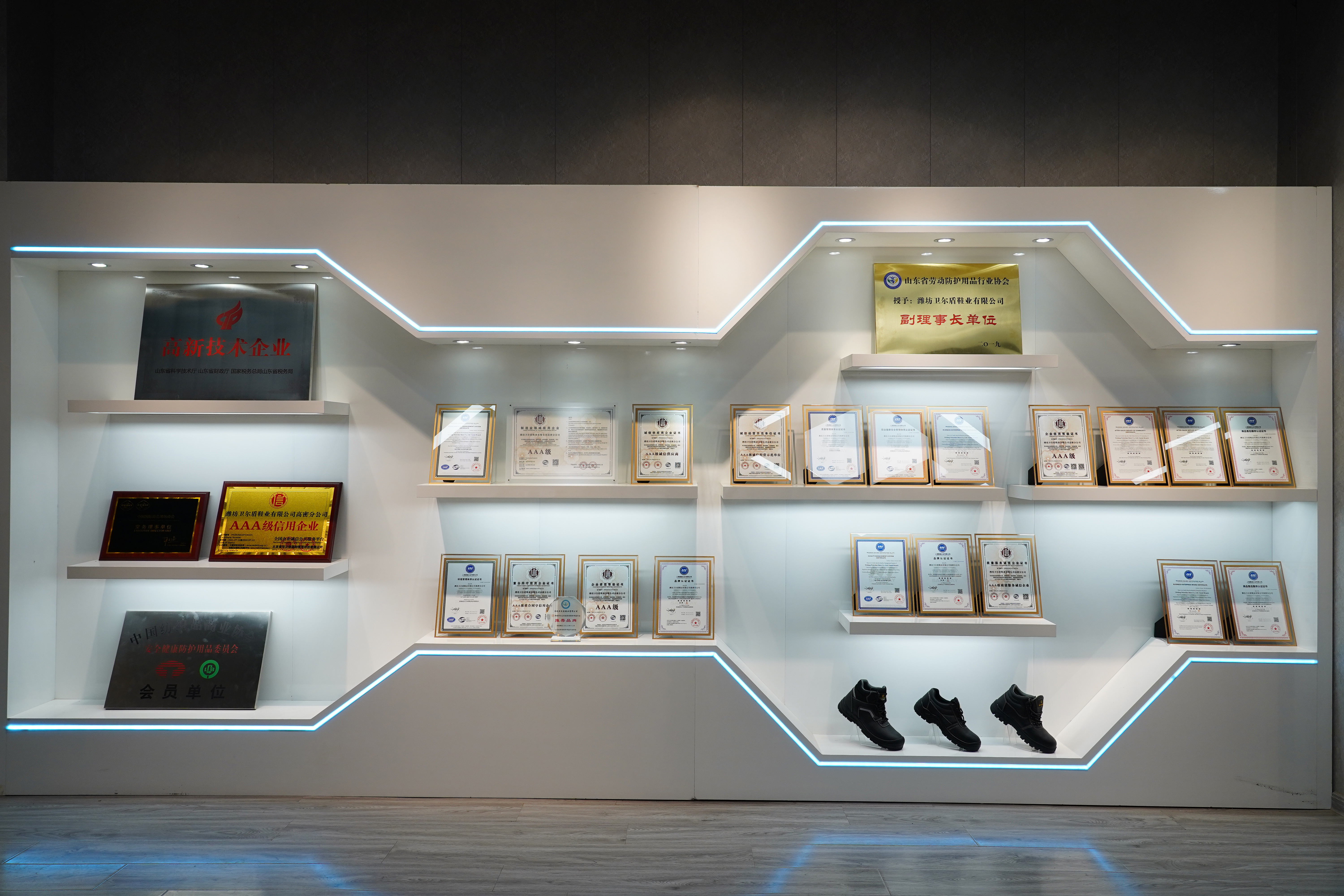
Weifang Weierdun's certification set includes management system certificates and product certificates. The management system certificates are ISO 9001 (No. 72225Q10063R0S, valid 14 May 2025 to 13 May 2028), ISO 14001 (No. 72225E10050R0S, same validity period) and ISO 45001 (No. 72225S10039R0S, same validity period), issued by HUA LONG INTERNATIONAL CERTIFICATION (BEIJING) COMPANY LTD. The product certificates include an EU type-examination certificate issued by SGS Fimko Ltd under 0598/PPE/24/5429 Issue 1 for ankle boot style 1088N, class I S3, valid to 3 December 2029; an EU type-examination certificate issued by Intertek Italia S.p.A. (Notified Body 2575) under ITASINB2202625B for article 9156, category SBP SRA, valid to 31 January 2028; a UKCA type-examination certificate issued by Intertek (Approved Body AB0362) under LECF100387731 for model 9160, category SBP SRA, valid to 26 January 2028; and an ASTM F2413-24 / ASTM F2412-24 certificate of conformance issued by TUV SUD under 6643026329101 for the men's safety shoe style 9156, size 9.
Each certificate names a specific style, size range and construction class. That specificity is the evidence a trading company usually cannot reproduce without going back to the factory. The practical test is simple: ask for the certificate number that matches the exact model being quoted, and check that the certificate validity covers the shipment date.
Documented cases as execution evidence
Certificates prove that a product can be made to specification. They do not prove that a supplier can deliver repeatedly. Case evidence is the weaker but more useful signal at the execution stage.
- United Kingdom, distributor: a long-standing GUYISA distributor runs an annual programme of approximately 64,000 pairs, carrying specific models as permanent lines and launching new ranges each year. The repeat annual pattern is the relevant evidence — the distributor has continued to reorder rather than switch supplier.
- United States, omnichannel retailer: a custom-branded programme of 200,000 pairs produced to the buyer's specification, with a long-term cooperation agreement.
- Türkiye, PPE distributor: an ODM development combining the factory's outsole with the buyer's own upper design, evaluated as a sample in the local market and followed by a bulk order of approximately 2,000 pairs.
- Kazakhstan, PPE distributor: a 45,000-pair stock order covering anti-static models for year-round use plus warm-lined winter models, shipped as a single programme so the distributor could serve cold-season demand without a second sourcing round.
- Bangladesh, engineering project contractor: 18,200 pairs delivered in two paid batches of 3,000 and 15,200 pairs, released to match the project's phased construction plan, with the buyer returning for the larger second batch.
None of these cases proves that a new buyer will receive the same outcome. What they do show is that the producing entity has completed repeated, documented shipments with named buyers in four regions — which is a different order of evidence from a testimonial on a website.
Where the trading-company route still makes sense
A balanced comparison has to state the boundary. Factory-direct sourcing is not automatically the better route in every case, and a buyer who treats it as a default is making a different mistake.
- Multi-category consolidation. When a container needs to combine safety footwear, gloves, helmets and eyewear, a trading company can consolidate from multiple factories. A safety shoe factory produces safety shoes; it is not a PPE supermarket.
- First trial orders below factory MOQ. Factory MOQ is based on the customer's specific circumstances, but a very small first order may still be more efficiently handled through a trading partner that already carries stock.
- Established regional distribution. A local trading partner with warehouse, customs clearance and after-sales infrastructure may be the practical choice for a buyer entering a market for the first time.
The boundary that matters is this: a trading company can be a legitimate first step, but the buyer should still ask the factory questions. Who owns the production line, which certificate covers the exact model, and what happens on a quality claim — those answers remain the buyer's responsibility regardless of which route is used.
What is likely to change in safety shoe sourcing over the next few years
Three structural signals are worth tracking, because they affect both routes.
First, the standard baseline has moved. EN ISO 20345:2022 requires slip resistance as a mandatory baseline requirement, according to SRC-0003. That removes some of the ambiguity that used to allow a lower-specification product to be presented as compliant. Buyers who are sourcing against the current edition can now use SR as a baseline screening criterion rather than an optional add-on.
Second, the Chinese domestic standard has also moved. GB 25038-2024 took effect on 1 June 2025, according to SRC-0002. That matters because it changes the reference point for products manufactured for the domestic market and for export orders that also reference the Chinese standard. A supplier that can document both standards is in a stronger position than one that only references the older edition.
Third, the buyer-side cost model has become more explicit. With hidden PPE costs at 70% to 85% of lifetime cost according to SRC-0004, an increasing share of procurement decisions is shifting from unit price to replacement rate, claim resolution and consistency across repeat orders. That shift favours routes where the specification decision sits close to the production line, because those routes are easier to audit.
For context on scale, the global industrial safety footwear market was valued at USD 12.66 billion in 2025 according to SRC-0001, with North America accounting for a 32% revenue share in the same year. Those figures describe the size of the market, not the performance of any single supplier, but they explain why sourcing decisions in this category attract more scrutiny than in lower-consequence product categories.
Frequently asked questions
Is GUYISA a safety shoe manufacturer or a trading company?
GUYISA is the safety footwear brand of Weierdun Group, manufactured by Weifang Weierdun Shoes Co., Ltd. The company researches, develops, manufactures and exports safety footwear in house, and offers OEM/ODM, bespoke branding and bulk purchasing services. The production base is in Weifang, Shandong Province, China.
Should I buy from a factory instead of a trading company?
Buy from the factory where specification control, audit and total cost matter, because it removes the intermediate margin and keeps specification, mould and quality decisions inside the production building. The buyer should still verify that the supplier owns the production lines, through a visit, a video audit or a third-party inspection, before treating the quotation as a factory quotation.
Does GUYISA support OEM and ODM customisation?
Yes. GUYISA supports OEM and ODM service, including custom logo, colour, material and exclusive new style development. Customisation covers logo and brand label, upper material, colour matching to a customer sample, toe cap type, anti-puncture midsole, outsole, lining, functional specification, style, size range and packaging. A 24-hour customer team is available throughout the project.
What is the MOQ for GUYISA bulk orders?
For in-stock GUYISA models, a low MOQ is available. For OEM and custom orders, MOQ is quoted separately and depends on the customer's specific circumstances. Buyers should confirm the MOQ for the specific SKU and size run before treating the quotation as final.
Can I get samples of GUYISA safety shoes?
Yes. GUYISA provides a sample service and also supports custom prototyping according to buyer requirements. Custom samples can be shipped within 10 days according to the capability unit, which allows a buyer to evaluate fit and specification before committing to a bulk order.
How fast can GUYISA ship my order?
In-stock orders of 500 pairs or fewer can ship within 7 days. In-stock orders above 500 pairs ship in approximately 10 to 15 days. Custom bulk orders require 25 to 45 days. Monthly capacity is 400,000 pairs, and the warehouse holds over 1 million pairs of finished goods.
A checklist that separates a real manufacturing partner from a reseller
The following questions are not designed to eliminate trading companies. They are designed to produce answers that can be verified, which is what the buyer actually needs at the execution stage.
- Does the supplier own and operate its own production lines, or does it subcontract production to a third party?
- Is the certificate or test report issued against the exact model, size range and construction class being quoted, or only against a generic category?
- Can the supplier arrange a factory visit, a live video walk-through, or a third-party inspection on the first order?
- What is the MOQ for in-stock models and for custom models, and does the MOQ differ by colour or size run?
- Are free samples and prototyping supported, and what is the turnaround time for a custom sample?
- What is the production lead time for a custom bulk order, and what is the dispatch time for an in-stock order above 500 pairs?
- Who handles a quality claim, what evidence is required, and is the resolution a replacement or a credit?
- How are specification changes handled after the order is placed, and who owns the mould or last if a custom tool is created?
- Can the supplier provide dated evidence of capacity, staffing and stock levels, rather than only a claim on a website?
- Can the supplier provide a reference from a buyer in a comparable market or application?
For buyers who want to review the available model range against their own specification, the GUYISA safety shoe catalogue is publicly available for download: GUYISA Safety Shoes Catalogue (PDF).
The route decision is not permanent. Many importers begin with a trading company for a first trial order and move to a factory relationship once volume justifies the audit cost. What matters is that the move happens on evidence — a verified production line, a certificate that matches the order, a sample that matches the production run, and a lead time that the supplier can actually meet. The checklist above is a starting point for that evidence, not a substitute for it.
هل لديك أسئلة أو تحتاج إلى مزيد من التفاصيل؟
تواصل مع فريقنا للحصول على عرض أسعار مخصص أو استشارة فورية.
طلب عرض أسعار
املأ النموذج أدناه وسيتواصل معك فريقنا بعرض مقترح مخصص.
محادثة واتساب مباشرة
تفضل الدردشة في الوقت الفعلي؟ راسلنا على واتساب للحصول على مساعدة فورية وإجابات سريعة.
- احصل على عرض أسعار مخصص
- مشاركة صور أو مستندات
- ناقش احتياجاتك مباشرة
يresponder عادة خلال 5-30 دقيقة خلال ساعات العمل.