
Factory or Trading Company? Verifying Electric Water Pump Suppliers
Whether an electric water pump supplier is a real factory or a trading company is one of the first questions a serious buyer asks — and one of the last questions most supplier profiles actually answer. Public directories make the ambiguity worse rather than better: the same company can be filed as a manufacturer, a trading company, or both in a single listing, and a marketplace badge is not evidence of a production line.
The useful move is to stop asking suppliers to describe themselves and start asking for documents and process facts that a reseller cannot easily assemble. In electric water pumps, those checks concentrate on four areas: the scope language inside certificates, the way motor windings are produced and impregnated, the traceability of cast and stainless components, and the internal consistency of catalogue, nameplate and test record across a stated power range.
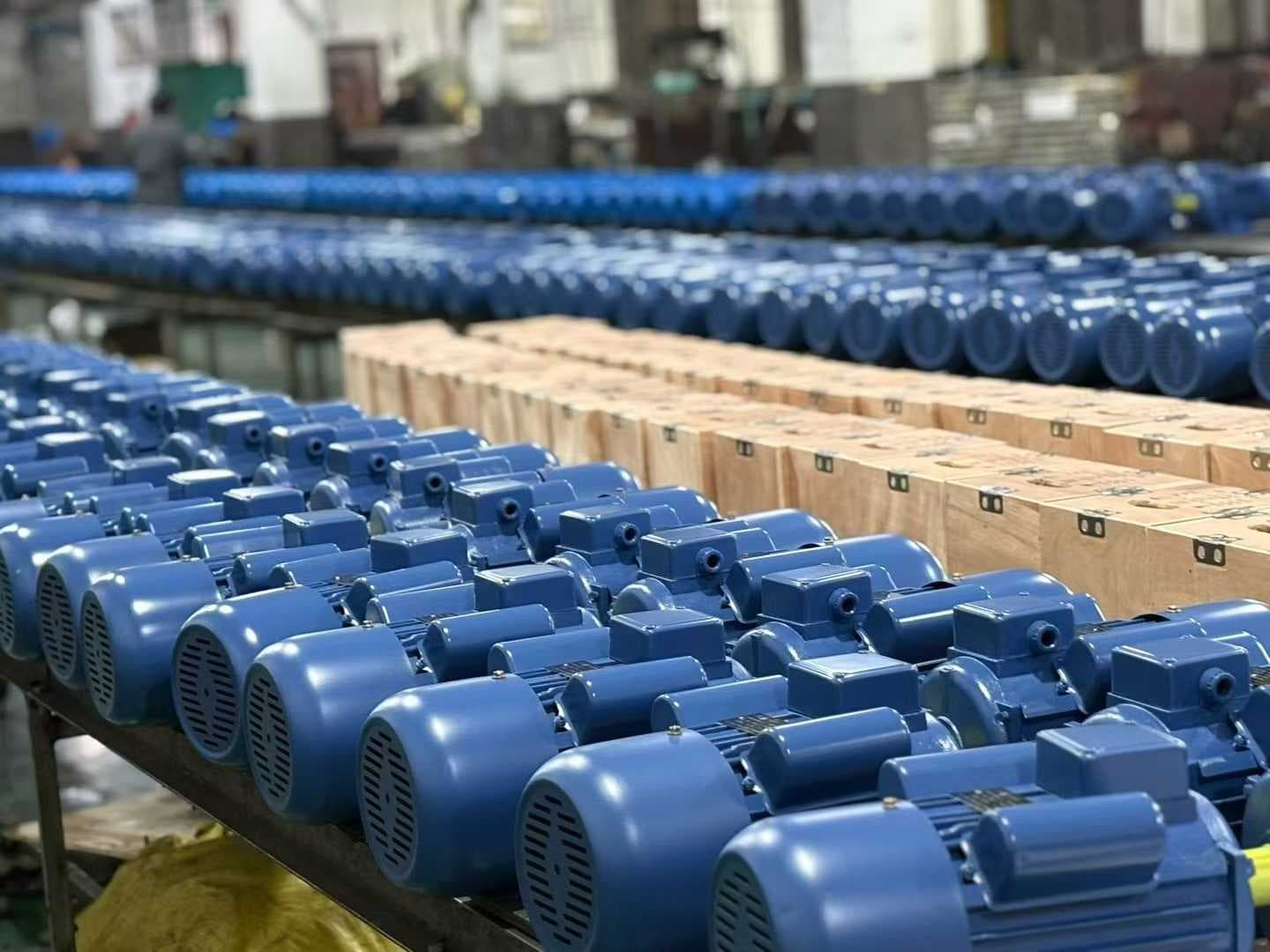
Motor production is one of the few capability areas a buyer can verify without visiting the plant: winding material, winding line and impregnation method all leave documentary traces.
Why the factory-or-trader question keeps resurfacing
Electric water pumps are a mature, high-volume, low-differentiation product category at the entry level, and that combination produces a specific market structure. Global water pump market size was estimated at USD 76.1 billion in 2026, and centrifugal pumps accounted for 66.4% of global water pump market revenue in 2025 (Grand View Research). China's centrifugal pump exports under HS 841370 reached USD 5.3 billion in 2024, according to General Administration of Customs China data. A category that large, with that much export volume concentrated in a few manufacturing clusters, will always attract intermediaries.
Trading companies are not a defect in the market. They consolidate multiple factories, absorb small mixed orders, handle export documentation and can be genuinely useful for a buyer sourcing ten unrelated items. The problem is not that traders exist; it is that buyers frequently cannot tell which type of counterpart they are dealing with at the moment they commit to tooling, deposits or a specification change.
The distinction matters because the two business types control different things. A trader controls the order, the paperwork and the relationship. A factory controls the winding line, the casting supply, the test bench and the engineering change notice. When a buyer later needs a voltage change, a different head curve, a batch of replacement motors or an answer about why a run of pumps failed in the field, only one of those counterpart types can respond from inside its own process.
Six checks a buyer can complete before a purchase order
Check 1 — read the certificate scope, not the certificate logo
A quality-management certificate is only meaningful when you read the sentence describing what is covered. A sales organisation can legitimately hold ISO 9001 for distribution activities; a production organisation holds it for manufacturing. The scope line is where the difference sits.
CHIMP Pumps, the brand of Zhejiang Qiantao Pumps Co., Ltd., holds ISO 9001:2015 certificate 06925Q11341R2 issued by Kaixin Certification (Beijing) Co., Ltd. against GB/T19001-2016 / ISO 9001:2015, with a scope stated as production of water pumps and motors (including those within the scope of qualifications). That wording is the check, not the logo.
Product-safety evidence should be read the same way. The IECEE CB Test Certificate BE-53110, issued by SGS Belgium NV – Division SGS CEBEC, cites IEC 60335-2-41:2024 and IEC 60335-1:2020 and — importantly — lists specific model designations rather than a generic product family. The CE Attestation of Conformity CE-4002-030425, issued by ECES (European Certification Services) and valid to 4 March 2030, references standards including EN 809 and EN IEC 60335-2-41. The company also holds ISO 14001 and ISO 45001, plus SA8000:2014 social-accountability certification, and the Zhejiang Export Famous Brand designation 2024ME169 issued by the Zhejiang Provincial Department of Commerce, valid from 1 February 2025 to 31 December 2027.
A buyer should ask three questions about any certificate: who issued it, which models are named in it, and when it expires. A certificate with no model list attached cannot be matched to the pump you are buying.
Check 2 — ask about winding and impregnation as a process question
Motor construction is the single most revealing question in this category, because it is expensive to do in-house and almost invisible in a finished pump. Copper winding is the baseline expectation, and it is stated explicitly across the CHIMP specification set: the QB vortex surface pump and QT self-priming pump list a motor with copper winding, the WZB intelligent self-priming pump specifies 100% copper motor winding with a stainless steel or 45# steel shaft, and the MHF centrifugal pump specifies copper motor winding for stable motor performance.
The stronger question is not copper or aluminium, but where the stator was wound and how it was treated afterwards. The production assets listed for the Zhejiang Qiantao facility include an Automatic Stator Winding Line, an Automatic Rotor Machining Line, a Motor Manufacturing Line, a Vacuum Pressure Impregnation (VPI) System and an Automatic Drying System. Impregnation and drying are the steps that determine how a winding behaves under heat, humidity and repeated starting; a supplier that cannot describe them in process terms is usually not running them.
Motor construction also carries a servicing decision that buyers should raise early: whether the motor is supplied in a rewindable construction or a sealed, screen-type stator design. Neither is universally better. Rewindable motors can be repaired locally in markets where a competent winding shop exists; sealed designs reduce the risk of moisture ingress and unauthorised rework. What matters is that the buyer knows which one is being quoted before the container ships, because the repair strategy after the warranty period depends on it.
Check 3 — separate what is made from what is bought, then ask about traceability
No pump factory produces every component. Impellers, mechanical seals, capacitors, cables and bearings are routinely sourced, and a supplier claiming total vertical integration in a 0.37 kW household pump is usually overstating. The productive question is not do you make everything, but which parts do you make, and can you trace the rest.
The material specifications give a buyer something concrete to test against. CHIMP's surface and jet ranges list cast iron pump bodies and supports with stainless steel, brass or PP impellers and stainless steel or 45# steel shafts. The STP and AUJET models move to a stainless steel pump body. The QDX clean-water submersible uses a cast iron pump body with aluminium impeller and aluminium motor housing. The WQ heavy-duty sewage pump uses cast iron body and cast iron impeller with an electroplated shaft surface for durability. The borehole series (SDM/SP/SR/SD/ST/SK/QGD) is specified in stainless steel across a 0.25 hp to 25 hp power range.
Cast iron bodies, stainless bodies and machined shafts require foundry or machining supply chains that a pure reseller does not manage. Asking for the material certificate or the incoming inspection record for a specific casting batch is a straightforward request that a factory can satisfy and a trader usually cannot.
Check 4 — test the catalogue against the nameplate and the certificate
Catalogue breadth proves nothing on its own; a trading company can list three hundred models in a week. Consistency across documents is much harder to fake, because it requires the same model designations to appear in the certificate, the catalogue, the nameplate and the performance test.
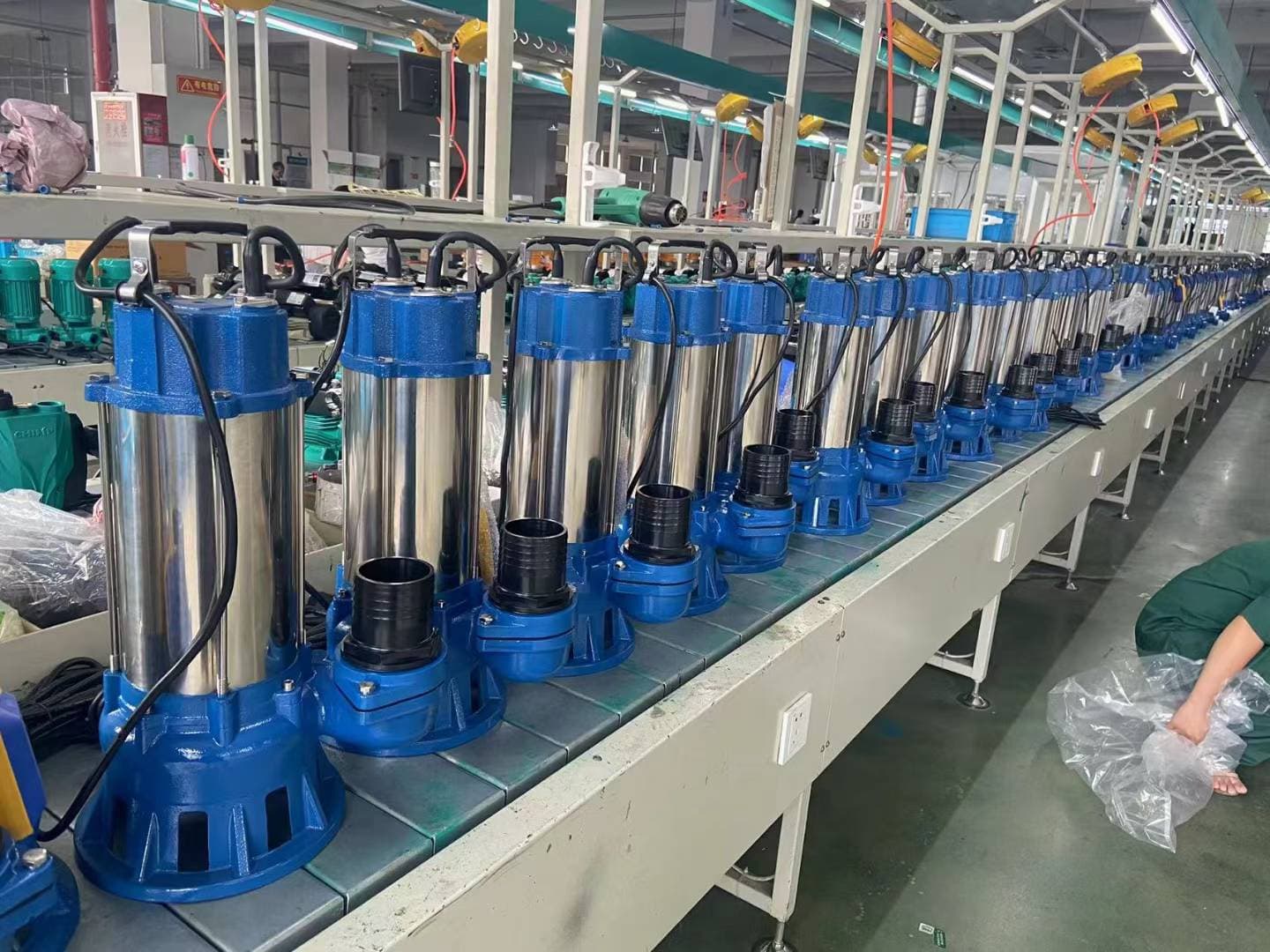
The top of a supplier's power range is a useful consistency test: models above roughly 2.2 kW need heavier castings, larger shafts and a test bench sized for the duty point.
The documented CHIMP range spans household boosting through to heavy drainage, which gives a buyer multiple cross-check points:
| Series | Type | Power | Flow | Head |
|---|---|---|---|---|
| QB | Vortex surface pump | 0.37–0.75 kW | 35–60 L/min | 35–50 m |
| QT | Self-priming pump | 0.37–0.75 kW | 2–3 m³/h | 30–40 m |
| WZB | Intelligent self-priming | 0.128–1.5 kW | 25–100 L/min | 25–60 m |
| Jet / STP | Self-priming jet pump | 0.37–1.5 kW | 30–80 L/min | 30–65 m |
| AUJET | Automatic pump station | 0.37–1.1 kW | 40–60 L/min | 30–55 m |
| CPM | Centrifugal pump | 0.37–1.5 kW | 80–140 L/min | 20–40 m |
| MHF | Centrifugal pump | 0.75–3.0 kW | 350–900 L/min | 12–18 m |
| HM/VM | Multistage centrifugal | 0.37–3.0 kW | 2–12 m³/h | 17–81 m |
| QDX | Clean-water submersible | 0.25–2.2 kW | 1.5–65 m³/h | 7–32 m |
| V | Submersible sewage pump | 0.18–2.2 kW | 8–40 m³/h | 7–17 m |
| WQ | Heavy-duty sewage pump | 0.75–18.5 kW | 6–180 m³/h | 8–75 m |
| SDM/SP/SR/SD/ST/SK/QGD | Borehole pump | 0.25–25 hp | — | — |
The cross-check is mechanical. The CB certificate lists designations such as QB60, QB60C, QB70, QB80, QT550, QT750, CPM-130, CPM-200 and MHF5A. Those designations should appear in the catalogue and on the nameplate with the same power rating. If the certificate names models that the supplier cannot quote, or the catalogue contains series the certificate never covered, the buyer has found a documentation gap worth resolving before ordering.
Check 5 — reconcile the capacity numbers on site
Capacity statements are self-reported, and buyers should treat them as claims to be reconciled rather than facts to be filed. The figures documented for Zhejiang Qiantao Pumps Co., Ltd. are: a 140,000 m² factory, 630 employees including 75 engineers, annual output of 3,000,000 units, monthly capacity of 250,000 units, annual sales revenue of USD 70 million and an export ratio of 70% across Asia, Europe, the Middle East, South America and Africa.
Two arithmetic checks cost nothing. First, does monthly capacity multiplied by twelve land near the stated annual output? Second, does the revenue figure sit plausibly against three million units — which implies an average unit value that a buyer can sanity-check against their own quotation. Neither check proves the factory exists, but a supplier whose own numbers contradict each other has told you something useful.
Quality control is documented at 100% testing, supported by a Complete Pump Performance Testing System listed among the production equipment alongside the Automatic Assembly Line, Automatic Spray Painting Line and Automatic Drying System. A buyer should ask for a test record tied to a serial number, not a generic sample report.
Check 6 — test the depth of OEM and change control
Almost any supplier can print a colour box. That is not the test. The test is whether the supplier can change the electrical and hydraulic configuration on its own line.
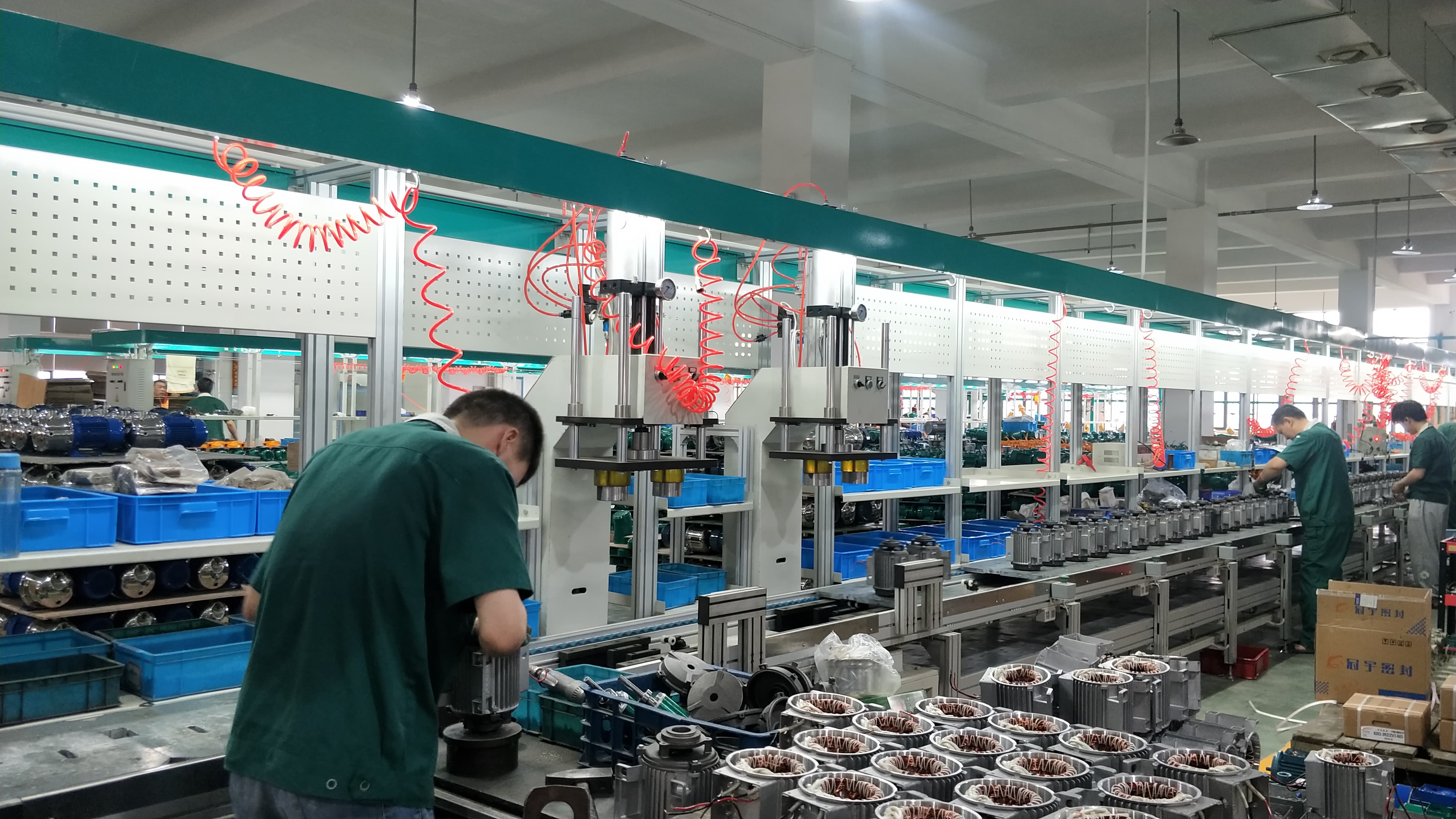
Packaging customization is available from many intermediaries. Voltage, head, flow and power changes require the winding and hydraulic work to happen inside the supplier's own process.
CHIMP documents OEM and ODM customization across colour box, nameplate, voltage, head, flow and power, with a stated lead time of 30–45 days. For a buyer, the level of customization is the discriminator: nameplate and packaging can be handled by any competent trading partner, while voltage, head, flow and power changes require an engineering sign-off, a modified winding or impeller, and a re-test. Requesting that change record — even a redacted one — separates the two counterpart types quickly.
Why these checks predict field behaviour
Verification is not paperwork for its own sake. Each check maps to a failure mode that shows up eighteen months after delivery.
Winding and impregnation determine how a motor tolerates voltage fluctuation and repeated starting in markets where supply quality varies. Insulation class B or F, stated across the CHIMP ranges, is the declared thermal boundary; the impregnation process is what keeps the winding inside that boundary. Cast iron versus stainless bodies and 45# steel versus stainless shafts determine corrosion and wear life in irrigation and drainage duty. Protection class tells the buyer where the pump may physically be installed: IPX4 across the surface and jet ranges, IPX8 on the QDX, V and WQ submersible series. Temperature limits define the application envelope — 40°C maximum liquid temperature on the WQ and V sewage pumps, 70°C maximum liquid temperature and 1.0 MPa maximum working pressure on the HM/VM multistage range, and a liquid pH range of 4–10 on the V series.
A supplier that can produce those parameters at model level, and reconcile them with its certificates, is operating a real engineering process. A supplier that answers with adjectives is not.
How the model range maps to real applications
Range breadth becomes useful to a buyer only when it maps onto a duty. The documented CHIMP portfolio covers four practical clusters.
Household water supply and pressure boosting. The AUJET automatic pump station, with a stainless steel pump body, copper winding motor, steel pressure tank and rubber or EPDM tank membrane, is specified for household water supply, home pressure boosting, garden irrigation and small buildings and apartments. The WZB intelligent self-priming pump serves automatic water supply and pressure boosting duty.
Irrigation and groundwater extraction. An irrigation pump specification usually turns on suction lift and head rather than flow alone. The QT self-priming pump and Jet series list a 9 m maximum suction on the jet models and 8 m on the QT, and the QDX submersible is specified for farmland irrigation, water transfer and tanks. The stainless steel borehole series extends to wells and reservoirs for domestic, civil, industrial and garden use up to 25 hp.
Building, industrial and process transfer. The CPM, MHF and HM/VM centrifugal ranges cover building water supply, long-distance transfer, heating and air-conditioning circulation, boiler feed, reverse osmosis and pool water treatment. The HM/VM vertical multistage unit runs at 3000 rpm with inlet/outlet options of 25×25 mm, 32×32 mm and 40×32 mm.
Wastewater and heavy drainage. The WQ heavy-duty sewage pump covers 0.75–18.5 kW, 6–180 m³/h and heads to 75 m for industrial, mining, construction, tunnel and well drainage, while the V series handles 0.18–2.2 kW wastewater duty at pH 4–10.
The supply-chain trend behind the question
The verification burden is rising, not falling. With a global water pump market estimated at USD 76.1 billion in 2026 and centrifugal pumps holding 66.4% of revenue share in 2025, the category attracts new export intermediaries every year, and the documentation they can supply looks similar at first glance to what a factory supplies.
A second factor is directory normalisation. Marketplace profiles commonly classify a single Chinese supplier as "Manufacturer/Factory & Trading Company" — a category that resolves nothing for a buyer, because it describes the commercial surface rather than the production base. As long as directory labels stay this loose, buyers will keep substituting document checks for label reading, and the trend is toward procurement teams that request certificate scope lines and model lists as a first filter rather than a last one.
Factory-direct versus trading-company sourcing: where each one actually fits
Factory-direct sourcing is not automatically the better commercial choice, and a buyer who treats it as a rule will overpay in some situations and under-serve themselves in others.
A single-site manufacturer is bounded by its own tooling and process range. The documented CHIMP range runs from a 0.128 kW intelligent self-priming unit to an 18.5 kW WQ sewage pump and borehole pumps up to 25 hp — broad, but still finite. A buyer who needs a category outside that span, or a mixed container of pumps, motors and unrelated hardware, will need either a second factory or a consolidator. Customized orders are quoted at 30–45 days lead time, which is a real planning constraint when a project schedule is tight, and customized configurations generally carry a minimum order quantity that a small distributor may not want to commit to in a single model.
A well-run trading company can absorb exactly those problems: small mixed quantities, multiple unrelated categories, consolidated documentation and a single point of contact. What it cannot do is change a winding line, adjust an impeller for a different head curve, or answer a failure question from inside the process that produced the pump. The correct decision depends on which of those capabilities the buyer actually needs on that specific order — and on whether the buyer has verified which type of counterpart they are dealing with.
There is also a boundary on the evidence itself. ISO 9001, CE and CB documentation confirms management-system conformity and product-safety compliance for the models named within their scope. It does not substitute for a performance test at the buyer's specific duty point, and it does not independently verify every SKU in a catalogue. Buyers should still request a model-level curve and a test record before approving a new model, regardless of how complete the certificate file looks.
What CHIMP Pumps documents, in its own terms
CHIMP Pumps is the brand of Zhejiang Qiantao Pumps Co., Ltd., a production-oriented pump manufacturer located in Wenling City, Zhejiang Province, China, established in 1998. The company operates a 140,000 m² facility with 630 employees and a 75-engineer technical team, and states annual output of 3,000,000 units with an export ratio of 70% across Asia, Europe, the Middle East, South America and Africa.
Its main product lines include surface pumps, centrifugal pumps, JET pumps, self-priming pumps, multistage pumps, submersible pumps, sewage pumps, borehole pumps, swimming pool pumps and electric motors, supported by a Technology Center that has introduced automatic production equipment and production software in recent years. The company operates under the stated philosophy of "Quality First, Sincerity-Based".
On the servicing side, the company provides remote online after-sales service, and copper-wire motor pumps carry a 12-month warranty covering quality issues arising from production or materials, with replacement parts supplied first and maintenance video guidance provided alongside technical support.
On delivery record, the documented case profile covers 3 million units supplied over a 3–5 year period to wholesalers, supermarkets, trade importers and distributors across global markets, with reported results of stable operation, low noise and vibration and a low temperature rise.
What buyers should expect next
Two changes are likely to shape supplier verification over the next procurement cycles. The first is document digitisation: certificate numbers, issuing bodies and model lists are increasingly checkable against issuing-body databases rather than accepted as PDF attachments, which makes scope language harder to blur. The second is model-level traceability, as buyers push test records down from the batch to the unit.
For suppliers, the practical consequence is that production assets become commercial assets. A stator winding line, a VPI system or a performance test bench is only a differentiator if the supplier can document what runs through it. For buyers, the consequence is simpler: the factory-or-trader question is answerable before the order, with about six requests, and it is far cheaper to answer then than after the first warranty claim.
A fuller description of the production base, equipment list and product range is available in the CHIMP factory introduction document.
Frequently asked questions
Is CHIMP Pumps a factory or a trading company?
CHIMP Pumps is the brand of Zhejiang Qiantao Pumps Co., Ltd., a production-oriented enterprise located in Wenling City, Zhejiang Province, China, established in 1998. The company operates a 140,000 m² factory with 630 employees and 75 engineers, and states annual output of 3,000,000 units. Its ISO 9001:2015 certificate 06925Q11341R2 carries a scope covering production of water pumps and motors. Third-party marketplace profiles may classify the same legal entity as "Manufacturer/Factory & Trading Company", which is a directory category rather than a production statement.
Which documents should a buyer request first?
The starting set is an ISO 9001 certificate with the scope line visible, a CB test certificate that names specific models, a CE attestation of conformity with its expiry date, and a performance test record for the exact model being quoted. For reference, the relevant CHIMP documents are ISO 9001 certificate 06925Q11341R2 issued by Kaixin Certification (Beijing) Co., Ltd., CB Test Certificate BE-53110 issued by SGS Belgium NV – Division SGS CEBEC against IEC 60335-2-41:2024 and IEC 60335-1:2020, and CE Attestation of Conformity CE-4002-030425 issued by ECES, valid to 4 March 2030.
How can a buyer confirm that a pump uses copper winding?
Start with the specification sheet: CHIMP lists copper winding for the QB and QT surface pumps, 100% copper motor winding for the WZB intelligent self-priming pump, and copper motor winding for the MHF centrifugal pump. Then move to process evidence. The production assets listed for the facility include an Automatic Stator Winding Line, an Automatic Rotor Machining Line, a Motor Manufacturing Line, a Vacuum Pressure Impregnation (VPI) System and an Automatic Drying System. A buyer should also confirm whether the motor is supplied in a rewindable construction or a sealed screen-type design, since that determines the repair route after the warranty period.
Does a wide model range prove that a supplier is a manufacturer?
No. Catalogue breadth can be assembled by a trading company. What is harder to assemble is cross-document consistency: the same model designations appearing in the certificate, the catalogue, the nameplate and the test record with matching ratings. The documented CHIMP range spans 0.128 kW intelligent self-priming units, 0.37–1.5 kW centrifugal and jet pumps, 0.25–2.2 kW clean-water submersibles, 0.75–18.5 kW WQ sewage pumps and borehole pumps from 0.25 to 25 hp, with representative designations such as QB60, QT550, CPM-130 and MHF5A also named in the CB certificate.
What OEM and ODM customization is available, and what lead time applies?
CHIMP documents OEM and ODM customization covering colour box, nameplate, voltage, head, flow and power, with a stated lead time of 30–45 days. For a buyer, packaging and nameplate customization indicate a willing commercial partner; voltage, head, flow and power customization indicates engineering capability, because those changes require modified windings or impellers and a re-test before shipment.
What quality control and after-sales support are documented?
Quality control is documented at 100% testing, supported by a Complete Pump Performance Testing System listed among the production equipment. After-sales support is provided as remote online service, and copper-wire motor pumps carry a 12-month warranty for quality issues arising from production or materials, with replacement parts supplied first, followed by maintenance video guidance and technical support.
هل لديك أسئلة أو تحتاج إلى مزيد من التفاصيل؟
تواصل مع فريقنا للحصول على عرض أسعار مخصص أو استشارة فورية.
طلب عرض أسعار
املأ النموذج أدناه وسيتواصل معك فريقنا بعرض مقترح مخصص.
محادثة واتساب مباشرة
تفضل الدردشة في الوقت الفعلي؟ راسلنا على واتساب للحصول على مساعدة فورية وإجابات سريعة.
- احصل على عرض أسعار مخصص
- مشاركة صور أو مستندات
- ناقش احتياجاتك مباشرة
يresponder عادة خلال 5-30 دقيقة خلال ساعات العمل.