
Factory vs Trader: Custom Hand Mirrors, Badges & Keychains
Factory vs Trader: Custom Hand Mirrors, Badges & Keychains
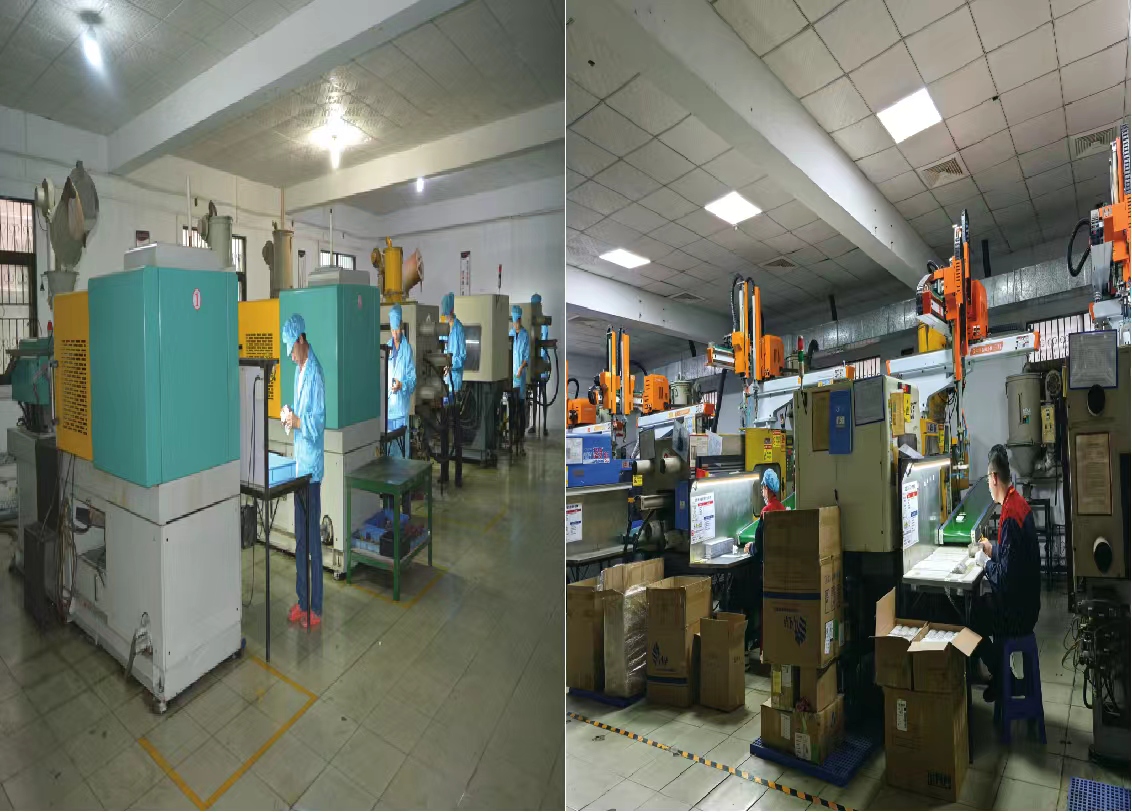
Injection molding department: where the tooling decision becomes visible in the part.
Buying custom hand mirrors, badges or keychains from a source factory rather than a trader changes who holds the mold, who answers for the production date, and who can produce inspection evidence before the goods leave. BUILD PLASTIC & HARDWARE GIFTS — the trading name of Dongguan Build Plastic & Hardware Products Co., Ltd. — presents itself as a source factory in Dongguan that opens molds and produces custom plastic and hardware crafts, and states that it offers factory prices because production is not routed through trading intermediaries. A trader occupies a different position in the same chain: it contracts manufacturing partners and resells the finished goods.
Neither position is automatically better. The comparison that follows sets the stated factory position against the trader model on the six points that usually decide a craft-gift order: production role, minimum order quantity, the production clock, test documentation, packaging, and pre-shipment quality evidence.
Why the factory-or-trader question is a supply question, not a price question
The craft-gift category is broad enough to support both models at once. Grand View Research valued the global handicrafts market at USD 740.0 billion in 2024 and projected USD 983.1 billion by 2030 in its 2025–2030 handicrafts report. Narrower segments follow their own cycles: a badge-making-supplies projection published through EIN Presswire put that segment at USD 1.33 billion in 2026, up from USD 1.23 billion in 2025, while Dataintelo valued the global custom trophy service market — medals, trophies and plaques — at USD 5.8 billion in 2025.
Those figures describe demand at category level. They do not indicate the capacity of any individual supplier, and they are not evidence that a particular factory or trader is growing. What they do show is that promotional, recognition and gift categories are large enough for buyers to run multi-year programmes — exactly the situation in which the choice of counterparty becomes a supply-continuity question rather than a one-off purchase.
Source factory and trader, defined
A source factory operates the processes that form the product. In this case the stated process set covers injection molding, die casting, stamping, cutting, screen printing, pad printing, automatic gluing and ink spraying, and automated packaging assembly lines, supported by dust-free workshops and independent quality inspection facilities. BUILD PLASTIC & HARDWARE GIFTS states that it was established in 1999, runs a 6,000 m² plant with 100 employees and 15 engineers, produces approximately 6,000,000 units a year, and exports about 85% of its output to Europe, America and Japan.
Its stated product scope covers badges, keychains, fridge magnets, makeup mirrors, ornaments, jewelry boxes, medals, trophies, commemorative coins, candle holders, hair clips, bookmarks, necklaces, phone chains, ring holders, lipstick-holder hand mirrors, wine bottle stoppers, bottle openers, napkin rings, fork and spoon sets, and coasters, plus other plastic and hardware gifts.
A trader, in this comparison, is a commercial intermediary that places orders with manufacturing partners and resells the finished goods; the equipment and process knowledge remain with those partners. That definition alone does not make the trader the weaker option. Intermediaries can be the practical route for a buyer who needs several unrelated categories consolidated into one shipment, or whose volume sits below what a factory will tool for. What changes is the direction of due diligence: with a factory, the buyer inspects a production floor; with a trader, the buyer inspects a documentary chain — who molds the item, whose certificate covers the site, and who signs the inspection report.
Verifying the source-factory position before the first order
The factory claim is checkable, and the checks should be specific rather than general. A business licence should match the exact legal name and the production address. A live or recorded factory walk-through should show the departments the process list implies — molding, die casting, stamping, printing, assembly and inspection. A mold register should show which tools the supplier owns and which belong to customers.
The company lists brand and systems certifications including Disney FAMA: 025795, Universal Studios, Bandai, Hasbro, LVMH, L'Oréal, Victoria's Secret, Starbucks, BSCI, ISO 9001, Higg Index and Sedex, and states that these additional qualifications make it more suitable for brand-customisation orders than suppliers holding fewer. That is an attributed positioning statement, and it should be read alongside certificate scope: which legal entity, which site, which product families and which validity period each document covers. A buyer whose programme depends on a brand approval should ask for the approval document itself and confirm that it names the site that will actually run the order.
The company also states that it manufactures with virgin materials rather than low-cost recycled material, contrasting this with low-priced and generic market offers. Material declarations, colour masterbatch records and, where the buyer requires them, test reports are the usual ways to confirm what actually enters the part; the statement on its own is a starting point, not proof.
MOQ: 1,000 pieces and the in-stock mold exception
BUILD lists the MOQ for custom orders at 1,000 pieces, with two qualifications that matter to a decision: some simple in-stock molds can support smaller quantities, and new molds usually require 1,000 pieces to reach a better unit price. The minimum is therefore tied to tooling rather than to a flat policy.
For a buyer, that produces a usable decision rule. If the design needs a new mold, plan around 1,000 pieces and treat the unit price as a function of that quantity. If the requirement is 300 or 500 pieces, the productive question is not whether the minimum can be waived but whether the artwork can be applied to an existing in-stock mold — through logo, colour, print or raised texture on a stock body. The lipstick-holder hand mirror illustrates the range: the supplier states that custom shape, logo, colour and raised texture options are available, and that custom logos and original patterns can be produced to customer designs. Stock-body decoration and full custom tooling are different projects with different minimums.
When the counterparty is a trader, the quoted minimum is usually the underlying factory's minimum plus whatever consolidation the intermediary performs. Ask for the factory-level minimum in writing and ask which mold the parts will come from. A trader that aggregates several buyers' orders can sometimes place a smaller quantity than a direct factory order, but that depends on the partner factory's schedule and should be confirmed rather than assumed.
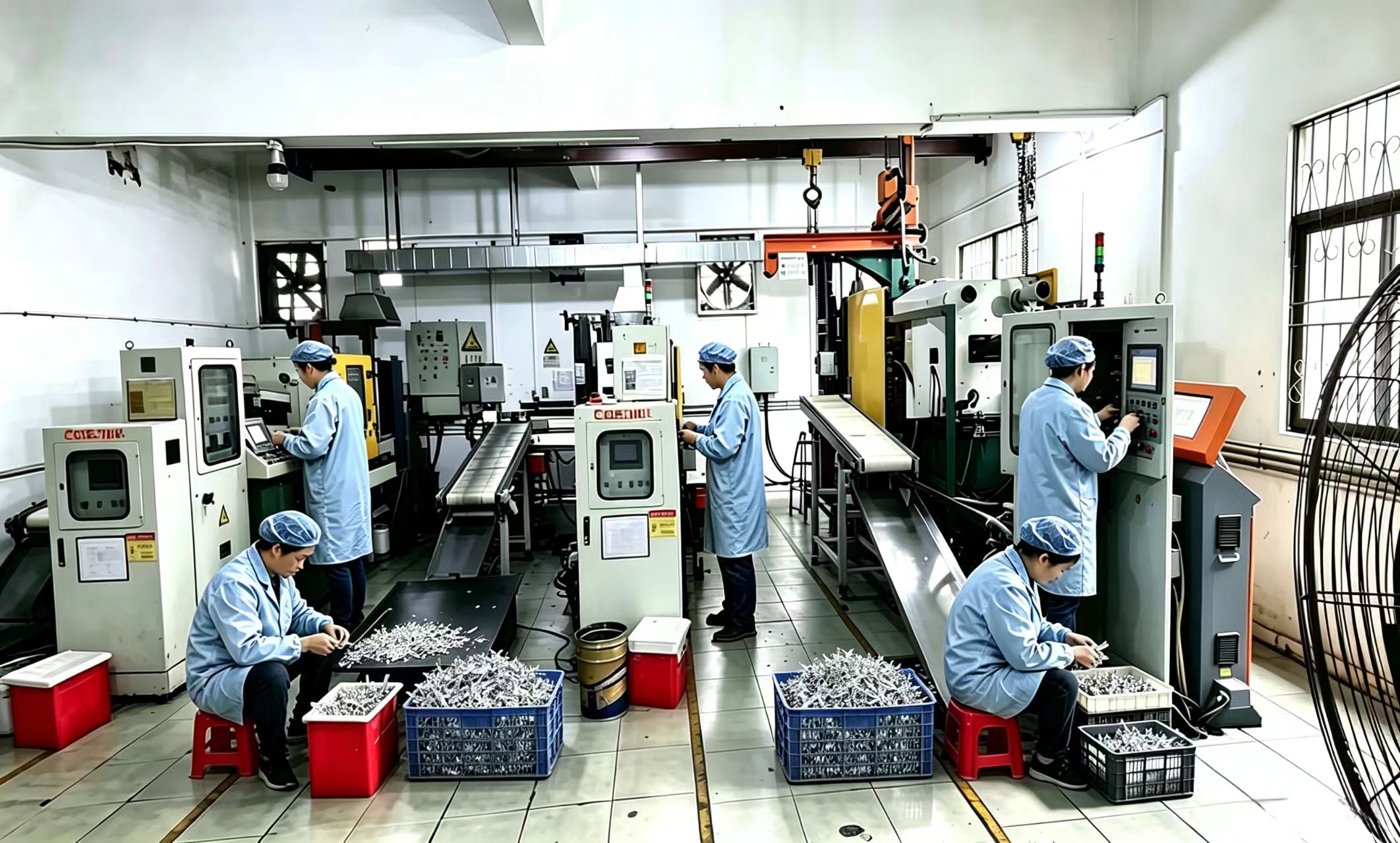
Die casting department: the metal side of a mixed badge, medal and keychain order.
Tooling, sampling and the 30–40 day production window
Production time is stated as 30–40 days after sample confirmation for regular orders, with longer lead times for large or complex orders and during peak season; the schedule is confirmed before order placement. The wording matters, because the clock starts at sample confirmation, not at inquiry.
The stated workflow explains what happens before that point. The buyer supplies high-resolution vector files in AI, CDR or PDF format with dimensions, processes and colours marked. The supplier then produces 3D renderings, the renderings are confirmed, the mold is opened, a sample is made, the sample is confirmed, and mass production begins. A buyer planning a retail launch should therefore map the whole sequence rather than the 30–40 days alone: artwork preparation, rendering rounds, mold opening, sample production, sample shipment and approval, then the production window, then inspection and freight. Environmental testing, where required, carries its own separately confirmed lead time and should be scheduled against the same calendar.
For a trader-routed order the equivalent question is whose production slot has been reserved. An intermediary's estimate is not the same as a factory's confirmed schedule; buyers who need date certainty should ask for the factory confirmation behind the delivery date, and for the point at which that date is re-confirmed if sample approval slips.
Lead and cadmium testing for European buyers
BUILD states that for European buyers, environmental tests such as lead and cadmium testing can be arranged as required for custom gift orders, that the testing fee for arranged tests is borne by the customer, and that the lead time for environmental testing is confirmed separately.
Three practical points follow. First, the test is an arranged service per order rather than a standing certificate, so the report should be requested for the specific product, material and finish in that order. Second, the scope of the report should be defined before the sample is approved: which components are sampled, including the metal badge body, the plating, the mirror frame, printed surfaces and any painted or epoxy-filled areas. Third, because the cost sits with the buyer and the timing sits in the calendar, both belong in the quotation comparison rather than in a later add-on.
Finish selection is part of that scope. The supplier lists conventional electroplating colours including gold plating, silver plating, antique bronze, gun black, nickel finish, matte gold and matte silver, and states that with proper sealing protection under normal use the finish is not prone to fading, while prolonged soaking, friction or strong acid environments accelerate oxidation. That is a use-condition statement, and it tells the buyer what to specify: the finish, the sealing, and the cleaning instructions that accompany the product.
For US-bound programmes the documentary picture differs. A 2026 compliance guide published by Tongxing Packing states that jewelry boxes and related gift storage entering the US market must comply with CPSIA — which limits lead in accessible components to 100 ppm — and with Proposition 65. Applicability depends on the product, its intended use and the age grade, so the requirement should be confirmed with an accredited laboratory rather than inferred from a category label.
Packaging: OPP bag and carton versus back cards, hang tags and gift boxes
The default packaging is a regular OPP bag combined with a carton. Custom back cards, hang tags and gift boxes are available as optional packaging components, with packaging quoted separately.
The split is useful for decision-making because it separates protection from presentation. OPP bag plus carton is a bulk-protection specification: it suits wholesale, promotional distribution and any programme where retail presentation is handled downstream. Back cards and hang tags turn a loose item into a peg-ready retail unit and carry brand, barcode and product information. Gift boxes change the unit from a component into a finished gift, which is the relevant format for sets such as a lipstick-holder hand mirror, a jewelry box or a commemorative coin presentation.
Because packaging is quoted separately, it should appear as its own line in any comparison, with its own minimum quantity, artwork approval and lead time. Buyers weighing a factory quotation against a trader quotation should check whether packaging sits inside the unit price, who sources the printed components, and whether packaging approval runs in parallel with or after product sample approval. A quotation that omits packaging, testing and inspection is not comparable with one that includes them.
Quality-control evidence before shipment
BUILD states that it conducts full inspection before shipment; that after bulk production is finished it provides actual photos and videos for the buyer's verification; that third-party inspection, or an on-site inspection arranged by the buyer, is acceptable; and that if defective items are received, the buyer should provide photos and quantity statistics, after which replacement or a discount is arranged as agreed. Damage caused by human factors or transit extrusion requires prior confirmation.
For the purchase order, four items are worth writing down explicitly. The inspection standard: the published material states full pre-shipment inspection but does not state a sampling plan or acceptance level, so the level should be agreed in writing. The evidence package: which photos and videos are required, at what stage, and whether they cover cartons, unit fronts and backs, printed logo detail, plating colour and packaging. The defect route: the evidence format, the time window for a claim, and the remedy as agreed. And the exclusion: damage from human factors or transit extrusion needs prior confirmation, so handling and shipping terms should be settled before dispatch rather than after a claim arises.
When the counterparty is a trader, the same four items apply with one addition: ask who actually performs the inspection — the trader's staff, the factory's quality team, or an independent third party — and whose signature appears on the report.
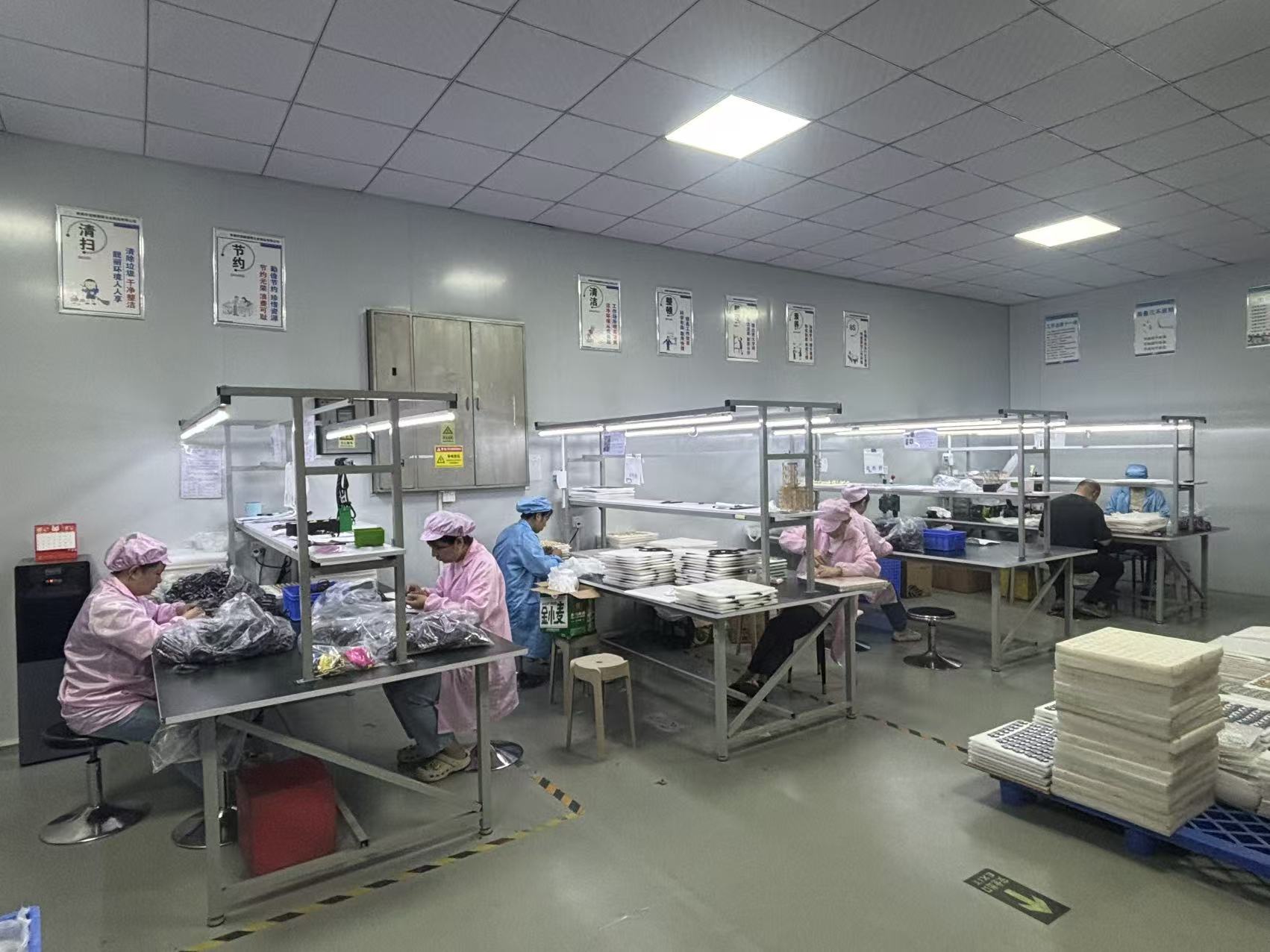
Quality inspection department: pre-shipment inspection is only as useful as its independence.
Side-by-side: what to compare, and what to verify
| Decision point | Stated source-factory position (BUILD PLASTIC & HARDWARE GIFTS) | What to verify if the counterparty is a trader |
|---|---|---|
| Production role | Source factory; mold opening and production stated in-house across badges, keychains, hand mirrors, lipstick-holder mirrors, medals, trophies and the wider listed scope | Which factory molds the item, and whether the intermediary discloses the production site |
| MOQ | 1,000 pcs for custom orders; some simple in-stock molds support smaller quantities; new molds usually 1,000 pcs | Whether the quoted minimum is the factory's or the trader's own |
| Lead time | 30–40 days after sample confirmation; longer for large, complex or peak-season orders | Whether the date reflects a confirmed factory slot or an intermediary estimate |
| Testing | Lead and cadmium and other environmental tests arranged on request; fee borne by the buyer; lead time confirmed separately | Which laboratory, whose name appears on the report, and which components were sampled |
| Packaging | Default OPP bag plus carton; optional back cards, hang tags and gift boxes, quoted separately | Whether packaging is inside the unit price, and who sources the printed components |
| Pre-shipment QC | Full inspection before shipment; photos and videos after bulk production; buyer or third-party inspection accepted; defect claims with photos and quantity statistics | Who inspects, whose signature is on the report, and how a defect claim is routed |
| Certifications | Disney FAMA: 025795, Universal Studios, Bandai, Hasbro, LVMH, L'Oréal, Victoria's Secret, Starbucks, BSCI, ISO 9001, Higg Index, Sedex (company-stated) | Whether each certificate names the actual production site that will run the order |
Total cost, not unit price
Unit price is only one line of a landed-cost comparison, and the lines that sit around it differ by model. Tooling, sample cost, testing fees, packaging components, inspection and freight all attach to the order before duty does.
Duty itself depends on classification. A 2026 classification summary published by Gaia Dynamics places base-metal key rings and keychains under HTS 7326.90.86.88 at a 2.9% duty rate, with plastic keychains pointing toward heading 3926 at roughly 3–6.5%. Separately, HS 711719 covers imitation jewellery of base metal, whether or not plated with precious metal, while the US tariff schedule defines imitation jewellery under heading 7117 to exclude certain articles such as buttons and hair slides. Because BUILD's product list spans metal badges, plastic mirrors, hair clips, ornaments and jewellery-adjacent items, one HS code will not cover a mixed order; classification runs product by product and should be confirmed with a customs broker for the destination market.
The supplier does not publish a price list, so no unit-price conclusion can be drawn here. The practical route is to request quotations on the same specification — same material, finish, packaging, testing and inspection scope — from the factory and from a trader, then compare the totals rather than the piece price.
Where each model fits
The factory model fits buyers with a defined brand programme, a design that justifies tooling, and volume at or above the 1,000-piece custom minimum. It also fits buyers who need the material specification held constant across repeat orders, who want test reports arranged against their own market requirements, and who intend to inspect before shipment or to commission a third party to do so.
The trader model fits a different profile: a buyer assembling several unrelated categories into a single consolidated shipment, a buyer testing a market with quantities below a factory's tooling threshold, or a buyer who prefers to contract one intermediary for coordination rather than manage several production sites. In these cases the trader is not a compromise but a deliberate structure — provided the buyer knows which factory is behind the order and who is accountable for inspection.
The stated boundaries of the factory position should be weighed honestly. The 1,000-piece custom minimum is a real constraint for small launches. The 30–40 day production window excludes sample-making, approval and freight, so it will not suit a rush programme. Testing is arranged at the buyer's cost and with separately confirmed timing. The factory-price statement is the supplier's own positioning and needs to be tested against a live quotation. And certificates establish systems and brand approvals, not the outcome of a specific production run.
Market outlook and what it changes for buyers
The category figures point to continuing breadth rather than a single growth story. A handicrafts market moving from USD 740.0 billion in 2024 toward a projected USD 983.1 billion by 2030, a badge-supplies segment projected at USD 1.33 billion in 2026, and a custom trophy service market valued at USD 5.8 billion in 2025 all describe established demand across promotional, recognition and gift channels.
For a sourcing team, the implication is procedural rather than promotional. Programmes that run for several seasons make repeat-order consistency more valuable than a single low quotation: the same material, the same finish, the same packaging artwork and the same inspection standard behind each release. That favours buyers who document the specification before tooling and who keep the mold, the material declaration and the test reports under their own control. None of this predicts prices or capacity for any individual supplier; capacity should be confirmed order by order.
What to put in the RFQ
- Product, material and finish, with the vector file in AI, CDR or PDF and dimensions, processes and colours marked.
- Target quantity and whether an existing in-stock mold can be decorated instead of a new tool being opened.
- Required on-shelf or on-site date, expressed backwards through sampling, production, inspection and freight.
- Destination market and whether lead and cadmium testing is required, with the components to be sampled.
- Packaging format: OPP bag and carton only, or back cards, hang tags and gift boxes, quoted as separate lines.
- Inspection basis: who inspects, at what stage, and the sampling level or acceptance figure to be applied.
- Photo and video evidence required before shipment, and the list of views and details it must cover.
- Defect claim route, evidence format and the agreed remedy.
- Certificate copies checked for site, product family and validity period.
- Customs classification per product, confirmed before landed cost is calculated.
Frequently asked questions
How can a buyer confirm whether a supplier is a source factory or a trader?
Compare the legal name and address on the business licence with the production site, then ask for a walk-through of the departments that the claimed processes require — molding, die casting, stamping, printing, assembly and inspection. A mold register showing which tools the supplier owns is a further indicator. BUILD PLASTIC & HARDWARE GIFTS states that it is a source factory rather than a trading intermediary, and that production is carried out in-house, which is the claim a buyer verifies against documents and the site.
What is the minimum order quantity for custom badges, keychains and hand mirrors?
The stated MOQ for custom orders is 1,000 pieces. Two qualifications apply: some simple in-stock molds can support smaller quantities, and new molds usually require 1,000 pieces to achieve a better unit price. Buyers needing fewer pieces should ask whether an existing mold can be decorated with their logo, colour or print rather than whether the minimum can be removed.
How long does production take after the sample is confirmed?
Regular orders are stated at 30–40 days after sample confirmation, with longer lead times for large or complex orders and during peak season. The schedule is confirmed before order placement. Sample making, approval and environmental testing sit outside that window, and the lead time for environmental testing is confirmed separately, so the full calendar should be planned from artwork submission rather than from the production start date.
Can lead and cadmium testing be arranged for European buyers?
Yes, as required for custom gift orders: environmental tests such as lead and cadmium testing can be arranged, the testing fee is borne by the customer, and the lead time is confirmed separately. The report should be requested for the specific product, materials and finishes in the order, with the sampled components defined before sample approval.
Can goods be inspected before shipment, and how are defective items handled?
The stated process is full inspection before shipment, with actual photos and videos provided after bulk production for the buyer's verification; third-party inspection or an on-site inspection arranged by the buyer is also accepted. If defective items are received, the buyer provides photos and quantity statistics, and replacement or a discount is arranged as agreed. Damage caused by human factors or transit extrusion requires prior confirmation.
For buyers who want the full product scope, process list and certification summary in one document, the company catalogue is available for download: BUILD PLASTIC & HARDWARE GIFTS catalogue (PDF). Company information and the stated manufacturing scope are published at BUILD PLASTIC & HARDWARE GIFTS.
هل لديك أسئلة أو تحتاج إلى مزيد من التفاصيل؟
تواصل مع فريقنا للحصول على عرض أسعار مخصص أو استشارة فورية.
طلب عرض أسعار
املأ النموذج أدناه وسيتواصل معك فريقنا بعرض مقترح مخصص.
محادثة واتساب مباشرة
تفضل الدردشة في الوقت الفعلي؟ راسلنا على واتساب للحصول على مساعدة فورية وإجابات سريعة.
- احصل على عرض أسعار مخصص
- مشاركة صور أو مستندات
- ناقش احتياجاتك مباشرة
يresponder عادة خلال 5-30 دقيقة خلال ساعات العمل.