
Family Camping vs. Overlanding: Matching Tents to Scenarios
Family Camping vs. Overlanding: Matching Tents to Scenarios
The global camping tent market was valued at USD 6.18 billion in 2025 and is projected to reach USD 10.91 billion by 2034, according to Grand View Research market reporting. That figure describes one industry, but it does not describe one buyer. Vehicle-based family camping and mobile overlanding consume the same category for entirely different physical reasons, and a tent optimised for one is usually the wrong answer for the other.
This article works through three concrete purchasing scenarios — a large family basecamp, family camping across mixed terrain, and mobile overlanding — and maps MARVELOUS product directions to each of them. The mapping is built on the constraints that actually decide a purchase: capacity, expanded floor area, vehicle load, setup and pack-down time, and structural durability. Feature lists rarely settle these questions. Physical limits usually do.
Why Scenario Fit Outranks Feature Comparison
A tent is not weak because a family of seven found it cramped, and it is not defective because an overlander had to strike it every morning. In both cases the product was simply deployed outside the scenario it was dimensioned for. Three constraints bind almost every camping tent decision, and they pull in opposite directions.
- Capacity-to-space ratio. Occupancy drives required floor area and, for family use, interior standing height. More people means more envelope, and envelope is not free.
- Space-to-vehicle ratio. Expanded size and packed transport volume are different numbers. A tent that pitches beautifully may still not fit into the vehicle assigned to carry it.
- Mobility-to-setup-time ratio. The more often a camp moves, the more the setup and pack-down cycle dominates the experience. Hard shell rooftop tents typically require 3–8 minutes of setup, against 15–25 minutes for ground tents, per Rooftop Tent Market Insights data.
A buyer who ranks these three constraints in the correct order for their own trip usually arrives at a shortlist quickly. A buyer who ranks features instead tends to buy capacity they cannot transport, or mobility they do not need.
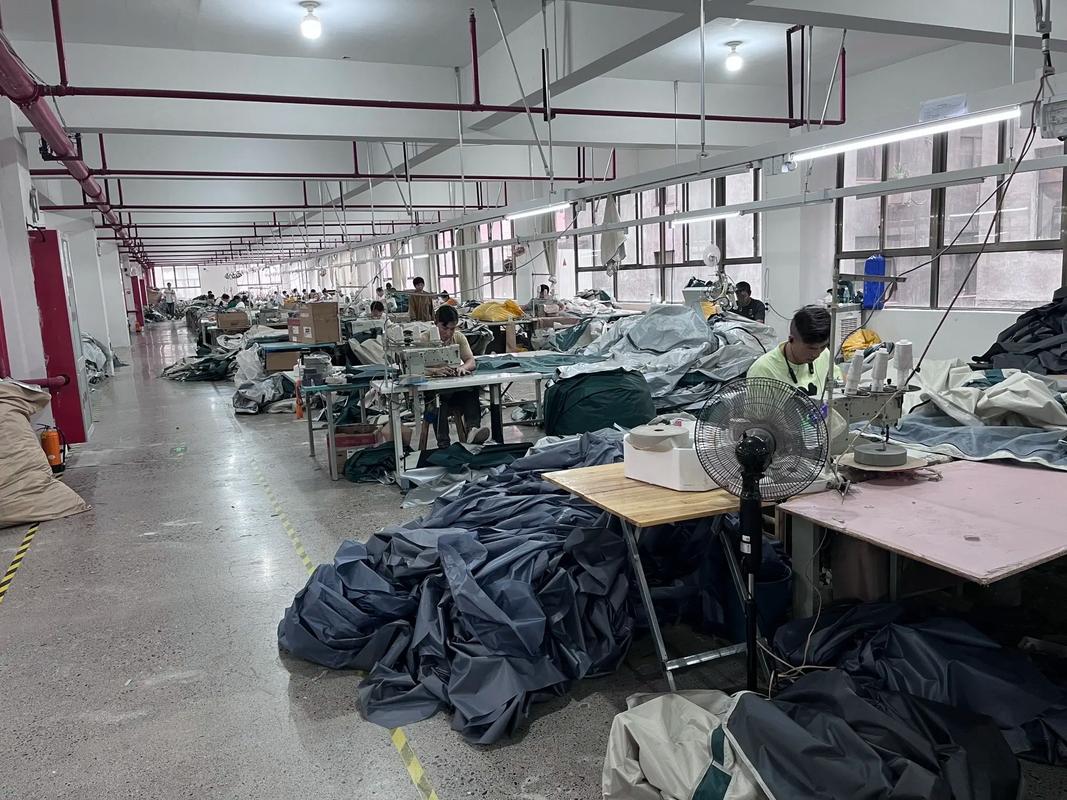
Camping tent production room — MARVELOUS, Xiamen (camping tents, rooftop tents and inflatable tents produced under one quality system).
The Three Scenario Archetypes
| Scenario | Space priority | Mobility profile | Binding constraint | Product direction |
|---|---|---|---|---|
| Large family basecamp (vehicle-based) | Standing height and a large footprint for 6–8 people | Low — one pitch held over several nights | Transport volume and required pitch area | MOT-M100 |
| Family camping, mixed terrain | Balanced family-scale interior with weather resilience | Medium — occasional relocation between sites | Ground condition, weather exposure, pack weight | MOT-CT900 |
| Mobile overlanding | Compact envelope, fast pack-down | High — daily or frequent relocation | Vehicle roof load capacity and rack compatibility | Hard shell rooftop tent line |
The table is deliberately organised around constraints rather than around product names, because the same shortlist logic applies whether a buyer is a distributor building an assortment or an end user planning a single season.
Scenario One: MOT-M100 for the Large Family Basecamp
The basecamp scenario has a clear signature: a vehicle arrives at a site, the tent goes up once, and the camp stays put for several nights. Under those conditions, setup time is paid once, and interior volume is enjoyed continuously. That trade favours a large footprint and generous headroom.
MOT-M100 is configured for 6–8 people with an expanded size of 375 × 375 × 240 cm. The 240 cm vertical dimension delivers standing height inside the tent, which changes how a family of that size uses the interior — dressing, moving children, and organising gear stop being a crouching exercise. The 375 cm sides produce a footprint that must be matched against the actual pitch area available, and the packed tent must be matched against the transport volume of the vehicle or trailer assigned to carry it.
Where the M100 stops working
A 6–8 person basecamp envelope is not a touring product. If the itinerary changes location every day, the pitch-and-pack cycle becomes the dominant cost of the trip, and a hard shell rooftop configuration typically completes that cycle in a fraction of the time. Buyers planning multi-stop routes should read the M100 as a stay-put solution rather than a mobile one.
Scenario Two: MOT-CT900 for Family Camping Across Mixed Terrain
The mixed-terrain family scenario sits between the two extremes. The group is family-scale rather than basecamp-scale, the campsite may change two or three times across a trip, and the ground is not guaranteed to be level, dry, or sheltered. Here the constraint set shifts from "maximum interior volume" to "predictable behaviour when conditions vary."
MOT-CT900 occupies that position in the MARVELOUS family range. Where the M100 is dimensioned around maximum internal envelope, the CT900 is dimensioned around the balance between family-scale interior space and handling of variable ground and weather. Because packed dimensions, packed weight, and pole configuration differ by model configuration, buyers evaluating vehicle fit should confirm those values against the current specification sheet for the specific configuration rather than assuming they carry over from another family model.
One structural detail applies across the MARVELOUS range and is relevant to mixed terrain specifically: internal comparative data records the pole specification as approximately 1.5 mm larger in diameter than the traditional tent pole benchmark, described as more stable with better pressure-bearing capacity. The same comparison records a cost difference of 10% lower against that benchmark, and a maintenance profile based on easy disassembly with separable broken pole segments that can be replaced individually rather than requiring a full pole set replacement.
Scenario Three: Mobile Overlanding and Hard Shell Rooftop Tents
Overlanding is defined by movement. The rooftop tent market was valued at approximately USD 215.5 million in 2024, with hard shell models accounting for more than 53% of revenue share, according to Business Research Insights. That concentration is not incidental. Hard shell rooftop tents typically use aluminium or ABS plastic shells, and their 3–8 minute setup time — against 15–25 minutes for ground tents — directly addresses the cost of a daily cycle.
The scenario also removes a dependency that ground camping cannot remove: the tent no longer requires a dry, level, unobstructed patch of ground. That matters on rocky or uneven terrain, and it matters for buyers whose routes alternate between formal campsites and dispersed sites.
The vehicle is part of the product decision
A rooftop tent purchase is not a tent purchase alone. It is a vehicle-plus-tent system decision, and it is limited by roof load capacity and rack compatibility. Where those are absent or insufficient, the rooftop option is not physically available regardless of preference, budget, or product quality. This is the single most common point at which overlanding buyers discover that a shortlist was never viable.
Technical Explanation: What Actually Decides Scenario Fit
Structure and pressure bearing
Pole diameter and shell material determine how a tent behaves under wind load and repeated pitching. MARVELOUS comparison data against the traditional tent pole benchmark records the -1.5 mm diameter difference noted above, along with better pressure-bearing capacity and easier field maintenance. For buyers, the practical consequence is serviceability: a damaged segment can be separated and replaced instead of writing off the tent.
Fabric integrity and waterproofing
Two failure modes are explicitly monitored in MARVELOUS production: fabric crack and waterproof invalidation. The stated control method is to set up the tent and check it piece by piece, and the enterprise measure applied to non-conforming units is selection out of the line and reprocessing, rather than allowing them to continue downstream. For importers and distributors, this is relevant because waterproofing failure is typically discovered by the end user, at the site, in bad weather — the most expensive possible place to discover a defect.
Compliance as a constraint, not a feature
Camping tents fall under ISO 5912:2020, which specifies safety, performance, and fitness-for-use requirements including flammability and rain resistance. In North America, CPAI-84 is a mandatory flammability standard in several US states (California, New York, New Jersey, Massachusetts, Louisiana, Michigan, and Minnesota) and a federal requirement in Canada. These standards affect which products can be placed in which market at all, which makes documentation a procurement variable rather than a marketing point.
Comparison with Traditional Solutions — and Where Each Approach Stops
| Approach | Advantage in its scenario | Where it stops working |
|---|---|---|
| Large ground basecamp tent (MOT-M100) | Standing height and a 375 × 375 × 240 cm envelope for 6–8 people | Requires transport volume and pitch area; setup cycle is slower than a hard shell rooftop tent, so it does not suit daily relocation |
| Mixed-terrain family tent (MOT-CT900) | Balances interior space against variable ground and weather | Packed dimensions and weight must be verified configuration by configuration before vehicle fit can be confirmed |
| Hard shell rooftop tent | 3–8 minute setup; independent of ground condition | Limited by vehicle roof load capacity and rack compatibility; floor area per person is smaller than a large ground tent |
| Inflatable tent | Market growth attributed to demand for ease and speed of setup, particularly in glamping (segment valued at USD 1.033 billion in 2024) | Uses air chambers rather than poles, so maintenance, repair and setup routines differ from pole-based structures |
No approach dominates. A buyer who needs standing height for a large family gives up the speed advantage; a buyer who needs daily mobility gives up floor area. Naming that trade-off explicitly is more useful than presenting one design as universally superior.
Market Trend Analysis
The growth numbers point to segment-differentiated demand rather than uniform expansion.
- The overall camping tent market moves from USD 6.18 billion in 2025 toward a projected USD 10.91 billion by 2034 (Grand View Research / Market Reports World).
- Within rooftop tents, hard shell models hold more than 53% of revenue share, and North America accounts for 38.6% of the market, followed by Europe at 27.4%, per Dataintelo analysis.
- The inflatable segment reached USD 1.033 billion in 2024, with growth attributed to demand for ease and speed of setup in glamping (Intel Market Research).
- The premium rooftop segment is composed of identifiable international brands, including Alu-Cab (South Africa), iKamper (South Korea), Thule (Sweden), and James Baroud (Portugal), as listed in Camp Auto Parts industry reporting.
Read together, these figures suggest that basecamp demand and overlanding demand are responding to different product characteristics, and that a supplier covering only one category serves only one of them.
From Scenario Fit to Supply Continuity
XIAMEN MARVELOUS OUTDOOR TECHNOLOGY Co.,Ltd is an outdoor products factory established in 2019, operating a 4,000 m² facility with approximately 50 employees, 20 engineers in R&D, and an annual output of 50,000 units. Its main products are camping tents, rooftop tents, and inflatable tents. Export accounts for 95% of output, with main markets in Russia, the USA, Australia, and Canada. The MARVELOUS brand itself traces to a family-owned business specialising in the design and production of outdoor tents since 1980.
For a distributor whose assortment covers several of the scenarios above, that range matters commercially. A retailer that stocks a large family basecamp model, a mixed-terrain family model, and a hard shell rooftop model under one supplier reduces the number of quality systems, documentation sets, and production relationships it has to manage. When the scenario mix shifts — for example toward overlanding — the assortment changes without a full supplier requalification.
Execution-side terms are documented as follows: minimum order quantity is 1 unit; delivery terms are EXW, FOB, or CIF; acceptance criteria are based on pre-shipment test; payment terms are TT or LC. Typical production lead time is 30 days, with a monthly production capacity of 5,000 to 10,000 units. That combination — a one-unit minimum alongside a 5,000–10,000 unit monthly ceiling — is what allows a scenario-specific pilot order to be validated before it becomes a recurring line.
Future Outlook
If the market trajectory continues toward the projected USD 10.91 billion by 2034, the more consequential change for buyers may be in assortment planning rather than in volume. Scenarios, not price bands, are becoming the practical organising principle for camping tent ranges: a basecamp line, a mixed-terrain family line, and an overlanding line, each with distinct capacity and vehicle assumptions.
Two constraints will shape that evolution. First, compliance requirements such as ISO 5912:2020 and CPAI-84 will keep material and flammability documentation on the procurement checklist rather than in the marketing copy. Second, the hard shell share of rooftop tent revenue above 53% suggests the overlanding mix is unlikely to revert to soft-shell dominance in the near term, while the inflatable segment's growth is tied specifically to speed-of-setup demand — a different motivation from mobility.
FAQ
How does a buyer decide between a family basecamp tent and a hard shell rooftop tent?
The decision depends on three measurable constraints: occupancy, how long the camp stays in one place, and the vehicle. Hard shell rooftop tents typically set up in 3–8 minutes versus 15–25 minutes for ground tents, which favours itineraries with frequent relocation. A basecamp model such as MOT-M100 supports 6–8 people within a 375 × 375 × 240 cm expanded envelope, which favours multi-night, vehicle-based stays at a single pitch. Where a vehicle lacks sufficient roof load capacity or a compatible rack, the rooftop option is physically unavailable regardless of preference.
What interior space does MOT-M100 provide for six to eight people?
MOT-M100 is configured for 6–8 people with an expanded size of 375 × 375 × 240 cm. The 240 cm vertical dimension provides standing height inside the tent, and the 375 cm sides establish the required ground footprint. Buyers should verify the available pitch area and the packed transport volume of the carrying vehicle against the actual configuration.
What scenario is MOT-CT900 designed for?
MOT-CT900 is positioned for family camping across mixed terrain, where conditions change between sites and the ground is not guaranteed to be level or dry. It balances family-scale interior space against variable ground and weather. Packed dimensions, packed weight, and pole configuration vary by configuration and should be confirmed against the current specification sheet before vehicle fit is assessed.
How does pole structure affect durability on mixed terrain?
MARVELOUS comparative data records the pole specification as approximately 1.5 mm larger in diameter than the traditional tent pole benchmark, described as more stable with better pressure-bearing capacity. The same comparison records the cost difference at 10% lower against that benchmark. Maintenance relies on easy disassembly, with broken pole segments separable and replaceable individually.
How is waterproofing failure risk controlled before shipment?
Two failure modes are explicitly monitored: fabric crack and waterproof invalidation. The control method is to set up the tent and check it piece by piece. Units that are defective or do not meet standards during production are selected out and reprocessed rather than allowed to continue.
What commercial terms apply to a first order and to follow-on supply?
The documented purchasing terms are: MOQ of 1 unit; delivery terms of EXW, FOB, or CIF; acceptance criteria based on pre-shipment test; and payment terms of TT or LC. Typical production lead time is 30 days, with monthly production capacity of 5,000 to 10,000 units.
Manufacturer documentation, including the current MARVELOUS product brochure, is available at: MARVELOUS product brochure (PDF).