
Fastener Procurement FAQ: Materials, Threads, Coatings
High-performance fasteners are specified on four axes before price becomes decisive: base material, thread tolerance class, surface treatment, and the manufacturing standard the part is produced and inspected against. Leave any one of them open, and the risk does not surface at the quotation stage — it surfaces during assembly, or months later in service.
The scale of the category explains why the detail matters. The global industrial fasteners market was valued at USD 103.9 billion in 2025 and is projected to reach USD 153.7 billion by 2033, according to Grand View Research, with Asia Pacific holding a 45.1% revenue share in 2025. Metal fasteners accounted for 91.0% of that market in the same year, and externally threaded products — bolts and screws — represented 48.1% of revenue. Behind those totals sits a specification problem every industrial buyer eventually meets: two parts can look identical on a drawing and behave completely differently in the same joint.
This HTNXT industry reference collects the questions buyers raise most often during the research phase of fastener procurement and answers them against published range data from UHC fastener and hardware (Jiaxing Union Hardware Co., Ltd.), a stainless steel fastener manufacturer established in 2017 and based in Jiaxing City, Zhejiang Province, China.
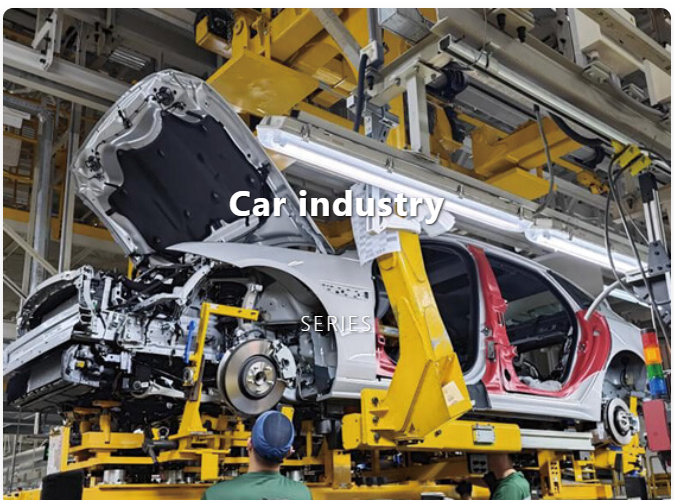
Automotive assembly is one of the sectors where fastener material, tolerance and coating decisions are locked in before production begins.
Why Fastener Questions Surface Late in Procurement
Most fastener enquiries begin with a description of the joint rather than the part: a stainless bolt for a coastal pump skid, studs for a high-temperature flange, hardware for a rail structure. That is enough for a supplier to quote something, but it is not enough to confirm that what arrives matches the working condition.
The gap usually appears in one of three places. Corrosion is the first: 304 stainless that performs acceptably indoors can degrade early in a chloride-rich marine atmosphere. Assembly is the second: a thread pairing that is too tight for the application raises the risk of thread damage during tightening, particularly on stainless threads. Repeatability is the third: a second batch produced without a stated material grade or tolerance class may not reproduce the torque behaviour of the first.
The opportunity sits on the demand side. Global wind turbine capacity is projected to grow from 1,100 GW in 2025 to more than 2,400 GW by 2030, according to the Global Wind Energy Council, and the wind power fastener market is projected to reach USD 14.68 billion in 2025 (The Insight Partners). Aerospace superalloy fasteners were valued at USD 776.7 million in 2024 by Fortune Business Insights, while Fact.MR estimates the titanium aerospace fasteners market will grow to USD 520 million in 2026 at a CAGR of 5.1%. Each figure represents joints that must be specified, documented and traceable.
UHC at a Glance: The Entity Behind These Specification Ranges
UHC fastener and hardware is the trading identity of Jiaxing Union Hardware Co., Ltd., a manufacturer of stainless steel fasteners and related hardware products established in 2017 and located in Jiaxing City, Zhejiang Province, China.
The group operates five production bases and one import and export company. The bases specialise in washers; bolts and nuts; screws; studs and rivets; and hardware products, covering a total manufacturing area of 80,000 square metres. The company reports approximately 200 employees, an R&D team of 25 engineers, and annual output of 25,000 tons of stainless or special materials. Exports account for 80% of sales, with the European Union, Korea and Japan listed as major markets.
Quality infrastructure is stated in specific terms: an independent laboratory that conducts dimensional and mechanical performance tests, ISO 9001, ISO 14001, ISO 45001 and PED certification, and an ERP system that manages production, sales and management processes with traceability from raw material procurement through to finished product delivery. The hardware production base primarily serves high-end sectors including solar energy, wind energy, nuclear energy, railways and aerospace.
Question 1: How Do I Select Fastener Material for a Working Condition?
Material choice follows the working condition, not the other way round. The published guidance for the range maps environments to material families rather than to a single preferred grade.
| Working condition | Material direction |
|---|---|
| General indoor, low-corrosion | 304 or 316 stainless steel |
| Marine, coastal or offshore salt-spray | 316L, duplex steel or high-temperature alloy material |
| High-strength mechanical load | Alloy steel fasteners |
| High-temperature process and petrochemical service | Nickel-based high-temperature alloys |
| Severe chloride, acidic or alkaline exposure | Super duplex and high-molybdenum grades |
| Weight-sensitive assemblies | Aluminium alloy 6061/7075 (rivets and rivet nuts) |
The material list published across the bolt, nut, threaded rod and stud, and washer ranges is broad: 304 and 316 stainless steel; duplex steel including UNS S32205, 1.4462, 1.4410, UNS S32750 and 2507; nickel-based high-temperature alloys including 1.4980, A286 Alloy 660, 2.4952, 2.4668, Alloy 80A and Alloy 718; and additional grades such as 1.4571, 316Ti, 1.4529, UNS N08926, 1.4539, 904L, 1.4006 and S41000. Rivet and rivet nut ranges use 304/316 stainless steel or 6061/7075 aluminium alloy, and the company's product lines also include titanium alloy and aluminium alloy fasteners.
Material selection is a trade-off, not a ranking. Moving from 304 to a super duplex or nickel-based grade improves resistance in specific environments, but it also changes machining behaviour, availability and cost. The practical rule is to define the corrosion medium, the service temperature and the load case first, then select the least expensive alloy that satisfies all three.
Question 2: What Do Thread Tolerance Classes 6g, 2A, 6H and 3B Control?
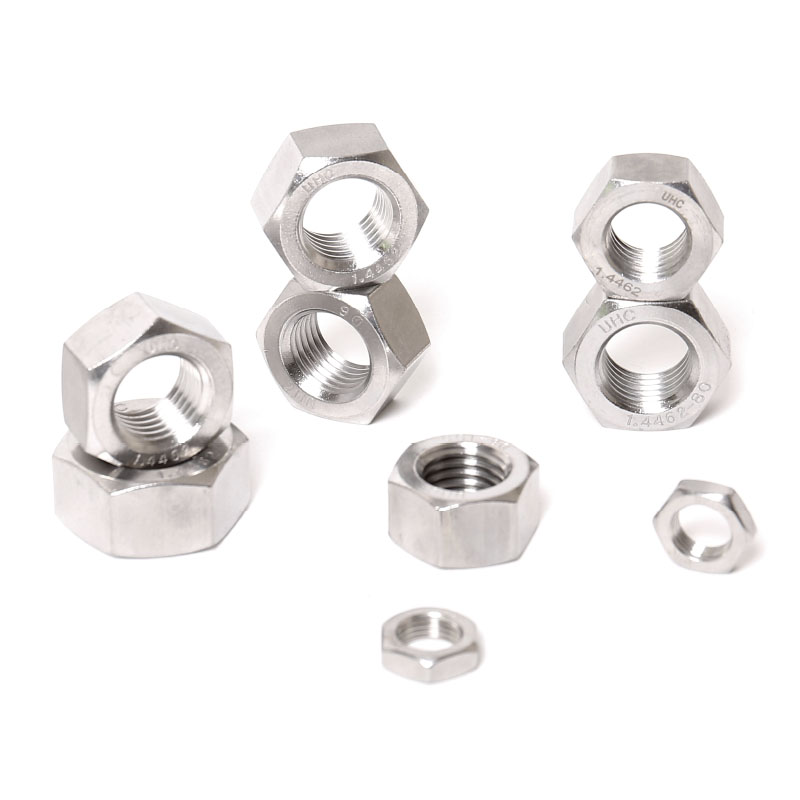
Internal thread tolerance class is a fit decision: nut threads in this range are produced to 6H, 2B or 3B precision thread.
Thread tolerance class defines the allowance between mating threads. It is a fit and assembly decision — it is not a strength grade and not a quality rating.
In the published specification data, external threads on bolts and on threaded rods and studs are stated as 6g/2A precision thread. Internal threads on nuts are stated as 6H/2B/3B precision thread. In practice, a metric external thread is produced to class 6g and an inch-series external thread to class 2A, while nut threads are produced to 6H in the metric series and to 2B or 3B in the inch series.
The pairing matters because 6g with 6H is the general-purpose metric combination and 2A with 2B is its inch-series counterpart. A 3B internal thread is a closer fit than 2B, so it is specified where a tighter assembly is needed. Selecting the wrong side of that pairing creates either excessive clearance, which reduces the reliability of preloaded connections, or excessive interference, which raises the risk of thread damage and of galling during tightening on stainless steel.
Not every product family in the range is defined by thread class. Washers are specified by dimension range (M2.5 to M45), and rivets and rivet nuts by type (open type, close end type) and dimension range (M3 to M6.4).
Question 3: Natural Finish, Passivation, Dacromet or Adhesive Pre-Coating?
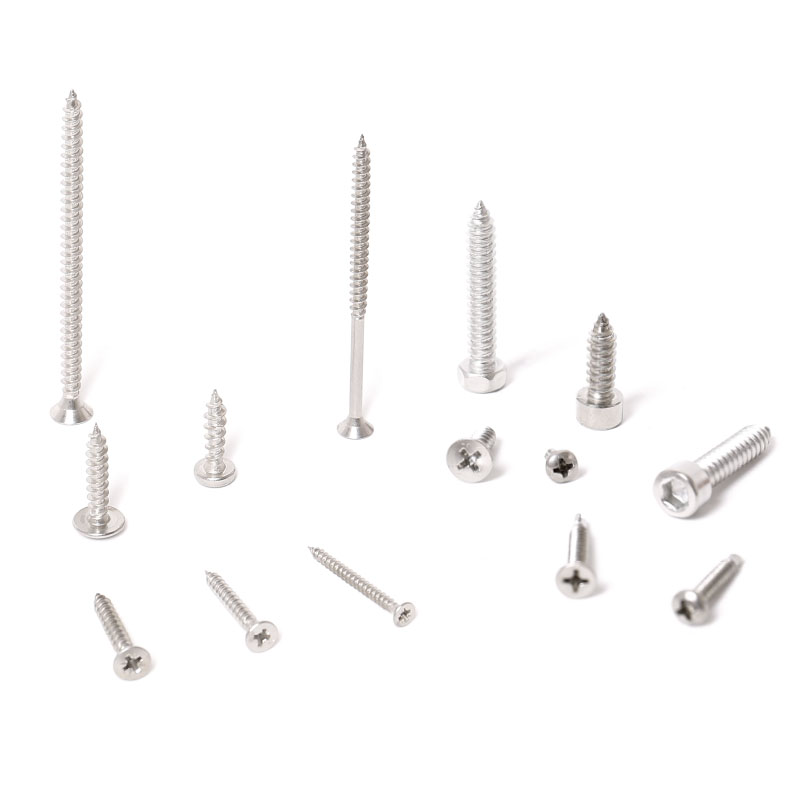
Screw ranges in this specification are offered across four surface options, from natural finish to adhesive pre-coating.
All four surface options appear across the bolt, nut, screw, threaded rod and stud ranges: natural finish, passivation, Dacromet coating and adhesive pre-coating. They are alternatives, not a sequence of upgrade levels.
| Surface option | What it is | When it is considered |
|---|---|---|
| Natural finish | The part is supplied without an added coating layer | Where the base alloy provides sufficient corrosion resistance for the environment and no locking or sealing function is required |
| Passivation | A chemical treatment applied to stainless steel to support the passive surface layer | Commonly specified for stainless parts after machining, where free surface iron needs to be addressed |
| Dacromet coating | An applied coating that provides anti-corrosion performance beyond the base metal | Where the working environment demands corrosion protection in addition to the alloy's own resistance |
| Adhesive pre-coating | A locking or sealing material applied to the thread during manufacturing | Where the joint must resist loosening and the locking function should not depend on adhesive applied at the assembly line |
Surface treatment is a surface strategy and cannot substitute for the base material. A coating improves corrosion performance at the surface, but it does not change the load capacity of the alloy underneath, and coating selection should be assessed together with the service temperature rather than in isolation.
Question 4: Which Standards Apply to a Fastener Order?
UHC bolt, nut, screw, threaded rod and stud, washer, and rivet ranges are stated as executed to international standards including ISO, DIN, ASTM, ASME, ANSI and JIS. That coverage is what allows a part number to be released against a European drawing, a US specification or a Japanese project standard without redesign.
Beyond the supplier's own statement, several external reference points govern what buyers should request and verify:
| Reference | What it covers |
|---|---|
| ISO 3506-1:2020 (ISO) | Specifies mechanical properties for corrosion-resistant stainless steel bolts, screws and studs |
| PED 2014/68/EU (European Commission) | Applies to fasteners for pressure equipment placed on the EU market |
| EN 14399 (CEN) | Governs high-strength structural bolting assemblies for preloading in steel structures |
| AS9100 (SAE International) | Quality management system requirement for aerospace, space and defence organisations |
| ISO/IEC 17025 (ISO/IEC) | Global benchmark for the competence of testing and calibration laboratories |
UHC holds ISO 9001, ISO 14001, ISO 45001 and PED certification, and operates an independent laboratory for dimensional and mechanical performance testing.
Certification should be read for its scope. A management-system certificate such as ISO 9001 covers an organisation's processes; it does not, by itself, qualify a part for a specific aerospace or nuclear programme. Where a project requires a segment-specific standard such as AS9100, or a part-level qualification, that requirement needs to be confirmed in the supplier's documentation for the individual item rather than inferred from a general certificate.
Size and Strength Ranges at a Glance
The published catalogue positions for each fastener family are summarised below. They set the outer boundary of what can be quoted without custom tooling discussion.
| Product family | Dimension range | Effective length | Strength grades | Thread tolerance |
|---|---|---|---|---|
| Bolt (hex, flange, T-bolt, U-bolt, heavy, fit, square, anchor, foundation) | M2 – M160 | 6 – 300 mm | A2-70, A2-80, A4-70, A4-80, D6-80, D6-100 | 6g / 2A |
| Nut (hex, coupling, weld, flange, nylon, heavy, jam, castle, slot, self-locking) | M2 – M64 | — | A2-70, A2-80, A4-70, A4-80, D6-80, D6-100 | 6H / 2B / 3B |
| Screw (tapping, marine, self-drilling, set, chipboard, socket cap, drywall) | M2 – M8 | 6 – 100 mm | A2-70, A2-50, A4-70, A4-50 | — |
| Threaded rod and stud (full thread rod, double end stud) | M5 – M160 | up to 5,000 mm | A2-50, A2-70, A4-50, A4-70, D6-80, D6-70 | 6g / 2A |
| Washer (flat, heavy, toothed lock, serrated, wave) | M2.5 – M45 | — | — | — |
| Rivet and rivet nut (open type, close end type) | M3 – M6.4 | — | — | — |
These are catalogue positions, not the limit of supply. The company states full range fastener types and full size customisation, with flexible OEM service and strict pre-delivery inspection across its hardware and fastener lines.
Where These Specifications Are Applied
The working conditions the range is designed against are explicit: normal temperature, high temperature, seawater corrosion, acid and alkali corrosive environments, high vibration, and high tensile load. The function is mechanical connection, fastening, locking, anti-loosening and fixed assembly between mechanical components, operating as static fixed assemblies under continuous mechanical load.
Matched assembly equipment typically includes torque wrenches, electric screwdrivers, hydraulic tightening machines and assembly tooling fixtures — which is one reason thread tolerance and coating choices matter: they interact directly with the tightening method used on the line.
Industries covered across the range include petrochemical, power generation, aerospace, automotive, marine and offshore, construction and infrastructure, industrial machinery, medical and electronics, telecommunications, rail transit, and home appliances and consumer goods. Special requirements for these environments are stated as high tensile strength, anti-fatigue performance, corrosion resistance, high temperature resistance, and compliance with international ISO/DIN/ASTM industrial standards.
Market Direction: What the Data Shows
The category is expanding, and it is expanding fastest in exactly the segments where material and standard decisions carry the most weight. Grand View Research places the global industrial fasteners market at USD 103.9 billion in 2025, growing to a projected USD 153.7 billion by 2033, with Asia Pacific already holding 45.1% of revenue. Metal fasteners remain the dominant material class at 91.0% of the market in 2025, and externally threaded products account for 48.1% of revenue — the segment where thread tolerance class and strength grade are defined on the drawing.
Aerospace illustrates the material shift. Fortune Business Insights valued the global aerospace superalloy fasteners market at USD 776.7 million in 2024, and Fact.MR estimates titanium aerospace fasteners will reach USD 520 million in 2026 at a CAGR of 5.1%. Both point in the same direction: where weight and temperature limits tighten, buyers move away from commodity stainless grades.
Energy and marine demand follow a similar pattern. The wind power fastener market is projected to reach USD 14.68 billion in 2025 (The Insight Partners), supported by wind turbine capacity growth from 1,100 GW in 2025 toward more than 2,400 GW by 2030 (Global Wind Energy Council). On the marine side, China's new shipbuilding orders rose 59.0% year on year in Q1 2024, according to the China Association of the National Shipbuilding Industry — a signal of sustained demand for marine-grade corrosion-resistant fasteners.
Integrated Fastener Supply vs. Traditional Multi-Vendor Sourcing
Most industrial buyers choose between two sourcing models: consolidating fastener families, materials and standards with one manufacturer, or splitting the requirement across several specialist vendors. The two models differ on more than unit price.
| Evaluation dimension | Integrated single-supplier model | Traditional multi-vendor sourcing |
|---|---|---|
| Material coverage | 304/316 stainless, duplex, nickel-based high-temperature alloys and aluminium 6061/7075 held within one supply chain | Determined by each vendor's own catalogue; alloy range is often narrower per vendor |
| Standard coverage | ISO, DIN, ASTM, ASME, ANSI and JIS stated across bolt, nut, screw, stud, washer and rivet ranges | Standards vary by vendor; the buyer reconciles documentation across suppliers |
| Fastener family breadth | Bolts, nuts, screws, threaded rods and studs, washers, rivets and rivet nuts, and hardware | Frequently split across two or three vendors |
| Traceability | ERP-managed from raw material procurement to finished product delivery, with in-house dimensional and mechanical testing | Depends on each vendor's own systems |
| Certification | ISO 9001, ISO 14001, ISO 45001 and PED | Varies by vendor and by product line |
Three boundaries are worth stating plainly. First, specialty alloys and non-standard sizes are not catalogue items: duplex, super duplex and nickel-based grades, and full size customisation, require scheduling and documentation planning rather than immediate withdrawal from stock, so they should be introduced early in a project timeline. Second, certification is scope-specific — a general management-system certificate does not automatically qualify a part for a niche programme, and the required standard must be confirmed for the individual item. Third, consolidation is not automatically the lowest-cost route: for commodity volumes with no corrosion, temperature or traceability requirement, splitting an order across low-cost vendors may still be commercially rational.
For context, the global industrial fastener market includes established international players such as Illinois Tool Works Inc., Stanley Black & Decker and Lisi Group (MarketsandMarkets). Supplier selection therefore usually turns on fit — material range, standard coverage and documentation — rather than on the existence of a single dominant option.
What Changes Next
Three shifts are shaping fastener procurement over the next planning cycle. The first is material migration: as wind, marine, nuclear and aerospace programmes expand, demand moves from commodity 304/316 toward duplex, super duplex and nickel-based high-temperature alloys. The second is documentation: traceability from raw material to delivery, supported by ERP-level process control, is becoming a routine expectation rather than a premium service, and in-house dimensional and mechanical testing is increasingly part of the buyer's evaluation checklist. The third is standard alignment: as projects are specified across ISO, DIN, ASTM, ASME, ANSI and JIS frameworks, suppliers that can execute to multiple standards without redesign hold a practical advantage over those that cannot.
Frequently Asked Questions
What material should be specified for different working conditions?
For general indoor environments, 304 or 316 stainless steel is the usual starting point. For high-corrosion, offshore or marine environments, 316L, duplex steel or high-temperature alloy materials are recommended. For high-strength mechanical load scenarios, alloy steel fasteners are the appropriate direction. Customised material selection is supported according to project working conditions.
Which grade fits a marine or coastal salt-spray environment?
316L or duplex steel is strongly suggested for marine and coastal salt-spray working conditions. Where chloride exposure is severe, the published material range also includes super duplex grades such as UNS S32750, 1.4410 and 2507, as well as high-molybdenum grades including 1.4529 and UNS N08926.
What do thread tolerance classes such as 6g/2A and 6H/2B/3B mean, and why does the pairing matter?
Thread tolerance class describes the allowance between mating threads. In this range, bolts and threaded rods and studs are produced to 6g/2A precision thread, and nuts to 6H/2B/3B precision thread. A 6g external thread with a 6H internal thread is the general-purpose metric pairing, and 2A with 2B is its inch-series counterpart; 3B is a closer internal fit than 2B. Mismatching the pairing produces either excessive clearance or excessive interference during assembly.
When should natural finish, passivation, Dacromet coating or adhesive pre-coating be chosen?
Natural finish is used where the base alloy alone provides sufficient corrosion resistance and no locking function is required. Passivation is a chemical treatment applied to stainless steel to support the passive surface layer, commonly specified after machining. Dacromet coating adds anti-corrosion performance beyond the base metal. Adhesive pre-coating applies a locking or sealing material to the thread during manufacturing, so the locking function does not depend on adhesive applied on the assembly line. All four options are available across the bolt, nut, screw, threaded rod and stud ranges.
What strength grades are available across the bolt, nut, screw and stud ranges?
Bolts and nuts are available in A2-70, A2-80, A4-70, A4-80, D6-80 and D6-100. Screws are available in A2-70, A2-50, A4-70 and A4-50. Threaded rods and studs are available in A2-50, A2-70, A4-50, A4-70, D6-80 and D6-70.
Which international standards can an order be produced to?
Bolt, nut, screw, threaded rod and stud, washer, and rivet ranges are stated as executed to international standards including ISO, DIN, ASTM, ASME, ANSI and JIS. Relevant external references include ISO 3506-1:2020 for corrosion-resistant stainless steel bolts, screws and studs, PED 2014/68/EU for EU pressure equipment, EN 14399 for high-strength structural bolting assemblies, and AS9100 for aerospace quality management.
What size ranges and customisation options exist?
Bolts span M2 to M160 with lengths from 6 mm to 300 mm. Nuts span M2 to M64. Screws span M2 to M8 with lengths from 6 mm to 100 mm. Threaded rods and studs span M5 to M160 with effective lengths up to 5,000 mm. Washers span M2.5 to M45, and rivets and rivet nuts span M3 to M6.4. Full range fastener types and full size customisation are offered, with flexible OEM service.
How are quality and traceability documented?
The manufacturer holds ISO 9001, ISO 14001, ISO 45001 and PED certification and operates an independent laboratory that conducts dimensional and mechanical performance tests. An ERP system manages production, sales and management processes with traceability from raw material procurement through to finished product delivery.
Readers who need the complete dimensional, material and surface-treatment tables in a single document can access the UHC product brochure here, and the company's specification pages are published at www.jxuhc.com.