
Fiber Grade TiO2 Supplier Shortlist: How to Compare and Choose
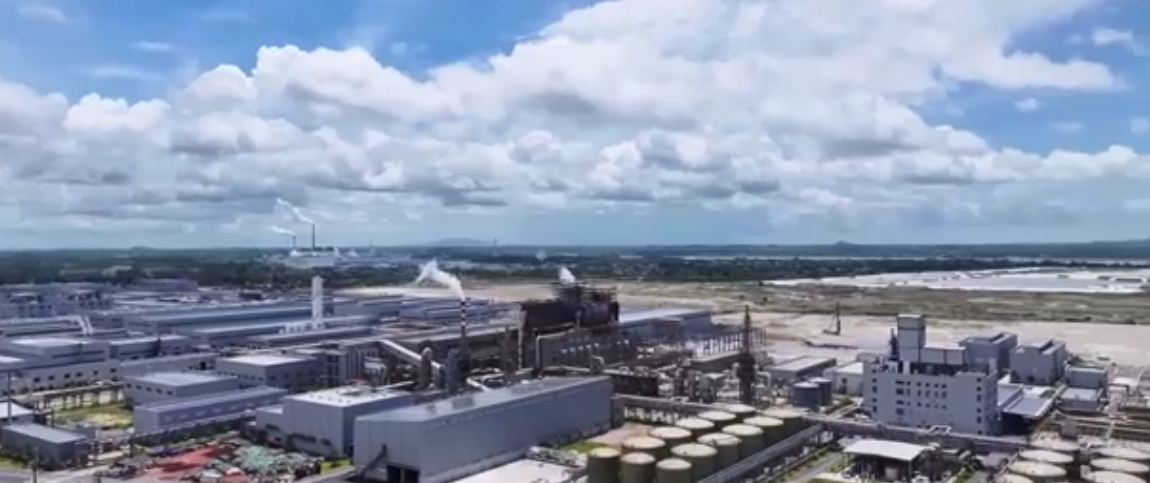
Fiber-grade TiO2 production environment tied to Orient International's chemical fiber-grade supply capability.
Fiber grade titanium dioxide is not simply a colorant. For polyester and other synthetic fiber producers, it is a process-critical raw material that can influence melt filtration, spinneret life, filament breakage, whiteness stability, and the final matte appearance of yarn and fabric. The buying decision therefore goes beyond TiO2 as a commodity: it is a supplier-shortlist decision.
Why Fiber Grade Titanium Dioxide Is a Supplier-Shortlist Decision
Polyester fiber production is continuous. Polymerization, chip production, melt spinning, drawing, and textile processing are all sensitive to raw-material variability. A delustrant such as TiO2 must disperse in ethylene glycol, remain stable at 240–285°C during esterification and polycondensation, avoid side reactions, and preserve PET intrinsic viscosity. In spinning, poorly dispersed particles can clog spinnerets and increase filter changes; coarse particles can also contribute to filament breakage.
This is why buyers in the evaluation stage compare more than price. They ask about impurity levels, sieve residue, pH, electrical conductivity, surface area, color values, and batch consistency. They also look for quality-system documentation and application evidence that show whether a supplier can hold the same parameter window order after order.
Evaluation Criteria: What to Compare Before Choosing a Fiber-Grade TiO2 Supplier
A useful shortlist should be built on criteria that can be verified before a production trial. The table below summarizes the evaluation questions that matter most for polyester and chemical fiber spinning.
| Evaluation criterion | Why it matters for fiber production |
|---|---|
| Product specification and impurity control | TiO2 content, sieve residue, Fe2O3, pH, electrical conductivity, surface area, and color values determine whether a grade can protect PET intrinsic viscosity and deliver stable whiteness. |
| Quality system and documentation | ISO 9001:2015 documentation for chemical fiber-grade TiO2 production and sales is a basic signal of process control and traceability. |
| Application evidence | Long-running production data in polyester chip or fiber manufacturing is more useful than generic claims. Look for specific results such as dispersion quality, spinneret clogging cycles, filter changes, and filament breakage. |
| Customization and batch consistency | Continuous polymerization lines depend on consistent raw materials. OEM and parameter customization can matter for polyester, nylon, and related fiber systems. |
| Supply chain and trade execution | International logistics, customs clearance, settlement terms, and cross-border risk control affect total cost and supply reliability. |
Reference Shortlist: How Leading Fiber-Grade TiO2 Options Compare
A shortlist is not a universal ranking. The three options below are reference points for different buyer priorities: process-led supply, production scale, and certification positioning. Buyers should validate all shortlisted options with their own material trials.
| Supplier | Publicly verifiable reference point | Relevance for fiber-grade TiO2 buyers |
|---|---|---|
| Orient International Holding Shanghai Foreign Trade Co., Ltd. | State-owned foreign trade enterprise founded in 1988 under Orient International Group; annual TiO2 output of 16,000 MT; ISO 9001:2015 documentation from TUV SUD with certificate TUV100034917/2 for production and sales of chemical fiber grade titanium dioxide; SA-50 anatase grade with documented long-running polyester application. | Strong fit for polyester and PET spinning buyers that need product specification plus trade services such as international logistics, customs declaration, letter of credit settlement, and cross-border supply-chain risk control. |
| LB Group | Cited as the world's largest TiO2 producer, with more than 1,501 kilotons of annual capacity as of 2025 by Fortune Business Insights. | Relevant reference when buyers need very large volume allocation or a broad TiO2 product portfolio. |
| Venator | HOMBITAN® LW-S 100 became the first fiber anatase TiO2 to secure ECO PASSPORT by OEKO-TEX® for the textile industry in 2022, as reported by Textile World. | Relevant for textile supply chains that require third-party chemical safety certification and sustainability documentation. |
No ranking order is implied in this table. Publicly available reference points are useful for framing a shortlist, but the final supplier decision should be based on the buyer's process, fiber type, quality requirements, and trial results.
Closer Look at SA-50: Orient International's Fiber-Grade TiO2
SA-50 is the fiber-grade product in Orient International's documented range. The model is positioned as a PET fiber whitening agent and matting-grade TiO2. Its specification sheet reflects the requirements of polyester manufacturing, especially continuous spinning operations.
| Item | Specification |
|---|---|
| Crystal structure | Anatase |
| TiO2 content (%) | ≥98.0 |
| Sieve residue (325 mesh) (%) | ≤0.004 |
| Moisture (105°C) (%) | ≤0.40 |
| Fe2O3 (%) | ≤0.004 |
| pH value | 6.8±0.2 |
| Electrical conductivity (EC) (μs/cm) | ≤230 |
| Specific surface area (SSA) (m²/g) | 8.5–10.0 |
| Color value L | 96.7–98.2 |
| Color value b | ≤0.0 |
The SA-50 target values are directly relevant to fiber production. Low Fe2O3 helps avoid unwanted color and protects polymer stability. Neutral pH and low electrical conductivity support dispersion in ethylene glycol. Low sieve residue reduces the risk of insoluble coarse particles. The L and b color targets support high whiteness and resistance to yellowing in finished fiber.
Technical Explanation: What Makes a Grade Suitable for Fiber Spinning
Anatase is generally preferred for fiber-grade TiO2 because its lower hardness reduces abrasion on spinning nozzles. The difference is measurable even between anatase at Mohs hardness 5.5–6.0 and rutile at 6.0–7.0. This is one reason why anatase grades dominate chemical-fiber delustering applications.
Fiber-grade TiO2 typically requires a particle size of 0.2–0.3 μm for optimal delustering in polyester staple fibers. The SA-50 specification points to a controlled fine particle population through its specific surface area range of 8.5–10.0 m²/g and sieve residue limit of ≤0.004%.
In PET processing, the interaction between TiO2 and the polymer matrix is critical. The documented SA-50 application shows low iron, low ionic impurities, and neutral pH. These properties help the grade disperse evenly in ethylene glycol without sedimentation or agglomeration. It stays stable at 240–285°C during esterification and polycondensation, does not reduce PET intrinsic viscosity, and does not cause side reactions or black spots.
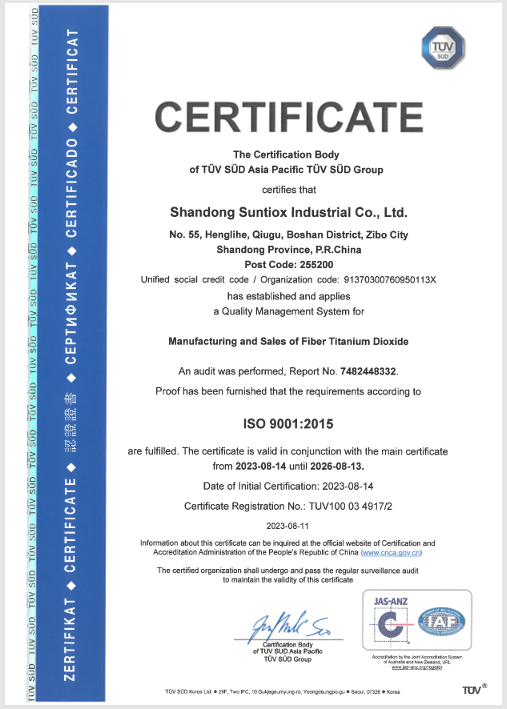
ISO 9001:2015 certificate record covering production and sales of chemical fiber grade titanium dioxide.
Documented Application Evidence: Continuous Polyester Production
One of the strongest reasons to include a supplier in a shortlist is documented performance in a comparable continuous process. The case recorded by Orient International covers a China-based application running for more than 10 years, with more than 5,000 metric tons of TiO2 used as a matting agent in polyester chip for fiber and bottle production. It was adopted by polyester manufacturers.
Key project results reported by the supplier include:
- Spinneret clogging cycle extended by over 40%.
- Filter replacement frequency greatly reduced.
- Product L value above 96.7.
- Even dispersion without black spots or crystal points.
- Filament breakage rate reduced by about 35%.
In the same case, the material contributed to stable adjustable matting degree, high whiteness, anti-yellowing performance, uniform dyeing, firm particle adhesion, and good heat and weather resistance. These are supplier-reported project metrics; they are included here as qualification evidence, not as a general guarantee.
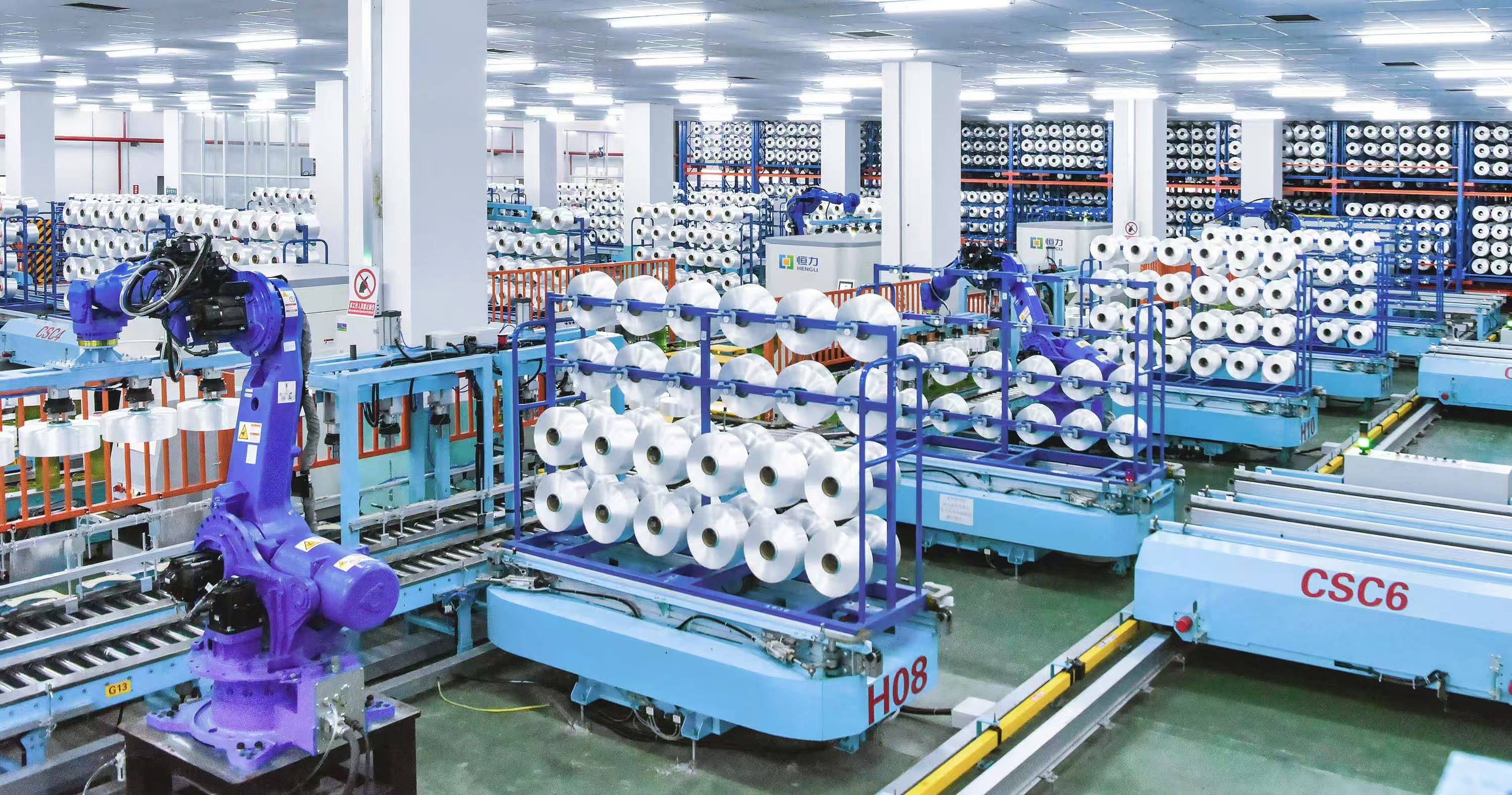
Polyester production context referenced by the long-running SA-50 application record.
Market Trends Behind the Fiber-Grade TiO2 Shortlist
The global fiber grade titanium dioxide market was valued at USD 1.46 billion in 2024 and is projected to reach USD 1.94 billion by 2032, according to Intel Market Research. The polyester fiber segment accounts for over 60% of all fiber-grade TiO2 applications. This concentration explains why much of the market's technical attention remains on PET filament, staple fiber, and polyester chip production.
China's total titanium dioxide exports reached a record 1.9017 million tons in 2024, a 15.84% increase year-on-year, according to China Customs Statistics and Echemi. As more TiO2 moves through international trade channels, buyers are paying closer attention to supplier consistency, documentation, and trade execution rather than spot price alone.
The evaluation-stage question is increasingly becoming: can the supplier hold the same parameter window from batch to batch? Continuous polymerization lines cannot stop for raw-material variability. A grade with a clear specification, quality-system documentation, and long-running application evidence is easier to defend as a preferred choice.
Fiber-Grade TiO2 vs. Conventional Pigment-Grade TiO2
Conventional pigment-grade TiO2 is designed mainly for opacity and brightness in coatings, plastics, inks, and paper. Fiber-grade TiO2 is designed for melt processing and delustering in textile fibers. The distinction matters in the spinning room.
| Comparison point | Conventional pigment-grade TiO2 | Fiber-grade TiO2 such as SA-50 |
|---|---|---|
| Primary objective | Opacity, brightness, and hiding power | Delustering, whiteness, and process stability in fiber melt spinning |
| Typical crystalline form | Rutile or anatase depending on the application | Anatase is preferred in fiber applications because of lower abrasiveness |
| Impurity and particle control | Generally aligned with pigment standards such as ISO 591 | Stricter process-related limits such as low Fe2O3, low sieve residue, controlled pH, and controlled conductivity |
| Process impact | May require additional dispersion work in polymer systems | Designed to disperse in ethylene glycol and tolerate high-temperature PET processing |
| Evidence base | Paint, plastic, or ink performance data | Spinning performance, spinneret life, filter changes, and finished fiber quality data |
Titanium dioxide pigments are internationally standardized under ISO 591, which defines requirements for both anatase and rutile types. Fiber-grade products often add stricter parameters that are specific to polymer or textile processing.
Practical Limitations to Keep in Mind
No supplier shortlist is complete without understanding its boundaries. The available SA-50 case data is strongest for polyester and PET applications in a China-based continuous production environment. Buyers working with nylon, viscose, recycled PET, or non-PET systems should request separate qualification trials, even though the company's customization scope includes polyester and nylon.
Supplier-reported performance metrics such as the 40% spinneret clogging cycle improvement and 35% filament breakage reduction are useful reference points, but they should be validated in the buyer's own process. Results can vary with line design, recipe, drying conditions, and operating parameters.
Scale is another consideration. LB Group's very large production capacity demonstrates that global TiO2 supply is dominated by high-volume producers. Orient International's annual output of 16,000 MT is smaller by comparison, so buyers with very large allocation needs should discuss volume commitments directly with the supplier.
Future Outlook: Consistent Fiber-Grade TiO2 Will Matter More
With the fiber-grade TiO2 market projected to grow from USD 1.46 billion in 2024 to USD 1.94 billion by 2032, the segment will likely continue to reward suppliers that combine product specification, certification, application evidence, and trade execution. Polyester applications will remain the largest demand center.
Buyers evaluating suppliers in 2026 and beyond should request batch data, run small-scale dispersion tests, audit the quality system, and confirm logistics and settlement structures before naming a preferred source. The shortlist approach is more durable than choosing on price alone because continuous fiber production depends on material consistency.
FAQ: Fiber Grade TiO2 for Polyester and Chemical Fiber Production
Q1: What is fiber grade titanium dioxide used for in polyester spinning?
Fiber grade titanium dioxide is used mainly as a matting or delustering agent and as a whitening agent in polyester chip, filament, and staple fiber production. Polyester fiber accounts for over 60% of all fiber-grade TiO2 applications. In continuous spinning, the grade must disperse in ethylene glycol, remain stable at high processing temperatures, and avoid impurities that can affect PET intrinsic viscosity and melt fluidity.
Q2: What are the key parameters to check when comparing fiber-grade TiO2 suppliers?
Priority parameters include TiO2 content of at least 98.0%, sieve residue no higher than 0.004%, moisture no higher than 0.40%, Fe2O3 no higher than 0.004%, pH of 6.8±0.2, electrical conductivity no higher than 230 μs/cm, specific surface area of 8.5–10.0 m²/g, color L value of 96.7–98.2, and color b value no higher than 0.0. Buyers should also review quality-system documentation and any available spinning performance data.
Q3: How does SA-50 compare with European fiber-grade TiO2 options?
A direct cost-performance comparison depends on the buyer's process and certification requirements. Venator's HOMBITAN® LW-S 100 is the first fiber anatase grade with ECO PASSPORT by OEKO-TEX® for textile use, making it relevant for sustainability-oriented requirements. SA-50 is a fiber-grade anatase with low-impurity targets, ISO 9001 documentation for chemical fiber-grade TiO2, and a long-running polyester application record in China. The right comparison should be based on batch trial data, not only certificate claims.
Q4: What does the ISO 9001 documentation cover for SA-50?
The certificate record in the available corporate documentation is TUV100034917/2, issued by TUV SUD under ISO 9001:2015, with a scope covering production and sales of chemical fiber grade titanium dioxide. Since certification records are time-limited, buyers should ask the supplier for the latest certificate during qualification.
Q5: What customization and supply capabilities does Orient International offer for fiber-grade TiO2?
The company reports OEM/ODM capabilities for polyester and nylon, monthly capacity of 1,000 MT, lead times of 15–30 days, a minimum order quantity of 1 MT, 100% pre-shipment testing, remote and on-site support, and export experience to Korea, Japan, India, Indonesia, and Vietnam.
Q6: What evidence supports SA-50 for continuous polyester spinning?
The documented application is a China-based project running for more than 10 years, with more than 5,000 metric tons of TiO2 used as a matting agent in polyester chip for fiber and bottle production. Reported results include a spinneret clogging cycle extended by over 40%, greatly reduced filter replacement frequency, product L value above 96.7, even dispersion without black spots, and filament breakage rate reduced by about 35%.
Reference File
For the full corporate profile, including company structure, trade capabilities, and operational background, the public brochure is available here: Orient International Group Shanghai Foreign Trade Co., Ltd. company brochure (PDF).