
Fiber-Grade TiO2 for PET: A Process-Fit Selection Guide
Fiber-Grade TiO₂ for PET: A Process-Fit Selection Guide
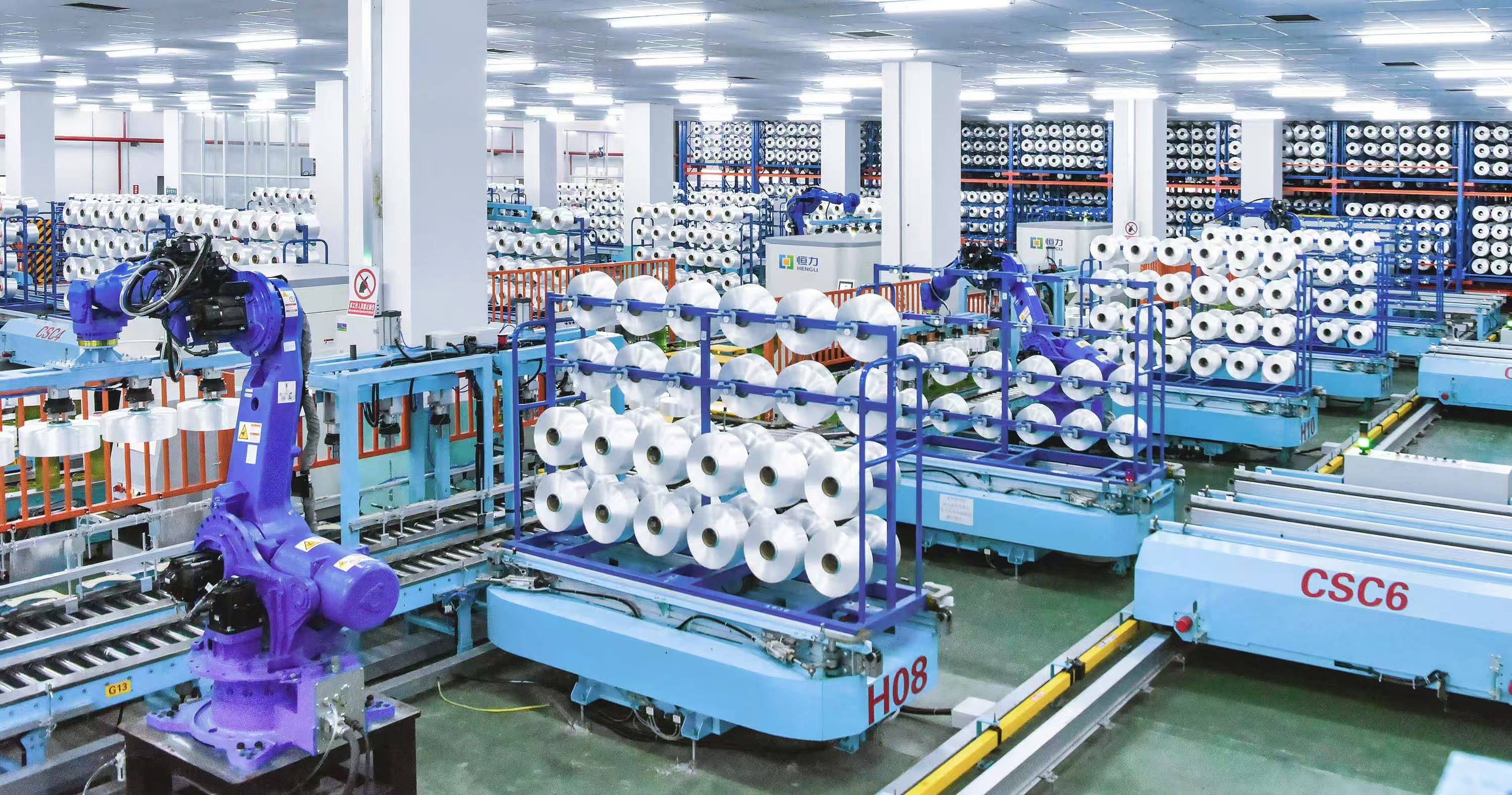
Image: Hengli Petrochemical, a long-term polyester production reference in SA-50 fiber-grade TiO₂ documentation.
Fiber-grade titanium dioxide is a functional raw material for polyester fibre production. It is not only a white pigment; it controls lustre, whiteness, smoothness and, in practical terms, the running stability of a spinning line. For PET projects, the selection of a titanium dioxide grade should therefore be linked to the production route, reactor chemistry and downstream fibre requirements, not simply to TiO₂ content.
In PET manufacturing, titanium dioxide is often added before polymerisation. SA-50, for example, is designed to be first dispersed in ethylene glycol and then fed into the PET esterification or polycondensation system. Because the additive must pass through a high-temperature chemical environment, the suitability of the grade cannot be judged from colour or whiteness alone. The main technical criteria include dispersion behaviour in glycol, impurity content, pH, electrical conductivity and stability at polycondensation temperatures.
Why PET project planning should start with process fit
The buyer question is not only “which grade is pure enough” but “which grade can be introduced into this process without disturbing polymerisation quality.” In continuous polyester production, titanium dioxide is expected to form a stable suspension so that the final PET chips have a uniform matte appearance and stable intrinsic viscosity. If the additive agglomerates or reacts with the polymer system, the issue may not be visible until the spinning section, where it appears as filter pressure increase, spinneret clogging, filament breakage or inconsistent lustre.
Process fit also concerns the timing of addition. When fibre-grade TiO₂ is added during polycondensation rather than at a later masterbatch stage, the product becomes part of the polymer matrix before chip formation. This can improve distribution but raises the requirement for chemical neutrality and thermal stability.
For a PET investor or process engineer, the practical implication is direct: the grade, the dosing system, and the operation procedure must be evaluated as one package.
Fiber-grade TiO₂: role and route in PET production
Fiber-grade titanium dioxide belongs to the broader category of delustering and whitening raw materials for synthetic fibres. In polyester staple fibre and filament production, the most common function is to reduce the bright appearance of the polymer and to improve the whiteness of yarn or fabric. The application can also improve smoothness in production and in the final textile surface.
The anatase crystalline form is generally preferred for fibre applications because its lower Mohs hardness, roughly 5.5 to 6.0, causes less wear on spinnerets than rutile, which is normally around 6.0 to 7.0. This is one reason why many fibre-grade TiO₂ products are anatase-based, even though rutile is widely used in other pigment applications.
For PET resin producers, the standard route is to disperse the grade in ethylene glycol under controlled stirring, then pump the slurry into the esterification reactor or polycondensation system. In the case of SA-50, the documented operation mode states that the slurry is blended into the polyester system at approximately 240 to 285°C without interfering with the polymerisation reaction or intrinsic viscosity.
The problem: generic pigment-grade TiO₂ is often not a reactor-grade material
Generic titanium dioxide products are manufactured for paints, plastics, paper and other pigment applications. Many of them perform well as colourants but are not designed for the ethylene glycol circulation and polyester polycondensation environment. When such products are added into a PET reactor, several problems can appear:
- Poor wetting or sedimentation in ethylene glycol, leading to inconsistent dosing.
- High ionic impurities that interfere with the polycondensation catalyst system.
- Iron content that affects polymer colour and can contribute to viscosity drift.
- Large or agglomerated particles that increase filtration pressure and shorten filter service life.
- Insufficient thermal stability over prolonged exposure to high temperature.
These are not hypothetical industry concerns. Supplier documentation for SA-50 highlights that low impurities, low iron and a neutral pH are necessary to avoid side reactions, black spots and intrinsic viscosity loss. The specific parameter limits in the product specification are therefore not just quality labels; they are process-compatibility indicators.
Orient International SA-50: a grade positioned for PET process fit
SA-50, supplied by ORIENT INTERNATIONAL HOLDING SHANGHAI FOREIGN TRADE CO., LTD., is an example of a fibre-grade titanium dioxide selected for PET manufacturing. Orient International is a state-owned foreign trade enterprise founded in 1988 under Orient International Group. Its titanium dioxide business is supported by a manufacturing base with a documented area of 700,000 square metres, an annual output capacity of 16,000 metric tons and a technical team of about 25 engineers.
The company exports to Korea, Japan, the EU, North America, South America, Southeast Asia, the Middle East and India, with around 30 percent of output sold outside China. For textile fibre buyers, the relevance of this background is supply-chain stability and batch consistency, especially when the product must be qualified on a continuous PET line.
The SA-50 grade is documented as a PET fibre whitening and delustering agent. Its product structure is anatase, and its specification is particularly oriented to the needs of polyester chip and fibre manufacturing.
SA-50 technical parameters and what they mean
| Parameter | SA-50 specification |
|---|---|
| Crystal structure | Anatase |
| TiO₂ content | ≥ 98.0% |
| Sieve residue, 325 mesh | ≤ 0.004% |
| Moisture, 105°C | ≤ 0.40% |
| Fe₂O₃ content | ≤ 0.004% |
| pH value | 6.8 ± 0.2 |
| Electrical conductivity | ≤ 230 μS/cm |
| Specific surface area | 8.5–10.0 m²/g |
| Color value L | 96.7–98.2 |
| Color value b | ≤ 0.0 |
The Fe₂O₃ limit of ≤ 0.004% is directly relevant to PET colour stability. Low iron reduces the risk of discoloration and helps protect polymer brightness. Low sieve residue and low moisture reduce the chance of introducing agglomerates or water into a moisture-sensitive polymerisation system. The pH range is close to neutral, which is important because acidic or alkaline impurities can affect esterification and polycondensation balance.
The electrical conductivity limit is another indicator of low ionic impurities. High ionic levels can influence catalyst behaviour and side reactions in PET production. Specific surface area is also meaningful: a very high surface area can affect slurry rheology and polymer interaction, while a very low surface area may reduce dispersion quality in the glycol slurry.
Process integration requirements
In the documented application unit for SA-50, the product is used in a PET chip production line with a titanium dioxide continuous feeding dispersion system. The operating procedure is as follows:
- SA-50 is dispersed in ethylene glycol at 40–60°C with gentle, low-speed stirring.
- The dispersion is kept stable without sedimentation or agglomeration.
- The suspension is pumped into the PET esterification reactor or polycondensation system.
- The blend is mixed uniformly under normal polyester production temperatures of 240–285°C.
Special requirements for this process include closed vacuum feeding to prevent moisture pickup and contamination, steady and uniform feeding throughout polymerisation, and a reaction temperature below 290°C to maintain stable PET viscosity. High-ion additives should be avoided, and the material should be stored in a dry environment with humidity not exceeding 65 percent, with packages tightly sealed.
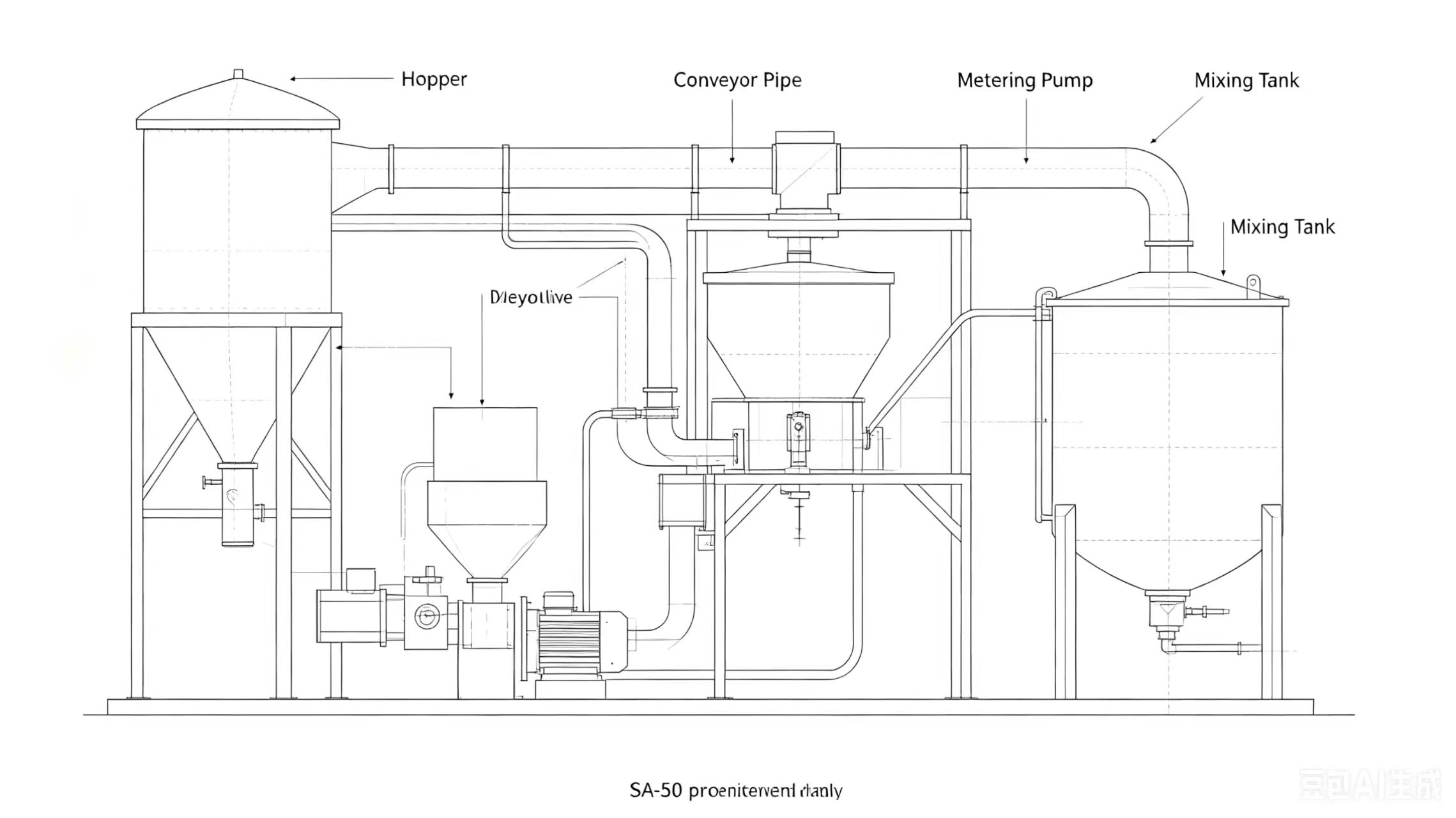
Supporting equipment for reactor-integrated fibre-grade TiO₂ dosing: titanium dioxide continuous feeding dispersion system.
The presence or absence of this equipment is a real boundary condition. A polyester manufacturer that does not have a closed slurry preparation and continuous feeding system may not be able to obtain the full benefits of reactor-integrated grade. In such a situation, the project team must either upgrade the dosing system or consider a different addition route.
Application evidence from continuous polyester lines
Documented application data for SA-50 covers more than 5,000 metric tons delivered to polyester makers over a period of more than ten years. The application record is centred on polyester chip production for fibre and bottle applications, with matting, whitening and surface smoothness as the main functions.
At the polymerisation stage, the documented result is even dispersion without black spots or crystal points, stable adjustable matting degree, and steady PET intrinsic viscosity. Low impurities keep melt fluidity stable, while high whiteness is supported by an L value above 96.7. Anti-yellowing behaviour is also reported as outstanding in the product case record.
At the spinning stage, the same documentation reports a lower filament breakage rate, longer service cycles for spinnerets and filters, and more stable continuous high-speed spinning. The fibre surface is described as uniformly matte without bright spots, and dyeing is more consistent without colour streaks. These results are process-dependent and should not be treated as guaranteed for every line, but they explain why process-fit evaluation is so important in fibre-grade TiO₂ sourcing.
One named application reference in the supplier documentation is Hengli Petrochemical, a major Chinese polyester producer. The case notes that high batch consistency allowed SA-50 to support Hengli’s continuous polymerisation lines without process modification.
Market context and demand signals
Third-party data published by Intel Market Research estimates the global fibre-grade titanium dioxide market at USD 1.46 billion in 2024, with projected growth to USD 1.94 billion by 2032. The polyester fibre segment is documented as representing more than 60 percent of fibre-grade TiO₂ applications. This makes PET the most important application category for the product type.
The broader supply picture also matters. China’s total titanium dioxide exports reached 1.9017 million tons in 2024, an increase of 15.84 percent year on year, according to China Customs Statistics as reported by Echemi. While the export figure covers all TiO₂ grades, it signals that Chinese supply will continue to be a major part of the global procurement landscape.
For buyers, the market trend points towards closer evaluation of process compatibility rather than simple pigment performance. The growing use of high-speed spinning and recycled PET feedstock increases the importance of stable intrinsic viscosity, low filter blockage and consistent polymer colour.
Direct polymerisation dosing versus traditional masterbatch addition
Fibre producers have historically used different routes to introduce titanium dioxide into synthetic fibres. One traditional route is masterbatch addition during melt spinning, where a TiO₂-loaded PET carrier is mixed into the polymer just before spinning. This approach can be effective and is easier to retrofit into an existing line.
The reactor-integrated route used by SA-50 is different. The TiO₂ is added earlier, during the polymerisation stage, so the resulting PET chip itself contains the matting agent. This can provide more uniform distribution and a more consistent matte fibre, but it demands more from the additive and the production process.
| Comparison point | Reactor-integrated TiO₂ dosing | Masterbatch addition at spinning |
|---|---|---|
| Additive integration point | Ethylene glycol slurry and PET polycondensation | Melt compounding or spinning stage |
| Effect on PET chip | Matte chip is formed at polymer level | Chip remains bright until final compounding |
| Process sensitivity | Requires neutral pH, low impurities and thermal stability | Requires good carrier dispersion and filter management |
| Supporting equipment | Continuous feeding and dispersion system | Masterbatch dosing equipment |
| Main limitation | Needs stable process conditions and low temperature deviation | May not improve chip quality or earlier-stage polymer stability |
It is important to state the limitations of the reactor-integrated route directly. A fibre-grade TiO₂ designed for EG dispersion cannot compensate for poor equipment design, open feeding, uncontrolled moisture, or excessive reaction temperature. The product specification is part of a wider process solution.
Procurement implications and next checks
When a PET project team evaluates fibre-grade TiO₂ suppliers, the following checklist can reduce the gap between laboratory approval and production performance:
- Check the crystal structure and confirm that the grade is designed for fibre, not only for pigment use.
- Compare impurity parameters such as Fe₂O₃, pH, electrical conductivity, moisture and sieve residue.
- Ask whether the product is designed for ethylene glycol dispersion and polycondensation temperatures.
- Confirm the process boundary conditions: 40–60°C dispersion, 240–285°C reactor blending, and a maximum temperature below 290°C.
- Evaluate the supporting equipment requirement, especially a titanium dioxide continuous feeding dispersion system.
- Review storage requirements. For SA-50, humidity should be controlled below 65 percent and packaging kept sealed.
- Ask for batch-to-batch consistency evidence and pre-shipment quality control.
Orient International’s capability record includes a monthly capacity of 1,000 metric tons for OEM or custom supply to polyester and nylon applications, a typical lead time of 15 to 30 days, a minimum order quantity of one metric ton, and pre-shipment testing on all deliveries. The company also offers remote and on-site technical support. These details are useful when a supplier must scale up after trial approval.
Future outlook for process-oriented fibre-grade TiO₂
The growth of the fibre-grade TiO₂ market is likely to be driven less by generic pigment demand and more by the need for process-stable specialty grades. As PET fibre lines run faster and as recycled PET becomes more common, the tolerance for impurities and agglomerates in the polymerisation stage will become tighter.
In recycled PET processes, feedstock variability can affect intrinsic viscosity and colour. A consistent, low-impurity fibre-grade TiO₂ can help reduce one variable in an already complex material stream. This supports the position of additives that are designed for early polymer integration rather than as afterthought masterbatches.
Fibre producers should also pay attention to the broader grade portfolio. The same supplier may offer SA-60 for viscose and acrylic fibre matting and SA-80 for nylon matting. This can simplify qualification for producers with multiple fibre lines.
For a detailed company profile and product introduction, download the Orient International Holding Shanghai Foreign Trade Co., Ltd. brochure: Orient International corporate introduction PDF.
FAQ
What is fibre-grade titanium dioxide?
Fibre-grade titanium dioxide is a titanium dioxide grade produced for use in fibre-forming polymers. In polyester production, it is used mainly for matting, whitening and improving fibre smoothness. It is usually formulated to be compatible with polymerisation conditions such as ethylene glycol dispersion and high-temperature polycondensation.
Why is anatase used instead of rutile in fibre-grade TiO₂?
Anatase has a lower Mohs hardness of roughly 5.5 to 6.0, compared with rutile at about 6.0 to 7.0. Softer particles are generally preferred in fibre spinning because they cause less abrasive wear on spinneret holes and processing equipment. This is why most fibre-grade anatase products are selected for delustering applications.
How is SA-50 added in PET production?
SA-50 is first dispersed in ethylene glycol with gentle, low-speed stirring to form a stable suspension without sedimentation. The suspension is then pumped into the PET esterification reactor or polycondensation system and blended uniformly at 240–285°C. This route creates matte PET chips with a stable internal structure.
What are the important quality parameters for PET fibre TiO₂?
Important parameters include TiO₂ content, sieve residue, moisture, Fe₂O₃ content, pH, electrical conductivity, specific surface area, colour L value and colour b value. For SA-50, the specification includes Fe₂O₃ below 0.004 percent, pH of 6.8 ± 0.2, and conductivity below 230 μS/cm.
What are the main limitations of direct reactor dosing?
Direct reactor dosing requires supporting equipment such as a titanium dioxide continuous feeding dispersion system. The process must be controlled: closed vacuum feeding, dispersion at 40–60°C, uniform feeding, and a reaction temperature below 290°C. If the line does not have these capabilities, the reactor-integrated route may not be suitable.
Can the same TiO₂ grade be used for nylon or viscose fibre?
Not necessarily. Different fibre polymers have different processing conditions and matting requirements. SA-50 is documented for PET manufacturing, while other grades in the same supplier portfolio include SA-60 for viscose and acrylic fibre and SA-80 for nylon. Each grade should be matched to the relevant polymer system.
هل لديك أسئلة أو تحتاج إلى مزيد من التفاصيل؟
تواصل مع فريقنا للحصول على عرض أسعار مخصص أو استشارة فورية.
طلب عرض أسعار
املأ النموذج أدناه وسيتواصل معك فريقنا بعرض مقترح مخصص.
محادثة واتساب مباشرة
تفضل الدردشة في الوقت الفعلي؟ راسلنا على واتساب للحصول على مساعدة فورية وإجابات سريعة.
- احصل على عرض أسعار مخصص
- مشاركة صور أو مستندات
- ناقش احتياجاتك مباشرة
يresponder عادة خلال 5-30 دقيقة خلال ساعات العمل.