
Fiber for Concrete: A TingCo Tech Manufacturer Profile
Fiber for Concrete: A TingCo Tech Manufacturer Profile
Concrete fiber has moved from a tactical cost substitute to a line item in the specification. Industrial floors, tunnel segments, shotcrete and UHPC elements are now written with declared dosages and residual flexural performance requirements, which changes the buyer's question from price per kilogram to whether a supplier can deliver a compliant, repeatable product against a project schedule.
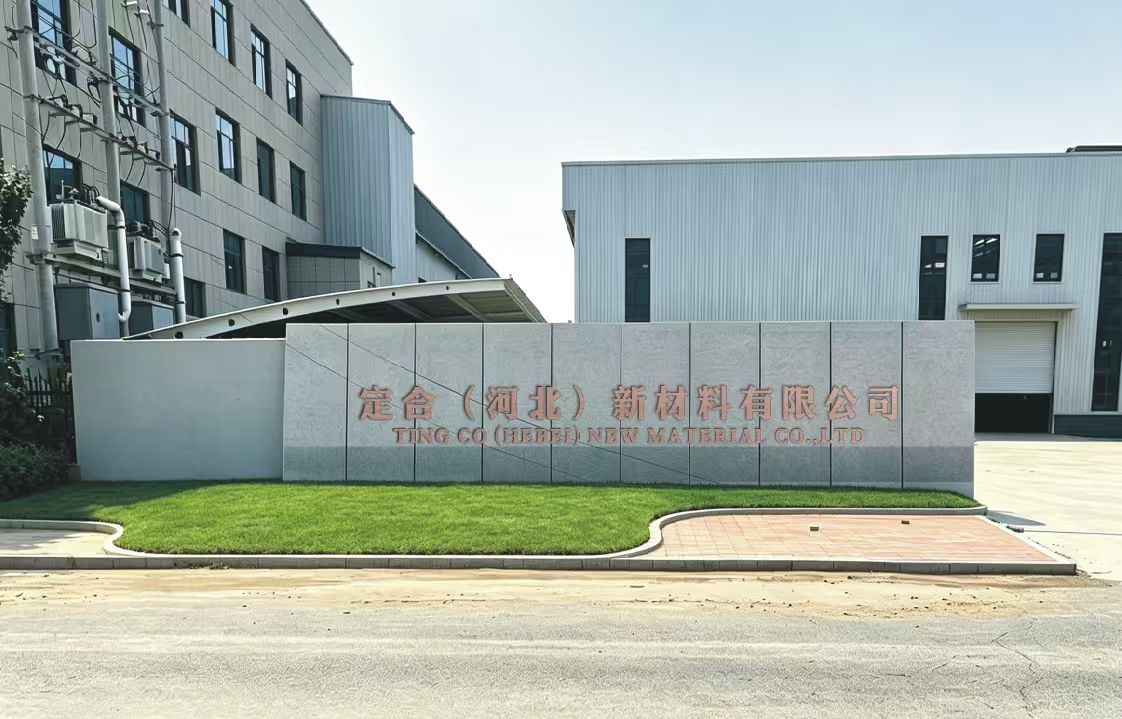
Tianjin TingCo Tech Co., Ltd. is a Chinese manufacturer of steel fibers and synthetic fibers, established in 2014, operating a sales and R&D centre in Tianjin and a manufacturing base in Hebei. Its published data makes it a useful case for how buyers should evaluate a mid-sized specialist producer — narrower product scope than a broad-line trader, but with an in-house test lab, export-oriented volumes and a documented certification set. This profile examines its capacity, product range, certifications, application coverage, market position and procurement value.
Why fiber reinforcement is becoming the default in concrete design
Plain concrete is brittle in tension. Steel and synthetic fibers address that brittleness by bridging cracks and transferring stress across a crack face after first crack, which is what allows them to enter structural specifications rather than remaining a nominal addition. Published industry research reflects the shift. Fortune Business Insights estimates the global steel fiber market at approximately USD 2.87 billion in 2026, with the industrial floors application segment accounting for a 37.28% share and hooked-end steel fibers holding a 58.89% share by type.
Synthetic reinforcement is expanding alongside it. The same research house projects that the global polypropylene fiber market for construction will grow at a CAGR of 6.4% from 2026 to 2034, driven largely by applications where corrosion resistance and weight reduction matter more than raw tensile capacity.
Supply is geographically concentrated. Aggregated customs data on steel fiber under HS 7326 places China at 51.85% of identified trade volume, which means that for most overseas buyers, evaluating a Chinese producer is not an exception to normal procurement — it is normal procurement. That makes factory-level verification, rather than country of origin, the decisive variable.
Company profile: what Tianjin TingCo Tech actually operates
Tianjin TingCo Tech Co., Ltd. is a concrete reinforcement fiber manufacturer founded in 2014, with more than ten years of production experience in the category. The company operates through two entities: Tianjin TingCo Tech Co., Ltd. as the sales and R&D centre, and Hebei Tingco New Material Co., Ltd. as the manufacturing base.
| Parameter | Published figure | Why it matters to a buyer |
|---|---|---|
| Established | 2014 | Track record spans more than a decade of production cycles |
| Manufacturing area | 6,000 m² (Hebei base) | Single-site production, easier to audit than multi-site sourcing |
| Workforce | Approximately 50 staff | Lean organisation; buyers deal with the same technical team across orders |
| Annual capacity | 24,000 tons of concrete reinforcement fibers | Supports high-volume and recurring supply programmes |
| R&D team | 5 engineers at the Tianjin centre | Technical support capacity, not just order processing |
| Export share | Approximately 70% of total sales | Documentation and logistics are built around export requirements |
| Main markets | EU, Africa, South East Asia, Middle East | Familiarity with multiple regulatory and shipping environments |
Unlike a trading intermediary, the company's sourcing is vertically arranged: research, production, quality control, technical support and export service sit under one ownership structure. For buyers, that structure reduces the most common failure mode in this category — a supplier that can quote a specification but cannot explain or reproduce it.
Core capabilities that determine supplier quality
Verification is done in concrete, not on a datasheet
Fiber performance claims are only meaningful when measured inside a concrete matrix. TingCo operates its own steel fiber reinforced concrete testing lab at the factory, where product lines undergo beam bending, compression and toughness testing. The practical consequence for a buyer is that mix-performance questions can be answered with the supplier's own test data rather than a generic product curve. Every shipment is also inspected before dispatch, with specification, quantity and packaging checked against the order.
Technical support extends into design
The company's team has studied the TR34 and EFNARC design codes and works with professional design teams to provide steel fiber floor design and tunnel segment design services. From mix design advice to construction guidance, the service model is closer to a technical partner than a transactional supplier. For a contractor specifying a jointless industrial floor or a segment manufacturer optimising fiber dosage against cost, that involvement is the difference between a fiber delivered and a fiber correctly used.
One brand across steel and synthetic fibers
Holding both steel and synthetic fibers under one brand simplifies procurement: buyers can source corrosion-sensitive PP alternatives and high-tensile steel reinforcement from one contract, one set of compliance documents and one logistics plan. It also allows selection against application and budget rather than against supplier availability.
Commercial discipline
The company states three operating rules it has followed since 2014: quoted pricing is held without last-minute markups, delivery commitments are not renegotiated without cause, and technical problems are addressed directly rather than deferred. For procurement managers, price and delivery reliability are the two variables that most often destroy a landed-cost calculation after the contract is signed.
Product range and published specifications
The product portfolio covers steel fibers, brass-coated steel fibers, stainless steel fibers and polypropylene fibers, spanning hooked-end loose steel fibers, glued bundled steel fibers, brass-coated micro steel fibers, stainless steel micro fibers, and PP macro, micro and twisted fibers.
| Fiber family | Diameter | Length | Tensile strength | Typical fit |
|---|---|---|---|---|
| Steel fiber (carbon steel wire) | 0.55–0.90 mm | 35–60 mm | 1,200–2,500 MPa | Industrial floors, tunnel segments, shotcrete, mining support, precast |
| Brass-coated micro steel fiber (UHPC / RPC) | 0.175–0.3 mm | 6–25 mm | 2,200–2,850 MPa | Bridge decks, high-speed rail precast, airport runways, seismic-resistant structures |
| Stainless coating micro fiber | Micro diameter range | Short cut length | Stainless coating option | UHPC elements requiring corrosion and heat resistance |
| PP micro fiber | 18 μm / 32 μm / 36–38 μm | 6 / 12 / 19 mm | 550 MPa | Plastic shrinkage crack control in floors and screeds |
| PP macro fiber | 0.7 mm | 30–58 mm | 550–600 MPa | Industrial flooring and structural synthetic reinforcement |
| PP twisted fiber | 0.6–0.7 mm | 46–54 mm | 450–650 MPa | Concrete reinforcement where corrosion resistance is required |
Model designations are published for the main lines, including TC-07560-HNG, TC-07560-HHG, TC-05535-HNG and TC-07535-HNL for the steel fiber range, and TC-0213-CMS, TC-0220-CMS and TC-0213-SMS for the micro steel fiber range. Custom specifications, OEM packaging and private-label solutions are available on request, which matters for distributors and brand owners who need supplied product to carry their own identity rather than the producer's.
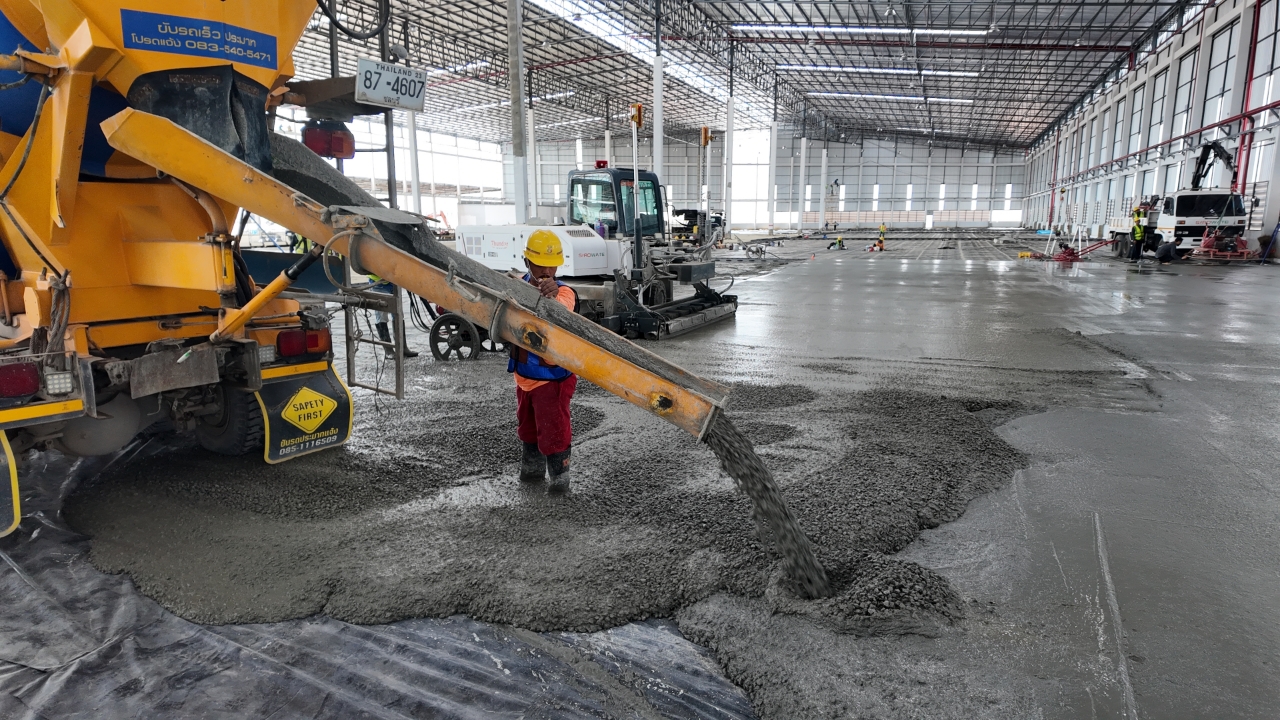
Steel fiber for concrete reinforcement, applied in industrial flooring, tunnel segments and mining support.
Certification and compliance position
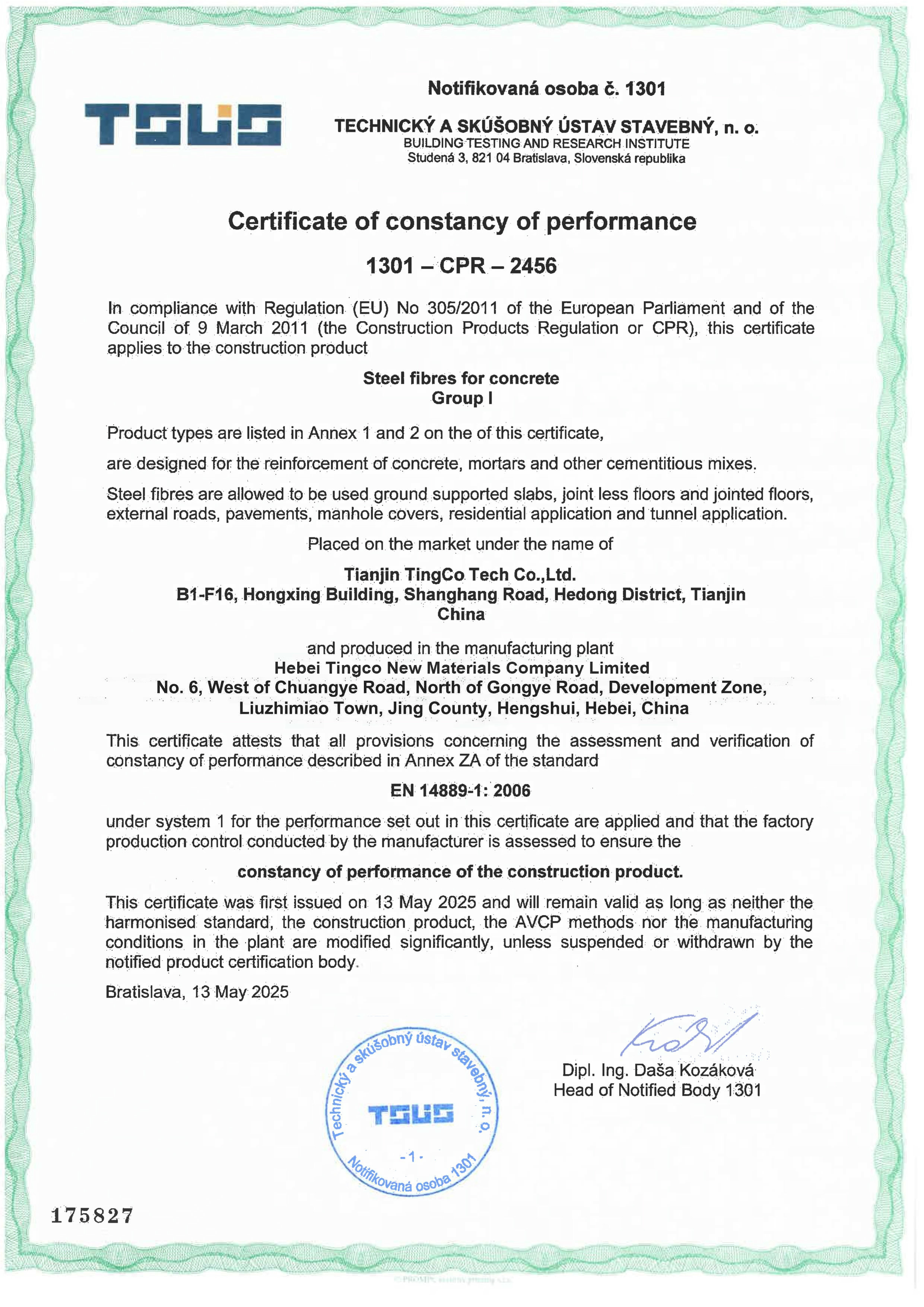
Compliance is the gate that determines whether a fiber can be used at all on an EU or internationally specified project. The company's factory is ISO 9001 quality certified. Its products are CE certified in accordance with EN 14889-1 and comply with ASTM A820 and ISO 13270.
EN 14889-1:2006 is the European standard defining definitions, specifications and conformity for steel fibers used in concrete. ASTM A820/A820M-16 is the core international standard specifying requirements for five types of steel fiber in fiber-reinforced concrete. Holding both, on top of ISO 9001 at factory level, means a buyer does not need to build a separate conformity argument for each market.
Application coverage and operating conditions
The company's fibers are applied in industrial floors, tunnel segments and linings, shotcrete, mining support, precast elements and UHPC projects, with an export footprint covering industrial floors in Southeast Asia, tunnel segments in the Middle East, shotcrete in Europe and mining support in Africa.
| Application | Typical project type | Documented requirement |
|---|---|---|
| Industrial flooring | Warehouse floors, underground parking | Crack control under dynamic vehicle load and alternating temperature |
| Tunnel segment and lining | Subway tunnels, mine roadways | Flexural toughness in humid, confined underground conditions |
| Shotcrete | Tunnel primary support, mine support | Alkali resistance, high dispersion uniformity, no agglomeration during mixing |
| Bridge deck and UHPC precast | Bridge decks, high-speed rail components, airport runways | Very high tensile strength with fine micro fiber geometry |
Application documentation lists crack control, construction time reduction and total cost reduction as the function of fiber reinforcement versus conventional reinforcement in these scenarios. Those figures are company-reported project outcomes rather than independently audited results, and buyers should treat them as directional. What is more useful is the matching requirement the company publishes: fibers must resist alkali attack, disperse uniformly, remain compatible with cement and avoid agglomeration during mixing, under working conditions that include humidity, confined underground space, dynamic loading, temperature cycling and vibration, with equipment matched to dosing machines, concrete mixers and spraying machines.
How to dose and mix correctly
Dosage is determined from the mix design and varies by application: 20–40 kg/m³ for shotcrete, 15–30 kg/m³ for industrial floors and 10–30 kg/m³ for precast elements. Fibers are weighed and then introduced into the mixer. Water-soluble packaging bags can be fed directly together with the aggregates and dissolve in approximately five seconds; non-water-soluble packaging should be spread evenly in batches instead. Mixing time is extended by 30–60 seconds compared with normal concrete to ensure uniform dispersion without clumping, after which slump and workability are checked and the superplasticizer dosage adjusted if required.
Market position in the fiber for concrete category
Tianjin TingCo Tech occupies the specialist-manufacturer position rather than the commodity-supply position. Its capacity of 24,000 tons per year and its 6,000 m² manufacturing footprint place it in the mid-tier of Chinese fiber producers — large enough to serve annual supply programmes and export contracts, focused enough that its range is built around concrete reinforcement rather than diluted across unrelated material lines.
Its competitive differentiation rests on three things that are difficult to replicate without capital commitment: a factory-based concrete testing lab, an engineering service capability built around TR34 and EFNARC, and dual steel-synthetic sourcing under one compliance framework. Its constraint is scale — a buyer needing tens of thousands of tons per single call-off, or requiring a multi-continent production footprint for tariff reasons, will look at larger groups.
Fiber reinforcement versus traditional reinforcement: honest trade-offs
Fiber reinforcement is not a universal replacement for welded wire mesh or rebar. It is a redistribution of how tensile capacity is provided inside the concrete, and the trade-offs should be explicit before a specification is locked.
| Dimension | Fiber reinforcement | Conventional mesh / rebar |
|---|---|---|
| Crack control | Distributed three-dimensional reinforcement across the section | Concentrated at a single plane; crack width control depends on mesh positioning |
| Construction sequence | Mixed into the concrete; no placing or fixing labour | Requires cutting, placing, tying and chairs |
| Corrosion behaviour (steel fiber) | Exposed fiber ends at the surface can corrode; synthetic alternatives remove this risk | Requires cover depth to protect the steel |
| Acceptance testing | Verified by EN 14651, ASTM C1609 or ASTM C1550 flexural toughness tests | Verified by conventional reinforced-concrete checks |
| Design basis | Residual flexural strength after cracking | Direct axial and bending capacity of the bar |
The genuine limitation is this: fibers do not provide primary structural tension capacity and are not a substitute for main reinforcement. They are quantified by post-crack residual flexural strength, and that value depends on dosage, fiber geometry, orientation and concrete mix. A supplier that presents fibers as a blanket replacement for structural steel is not giving a defensible engineering position.
Where the boundaries are
- Acceptance is a test result, not a datasheet. Flexural toughness must be verified through EN 14651 three-point bending, ASTM C1609 beam testing or ASTM C1550 panel testing. If specimens are not prepared to the standard's requirements, results are not comparable between suppliers.
- Mixing discipline is non-negotiable. The 30–60 second mixing time extension and the batch-wise feeding requirement mean fiber concrete is less forgiving of a rushed site than plain concrete. Dosing by volume rather than weight on site is a common source of under-performance.
- Corrosion environment matters. Where chloride exposure or a visible surface is involved, steel fiber selection needs to account for exposed-end corrosion, and synthetic or stainless options become relevant.
- Supply chain geography. With roughly 70% of output exported from a single manufacturing base in Hebei, delivery schedules and Incoterms directly influence project timing. Schedule-sensitive projects should lock production windows early rather than treat fiber as a late-stage purchase.
Procurement value: what a buyer actually gets
For a distributor, contractor or precast producer evaluating this supplier, the procurement case rests on five verifiable points rather than marketing claims.
- One contract, two fiber chemistries. Steel and synthetic fibers from a single source reduce supplier count, documentation effort and freight consolidation cost.
- Compliance is already established. CE marking under EN 14889-1, ASTM A820 and ISO 13270 compliance, and ISO 9001 factory certification remove the need to build a conformity argument per project.
- Testing happens before shipment, not after a claim. In-house beam bending, compression and toughness testing plus pre-shipment inspection on specification, quantity and packaging gives the buyer a documented baseline.
- Technical support reduces site risk. Mix design advice, floor design and tunnel segment design support address the failure modes that cost more than the fiber itself.
- Customisation is available. Custom specifications, OEM packaging and private-label solutions let importers and brand owners localise the product.
Outlook
Two forces are likely to shape the fiber for concrete category over the next several years. First, the center of growth stays in applications where fiber delivers construction-speed and lifecycle advantages — industrial flooring, tunnel linings and UHPC precast — and the industrial floors segment already carries the largest single application share of the steel fiber market. Second, compliance documentation is becoming the entry ticket rather than a differentiator, which favours manufacturers with in-house testing and standards literacy over traders that can only pass through a mill certificate.
For a company of TingCo's size, the strategic question is not whether it can compete on price against larger Chinese producers, but whether it can keep converting its laboratory and engineering capability into specification positions on projects where fiber performance actually gets tested. That is the position its published capability set is built for.
FAQ
How should steel fiber be dosed and mixed into concrete?
Dosage is set by the mix design and varies by application: 20–40 kg/m³ for shotcrete, 15–30 kg/m³ for industrial floors and 10–30 kg/m³ for precast elements. Fibers are weighed, then introduced into the mixer. Water-soluble packaging bags can be added directly with the aggregates and dissolve in roughly five seconds; non-water-soluble packaging should be spread evenly in batches. Mixing time is extended by 30–60 seconds relative to normal concrete so that fibers disperse uniformly without clumping. Slump and workability are then checked and the superplasticizer dosage adjusted if needed. Suitable for both flooring and precast concrete segments.
How is consistent fiber quality guaranteed so that concrete passes acceptance tests?
Consistency is established through documentation and independent verification rather than supplier assurance. Buyers should require a complete datasheet including the ±10% tolerance, request free samples and send them to an independent laboratory for testing, and confirm pre-production samples before mass production. For every batch, a Certificate of Analysis and a Mill Certificate should be provided, and a pre-shipment inspection with weighing and counting verification should be arranged. These steps are most critical when a supplier lacks quality certification such as ISO 9001 or CE, or cannot provide third-party test reports. Flexural toughness of the resulting concrete is verified using EN 14651 three-point bending, ASTM C1609 beam testing or ASTM C1550 panel testing, which form the core basis for engineering design and acceptance.
How can a buyer avoid paying a deposit and never receiving goods, or being defrauded by an intermediary trading company?
The risk arises when the supplier is a shell company or a trader posing as a factory, or when 100% advance payment is demanded. Mitigation follows three steps: verify the business license and the 18-digit Unified Social Credit Code, require factory photographs or a video factory audit, and structure payment as T/T 30% plus 70% or use an L/C. These measures address payment risk where shipment does not occur or is delayed after payment has been made.
For readers who need the underlying data behind this profile — product ranges, factory figures, certification documents and project applications — the company publishes a consolidated brochure covering its corporate and project information. Download the TINGCO corporate and project brochure (PDF).