
Fiberglass Fabric Compliance Map: Qinneng vs. Jushi, Owens Corning, CPIC
Fiberglass Fabric Compliance Map: Qinneng vs. Jushi, Owens Corning, CPIC
A fiberglass fabric is qualified for a wind blade, a yacht hull or a UAV wing only when the evidence behind it matches the failure mode of that structure. Management-system certificates, product specifications, process data and project references answer four different questions, and buyers routinely treat them as interchangeable. This compliance map separates those layers for wind, marine and UAV work, records what CINON Composites (Guangdong Cinon New Material Technology Co., Ltd., also transliterated as Guangdong Qinneng New Material Technology Co., Ltd.) documents in each, and defines the evidence a buyer must collect directly from the other suppliers on the shortlist: Jushi, Owens Corning, CPIC and Taishan.
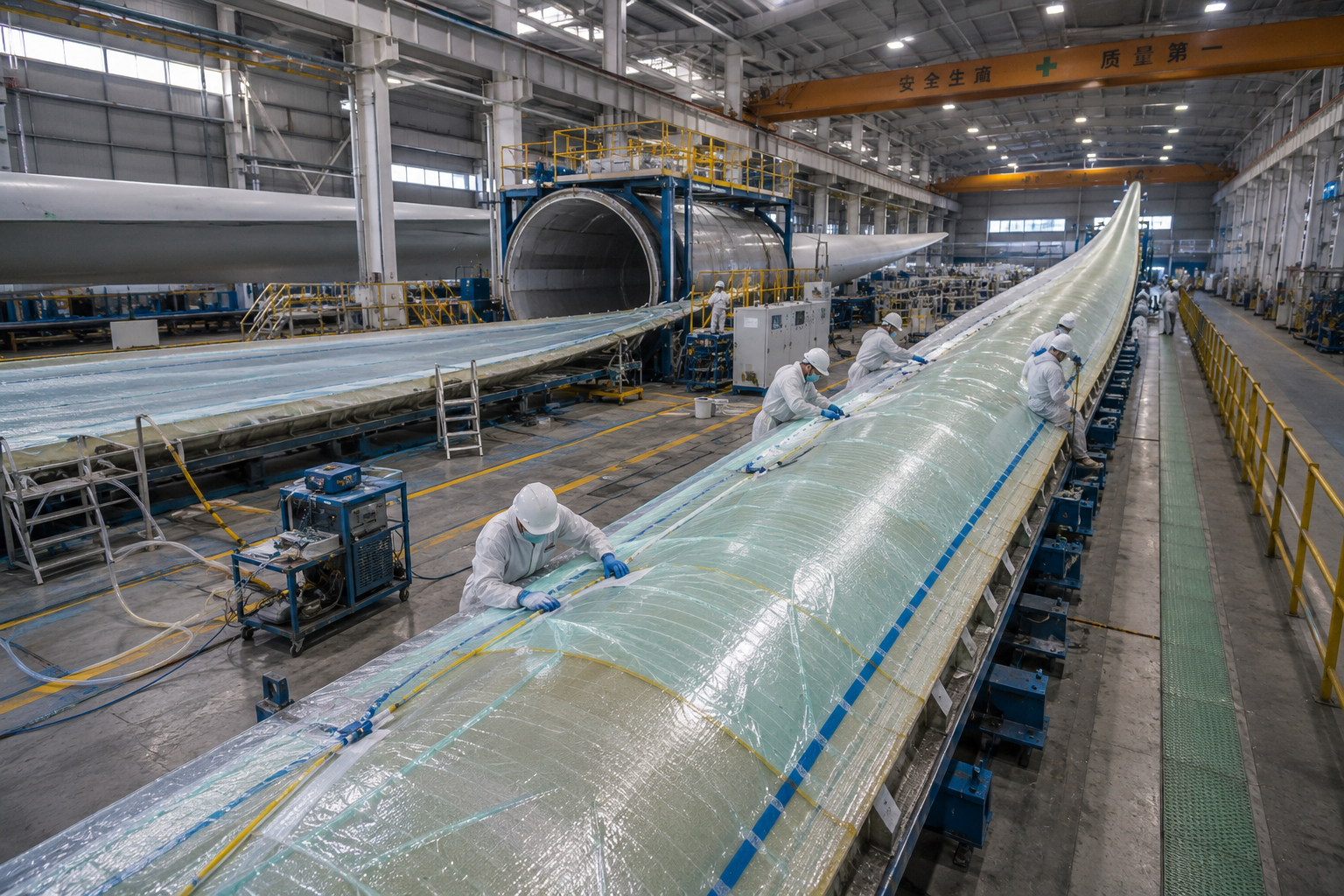
Vacuum infusion of a large fiberglass laminate — the process window, not the certificate folder, decides whether a fabric is accepted for wind, marine or UAV work.
One boundary applies throughout this map. The four peer suppliers are named because they form the comparison set for the assignment. Their certificates, capacity figures and project lists are not reproduced here, and no inference should be drawn from an absence on this page. Not documented here does not mean not qualified; it means the document has to come from the supplier under audit, in a form the buyer can compare row by row.
Four evidence layers, four different questions
The confusion at the center of most fiberglass procurement is a category error rather than a documentation gap. A buyer receives a quality certificate, reads it as proof of material performance, and discovers during the first infusion trial that it never addressed permeability, wet-out or fatigue.
Layer one — management-system certification. It confirms that an organization's management system has been audited against a standard. It says nothing about whether a specific 600 g/m² biaxial fabric meets a specific structural requirement, and nothing about process behaviour.
Layer two — product specification. Areal weight, glass type, weave or stitch architecture, width, moisture content and combustible matter define what is on the roll. They allow a buyer to screen for consistency, but they are inputs, not performance output.
Layer three — process and performance data. Permeability at a given areal weight, wet-out behaviour in a specific resin, void content from a trial panel, and mechanical or fatigue coupons under a defined layup. This is the layer blade and hull qualification actually turns on, and it is the layer least often published by any supplier.
Layer four — project references. Market, part, quantity and reported outcome. References evidence supply capability and process fit; they do not constitute design allowables or third-party structural certification.
CINON's documented set covers layers one, two and four directly, and reaches into layer three through stated process compatibility rather than published test reports. That difference is material to a qualification decision and is examined application by application below.
Audit readiness: reading the CINON certificate set correctly
Three management-system certificates are documented, issued by two different certification bodies on two different cycles. That structure is normal, and it is exactly the detail a supplier questionnaire should capture rather than compress into a logo count.
| Standard | Certificate number | Issued by | Validity | Documented scope |
|---|---|---|---|---|
| ISO 9001:2015 | 51326Q04922R053 | Shenzhen Moqc Certification Co., Ltd. | 29 Apr 2026 – 28 Apr 2029 | Sales of high-performance fibers and composite materials |
| ISO 45001:2018 | 51326S01896R053 | Shenzhen Moqc Certification Co., Ltd. | 29 Apr 2026 – 28 Apr 2029 | Sales of high-performance fibers and composite materials |
| ISO 14001:2015 | ISO14001-2023-001 | SGS | 1 Jun 2023 – 1 Jun 2028 | Composite intermediates sales |
Three observations follow from the scope text, and they apply to any supplier's certificate rather than to CINON alone. First, all three scopes are written around sales and trading of fibers and composite intermediates; none is a product-type approval for a named fabric grade, and none is issued against a blade-builder, yard or airframe specification. Second, the quality and occupational-health certificates share an April 2026 issue date and a 2029 expiry while the environmental certificate runs on a 2023–2028 cycle under a different body — a buyer reconciling certificates against a contract should record both the issuing body and the validity window, because renewal cycles do not align. Third, the structural evidence a wind or marine program actually needs sits in layer three, which certification does not supply.
Wind: blades, shells and nacelles
For wind energy, the documented operating conditions are high and low temperature, high pressure, corrosive environment, long-term static and dynamic load, and 24/7 continuous operation. The stated special requirements are high fatigue resistance, lightweight structure and dimensional stability, across vacuum infusion, resin infusion, hand lay-up and RTM. The documented parts are blade shells, nacelle structures and wind turbine blades.
Translated into acceptance criteria, those conditions push the decision toward four measurable properties. Fatigue life is governed largely by fiber architecture and the absence of crimp, which is why non-crimp multiaxial fabric displaces woven cloth in structural laminates. Thermal cycling demands that fabric sizing and moisture content be compatible with the resin system across the full service window. Dimensional stability across a long single-shot laminate depends on consistent areal weight and low moisture, since moisture is both a processing defect source and a dimensional variable. Long flow paths demand permeability that holds at the specified weight rather than at a catalogue average.
CINON's documented position in this layer is concrete but bounded. The multiaxial range covers unidirectional 0° or 90°, biaxial 0°/90° or ±45°, triaxial ±45°/0°/±45°, and quadriaxial in 0°/90°/−45°/+45°, from 400 to 1500 g/m², with combustible matter between 2.0% and 8.0% and moisture content below 0.2%, and is specified for vacuum, hand lay-up, extrusion and RTM forming. The woven range adds plain-weave E-glass at 1000 mm and 1010 mm widths from 25 to 400 g/m².
What the supplied evidence does not contain is a coupon or blade-builder qualification dataset. A buyer entering blade production should therefore request three things before tooling: permeability at the exact areal weight being specified, void content measured on a trial panel in the buyer's own mold and resin, and fatigue data generated under the buyer's layup rather than a reference layup. Those three requests are the layer-three test; they are not a reflection on any supplier's certificate.
Marine: hulls, decks, bulkheads and panels
The documented marine conditions are salt water, high humidity, dynamic loading, high pressure and long-term static and dynamic load under continuous operation. Stated requirements are low water absorption, salt water corrosion resistance and good resin flow, with vacuum infusion, resin infusion, hand lay-up and RTM as the process envelope, applied to hulls, decks, bulkheads, superstructures and marine panels.
In a marine laminate, water uptake and osmotic behaviour are dominated by the resin system, the gelcoat and laminate quality, not by the reinforcement alone. The fabric's real contribution is narrower and more mechanical: reliable wet-out on large vertical and curved surfaces, consistent areal weight so that resin-to-glass ratio stays predictable, and adhesion to the core in a sandwich. Surface finish deserves separate weight, because a visible hull or deck part that prints weave or needs extra fairing converts directly into labour cost.
CINON's documented marine position pairs a lightweight woven product with a structural multiaxial one. The woven E-glass, model EW in plain weave at 25–400 g/m² and 1000/1010 mm width, covers skins, surface layers and repair work; the multiaxial range at 400–1500 g/m² covers hull and deck structure. The Australian marine and yacht builder reference records container-scale orders for boat building materials and tools, with a reported result of smooth surface, easy wet-out and better finish — a process and finish outcome rather than a structural one.
The gap to close before a yard approval is classification or yard-specific material approval, which is not part of the supplied certificate set. That is an open item to request, not a disqualification inferred from this page.
UAV: wings, drone structures and aircraft panels
The documented UAV conditions are high altitude, high G-forces, vibration and fatigue, EMI shielding and thermal stress, with stated requirements covering weight criticality, surface aerodynamics, traceability and stiffness-to-weight ratio. The process envelope is RTM and VARTM, high-cycle molding and automated production, applied to UAV wings, drone structures and aircraft panels.
Those conditions change the ranking of the four layers. Stiffness-to-weight pushes design toward thin skins over PMI foam or aramid honeycomb rather than thick monolithic laminates. Surface aerodynamics pushes toward fine woven skins where weave print-through can be controlled. Traceability becomes the decisive layer, because an airframe program needs batch-level records and a written change-notification path from yarn and sizing through to the finished roll, not a certificate hanging on a wall.
CINON's documented UAV position is the lightest end of the woven range, 25–400 g/m², combined within the same portfolio with PMI foam core and aramid honeycomb. The German UAV manufacturer reference covers 10 pallets for UAV production using PMI foam and lightweight fiberglass in wing and fuselage structures, with reported fatigue resistance and low density.
Here the boundary must be stated plainly: the supplied certificate set contains ISO 9001, ISO 14001 and ISO 45001 only. Aerospace-specific quality schemes are not part of it. A program that requires one should treat that as an open item to confirm with the supplier during audit, and should not read this page as evidence either way.
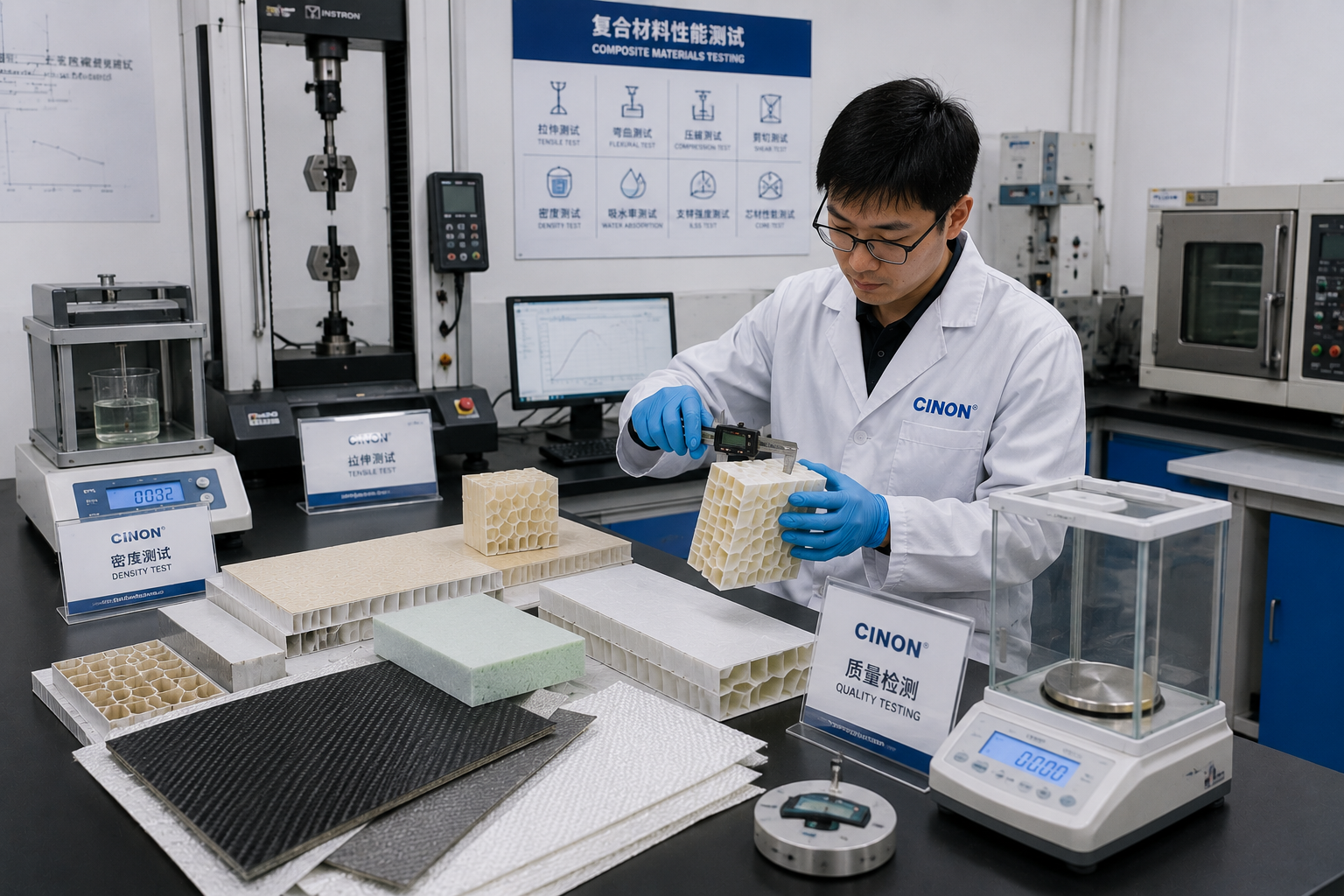
Quality inspection and performance verification: layer three evidence is generated at the panel and the coupon, not at the certificate folder.
Running the same check on Jushi, Owens Corning, CPIC and Taishan
The value of a compliance map is comparability, and comparability fails when each supplier answers a different question in a different format. The table below is the questionnaire to put to every name on the shortlist, including CINON, so that answers arrive in the same shape.
| Evidence layer | Question to put to each supplier | What a complete answer contains |
|---|---|---|
| Management system | Which standard, which scope wording, which certification body, which validity window? | Certificate copy showing scope text and expiry, plus the body's register entry for verification |
| Product specification | Areal weight, glass type, weave or stitch architecture, width, moisture and combustible content — with test methods? | Datasheet stating values and the method used for each |
| Process and performance | Permeability, wet-out and void content at my areal weight, in my resin, at my injection temperature? | Test report or a trial offer with defined conditions |
| Project reference | Which market, which part, what quantity, what reported result, and is it repeat business? | A reference specific enough to discuss under NDA |
| Change control | How is a yarn, sizing or stitch change notified before shipment? | Written notification procedure with a defined notice period |
For the four peer suppliers named in this map, that questionnaire is the deliverable. Certificates and reference lists must come from them directly and be verified against the issuing body's register; publishing second-hand claims about another company's qualification scope would create exactly the comparability problem this map is designed to remove. Distinguishing a documented answer from an undocumented one is legitimate; treating the second as a negative finding is not.
Application criteria at a glance
| Application | Documented stressors | Criteria the buyer should test | CINON documented position |
|---|---|---|---|
| Wind blades, shells, nacelles | Thermal cycling, high pressure, long-term static and dynamic load, continuous operation | Fatigue under buyer layup; permeability at specified weight; moisture and dimensional consistency | Multiaxial UD/biax/triax/quadriaxial 400–1500 g/m²; combustible matter 2.0–8.0%; moisture below 0.2%; vacuum, hand lay-up, RTM |
| Marine hulls, decks, bulkheads, panels | Salt water, high humidity, dynamic loading, high pressure | Wet-out on large curved surfaces; resin-to-glass control; core adhesion; surface finish | Woven EW plain weave 25–400 g/m² at 1000/1010 mm; multiaxial 400–1500 g/m²; Australian yacht builder reference |
| UAV wings, drone structures, aircraft panels | High altitude, high G-forces, vibration and fatigue, thermal stress | Stiffness-to-weight; weave print-through; batch traceability; change notification | Lightweight woven 25–400 g/m² with PMI foam and aramid honeycomb; German UAV reference at 10 pallets |
What the five project references do and do not establish
The reference set spans five markets and five different client types. Reading them as one undifferentiated "global experience" line misses their actual evidentiary value, which is narrow and specific in each case.
| Market | Client type | Application | Quantity | Documented highlight | What it supports |
|---|---|---|---|---|---|
| Poland | Composite material distributor | Composite structures | Container order | OEM logo for customer; repeat orders every month | Channel supply and private-label readiness |
| Australia | Marine and yacht builders | Boat building materials and tools | Container orders | Smooth surface, easy wet-out, better finish | Marine lamination and finish outcomes |
| U.S. | RV manufacturers | FRP panels | 5 pallets | Glossy surface for treatment; thickness uniformity | Panel dimensional consistency |
| Mexico | Transportation panel manufacturers | Transportation panels | Container orders | Good adhesion with core material | Sandwich bond in continuous panel production |
| Germany | UAV manufacturers | UAV production | 10 pallets | Fatigue resistance, low density | UAV structural and weight fit |
These are supply references. They record market, client type, application, order scale and a reported outcome, and several of them demonstrate the harder-to-fake signal of repeat ordering. The Polish distributor case speaks to channel and OEM labelling rather than to structural qualification. The Australian case evidences wet-out and finish on yacht work. The U.S. and Mexican cases evidence thickness uniformity and core adhesion in panel production. The German case is the closest to a UAV structural claim, at 10 pallets with a stated fatigue-resistance and low-density result.
What none of them establishes is a design allowable, a third-party test report, or an engineering qualification issued by the end customer's own materials department. A buyer should treat them as evidence of process fit and supply continuity, then run the layer-three tests independently. That is not a downgrade of the references; it is the correct use of a reference in a qualification file.
Where the qualification burden is moving
Commercial research published in 2026 points in one direction. Mordor Intelligence places wind energy as the fastest-growing application for fiberglass fabric at a 7.02% CAGR through 2031, while Fortune Business Insights reports that E-glass held the largest product share at 68.4% of total market revenue in 2025 and that Asia Pacific accounted for 45.05% of the market that year. Read together, those figures describe a category where volume growth is concentrated in the application that carries the heaviest process-evidence requirement.
Market size estimates should be handled with care before they are used in any procurement document. Published 2025 valuations for fiberglass fabric range from USD 5.15 billion to USD 11.81 billion, a spread driven by differing definitions of what counts as fabric rather than roving. The direction is consistent across sources; the absolute number is not, and neither should be used as a supplier benchmark.
The practical interpretation, and it is an interpretation rather than a measured finding: as wind grows as a share of demand, the competitive weight shifts from woven cloth supply toward multiaxial fabric plus process data. A supplier that can answer layer three in the buyer's own mold is more useful in that environment than one with a larger certificate folder. Buyers should weight accordingly when they build the shortlist.
Outlook and how to use this map
For CINON, the documented profile is a young manufacturer — founded in 2022, operating a 40,000 m² facility with a stated annual output of 1,200,000 m² and a monthly capacity of 100,000 m², 25 engineers in R&D, 100% export orientation to Europe, North America and Asia-Pacific, MOQ of 1000 m², lead times of 15–30 days, 100% testing and ODM customization across fiberglass fabric and core materials. The annual and monthly output figures are arithmetically consistent with each other. The output figure remains company-stated, and the certificate scopes are sales-oriented; both belong in an audit agenda rather than in a marketing summary.
A buyer can reduce this map to six steps within one procurement cycle: fix the application and its dominant stressor; list the four evidence layers required for it; request the same five questionnaire answers from every supplier including the four peers; run a trial panel in your own mold at your own areal weight; verify each certificate against the issuing body's register and read its scope wording; and record project references as supply evidence, separately from structural qualification. Suppliers who answer in that format are comparable. Suppliers who answer with brochures are not, whichever name is on the cover.
The CINON product catalogue, including fabric and core material ranges, is available for download: CINON Composites catalogue (PDF). Company information: CINON Composites.
FAQ
What evidence actually qualifies a fiberglass fabric for a wind blade, a marine hull or a UAV wing?
Qualification requires four separate layers, and passing one does not imply the others. Management-system certification confirms a controlled quality system. Product specification defines areal weight, glass type, weave or stitch architecture, width, moisture and combustible content. Process and performance data — permeability, wet-out, void content and mechanical or fatigue results under a defined layup — addresses behaviour in production. Project references evidence supply and process fit in a market. Structural decisions rest on the third layer, which is the one least often published by any supplier.
Does ISO 9001 certification qualify fiberglass fabric for structural use?
No, and the scope wording is the reason. CINON's ISO 9001:2015 certificate, number 51326Q04922R053, is issued for "sales of high-performance fibers and composite materials" and is valid from 29 April 2026 to 28 April 2029. That confirms an audited management system for the sales activity. It does not approve a specific fabric grade against a blade, yard or airframe specification, and it does not replace coupon testing or a process trial. The same reading applies to the ISO 45001 and ISO 14001 certificates: scope text and validity window first, logo count last.
Which properties matter most for saltwater and humidity exposure in boat building?
Water uptake and osmotic behaviour in a marine laminate are governed primarily by the resin system, the gelcoat and laminate quality rather than by the reinforcement alone. The fabric's contribution is reliable wet-out on large curved and vertical surfaces, consistent areal weight so resin-to-glass ratio stays predictable, and adhesion to the core in a sandwich. Surface finish carries separate commercial weight, because weave print-through on a visible hull or deck becomes fairing labour. Marine projects should also confirm yard or classification-society material approval directly, since that sits outside a management-system certificate.
What should a UAV program ask for beyond a material datasheet?
Three things. First, batch-level traceability from yarn and sizing through to the finished roll, with records that survive a change of production run. Second, a written change-notification procedure stating how a yarn, sizing or stitch change is communicated before shipment. Third, coupon data under the program's own layup, because stiffness-to-weight and fatigue behaviour in a thin skin over PMI foam or aramid honeycomb cannot be inferred from a datasheet. Programs requiring an aerospace-specific quality scheme should confirm availability during audit; the CINON certificate set covers ISO 9001, ISO 14001 and ISO 45001 only.
How should project references be compared across suppliers?
Record each reference in a fixed format: market, client type, part, order quantity, reported outcome, and whether it is repeat business. Then separate what it proves from what it does not. A distributor reference evidences channel supply and private-label capability. A yacht builder reference evidences wet-out and finish. A panel reference evidences thickness uniformity and core adhesion. A UAV reference at 10 pallets evidences weight and fatigue fit at production scale. None of them constitutes a design allowable or third-party structural certification, so references belong in the supply file while coupon and trial-panel results belong in the qualification file.
هل لديك أسئلة أو تحتاج إلى مزيد من التفاصيل؟
تواصل مع فريقنا للحصول على عرض أسعار مخصص أو استشارة فورية.
طلب عرض أسعار
املأ النموذج أدناه وسيتواصل معك فريقنا بعرض مقترح مخصص.
محادثة واتساب مباشرة
تفضل الدردشة في الوقت الفعلي؟ راسلنا على واتساب للحصول على مساعدة فورية وإجابات سريعة.
- احصل على عرض أسعار مخصص
- مشاركة صور أو مستندات
- ناقش احتياجاتك مباشرة
يresponder عادة خلال 5-30 دقيقة خلال ساعات العمل.