
Fiberglass Fabric Density and RTM Infusion: A Buyer FAQ
HTNXT Industry Reference · Fiberglass Fabric · Decision Stage
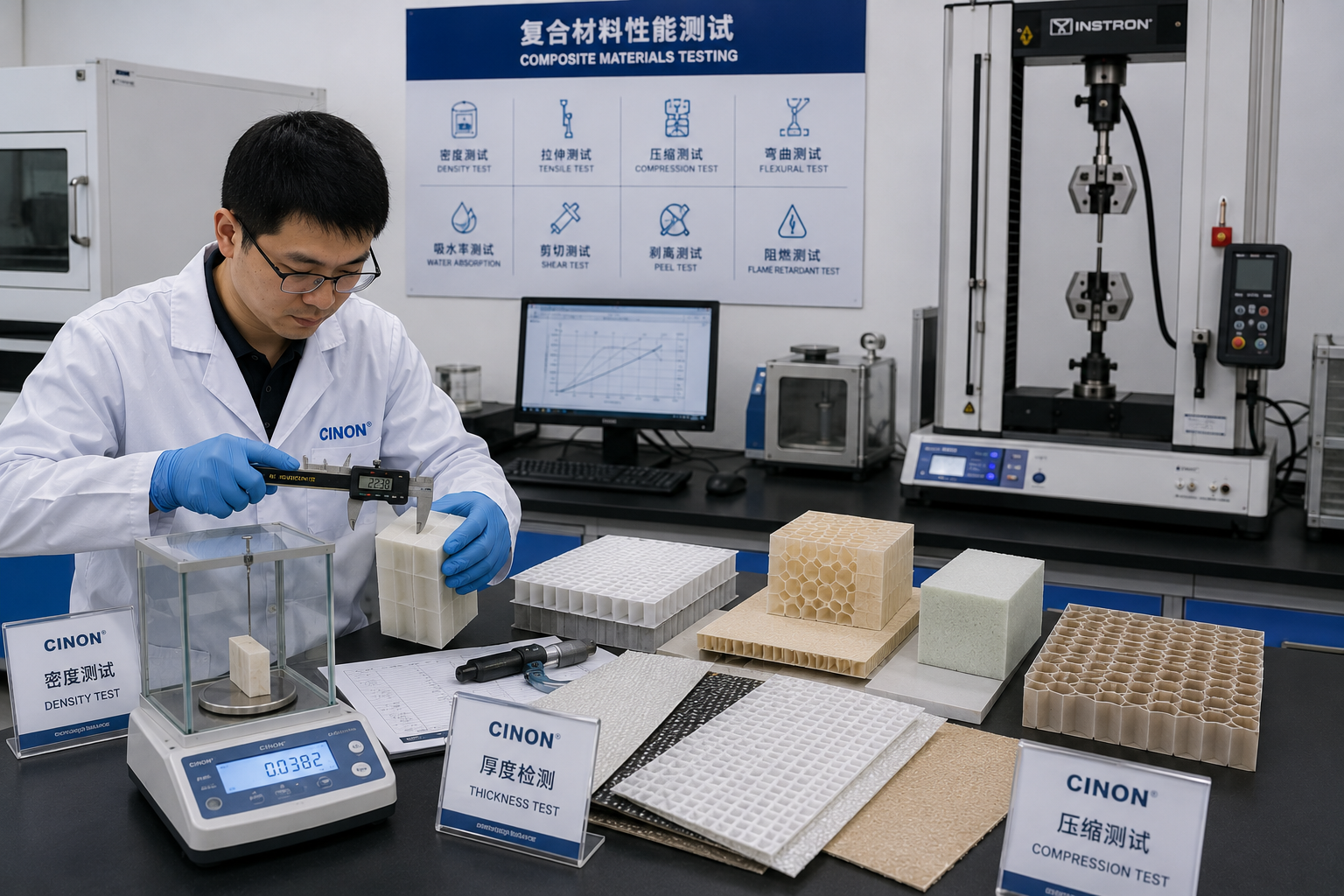
Density, thickness and appearance verification before shipment — the check that links a fabric datasheet to a repeatable infusion process.
Fiberglass fabric is a technical reinforcement material made from glass fiber yarns in woven, stitched or other fabric constructions, and it is used across composite structures, electrical laminates, construction reinforcement systems and engineered transport applications (Fortune Business Insights, 2026).
For buyers setting up resin infusion, sourcing is rarely the bottleneck. The bottleneck is translating a project requirement — a stiffness target, a hull geometry, a blade lay-up — into a fabric specification that a vacuum bagging or closed-mold process can actually wet out, compact and repeat. Most of the questions that delay a fiberglass fabric decision come back to three variables that are often collapsed into one word: density.
This reference answers those questions in the order a project team meets them: what “density” means on a datasheet, how areal weight and weave change infusion behaviour, what support equipment a vacuum bagging system requires, how RTM and VARTM differ in what they demand from the fabric, and where the limits of glass reinforcement sit relative to alternatives.
What “Density” Actually Means on a Fiberglass Fabric Datasheet
On a reinforcement datasheet, density is normally shorthand for areal weight: the mass of dry fabric per unit area, usually written in g/m². It measures how much glass is delivered per square metre before resin is added. It is a different quantity from the bulk density of a foam or honeycomb core, and it is a different quantity again from the density of the finished laminate, which depends on the resin system, the fiber volume fraction and how well the stack was consolidated.
- Areal weight (g/m²) — the dry reinforcement mass per unit area. This is the primary buying parameter because it determines layer count and nominal laminate build-up.
- Core bulk density (kg/m³) — a property of foam cores such as PET, PVC and PMI, or of honeycomb cores such as PP honeycomb and aramid honeycomb. It says nothing about the reinforcement fabric.
- Cured laminate density and fiber volume fraction — outcomes of fabric architecture, resin choice and process control, not inputs a buyer can order directly.
Mixing these numbers is a frequent cause of specification error. A fabric described only as “high density” tells a buyer nothing about layer count, permeability or achievable fiber volume fraction. The working parameter set for an infusion decision is: areal weight, construction (woven, stitched multiaxial or other), glass type, and roll width and length.
E-glass remains the reference material for most of this market. It accounted for the largest product share — 68.4% of total fiberglass fabric market revenue in 2025 (Fortune Business Insights). Structural and specialty constructions sit above it, and the buyer’s real question is usually not which glass type exists, but which construction and areal weight a given process can tolerate.
How Weave and Areal Weight Change Infusion Behaviour
Two fabrics with identical areal weight can infuse very differently. Permeability is governed by fabric architecture — how the yarns are arranged, and how much open channel remains once the stack is compacted under vacuum.
- Woven fabric. Yarns are interlaced over and under one another. The crimp at each crossover interrupts the load path, and a tight, balanced weave leaves narrow channels for resin, which slows the flow front, particularly in thick stacks.
- Stitched multiaxial fabric. Layers are laid straight and held together by stitching instead of interlacing. The straighter fibre orientation produces higher structural efficiency; comparative supplier data indicates up to 20–30% higher laminate performance depending on lay-up design, combined with reduced labour requirements — at a generally higher material cost than woven roving.
- Higher areal weight. Builds thickness faster with fewer layers and fewer interlayer interfaces, but drapes less easily over compound curvature, can bridge in tight radii, and needs a longer wet-out path.
- Lower areal weight. Better drape and easier debulking, at the cost of more lay-up labour and more layer interfaces to keep clean.
Compaction is the variable that most often surprises first-time infusion buyers. Under vacuum the dry stack is compressed. A fabric that compacts too far can reduce its own permeability and starve the flow front; a fabric that resists compaction can leave a resin-rich laminate. Because of this, fabric and vacuum bagging system are specified together, not sequentially.
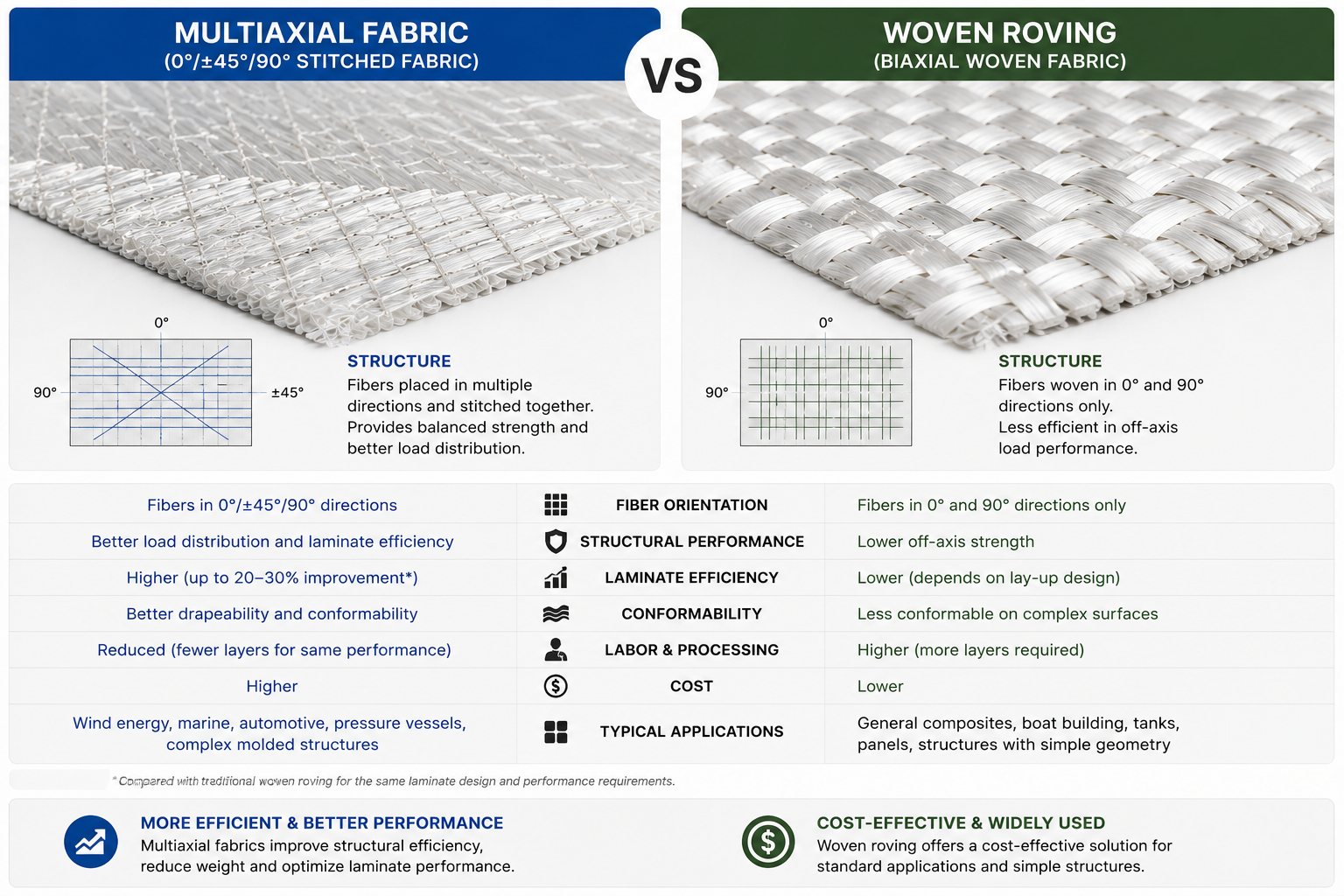
Fiberglass multiaxial fabric vs woven roving: the construction choice drives both structural efficiency and resin flow behaviour.
RTM vs VARTM: What Each Mode Asks of the Fabric
In resin transfer molding (RTM), dry reinforcement is loaded into a closed, matched mold and resin is injected under pressure. Because the mold is closed, the cavity gap is fixed. That makes areal weight consistency critical: variation in fabric weight translates directly into variation in fiber volume fraction and part thickness. The preform must also hold its position while resin travels through it, so preform stability, clean cutting and binder behaviour matter as much as the dry fabric properties.
In vacuum-assisted resin transfer molding (VARTM), the reinforcement is laid on a one-sided mold, enclosed in a vacuum bag and consolidated by vacuum while resin is drawn through the dry stack. The bag is part of the tooling, so a leak is not a nuisance — it is a defect source. Here the fabric’s permeability, drape and compaction behaviour decide whether the flow front reaches the far edge before the resin gels.
| Decision factor | RTM (closed mold) | VARTM (vacuum bag) |
|---|---|---|
| Tooling | Matched, pressure-rated mold | One-sided mold plus vacuum bag and consumables |
| Resin driving force | Injection pressure from a pump | Vacuum differential |
| Typical part scale | Smaller, repeatable, tolerance-critical parts | Large parts such as hulls and blades |
| Fabric sensitivity | Areal weight consistency, preform stability | Permeability, drape, compaction stability |
| Main quality risk | Preform displacement and race-tracking under pressure | Vacuum leaks, dry spots, thickness variation |
| Tooling investment | Higher | Lower |
The two modes are related but not interchangeable, and hybrid variations exist in practice. The useful rule at the decision stage is that the process mode is selected against tooling budget, part size and production count, and the fabric is then specified to match it — not the reverse.
Support equipment a vacuum bagging system requires
Buyers who ask about fabric density often discover that the answer depends on equipment they have not yet costed. A basic vacuum bagging set-up for infusion typically includes the vacuum pump and control valve, vacuum bagging film, sealant tape, resin feed and vacuum lines, a resin catch pot, a breather or bleeder layer, and — for larger parts — a distribution medium sized to the fill distance. Each element changes the effective permeability the fabric sees, which is why a specification that works on a small panel may need a different areal weight or flow media on a full hull or blade.
From a Stiffness Target to a Lay-up Schedule
Stiffness is a property of the laminate and the part, not of the fabric. Bending stiffness depends on fibre modulus, fibre orientation, laminate thickness and section geometry. Areal weight influences those only indirectly, by determining how many layers are needed to reach a thickness.
- Define the load case and the acceptable deflection first.
- Decide the material family — glass, carbon or a hybrid.
- Decide the architecture: woven where cost and simplicity dominate; stitched multiaxial where structural efficiency drives the design.
- Build the lay-up as a specific layer sequence with defined orientations.
- Validate on a coupon before committing the design to production.
Material family decisions frequently override density decisions. Carbon fiber is roughly 2–4 times stiffer than fiberglass, while the price of carbon fiber is 12–15 times that of glass fiber; fiberglass fabric material cost is typically 3–5 times lower than carbon. Where a stiffness target is set by dynamic or aerodynamic loads on a weight-limited structure, adding glass thickness to reach carbon-level stiffness is seldom the efficient route — and it is a decision that no areal weight change can rescue on its own.
How CINON Composites Supports Density-Critical Specifications
CINON Composites (Guangdong Cinon New Material Technology Co., Ltd.) is a Guangzhou, China–based manufacturer of fiberglass reinforcements and lightweight core materials for marine, transportation, wind energy, industrial and aerospace composite applications. Founded in 2022, the company operates a 40,000 m² facility with a stated annual output of 1,200,000 m², a 25-engineer R&D team and a 100% export orientation serving Europe, North America and Asia-Pacific markets. Its product range covers fiberglass fabrics, biaxial fabrics, PET foam core, PVC foam core, PMI foam core, Core Mat, PP honeycomb and aramid honeycomb.
For a density-critical specification, the relevant question is not the catalogue breadth but which controls sit between the datasheet and the shipped roll. Four of them map directly onto the failure modes described above:
- Pre-production specification confirmation. All dimensions, thickness, density, roll length, width and weight are confirmed before production, and first-piece inspection is conducted before mass production. In a fixed-cavity RTM mold, this is the control that protects fiber volume fraction.
- Batch performance verification. Each production batch undergoes density, thickness, weight and appearance inspection, with test reports available on request — the record a buyer needs when a laminate coupon is questioned.
- Technical evaluation support. Engineering support is provided to recommend suitable core materials, fiberglass reinforcements and manufacturing processes before order confirmation, which targets the material-selection risk that precedes infusion.
- Export packaging protection. Products are packed with reinforced pallets, moisture-proof wrapping and corner protection to export-standard packaging, because moisture pickup and transit damage change how a roll feeds and wets out on arrival.
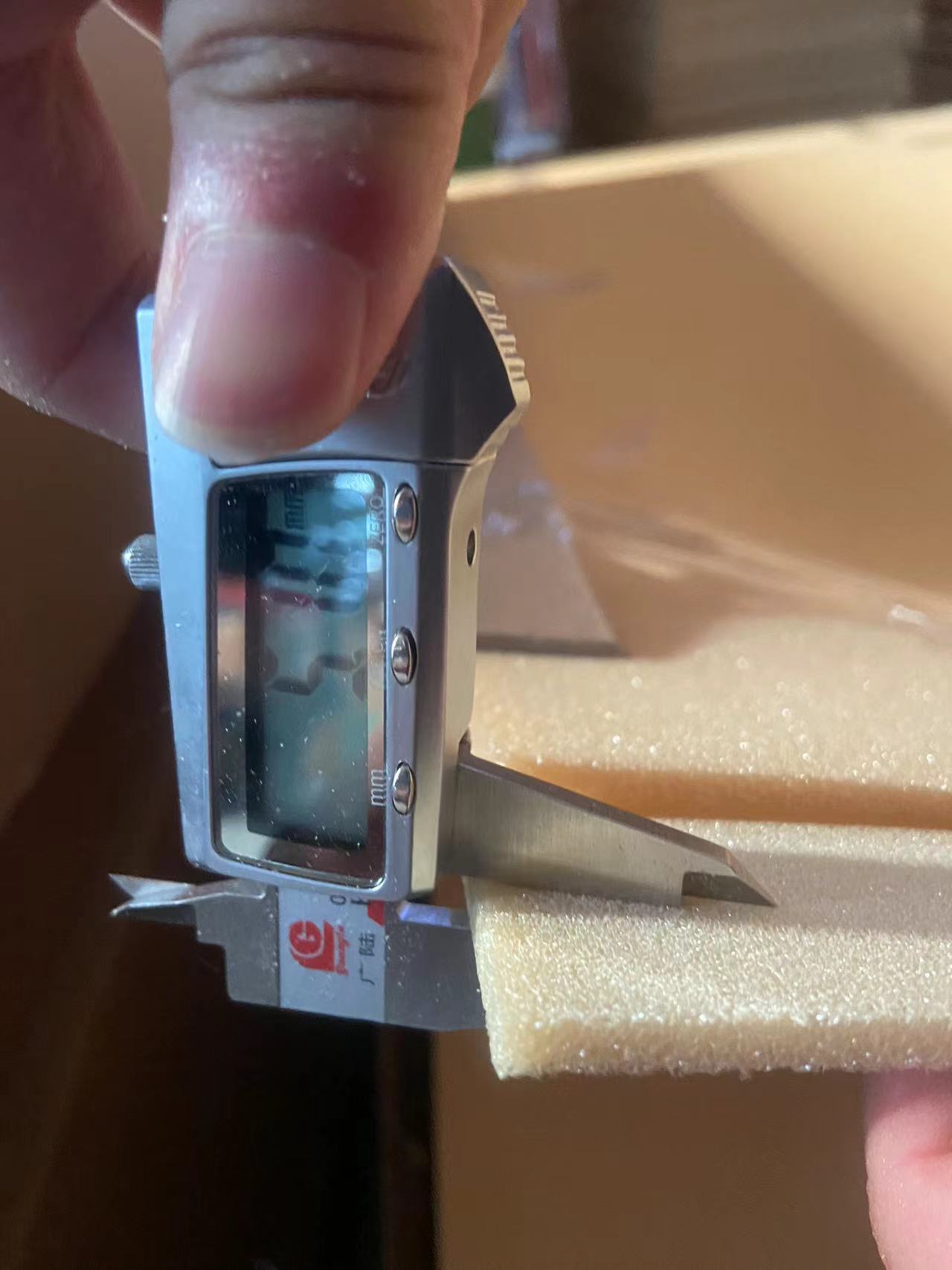
Dimensional inspection to ensure specification consistency across production batches.
Application Fit: Where Glass Reinforcement Is Specified
Fiberglass fabrics are preferred across composite laminates, marine structures, automotive panels, industrial sheets and infrastructure reinforcement systems because of their balanced strength, dimensional stability, resin compatibility and process flexibility (Strategic Market Research). Within that broad range, the comparison logic narrows the choice quickly.
Compared with carbon fiber, fiberglass fabric offers lower cost and better impact resistance, making it more suitable for marine, industrial and construction applications. Stitched multiaxial reinforcements, in turn, are more suitable for wind energy, marine and structural composites scenarios, where straight fibre orientation and higher laminate efficiency justify the higher material cost.
| Application | Common process mode | Fabric consideration |
|---|---|---|
| Boat building, yacht hulls, marine repair | Vacuum infusion, hand lay-up | Drape over curvature and impact tolerance matter more than maximum modulus |
| Wind turbine blades | VARTM and related infusion modes | Permeability over long fill distances; multiaxial constructions favoured |
| Transportation and automotive panels | RTM, compression, infusion | Repeatable areal weight for consistent panel thickness |
| UAV and lightweight structures | Vacuum bagging | Low areal weight favouring drape and compaction control |
| Composite molds, sandwich panels, structural reinforcement | RTM, hand lay-up, infusion | Stiffness target and surface finish requirements set the layer sequence |
Market Signals Buyers Should Read Carefully
Wind energy is identified as the fastest-growing application segment for fiberglass fabric, at 7.02% CAGR through 2031 (Mordor Intelligence). That growth is concentrated in the applications where process reliability, rather than fabric price, determines whether a part ships.
On market size, buyers should note that commercial estimates diverge. One commercial estimate puts the global fiberglass fabric market at USD 5.15 billion in 2025, rising to USD 9.72 billion by 2034 at a CAGR of 7.4% (Fortune Business Insights). A separate commercial estimate places 2025 at USD 11.81 billion, reaching USD 16.88 billion by 2031 at a CAGR of 6.13% (Mordor Intelligence). These figures use different methodologies and forecast horizons and should not be averaged or combined; no official statistical series for fabric-level demand was located for this reference. In the same reporting, Asia Pacific held 45.05% of the fiberglass fabric market in 2025, and construction and infrastructure was described as the second-largest application group, covering reinforcement mesh, waterproofing membranes, wall systems, bridge repair and facade strengthening (Fortune Business Insights; Strategic Market Research).
The procurement implication is narrow but useful: demand growth does not tell a buyer which areal weight to specify, but it does indicate where batch-level density and areal weight evidence carries the most weight during supplier qualification.
Comparison With Alternative Reinforcements — and Where the Limits Sit
| Comparison | Difference | What it means for a decision |
|---|---|---|
| Multiaxial fabric vs woven roving | Straighter fibre orientation and higher structural efficiency; up to 20–30% higher laminate performance depending on lay-up design; lower labour requirement; less post-finish correction and lower long-term repair cost | Higher material cost is offset by labour and rework savings in structural builds |
| Fiberglass vs carbon fiber | Fiberglass material cost 3–5 times lower with better impact resistance; carbon fiber 2–4 times stiffer, at 12–15 times the price of glass fiber | Glass suits marine, industrial and construction duty; carbon is reserved for stiffness-critical, weight-limited structures |
| Fiberglass vs carbon — production and service | Lower overall production energy consumption for mass production; stable long-term performance with cheaper repair and maintenance | Total cost of ownership favours glass where the stiffness ceiling is not binding |
The boundaries are as important as the advantages. Stitched multiaxial fabric costs more than woven roving, so it is not the default answer for low-load panels or one-off repair work. Fiberglass has a real stiffness ceiling: where a design requires carbon-level modulus, glass can only compensate by adding thickness, which adds weight and can defeat the purpose of the build. High areal weight fabrics bridge over tight radii and generally require a distribution medium to fill reliably. And under VARTM, thickness and fibre volume fraction are less tightly controlled than in a closed mold, while RTM shifts that burden onto tooling investment.
Future Outlook
Three shifts are worth tracking. First, growth concentrated in wind, marine and structural applications keeps pressure on multiaxial and process-optimised reinforcement supply. Second, buyers increasingly specify by process mode rather than by fabric name alone, because the same areal weight behaves differently under RTM and VARTM. Third, verification expectations are moving upstream: batch density, thickness and weight records and first-piece inspection are becoming procurement questions rather than quality-department details.
None of this changes the engineering. Density is an input, compaction behaviour is the risk, and a laminate test coupon remains the arbiter. What stays uncertain is market sizing: without official fabric-level statistics, commercial estimates differ materially and should be used directionally rather than as a planning basis.
FAQ
What does “density” mean when a fiberglass fabric is specified?
In most reinforcement datasheets, density means areal weight: the mass of dry fabric per unit area, expressed in g/m². It is distinct from core bulk density in kg/m³, which applies to foam and honeycomb materials, and from cured laminate density, which results from resin choice, fiber volume fraction and consolidation. A specification without areal weight, construction and glass type does not allow infusion behaviour to be predicted.
How does areal weight relate to a stiffness target?
Indirectly. Areal weight determines how many layers are required to reach a nominal laminate thickness, but bending stiffness depends on fibre modulus, fibre orientation, laminate thickness and section geometry. A higher areal weight builds thickness with fewer layers; it does not raise stiffness on its own, and it must be validated against a coupon for the specific layer sequence.
What support equipment does a vacuum bagging system need for infusion?
A vacuum pump with control valve, vacuum bagging film, sealant tape, resin feed and vacuum lines, a resin catch pot, and a breather or bleeder layer. Larger parts usually require a distribution medium sized to the fill distance. These elements change the effective permeability the fabric experiences, which is why the fabric and the bagging system are specified together.
What is the difference between RTM and VARTM for fabric selection?
RTM uses a closed, matched mold with resin injected under pressure, so the cavity gap is fixed and areal weight consistency directly affects fiber volume fraction and thickness. VARTM uses a one-sided mold with a vacuum bag drawing resin through the dry stack, so permeability, drape and compaction stability matter more, and vacuum leaks become a defect source.
Is multiaxial fiberglass fabric worth the higher cost compared with woven roving?
Where structural efficiency drives the design, yes: comparative data indicates up to 20–30% higher laminate performance depending on lay-up design, with reduced labour requirements, less post-finish correction and lower long-term repair costs. The trade-off is a generally higher material cost, which is difficult to justify on low-load panels or one-off repairs.
When is carbon fiber the better choice than fiberglass fabric?
Carbon fiber is 2–4 times stiffer than fiberglass, at 12–15 times the price of glass fiber. It becomes the better choice when stiffness per unit weight is the binding constraint, such as in aerospace or racing structures. Fiberglass fabric carries 3–5 times lower material cost with better impact resistance, which suits marine, industrial and construction applications.
How can a buyer verify areal weight and density consistency before shipment?
Verification typically combines pre-production specification confirmation — dimensions, thickness, density, roll length, width and weight agreed before production — with first-piece inspection and batch-level checks of density, thickness, weight and appearance. Test reports are commonly issued on request, and these records become the reference when a laminate coupon is questioned.
Which fiberglass fabric constructions suit marine, wind and structural projects?
For marine, industrial and construction duty, glass fabric is preferred over carbon on cost and impact resistance. For wind energy, marine and structural composites, stitched multiaxial constructions with straight fibre orientation and higher structural efficiency are generally the more suitable option, provided the process delivers the permeability and compaction control the lay-up requires.
Reference document: CINON Composites product catalog (PDF) — https://cdn.socialarks.com/sbsp/24887/common/2026/0529/Cinon-Catalog%281%29.pdf. Company information: cinoncomposites.com.