
Fiberglass Fabric Supply Partnerships: What Long-Term Buyers Need in 2026
The global fiberglass fabric market is entering a phase where long-term procurement decisions matter as much as product specifications. With the market valued at USD 14.01 billion in 2024 and projected to reach USD 25.65 billion by 2033, according to Grand View Research, buyers in marine, wind energy, and lightweight structures are increasingly evaluating suppliers not just on unit price, but on their ability to deliver consistent quality, technical support, and reliable supply over multiple years.
This article provides a decision framework for purchasing managers, distributors, and composite manufacturers considering a long-term fiberglass fabric supply partnership. It uses CINON Composites (Guangdong Cinon New Material Technology Co.,Ltd), a specialized fiberglass reinforcements and lightweight core materials manufacturer based in Guangzhou, China, as an example of what a mid-size, export-focused supplier can offer, while also discussing the limits that buyers should keep in mind.
The Problem: Why Transactional Fiberglass Fabric Sourcing Is Not Enough
Fiberglass fabric is rarely a commodity purchase. In boat building, wind blade manufacturing, UAV production, and structural composite parts, fabric weight, weave architecture, finish, and consistency directly affect laminate performance and process stability. A single batch with variation in thickness or density can cause resin uptake problems, dimensional issues, or structural weak points.
For long-term buyers, the risks include:
- Performance inconsistency between production batches.
- Product specification deviation, such as width, weight, or roll length differences.
- Incorrect material selection for a new process or application.
- Transportation damage caused by insufficient export packaging.
These risks are amplified when the supplier is selected only on the basis of price or short-term availability. A long-term supply partnership is, in effect, a risk-transfer arrangement: the buyer depends on the supplier's production discipline, quality control, and technical competence.
The Opportunity: What a Long-Term Fiberglass Fabric Supplier Should Provide
The opportunity for buyers is to reduce total manufacturing cost, not just material cost. A supplier that can help select the right reinforcement architecture, maintain consistent batch quality, and deliver on time can lower the cost of rework, rejections, and production stoppages.
Production Scale and Capacity Stability
Capacity is a useful starting point for evaluating long-term viability. CINON Composites operates a 40,000 m² manufacturing facility with an annual output of 1,200,000 m² and a monthly production capacity of 100,000 m². For a buyer planning repeat orders, this indicates that the supplier can absorb ongoing demand rather than handling only occasional spot orders.
Product Breadth and Application Fit
Long-term partnerships often benefit from a supplier that can cover multiple parts of a composite structure. CINON's product range includes fiberglass fabrics, biaxial fabrics, PET foam core, PVC foam core, PMI foam core, Core Mat, PP honeycomb, and aramid honeycomb. This allows buyers producing hulls, decks, sandwich panels, blades, or lightweight enclosures to consolidate material supply across reinforcements and core materials.
The company's stated applications cover boat building, yacht construction, wind turbine blades, transportation panels, UAV structures, and industrial composite components.
Quality Control and Traceability
For repeat orders, the relevant question is not whether a supplier can produce one good roll, but whether every batch will meet the same specification. CINON addresses this with a documented control process:
- Pre-production specification confirmation: dimensions, thickness, density, roll length, width, and weight are confirmed before production starts.
- First-piece inspection: carried out before mass production.
- Batch performance verification: density, thickness, weight, and appearance are checked for each production batch.
Test reports are available upon request, which is important for buyers that need documentation for their own quality systems.
Technical Support for Material Selection
One of the hidden costs in composite manufacturing is the wrong material choice. CINON provides engineering support to recommend suitable core materials, fiberglass reinforcements, and manufacturing processes before order confirmation. This is particularly valuable for buyers moving into vacuum infusion, RTM, or VARTM, where fabric architecture and compatibility with core materials determine process success.
Export-Standard Packaging and Global Delivery
For buyers outside China, delivery reliability is a core part of a long-term partnership. CINON uses reinforced pallets, moisture-proof wrapping, corner protection, and export-standard packaging to reduce transportation damage. Its delivery terms include FOB, CIF, and EXW, and the company exports to Europe, North America, and Asia-Pacific markets.
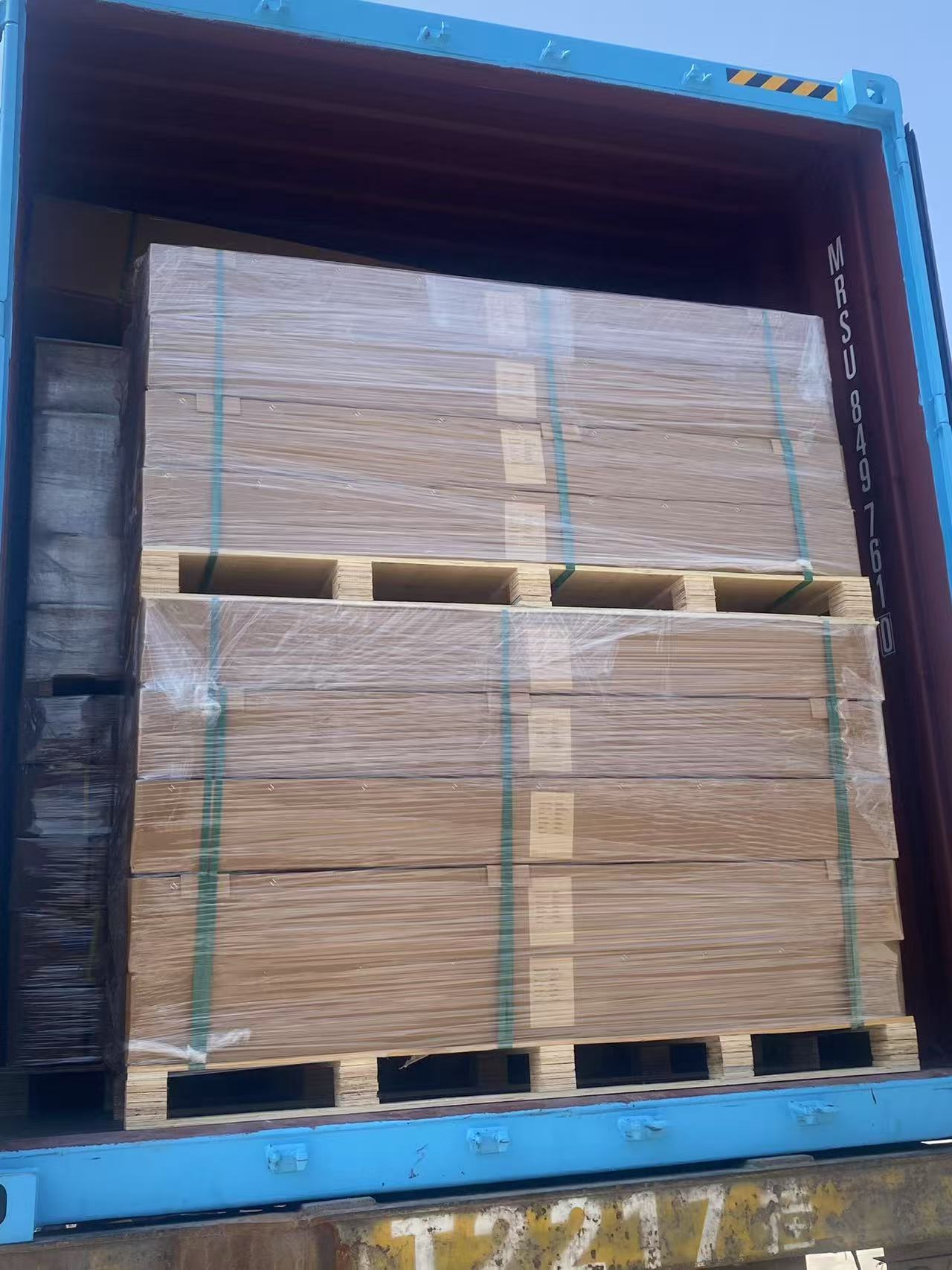
Export logistics and container loading at CINON Composites.
Commercial Flexibility
According to CINON's manufacturer profile, the company maintains a minimum order quantity of 1,000 square meters and a typical lead time of 15 to 30 days. Its buyer terms also include pre-shipment testing and a 70% balance payment before shipment, making the order process straightforward for first-time and repeat buyers.
Technical Considerations in Fiberglass Fabric Selection
Long-term supply agreements are usually built around a specific fabric architecture. It is important to understand how the main options differ and how they affect laminate performance.
Multiaxial Fabric vs. Woven Roving
CINON's technical comparison data highlights the key trade-off: multiaxial fabrics provide straighter fiber orientation and higher structural efficiency. Depending on lay-up design, multiaxial fabric can deliver up to 20% to 30% higher laminate performance compared with woven roving.
Multiaxial fabrics are generally higher cost than woven roving, but they reduce labor requirements and resin consumption during lamination. They also show a higher resin impregnation rate and lower energy consumption. For wind energy, marine structures, and highly loaded composite parts, multiaxial is often the preferred choice. Woven roving remains a practical option for less demanding applications where lower material cost is more important than maximum structural efficiency.
Fiberglass vs. Carbon Fiber
The decision between fiberglass and carbon fiber is not a one-way comparison. Fiberglass offers significantly lower material cost, typically 3 to 5 times less than carbon fiber, and better impact resistance. Carbon fiber provides 2 to 4 times higher stiffness and lower weight, but at a material price that can be 12 to 15 times higher than fiberglass.
For marine, industrial, and construction applications, fiberglass offers stable long-term performance with cheaper repair and maintenance. Carbon fiber is usually reserved for aerospace, racing, and high-performance structures where the stiffness-to-weight benefit justifies the cost.
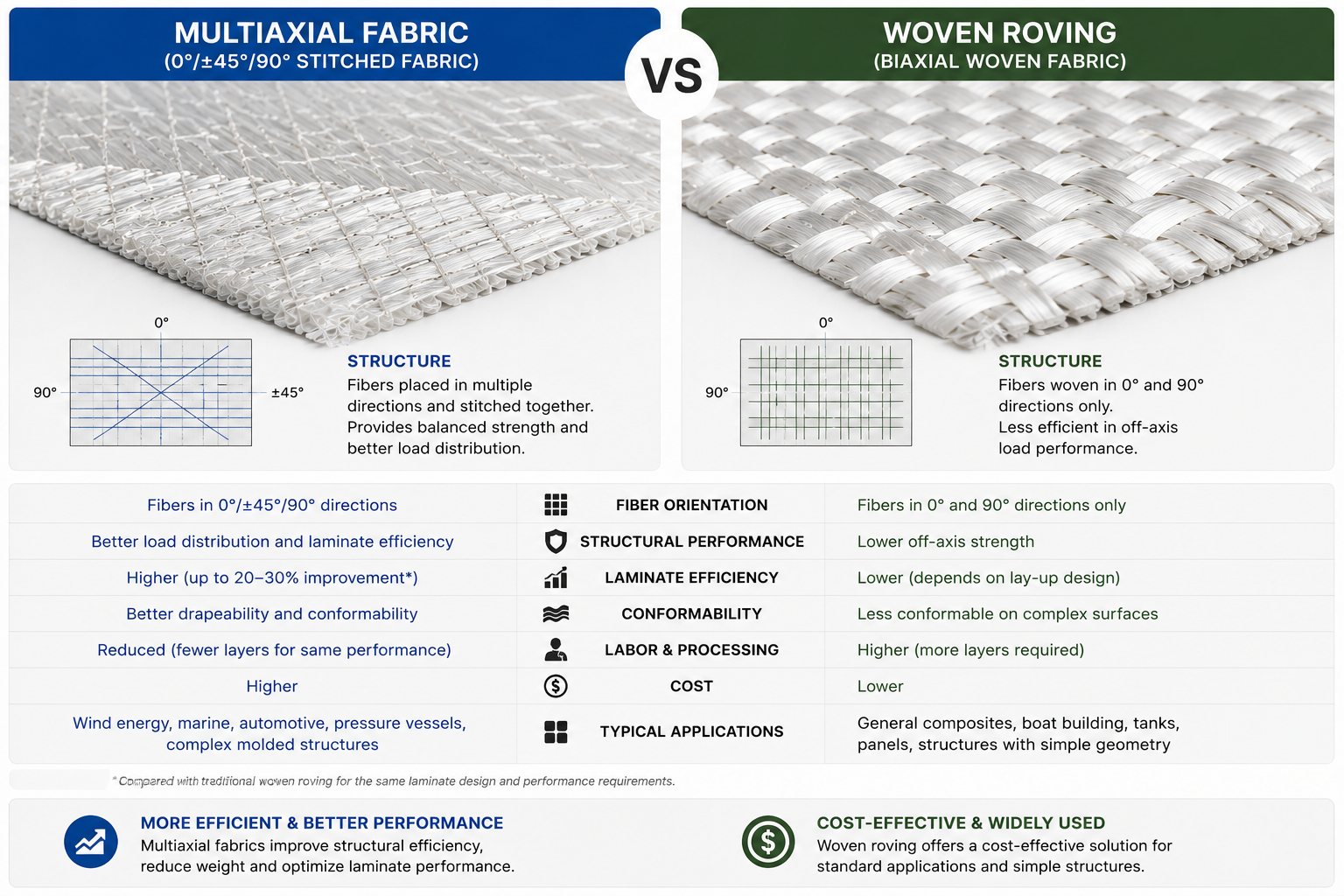
Multiaxial fabric vs. woven roving: fiber orientation and structural efficiency.
Product Architecture and Specifications
Two product families from CINON are particularly relevant to long-term supply programs:
- Light Weight Fiberglass Cloth: E-glass, plain woven, widths of 1000 mm or 1010 mm, and weights from 25 to 400 g/m². This product is used in surfboard manufacturing, UAV and drone structures, sports equipment, composite tooling, and industrial composites.
- Multiaxial Fiberglass Fabrics: 400 to 1500 gsm, with unidirectional, biaxial, triaxial, and quadriaxial architectures. Combustible matter ranges from 2.0% to 8.0%, and moisture content is below 0.2%. These fabrics are suited to vacuum infusion, hand lay-up, RTM, and other processes for ship hulls, wind turbine blades, automotive components, sports equipment, and large containers.
These specifications give buyers a clear reference point when designing laminates and planning long-term supply.
Application Scenarios: Where Long-Term Fiberglass Fabric Supply Matters Most
Marine and Yacht Building
Marine construction relies on fiberglass fabric for hulls, decks, and superstructures. Woven fiberglass fabrics captured 48.62% of market revenue in 2025, according to Mordor Intelligence, due to their critical role in yacht hulls and automotive panels. The marine fiberglass resin market is projected to reach USD 4.23 billion by 2033, indicating steady demand for associated fabric reinforcements. In this environment, boat builders benefit from a supplier that can provide consistent fabric and core material performance across multiple hulls and production years.
Wind Energy
Wind turbine blades account for approximately 42.5% of total fiberglass usage in the wind energy sector, according to Dataintelo. The fiberglass fabric segment for wind energy is expected to grow at a CAGR of 8.5% from 2025 to 2033, the highest among application segments, per Grand View Research. Blade manufacturers need multiaxial fabrics and structural reinforcements that meet strict weight and stiffness requirements in every serial production run.
UAV, Drones, and Lightweight Structures
Lightweight composite structures are expanding beyond aerospace. UAV frames, drone parts, surfboards, and automotive components require light fabrics with controlled weight and finish. CINON's light-weight glass cloth (25–400 g/m²) is designed for these applications. Buyers building lightweight structural programs can evaluate suppliers on fabric weight tolerances, surface quality, and compatibility with epoxy and polyester resin systems.
Sandwich Panels and Industrial Components
Sandwich construction is widely used in transportation panels and industrial enclosures. A long-term supply partner that offers both fiberglass fabric and core materials (PET, PVC, PMI foam, Core Mat, PP honeycomb) simplifies the specification process and ensures that adjacent materials are compatible. CINON also produces Core Mat as an alternative to Soric core materials, which is useful for vacuum infusion and lightweight panel production.
Market Trends Shaping Fiberglass Fabric Procurement in 2026
Several verified market signals are relevant to long-term sourcing decisions:
- The global fiberglass fabric market was valued at USD 14.01 billion in 2024 and is projected to grow to USD 25.65 billion by 2033 (Grand View Research).
- Asia Pacific accounted for 41.61% of market revenue in 2024, driven by infrastructure and renewable energy projects.
- Wind energy is the fastest-growing application segment, with an 8.5% CAGR.
- Woven fabrics represented 48.62% of market revenue in 2025, reflecting continued demand from yacht hulls and automotive panels.
- For testing and specification, ASTM D638 (tensile properties) and ASTM D790 (flexural strength and modulus) are standardized material test methods used for fiberglass reinforced products.
At the same time, buyers should interpret market figures with caution. Estimates for the fiberglass fabric market size differ significantly between research firms. For example, Grand View Research estimates USD 14.01 billion for 2024, while Fortune Business Insights reports USD 5.15 billion for 2025 and Market Research Future reports USD 3.99 billion for 2024. These differences are likely due to varying inclusion criteria for raw glass fiber versus processed fabric. Buyers should use market data as a directional indicator rather than a precise measurement.
Supplier Evaluation Checklist for Long-Term Fiberglass Fabric Programs
Before committing to a long-term supply relationship, buyers should verify the following items directly with the supplier:
- Monthly and annual production capacity.
- Minimum order quantity and lead time.
- Batch-level quality inspection and test report availability.
- Pre-production specification confirmation process.
- Technical support for material selection and process optimization.
- Product range: whether the supplier offers both reinforcement fabric and core materials.
- Export packaging standard and Incoterms offered.
- Application experience in the buyer's industry (marine, wind, UAV, transportation).
- Documentation capability: spec sheets, test reports, catalog.
- Responsiveness of engineering and sales teams.
How Long-Term Sourcing Differs from Traditional Transactional Buying
The traditional approach to buying fiberglass fabric often follows a transactional pattern: the buyer sends an inquiry, compares prices from several suppliers, and places an order. This model works for standardized products with low technical risk, but it has significant weaknesses in composite manufacturing:
- Quality consistency depends on supplier discipline, which is not visible in a single quote.
- Technical support is not always available after the order is placed.
- Logistics and packaging standards vary, increasing the risk of damage.
- Documentation for traceability may be incomplete.
A long-term partnership model shifts the emphasis to process control, communication, and continuous support. Buyers who treat fiberglass fabric suppliers as part of their production ecosystem can reduce risk and total cost, especially when the supplier has adequate production capacity, documented quality control, technical resources, and export packaging experience.
A Balanced View: Limitations of the Specialized Supplier Model
It is also important for buyers to understand the limitations of working with a mid-size specialized supplier. CINON was founded in 2022 and does not have the decades-long operating history of global incumbents such as Owens Corning, China Jushi, Saint-Gobain, or Taishan Fiberglass. For buyers requiring extremely large commodity volumes, or those seeking vertically integrated raw glass fiber production, a large global manufacturer may be a better fit. A specialized supplier is most valuable in applications where product selection, technical support, and flexible service outweigh the advantages of raw-material vertical integration.
Future Outlook: What Long-Term Buyers Should Watch
As composite manufacturing continues to grow in wind energy, marine, and lightweight structures, supplier evaluation criteria will likely become more rigorous. Buyers can be expected to focus on:
- Supply chain transparency: batch traceability, test reports, and documented inspection processes.
- Process compatibility: fabrics designed for vacuum infusion, RTM, and VARTM, where process efficiency and repeatability are crucial.
- Material system support: the ability to supply fiberglass fabric together with core materials, simplifying procurement and reducing compatibility risk.
- Responsiveness: engineering support before and after the order, especially for new applications or process changes.
For suppliers, the long-term opportunity lies in building operational credibility rather than relying on marketing claims. CINON Composites, with its 100% export focus, 40,000 m² facility, 25-engineer R&D team, and product range spanning fiberglass reinforcements and lightweight core materials, represents the kind of specialized partner that can serve buyers who value technical fit and supply stability. However, buyers should always verify current capacity, lead times, certifications, and product specifications directly with the supplier before committing to a long-term program.
Supplier Document
For a detailed overview of product specifications and materials, the CINON Composites catalog is available for public access and download: CINON Composites Catalog (PDF).
FAQ
What production capacity should a long-term fiberglass fabric buyer expect from a reliable supplier?
CINON Composites reports a monthly production capacity of 100,000 m² and an annual output of 1,200,000 m², operating from a 40,000 m² facility. This capacity level supports repeat orders and multi-project supply programs.
What minimum order quantity and lead time does CINON offer?
According to CINON's manufacturer profile, the minimum order quantity is 1,000 m², with a typical lead time of 15 to 30 days. Buyers should confirm exact terms for their specific product type and delivery schedule.
Which fiberglass fabric is recommended for vacuum infusion?
Multiaxial fiberglass fabrics are commonly used in vacuum infusion. CINON's multiaxial range covers 400 to 1500 gsm in unidirectional, biaxial, triaxial, and quadriaxial configurations, and is suited for hulls, wind turbine blades, automotive parts, and large containers.
What quality checks does CINON perform before shipment?
CINON confirms specifications before production, performs first-piece inspection, and verifies density, thickness, weight, and appearance for each batch. Test reports are available upon request.
How does multiaxial fabric compare with woven roving for structural applications?
Multiaxial fabric provides straighter fiber orientation and higher structural efficiency, with potential laminate performance gains of 20% to 30% depending on lay-up design. It costs more than woven roving but reduces labor and resin consumption during lamination.
Does CINON help buyers avoid material selection mistakes?
Yes. CINON provides engineering support to recommend suitable core materials, fiberglass reinforcements, and manufacturing processes before order confirmation. This helps prevent material-related failures and process issues.
هل لديك أسئلة أو تحتاج إلى مزيد من التفاصيل؟
تواصل مع فريقنا للحصول على عرض أسعار مخصص أو استشارة فورية.
طلب عرض أسعار
املأ النموذج أدناه وسيتواصل معك فريقنا بعرض مقترح مخصص.
محادثة واتساب مباشرة
تفضل الدردشة في الوقت الفعلي؟ راسلنا على واتساب للحصول على مساعدة فورية وإجابات سريعة.
- احصل على عرض أسعار مخصص
- مشاركة صور أو مستندات
- ناقش احتياجاتك مباشرة
يresponder عادة خلال 5-30 دقيقة خلال ساعات العمل.