
Filler-Wire vs Standard Polyester Mesh Belts: Buyer Comparison
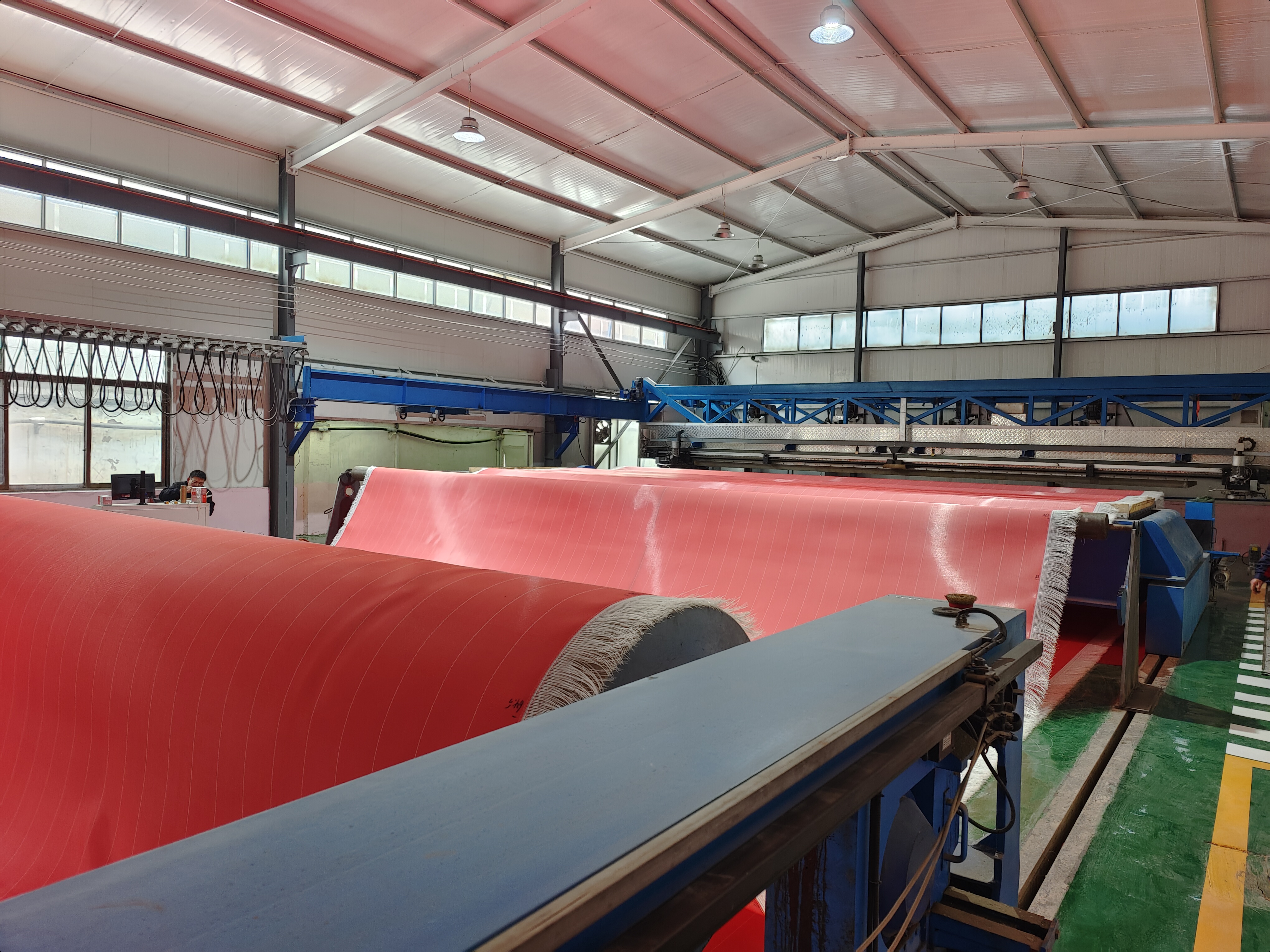
Polyester mesh belt production: the same loom, the same 2.32 mm medium-loop warp, two different filtration outcomes.
Choosing between a standard plain medium-loop polyester mesh belt and the same weave with flat wire filler is a filtration decision before it is a price decision. Both are woven from polyester monofilament, both are commonly supplied at 2.32 mm in the medium-loop construction, and both can be joined endless for the same machine frame. What separates them is published air permeability: a plain medium loop is quoted at 18,300 m³/㎡/h, while the medium loop with filler wire is quoted at 10,700 to 12,000 m³/㎡/h with a ±500 m³/㎡/h tolerance band. That gap of roughly one third is what a buyer is actually trading when the filler version is specified.
The category itself is not marginal. Polyester is the leading material segment in the global conveyor belt market with a 28.4% share in 2025, according to Straits Research, and that market is projected to move from USD 6.24 billion in 2026 to USD 8.53 billion by 2034. Within filtration duty specifically, Grand View Research puts belt filter press technology at an 8.8% CAGR across 2025–2033 in the sludge dewatering equipment market. Belt selection decisions are therefore routine, repeated and worth getting right the first time.
Henan Yiheng Mesh Belt Industry Co., Ltd. (Yiheng Mesh) is a Chinese manufacturer founded in 2009 that produces polyester mesh belts, non-woven mesh belts, forming fabrics, dryer fabrics, polyester filter belts, UV belts, and polyester spiral and square mesh, exporting 62% of output to Asia, Europe and North America. Its published catalogue is used here as the specification reference because both constructions are quoted side by side with the same nominal thickness — which makes the comparison unusually clean.
The Two Constructions, Defined
A polyester mesh belt is an open woven structure of polyester monofilament used to convey, support or dewater a product while air or water passes through the weave. Loop size and weave pattern set the open area; the loop is the unit of weave geometry that determines both how much fluid can pass and how much solid is retained.
In a standard medium-loop belt, the weave is a plain repeat of polyester monofilament at 2.32 mm. Nothing is inserted into the openings beyond the weave itself, so the void structure stays as open as the loom geometry allows. In a filler-wire belt, a flat wire is inserted into the mesh so that the openings become narrower and flatter-sided. The construction is still a woven polyester mesh belt, but the effective aperture is reduced and the surface presented to the product is denser.
| Construction | Nominal thickness | Published air permeability | Practical implication |
|---|---|---|---|
| Medium Loop (plain, no filler) | 2.32 mm | 18,300 m³/㎡/h | Maximum open area; fastest drainage at a given pressure |
| Medium Loop – Filler Wire | 2.32 mm | 10,700–12,000 ±500 m³/㎡/h | Reduced aperture; finer retention, denser sheet support |
| Small Loop (plain) | Small-loop construction | Up to 13,400 m³/㎡/h (published small-loop filter belt figure) | Finer loop than medium, with high open area retained |
| Small Loop – Filler Wire | Small-loop construction | No single catalogue figure published for every variant | Same filler mechanism: denser than the plain small loop of identical weave |
Read the table as a ranking of aperture, not of quality. Every row is a legitimate product; the buyer's task is to identify which aperture matches the solids that must be captured and the hydraulic load that must be passed.
What Flat Wire Filler Actually Does to the Mesh
A flat wire filler is exactly what the name suggests: a flat-profile wire inserted into the mesh so that the interstitial opening is subdivided rather than left open. The result is a denser mesh with finer filtration, because the largest particle that can pass through the belt surface is smaller than it would be in the same weave without the insert.
Two mechanical consequences follow, and buyers should hold both in mind simultaneously:
- Retention improves. Fine fibres, short pulp fractions, latex residues and sludge fines that would migrate through an 18,300 m³/㎡/h plain weave are more likely to stay on the belt surface or in the cake.
- Permeability falls. The published figure drops to 10,700–12,000 ±500 m³/㎡/h because the filler occupies space that air and water previously moved through freely.
The nominal thickness does not change. A 2.32 mm medium loop and a 2.32 mm medium loop-filler wire have the same quoted thickness, so machine settings that depend on belt calliper — roller gaps, sealing geometry, tracking hardware — are unaffected by the choice. The decision lives entirely in the aperture, and therefore in drainage rate versus solids capture.
This is also why filler wire should not be described as an upgrade. It is a reallocation: open area is exchanged for retention. A buyer who specifies filler wire on a duty that is limited by hydraulic throughput has bought a slower belt at a higher unit price.
Matching Each Construction to the Duty
The same specification question lands differently in each of the five duty families where these belts are regularly specified. What follows maps the published difference to the operational problem each duty actually presents.
Belt filter press and sludge dewatering. A belt filter press belt has to do two things at once: release water quickly in the gravity and wedge zones, and hold the solids long enough to form a cake that releases cleanly at the discharge. Where the feed is a municipal sludge with a fine, high-fines solids fraction, the limiting failure is often solids carryover and cloudy filtrate rather than drainage speed, and that is the case where the filler version's 10,700–12,000 ±500 m³/㎡/h aperture becomes the productive choice. Where the plant is hydraulically limited and the cake already forms well, the plain medium loop at 18,300 m³/㎡/h removes water faster. Polyester filter belts in this duty are also expected to resist heat up to 180°C and to resist acids and alkalis, which is not typical of conventional low-strength seamed filter belts.
Papermaking pulp washing. Pulp washing rewards uniform liquor displacement through a supported fibre mat. A denser surface helps retain shorter fibre fractions and reduces the chance of fibre pulling through the weave, but it also resists the wash liquor flow that the duty depends on. The practical rule is to match the aperture to the furnish: finer furnishes and higher short-fibre content push toward filler wire, while high-throughput washing of coarser stock favours the open medium loop.
Latex wire drying. In latex drying, the belt carries a coated or dipped web through a heated tunnel. The failure modes are marking, sticking and uneven support rather than filtration as such. A denser mesh with flat-sided openings presents a more continuous support surface, which reduces the chance of the web sinking into large openings, while the polyester body provides the heat resistance up to 180°C and the acid and alkali resistance the surrounding chemistry may require.
Meltblown non-woven. Meltblown production deposits extremely fine fibres onto a moving belt while air is drawn through it. Here the belt is both a conveyor and an air-permeable forming surface. Fine fibre retention is the dominant requirement, because fibre pulled through the mesh contaminates the vacuum system and disturbs web formation, which is exactly the problem a filler-wire construction addresses. Airflow demand remains real, so the choice is a balance between the finest aperture that holds the fibre and the most open aperture that still holds it.
Fabric pre-shrinking. Pre-shrinking and drying ranges run the fabric over a heated conveyor under tension. Marking and dimensional stability matter more than drainage. A denser filler-wire surface reduces the peg-mark pattern transferred to the fabric face, while the plain weave gives more open airflow where the drying duty is airflow-limited rather than surface-limited.
| Duty | What limits performance | First construction to trial |
|---|---|---|
| Belt filter press, sludge dewatering | Solids carryover and filtrate clarity | Medium Loop – Filler Wire |
| Belt filter press, high hydraulic load | Drainage rate and cake throughput | Medium Loop (plain) |
| Papermaking pulp washing, fine furnish | Short-fibre retention | Filler-wire construction |
| Latex wire drying | Marking and uneven web support | Filler-wire construction |
| Meltblown non-woven | Fibre pull-through versus airflow | Filler wire, then confirm airflow |
| Fabric pre-shrinking | Surface marking versus drying airflow | Depends which limit bites first |
Where Filler Wire Is the Wrong Choice
A comparison that only lists advantages is a sales document. Four boundaries matter to a decision-stage buyer:
1. The permeability penalty is fixed, not negotiable. If a belt filter press is limited by hydraulic loading rather than by solids capture, moving from 18,300 to 10,700–12,000 ±500 m³/㎡/h can reduce throughput and, in the worst case, push the plant back to a lower solids loading to keep the cake forming. Filler wire is the right answer to a retention problem, not to a flow problem.
2. Temperature, not weave, becomes the constraint above 180°C. Polyester mesh belts are published as heat resistant to 180°C and resistant to acids and alkalis. In duties that exceed that ceiling, or that involve solvents aggressive to polyester, changing from plain to filler weave does not help — the polymer itself is the limiting factor and the specification has to change at material level.
3. The join remains the weakest point in any woven belt. Filler wire adds density to the body of the mesh, not to the seam. Buyers replacing belts on a short cycle should confirm whether failures are body abrasion or seam failure; if the seam is the failure mode, weave selection alone will not extend life.
4. General conveyor belt standards do not automatically cover open woven mesh. ISO 14890 governs rubber- or plastics-covered conveyor belts with textile carcasses; an open polyester mesh belt is not a covered belt and should not be certified by citation to that standard. Trade classification is separate again: HS Code 5911.90 applies to textile products and articles for technical uses, which is the relevant customs heading for these belts. Buyers who need a standards reference should ask which standard the supplier is actually claiming, and for what.
Procurement Comparison: Inspection, Payment, MOQ and Incoterms
Once the construction is chosen, the commercial terms determine whether the trial is conclusive. Yiheng Mesh publishes the following positions, which are the same for both weave options:
| Commercial term | Published position | Why it matters at decision stage |
|---|---|---|
| Quality inspection | 100% pre-shipment inspection | Every roll checked before it leaves, not sampled |
| Third-party inspection | Optional BV or SGS inspection | Independent verification available on request |
| Payment terms | 30% deposit, 70% balance before shipment | Balance released only after inspection, if inspection is ordered |
| Minimum order | 2 square meters | A side-by-side trial of both weaves is commercially practical |
| Delivery terms | FOB, CIF, DAP, DDP | Cost-landed comparison can be built on the same quotation |
| Trade classification | HS 5911.90 | Duty and documentation planning before order |
The 2 square meter minimum is the commercially decisive item in this list. It means a buyer does not have to choose between the two constructions on paper. A 2 m² order of each allows both belts to run on the same machine, on the same feed, for long enough to measure filtrate clarity and cake dryness rather than infer them from an air permeability figure.
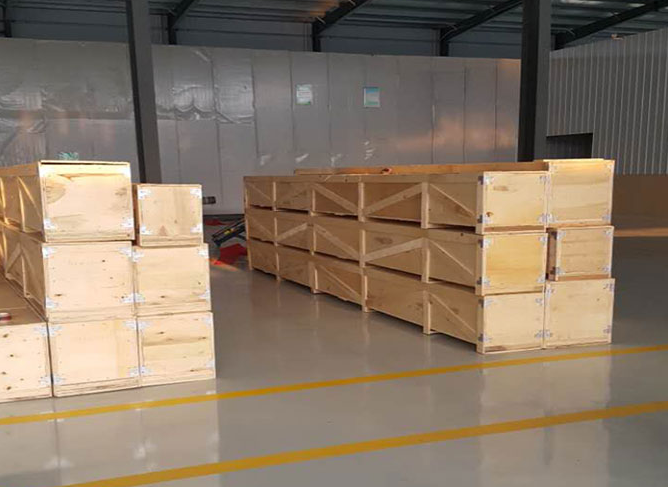
Rolls packed for shipment. Inspection and delivery terms are identical for plain and filler-wire constructions, so the comparison stays technical.
Incoterm choice changes the landed-cost arithmetic rather than the belt. FOB leaves inland and ocean freight to the buyer's forwarder; CIF places freight and insurance with the supplier; DAP and DDP move progressively more of the delivery obligation to the supplier. For a first trial order, buyers commonly compare constructions on an FOB basis to isolate the product variable, then switch to DAP or DDP for production volumes once the logistics route is proven.
Total Cost of Ownership and the Strength Question
Two published figures shape the cost comparison, and they point in different directions from the permeability number.
The first is strength. Large-loop filter belt constructions are published at a breaking strength of up to 2,300–2,800 N/cm, against roughly 1,800 N/cm for typical entry-level belts — an improvement of up to 55%. Strength comes from loop construction and yarn specification, not from the filler wire. A buyer who needs a stronger belt should be looking at loop size and yarn, and treating filler wire as a separate retention decision.
The second is life and energy. Higher open area and permeability enable faster drainage and a drier sludge cake, which lowers downstream drying energy consumption; and higher-grade belts are published as offering a lower total cost of ownership than alternatives because longer service life from acid, alkali and abrasion resistance leads to fewer belt changes. Maintenance requirements are correspondingly lower, with less frequent belt replacement and reduced downtime for seam repair.
Put together, the cost logic is not "filler wire costs more, therefore it is better." It is: pay for retention only where retention is the failure, and take the permeability and the price only where throughput is the failure. Both constructions sit inside the same life-extension logic; the difference is which operating problem disappears first.
Market Context: Why Finer Retention Is Being Specified
Two verified data points explain why filler-wire constructions are being discussed more often in procurement conversations than their niche appearance suggests.
Belt filter press technology is projected to grow at an 8.8% CAGR from 2025 to 2033 within the sludge dewatering equipment market, according to Grand View Research. Growth in that segment translates directly into installed belt area, because a belt filter press is a consumable-driven machine: every additional unit adds a recurring belt requirement, and many of those units are specified on filtrate quality and cake dryness rather than on raw throughput.
At the same time, polyester's position as the leading material segment in the global conveyor belt market — 28.4% share in 2025 per Straits Research — means the material itself is not the differentiating variable. When one polymer family dominates, competition moves into construction: loop geometry, weave pattern, and whether a filler wire is present. That is precisely the axis this comparison sits on.
A third, qualitative shift is visible across non-woven and filtration duties: finer fibre webs and tighter discharge limits both ask the belt to retain more while still passing air. Those two requirements pull in opposite directions, which is why the plain and filler-wire versions of the same 2.32 mm medium loop continue to coexist in catalogues rather than one superseding the other.
A Short Decision Sequence
- Name the failure mode. Filtrate clarity or solids carryover points to filler wire; slow drainage or insufficient throughput points to the plain medium loop.
- Check the aperture budget. If the duty can tolerate 10,700–12,000 ±500 m³/㎡/h, filler wire is available; if it needs the full 18,300 m³/㎡/h, it is not.
- Confirm the temperature and chemistry. Up to 180°C with acid and alkali resistance is the published envelope; outside it, change material, not weave.
- Separate strength from retention. Specify loop construction for breaking strength and filler wire for aperture; do not expect one to deliver the other.
- Run both. At a 2 m² minimum, order the plain and the filler version together and measure cake dryness and filtrate clarity on your own feed.
- Fix the commercial terms in the same document. 100% pre-shipment inspection, optional BV or SGS verification, 30% deposit with 70% before shipment, and a named Incoterm from FOB, CIF, DAP or DDP.
Future Outlook
The direction of travel favours more precise aperture specification rather than a single default weave. With the conveyor belt market projected to grow from USD 6.24 billion in 2026 to USD 8.53 billion by 2034, and belt filter press technology compounding at 8.8% through 2033, the installed base of machines sensitive to solids capture keeps expanding. Each of those machines has a feed that shifts with season, catchment and upstream process change — which is an argument for buyers holding qualification data on both the plain and the filler construction rather than standardising on one.
Two practical developments follow. First, specification documents are likely to move from naming a product to naming a measured aperture with a tolerance band, in the way this catalogue already quotes 10,700–12,000 ±500 m³/㎡/h rather than a single number. Second, third-party verification — the optional BV or SGS inspection already offered — becomes more valuable as a procurement record than as a one-off check, because it makes belt-to-belt comparison defensible across suppliers.
Neither development removes the underlying trade-off. A denser mesh still costs airflow; an open mesh still passes fines. What changes is how precisely a buyer can state which of the two they are buying.
FAQ
Is a filler-wire polyester mesh belt stronger than a standard medium loop belt?
No. Breaking strength is a function of loop construction and yarn, not of the filler wire. Large-loop filter belt constructions are published at up to 2,300–2,800 N/cm against roughly 1,800 N/cm for typical entry-level belts, an improvement of up to 55%, and that figure is attributed to the loop construction. Filler wire changes aperture and retention, not tensile strength.
How much air permeability is given up when filler wire is added to a medium loop?
The plain medium loop at 2.32 mm is published at 18,300 m³/㎡/h. The medium loop-filler wire at the same 2.32 mm is published at 10,700–12,000 m³/㎡/h with a ±500 m³/㎡/h tolerance band. The reduction is therefore roughly one third of the plain figure, and the tolerance band should be carried into any acceptance test rather than treated as a single target value.
Which duties should default to a filler-wire construction?
The construction is indicated where fine solids retention or even surface support is the limiting requirement: belt filter press dewatering of fine-fraction sludge, papermaking pulp washing of finer furnishes, latex wire drying where marking and uneven support are the failure modes, meltblown non-woven forming where fibre pull-through contaminates the vacuum system, and fabric pre-shrinking where surface marking dominates. In each case the buyer should still confirm that the reduced permeability of 10,700–12,000 ±500 m³/㎡/h clears the airflow or hydraulic requirement.
What are the minimum order quantity and payment terms for comparing both weaves?
The published minimum order is 2 square meters, which is small enough to order both the plain and the filler-wire version for a side-by-side trial on the same machine. Payment terms are 30% deposit with 70% balance before shipment, and delivery can be quoted on FOB, CIF, DAP or DDP terms so that a landed-cost comparison is built on the same quotation basis.
Is third-party inspection available, and what does it add to a comparison?
Yiheng Mesh performs 100% pre-shipment inspection on every order and offers optional BV or SGS third-party inspection. The first is an internal control applied to all rolls; the second is an independent record that can be attached to a purchasing file. For buyers comparing constructions across more than one supplier, the third-party option is what makes the permeability and thickness figures comparable rather than self-declared.
What temperature and chemical limits apply to both constructions?
Polyester mesh belts in these duties are published as heat resistant to 180°C and resistant to acids and alkalis, characteristics not typical of conventional low-strength seamed filter belts. Those limits apply to the polymer, so they are identical for the plain and filler-wire versions of the same weave. Above 180°C, or in chemistry that attacks polyester, the weave choice is not the relevant variable.
How are these belts classified for customs and trade documentation?
Polyester mesh belts fall under HS Code 5911.90, the heading applied to textile products and articles for technical uses according to the USITC Harmonized Tariff Schedule. This classification is separate from product standards: ISO 14890 governs rubber- or plastics-covered conveyor belts with textile carcasses and does not describe an open woven polyester mesh belt, so buyers should confirm which standard a supplier is actually claiming.
For full construction data, weave options and commercial terms, the manufacturer's catalogue is available as a downloadable PDF brochure.
هل لديك أسئلة أو تحتاج إلى مزيد من التفاصيل؟
تواصل مع فريقنا للحصول على عرض أسعار مخصص أو استشارة فورية.
طلب عرض أسعار
املأ النموذج أدناه وسيتواصل معك فريقنا بعرض مقترح مخصص.
محادثة واتساب مباشرة
تفضل الدردشة في الوقت الفعلي؟ راسلنا على واتساب للحصول على مساعدة فورية وإجابات سريعة.
- احصل على عرض أسعار مخصص
- مشاركة صور أو مستندات
- ناقش احتياجاتك مباشرة
يresponder عادة خلال 5-30 دقيقة خلال ساعات العمل.