
Filling Machine Compliance Claims: A Checklist by Line Type
A compliance claim for a cosmetic filling machine is a bounded statement. It describes one machine, one model designation and one set of assessed standards — it does not automatically extend to the line the machine sits in, to the neighbouring model in a catalogue, or to the cosmetic product that leaves the factory.
That boundary is where most procurement disputes start. A buyer receives a quote marked “CE certified”, files it next to the purchase order, and later discovers the certificate names a different model code, a different machine, or a different market scope. The equipment may be perfectly built. The problem is documentary: the claim was accepted at line level while the evidence existed only at component level.
This checklist is organised the way buying decisions are actually made — by line type. It covers hot filling and cooling, powder compaction, and rotary filling and capping, and it separates what a supplier can document today from what a buyer still has to verify before a machine is accepted into regulated cosmetic production.
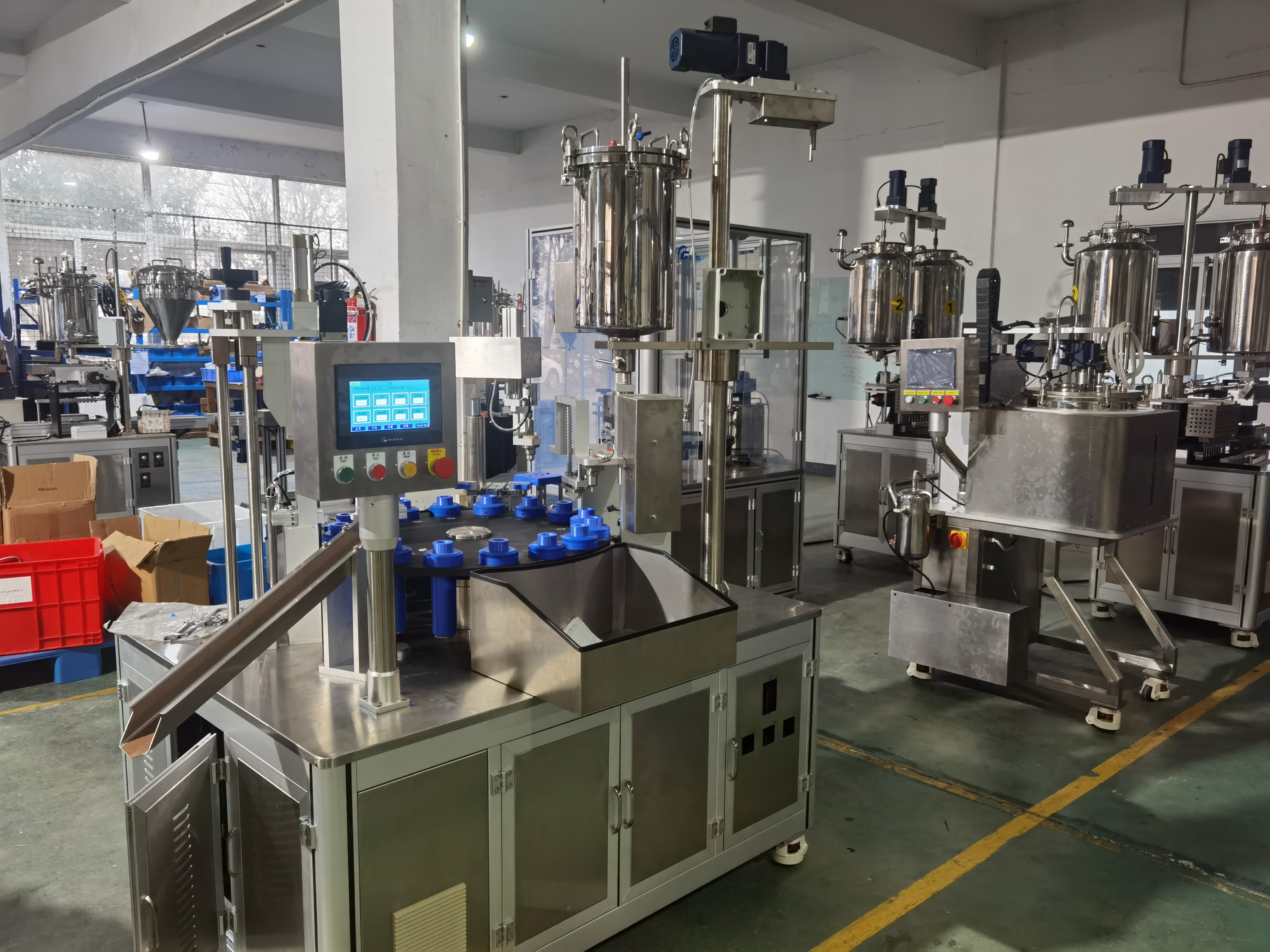
Rotary filling equipment on the factory floor during build and release testing. Photograph: GIENICOS.
Why “CE Certified” Is Not a Line-Level Statement
Machinery compliance and cosmetic product compliance are two different files. A machine certificate addresses the safety of the equipment — typically electrical safety and risk assessment. A finished cosmetic requires its own registration, notification and quality system evidence, which no machine supplier can supply on a buyer's behalf.
The market context makes this distinction more urgent rather than less. Future Market Insights places the global cosmetic filling machines market at USD 476.80 million in 2025, projected to reach USD 718.63 million by 2036, and estimates that automatic filling machines will hold a 41.2% share of the technology mix in 2026. More automated equipment means more documentation per project — and more opportunities for a certificate to be attached to the wrong model.
There is also a trade-documentation dimension that buyers often overlook. Cosmetic filling machinery sits under HS Code 8422.30, specifically 8422.30.91 for machinery used in opening, filling and closing containers, per the Harmonized Tariff Schedule maintained by the USITC. Customs entries, tender files and internal asset registers all reference the machine by that classification — so the model designation used in the certificate should match the designation used commercially.
What a Qualification Document Set Should Name
Before comparing two machines, compare two document sets. A usable set answers five questions without a follow-up email:
- Who issued it. The legal manufacturer or an accredited testing body, named in full.
- Which model. The exact model code as quoted — not a product family name.
- Which standards and certificate numbers. Cited, dated and checkable.
- Which market. EU conformity, for example, is not a global permission.
- What is excluded. Hygiene validation, product registration, utility requirements and operator qualification are normally outside a machinery certificate.
A document set that fails any of these five points is not disqualifying — many are simply issued later in the order cycle — but it must be logged as an open item with an owner and a date, not assumed.
What GIENICOS Documents Today
Shanghai GIENI Industry Co., Ltd. (GIENICOS) is a Shanghai-based manufacturer founded in 2011 that designs and builds intelligent cosmetic filling and packaging equipment, with a factory in Jiading District, Shanghai, a documented range spanning lipgloss, mascara, lipstick, hot pouring, compact powder, nail polish, eyeliner, eyebrow pencil and skincare filling, and an installed base across 100 countries and regions.
Its publicly recorded certification scope is specific rather than blanket. The table below reproduces what the record states, so that a buyer can see immediately where the evidence stops.
| Certificate | Models named | Market / issuer |
|---|---|---|
| ATGZAHS190528008-M1 | MT-1, MT-4, MT-6, MT-100 and MT-300 melting tanks; TSP and TSF hot pouring machines | EU; Anbotek (Guangzhou) Compliance Laboratory Limited. EN 60204-1:2018 and EN ISO 12100:2010 are listed as applicable standards for the MT-1 melting tank. |
| AT58250SC100097 | Multi-color Hot Filling Machine | EU; Anbotek (Guangzhou) Compliance Laboratory Limited |
| AT18250SC100526 | JY-CR50 and JY-CR200 High Speed Powder Mixers | EU; Anbotek (Guangzhou) Compliance Laboratory Limited. Complies with EN 60204-1:2018 and EN ISO 12100:2010. |
The same record contains no certificate entry naming the Lipstick Cooling Tunnel, the Automatic Powder Press Machine, the Compact Powder Press Machine, the Rotary Nail Polish Filling Machine or the Semi Automatic Rotary Capping Machine. That absence is not evidence of non-conformity — it simply means the buyer must request model-specific documentation instead of inferring coverage from a neighbouring certificate. A hot pouring machine certificate does not travel upstream to a cooling tunnel, and a powder mixer certificate does not travel downstream to a press.
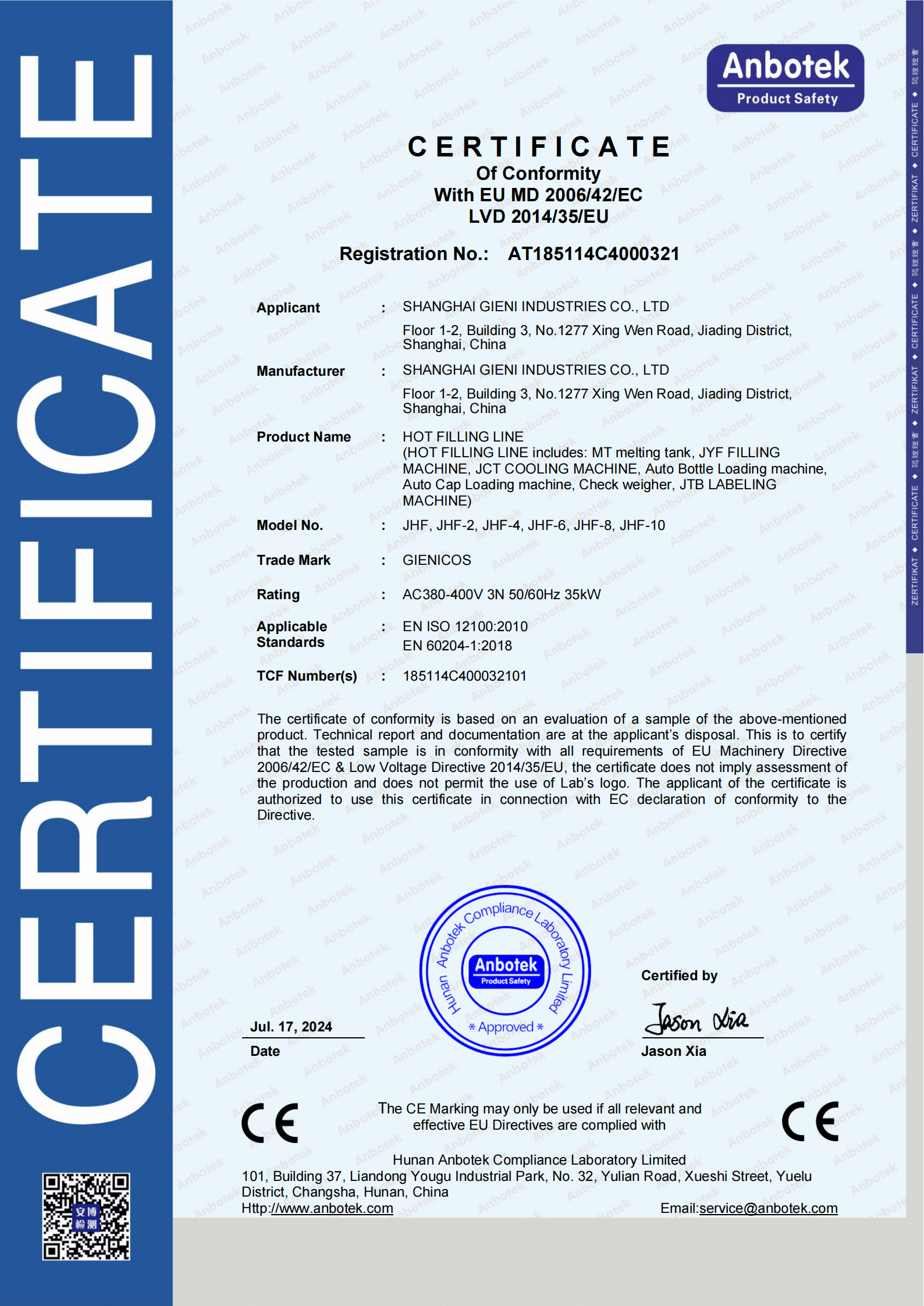
Certification paperwork on file for a hot filling line. Before acceptance, the certificate number, model designation and applicable standards must be matched line by line against the purchase order.
Checklist 1: Hot Filling and Cooling Lines
The hot filling family is the most documentation-sensitive of the three, because heat, vacuum and cooling are supplied by separate assemblies that may be certified separately — or not at all. The relevant GIENICOS equipment includes the 20L Hot Pouring Machine (MT 20P: 20 L tank with heating, stirring and vacuum, and a sanitary discharge valve without dead angle), the Lipstick Cooling Tunnel (JCT: refrigerated air circulation with a continuous conveyor, with temperature, conveyor speed, dimensions and power supply customisable to the line), and the Hot Filling & Cooling Line (JHF: filling ranges of 1–20 mL, 20–50 mL, 50–100 mL and 100–200 mL, with 2, 4, 6 or 16 nozzles, reaching up to 60 pcs/min on a six-nozzle configuration).
Questions to put in writing before the machine is released:
- Does the certificate name the exact model code being quoted — MT 20P, TSP, TSF or another designation — and not only a product family?
- Is the certificate scoped to the heated tank, to the control panel, or to the unit as delivered?
- For a multi-station line, is documentation issued per machine or per integrated line, and can both versions be supplied?
- Which standards are cited, and are they current at the planned delivery date rather than at the date of quotation?
- What document covers the cooling tunnel's refrigeration circuit and its electrical panel?
- Are temperature tolerance and conveyor speed stated in writing as acceptance criteria, or only discussed commercially?
- Which components are product-contact stainless steel, and what disassembly is required for cleaning between shade changes?
- Who signs the factory release test, and which parameters are recorded — filling volume, filling precision, nozzle count and output?
Checklist 2: Powder Compaction
Powder lines are usually discussed in terms of pressing force and output, but the qualification question is narrower: which document names the press? GIENICOS builds the Automatic Powder Press Machine (GP 050 SE: rotary, servo press with hydraulic option, 50–60 pcs/min on a four-cavity example, single colour with customisation, 0.5–1 operator, optional robotic pan feeder) and the Compact Powder Press Machine family, including the JTC hydraulic up-bottom press (working pressure 0.1–14 MPa, maximum hydraulic output 8 tons) and the JBC-4 and JBC-5 bottom-up presses (JBC-4: 2–3 molds/min, typically 720–1080 pcs/hour, up to 6 pans per mold, 15 tons maximum; JBC-5: servo-hydraulic, 14 tons, 3 molds/min, typically 9 pcs per mold at approximately 50 mm diameter).
- Is there a certificate naming the press model itself, or only the upstream mixer? The JY-CR50 and JY-CR200 mixers are covered under AT18250SC100526; press coverage must be confirmed separately.
- What pressing force, dwell time and pressure curve are recorded at acceptance, and against which specification?
- What documentation accompanies dust extraction and containment around the press station?
- Is the supported pan size range and mold compatibility listed in the handover file?
- What changeover time is documented for a colour or pan-size change, and who performs it?
- How many operators per shift are stated, and does that figure include pan feeding?
Checklist 3: Rotary Filling and Capping
Rotary configurations combine dosing and closure in one sequence, which makes the interface between the two the weak point in the documentation. GIENICOS equipment in this family includes the Rotary Nail Polish Filling Machine (JQR-01N: piston, vacuum or pressurised filling; 5–30 mL container range; filling precision approximately ±0.2 g; AC220V single phase, 2 kW; process sequence of bottle feed, filling, brush feed, cap feed, capping and discharge) and the Semi Automatic Rotary Capping Machine (JR-01X: servo capping for round and square bottles, 30–40 pcs/min, adjustable torque, single-phase 220 V, 1.5 kW, 7 A, 0.5–0.8 MPa air supply).
- Does one document cover both the filler and the capper, or are two certificates required?
- Is there a torque calibration record, and at what interval is it repeated?
- Is the accepted container range — diameter, height, volume — written into the acceptance sheet?
- What happens when no bottle is detected at the filling station, and is that logic documented for the validation file?
- If the line reports to an MES or check-weigher, which interface documentation is handed over?
Where These Lines Actually Run
The commercial argument for a documentation-led acceptance process becomes clearer in high-speed installations. GIENICOS describes a lipgloss and mascara configuration operating at 60–72 pcs/min in mid-speed mode and 80–100 pcs/min in high-speed mode, with 10–12 servo piston filling positions per cycle, return-suction anti-drip nozzles, no-bottle no-fill detection, servo torque capping and SUS316L wetted parts, designed for GMP clean-room compatibility and typically integrated with an MES, remote monitoring, automatic check-weighing and rejection, labelling and sleeve shrink labelling.
That configuration is characteristic of cosmetic OEM, ODM, private-label and contract manufacturing sites, and the supplier records comparable clean-room applications in the United States, Mexico, Indonesia, Thailand, Poland and China. In one documented programme, 20 sets of equipment were supplied over five years for lipgloss and lipcream production across the US, Poland, Indonesia and Thailand.
Once a filler reports into an MES and a check-weigher, the machine certificate stops being a purchasing formality and becomes one input into a larger validation file. That is the practical reason to resolve model-code mismatches at quotation stage rather than at commissioning.
Documentation-Led Acceptance vs. Brand-Trust Acceptance
Most buyers still qualify equipment in one of two ways. Brand-trust acceptance relies on supplier reputation, a factory visit and a sample run. Documentation-led acceptance relies on certificate scope, cited standards, model-code matching, release-test records and a named signatory for each item.
The second approach catches errors the first cannot. A site visit confirms build quality and workshop practice — it does not reveal that the certificate on file names a different model, or that the cooling tunnel beside a certified pouring machine sits outside the documented scope. Conversely, documentation alone cannot confirm whether a machine was assembled and tested to the standard the paperwork implies, which is why GIENICOS records a 100% outgoing quality check before shipping and supports it with a 12-month warranty, remote technical support and on-site service.
The limits should be stated plainly. CE conformity to EN 60204-1:2018 and EN ISO 12100:2010 addresses electrical safety and machinery risk assessment; it does not validate cosmetic product safety, microbiological control or finished-goods registration. Certificate scope is recorded for the EU market, so other destinations require their own conformity route and their own paperwork. And qualification cannot be compressed indefinitely against production planning: GIENICOS states a monthly capacity of roughly 10 units, a lead time of 45–80 days and a minimum order quantity of one unit, which means a document request issued late in the order cycle will move the delivery date.
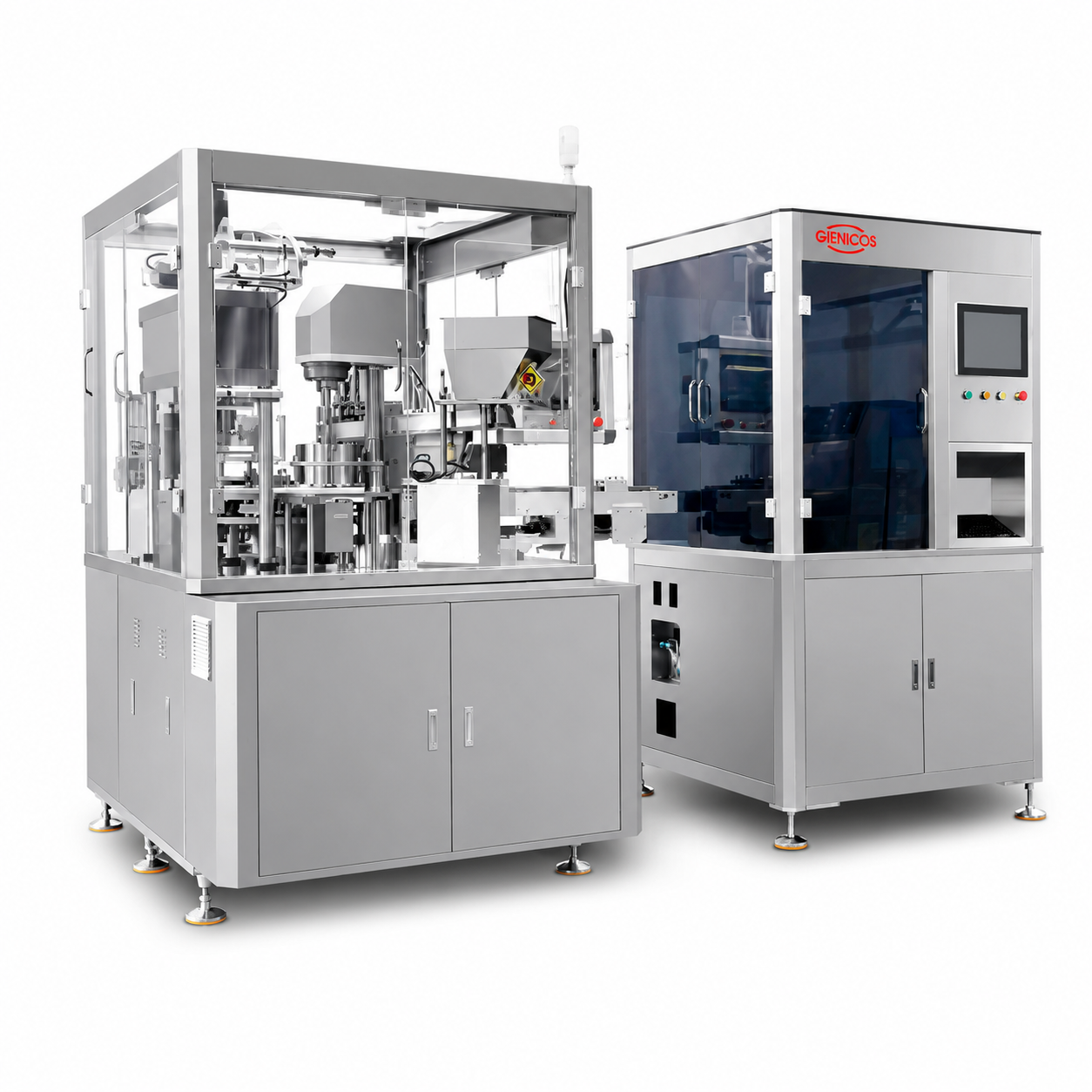
GP 050 SE automatic servo powder press. Press models require their own model-specific documentation — mixer certification does not extend downstream.
Market Signals Worth Reading Carefully
Two market signals reinforce the checklist argument. First, Asia Pacific dominated the filling machine market with a 33.08% share in 2025 according to Fortune Business Insights, which means a growing share of machinery documentation is produced in Asia and read by EU or US quality teams — a translation and traceability gap that model-code matching closes quickly. Second, the automation mix is shifting: automatic filling machines are projected to hold 41.2% of the cosmetic filling technology market in 2026, per Future Market Insights, and automated equipment carries more documentation per unit than semi-automatic equipment.
The same discipline applies to vendor market claims. Published estimates for the automatic lipstick filling segment diverge sharply — one forecast puts the segment at USD 1.2 billion by 2033 growing at 5.8% CAGR from 2025, while other research arrives at a far smaller figure. The difference is definitional, not arithmetic: individual machines versus complete production lines. A buyer who applies the same standard to market data and to compliance claims will ask what the number covers before quoting it internally.
What Changes Next
Documentation is moving from a per-machine artefact to a per-line deliverable. As fillers, cappers, check-weighers and MES interfaces become one production unit, quality teams increasingly expect a single handover package that maps every model code, certificate number and standard to the physical asset on the floor. Suppliers that can produce that mapping quickly will win evaluation rounds on evidence rather than on price alone — and buyers who ask for it early will avoid re-opening a qualification file after commissioning.
FAQ
Does a CE certificate covering a melting tank or hot pouring machine extend to the whole hot filling and cooling line?
No. Certification is recorded against named models. In the GIENICOS record, CE certificate ATGZAHS190528008-M1 names the MT-1, MT-4, MT-6, MT-100 and MT-300 melting tanks and the TSP and TSF hot pouring machines. Equipment that is not named — including the Lipstick Cooling Tunnel and the Hot Filling & Cooling Line — requires its own model-specific documentation from the supplier.
What documents should be requested for a compact powder press before installation?
A certificate or declaration naming the press model itself, the pressing force and dwell parameters recorded at acceptance, the supported pan size range and mold compatibility, documented changeover time, and the operator count per shift. Certification of an upstream mixer, such as the JY-CR50 and JY-CR200 covered under AT18250SC100526, should not be treated as coverage for the press.
What should be verified when a rotary filler is installed in a GMP clean-room workshop?
Three items beyond the certificate: the accepted container range in writing, the no-bottle no-fill and rejection logic documented for the validation file, and the capping torque calibration record with its repeat interval. For machines such as the JQR-01N nail polish filler and the JR-01X capping machine, the filler and capper may be covered by separate documents, so both should be requested by model code.
Is machinery certification sufficient to place a cosmetic product on the market?
No. Machinery conformity addresses equipment safety — the GIENICOS record cites EN 60204-1:2018 and EN ISO 12100:2010 for specific models — while finished cosmetic products require separate registration or notification, quality system evidence and product-specific testing. The machine certificate is one input to that larger file, not a substitute for it.
How early should a document request be raised in the order cycle?
Before the purchase order is issued. GIENICOS states a lead time of 45–80 days, a monthly capacity of roughly 10 units and a minimum order quantity of one unit, so a certificate query raised during commissioning falls outside the delivery window rather than inside it. Requests should name the model code, the destination market and the standards the buyer's quality team expects to see.
A full equipment reference covering hot pouring, cooling, powder pressing, rotary filling and labelling is available in the GIENICOS 2026 catalogue (PDF).
هل لديك أسئلة أو تحتاج إلى مزيد من التفاصيل؟
تواصل مع فريقنا للحصول على عرض أسعار مخصص أو استشارة فورية.
طلب عرض أسعار
املأ النموذج أدناه وسيتواصل معك فريقنا بعرض مقترح مخصص.
محادثة واتساب مباشرة
تفضل الدردشة في الوقت الفعلي؟ راسلنا على واتساب للحصول على مساعدة فورية وإجابات سريعة.
- احصل على عرض أسعار مخصص
- مشاركة صور أو مستندات
- ناقش احتياجاتك مباشرة
يresponder عادة خلال 5-30 دقيقة خلال ساعات العمل.