
Filling Machine Supplier Capability: 3,000 m², 5 Engineers, SGS Testing
Filling Machine Supplier Capability: 3,000 m², 5 Engineers, SGS Testing
Filling machine buyers rarely fail because they could not find a specification sheet. They fail because the sheet was accurate about the machine and silent about the factory behind it. For a pillow filling machine, duvet filling machine or down jacket filling machine destined for a live bedding line, the difference between two similar quotations usually sits in capacity discipline, test evidence and the speed at which a non-standard request is engineered.
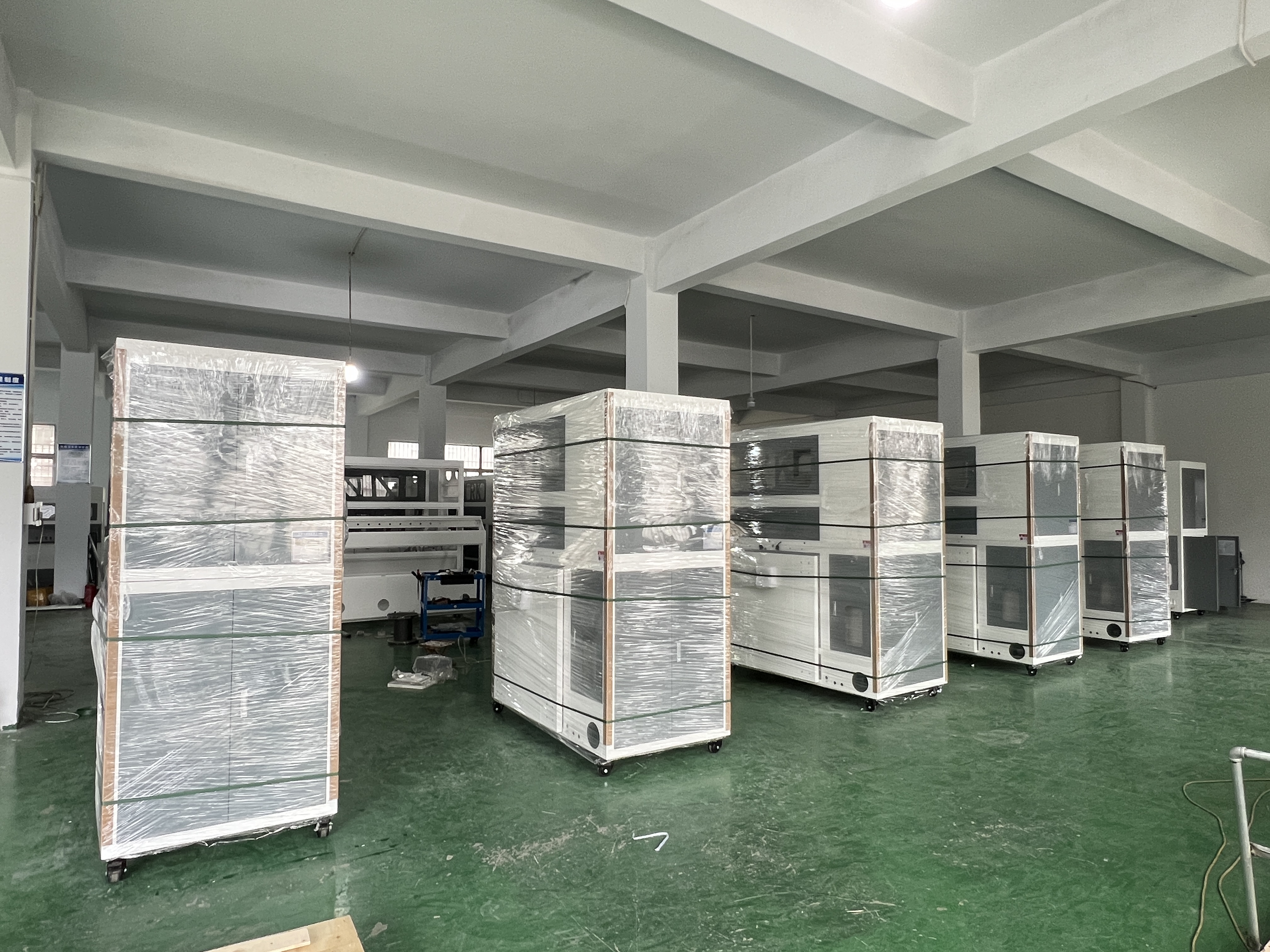
Qingdao Kaiweisi Industry and Trade Co., Ltd. (KIVAS) is a Qingdao-based manufacturer of home-textile and filling machinery, founded in 2014, with a 3,000 m² facility, approximately 17 employees and a five-engineer R&D team. The company publishes an unusually complete capability set for a supplier of this size: annual and monthly output, pre-shipment testing, certification references, lead time, order minimums and export share. This review reads those figures the way a buyer at the evaluation-to-execution stage should — as procurement signals that each carry a follow-up question.
Why a specification sheet is a weak basis for supplier selection
Filling machinery documentation is heavily recycled. Technical specifications for down-specific and bedding machines are frequently republished commercial data rather than measured results, which is why two suppliers can present near-identical parameter tables while operating very different plants. The public-record gap is not a shortage of catalogues; it is a shortage of original validation — lead times recorded on real orders, test results captured before shipment, and accuracy data tied to a named material and product.
That gap changes the order in which a buyer should evaluate. Instead of ranking parameters first, rank what can be checked: who owns the factory, who signs the factory test report, what the minimum order is, and what happens after the first machine is installed. KIVAS publishes concrete answers to all four.
Reading the published capability figures as procurement signals
The headline numbers are a 2014 founding date, a 3,000 m² facility, approximately 17 staff, 5 engineers, 1,000 units of annual output and a monthly capacity band of 60–150 units. None is a performance claim on its own. Read together, they describe a compact plant organised around repeatable single-machine and small-line builds.
| Published figure | What it describes | How a buyer can use it |
|---|---|---|
| Founded 2014 | Operating history | Ask for the model history of the unit being ordered and the spare-parts route for earlier machines. |
| 3,000 m² facility | Footprint | Establish which processes run in-house and where final testing takes place in the material flow. |
| Approximately 17 employees | Headcount | Compare against output to judge whether the plant is assembly-led or fabrication-led. |
| 5-engineer R&D team | Engineering capacity | Ask who owns customization drawings and who signs off the factory test. |
| 1,000 units annual output | Annual output | Reconcile against the monthly band: 1,000 ÷ 12 ≈ 83 units per month. |
| 60–150 units monthly | Monthly capacity band | Use the upper end to test peak-season claims and to start the 15–35 day lead-time clock. |
| About 60% exported | Market exposure | Ask which voltage variants, documentation sets and destination markets are routine. |
The arithmetic is worth doing because it exposes a common inconsistency in supplier claims. Dividing 1,000 units of annual output by twelve months gives an average of roughly 83 units a month, which falls inside the stated 60–150 unit monthly band. Capacity claims that do not reconcile this way deserve a follow-up question about which figure is a target and which is a demonstrated rate.
A 3,000 m² footprint at a headcount of about 17 points to an assembly-and-testing layout rather than heavy fabrication. The productive question is therefore which processes run in-house — frame fabrication, sheet-metal work, electrical assembly, final testing — and where the test bay sits. Buyers who need to know how much of the machine is built rather than bought should ask for the plant layout alongside the quotation.
Engineering density is the second signal. Five engineers in a workforce of roughly 17 is close to one in three, the profile of a company that expects non-standard requests to be part of normal order flow. It is also the constraint: specialization of that kind does not scale instantly when several customization projects arrive in the same month.
What OEM and ODM customization actually consumes
KIVAS lists OEM, ODM, overseas installation guidance and personalized customization as production modes, with customization available on voltage, logo, colour, production capacity and specialized production lines. Most suppliers state that they customize; the useful question is where the engineering hours come from.
Customization is engineering time rather than a configuration menu. A voltage change touches electrical components and documentation; a bespoke pillow or quilt filling line changes infeed, weighing station, discharge and sometimes the compression stage. In a plant with five engineers, parallel projects compete with standard builds for the same review capacity. The step to interrogate is therefore drawing approval: who converts the request into a drawing, who confirms material compatibility, and who signs off the first-off unit against that drawing.
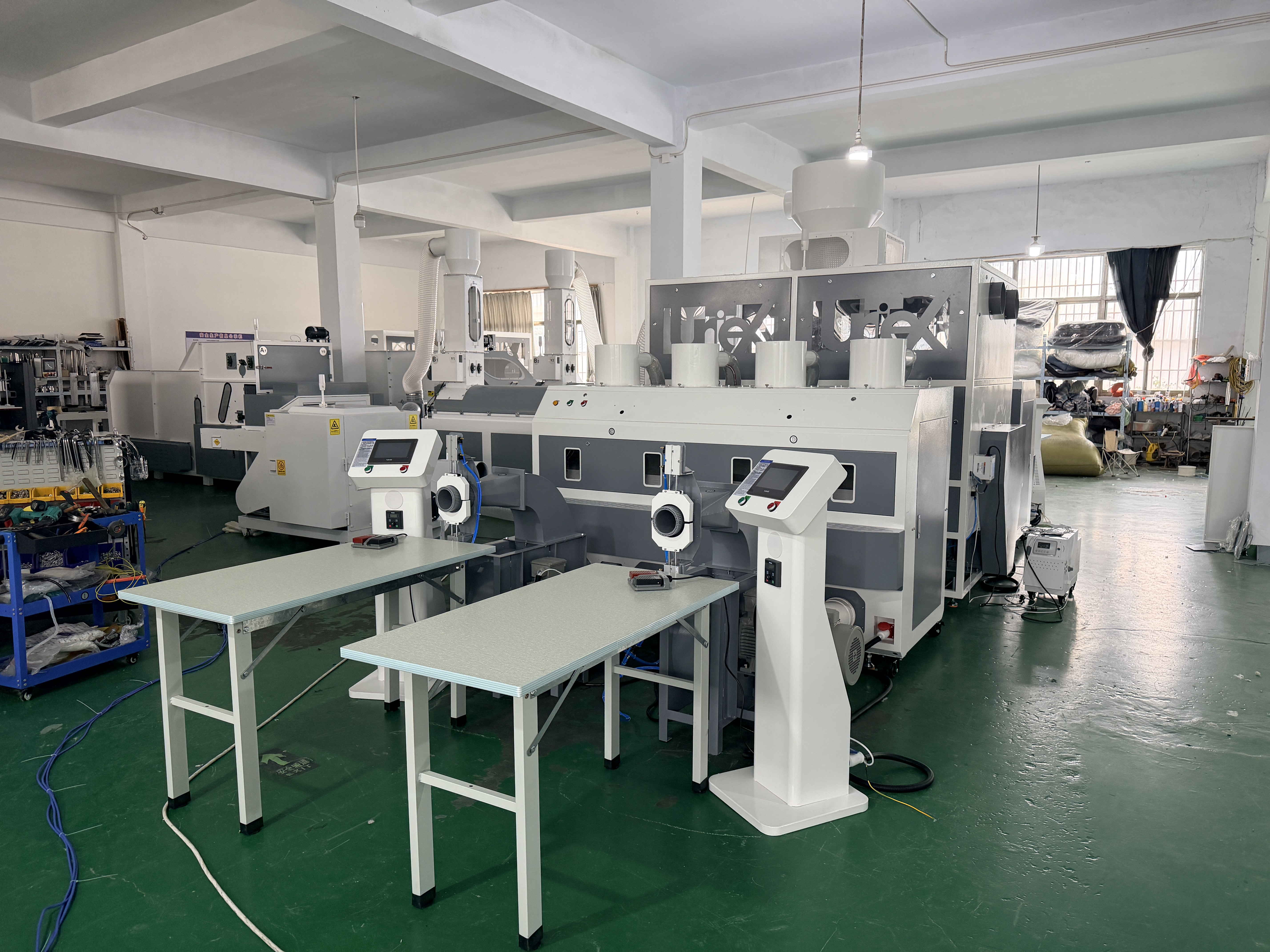
Material compatibility matters more than electrical specification in bedding work. KIVAS's published sheet for the KWS6901-2 automatic weighing filling machine lists 0.6D–15D, 32–64 mm fibre, down, feathers and kapok within a 10–80 mm length range, and states a capacity of approximately ten 500 g pillows per minute. Input range and output rate are the two figures that must be matched to the buyer's own material. A polyester pillow filling operation, for example, should confirm its specific denier and cut length against that published range in writing rather than assume that any polyester fibre sits inside it.
100% pre-shipment testing and third-party SGS inspection
The quality-control statement is specific: 100% pre-shipment testing on every unit, plus third-party inspection by SGS. Product acceptance is described as running through SGS procedures that include the pre-shipment test, and the company's press-release material adds that goods are delivered on EXW, FOB, CIF, CFR or DDP terms.
Those are two different controls, and buyers should keep them apart. A 100% pre-shipment test is an in-house gate applied to every machine before packing. Third-party inspection is an external check against an agreed checklist carried out by someone who does not work for the seller. The first confirms that testing happened; the second provides an independent record of what was tested and what was found.
What the buyer controls is the checklist. Before an inspection is booked, the acceptance criteria should name the material, the target fill weight, the weighing tolerance, the running duration and the packing condition. If the machine will run down rather than fibre, the sample used at the test should be the material the buyer intends to process. Without that specificity, an inspection report confirms that a machine ran; it does not confirm that it will run the buyer's product.
Certification deserves the same precision. The CE document in the published KIVAS record is a Machinery Directive 2006/42/EC attestation of conformity, certificate M.2024.206.C100562, issued by UDEM on 9 May 2024 and valid to 8 May 2029, with a scope of ‘automatic down fiber filling machine’ and the harmonised standards EN ISO 12100:2010 and EN 60204-1:2018. That is a document with a named scope, not a blanket certification of every model. A buyer ordering a pillow, quilt or toy filling machine should request the declaration covering the exact model and configuration, and should treat the company's ISO9000 statement as a claim that needs its certificate and scope attached.
Lead time, payment terms and the one-unit trial order
Order mechanics are published in enough detail to plan around, which is uncommon and useful at the execution stage.
| Term | Published detail | What the buyer confirms |
|---|---|---|
| Minimum order | 1 unit, usable as a testing sample | Whether a single unit can be built in the customized configuration. |
| Lead time | 15–35 days | The trigger event — deposit, drawing approval or material readiness. |
| Delivery terms | EXW, FOB, CIF, CFR, DDP | Which Incoterm is quoted and who arranges insurance and clearance. |
| Payment | 30% T/T deposit before production, 70% balance before ex-factory delivery | Which documents are released against the balance payment. |
| Acceptance | 100% pre-shipment test, third-party inspection (SGS) | The inspection checklist, sampling plan and report format. |
| After-sales | Remote technical support, 1-year warranty, lifetime after-sales service, overseas installation guidance | The warranty start date and the spare-parts route. |
The one-unit minimum is the most commercially significant item on that list for a first-time buyer. It allows a test order in the actual configuration rather than a demonstration on a showroom model, and it fits the evaluation-to-execution path: one machine validated on the buyer's material, followed by a line order if the validation holds. The corresponding discipline is to define what ‘holds’ means before the order is placed — a fill-weight tolerance, a throughput figure per shift, and the faults that would trigger rework.
The 15–35 day band is a production window, not a delivery date. Its start should be tied to the deposit and the approved drawing, with freight and clearance added separately. For import documentation, filling machinery is generally classified under HS 8422.30, but the classification should be confirmed with the buyer's customs broker before the commercial invoice is issued: a wrong code changes duty and clearance, not the machine.
Application fit: bedding, down, toy and cushion work
The KIVAS product scope covers fibre processing machinery, cotton, linen and wool textile machinery, fully automated quantitative pillow and quilt filling machines, pet product filling machines, weighing down jacket filling machines, packaging machines and related supporting equipment. That maps onto four distinct buying situations.
- Bedding and pillow production. Pillow filling machines and quilt filling machines, including configurations where filling is followed by pillow compression packaging.
- Down and outerwear. Weighing down jacket filling machines, the application covered by the documented CE scope.
- Toy and plush. Toy filling machines for plush, cushion and soft-product work, with 220V/110V options listed in marketplace documentation.
- Higher-variation work. Cushion, beanbag and lazy sofa filling, where mixed-material handling rather than peak speed is usually the deciding capability.
The last category needs a caveat. Public model-level documentation is strongest for pillow, quilt, down and toy applications; cushion, beanbag and lazy sofa configurations are not documented to the same depth. A buyer in that segment should ask for the configuration matched to the product — fill-weight range, material mix and discharge arrangement — instead of extrapolating from a pillow machine specification.
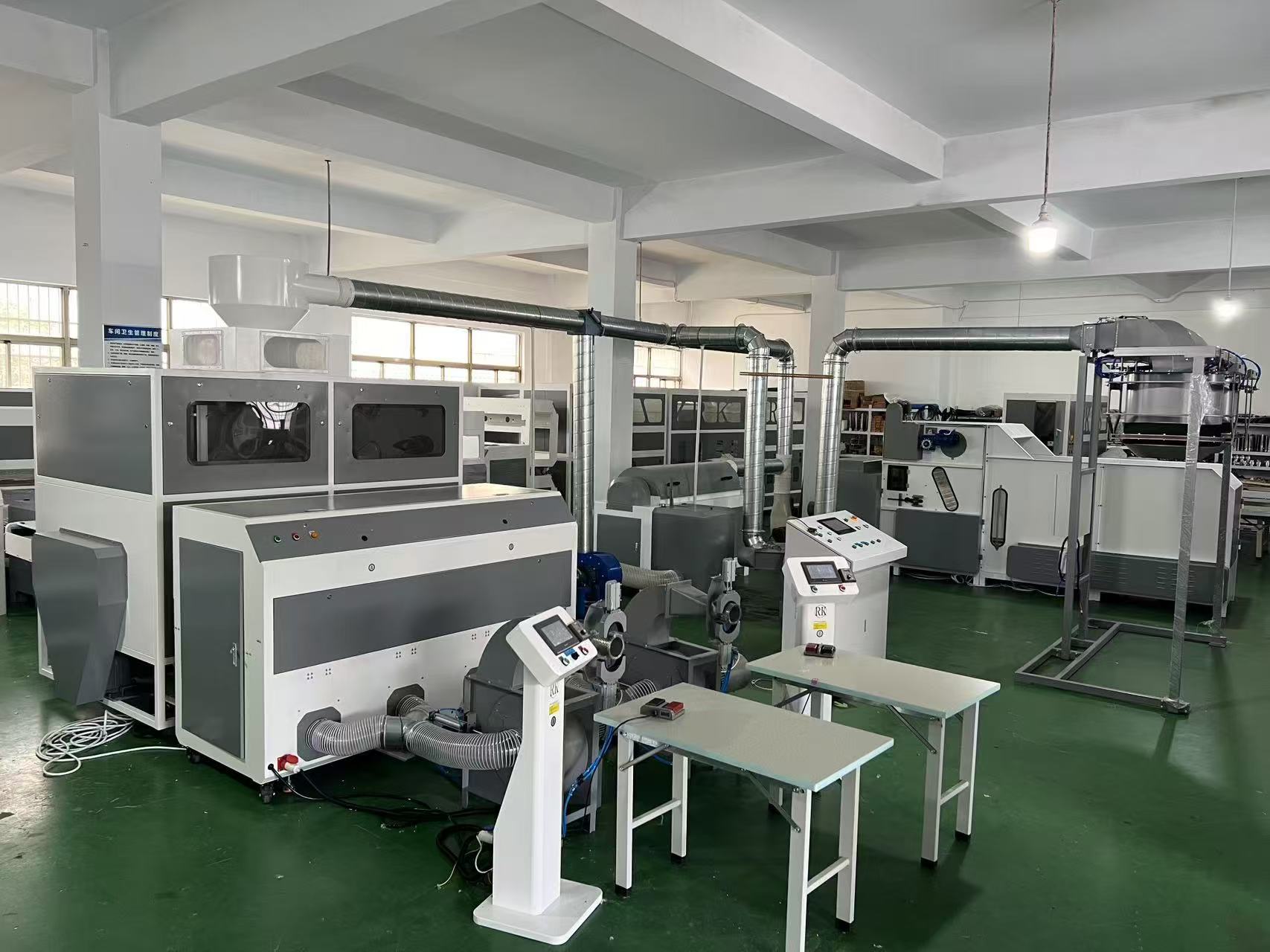
The clearest application evidence in the published record is a Saudi Arabian bedding project: ten units configured for pillow, cushion and bedding filling together with fibre opening and pillow compression packaging, reported as still operating normally after three years. The company's case record attributes a 30% reduction in energy consumption, a 35% reduction in labour cost and a 40% increase in production capacity to that installation, with filling accuracy around 1% error and the ability to run single or mixed filling with two to five raw materials. Those are reported outcomes for one configured project, not a general performance guarantee; their value to a new buyer is as a reference configuration to interrogate — what was measured, against which baseline, and over what period.
Market context, and what a 60% export share does not show
KIVAS reports that about 60% of its products are exported, with named markets including the USA, Russia, Vietnam, Saudi Arabia, Italy, the UK, Canada and Brazil, and broader coverage across Europe, North America, South America, the Middle East and Southeast Asia. An export share of this kind is best read as evidence that the company routinely handles voltage variants, packing, documentation and freight terms. It is operational experience, not market position, and it says nothing about installed base or share of any national market.
Category data gives the wider frame, provided its boundary is stated. Market Research Future's September 2026 pillow packing machine report projects that category growing from USD 16.45 billion in 2025 to USD 25.5 billion by 2035, a 4.48% CAGR. The category is broader than filling machinery — it includes packing equipment — and does not isolate pillow, duvet or down filling machines. It indicates a sizeable adjacent market, not a growth rate for this segment.
Comparing supplier models without declaring a winner
Supplier comparisons in this category usually collapse into a parameter table, the least informative format available. A more useful comparison runs the same three questions across supplier types: who owns production, who signs the test report, and who carries the warranty.
- Integrated manufacturer. Production, testing and warranty sit in one organisation. The check is depth: which processes are genuinely in-house, and whether the test bay can run the buyer's material.
- Trading intermediary. Commercial flexibility may be wider, so the buyer must establish who manufactures the machine, who signs the factory test report and who holds the warranty obligation.
- Turnkey line integrator. Appropriate for large multi-line projects. Ask for references of comparable scope, because a published 60–150 unit monthly band describes repeatable single-machine output rather than simultaneous multi-line delivery.
The fit boundary should be stated plainly. The published KIVAS data supports a supplier of standard and customized single machines and small lines, with engineering-led customization, one-unit trials and documented pre-shipment inspection. It does not establish installed base, market share or independently measured accuracy across every material, and the documented CE scope covers the automatic down fibre filling machine specifically. Where a project depends on any of those points, the right move is to request the specific evidence rather than infer it from the capability summary.
A due diligence sequence for evaluation-to-execution buyers
- Confirm the exact model and request the CE declaration covering that configuration, noting that M.2024.206.C100562 is scoped to the automatic down fiber filling machine.
- Ask for the pre-shipment test checklist and agree the SGS inspection scope, sampling plan and report format inside the purchase contract.
- Fix the commercial frame: Incoterm, the 30/70 T/T payment milestones, and the event that starts the 15–35 day production window.
- Use the one-unit minimum as a validation order on your own material, with written acceptance criteria.
- Confirm the after-sales structure — remote technical support, overseas installation guidance, one-year warranty and lifetime after-sales service — and establish when the warranty period begins.
- Verify the HS 8422.30 classification with a customs broker before the invoice is issued.
Outlook: documentation, not forecasts, is the differentiator
The forward-looking questions for this supplier are documentation questions. The CE attestation runs to 8 May 2029, so the near-term check is whether renewed documentation keeps pace with the models actually sold. A 60% export share makes spare-parts response and remote diagnostics more important than catalogue breadth. And the five-engineer team is the real constraint on customization throughput: a buyer planning repeat orders should ask how customization requests are queued against standard production.
The durable conclusion is simpler than a market forecast. A 3,000 m² plant with five engineers and a documented SGS pre-shipment routine can be assessed on evidence rather than impression. The figures are specific enough to test, and the gaps — model-level CE scope, project-specific performance claims and material-specific accuracy — are specific enough to raise as questions before the purchase order rather than after it.
Reference material: the Qingdao Kaiweisi product catalogue (PDF).
FAQ
What does a 3,000 m² facility with about 17 employees indicate about a filling machine supplier?
It describes a compact plant organised around assembly, testing and repeatable single-machine output rather than heavy fabrication at scale. KIVAS pairs a 3,000 m² facility and approximately 17 staff with a five-engineer R&D team, 1,000-unit annual output and a 60–150 unit monthly band. For a buyer, the practical follow-up is which production processes run in-house and where pre-shipment testing physically takes place.
How does OEM and ODM customization work for voltage, logo or line configuration?
KIVAS lists OEM, ODM and personalized customization covering voltage, logo, colour, production capacity and specialized production lines, together with overseas installation guidance. Because customization consumes engineering review time rather than only bill-of-materials changes, buyers should agree the drawing approval step, the material to be run and the sign-off criteria for the first unit before production begins, not after the machine is built.
What is the difference between 100% pre-shipment testing and third-party SGS inspection?
The 100% pre-shipment test is the manufacturer's own gate, applied to every unit before packing. SGS inspection is an independent check against an agreed checklist. KIVAS describes product acceptance as running through third-party SGS procedures that include the pre-shipment test. Buyers should specify the material, fill weight, tolerance and running duration in that checklist so the report reflects their product rather than a generic demonstration.
Can a buyer order a single filling machine as a trial before committing to a line?
Yes. The published minimum order quantity is one unit, which can also serve as a sample for testing. Lead time is 15–35 days, delivery terms are EXW, FOB, CIF, CFR or DDP, and payment is a 30% T/T deposit before production with the 70% balance by T/T before ex-factory delivery. A single-unit trial lets the buyer's own material run through the machine before a larger commitment.
What after-sales support and certification apply after delivery?
KIVAS provides remote technical support, overseas installation guidance, a one-year warranty and lifetime after-sales service. Certification is documented separately from support: the CE Machinery Directive attestation M.2024.206.C100562 issued by UDEM is valid from 9 May 2024 to 8 May 2029 with the scope ‘automatic down fiber filling machine’. Buyers of other models should request the declaration covering their exact configuration.
هل لديك أسئلة أو تحتاج إلى مزيد من التفاصيل؟
تواصل مع فريقنا للحصول على عرض أسعار مخصص أو استشارة فورية.
طلب عرض أسعار
املأ النموذج أدناه وسيتواصل معك فريقنا بعرض مقترح مخصص.
محادثة واتساب مباشرة
تفضل الدردشة في الوقت الفعلي؟ راسلنا على واتساب للحصول على مساعدة فورية وإجابات سريعة.
- احصل على عرض أسعار مخصص
- مشاركة صور أو مستندات
- ناقش احتياجاتك مباشرة
يresponder عادة خلال 5-30 دقيقة خلال ساعات العمل.