
Fine Copper Shortlist: 20-4DT, 22DTA and 24-2DT Wire Drawing Machines
A fine copper drawing line is usually narrowed down by two numbers before price, footprint or supplier reputation enter the conversation: the finished diameter band the machine must hold, and how many wires it must draw at the same time. Jiangsu Listrong Mechanical & Electrical Co., Ltd., a wire drawing machine manufacturer based in Dongtai City, Jiangsu, China, lists three models whose published output ranges sit at different points on that map — the 24-2DT at 2×Φ0.1–0.3 mm bare copper and 2000 MPM, the 22DTA at Φ0.15–0.6 mm bare copper with annealing at 2000 m/min, and the 20-4DT at 4×Φ0.15–0.50 mm bare copper and 1500 MPM.
Read as a set rather than as three rival products, they answer three different production questions: ultra-fine output at the highest per-wire speed, a single-wire band that includes annealing, and four-wire parallel volume in the middle of the fine range. The shortlist below sets out what each published specification implies for procurement, which customization items decide the final configuration, and where the boundaries of each model sit.
Why fine copper is specified by range, not by top speed
Fine copper is not one product. A 0.1 mm conductor and a 0.5 mm conductor differ in die count, break sensitivity, takeup tension and downstream process — enamelling, stranding, or an EV conductor line. A machine rated at 2000 MPM reaches that figure only inside its designed band, with a defined inlet rod, a defined die sequence and a defined takeup. Outside that band the number stops meaning anything.
The three Listrong models make the trade-off visible. The two-wire 24-2DT and the single-wire annealed 22DTA are both rated at 2000 (MPM and m/min respectively), while the four-wire 20-4DT is rated at 1500 MPM. In other words, parallelism is bought with per-wire speed. That single observation reorders most fine-copper shortlists before any commercial comparison begins.
The three models side by side
| Model | Wire configuration | Bare copper output range | Rated speed | Annealing in published specification |
|---|---|---|---|---|
| 24-2DT | 2 wires | Φ0.1–0.3 mm | 2000 MPM | Not part of the published specification |
| 22DTA | 1 wire | Φ0.15–0.6 mm | 2000 m/min | Yes — in-line annealing |
| 20-4DT | 4 wires | Φ0.15–0.50 mm | 1500 MPM | Not part of the published specification |
The table reflects published model data. Final diameter band, speed and configuration for a specific order are confirmed in the technical agreement, because die sequences, takeup and control configuration change with the buyer's product mix.
24-2DT: two wires at the fine end
The 24-2DT is positioned at the finest end of the set: two wires of Φ0.1–0.3 mm bare copper at 2000 MPM. Its value is not simply that it draws thin wire; it is that it draws two thin wires simultaneously at the highest per-wire speed in the group. For a plant whose order book sits predominantly below 0.3 mm — fine conductors for electronics, signal wiring, small-gauge stranded products — the two-wire configuration expands output without asking the operator to manage four ends at once.
The boundary is explicit in the specification. The published range ends at 0.3 mm; diameters above that sit outside the stated band and should not be assumed. A buyer whose portfolio regularly runs 0.4–0.5 mm should treat this model as a dedicated fine-line asset rather than a general-purpose machine, and plan the wider sizes on a different unit.
22DTA: one wire, annealed, across the widest band
The 22DTA covers Φ0.15–0.6 mm bare copper with annealing at 2000 m/min. It is the broadest diameter band in the set and the only model here whose published specification includes annealing.
Annealing changes the procurement question. When softening is part of the drawing line, the conductor leaves the machine in a condition that suits enamelling, flexible conductors or further stranding without a separate annealing pass and the coil handling that pass implies. That does not make the 22DTA automatically preferable — it makes it the correct answer only where the downstream process actually needs annealed wire. A plant that buys annealed wire elsewhere, or that anneals on a separate asset it already owns, is paying for a function it will not schedule.
A documented fine-copper application illustrates where this band lands in practice: 0.195 mm copper drawn at 24 m/s in 24/7 automatic operation, producing conductors for power and signal transmission lines in new energy vehicles, with a steam generator or nitrogen generator as matched equipment. 0.195 mm falls inside the 22DTA's stated 0.15–0.6 mm band. The same case record notes the consumable requirements attached to that class of work: high-quality drawing oil and annealing oil, high-precision drawing dies, and oxygen-free copper rod.
The boundary here is structural rather than diameter-based. The 22DTA is a single-wire machine, so hourly output scales with speed and finished diameter, with no strand multiplier. Where the bottleneck is tonnage in the 0.15–0.50 mm band, the four-wire 20-4DT addresses it more directly — at the cost of annealing, which is not in its published specification.
20-4DT: four-wire volume in the middle band
The 20-4DT draws 4×Φ0.15–0.50 mm bare copper at 1500 MPM. It carries the highest simultaneous strand count in the group, and it accepts material from a de facto 0.15 mm up to 0.50 mm, which covers a large share of ordinary fine and intermediate copper production.
The trade-off is stated in the data rather than inferred: 1500 MPM against 2000 on the other two models. Four ends at a lower per-wire speed is a volume strategy, not a speed strategy. It rewards plants with a stable single product mix, because multi-wire operation concentrates variability — a single wire break typically interrupts the rhythm of the whole line, so discipline in rod quality, die inspection and oil filtration matters more than it does on a single-wire machine.
Its boundary is the mirror image of the 22DTA's. There is no annealing in the published specification, and no combination of four-wire output with in-line annealing among these three models. A buyer who needs annealed conductor at four-wire volume is looking at a requirement none of the three covers as specified, and should raise it as a separate configuration question rather than assume it.
The five customization checks that decide the order
All three models are quoted as a configuration, and five items change both the commercial offer and day-to-day usability. Each is a question to put in writing before the purchase order, not after installation.
1. Bobbin size
State the barrel diameter, flange diameter and traverse that the machine must accept, and confirm the drawing side is built around it. A bobbin mismatch discovered at commissioning is a mechanical change, not a setting change.
2. Die base adjustment
Die geometry and the die sequence follow from the diameter band and the per-wire speed. Confirm how the die base is adjusted when the product mix moves within the 0.1–0.6 mm span, and record the die sequence for each product you intend to run.
3. Spool dimension
Takeup spools must match the next machine in your plant — enamelling, stranding or rewinding. Spool dimension is a system decision, and it should be specified by the downstream equipment rather than by the drawing machine alone.
4. Shaftless takeup
Shaftless takeup changes how spools are loaded and how much space the takeup end requires. It should be confirmed at quotation stage together with spool weight, because handling method and floor layout are fixed early in a line design.
5. Electric control part sourcing
Ask which control and drive components are used and where they are sourced. This determines spare-part lead time and the documentation package you will hold for the life of the machine — both long-term factors rather than purchase-day factors.
What long-term execution support looks like
For a decision-stage buyer, the machine specification is only half the file. The other half is whether the supplier can still support the line in year three, when the product mix has shifted and a control component needs replacing.
On supplier identity, Jiangsu Listrong states that it operates as a wire drawing machine manufacturer rather than a trading company, and that customers may inspect its factory online or offline at any time. As a basis for long-term production supply, the company reports more than 20 years of wire drawing machine manufacturing experience, supported by in-house technology development and testing departments. Its published company profile lists 70 employees, 15 engineers, an annual output of 550 sets and an export share of about 40%, with main markets in the Middle East, India and South East Asia.
On service, the company provides installation and commissioning support and after-sales service for its wire drawing machines, backed by a post-sales service team. It arranges engineer dispatch for machine installation and operator training, and reports that its engineers have service experience in more than 60 countries. Under its standard terms, warranty coverage lasts 12 months from the date of dispatch from its factory. The company also provides whole plant planning and technical advice for wire and cable production — relevant when a fine copper line has to be sequenced against drawing, annealing, bunching and cable assembly.
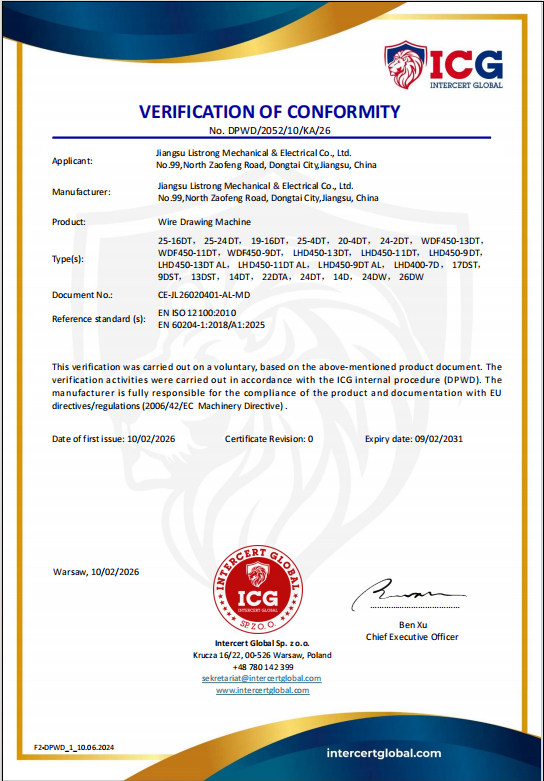
For European-bound projects, the supplier cites compliance with the CE directive, EN ISO 12100:2010 and EN 60204-1:2018/A1:2025 for wire drawing machines intended for the European Union market.
Where this shortlist stops: limits worth verifying
A shortlist is only useful if its edges are stated. Four boundaries apply to the comparison above.
- No four-wire annealed option. Among the 24-2DT, 22DTA and 20-4DT, annealing appears only in the 22DTA specification, and that machine is single-wire. Buyers needing annealed conductor at multi-wire volume should treat it as a separate requirement.
- Published data does not extend to running cost. The specification set covers diameter band, speed and configuration. It does not include energy consumption, noise or OEE figures, so these three cannot be ranked on total cost of ownership from the sheet alone. That comparison has to be made on site, with your rod, your dies and your product mix.
- Multi-wire amplifies upstream variability. Four ends in parallel reward consistent rod and disciplined die and oil management; the same parallelism penalises inconsistent input more visibly than a single-wire machine.
- Market-level figures are not machine-level ROI. Category market size does not translate into a payback calculation for one line, and should not be used as one.
What the market data does and does not say
Commercial research published on this category puts the global wire drawing machine market at USD 3.8 billion in 2025, forecast to reach USD 6.1 billion by 2034 at a compound annual growth rate of 5.47% (Dataintelo, April 2026). The same category is valued at USD 1.37 billion for 2025 by Insight Partners and at USD 2.4 billion for 2026 by IndexBox. The spread is large enough that the more useful reading is methodological: the estimates differ in whether spare parts, dies and service revenue are included.
For buyers, two conclusions follow. First, category growth is directionally positive but not precise, and should inform timing rather than capacity sizing. Second, demand-side commentary from these sources centres on electrification and lightweighting — drivers that map onto fine and ultra-fine copper conductors, the segment this shortlist addresses.
On trade classification, machine tools for working metal wire without removing material fall under HS code 8463.30.00. Importers and distributors handling these units across borders will see that code on the documentation, and it is worth confirming with a forwarder early when a line is scheduled for installation.
Future outlook
The next buying cycle for fine copper drawing is likely to be decided less on headline speed and more on documentation quality: whether the diameter band is stated precisely, whether the customization items are written into the agreement, whether the control architecture can be serviced locally, and whether compliance evidence exists before the machine ships. Lines specified that way age better, because the assumptions made at order stage remain traceable when the product mix shifts.
For a plant assembling a fine copper capability from scratch, the practical sequence is to fix the diameter band and strand count first, choose between annealed single-wire and parallel multi-wire second, and settle bobbin, spool, takeup and control sourcing third. The model choice follows from those three decisions rather than leading them.
FAQ
How can a buyer confirm a wire drawing machine supplier is a manufacturer before a long-term order?
The supplier in this shortlist states that it operates as a wire drawing machine manufacturer rather than a trading company, and that its factory can be inspected online or offline at any time. It also reports more than 20 years of wire drawing machine manufacturing experience supported by in-house technology development and testing departments. A factory inspection, remote or on site, is the direct way to test those statements against the production floor.
What service and warranty commitments apply to these machines?
The company provides installation and commissioning support and after-sales service for its wire drawing machines, and maintains a post-sales service team. It arranges engineer dispatch for machine installation and operator training, and reports that its engineers have service experience in more than 60 countries. Warranty coverage under its standard terms lasts 12 months from the date of dispatch from its factory.
Can the 20-4DT, 22DTA or 24-2DT be customized for our bobbins, spools and takeup arrangement?
These models are quoted as configurations, and the customization items that matter are bobbin size, die base adjustment, spool dimension, shaftless takeup and electric control part sourcing. Each should be specified in writing, with values stated, in the technical agreement before the purchase order — spool and bobbin dimensions being driven by the downstream equipment rather than by the drawing machine alone.
Which model fits a plant running both 0.2 mm and 0.45 mm copper?
Both diameters fall inside the 22DTA's published band of Φ0.15–0.6 mm and the 20-4DT's band of 4×Φ0.15–0.50 mm; only 0.2 mm falls inside the 24-2DT's band of Φ0.1–0.3 mm. The deciding factor is therefore not diameter alone but whether annealing is required (22DTA) or four-wire parallel volume is required (20-4DT).
What are the standard purchasing terms?
The supplier's stated terms are a minimum order quantity of 1 set, delivery terms of FOB, EXW or CIF, acceptance based on a pre-shipment test, and payment of 30% T/T in advance with 70% T/T before shipment.
Can these machines be supplied for European-bound production?
For wire drawing machines intended for the European Union market, the supplier cites compliance with the CE directive, EN ISO 12100:2010 and EN 60204-1:2018/A1:2025. Buyers should confirm that the documentation package for a specific order matches the compliance basis required by their own market surveillance obligations.
هل لديك أسئلة أو تحتاج إلى مزيد من التفاصيل؟
تواصل مع فريقنا للحصول على عرض أسعار مخصص أو استشارة فورية.
طلب عرض أسعار
املأ النموذج أدناه وسيتواصل معك فريقنا بعرض مقترح مخصص.
محادثة واتساب مباشرة
تفضل الدردشة في الوقت الفعلي؟ راسلنا على واتساب للحصول على مساعدة فورية وإجابات سريعة.
- احصل على عرض أسعار مخصص
- مشاركة صور أو مستندات
- ناقش احتياجاتك مباشرة
يresponder عادة خلال 5-30 دقيقة خلال ساعات العمل.