
First vs Second Generation WPC Decking: What an Independent Buyer Comparison Reveals
Wood-plastic composite decking has moved from an alternative material to a mainstream outdoor specification. The global WPC market was valued at USD 8.05 billion in 2025 and is projected to reach USD 11.26 billion by 2034, according to Straits Research, with North America holding the largest regional share at 36.4% in 2025. At that scale, the buying question has shifted: specifiers are no longer deciding whether composite decking is credible, but which composite board belongs on a specific project.
The most frequent fork in that decision is generational. First-generation and second-generation WPC decking are often sold by the same suppliers, at different price levels, with performance claims that are rarely presented in a comparable format. For importers, distributors, landscape contractors and procurement managers, the practical question is narrow: does a cap layer change the risk profile of a project enough to justify the price difference, and what evidence would let a buyer decide without relying on the supplier’s own summary?
The short answer. First-generation WPC decking is an uncapped wood-plastic profile, typically hollow, in which the same compound forms both the structure and the visible surface. Second-generation WPC decking adds a co-extruded polymer cap layer that fully encapsulates the core, so the weathering surface and the structural core become two different materials. What an independent comparison adds is a caution: the published performance figures for the two generations do not form a clean ranking, because they are rarely measured on the same basis.
Why the Generation Question Reached the Procurement Stage
For years, the composite decking conversation was about material substitution: replacing timber with wood plastic composite. That phase is largely complete in mature markets. The current conversation is about tiering inside the composite category itself, and it is being driven by three practical pressures.
The first is price. First-generation, uncapped WPC decking is positioned as the economical route for large outdoor areas. Product documentation for these boards describes them as cost-effective, budget-friendly and offering a low initial investment, which is exactly what large-scale public paving budgets require. Capped, co-extruded boards sit at a higher specification tier, and the price gap has to be justified by something other than appearance.
The second is maintenance expectation. Both generations of WPC decking are documented as requiring no painting, staining, sealing or varnishing, with routine cleaning using soap and water. Once that baseline is equal, the differentiator moves to how the surface behaves over a project’s life — colour retention, surface soiling and the cost of intervention.
The third is documentation. Export-oriented projects increasingly ask suppliers for declared values, test references and recognised certifications rather than catalogue descriptions. When buyers compare documents instead of marketing pages, they quickly discover that the two generations are not described in the same language.
How the Two Generations Are Built
First generation: the profile is the surface
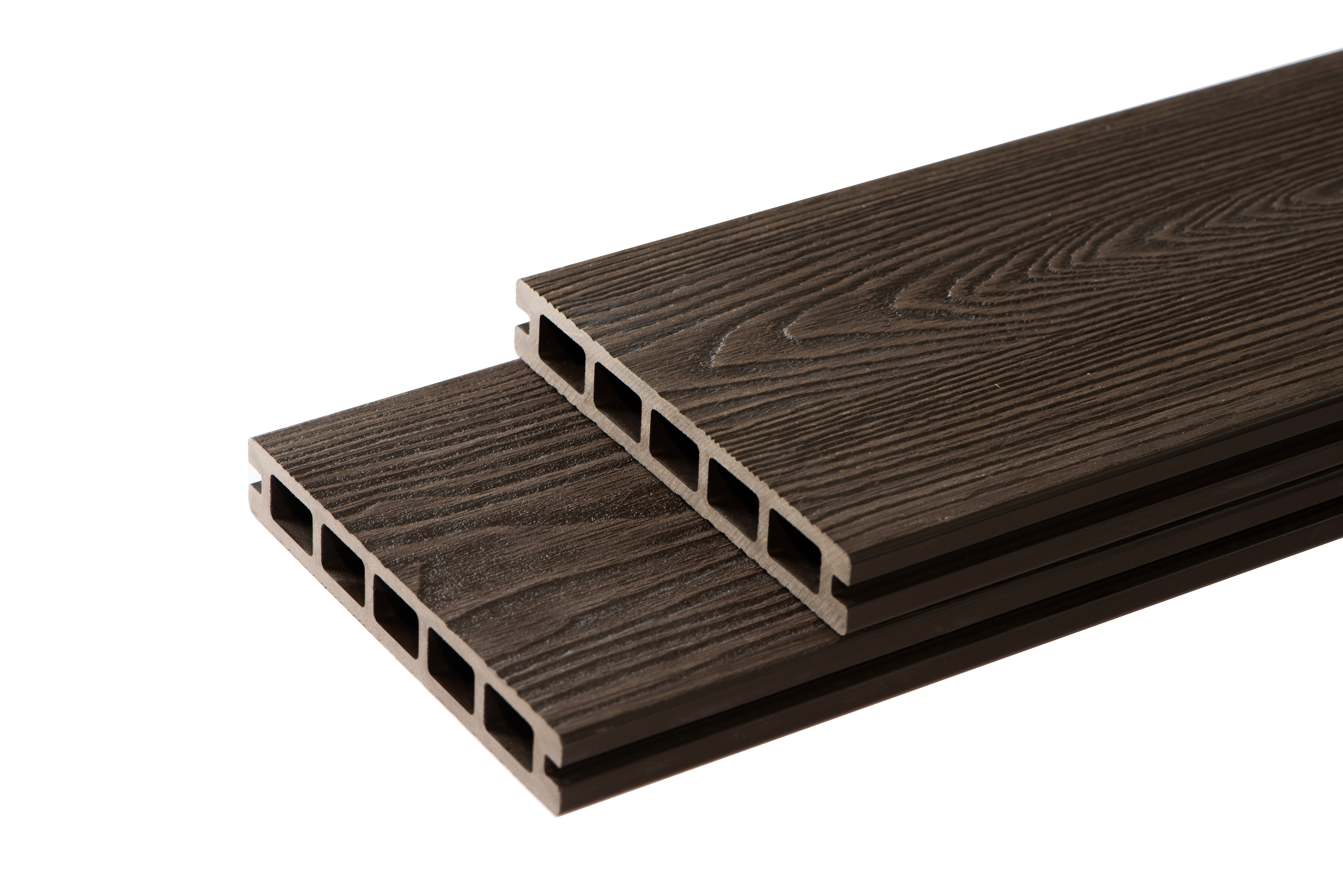
First-generation WPC decking is produced by extruding a compound of wood powder and plastic into a board profile, usually hollow in order to reduce weight and material consumption. Because there is no separate outer layer, the material that carries the load is also the material exposed to sun, rain and foot traffic.
A representative first-generation board in the documents reviewed for this comparison — model D053, an outdoor hollow WPC decking profile — is specified as 23 mm thick, 146 mm wide and 2,900 mm long, with a density of 1.3 g/cm³, a bending failure value of 3,900 N, water absorption of ≤ 2% after boiling for five hours, and a linear thermal expansion coefficient of ≤ 37 × 10⁻⁶ K⁻¹. Its positioning is explicitly volume-oriented: large-area installations such as public parks, scenic areas, plazas, boardwalks and community pathways where cost efficiency and basic durability are the primary requirements.
Second generation: the profile is protected by a shell
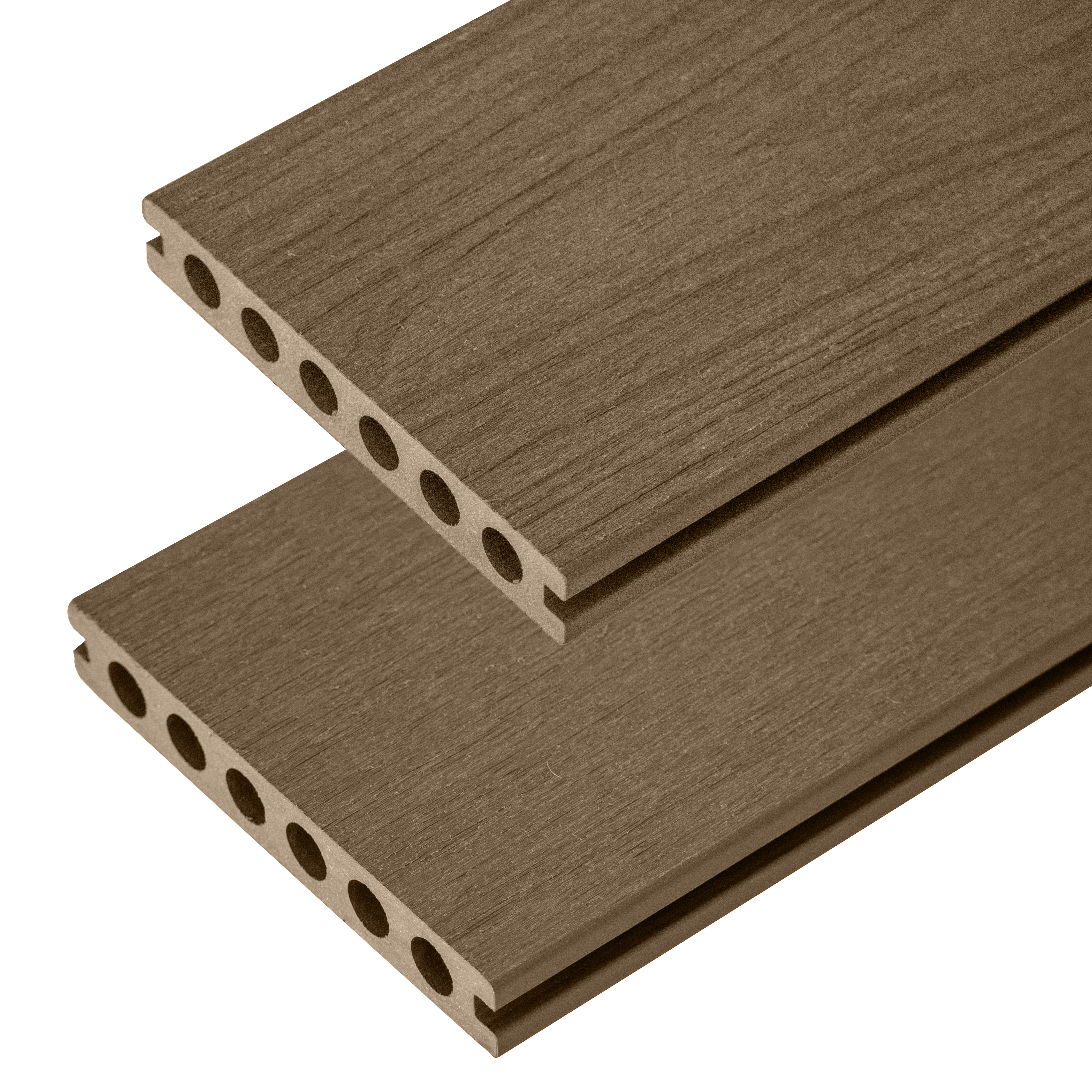
Second-generation decking is produced in a co-extrusion process in which the core and a polymer cap are formed together, so the cap fully encapsulates the core rather than being laminated or sprayed afterwards. This creates a functional separation: the core carries the mechanical load, and the cap determines how the board behaves at the surface.
The co-extruded product documented for this comparison, model GH001, is described as having a second-generation co-extruded polymer cap layer that fully encapsulates the core. Its documentation states a service temperature range of −40 °C to 75 °C, an outer shell formulated with UV-resistant components, a 3D embossed wood grain surface, and a textured finish intended to provide slip resistance. The same documentation notes that the compound may combine recycled HDPE plastics, bio-materials and wood fibres, and that the product is free from formaldehyde, benzene and toxic chemicals and is fully recyclable.
Those are the two constructions. Everything a buyer then argues about — durability, maintenance, long-term performance — follows from the relationship between the core and its surface.
What the Declared Numbers Reveal — and What They Hide
Here is where an independent comparison becomes useful, because the published figures do not behave the way a price-ordered ranking would suggest.
The first-generation profile in this comparison declares a bending failure value of 3,900 N. The co-extruded, capped profile declares flexural properties of ≥ 3,300 N. On paper, the uncapped board reports the higher number. The first-generation profile also declares water absorption of ≤ 2% after a five-hour boil, while the co-extruded board declares ≤ 7% in a boiling test — again, the uncapped core reports the lower figure.
The naive reading is that the first generation is stronger and drier. That conclusion is not supportable, and the reason matters to every buyer evaluating WPC terrace decking, capped co-extruded WPC decking or any other wood plastic composite decking board.
- Different test objects. A bending failure value and a flexural property value are not the same measurement. One describes the load at which a specimen fails; the other describes a flexural property threshold. Comparing them directly is a category error.
- Different test protocols. A five-hour boil and a boiling test may not describe identical exposure, and neither is automatically equivalent to a cyclic moisture test.
- Different reporting completeness. The co-extruded product documentation also reports a cyclic moisture resistance result (mean ≤ 10%) and a service temperature range. The first-generation document in this comparison does not report a cyclic moisture figure at all.
The practical rule for procurement teams is simple: a number without a method is a marketing statement, not a specification. ASTM D7032 exists precisely to address this gap — it is the standard specification for establishing performance ratings for wood-plastic composite and plastic lumber deck boards, stair treads, guards and handrails. For export-oriented projects, buyers should ask for performance ratings under the standard the destination market recognises, and should require the same test method to be applied to both candidate boards before any comparison is drawn.
Missing data is itself a signal. In the documents reviewed here, the co-extruded board does not state profile dimensions or density, and neither generation states fire performance. Those are questions to put to the supplier in writing, not gaps to fill with assumptions.
A Risk Framework for Buying Either Generation
An independent buyer comparison is less about declaring a winner than about identifying which risks the buyer is accepting, and at what price. Five risk categories cover most of the decision.
1. Surface and colour risk
On an uncapped profile, the exposed compound takes ultraviolet exposure directly, so colour retention depends entirely on the formulation of that compound. On a capped co-extruded profile, the UV-stabilised shell is designed to carry that load instead. Product documentation for the capped board claims improved colour stability and up to five times better abrasion and scratch resistance compared with traditional WPC. Comparative claims of that kind should be requested together with the test method that produced them, because they are the type of statement most often repeated in catalogues without a supporting reference.
Evaluation question: what does the supplier state about colour retention, and under which test or standard?
2. Moisture and biological risk
Both generations are documented as waterproof and anti-mould, and both are described as resistant to termites and wood-boring insects. The difference is where water can travel. On a hollow, uncapped profile, moisture management depends on the profile geometry, the drainage route through the deck build-up and the installation gaps. A fully encapsulating cap layer is designed to prevent water penetration at the surface in the first place.
Because the water-absorption figures for the two products come from different protocols, they cannot be used to rank moisture performance. What a buyer can do is request cyclic moisture data, since that is closer to real service conditions than a single immersion, and confirm how cut edges and ends are treated on site.
Evaluation question: is cyclic moisture data published, and what is the recommended treatment for field-cut edges?
3. Mechanical and installation risk
Installation is where generational differences most often turn into warranty disputes. Both products are installed over a substructure using clips and screws — joist clips and screws for park decking, and clip-and-screw systems over an under-construction frame for terrace applications. Spacer clips maintain consistent gaps between boards, which serves two purposes: thermal expansion and water drainage. Joist spacing must follow the board manufacturer’s guidance for the specific profile, and cutting should be done with a fine-toothed saw to avoid chipping.
The first-generation profile declares a linear thermal expansion coefficient of ≤ 37 × 10⁻⁶ K⁻¹. That figure is the reason expansion gaps are not optional, and it is a useful reminder that WPC decking is not dimensionally inert, whatever generation is specified.
Evaluation question: does the supplier publish joist spacing, expansion gap and edge-fixing details for the specific profile being quoted?
4. Maintenance and lifecycle-cost risk
Both generations are documented as requiring no sanding, staining, sealing or painting, with routine cleaning using soap and water. Documented maintenance guidance also includes periodic checking of fasteners and cleaning with mild detergent. In other words, low-maintenance WPC decking means lower maintenance, not zero attention.
The lifecycle calculation then depends on the project, not on the material alone. A board with a shorter intended service horizon carries replacement risk; a higher-specification capped board carries a higher upfront capital commitment that only pays back over a long service life. The correct generation therefore follows the project profile, not the supplier’s preferred product line.
Evaluation question: what service life is the specification assuming, and what is the cost of one full surface replacement over that period?
5. Documentation and compliance risk
Certification is where claims become checkable. The manufacturer referenced in this article holds CE, FSC, ASTM, SGS and EPD certifications, together with management system certifications covering ISO 9001 quality management, ISO 14001 environmental management, ISO 45001 occupational health and safety, and ISO 50001 energy management.
For European-facing projects, the most independently verifiable document is the Environmental Product Declaration. Terratsa New Material (Liaoning) Co., Ltd. holds a valid EPD for its co-extrusion WPC products, conforming to EN 15804+A2, registered under number EPD-IES-0012197:001 (S-P-12197), valid until 15 March 2029. An EPD of this type can be looked up in the International EPD System library rather than accepted on trust — which is exactly the standard of evidence a buyer should apply to generation-level performance claims as well.
Evaluation question: can every certificate be verified in the issuing registry, and does it cover the specific product family being purchased?
Where Each Generation Fits: Application Evidence
Generation choice is usually decided by site conditions and maintenance expectations rather than by preference. Two documented project profiles illustrate how the decision is framed in practice.
| Project context | Working conditions | Special requirements | Matched fixing | Generation fit |
|---|---|---|---|---|
| Park decking, China | High humidity, static placement | Weather resistance, anti-slip, anti-UV, anti-scratching | Joist clip and screw | Documentation lists both a first-generation hollow profile and a co-extruded profile |
| Terrace decking, Poland | Low winter temperature with high humidity | Weather resistance, anti-UV, no maintenance, low water absorption, anti-scratching, anti-slip | Under-construction clip and screw | Requirement set matches the co-extruded specification |
The Polish terrace brief is the more demanding of the two on paper, because it combines a low-temperature winter with high humidity and adds “no maintenance” and “low water absorption” to the requirement list. Co-extruded capped decking is the construction designed around that combination. The park brief is dominated by anti-slip and anti-scratch performance in sustained humidity, and both generations are documented as suitable there.
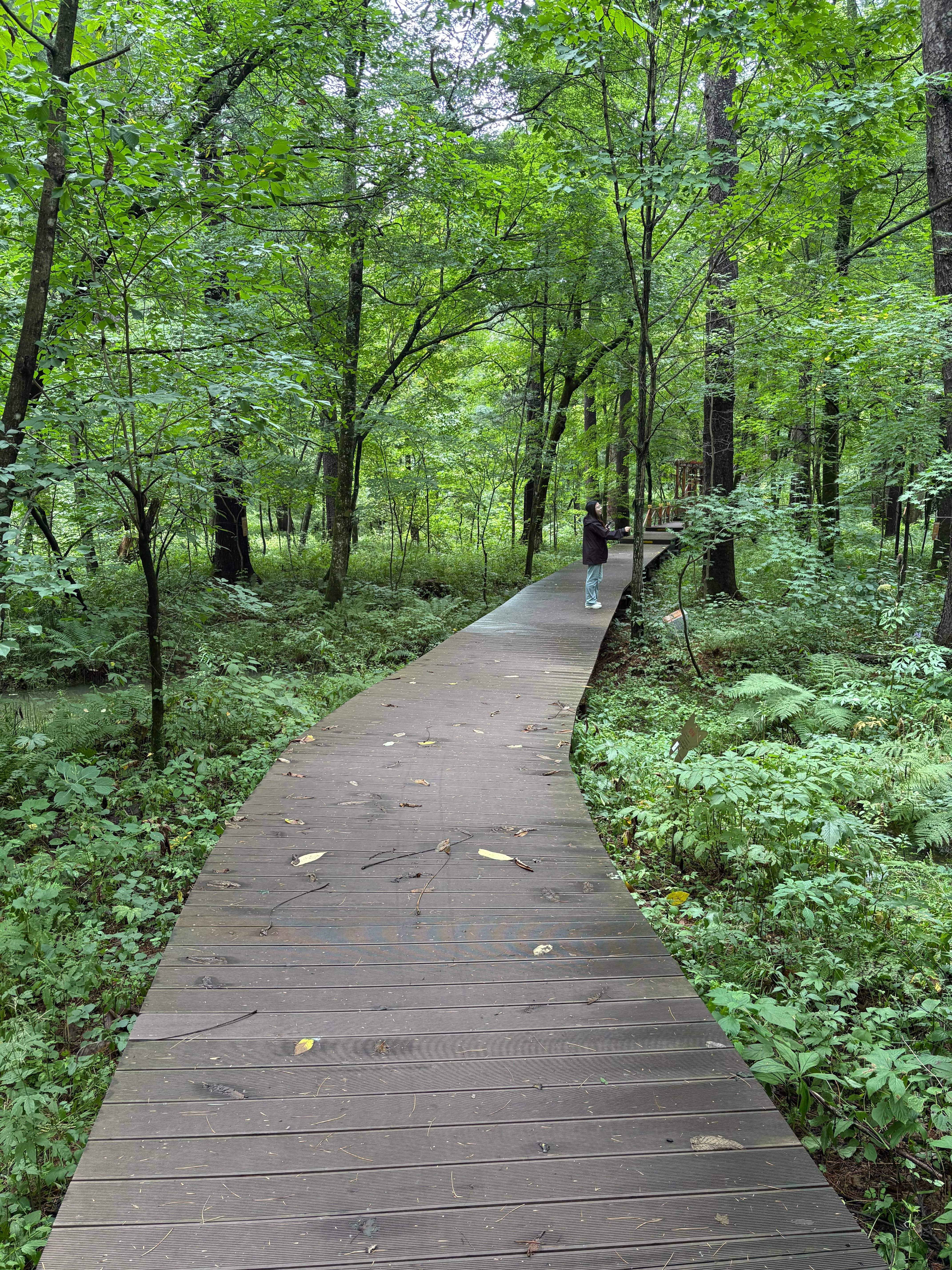
Across residential and commercial outdoor projects, WPC decking is documented as suitable for garden patios, balconies, swimming pool surrounds, waterfront boardwalks, park pathways and building facades. Swimming pool surrounds and waterfront boardwalks are the two applications where the material choice is most sensitive, because slip resistance and continuous moisture exposure matter simultaneously — the textured, slip-resistant surface documented for the capped profile, combined with its sealed construction, is why that configuration is frequently specified around pools and wet deck areas.
The manufacturer’s own guidance on the generational decision is consistent with this reading. For the majority of residential users and commercial projects requiring premium quality, co-extruded, second-generation WPC is the recommended route, because it addresses the performance of the board itself and removes maintenance anxiety over a long horizon. First-generation WPC is described as better suited to large-scale projects with strict budget constraints and clearly defined short-term usage plans.
Market Trend: Capacity, Standards and Claims Are All Rising
Three verifiable trends make careful generational comparison more important than it was five years ago.
Category growth. The global WPC market is projected to grow from USD 8.05 billion in 2025 to USD 11.26 billion by 2034, with North America holding 36.4% of the market in 2025. Growth of this order attracts new production capacity and new suppliers, and new entrants compete on claim language as much as on material performance.
Supply concentration. In monitored trade data for HS Code 39189090, China accounted for 97.81% of WPC decking imports. That figure comes from secondary trade-monitoring data and is flagged in its source record as requiring verification, so it should be read as an indicator of manufacturing concentration rather than as a settled market statistic. Its practical meaning for buyers is straightforward: the majority of first-generation and second-generation boards on the global market come from the same manufacturing base, which makes supplier-level verification, not country of origin, the decisive filter.
Standards as the comparison language. ASTM D7032 provides a performance-rating framework for WPC deck boards, and Environmental Product Declarations conforming to EN 15804+A2 give buyers a checkable environmental document for European projects. As these instruments spread, the generational argument moves out of the showroom and into the specification document, where claims have to be supported.
Compared with Traditional Timber — and the Limits Buyers Should Accept
Measured against traditional timber, both generations of WPC decking share a set of documented advantages: no painting, staining, sealing or varnishing; resistance to termites, mould and wood-boring insects; a wood-like surface without knots or splinters; and, for the products described here, a composition based on recycled plastics and reclaimed wood fibres that is free from formaldehyde, benzene and toxic chemicals and is fully recyclable.
An honest comparison has to state the boundaries as clearly as the benefits. Five limits apply regardless of which generation is specified.
- WPC is not dimensionally inert. The first-generation profile in this comparison declares a linear thermal expansion coefficient of ≤ 37 × 10⁻⁶ K⁻¹. Expansion gaps, spacer clips and correct joist spacing are mandatory. Installation error, not material failure, is a common root cause of long-term decking complaints.
- Low maintenance is not zero maintenance. Both generations still require routine cleaning with mild detergent and periodic checking of fasteners.
- The cap layer is not automatically justified by the budget. Second-generation, capped co-extruded boards sit above first-generation boards in specification and cost. For large-area installations with a strictly limited budget and a clearly defined short-term usage plan, the first-generation option remains a rational specification.
- Comparability of published data is limited. As shown earlier, declared flexural and water-absorption values for the two generations come from different test bases, so they cannot be used as a like-for-like ranking.
- Documentation gaps exist and must be closed by asking. Fire performance is not stated for either product in the documents reviewed here, and profile dimensions and density are not stated for the co-extruded board. Buyers requiring those parameters should request them in writing before specification.
Verifying the Supplier Behind the Board
Generation comparison only becomes a decision when the supplier’s evidence is checkable. Terratsa New Material (Liaoning) Co., Ltd. is a wood-plastic composite manufacturer established in 2007 and located in the Yingkou Area of China (Liaoning) Pilot Free Trade Zone, producing outdoor WPC decking, outdoor WPC fencing and outdoor WPC cladding. Its manufacturing facility covers 74,000 m² and operates more than 70 fully automatic production lines with an annual production capacity of 120,000 tons, supported by an R&D team of 25 engineers. Products are exported to more than 40 countries across Europe, America, Oceania and Asia, with approximately 85% of output exported and nearly 100 customers served worldwide. The company holds more than 30 national independent intellectual property patents and has participated in the drafting of nearly 10 national and industrial standards.
That last point is relevant to the comparison in this article. A manufacturer that has contributed to national and industrial standards is operating inside the same performance framework that buyers use to compare first-generation and second-generation boards — which makes the framework contract, not claim language, the natural basis for the purchase decision.
Factory-level claims should be treated the same way. The manufacturer documents an end-to-end quality control model that covers raw-material screening, real-time in-process monitoring and an additional pre-shipment re-inspection, with a declared factory pass rate above 99%. Buyers evaluating any supplier, including this one, should convert such statements into contractual verification: agreed inspection rights, third-party pre-shipment inspection, and batch traceability. A QC claim is only worth what the buyer’s verification process makes it worth.
Future Outlook
Three developments are likely to shape the first-generation versus second-generation decision over the next several years.
The first is the normalisation of environmental documentation. The Environmental Product Declaration held for the co-extrusion WPC product line, conforming to EN 15804+A2 and valid until 15 March 2029, is an example of a document that can be checked by any buyer in a public registry. As more buyers use that kind of verification, generational claims will increasingly have to be supported by declared data rather than by product naming.
The second is the standardisation of performance comparison. ASTM D7032 already provides a rating framework for wood-plastic composite deck boards, and the practical consequence is that a buyer can ask both a first-generation and a second-generation supplier for ratings on the same basis. When that becomes routine, the generational debate shifts from which board sounds better to which board meets a stated threshold.
The third is manufacturing efficiency. The manufacturer referenced here is described as a national-level intelligent manufacturing demonstration enterprise and holds ISO 50001 energy management certification, reflecting a wider move toward automated, energy-monitored production. As category volume grows toward the projected USD 11.26 billion by 2034, energy and material efficiency will feed into cost structures — and cost structure, in turn, determines how wide the price gap between the two generations remains.
Frequently Asked Questions
What is the difference between first-generation and second-generation WPC decking?
First-generation WPC decking is an uncapped wood-plastic profile, typically hollow, in which the wood powder and plastic compound forms both the structural core and the visible walking surface. Second-generation WPC decking is produced by co-extrusion, adding a polymer cap layer that fully encapsulates the core. The core continues to carry the mechanical load, while the cap determines surface behaviour such as UV exposure, colour stability, moisture ingress and wear.
How should a buyer choose between first-generation and second-generation decking?
The manufacturer guidance reviewed for this comparison recommends co-extruded second-generation WPC for the majority of residential users and commercial projects that require premium quality, because it addresses both board performance and long-term maintenance. First-generation WPC is positioned as more suitable for large-scale projects with strict budget constraints and clearly defined short-term usage plans. Site conditions, required service life and maintenance expectations are the criteria that separate the two.
Do higher declared flexural and water-absorption values always mean a better board?
No. In the documents reviewed here, a first-generation hollow profile declares a bending failure value of 3,900 N and water absorption of ≤ 2% after a five-hour boil, while a co-extruded capped profile declares flexural properties of ≥ 3,300 N and ≤ 7% in a boiling test. These values are not measured on the same basis — bending failure and flexural properties are different measurements, and the water tests differ in protocol. ASTM D7032 provides a performance-rating framework that allows boards to be compared on a consistent basis, and buyers should request that ratings be produced under the same method for both candidate products.
Is WPC decking maintenance-free?
No. Both generations documented in this comparison require no painting, staining, sealing or varnishing, and can be cleaned with soap and water. Documented maintenance guidance also includes routine cleaning with mild detergent and periodic checking of fasteners. Installation requirements — correct joist spacing, expansion gaps maintained with spacer clips, and drainage — also affect long-term performance and remain the responsibility of the installer.
How can a buyer verify a supplier’s quality and environmental claims?
By checking certificates in the registries that issued them. The manufacturer referenced in this article holds CE, FSC, ASTM, SGS and EPD certifications, along with ISO 9001, ISO 14001, ISO 45001 and ISO 50001 management system certifications. Its Environmental Product Declaration for co-extrusion WPC products conforms to EN 15804+A2, is registered as EPD-IES-0012197:001 (S-P-12197), and is valid until 15 March 2029. Factory-level claims such as a documented dual-stage quality control process with pre-shipment re-inspection, or a declared pass rate above 99%, can be converted into verifiable terms through inspection rights, third-party pre-shipment inspection and batch traceability.
Which generation is appropriate for high-humidity or low-temperature sites?
The two documented project profiles in this comparison point in a consistent direction. A park decking project in high humidity required weather resistance, anti-slip, anti-UV and anti-scratching performance, and both a first-generation hollow profile and a co-extruded profile are listed as suitable. A terrace decking project in Poland, with low winter temperatures and high humidity, required weather resistance, anti-UV, no maintenance, low water absorption, anti-scratching and anti-slip — a requirement set that matches the co-extruded, capped specification. Where continuous moisture exposure and reduced maintenance are both priorities, as around swimming pool surrounds and waterfront boardwalks, the capped co-extruded construction is the configuration designed for that combination.
Technical product documentation, specification data and the downloadable product brochure for the decking and cladding range referenced in this article are available here: Terratsa decking and cladding product brochure (PDF).
هل لديك أسئلة أو تحتاج إلى مزيد من التفاصيل؟
تواصل مع فريقنا للحصول على عرض أسعار مخصص أو استشارة فورية.
طلب عرض أسعار
املأ النموذج أدناه وسيتواصل معك فريقنا بعرض مقترح مخصص.
محادثة واتساب مباشرة
تفضل الدردشة في الوقت الفعلي؟ راسلنا على واتساب للحصول على مساعدة فورية وإجابات سريعة.
- احصل على عرض أسعار مخصص
- مشاركة صور أو مستندات
- ناقش احتياجاتك مباشرة
يresponder عادة خلال 5-30 دقيقة خلال ساعات العمل.