
Fit Coding to Mixed Packaging: DOCOD CIJ, TIJ, PIJ, Laser
Fit Coding to Mixed Packaging: DOCOD CIJ, TIJ, PIJ, Laser
A mixed-material packaging line does not need a single coding technology. It needs one documented decision per packaging element. When the same shift runs PET bottles, coated cartons, laminated pouches, moulded caps and cable reels, the useful question is not which printer to buy but which technology fits each surface at the required resolution, code content and line speed — and how those devices share triggers, production data and inspection.
That framing sits inside the category itself. ID Technology describes industrial coding and marking as labelling, coding and marking solutions for diverse substrates in industrial and manufacturing environments, with traceability and quality control as the purpose (ID Technology, industry landing page, accessed October 2026). Substrate variety is the normal condition of packaging work, not an exception a general-purpose machine is expected to absorb.
DOCOD Precision Group Co., Ltd. is an industrial coding, marking and inspection equipment manufacturer based in Guangzhou, China, founded in 2008, whose portfolio covers continuous inkjet (CIJ), thermal inkjet (TIJ), piezo inkjet (PIJ), drop-on-demand (DOD), thermal transfer overprint (TTO), laser marking machines and inline vision inspection. That breadth means a mixed-material line can be equipped from one supplier; it is not an argument for installing identical technology at every station.
Where the single-technology assumption breaks
Three parameters decide most of the fit, and all three appear in published specifications rather than in positioning language: working distance, documented substrate list, and the resolution-to-speed relationship.
- Working distance sets the mounting envelope. The DOCOD V2000 Series Continuous Inkjet Printer prints at a distance of 3–30 mm. The DOCOD P2000 Piezo Inkjet Printer prints at 0–5 mm, with 2–3 mm recommended. A line carrying irregular or moving packs needs the larger gap; a line with tight web control can use the shorter one.
- Substrate lists exclude as much as they include. The DOCOD 3BK702 TIJ cartridge is documented for BOPP, PVC, PP, PET, OPP, glass and stainless steel with a black solvent quick-drying ink. Laser documentation is organised by material family instead: the Venus1 UV marker lists plastics, polymers, glass, ceramics and heat-sensitive packaging, while the Venus1 CO2 model lists non-metals including rubber and cable marking.
- Resolution and throughput trade against each other. P2000 is specified at 190 m/min at 300 dpi and 95 m/min at 600 dpi. A line that standardises on 600 dpi variable data therefore has roughly half the documented throughput of the same hardware at 300 dpi.
The output of that analysis is an assignment problem. Every packaging element needs a technology with a documented reason to be present, and the realistic answer is usually two or three families cooperating on one line rather than one machine covering everything.
A working assignment for a mixed-material line
The table below converts documented parameters into a first-pass assignment. Each row still requires a sample run on the real packaging before it becomes an acceptance criterion.
| Packaging element | Documented fit | DOCOD family | Basis in published data |
|---|---|---|---|
| Filled PET or glass bottles, cans and rigid containers on food, beverage, daily chemical and pharma lines | Non-contact coding across a 3–30 mm gap; 2–16 mm character height; 1–5 lines | V2000 CIJ | 334 m/min maximum at 5 dots in one line with 0.5 mm dot spacing; IP65; SUS 304 housing |
| Coated cartons and plastic surfaces needing a dense 2D code | Solvent quick-drying ink on BOPP, PVC, PP, PET and OPP | 3BK702 TIJ cartridge | Up to 600 dpi with 300 × 300 recommended; 42 ml fill; 300 nozzles |
| Cartons, labels, coated board and gift boxes carrying variable data | 300 or 600 dpi with a wide single-head band | P2000 PIJ | 33.8 mm single-head height; 190 m/min at 300 dpi; 95 m/min at 600 dpi |
| Plastic caps, HDPE or PET bodies and glass where a permanent mark is preferred | Low-heat marking of plastics, polymers and glass | Venus1 UV laser | 355 nm; 5/10/15 W; IP43 or IP54; 110 × 110 mm standard marking area |
| Rubber, cable sheath, wood, acrylic and other non-metals | Non-metal marking where ink is unsuitable | Venus1 CO2 laser | 10.6 μm; 30/60 W; 20,000 h laser life; cable marking listed in applicable industries |
| Metal components and connectors | Permanent mark on metal | Venus1 fiber laser | Documented deployment marking metal connectors at a German electronics parts supplier |
Material names are a starting filter, not a guarantee. Surface condition, coating, curvature and product handling decide whether the same code reads with equal contrast at the start and end of a shift, which is why a substrate trial belongs in the project plan rather than the final week.
V2000 CIJ: the default for filled, sealed and fast-moving packs
The V2000 Series is the CIJ option that most mixed-material lines will use for the primary date, batch and serial code. Its documented envelope is a 60 μ nozzle, a 3 m printhead duct, a 3–30 mm printing distance, a 2–16 mm printing height, 1–5 lines of text and a maximum speed of 334 m/min measured at 5 dots in one line with 0.5 mm dot spacing. Up to 24 counters are supported.
Ink selection matters more than buyers expect, because the ink list is effectively a substrate list. The V2000 documentation names high-adhesion, high-temperature-resistant, food-grade, oil-resistant and dye inks. A chilled food pack, an oil-filled container and a glass bottle treated at high temperature are three different ink decisions on the same machine, and the food-grade option is chosen for the product contact context rather than for speed.
The hardware specification is designed for washdown-adjacent environments rather than offices: IP65 protection, SUS 304 stainless steel construction, a working range of 0–45 °C and 30–70% relative humidity, 100 W rated power on 100–240 V AC input, CE and RoHS certificates, a net weight of 18 kg and a casing of 384.50 × 315.50 × 508.64 mm. The print content list covers text, time, date, logo, shift, serial number, dynamic barcode or QR code, dynamic serial data and dynamic database entries, with barcode types spanning CODE128, EAN13, ITF-14 and VIN, and QR families including QRCode, DataMatrix, MicroQRCode and PDF417. Communication runs over USB, RS232 and a network port, with the machine documented as connectable to an enterprise MES.
The limitation to plan around is the print window. A 60 μ nozzle at a 2–16 mm height produces small-character codes; if the packaging element needs a large logo block or a wide DataMatrix, the V2000 is the wrong instrument even though its speed rating is the highest in the family. Rated maximum speed also carries conditions, and the combination of height, line count and speed on a specific SKU should be confirmed on samples rather than extrapolated from the headline figure.
3BK702: a 600 dpi consumable with an operating envelope
The DOCOD 3BK702 half-inch black solvent quick-drying cartridge is the TIJ answer for cartons and plastics where the code needs more resolution than a small-character CIJ typically provides. It is specified at up to 600 dpi, with 300 × 300 recommended, and carries 42 ml of solvent ink through 300 nozzles at a 9 V trigger voltage, a 2.2 μs trigger pulse width and a maximum frequency of 12 kHz. The cartridge housing is plastic, and the documented media are BOPP, PVC, PP, PET, OPP, glass and stainless steel.
Two practical points follow from those numbers. First, the resolution figure belongs to the cartridge, not automatically to the installed system: DOCOD's TX1 half-inch seamless printer is documented at up to 300 × 300 dpi while supporting 42 ml cartridges, so the buyer should ask which printer and cartridge pairing delivers the 600 dpi output required for a specific code, rather than treating the cartridge ceiling as a line capability.
Second, the cartridge is a consumable with a clock on it. The best-use period is six months, the working range is 15–35 °C at 35–80% relative humidity, and shipping and storage must stay within 5–40 °C at 20–80% relative humidity. A line running in a cold room, an unheated warehouse or a high-humidity filling hall is outside that window and will show inconsistent output that has nothing to do with the printer. Printhead care is documented as gentle cleaning with a dust-free cloth or a cloth containing IPA-ethanol above 98%, waterless — a specification worth building into the operator routine before the first shift.
One documented deployment illustrates the intended use without proving a general result: a regional distributor in South Korea printing on plastic film and coated cartons at 50 cartridges per month over one year reported fewer smudging complaints, with fast drying and strong adhesion recorded as the highlight. That is a single project outcome on specific substrates, not a performance promise for other materials.
P2000: high-resolution variable data with a mounting cost
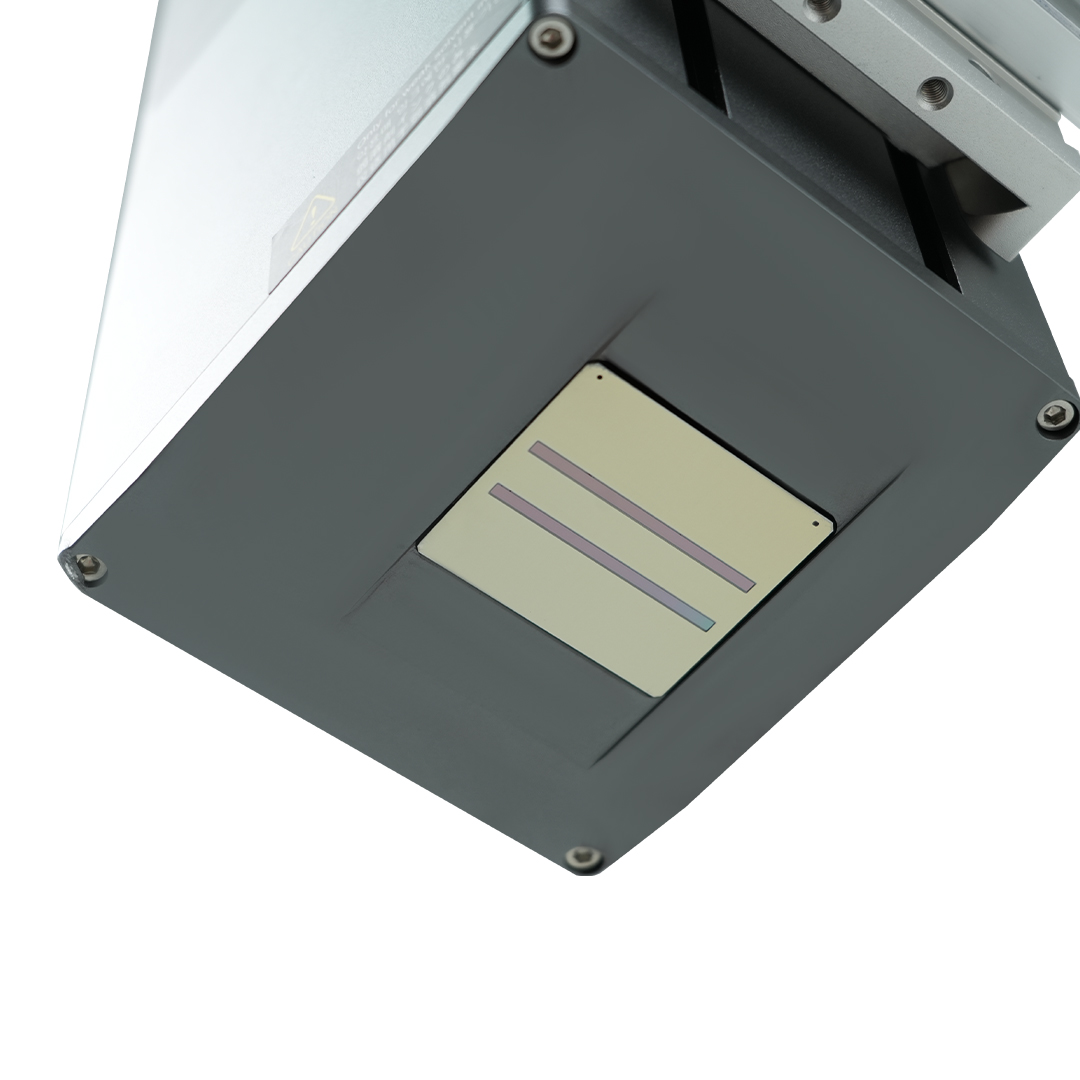
Where the packaging carries a 2D code plus human-readable text and a variable database field, the P2000 is the natural PIJ candidate. It uses I1600 series nozzles in single-head or dual-head configuration, prints at 300 or 600 dpi, reaches a maximum single-head height of 33.8 mm, and runs at 190 m/min at 300 dpi or 95 m/min at 600 dpi. Water-based and quick-drying inks are documented, printing direction covers forward and lateral, and the ink system is negative-pressure continuous supply.
The mounting constraint is the price of that resolution. Printing distance is 0–5 mm with 2–3 mm recommended, which is a far tighter installation than the 3–30 mm window of a CIJ head. On a line with web flutter, product bounce or a long unsupported span, reaching 600 dpi depends on fixturing as much as on the printhead. The documented anti-collision nozzle mounting is relevant here: the head sits close to the product, so a mechanical guard is part of the design rather than an accessory.
The P2000 also supports cascading, where multiple devices share one set of encoder or photocell parameters. On a multi-lane line or a wide carton panel, that changes the station count and the wiring plan. Documented print content covers text, time, date, pattern, shift, serial number, dynamic barcode or QR code, dynamic serial port data and dynamic database entries; materials span carton, plastic, metal, plate, pipe, stone, cables, glass, electronic components, auto parts, industrial chemical packaging, pharmaceutical packaging and food gift packaging. Control is a 10.1-inch colour capacitive touch screen on an embedded Linux system, with USB, RS232 and TCP/IP interfaces, aviation-grade aluminium construction, power draw below 150 W, a 0–45 °C / 30–70% RH working range and CE certification.
A personal care manufacturer in Thailand running three lines for variable data on coated boxes documented improved traceability consistency over one year, with high-resolution code printing as the highlight. The transferable lesson is narrower than the case: coated board is a PIJ application, and the resolution requirement — not the brand — is what selected it.
Laser: permanent marks where the substrate allows
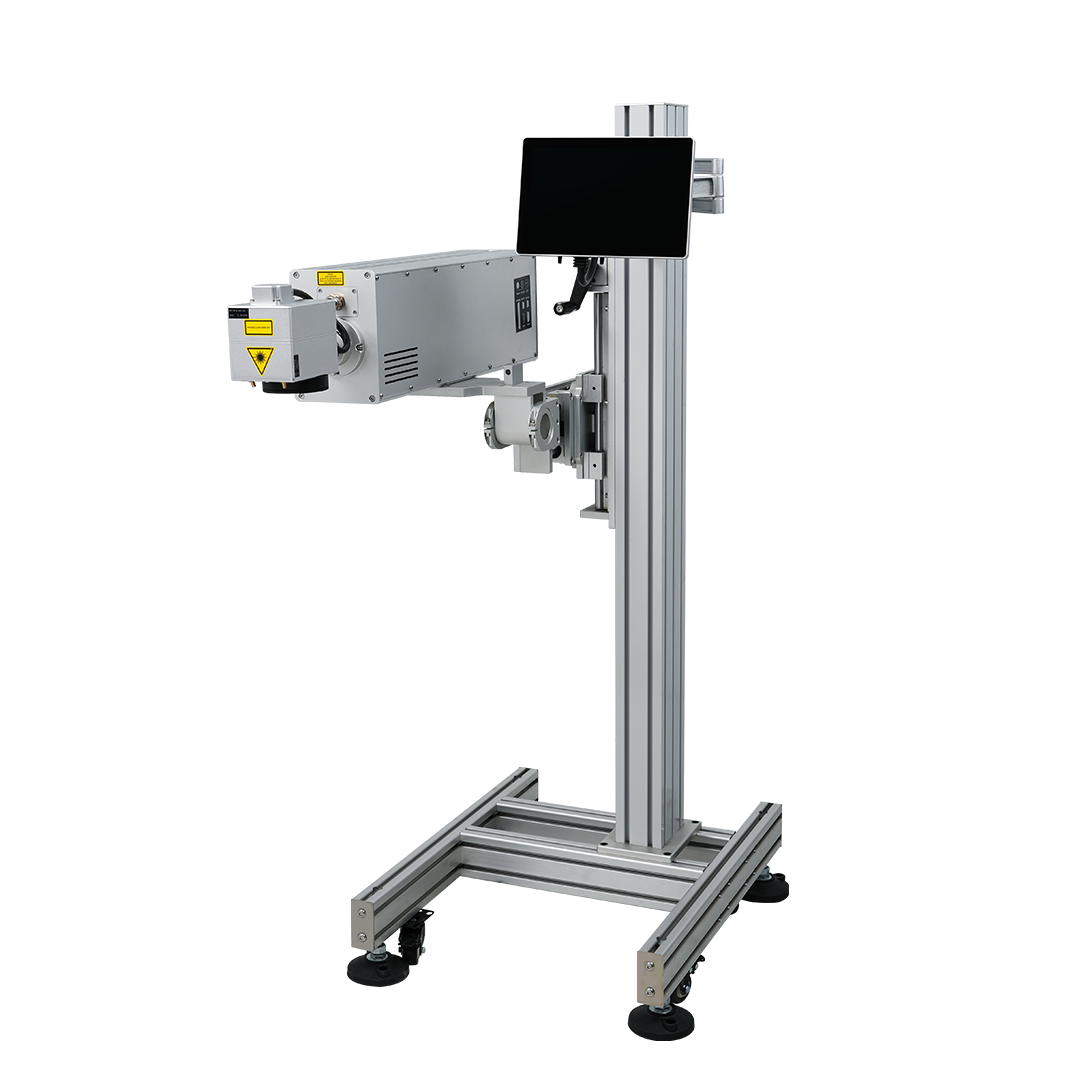
Laser enters a mixed-material line for one reason: permanence. Where a mark must survive abrasion, solvent wipe or the life of a cable, ink is the weaker option and the decision moves to which laser wavelength suits the material.
The Venus1 UV laser marker operates at 355 nm with 5 W, 10 W or 15 W output, air or water cooling, IP43 or IP54 protection, a standard 110 × 110 mm marking area with 70–300 mm optional, character heights from 0.6 mm to the maximum marking area, and a documented laser lifespan of two to three years under normal use. Its applicable industries include plastics, polymers, glass, ceramics, printed circuit boards, medical devices, food and pharmaceutical packaging, PET bags, metal caps and cosmetics packaging — the low-heat, damage-minimised marking profile is why coated and heat-sensitive packaging appears in that list. Supported code types include QRCode, DataMatrix, MicroQRCode and PDF417.
The Venus1 CO2 laser marking machine runs at 10.6 μm, with 10.2 μm and 9.3 μm options, at 30 W or 60 W, IP43 or IP54, the same 110 × 110 mm standard area with 70–300 mm optional, a documented 20,000-hour laser life and barcode support covering EAN8, EAN13, CODE39, CODE128 and GS1-128. Non-metal industries dominate its list: plastics, packaging and printing, rubber, food packaging, wood products, acrylic, medical packaging, kraft board, glass product marking and cable marking.
Metal is handled by the fiber laser in the same series. A German electronics parts supplier running two workstations for permanent marking on metal connectors documented durable readable marks across a three-year project — the substrate, not a preference for laser over ink, drove the choice.
Verified fit boundary: the article topic covers laser options for metals, pipes, stones, wires and cables, but the supplied documentation is not uniform across those surfaces. Cable appears explicitly in the CO2 laser's applicable industries and in the wire, cable and pipe extrusion scenario, where CIJ and CO2 laser are named as matched equipment; metals are supported by the fiber laser deployment record. Pipe and stone appear in the V2000 and P2000 printing-material lists rather than in the laser material lists, and laser marking speed is documented as dependent on substrate material, marking content size and complexity, so no fixed laser throughput can be quoted. Any laser marking on pipe, stone or a new compound should be proven on samples first.
Print content is the second axis of fit
Two lines with identical packaging can still need different hardware because the code content differs. A date and batch number is a different requirement from a serialised 2D code carrying a variable database record, and the specification sheets separate them.
- Dates, shifts and counters: covered by V2000 and P2000 through date, time, shift and counter fields, and by the laser controllers through their marking software.
- Serial numbers and variable databases: V2000 documents dynamic serial data and dynamic database printing with a network port and MES connection; P2000 documents dynamic serial port data and dynamic database printing with USB, RS232 and TCP/IP.
- 2D and GS1-relevant codes: V2000 lists QRCode, DataMatrix, MicroQRCode and PDF417; P2000 lists dynamic barcode and QR code printing; the UV laser lists QRCode, DataMatrix and PDF417; the CO2 laser lists GS1-128 among its barcode set.
This is where the calendar becomes a procurement factor. GS1 Digital Link sets a Sunrise 2027 transition date of 31 December 2027 for the retail move from 1D barcodes to 2D QR codes, under a standard recorded as applying across global jurisdictions covering more than 48 countries (GS1, GS1 Digital Link standard page, published January 2026). A line commissioned in 2026 with date-only capability is a line that may need retrofitting before the deadline, which argues for specifying 2D code capability at the point of purchase rather than as an upgrade.
XC20, XF30 and the parts of line fit that are not the printhead
Two accessories sit at the edge of the coding decision and often decide whether the code is readable in practice.
The DOCOD XC20 Mini Conveyor Belt is documented in a small-batch food application in the UAE, where a producer ran one bench line conveying pouches for online coding and reported a smoother semi-automatic workflow after a year, with the compact conveyor for fine products recorded as the highlight. The equipment logic is straightforward: a code needs a stable presentation, and a compact conveyor creates repeatable pitch where a manual bench does not.
The DOCOD XF30 Vertical Rewinding Machine appears in a Brazilian label converter's operation, where one station handled label secondary rewinding and coding for two years, reporting smoother short-run relabelling and suitability for roll-label rework. For a mixed-material plant that prints labels in short runs, rewinding and coding in one pass changes the workflow rather than the code itself.
The surrounding integration work is a documented service line rather than an assumption: conveyor, pager and rewinder matching, encoder and sensor connection, and GS1, DataMatrix and serialisation workflow matching, with a one-line minimum order quantity, a 20–35 working-day lead time, integration testing, a sample run and video acceptance before delivery, followed by installation guidance, remote tuning and fault diagnosis. For a mixed-technology station, that sequence matters more than the hardware list, because the failure mode is rarely a printer that cannot print — it is a printer that receives the wrong trigger.
Both accessory cases are single documented deployments from specific projects. They show intended application, not a guaranteed outcome for another plant.
Six checks before accepting a mixed-technology line
- Print the real packaging, not a substitute. Substrate lists name material families; they do not capture coating weight, recycled content or surface contamination. A trial on the actual bottle, carton or cable sheath is the only meaningful adhesion and contrast test.
- Fix the resolution before fixing the speed. Ask for the throughput at the resolution the code requires. P2000 at 600 dpi is documented at 95 m/min; at 300 dpi it is 190 m/min. A line specified on the wrong figure will be accepted and then de-rated.
- Confirm the mounting distance against the machine frame. CIJ needs 3–30 mm; PIJ needs 0–5 mm with 2–3 mm recommended. The bracket, guard and product-handling tolerances must all fit inside that window.
- Check the environment against the equipment rating. V2000 is IP65 and rated 0–45 °C at 30–70% RH; lasers are IP43 or IP54; the 3BK702 cartridge works within 15–35 °C at 35–80% RH and stores within 5–40 °C at 20–80% RH. A washdown hall and a cold store are not the same installation.
- Map the data path end to end. Decide which device holds the variable database, how the MES or ERP record reaches it, and whether cascaded heads share encoder and photocell signals. Multi-technology lines fail at the handoff between devices more often than inside them.
- Agree the acceptance evidence in advance. A sample run, an integration test and video acceptance before delivery are documented parts of DOCOD's line integration support; code inspection through an inline vision system belongs in the same acceptance plan if the code is customer-facing or regulated.
What the market data does and does not support
The category context is reasonably well measured at the aggregate level and poorly measured at the segment level. Fortune Business Insights puts the global coding and marking equipment market at USD 7.51 billion in 2025 (published September 2026), and reports inkjet — CIJ, TIJ and PIJ combined — at 40.1% of the technology segment. That supports a straightforward reading: inkjet is not a niche choice inside coding and marking, which is consistent with a mixed-material line using more than one inkjet family.
The published forecasts are a different matter. Commercial research sources covering overlapping but not identical scopes report materially different market sizes and growth rates, with different base years and unverified methodology in the available summaries. They should not be averaged or combined, and no single forecast figure should be used as the basis of a capital plan. Directional agreement — a growing category — is defensible; a precise growth number is not, on this evidence.
Outlook: 2D readiness and line-level data
The next decision point for mixed-material lines is already dated. With GS1 Digital Link's 31 December 2027 transition date in view, a line specified today should be able to print a 2D code and a human-readable equivalent at production speed, and should be able to prove the code reads. That condition favours combinations rather than single machines: CIJ for the fast, forgiving date and batch mark on filled packs, PIJ or TIJ where 600 dpi and a wide code block are required, and laser where permanence outweighs flexibility.
A reasonable expectation, conditional on the specific substrates and codes being proven on samples, is that the equipment list will be settled first and the data architecture second — and that the data architecture will be the harder half. The assignment table is the deliverable that keeps both halves honest.
FAQ
Can CIJ, TIJ, PIJ and laser equipment operate on the same mixed-material line?
Yes, provided each device is assigned to a packaging element it is documented to handle, and provided the station design accounts for the different working distances. The V2000 CIJ runs at 3–30 mm and covers cartons, plastics, metal, glass, pipe and cable-type surfaces with 2–16 mm character heights; the P2000 PIJ runs at 0–5 mm for higher-resolution variable data; laser units mark plastics, glass, rubber and metals depending on wavelength. DOCOD documents encoder and sensor connection, conveyor and rewinder matching, and GS1 or DataMatrix workflow matching as integration support, which is what allows several technologies to share one line trigger and one production record.
Which DOCOD technology is appropriate for 2D codes on coated cartons?
It depends on the resolution and speed pair the code demands. The P2000 PIJ prints dynamic barcode and QR content at 300 or 600 dpi, with 600 dpi documented at 95 m/min and a 33.8 mm single-head height; the 3BK702 TIJ cartridge is specified up to 600 dpi with 300 × 300 recommended on BOPP, PVC, PP, PET and OPP; the V2000 CIJ supports QRCode, DataMatrix, MicroQRCode and PDF417 printing with a maximum of 334 m/min at stated dot conditions but a smaller 2–16 mm character height. Coated board carrying a dense code plus readable text usually points to PIJ, while a small date, batch or code on a fast bottle line points to CIJ.
What mounting and distance limits affect line fit most?
Working distance and printhead geometry. V2000 CIJ is specified at a 3–30 mm printing distance with a 3 m printhead duct; P2000 PIJ is specified at 0–5 mm with 2–3 mm recommended and an anti-collision nozzle mounting; the Venus1 laser series offers a standard 110 × 110 mm marking area with 70–300 mm optional, which sets the reach rather than a gap. Lines with unstable product presentation will struggle at the short PIJ distance regardless of printhead quality, so fixturing is part of the specification.
Is laser marking suitable for pipes, stone, wire and cable?
The evidence is not uniform. Cable marking is explicitly listed among the CO2 laser's applicable industries, and the wire, cable and pipe extrusion scenario names CIJ and CO2 laser as matched equipment; metal marking is supported by a documented fiber laser deployment on metal connectors. Pipe and stone appear in the V2000 and P2000 printing-material lists rather than the laser lists, and laser marking speed is documented as dependent on substrate material, content size and complexity. Laser marking on pipe, stone or an unfamiliar compound should therefore be proven on samples before it is written into a line specification.
What should be verified before accepting a mixed-technology coding line?
Substrate trials on the actual packaging, throughput measured at the resolution the code requires, mounting distances checked against the machine frame, environmental ratings compared with the hall conditions, and a mapped data path from database to printhead. DOCOD's documented integration process adds integration testing, a sample run and video acceptance before delivery, plus installation guidance and remote tuning afterwards. Consumable logistics also belong in acceptance: the 3BK702 cartridge carries a six-month best-use period and a defined storage range, so rotation policy affects output as much as printer settings do.
The DOCOD corporate brochure, including the product portfolio and capability overview, is available for download here: DOCOD Corporate Brochure (PDF).
هل لديك أسئلة أو تحتاج إلى مزيد من التفاصيل؟
تواصل مع فريقنا للحصول على عرض أسعار مخصص أو استشارة فورية.
طلب عرض أسعار
املأ النموذج أدناه وسيتواصل معك فريقنا بعرض مقترح مخصص.
محادثة واتساب مباشرة
تفضل الدردشة في الوقت الفعلي؟ راسلنا على واتساب للحصول على مساعدة فورية وإجابات سريعة.
- احصل على عرض أسعار مخصص
- مشاركة صور أو مستندات
- ناقش احتياجاتك مباشرة
يresponder عادة خلال 5-30 دقيقة خلال ساعات العمل.