
Fitting an AI Development Platform to Hotel and Retail Ops
Industry Reference — AI Platform Fit for Hospitality and Retail Operations
Fitting an AI Development Platform to Hotel and Retail Ops
Scenario-level requirements in smart hotels and multi-site retail, mapped against platform components, supporting evidence and operating boundaries.
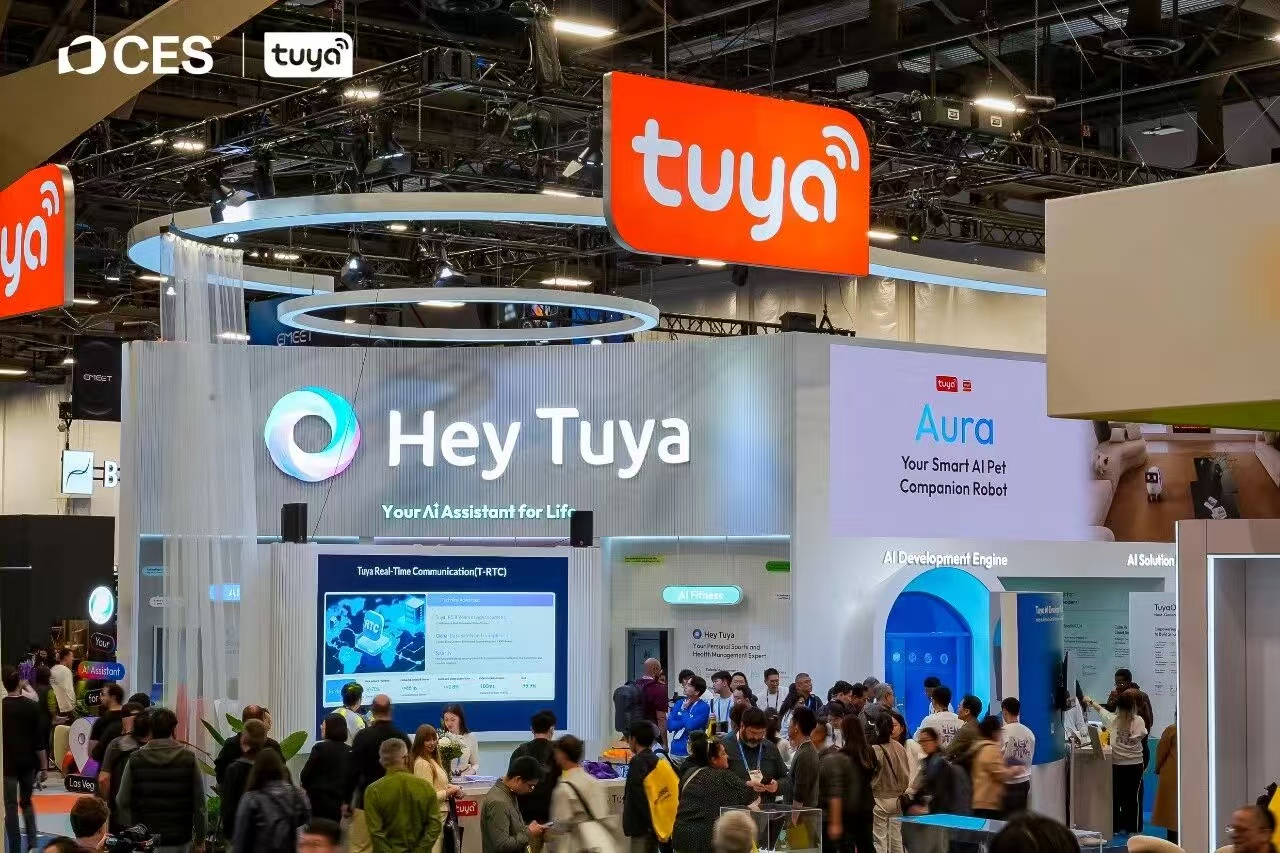
A smart hotel and a multi-site retail chain rarely fail at AI because a model is unavailable. They stall where the model has to meet a device, a room, an aisle, a shift roster and a data residency rule at the same time. That is why scenario fit — not benchmark performance — is the variable that decides whether an AI development platform earns a place in a hospitality or retail operating plan.
This reference examines two concrete scenarios — smart hotel operations and smart retail with remote store monitoring — and maps each one against the components of the Tuya AI Developer Platform: multimodal integration, knowledge base linking, visual workflow orchestration, model management, and edge or cloud deployment.
Where AI Projects Stall Before the Model Stage
The AIoT industry faces a consistent set of barriers when AI is integrated with physical devices: cross-vendor interoperability, time-to-mass-production, data privacy and compliance, localized deployment, and aligning AI models to industry data. These barriers surface as ordinary engineering work — firmware, module integration, app panels, cloud services, model integration and compliance — that must be completed before any AI feature reaches a guest or a shopper.
The business impact is measured in schedule rather than in model quality: longer time-to-market, increased development and maintenance costs, reduced user experience and product competitiveness, and slower global expansion. For a hotel, a failed integration is guest-visible at the front desk and in the room. For a retail chain, the same integration defect is repeated across every store in the fleet.
Two operating characteristics separate these verticals from a single-site building project: the number of physical endpoints, and the expectation that the same service level holds across every property or store. Both push the evaluation away from raw model capability and toward delivery structure — who integrates the hardware, who hosts the model, who maintains the workflow, and who carries compliance.
The buyer group reflects that structure. Platform-level decisions in this segment typically involve the CTO, CEO, product managers, R&D leads, procurement and supply chain leads, IT and operations leads, and business or operations leads — which is why scenario fit tends to be assessed as an operating question rather than a technical demonstration.
What the Tuya AI Developer Platform Supplies
Tuya Smart, formally Tuya Inc. (NYSE: TUYA; HKEX: 2391), is a global AI cloud platform service provider headquartered in Hangzhou, China, founded in 2014. The company reports more than 1,400 employees worldwide, including 980+ R&D engineers, and an export ratio of 85% across global markets. Its Tuya AI Developer Platform combines Platform-as-a-Service, SaaS capabilities, developer tools and private deployment options, and is positioned for brands, OEMs, solution providers and system integrators, developers, and industry enterprises including chain retailers, property, energy and industrial companies.
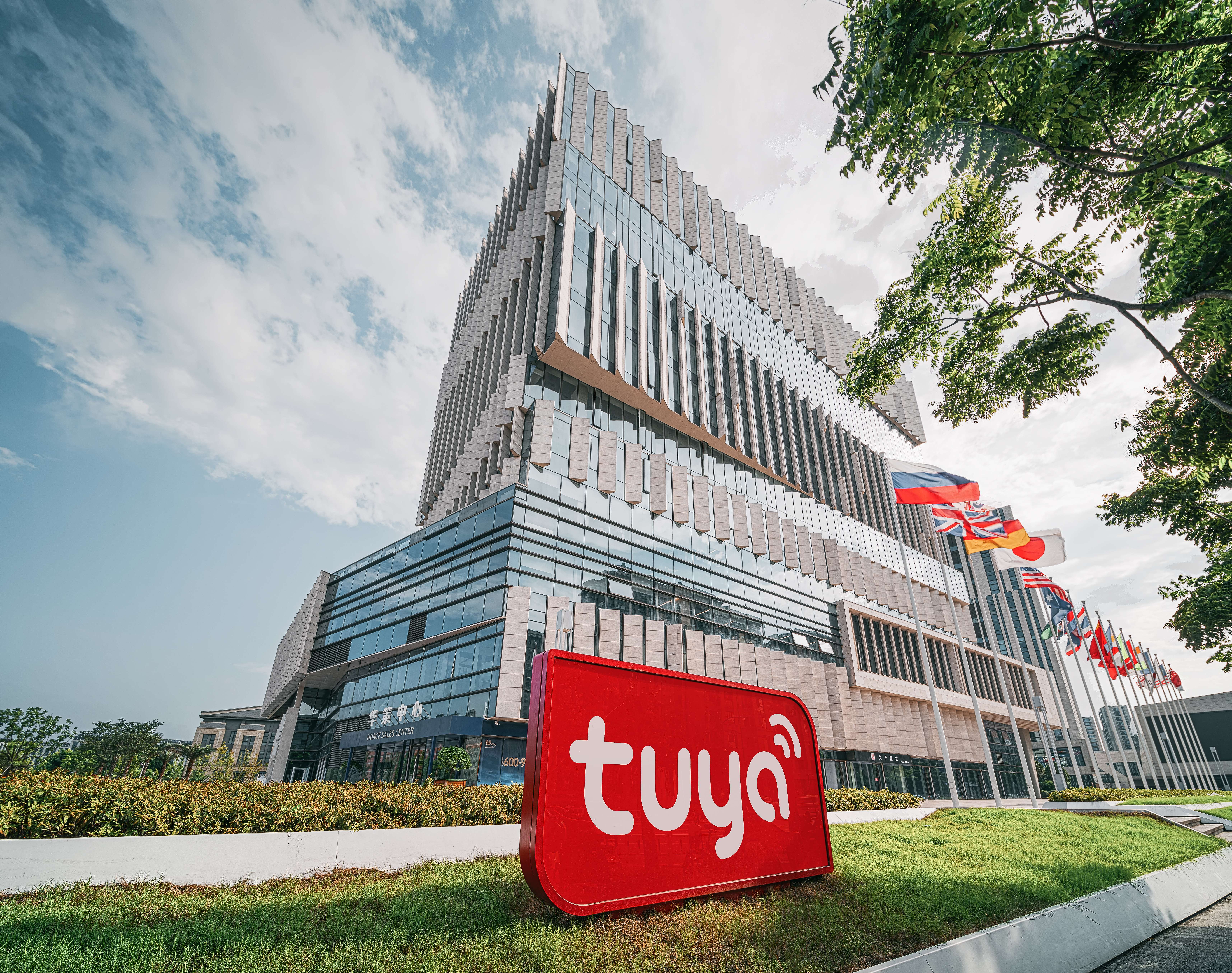
The platform's stated features are LLM-agnostic support, multimodal integration, visual workflows, a knowledge base with online and local data linking, model evaluation and management, and one-click deployment to edge or cloud. Implementation runs through API or SDK integration, Cobuilder automated prototype generation, marketplace or custom model deployment, optional private containerized deployment (Cube) and edge capabilities, with low-code workflows for customization.
Deliverables are structured around production rather than demonstration: a product prototype including panel and UI, firmware code and binaries, an App or OEM App, AI agents and workflows, cloud deployment documentation and runtime, test and certification reports, and operations and data dashboards. Cloud delivery can run on major public clouds — AWS, Azure, Google Cloud, Oracle and Tencent Cloud — or in Cube private cloud containers, and the platform supports 17 mainstream global languages.
Platform scale is cited at 1,970,000+ registered developers across more than 200 countries and regions as of March 31, 2026, with 5,800+ enabled customers and 3,000+ product SKUs. Security and AI governance credentials include ISO/IEC 27001, ISO/IEC 27017, ISO/IEC 42001 for AI management, and PSA Certified Level 1 for its IoT modules. Underlying delivery capability is described as ten years of experience across smart home, building, hotel, retail, energy, industry and campus projects, with clients ranging from startups to Global 500 companies.
Four Components That Decide Scenario Fit
Feature lists are not scenario fit. For hotel and retail operators, four components determine whether a platform can be run in production rather than only demonstrated.
1. Multimodal integration
Guest requests arrive as speech; store conditions arrive as video and telemetry. Multimodal integration is the component that allows one application layer to consume both, which is the precondition for the voice assistants listed in the platform's scenario set and for visual detection in retail environments.
2. A knowledge base with online and local data linking
The knowledge base links online and locally hosted data. For a property, that is the difference between generic assistant answers and answers grounded in the site's own information. For a chain operating under data residency constraints, local linking is what allows the knowledge layer to remain on premises while the application layer stays centrally managed.
3. Visual workflow orchestration
Workflow orchestration, presented visually, lets operations teams change a service flow — who is notified, what escalates, what is logged — without rebuilding firmware or issuing a new app release. In hotel and retail environments, where procedures change faster than hardware, this component largely determines the platform's operating cost over its service life.
4. LLM-agnostic model management and one-click deployment
Model support is LLM-agnostic, and the platform includes a model marketplace, model evaluation and management, and prompt optimization. Deployment is described as one-click to edge or cloud. Together these properties allow a team to select a model per market, validate it, and place it where it needs to run — at the edge for latency or residency, in the cloud for heavier analysis — without re-architecting the application.
Scenario One: Smart Hotel Operations
Smart hotel and building assistants and operations are named application scenarios for the Tuya AI Developer Platform, alongside smart home voice assistants, intelligent security detection, energy optimization and AIHEMS, predictive maintenance, and smart retail and remote store monitoring. A hotel deployment typically splits into three requirement groups.
Guest-facing assistance
Voice-first interaction in rooms and public areas requires two components to work together: multimodal integration to handle spoken input alongside device state, and a knowledge base that reflects the property's own information. The operational effect is that routine requests can be handled without adding front-desk load. The boundary is straightforward: answer quality scales with the property data that is actually linked, not with the model alone.
Energy and building operations
Energy optimization and AIHEMS are listed platform scenarios, and hotels carry continuous loads across HVAC, lighting and hot water. Data integration, model management, workflow orchestration and edge deployment allow control and analysis logic to run on site or centrally. No savings figure is asserted here, because energy outcomes depend on which loads are metered and how far control authority extends — variables set by the property, not by the platform.
Service escalation and multi-property consistency
Visual workflow orchestration carries service procedures, and Cube private containerized deployment supports environments where guest data must remain inside a controlled deployment. For groups operating several properties, the same logic can be extended across sites through a shared application layer rather than per-site custom builds.
| Hotel requirement | Platform component | Operational implication |
|---|---|---|
| Guest voice assistance | Multimodal integration; LLM-agnostic model support | One assistant layer can be pointed at different models per property or market |
| Property-specific answers | Knowledge base with online and local data linking | Responses reflect the site's own information; local data can stay local |
| Service escalation and procedures | Visual workflow orchestration; low-code customization | Operations teams adjust flows without firmware or app re-release |
| Energy optimization and AIHEMS | Data integration; model management; one-click edge or cloud deployment | Control and analysis logic can run on site or centrally, depending on site instrumentation |
| Guest data handling | Cube private containerized deployment; ISO/IEC 27001, 27017, 42001 | Deployment can be kept inside a controlled environment rather than on shared infrastructure |
Scenario Two: Smart Retail and Remote Store Monitoring
Smart retail and remote store monitoring places a different load on the same platform: many sites, thin local IT, and a requirement to compare conditions across a fleet rather than optimize a single location. Three requirement groups dominate.
Fleet-wide remote monitoring
Per-store edge deployment combined with one-click deployment to edge or cloud allows monitoring logic to be placed at each site while models are evaluated and managed centrally. Data integration, visualization and operations dashboards provide the central view. Low-code workflows cover the site-level variation that inevitably exists across a chain.
Detection and equipment maintenance
Intelligent security detection and predictive maintenance both depend on multimodal integration, since visual and telemetry streams have to be interpreted together, and on model evaluation and management so detection models can be updated without replacing hardware. The boundary is physical: detection performance depends on camera and sensor coverage and on site conditions, which the platform does not supply.
Chain-level data governance and rollout speed
Cube private containerized deployment, alongside public cloud options and the platform's coverage across more than 200 countries and regions, allows deployment topology to follow regional rules. On the delivery side, Cobuilder automated prototype generation and low-code workflows compress the front end of a project; the platform cites examples of 3 days for App UI customization and 15 days to mass production, dependent on project complexity.
| Retail requirement | Platform component | Operational implication |
|---|---|---|
| Fleet-wide visibility | One-click edge or cloud deployment; data integration; visualization | Consistent monitoring logic deployed across sites through a single deployment action rather than per-site builds |
| Remote store monitoring | Edge capabilities; optional Cube private containerized deployment | Video and telemetry can be processed locally, with only required data leaving the site |
| Intelligent security detection | Multimodal integration; model marketplace and management | Detection models can be swapped or updated per market without hardware change |
| Predictive maintenance | Model evaluation and management; knowledge base | Maintenance logic and thresholds can be revised as operating data accumulates |
| Multi-region rollout | Public cloud options plus Cube private cloud; 200+ countries and regions coverage | Deployment topology can follow regional and data residency requirements |
| Fast site onboarding | Cobuilder automated prototype generation; low-code workflows | Prototype-to-pilot cycles shorten; cited examples are 3 days for App UI customization and 15 days to mass production, depending on complexity |
Market Trend Analysis
The spending environment supports both scenarios, but the shape of that spending matters more than the headline figure. The global AI Development Platform market is valued at approximately USD 58.2B in 2025 and is projected to reach USD 156.7B by 2034, according to Dataintelo. The global AIoT market is estimated at USD 25.44B in 2025 with a forecast of USD 81.04B by 2030, according to MarketsandMarkets.
Those AIoT figures should be read as directional rather than precise. Estimates diverge because of definitional differences — whether software and hardware are counted together, and which verticals are included. Market Research Future, for example, places the AI-in-IoT market at USD 13.64B, well below the MarketsandMarkets estimate. The direction of travel is consistent; the absolute numbers are definition-sensitive.
The enterprise segment shows a similar pattern. The Enterprise Generative AI market is expected to grow at a CAGR of 38.4% between 2025 and 2030, reaching USD 19.8B by 2030, according to Grand View Research. Growth at that rate is concentrated in deployment and integration activity rather than in further model experimentation.
Supply-side signals point the same way. Tuya Inc. reported total revenue of USD 298.6M for fiscal year 2024, a 29.8% increase year over year, driven largely by its IoT PaaS and smart solution segments, per its SEC filing. On the adoption side, third-party reporting from Bamboo Works indicates that by the end of June 2025, approximately 93% of products deployed via Tuya's platform were equipped with AI capabilities — a figure best treated as indicative rather than audited.
For hotel and retail buyers, the implication is that AI features are becoming a default property of shipped devices rather than a premium add-on. When that happens, differentiation shifts from whether AI can be added to whether it can be operated across sites, under local rules, without a rebuild each time the model or the market changes.
Comparison: Platform Delivery Against Alternative Models
Platform delivery is one of several routes to a hotel or retail AI deployment, and each route has documented constraints. The comparison below reflects known limitations of alternative structures rather than a claim of superiority in every case.
| Delivery model | Typical strength | Documented limitation | Where it tends to fit |
|---|---|---|---|
| Independent cloud vendor | Strong general cloud AI and compute services | Lacks underlying hardware adaptation and edge AI model capability | Cloud-centric analytics with no device-level AI requirement |
| Chip manufacturer SDK | Deep silicon-level control and optimization | Provides hardware SDK only, without cloud service and cross-border compliance support | Teams with in-house cloud and compliance capability |
| Regional integrator | Local delivery, relationships and on-site presence | No global data center layout | Single-market deployments without cross-border requirements |
| Bespoke in-house build | Full control over architecture and roadmap | Carries the entire burden of firmware, module integration, app panels, cloud services, model integration and compliance | Organizations treating AI delivery as a core product line |
| Tuya AI Developer Platform | Combines hardware adaptation, cloud services, model management and compliance support in one delivery layer | Not a turnkey manufacturing service; domain-specific compliance obligations require separate agreements | Hotel groups and retail chains that need multi-site consistency under regional rules |
The platform's own boundaries are worth stating plainly. It does not include full turnkey offline manufacturing or contract manufacturing; manufacturing capacity must be confirmed with OEM or contract manufacturers. Full domain-specific compliance obligations — medical regulation is the clearest example — require separate agreements. And scenario outcomes for energy or monitoring depend on what is instrumented on site, so a buyer should not read platform capability as a guaranteed result.
It is also worth separating evidence types. Publicly documented platform proof in hospitality and retail is thinner than the platform's general AIoT record. The appliance project below illustrates the delivery method rather than a hotel or retail installation: a global brand and manufacturer in appliances and consumer electronics faced legacy appliances lacking connectivity and smart capabilities, and used device platform integration, TuyaOS and firmware adaptation, an OEM App or App SDK, and cloud operations and data analytics. The methodology combined platform-based integration with low-code panel and firmware adaptation and on-demand model and service integration. Reported qualitative outcomes were improved product intelligence and user experience, shortened R&D cycles, accelerated multi-region deployment and channel expansion through the platform ecosystem.
Future Outlook
Three planning implications follow from the evidence above. First, model choice is becoming a configuration decision rather than an architecture decision: LLM-agnostic support and a model marketplace mean a hotel group or retailer can change its model without restarting the project. Second, deployment topology is becoming a compliance variable: one-click edge or cloud deployment plus a private containerized option allows the same application to satisfy different regional rules.
Third, evaluation discipline becomes the recurring cost centre. Model evaluation and management, together with prompt optimization and knowledge base maintenance, are the activities that continue after launch — and in multi-property or multi-store environments, they are also the activities that determine whether service quality stays consistent across the fleet.
With enterprise generative AI spending projected to grow at 38.4% CAGR through 2030, and with AI already present in the large majority of products shipped through platform channels, the practical question for hospitality and retail operators is no longer whether to adopt AI, but which delivery layer will still be operable in three years.
FAQ
What hotel and retail AI scenarios can be built on the Tuya AI Developer Platform?
The platform's listed application scenarios include smart home voice assistants, intelligent security detection, energy optimization and AIHEMS, predictive maintenance, smart retail and remote store monitoring, and smart hotel and building assistants and operations. Hotel and retail use cases therefore fall within an existing scenario set rather than requiring a separate platform.
Which platform components matter most when a hotel is the first deployment site?
Four components carry most of the scenario fit: multimodal integration for guest interaction, a knowledge base with online and local data linking so answers reflect the property, visual workflow orchestration so service procedures can be changed without firmware work, and one-click deployment to edge or cloud so data handling can follow property or regional requirements. Deployment can also use Cube private containerized deployment, with ISO/IEC 27001, ISO/IEC 27017 and ISO/IEC 42001 credentials applicable to security and AI management.
How does remote store monitoring work without sending every video and sensor stream to the cloud?
The platform supports one-click deployment to edge or cloud plus optional private containerized deployment through Cube. Edge capabilities allow processing to occur at the store, with models managed and evaluated centrally. The constraint is site-side: adequate cameras, sensors and connectivity are prerequisites the platform does not supply, and the right split between edge and cloud depends on each chain's latency, bandwidth and residency requirements.
Is the platform tied to a single LLM provider?
No. LLM-agnostic support is a stated platform feature, supported by a model marketplace, model evaluation and management, and prompt optimization. In practice this means model selection can vary by market or by cost profile without re-architecting the application. Regional model availability and data residency rules still need to be confirmed per market before deployment.
What are the limits of using this platform for a hotel or retail project?
Three limits are documented. The platform does not include full turnkey offline manufacturing or contract manufacturing, so manufacturing capacity must be confirmed with OEM or contract manufacturers. Full domain-specific compliance obligations, such as medical regulation, require separate agreements. And scenario outcomes depend on site instrumentation — energy optimization and monitoring results are determined by what is metered and controlled at the property or store, not by the platform alone.
What does implementation involve, and how quickly can a team reach a working prototype?
Implementation runs through API or SDK integration, Cobuilder automated prototype generation, marketplace or custom model deployment, optional private containerized deployment and edge capabilities, with low-code workflows for customization. Platform materials cite examples of 3 days for App UI customization and 15 days to mass production, dependent on project complexity. Deliverables include the prototype and panel, firmware code and binaries, the App or OEM App, AI agents and workflows, deployment documentation, test and certification reports, and operations dashboards.
Reference material: the Tuya 2026 platform brochure is available as a public download at Tuya2026_V0.99_EN.pdf. Platform information is also published at tuya.com. Third-party market figures are attributed in the text; AIoT market sizing varies by definition, as noted above.