
Five Custom Sculpture Configurations Buyers Should Compare
Five Custom Sculpture Configurations Buyers Should Compare
Commissioning a custom sculpture is a configuration decision before it is a supplier decision. Five product configurations cover most of the demand that reaches export manufacturers: a granite tombstone, a Corten steel fire pit or planter, a large-scale stainless steel urban piece, a cast bronze religious statue, and a carved marble bathtub or ornament. Each one carries a different size logic, surface vocabulary, cost driver and set of standard applications.
That distinction matters especially at the decision stage. A buyer who has not fixed the configuration cannot compare quotations meaningfully, because a 50 cm bronze devotional figure and a 20 m stainless steel landmark are not variants of the same purchase. They use different alloys, different forming processes, different structural requirements and different site preparations, and they are evaluated against different quality criteria.
Jiangsu Xinyesheng Sculpture Co., Ltd is a sculpture manufacturer and exporter based in Jiangyin, China, working through a cooperative factory model that covers sculpture design, production, processing, transportation, installation and after-sales service. Its production is exported entirely to the EU, the USA and the Middle East. The dimensions, surface treatments and standard applications referenced in this article come from that production matrix rather than from generic industry description.
Why the configuration is fixed before the supplier is
Suppliers in this sector are usually evaluated on capability. Capability, however, only becomes comparable once the object type is fixed. A granite memorial project is judged on polishing quality, engraving accuracy and colour stability. A Corten fire pit is judged on how the weathering finish is handled. A large stainless steel landmark is judged on grade selection, welding and internal structure. A bronze religious statue is judged on casting method, copper content and patina. A carved marble piece is judged on stone density, carving and finish.
Treating all five as one category is the most common source of mismatched quotations. The five configurations below are therefore presented as product configurations, not as a ranking of companies, and each is described through the same four lenses: material and form, dimensions, surface options, and the decision point that most often determines whether the finished piece matches the brief.
Configuration 1: Granite Tombstone and Memorial (XYS-Monument-Custom)
Material and form. Natural granite is the base material, with Shanxi Black, G603 and Blue Pearl available as standard granite options. The configuration is a memorial element such as a granite tombstone, a European-style or American-style monument, or a kerbset monument.
Dimensions and size logic. Standard formats of 80 x 60 cm and 120 x 80 cm are available alongside fully customized dimensions. This is the one configuration in the list where a standard module usually comes first and customization second, because cemetery layouts are planned around fixed plot footprints before individual memorials are selected.
Surface options. 100% mirror polishing, laser engraving and sandblasting. These are not interchangeable: polished and sandblasted faces produce opposite tonal effects on dark granite, and engraving method changes the resolution at which lettering and portrait detail can be reproduced.
Standard uses. Cemetery construction, memorial stone engineering, landscape architecture and the funeral industry.
Decision point. Acid and alkali resistance, anti-weathering behaviour and colour stability are the three properties that determine whether a granite memorial still looks correct after years of outdoor exposure. They should be specified and confirmed rather than assumed.
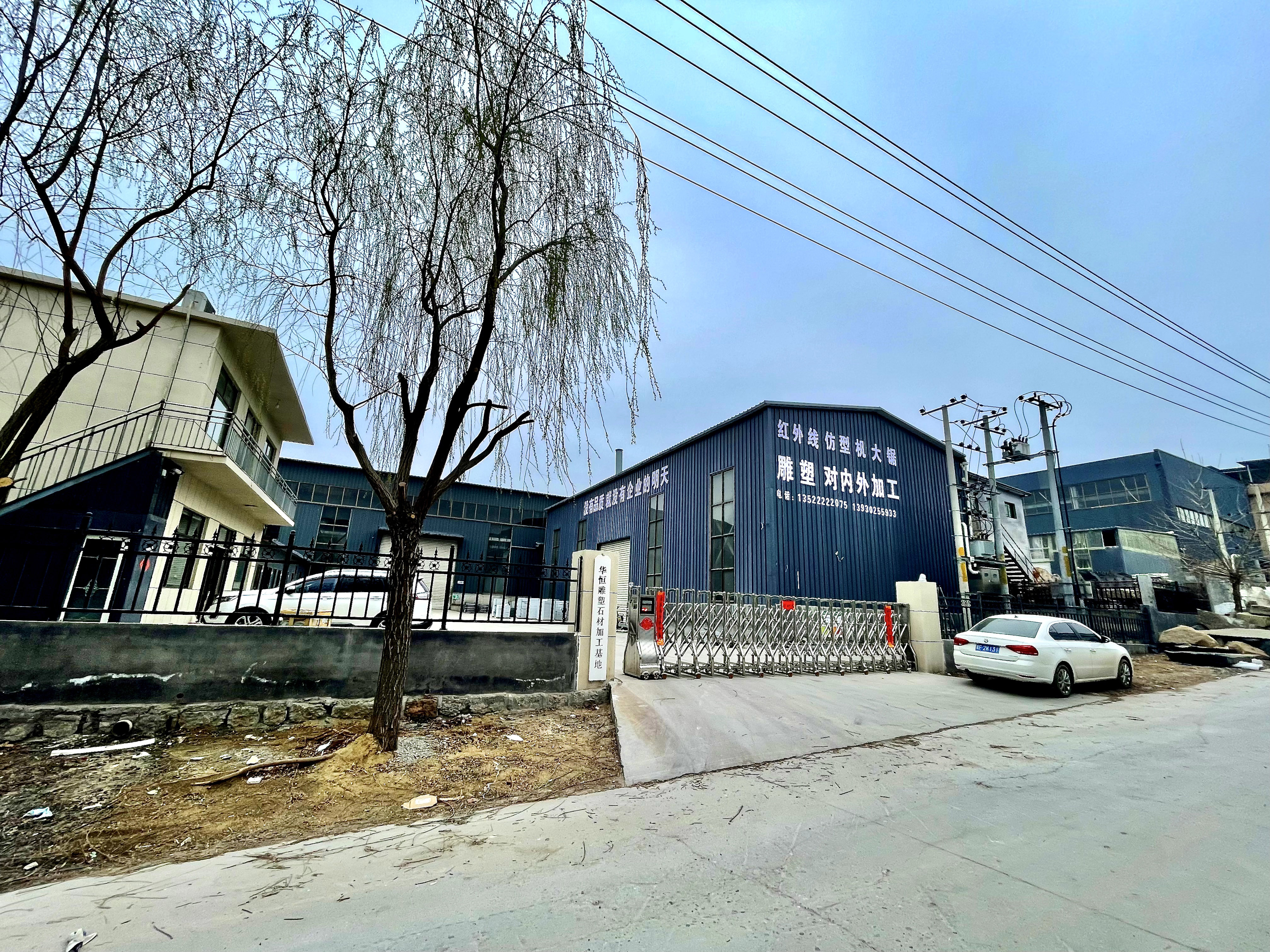
Granite memorial and stone sculpture processing workshop: standard module sizes and fully customized memorial dimensions are produced on the same line.
Configuration 2: Corten Fire Pit and Planter (XYS-Corten-Custom)
Material and form. Authentic Corten steel supplied to ASTM A242 / A588 weathering steel. The configuration covers landscape sculpture, garden edging, fire pits, metal screens and planter boxes.
Dimensions and size logic. Customized height and width, from small garden pieces to large architectural structures. Of the five configurations, this one is the most flexible in plan dimension, because Corten elements are produced from folded, welded and cut plate rather than from a cast or carved body.
Surface options. Two finishes are offered: a natural pre-rusted finish with a stable patina, or a raw finish left to weather. Both retain the material's core characteristics of maintenance-free service, natural ageing and atmospheric corrosion resistance.
Standard uses. Landscape architecture, public parks, modern garden design and industrial-style decor.
Decision point. The surface selection is a project schedule decision rather than a colour preference. Pre-rusting stabilises the patina before the piece leaves the factory, while a raw finish means the patina continues to develop during installation and after handover. Buyers specifying a fixed handover appearance should treat this as the controlling variable.
Configuration 3: Large-Scale Stainless Steel Urban Piece (XYS-Stainless-Custom)
Material and form. Premium 304 or 316 stainless steel, hand-forged and precision welded over an internal steel skeleton. Typical forms include metal sculpture, abstract art, garden decoration and urban landmark work.
Dimensions and size logic. Customized height from 1 m to 20 m. This is the widest span of the five configurations, and the only one where the upper part of the range is as much an engineered structure as it is a sculpture.
Surface options. Mirror polishing, brushed (satin), painted and electroplated finishes.
Standard uses. Urban public art, modern architecture, seaside landscape, luxury hotel and shopping mall installations.
Decision point. Grade selection is the decision that governs long-term appearance. Grade 316 stainless steel contains 2%–3% molybdenum, which raises its pitting resistance well above grade 304 (PREN approximately 26 versus approximately 19), giving over 30% higher pitting resistance than 304 and longer performance in coastal and salt-exposed environments. Grade 316 typically costs about 20%–30% more than 304, so the grade decision is also a budget decision: 316 suits coastal cities, seaside parks, swimming pools, humid tropical regions and marine-adjacent installations, while 304 remains appropriate for inland cities, dry climates, indoor plazas and general outdoor decoration without salt exposure.
Configuration 4: Bronze Religious Statue (XYS-Bronze-Custom)
Material and form. High-purity cast bronze with a copper content above 85%–95%. Brass is also available as a lower-cost alternative alloy. Typical forms include bronze statues, religious statues, animal sculptures and figurines.
Dimensions and size logic. Customized height from 50 cm to 10 m, including life-size figures. This is the only configuration of the five whose range begins at 50 cm, which makes it the standard choice for devotional figures displayed indoors, in chapels or in private collections, as well as for larger outdoor religious monuments.
Surface options. Patina, gold leafing, high polishing and antiqued finishes, produced through lost-wax casting and professional welding.
Standard uses. Public art, museums, real estate, religious institutions and private collections.
Decision point. Bronze and brass are not interchangeable. Bronze sculptures contain over 85% copper while brass sculptures contain over 60%, and that composition difference drives both appearance over time and outdoor suitability. Over a hundred years, bronze develops a greenish patina that reads as antique, whereas brass turns black over the same period. Bronze is the more suitable of the two for outdoor applications, including large-scale entertainment projects, wetland parks, villa decoration and government construction scenarios, and it typically costs about 20%–30% more than brass because it is alloyed with tin rather than the cheaper zinc used in brass.
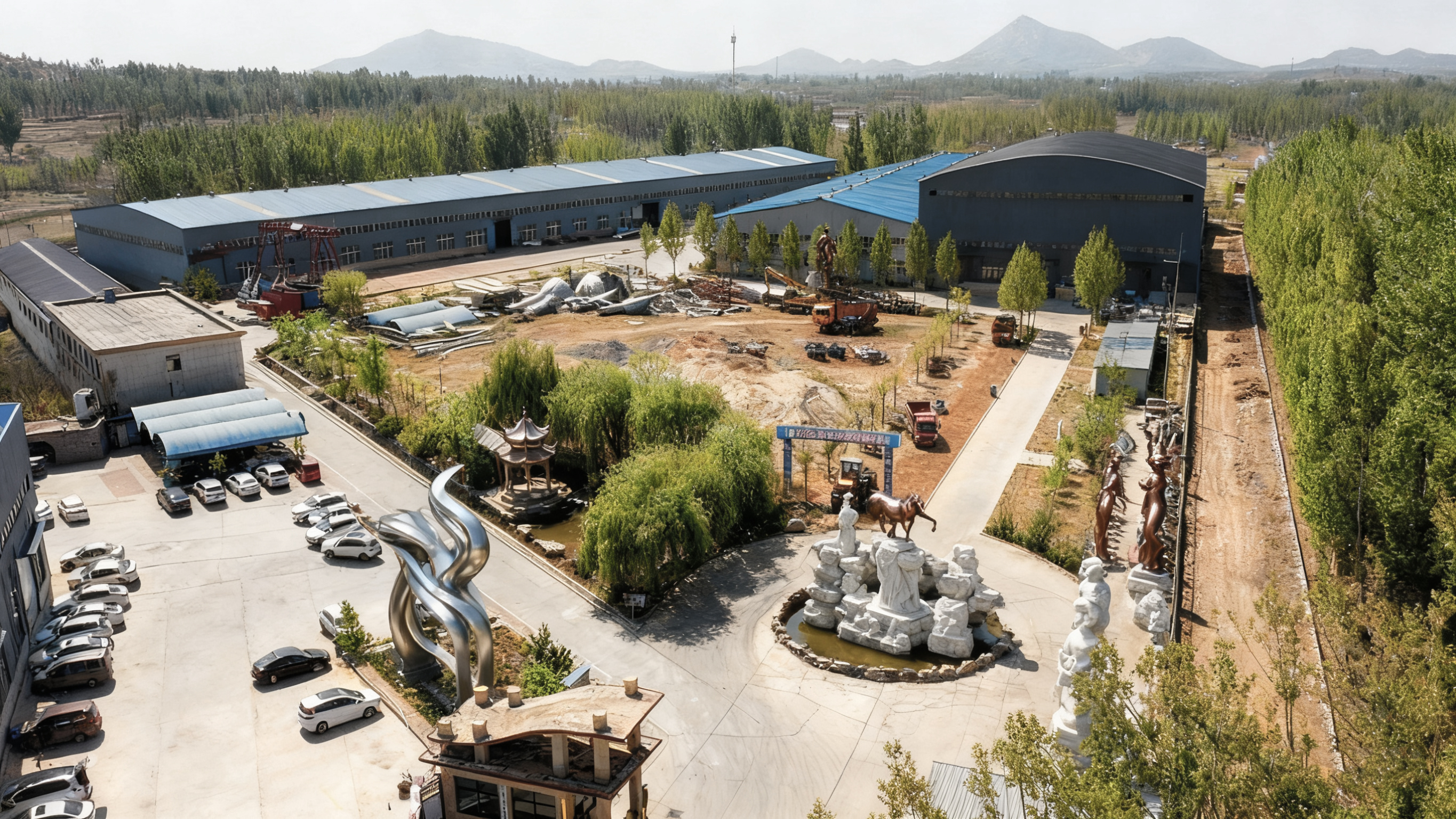
Bronze casting and stainless steel fabrication share one production floor: lost-wax casting for figurative work, precision welding and internal skeletons for large metal pieces.
Configuration 5: Carved Marble Bathtub and Ornament (XYS-Stone-Custom)
Material and form. Natural white marble, granite and travertine, carved rather than cast or welded. The configuration covers garden ornaments, fireplace mantels, stone fountains, religious carvings, marble statues and carved marble bathtubs.
Dimensions and size logic. Fully customized width, height and depth. This configuration has no standard module at all, which distinguishes it from the granite memorial configuration even though both are stone products.
Surface options. Hand-carved, honed, high-gloss polished and acid-washed finishes. High-density natural stone is weatherproof, which is what allows the same material family to serve both interior ornament and exterior landscape work.
Standard uses. Landscape design, architectural construction, home and garden, and temple decoration.
Decision point. Because a carved marble bathtub or basin combines a functional surface with a carved decorative surface, the finish schedule usually has to be split between the water-contact surface and the visible carved face. That is a specification decision made before carving begins, not a finishing step applied afterwards.
Size range across the five configurations: 50 cm to 20 m
All five configurations can be customised in size from roughly 50 cm up to 20 m depending on material, but the practical band differs by material and process. Bronze and brass begin at 50 cm and extend to 10 m. Stainless steel begins at 1 m and extends to 20 m. Corten steel spans small garden pieces to large architectural structures. Granite monuments are usually ordered against standard plot modules or customized dimensions. Carved marble and travertine are produced to fully customized width, height and depth.
The upper end of the range changes the nature of the purchase. A large stainless steel or Corten installation is delivered as a structure that depends on an internal steel skeleton, and on site-side installation foundations, steel structure support, lifting equipment and, in many projects, an integrated LED lighting system. Buyers planning a piece in that bracket should treat the sculpture and the site preparation as one package.
Technical explanation: how design control reduces commissioning risk
The five configurations differ in material, but they share a single production logic. Design is confirmed in a 3D preview before manufacturing starts, and figurative commissions can additionally be visualised through a 1:1 clay model. This step is what allows design-mismatch rework to be eliminated: because the design is previewed before production, there is no rework driven by design mismatch. Standard production time is 15–30 days, and every piece is inspected before shipment.
Process differs by configuration. Bronze work is produced through lost-wax casting and professional welding. Stainless steel work is hand-forged, precision welded and built over an internal steel skeleton. Stone work is carved by hand rather than formed. Across all of them, digital tooling such as CNC processing and 3D design preview runs alongside traditional hand-carving and hand-forging, which is what makes consistent quality possible across large orders as well as single pieces.
Surface protection is also handled per material: pickling and passivation for stainless steel, and a sealed patina for bronze. The intended result is that maintenance stays low even in outdoor or coastal environments, and in practice requires little beyond occasional rinsing. Packaging follows the same logic: reinforced wooden crates and steel frames are used for seaworthy transport, and global on-site installation guidance is available where the project requires it.
Application and use cases
Commissioned sculpture concentrates in a defined set of environments. The most common project types are luxury hotel projects, resort projects, landscape architecture projects, public art installations and private customised sculpture projects. Their function is consistent across markets: creating artistic landmarks, enhancing architectural aesthetics, cultural decoration and establishing space identity. Installations are permanent, intended for long-term display and expected to withstand outdoor weather exposure.
- Luxury hotel lobby or atrium: large stainless steel or mirror-polished pieces, and carved marble elements for interior fixtures.
- Resort and garden landscape: Corten steel fire pits, planters and screens, plus carved stone ornaments and fountains.
- Public art and urban landmark projects: large-scale stainless steel forms in the 1 m to 20 m band.
- Religious and memorial projects: cast bronze statues up to 10 m, and granite monuments in standard or custom dimensions.
- Private and residential commissions: bronze figurines and animal sculptures from 50 cm, and fully custom carved marble pieces.
Market trend: what the numbers say about commissioned sculpture demand
Published market data supports the view that commissioned sculpture is a stable, project-driven segment rather than a speculative one. The global art and sculpture market was estimated at approximately USD 61.83 billion in 2026 (Business Research Insights), and sculptures account for about 21% of global art acquisitions by transaction volume. Regional demand is also measurable: the United States sculpture market reached an estimated value of USD 5.8–6.2 billion in 2024, and the global bronze sculpture commission market alone reached USD 1.47 billion in 2024.
Budget distribution explains why configuration discipline matters commercially. Over 80% of public art open call projects in North America fall below a budget of USD 250,000, which means the majority of projects sit in the middle of the size range rather than at the monument scale. Public funding provides part of that base: the U.S. Federal Cultural Agencies budget for 2025 is USD 708.8 million, including USD 207 million for the NEA.
Trade classification adds a practical layer. Under EU rules, original sculptures classified under HS Code 9703 often bypass anti-dumping duties, while mass-produced items under HS 8306 face higher scrutiny. For a commissioned, one-off work, the classification route is part of the procurement file.
How these configurations compare with traditional fabrication
The difference between an integrated production model and a traditional workshop model is measurable in three areas. The first is design control: instead of relying mainly on hand casting, precision casting, CNC machining and 3D design preview are combined so that each piece matches the approved design and quality stays consistent across large orders. The second is cost: factory-direct pricing without a middleman is generally 10%–20% lower than traditional workshops for the same material and quality. The third is maintenance: professional anti-corrosion treatment — pickling and passivation for stainless steel, sealed patina for bronze — reduces the cleaning, repainting and repair work that traditional pieces typically require.
Those advantages have boundaries that buyers should price in rather than discover later. Grade 316 stainless steel typically costs about 20%–30% more than 304, and bronze typically costs about 20%–30% more than brass, so the higher-performance specification carries a real premium. The 15–30 day figure is standard production time and does not include transport, site preparation or installation. Granite memorials are usually constrained by cemetery plot modules, which limits how far customization can be pushed. Carved marble dimensions are fully custom, but they remain a carved natural stone product. And large-scale stainless steel or Corten works require site foundations and structural support that sit outside the sculpture contract itself.
As static installations, all five configurations consume zero energy in daily use. The long-term cost difference between them comes from surface treatment and maintenance frequency rather than from operation.
Future outlook
Three shifts are likely to shape commissioning decisions over the next few years. First, public art budgets concentrated below USD 250,000 in North America will continue to favour mid-scale configurations — Corten landscape elements, medium stainless steel works and carved stone features — over very large landmarks. Second, material specification is becoming more explicit, with coastal and marine-adjacent projects increasingly separating 316 from 304 at the specification stage rather than during fabrication. Third, the trade and compliance layer around HS Code 9703 versus HS 8306 will keep documentation quality relevant to how a commission is classified and cleared.
For buyers, the practical implication is unchanged: fix the configuration, then the material grade, then the finish schedule. Comparing suppliers before those three decisions are made tends to produce quotations that cannot be compared at all.
FAQ
How should a buyer choose between the five configurations?
Choose by site and function rather than by material preference. Granite monuments suit cemetery and memorial engineering where standard plot modules apply. Corten steel suits landscape architecture, public parks, modern garden design and industrial-style decor. Stainless steel suits urban public art, modern architecture, seaside landscape, luxury hotels and shopping malls, especially at large scale. Bronze suits public art, museums, real estate, religious institutions and private collections, including life-size figures. Carved marble, granite and travertine suit landscape design, architectural construction, home and garden, and temple decoration, including bathtubs, mantels and fountains.
What size range is realistic, and where does customization stop?
Bronze and brass are customized from 50 cm to 10 m, including life size. Stainless steel is customized from 1 m to 20 m. Corten steel covers small garden pieces through large architectural structures. Granite monuments are supplied in standard sizes such as 80 x 60 cm and 120 x 80 cm or customized, and carved marble is produced to fully customized width, height and depth. Across the five configurations, sizes from roughly 50 cm to 20 m can be customised depending on material. At the largest sizes, the piece depends on an internal steel skeleton and on site foundations and structural support.
Should an outdoor sculpture use 304 or 316 stainless steel?
Grade 316 contains 2%–3% molybdenum and has a pitting resistance PREN of approximately 26, compared with approximately 19 for grade 304 — over 30% higher pitting resistance. Grade 316 is therefore the appropriate choice for coastal cities, seaside parks, swimming pools, humid tropical regions and any marine-adjacent installation, and it typically costs about 20%–30% more than 304. Grade 304 remains suitable for inland cities, dry climates, indoor plazas and general outdoor decoration where salt exposure is not a concern.
How do bronze and brass compare for a religious statue displayed outdoors?
Bronze sculptures contain over 85% copper, while brass sculptures contain over 60%, and that is the core compositional difference. Over a hundred years bronze develops a greenish patina that becomes antique-like, whereas brass turns black over the same period, so bronze offers a distinct aesthetic advantage for antique appearance. Bronze is also better suited to outdoor applications and to large-scale entertainment projects, wetland parks, villa decoration and government construction scenarios, and it typically costs about 20%–30% more than brass.
What drives the cost difference between these configurations?
Alloy and grade are the primary drivers. Grade 316 stainless steel typically costs about 20%–30% more than grade 304 because of its higher nickel and molybdenum content, with the exact gap depending on sculpture size, thickness and surface finish. Bronze typically costs about 20%–30% more than brass because it contains over 85% copper and uses tin as the alloying element, while brass contains 60% copper and uses cheaper zinc. Factory-direct pricing is generally 10%–20% lower than traditional workshops for the same material and quality.
What is the minimum order quantity, and what production and installation support is provided?
There is no strict minimum order quantity; single-piece custom orders are accepted, and ordering multiple pieces at once is recommended to share mould and shipping costs. Full customization is supported from drawings, photos or concepts, with a 3D design draft confirmed before production, and prototyping available as an optional step. Standard production time is 15–30 days, and pieces are inspected before shipment. Each sculpture comes with installation instructions, and on-site installation can be guided by video call where needed. Surface protection — pickling and passivation for stainless steel, sealed patina for bronze — keeps maintenance to occasional rinsing, including in outdoor and coastal environments.
Reference document: the company's production capability profile is publicly available for download at Company Profile & Available Production Capabilities (PDF).