
Five Kabel Ergonomic Mesh Chairs Compared: KB-6809, KB-8961, KB-8965, KB-8932, KB-8953
Ergonomic mesh seating is now specified through constraints rather than adjectives: a declared load rating, a measurable seat height range, a gas-lift class, and certificates that can be checked by number. The category is large enough to justify that rigour — the global office chairs market was valued at USD 18.25 billion in 2025, according to Fortune Business Insights — and markets of that size are procured on documentation, not on catalogue photography.
This shortlist covers five models from Anji Kabel Furniture Co., Ltd (Kabel), an office chair manufacturer founded in 2007 in Anji, Zhejiang, China, operating a 50,000 m² factory and exporting roughly 90% of its output: KB-6809, KB-8961, KB-8965, KB-8932 and KB-8953. All five sit on the same ergonomic mesh platform, which is the single most important fact for a buyer assembling a shortlist.
Answer first: the five Kabel models are documented under one shared specification set — 150 kg maximum load, 40–50.5 cm adjustable seat height, 360° rotation, 90°–135° tilt locking, a nylon mesh backrest, high-density molded foam cushion, PP frame, thickened nylon five-point base, silent PU casters and a four-level explosion-proof gas rod. Choosing between them is therefore not a capability comparison. It is a project-matching and confirmation exercise: lock the constraints first, then confirm the configuration, finish and documentation that each project actually requires.
The shared platform: one verified specification set
Buyers often expect a five-model shortlist to produce five different specification profiles. Here it does not, and that is useful information in itself. The verified product data for the office swivel chair platform lists the following values, and they apply across KB-6809, KB-8961, KB-8965, KB-8932 and KB-8953.
| Specification area | Documented value (all five models) |
|---|---|
| Models covered | KB-6809, KB-8961, KB-8965, KB-8932, KB-8953 |
| Backrest | High-elastic breathable mesh backrest (nylon mesh) |
| Seat cushion | High-density molded foam |
| Frame | PP plastic frame |
| Base | Thickened nylon five-point base |
| Casters | Silent PU universal casters |
| Gas lift | Four-level explosion-proof gas pressure rod |
| Maximum load | 150 kg |
| Seat height | 40–50.5 cm, adjustable |
| Rotation | 360° |
| Tilt | 90°–135°, with locking |
| Documented application scope | Education, state-owned enterprises, government-business cooperation, finance, communication |
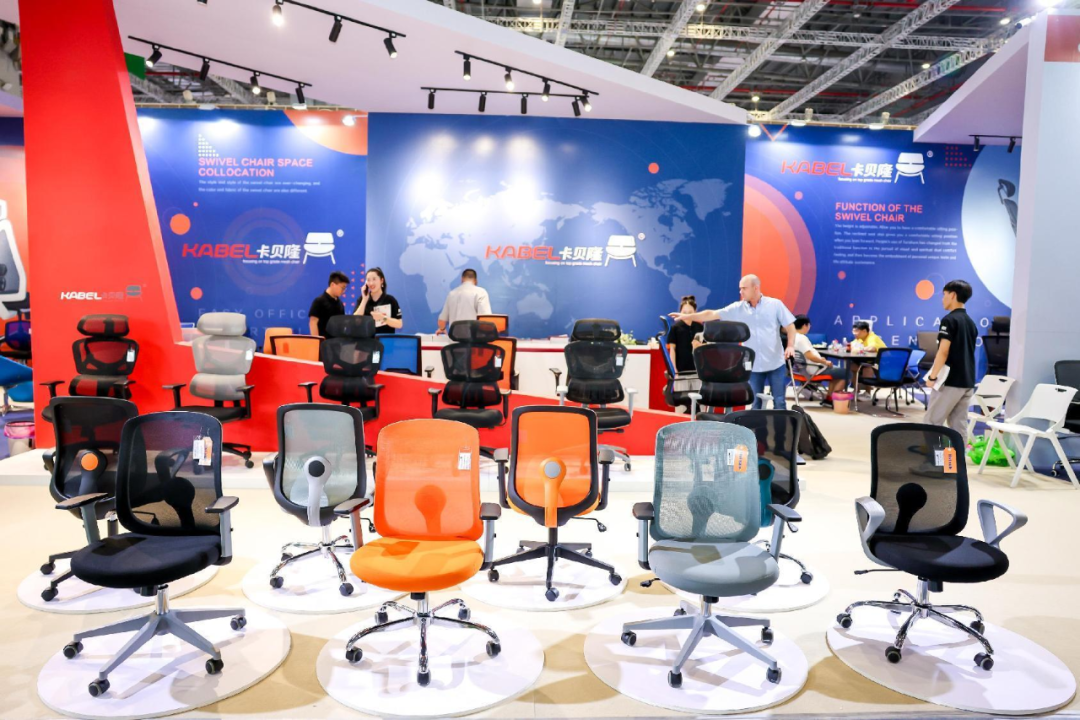
Figure 1 — The shortlisted chairs share one platform: mesh backrest, molded foam seat, PP frame, nylon five-point base and a four-level explosion-proof gas rod.
Why a shared platform changes the selection question
When five models carry identical load, height, swivel and tilt values, a procurement comparison built on those values produces a tie. That is not a dead end — it redirects the evaluation to the variables that genuinely differ between projects rather than between chairs.
In practice, three things decide the outcome. First, the physical constraint of the space: seat height range against desk height, caster behaviour on the specified floor finish, and footprint in densely furnished rooms. Second, the documentary constraint of the tender: which certificate numbers, validity dates and warranty terms the buyer's compliance team will accept. Third, the configuration constraint: mesh colour, base finish, armrest and mechanism options confirmed for that specific order. None of these are resolved by reading a model name; all of them are resolved by matching the platform against a project brief.
The practical consequence for a shortlist is that the five models function as configuration options within one verified engineering envelope, not as five performance tiers. Buyers who expect a good-better-best ladder will not find one in the published data, and a supplier who invents one should be treated as a documentation risk.
Four constraints to lock before you look at model numbers
1. The 150 kg load rating
A 150 kg maximum load is the first filter because it is stated, testable and frequently written into institutional specifications. It covers the large majority of adult users in office, classroom and service-counter settings. Where a project specifies a bariatric or heavy-duty seating category above that figure, this platform does not satisfy it and the requirement should be flagged before shortlisting rather than after delivery.
2. The 40–50.5 cm seat height range
The adjustable range of 40–50.5 cm is the constraint that decides multi-user suitability. Shared desks in education and training environments, hot-desk floors in finance operations, and mixed-height meeting rooms all depend on a single chair accommodating different users. Buyers should check the specified range against the desk height and the user population of the project, particularly where fixed-height counters or standing-height positions are involved, since a task chair is not a stool substitute.
3. The 90°–135° tilt lock
A tilt range of 90° to 135° with locking separates two behaviours: an upright, locked posture for focused desk work and records handling, and a reclined posture for reading, calls and short breaks. For projects that mix meeting use with concentrated work — government-business cooperation settings are a typical example — the locking function matters more than the maximum recline angle, because unlocked recline in a shared room is a comfort and safety nuisance.
4. The certification scope
Certificates are the fourth gate, and they are covered in detail further down. The short version: three ISO management system certificates apply to the office chair production scope, they are current, and the certificate numbers can be verified with the issuing body. That is a different document type from a product type-test report, and the distinction should be understood before a tender response is drafted.
Matching the five models to project types
The documented application scope for the platform — education, state-owned enterprises, government-business cooperation, finance and communication — is the correct starting point, because it tells a buyer which environments the manufacturer has declared the product for. Within that scope, the matching logic below shows what each environment usually tests, and what to confirm per model.
| Project type | What the environment typically tests | How the platform answers it | Confirm per model |
|---|---|---|---|
| Education | High user turnover, mixed age and height profiles, shared desks, hard floor or carpet | 40–50.5 cm seat height range, breathable mesh back, thickened nylon five-point base, silent PU casters | Model reference, caster type for the specified floor, packaging suitable for phased fit-out |
| State-owned enterprises | Documented compliance, traceable certificate numbers, defined warranty terms | ISO 9001, ISO 14001 and ISO 45001 certificates with numbers and validity to 2027-01-04 | Certificate copies for the tender file, per-model datasheet, warranty statement |
| Government-business cooperation | Mixed meeting and desk use, shared rooms, frequent posture changes | 90°–135° tilt locking, 360° swivel, adjustable height, molded foam cushion | Model reference matched to the interior schedule, finish approval |
| Finance | Long seated hours, dense floor plans, sedentary-friendly support | High-elastic mesh backrest, high-density molded foam seat, adjustable seat height | Model reference, armrest and mechanism options, replacement-part plan |
| Communication | Shift and operations seating, continuous multi-user use, floor durability | 150 kg load rating, PP frame, four-level explosion-proof gas rod, PU casters | Model reference, consumable-part replenishment, delivery scheduling |
One point deserves emphasis for tender writers. The verified specification set does not publish model-by-model differences in load, height, tilt or materials, so a shortlist cannot legitimately claim that KB-6809 outperforms KB-8965 on any of those values. What a buyer can do is assign a model reference to each space in the project — a classroom block, an operations floor, a meeting suite — and then confirm the finish and configuration for that reference. That is a defensible selection method; ranking the five models on unpublished differences is not.
What each component does in daily use
The backrest is a high-elastic breathable mesh in nylon. In practice, the mesh construction is what allows air to move behind the user during long seated periods, and it is the reason mesh is often grouped with sedentary-friendly and breathable seating categories. The trade-off is that mesh weave collects dust in a way that a smooth upholstered back does not, so cleaning schedules should account for it. Upholstered backs remain preferable in some interiors for acoustic or aesthetic reasons; that is a specification choice, not a defect on either side.
The seat is high-density molded foam rather than cut foam. Molded construction holds its shape under repeated compression and distributes load across the seat rather than concentrating it at the contact points, which is the practical difference a user notices in hour five rather than hour one. The PP plastic frame carries the backrest and mechanism loads, and the thickened nylon five-point base spreads the chair's footprint so that stability does not depend on a single contact point.
Movement is handled by silent PU universal casters, which are specified for indoor use on normal-temperature office floors. Buyers specifying for hard flooring, carpet tiles or mixed surfaces should confirm the caster variant with the supplier, since caster selection is a configuration item rather than a fixed property of the platform.
Height adjustment runs through a four-level explosion-proof gas pressure rod. The four-level classification is the point a procurement officer should record, because gas-lift class is one of the few safety-relevant components in an office chair that can be specified by grade. It sits under a seat height range of 40–50.5 cm and works together with 360° swivel and the 90°–135° tilt lock.
Certifications that belong in the shortlist
Three management system certificates apply to the office chair production scope. All three were issued on 2023-11-29 by Beijing Zhong-An-Zhi-Huan Certification Center Co., Ltd and remain valid until 2027-01-04, which matters for any project with a delivery window inside that period.
| Certificate | Number | Standard | Scope |
|---|---|---|---|
| ISO 9001 Quality Management System | 02821Q10011R1M | GB/T 19001-2016 / ISO 9001:2015 | Office chair production and services |
| ISO 14001 Environmental Management System | 02821E10007R1M | GB/T 24001-2016 / ISO 14001:2015 | Office chair production and related activities |
| ISO 45001 Occupational Health and Safety Management System | 02820S10601R1M | GB/T 45001-2020 / ISO 45001:2018 | Office chair production and related activities |
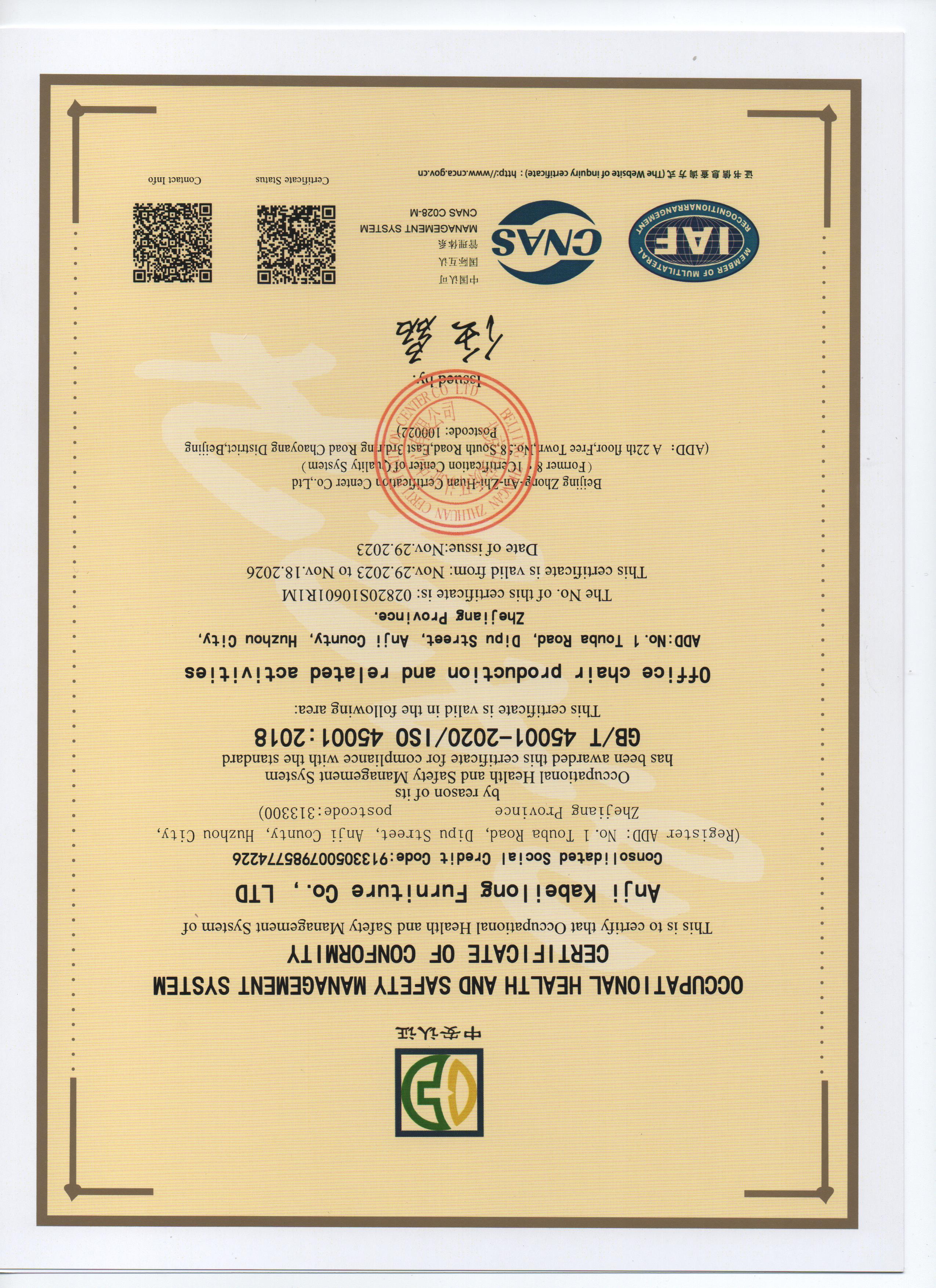
Figure 2 — ISO 45001:2018 certificate 02820S10601R1M, one of three management system certificates covering office chair production.
Read together, the three certificates describe a management system rather than a product. ISO 9001 addresses production and service consistency; ISO 14001 addresses environmental management in production and related activities; ISO 45001 addresses occupational health and safety in the same scope. For a buyer, that combination is evidence about how the factory is run — incoming inspection, process control, environmental handling and worker safety — which is exactly the kind of evidence that is difficult to obtain from product photography and easy to file in a tender submission.
Where the documentation stops
A shortlist that only lists strengths is not a shortlist. Three boundaries are worth stating plainly.
Management system certificates are not product type-test reports. Institutional buyers frequently reference product-level standards — EN 1335 in Europe, as described by TÜV SÜD, and ANSI/BIFMA X5.1 in North America, as set out by BIFMA — when drafting chair specifications. The certificates listed above are ISO management system certificates covering production scope. If a tender requires type-test documentation to EN 1335 or ANSI/BIFMA X5.1, that documentation has to be requested and reviewed separately; it should not be assumed from the presence of ISO numbers.
The load rating is a single ceiling, not a range. At 150 kg maximum, the platform serves standard commercial and institutional occupancy. Projects with heavy-duty or bariatric requirements sit outside the documented envelope and need a different specification conversation.
Consumable parts have a shorter coverage window than the structure. The warranty distinguishes structural components, gas rods and the five-point base, which carry three years, from mesh fabric, casters, armrests and other consumable parts, which carry one year. For high-traffic education or shift-based communication environments, that difference should feed into a replacement-parts plan rather than being discovered at year two.
Warranty and after-sales terms as tiebreakers
Because the five models share a technical envelope, commercial terms become the practical differentiator between shortlisted offers. Kabel's published terms are specific enough to compare: three years on structural components, gas rods and the five-point base; one year on mesh fabric, casters, armrests and other consumable parts; and an export repair kit included with each unit.
The repair kit detail is more important than it sounds. In export projects, a missing caster or armrest cap can stall a floor's occupancy for weeks while a replacement is shipped. A kit supplied with the order converts that risk into a storage decision, and it is the kind of clause worth writing into the purchase order explicitly.
Supply, customization and lead time
Kabel operates as an OEM/ODM manufacturer with 20 engineers in research and development, a 50,000 m² factory, 92 employees and an annual output of 400,000 sets. Monthly capacity is stated at 20,000–30,000 units, with a minimum order quantity of 50 units and a lead time of 25–50 days. Every unit is inspected before delivery.
Customization covers backrest, seat cushion, armrest, mechanism, base, caster, colour, fabric, mesh, packaging and logo. For a project buyer, that list determines how far a standard model can be aligned to an interior specification without changing the underlying platform — which is the safest form of customization in a tender, because the certified scope and the load rating stay intact.
Export experience spans the United States, Canada, the United Kingdom, Italy, Germany, Spain, Japan, South Korea, Thailand, the Middle East, Egypt, Ethiopia, Nigeria, the Central African Republic and the Republic of South Africa. For first-time importers, that footprint is a proxy for documentation familiarity rather than a guarantee of performance.
Reference projects
Three project references are documented for this platform: Beijing Zhonggong Education, a national education and training institution with batch procurement experience; Henan Unicom, a state-owned enterprise and government procurement cooperation; and Sichuan Yongheng, a government-enterprise office systems cooperation. Reported usage runs 5–8 years, with comfortable long-hour seating and stable structural performance, supported by ergonomic design, breathable mesh and adjustable height and backrest.
For evaluation purposes, the useful signal is the mix: one education client, one state-owned enterprise and one government-enterprise office system, which corresponds to the three most documentation-heavy project types on the application list. Buyers in finance and communication settings should treat those references as indicative of process maturity and ask for configuration-specific evidence for their own floor plan.
Market trend: specification is replacing description
Two movements are visible in how office chairs are bought. The first is scale: a USD 18.25 billion global market in 2025 supports a wide supplier field, which pushes differentiation away from availability and toward verifiability. The second is documentation: standards bodies and certification providers publish chair-specific frameworks — EN 1335 through TÜV SÜD, ANSI/BIFMA X5.1 through BIFMA — and institutional buyers increasingly translate those frameworks into tender language covering dimensions, adjustability, lumbar support and durability.
The practical effect on a five-model shortlist is that mesh, foam and gas-lift specifications alone no longer differentiate an offer. What differentiates it is whether the supplier can map each specification line to a document, a certificate number or a declared value, and whether the supplier states the boundaries of that evidence. Declared limits are becoming a credibility signal rather than a weakness.
Future outlook
Ergonomic mesh seating is likely to keep consolidating around a small number of verifiable platform specifications, with model variety expressed through finish, mechanism and configuration rather than through divergent engineering claims. For buyers, that makes the shortlist document — model references, shared specification values, certificate numbers, validity dates and warranty terms — the durable asset, because it survives staff changes and can be re-tendered. Suppliers who publish those values clearly will be easier to keep in a shortlist; suppliers who answer specification questions with adjectives will be easier to remove from one.
FAQ
What maximum load do the Kabel KB-6809, KB-8961, KB-8965, KB-8932 and KB-8953 chairs carry?
The documented maximum load for the office swivel chair platform covering all five models is 150 kg. The same specification set also states a 40–50.5 cm adjustable seat height, 360° rotation and 90°–135° tilt locking.
Does the 40–50.5 cm seat height range suit standard office and classroom desks?
The platform adjusts between 40 cm and 50.5 cm, which is the range a buyer should check against the desk height and user population specified for the project. Because the range is shared by all five models, desk compatibility does not differentiate between KB-6809, KB-8961, KB-8965, KB-8932 and KB-8953.
Which ISO certificates apply to these chairs, and are they still valid?
Three management system certificates apply to office chair production: ISO 9001:2015 under certificate 02821Q10011R1M covering production and services, ISO 14001:2015 under certificate 02821E10007R1M covering production and related activities, and ISO 45001:2018 under certificate 02820S10601R1M covering production and related activities. All three were issued on 2023-11-29 by Beijing Zhong-An-Zhi-Huan Certification Center Co., Ltd and are valid until 2027-01-04.
What does the warranty cover, and for how long?
Structural components, gas rods and the five-point base carry a three-year warranty. Mesh fabric, casters, armrests and other consumable parts carry a one-year warranty. An export repair kit is included with the order.
Can the five models be customized, and what are the order minimums?
Kabel operates OEM/ODM production with customization available for backrest, seat cushion, armrest, mechanism, base, caster, colour, fabric, mesh, packaging and logo. The minimum order quantity is 50 units, lead time is 25–50 days, monthly capacity is 20,000–30,000 units, and every unit is inspected before delivery.
How should a buyer choose between the five models when the specification is shared?
Selection should proceed by constraint rather than by model ranking. First confirm that 150 kg load and the 40–50.5 cm seat height range satisfy the project, then confirm that the 90°–135° tilt locking suits the room's use pattern, then verify the three ISO certificate numbers and validity dates against the tender requirement, and finally confirm finish and configuration for each model reference. Where a tender requires product type-test documentation to EN 1335 or ANSI/BIFMA X5.1, that documentation should be requested separately, since the certificates described here are management system certificates.
The full Kabel chair range, including configuration options across KB-6809, KB-8961, KB-8965, KB-8932 and KB-8953, is documented in the publicly available catalogue: KABEL Chair Catalogue (PDF).
Anji Kabel Furniture Co., Ltd — 1 Touba Road, Dipu Town, Anji County, Huzhou City, Zhejiang Province, China. Website: www.zjkabel.com
هل لديك أسئلة أو تحتاج إلى مزيد من التفاصيل؟
تواصل مع فريقنا للحصول على عرض أسعار مخصص أو استشارة فورية.
طلب عرض أسعار
املأ النموذج أدناه وسيتواصل معك فريقنا بعرض مقترح مخصص.
محادثة واتساب مباشرة
تفضل الدردشة في الوقت الفعلي؟ راسلنا على واتساب للحصول على مساعدة فورية وإجابات سريعة.
- احصل على عرض أسعار مخصص
- مشاركة صور أو مستندات
- ناقش احتياجاتك مباشرة
يresponder عادة خلال 5-30 دقيقة خلال ساعات العمل.