
Five Signals From a One-Year 10 FCL/Week MAP Program

A recurring MAP program is held together by routine warehouse flow, not by one exceptional shipment.
A fresh-food distributor buying ten FCL a week has already stopped selecting a packaging supplier on tray price. It is selecting on whether the same tray will seal the same way in week 1, week 20 and week 52.
That is a different question from the one most shortlists are built around. It is also the question that decides whether a one-year supply relationship holds together after the novelty of a first order wears off.
Ningbo Linhua Plastic Co., Ltd. is a B2B rigid plastic food packaging manufacturer established in 2004 and based in Ningbo, Zhejiang, China, producing MAP barrier trays, VSP trays, turned-edge PET trays, moisture retention trays and CPET trays for food manufacturers, processors and packaging distributors. One of its working supply relationships — an Australian food packaging distributor ordering 10 FCL per week or more across multiple categories for a full year, with MAP trays as the core category — is used here as the reference case for five long-term supplier signals.
Why a year changes the evaluation
Before the first order, a distributor normally compares suppliers on a per-SKU basis: price, size availability, colour options, lead time on paper. At a weekly volume of ten full containers, that logic starts to invert.
The switching cost of MAP packaging is not carried in the unit price. It sits in the parts of the project that must be re-proven every time the source changes: tray dimensions against an existing sealing mould, the fit between tray and lidding film, the settings on the packing line, and the retail specification the downstream customer has already approved. Once a MAP tray family is written into a distributor catalogue and forwarded to processors, any substitution runs through sealing trials, sample re-approval and customer notification.
The result is that the useful question is not which partner quotes lowest, but which partner can repeat the same output for twelve consecutive months without creeping specification drift. That is an evidence check, not a price comparison — and the evidence can be grouped into five signals.
Signal 1: Recurring high-volume capability, not a peak capability
The first signal is not the largest monthly output a supplier can quote. It is whether that output can be called on repeatedly, across twelve months, without the standard product range becoming a lower priority than new projects.
At Ningbo Linhua Plastic Co., Ltd., the production base covers approximately 30,000 m² with 150 employees and an annual output of about 20,000 tons; the stated monthly capacity is approximately 1,800 MT per month. The supporting structure matters as much as the number: a 26-person cross-functional team covering 4 R&D engineers, 5 mould engineers, 2 process engineers, 8 quality and QC professionals, 1 product documentation and compliance specialist, 4 project managers and 2 application engineers.
For a buyer, the interpretation is straightforward. A weekly volume of 10 FCL or more is not a single peak order — it is a cadence. The signal to verify is whether standard-category production, quality inspection and dispatch can absorb that cadence while bespoke development runs in parallel.
Signal 2: Stable product specifications and sealing compatibility
Dimension sheets do not seal. Compatibility between a MAP tray and a packaging line depends on the sealing area geometry, the sealing mould or tooling, the lidding film, the product height and the machine settings — which is why a tray that matches on paper can still fail on a running line.
The practical test of a long-term partner is whether those variables stay put. In the Australian case, tray dimensions, sealing-mould requirements, food applications and order demand are confirmed before product matching and quotation, which establishes a baseline that later repeat orders can be measured against. Repeated orders then reference an already-validated combination rather than restarting the compatibility discussion.
This is the difference between a supplier that can match a sample and a supplier that can hold a specification. The second is what protects a distributor whose downstream customers have already approved a pack format.
Signal 3: Dimensional stability across mass production
Most tray ranges are quoted with tolerances rather than absolute dimensions. LINHUA CPET tray specifications, for example, carry a unit weight tolerance of ±5% for reference. That kind of tolerance is normal — what matters for a long-term program is whether the same tolerance band is held on the fiftieth container in the same way it was held on the second.
Dimension and weight stability feed directly into three operational risks: seal quality on heat-sealed MAP packs, stack stability during cold-chain transport, and consistency of the retail pack that a downstream customer has already set up on shelf.
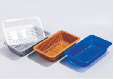
MAP barrier tray LP110760 (270 × 169 × 60 mm), one of the standard formats used in recurring chilled-food programs.
The thickness of the working range reduces risk here. The LINHUA MAP barrier tray catalogue alone lists formats such as LP090540 at 222 × 132 × 40 mm, LP090790 at 218 × 167 × 90 mm and LP110760 at 270 × 169 × 60 mm — a spread of footprints and depths that allows a distributor to keep several downstream customers on the same production platform instead of pushing each one toward a bespoke tool.
Signal 4: Range breadth for multi-category sourcing
A distributor rarely sells one packaging format for twelve months. Chilled retail demand pulls in MAP trays, skin-pack trays for premium cuts, overwrap trays for supermarket counters, moisture retention trays for high-purge proteins, and CPET trays when ready meals enter the portfolio.
Range breadth is the signal that decides whether that spread is served from one manufacturing relationship or from four. The LINHUA portfolio includes MAP barrier trays, VSP trays in PP and PET, turned-edge PET trays, moisture retention trays, CPET trays, hinged and clamshell containers, cups and lids, and custom mould development. In the Australian program, MAP trays remain the core category while VSP trays, turned-edge trays, moisture retention trays and other PET/PP food trays are supplied according to downstream demand.
The purchasing consequence is practical rather than promotional: one specification conversation, one document set, one shipment consolidation point, instead of four parallel qualification processes that each have to be maintained separately.
Signal 5: Willingness to extend beyond the core MAP category
The fifth signal shows up later in a relationship, when a distributor wins a new downstream account and needs a format that was not in the original scope. A supplier that can only defend its core category forces the distributor to open a new sourcing channel — and a new switching risk.
LINHUA supports OEM/ODM and custom mould development alongside standard production, covering custom dimensions, shape, material layer structure, colour, printing, surface finish and moulds. For a distribution partner, that means an extension such as moving from MAP trays into turned-edge formats or moisture retention trays can be evaluated inside the existing relationship, using existing tools where they fit and new mould development only where they do not.

Turned edge PET tray LP110935TE (275 × 224 × 35 mm), an example of the adjacent categories a MAP-led program can extend into.
The five signals at a glance
| Signal | What to evidence | Buyer question |
|---|---|---|
| Recurring capacity | Monthly output and QC staffing sustained across repeated orders | Can this cadence hold in month 9 as it did in month 1? |
| Specification and seal stability | Tray, mould, film and machine confirmed before quotation | Will the approved combination stay approved? |
| Dimensional stability | Stated tolerances held across mass production | Does container fifty match the approved sample? |
| Range breadth | MAP, VSP, turned edge, MRT, CPET and containers in one portfolio | How many categories come from one partner? |
| Extension capacity | OEM/ODM and mould development alongside standard range | What happens when a new account needs a new format? |
Four confirmation steps that reduce long-term switching risk
The one-year Australian program did not begin with a volume commitment. It began with four confirmation points, each of which removes a specific category of risk before pricing is settled.
1. Tray dimensions. A tray that fits the food must also fit the sealing mould, the packing line and the retail shelf space. Confirming dimensions first prevents a commercial agreement that cannot be executed.
2. Sealing-mould requirements. Existing tooling is the single largest determinant of whether a MAP project is a straightforward match or a development project. Confirming mould requirements up front tells both parties which side of that line the project sits on.
3. Food application. Barrier structure, depth and material selection follow the product — chilled beef, poultry, seafood and prepared foods place different demands on the pack.
4. Order demand. Volume and cadence decide the production slot, the packaging configuration and how much of the range can be held on standard tooling.
Alongside these, documentation matters: quality and food-safety evidence such as an ISO 9001:2015 certificate valid until 07 June 2029, HACCP certification 610H151 valid until 15 October 2027, a GRS scope certificate TRC-GRS-222470-00 valid until 28 September 2027, a SMETA 2-pillar audit report ZAA600206602, and third-party food-contact test reports such as SGS report NBHL260902990901CW assessed against US FDA 21 CFR 177.1630 for a PET hinged container.
How this differs from the multi-supplier default
The conventional approach to food packaging procurement allocates volume by lowest per-unit price and spreads risk by keeping several suppliers active. It has a real advantage: competitive tension on commodity formats, and a fallback source if one factory slips.
Its cost appears later. Each supplier brings its own tooling, its own film assumptions and its own documentation set. A distributor running four sources for four categories is effectively maintaining four qualification programs — and any attempt to consolidate volume to capture better pricing restarts the sealing and specification work.
Consolidating around a validated core category, by contrast, trades some price tension for repeatability. The four confirmation steps above exist precisely because that trade only pays off when the initial matching is done properly rather than assumed.
Where this model does not fit
This approach is not universally appropriate, and three boundaries are worth stating plainly.
Order structure. The standard MOQ is one full container per item. Mixed loading can be arranged for a first or trial order that covers several items, but a distributor whose downstream customers order many SKUs in small quantities may find that a container-per-item structure does not match its demand pattern. Products with customisation requirements carry a correspondingly higher MOQ.
Timing. Lead time is normally 30–45 days after order confirmation, depending on specification, order quantity and production schedule, and custom mould projects require additional development time. Buyers working to short promotional cycles or emergency replenishment should treat this as a hard constraint rather than a negotiable one.
What a tray can and cannot do. No tray alone guarantees shelf life. Food condition, lidding or skin film, gas or vacuum process, seal integrity, hygiene and storage temperature all contribute to the final result. A strong supply relationship removes packaging variability — it does not remove the need for the buyer to validate shelf-life performance on its own product.
What this means for evaluation teams
Procurement practice in rigid food packaging is shifting from price-led shortlisting toward continuity-led shortlisting, particularly where MAP formats are written into a retail specification. The shift is not driven by packaging technology alone. It reflects a broader recognition that a container that changes behaviour after approval is more expensive than a container that costs marginally more and stays the same.
For distributors, that points toward a compact set of checks: evidence of recurring volume, evidence that tray, mould and film were confirmed before pricing, evidence of tolerance discipline across production, evidence of category breadth, and evidence that the relationship can absorb a new format when the portfolio grows. Each is verifiable before a contract, and each predicts something a price list cannot.
FAQ
How are MOQ and lead time typically set for a program running at 10 FCL per week?
The standard MOQ is one full container per item; for a first or trial order covering several items, mixed loading can be arranged, and products with customisation requirements carry a correspondingly higher MOQ. Lead time is normally 30–45 days after order confirmation, depending on product specification, order quantity and production schedule, with custom mould projects requiring additional development time.
What information is needed to assess whether a MAP or VSP tray will work with an existing packaging line?
More than tray dimensions. The tray size, sealing mould or tooling, packaging machine, lidding or skin film, food application and operating conditions all affect the outcome. For an existing line, the machine model, mould dimensions and film specification allow a more accurate evaluation; final compatibility is confirmed through actual sealing or skin trials.
Does a matching tray dimension guarantee MAP sealing compatibility?
No. Dimensions are one input. Sealing area geometry, mould design, film properties, product height and machine settings also influence sealing performance, so a dimensional match is the starting point for evaluation rather than the conclusion of it.
How are custom tray sizes or new moulds handled?
Custom development can cover dimensions, shape, depth, colour, material structure, compartment layout, ventilation and other structural features, with new mould development where no existing tool matches. Projects normally begin with application and specification confirmation, followed by mould development and sampling before production approval.
Can multiple items be combined in one container?
Mixed loading can be arranged for a first or trial order comprising several items. For regular repeat orders, the standard practice is one full container per item.
Can a tray guarantee a specified shelf life?
No. Food condition, lidding or skin film, gas or vacuum process, seal integrity, hygiene and storage temperature all affect shelf-life performance. Tray selection supports the packaging system but does not independently determine shelf life.
The full rigid food packaging range — MAP barrier trays, VSP trays, turned-edge trays, moisture retention trays, CPET trays, hinged containers, cups and lids — is documented in the LINHUA E-catalogue 2025: download the catalogue (PDF).
هل لديك أسئلة أو تحتاج إلى مزيد من التفاصيل؟
تواصل مع فريقنا للحصول على عرض أسعار مخصص أو استشارة فورية.
طلب عرض أسعار
املأ النموذج أدناه وسيتواصل معك فريقنا بعرض مقترح مخصص.
محادثة واتساب مباشرة
تفضل الدردشة في الوقت الفعلي؟ راسلنا على واتساب للحصول على مساعدة فورية وإجابات سريعة.
- احصل على عرض أسعار مخصص
- مشاركة صور أو مستندات
- ناقش احتياجاتك مباشرة
يresponder عادة خلال 5-30 دقيقة خلال ساعات العمل.