
Five-Star Hotel Furniture: Evaluating Suppliers by Country
Five-Star Hotel Furniture: Evaluating Suppliers by Country
Long-term supply reliability in custom furniture for five-star hotels is set by conditions a manufacturer cannot change quickly: the policy environment it operates inside, the depth of its production capacity, the credibility of its export record, and the pace at which it absorbs new manufacturing technology. For an owner or FF&E team already in execution on a multi-property programme, those conditions — not a showroom sample — decide whether a bespoke casegood approved in 2026 can be reproduced to the same tolerance in 2031.
RICHART (Guangdong Richang Furniture Co., Ltd.) is a manufacturer of five-star hotel loose and fixed furniture, founded in 1990 and based in the Dawang High-tech Industrial Park in Zhaoqing, Guangdong Province. The company reports a 100,000-square-metre facility, 1,000 employees, an engineering team of 100, annual output value of 500 million CNY, and an export share of 60% across the USA, the EU, Southeast Asia, the Middle East and China. It is used here as a worked example of how country-level conditions translate into supplier behaviour — not as evidence that scale alone predicts reliability.
This brief does the opposite of a shortlist. It sets out an evaluation framework that holds across markets, then shows which verification questions change when the destination market changes.
The evaluation problem: samples are local, supply is long-term
A hotel furniture specification is not consumed once. It is re-ordered against — in phased refurbishments, in newly added properties operating under the same brand standard, and in the replacement of damaged or worn units. That re-ordering is where supplier continuity is either proved or lost, and it happens years after the original procurement team has moved on.
At the decision and execution stage, the levers available to a buyer are narrower than they were during design. Specification is largely frozen, brand standards are fixed, and the remaining choices concern who can hold that specification over time and on what documentary basis. Country-level analysis is useful at exactly this point, because it explains why two suppliers with similar catalogues behave differently under the same purchase order.
The trap is to treat country as a quality label. It is not. A supplier's country of manufacture tells a buyer which regulatory, documentary and logistics regimes the supplier has learned to operate within; it does not tell the buyer how that supplier will perform on a specific site in a specific month.
The four conditions that determine whether a supplier can be re-ordered from
Four conditions do most of the work in a long-term evaluation, and each has a specific evidential form. The table below states what each condition measures, what a buyer should request, and — critically — what the evidence cannot establish on its own.
| Condition | What it measures | Evidence to request | What it cannot establish |
|---|---|---|---|
| Policy environment | The documentary and compliance workload a supplier routinely carries for the markets it ships to | Certificate register with issuing body, scope, revision and expiry; test reports naming the actual specification; origin and customs documentation samples | That a specific requirement is satisfied on your project — that is a project-level determination |
| Production capacity | Ability to hold a programme's volume and repeat tolerances across batches | Floor space, workshop list, equipment provenance, engineering headcount | That capacity is free for your production slot, or that delivery will be on time |
| Export performance | Whether cross-border documentation, packing and shipping are routine rather than exceptional | Export revenue share, destination market mix, reference projects by market | After-sales response time, warranty behaviour, or financial stability |
| Technology adoption | Consistency of machining, finishing and inspection — the drivers of batch-to-batch matchability | Equipment list, finishing and environmental control setup, pre-delivery inspection regime | Field durability in your climate and cleaning regime |
Two further factors cut across all four: workforce depth and certification. Workforce depth is not headcount alone — it is whether the skills that matter to hotel furniture (joinery, upholstery, finishing, engineering) sit inside the plant or are subcontracted. Certification is not a quality score — it is a statement about a system, a process or a chain of custody, and its value depends entirely on whether it covers the thing the buyer is actually buying.
Policy exposure: what a country-level brief can and cannot establish
Policy is not a single variable, and no country-level summary can tell a buyer which rules apply to a given hotel project. That determination is made by the brand's FF&E specification, the destination market's own product requirements, and the contract documents. What country-level analysis can do is show how much documentary work a supplier habitually carries, and whether its certificates say what buyers assume they say.
Four exposure categories are worth mapping for any supplier under evaluation:
- Product performance documentation — the declarations, test reports and specification sheets that the brand standard requires before a sample is approved.
- Environmental and sustainability documentation — increasingly requested, and frequently misread.
- Customs, origin and transport documentation — the routine paperwork of cross-border supply, which fails quietly and late when it fails.
- Project eligibility rules — conditions attached to particular owners, operators or funding structures, which the supplier may never have had to satisfy before.
The most common misreading concerns environmental certificates. ISO 14001 is a management-system standard: it registers that an organisation runs an environmental management system, not that a particular chair or wardrobe meets an environmental performance threshold. Forest certification works the same way. RICHART's 2026 corporate disclosure reports FSC Chain of Custody certification DCI-COC-001074 valid to 2030; a chain-of-custody certificate tracks certified material through the supply chain, and it does not by itself certify the fire performance, durability or emissions profile of the finished article.
Production capacity and workforce depth: scale versus schedule
Capacity is the most over-read of the four conditions. Floor space indicates the size of the operation; it does not indicate throughput on your order. The more useful question is which production stages the supplier performs in-house, because every outsourced stage is a handoff where tolerance and finish can drift between the approved sample and the delivered batch.
RICHART's documented position illustrates the shape of the evidence. The company reports a 100,000-square-metre facility in Zhaoqing and a workforce of 1,000, including an engineering team of 100 — a derived ratio of roughly one engineer for every ten employees, which is a calculation from the company's two stated figures rather than a separately reported metric. Its production facilities are described as covering woodworking, sanding, painting, assembly, upholstery and packaging workshops, with automatic production equipment reported as imported from Italy, Germany, Japan and Taiwan, China.
Read correctly, that set of facts establishes that the finishing and upholstery stages sit inside the plant and that design-to-production engineering is internal. It does not establish that capacity is available in a given quarter, what the throughput per project is, or how installation labour in the destination market is staffed. Those are schedule questions, answered by production slot confirmation, reference project timelines and a named installation partner — not by a factory tour.
Export performance: reading a 60% export share correctly
Export share measures revenue geography. It is a proxy for how routinely a supplier exercises export documentation, packing standards, consolidation and freight coordination — and routine matters, because in custom hotel furniture the failures that hurt are administrative and late rather than dramatic.
RICHART reports that exports account for 60% of revenue and that its markets span the USA, the EU, Southeast Asia, the Middle East and China, with products and services provided to more than 500 high-star hotels worldwide. A multi-market mix of that kind implies the supplier has had to satisfy more than one documentation regime, which is a reasonable inference from the market list rather than a certified capability. A 60/40 export-to-domestic split also means international work is not a marginal activity bolted onto a domestic business.
What the ratio cannot tell a buyer: delivery performance to a named site, the Incoterms the supplier will accept, the warranty response process, or the supplier's financial resilience. Each of those needs its own evidence — reference projects with dates, a specimen contract, and a warranty schedule.
Technology adoption and process control: where supplier claims meet the hotel floor
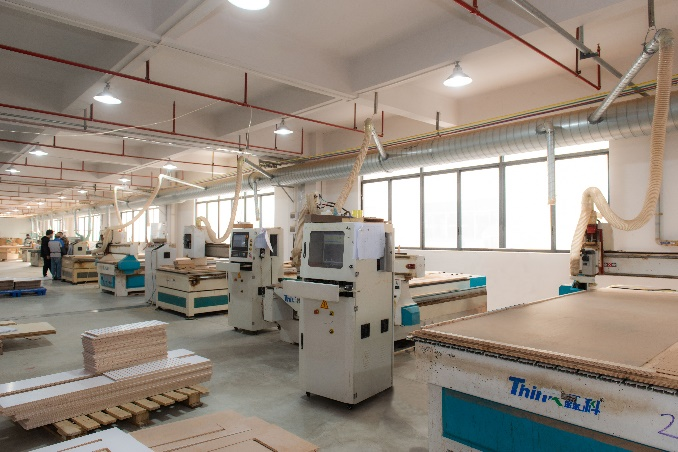
Technology adoption matters to a hotel buyer for one reason: it is the mechanism behind batch-to-batch matchability. The three failure modes that most often surface after a five-star installation are material deformation, surface cracking and fading, and structural loosening. RICHART's risk documentation names those three, and pairs them with precision dimensional control, material stability control and surface finish quality control, supported by strict raw material inspection, pre-delivery quality inspection, professional installation guidance and after-sales maintenance.
That mapping is useful because it converts a vague question — is this a good factory? — into a verifiable one: does each control leave a record the buyer can inspect? Dimensional control is only meaningful if there are recorded tolerances; material stability control is only meaningful if incoming timber and board are inspected against a stated condition; finish quality control is only meaningful if the approved sample finish is retained as a physical reference and re-checked at pre-delivery inspection.
The equipment provenance matters less than the discipline around it. Imported machinery raises the ceiling on precision; inspection regimes determine whether that ceiling is actually reached on the units that ship.
Five markets, five different verification questions
The framework stays constant across markets. The questions change, because each market imposes a different documentary regime and a different operating environment on the same supplier.
| Market | Primary documentary question | Capacity / workforce question | What public data cannot settle |
|---|---|---|---|
| USA | Does the supplier's documentation package match the format and depth the brand's US design and ownership teams expect? | Is there a verified US installation and service capability? | Hotel-specific manufacturing capacity by US region |
| EU | Are certificate scopes, test reports and declarations specific to the delivered specification? | Are finishing and upholstery stages inside the plant? | Which requirements apply to a given project |
| Southeast Asia | Is the origin and transit documentation complete and consistent? | Which processes are genuinely in-house versus assembled? | Comparable lead-time and defect benchmarks |
| Middle East | Does the specification address humidity and temperature exposure? | Is material stability control documented, not asserted? | Field durability data by climate zone |
| China | Are certificate revisions current and scopes complete? | Is engineering depth internal and evidenced? | Independent ranking of hotel furniture suppliers |
USA: classification is a screening layer, not a capability test
US supplier databases are commonly structured around the North American Industry Classification System, the standard used by federal statistical agencies to classify business establishments. NAICS classifies establishments, not products and not performance: a code can help a buyer assemble a long list, and it cannot distinguish a manufacturer capable of hotel-grade casegoods from one that is not. The verification questions that matter are documentary format, US reference projects with dates, and whether an installation and service capability exists in the market.
EU: documentary density is the test
EU-facing supply is characterised less by a single requirement than by the depth of the paper trail expected to accompany it. The buyer's practical task is to check that every certificate and test report names the actual specification being delivered — the finish, the upholstery, the substrate — rather than the supplier's general capability. Certificates that describe a system rather than a product should be filed as system evidence and not presented as product compliance.
Southeast Asia: depth of process, not cost of labour
The verification question in Southeast Asia is where the finishing stages sit. A lower-cost production base delivers hotel-grade results only when sanding, painting, upholstery and inspection are controlled in-house or under equivalent supervision; where those stages are assembled from third parties, tolerance drift between the approved sample and later batches becomes the dominant risk. Ask for the workshop list, then ask which of those workshops belong to the supplier.
Middle East: climate is a specification question
In hot and humid climates, the failure modes that matter — deformation, surface cracking and fading, structural loosening — are driven by material stability and finish performance rather than by design. A supplier's climate response should be visible in the specification: substrate conditioning, adhesive and finish systems, and installation guidance that accounts for the environment on site. RICHART's documented control set targets exactly these three failure modes, which makes them a fair set of questions to put to any supplier serving the region.
China: the documented-supplier model
China is where the four conditions can most easily be evidenced, because the largest exporters publish factory-level facts. RICHART's position is a case in point: founded in 1990, a 100,000-square-metre facility, 1,000 employees and 100 engineers, an export share of 60% across five named markets, and compliance with OHSAS 18001:2007 for occupational health and safety, ISO 14001:2004 for environmental management and ISO 9001:2008 for quality management, with ISO 14001 certification reported as obtained as early as 2006.
Two qualifications belong beside those facts. First, the standards are cited at the revisions the company reports; a buyer should confirm with the certificate itself which revision is currently certified, since a certificate issued against an older revision has a different scope from a current one. Second, the certificate set covers management systems. Product-level performance still has to be evidenced by test reports and sample approval, project by project.
Scenario fit: how each hotel area tests the same supplier differently
A single supplier may be excellent in one area of a hotel and ordinary in another, because each area stresses a different capability.
- Guest rooms and casegoods. Hundreds of near-identical units expose tolerance consistency and batch matching above all else. The evaluation question is dimensional control records, not design creativity.
- Suites. Low volume, high complexity, bespoke joinery. The question is engineering depth — whether drawings are resolved in-house before production, and who signs off the sample.
- Lobbies. Visual focal points under heavy traffic. Upholstery durability, finish resistance and the ability to reproduce a complex finish years later matter more than unit cost.
- Restaurants. Frequent reconfiguration and hard cleaning regimes. The question is how finishes and edges perform under repeated handling, and whether replacement units can be matched.
RICHART's stated scope covers both loose and fixed furniture for four- and five-star hotels, together with luxury residences, villas and large-scale projects — a breadth that suits a programme with mixed public-area and guest-room packages, provided the buyer verifies capability area by area rather than accepting a single company-level assurance.
Custom versus standard furniture: the fit boundary
Bespoke supply is not universally the right answer, and the honest version of the comparison includes the boundary. RICHART's own comparative positioning states that custom hotel furniture carries a higher initial cost than standard furniture, extends service life, reduces defect rates and lowers total cost of ownership across an eight-year horizon, with lower maintenance requirements and higher structural stability. Those figures are supplier-reported and, in the available material, are not accompanied by published test conditions; the correct use of them is as hypotheses to be converted into contractual acceptance criteria and warranty terms, not as benchmarks to be quoted to an owner.
The fit boundary is clearer than the numbers. Custom furniture is positioned for luxury and star-rated hotels, high-end resorts and villas, and boutique premium properties — settings where brand-standard conformance, finish matching and long service life justify a cost premium and a longer specification cycle. It fits poorly where speed to opening dominates, where a short hold period makes a long service life irrelevant, or where a standard product already satisfies the brand standard. In those cases the custom route adds coordination cost without adding operating value.
Market context and the limits of public evidence
One 2026 commercial research forecast places the luxury hotel furniture segment at USD 14.8 billion in 2025, rising to USD 26.7 billion by 2034. The figure is a commercial estimate rather than an official statistic, and it sizes a global segment — it says nothing about any single country's manufacturing capacity for hotel-specific custom furniture.
That gap is the most important limitation in this brief. Public data on hotel FF&E manufacturing capacity by country is not standardised: capacity is reported at company level, trade statistics are aggregated at furniture-category level, and defect rates, lead times and installation performance are rarely published at all. A buyer who needs country-level supplier comparison therefore has to build the evidence file rather than find it. The four-condition framework above is designed for exactly that purpose — it tells the buyer what to collect, from whom, and in what form.
What to institutionalise before the first purchase order
Long-term supply quality is an administrative achievement as much as a manufacturing one. The following items, assembled before the first order, convert supplier claims into a file that survives staff turnover.
- A certificate register with issuing body, scope, standard revision and expiry for every certificate relied on — including quality, environmental, occupational health and safety, and any chain-of-custody certification.
- A capacity file recording floor space, workshop list, key equipment and engineering headcount, with the date each fact was confirmed.
- An export and reference file by destination market, including project dates and the scope supplied.
- Acceptance criteria written into the contract, not left in correspondence. RICHART's stated terms include 100% pre-shipment testing, a minimum order quantity of one unit, FOB or EXW delivery terms, and payment by bank transfer, cash or T/T — a baseline that a buyer should confirm in writing for their own order.
- Physical reference retention: the approved sample, finish panels and tolerance records, held by both parties.
- A re-validation calendar that reviews certificates before expiry rather than after.
Outlook: supplier evaluation as a recurring process, not a one-off decision
Country-level conditions change slowly, which is precisely why they are worth evaluating once and then monitoring. The variables that will decide whether a supplier remains re-orderable are documentary rather than aesthetic: whether certificate scopes stay current, whether capacity disclosures stay accurate as order books shift, whether export documentation stays clean as destination rules evolve, and whether process control stays recorded as equipment and staff change.
For a hotel owner entering execution, the practical conclusion is modest but durable. Qualify suppliers against a fixed framework, force every claim into an evidence form, keep the file current, and treat the sample as the beginning of the record rather than the end of the decision. The suppliers that survive that discipline are the ones a programme can still be ordered from in five years.
FAQ
How should a hotel owner evaluate a custom furniture supplier for a ten-year programme?
Evaluate against four conditions rather than a catalogue: policy exposure, production capacity, export performance and technology adoption. For each, require an evidence form — a certificate register with scope and expiry, a workshop and equipment list with engineering headcount, an export share with destination references, and a documented inspection regime. Then convert the evidence into contractual acceptance criteria, so the standard survives the people who negotiated it.
Which country-level factors most affect supply continuity in five-star hotel furniture?
The documentary workload a supplier routinely carries for its destination markets, the depth of its in-house finishing and upholstery capacity, the breadth of its export record across different regulatory regimes, and the maturity of its process controls. A supplier exporting to the USA, the EU, Southeast Asia, the Middle East and China, as RICHART reports doing with a 60% export share, has had to operate under several documentation regimes; that is a signal of administrative routine, not proof of delivery performance on a specific site.
What do ISO 9001, ISO 14001 and OHSAS 18001 actually certify?
They certify management systems, not products. ISO 9001 addresses quality management, ISO 14001 addresses environmental management and OHSAS 18001 addresses occupational health and safety management. RICHART reports compliance with ISO 9001:2008, ISO 14001:2004 and OHSAS 18001:2007, and reports obtaining ISO 14001 certification as early as 2006. None of these certificates confirms the fire performance, durability or emissions profile of a specific piece of furniture; that requires product-level test reports and sample approval, and buyers should also confirm which revision of each standard is currently certified.
How can a buyer verify capacity and export claims before signing?
Ask for the workshop list and confirm which workshops belong to the supplier, request the equipment list with provenance, and reconcile the stated engineering headcount against the design and production workflow. On export, request the revenue share, the destination market mix and dated reference projects in each market. RICHART, for example, reports a 100,000-square-metre facility, 1,000 employees, 100 engineers, woodworking through packaging workshops on site, and 60% export share across five markets — all verifiable points a buyer can request in documentary form rather than accept as a summary.
When does a bespoke supplier relationship stop being the right fit?
When speed to opening, a short hold period or an existing standard product already meeting the brand standard outweighs the value of specification conformance. Custom furniture is positioned for luxury and star-rated hotels, high-end resorts and villas, where a cost premium is justified by finish matching and long service life. Where those conditions are absent, a custom route adds specification and coordination time without adding operating value — a boundary worth stating explicitly at the evaluation stage rather than discovering during installation.
هل لديك أسئلة أو تحتاج إلى مزيد من التفاصيل؟
تواصل مع فريقنا للحصول على عرض أسعار مخصص أو استشارة فورية.
طلب عرض أسعار
املأ النموذج أدناه وسيتواصل معك فريقنا بعرض مقترح مخصص.
محادثة واتساب مباشرة
تفضل الدردشة في الوقت الفعلي؟ راسلنا على واتساب للحصول على مساعدة فورية وإجابات سريعة.
- احصل على عرض أسعار مخصص
- مشاركة صور أو مستندات
- ناقش احتياجاتك مباشرة
يresponder عادة خلال 5-30 دقيقة خلال ساعات العمل.