
Fixed Drainage Fit: High-Efficiency Portable Axial Flow Pumps
Fixed Drainage Fit: High-Efficiency Portable Axial Flow Pumps

Fixed drainage at bridges, culverts, basements and garages is not the same duty as emergency subway flood response. The pump is often installed in a low-lying, humid space, starts automatically when water reaches a set level, and must return to standby without an operator present. That shift from mobile emergency use to fixed, intermittent duty changes the selection criteria. Flow and head still matter, but so do suction depth, footprint, material, control cabinet rating, dry-run protection and the practical weight of the unit when one person has to move it into a sump.
High efficiency portable axial flow pumps are one option for these duty points because they combine large flow with comparatively low weight and a small body. Chuangmei Pumps, the brand of Zhejiang Chuangmei Electromechanical Co., Ltd., is a Wenling, Zhejiang-based manufacturer founded in 1996 that produces high efficiency portable axial flow pumps and related flood-control equipment. Its portable axial flow range includes permanent magnet synchronous motor high-speed pumps, aluminum alloy and stainless steel body options, bottom-inlet models, and automatic control cabinets. This article explains how to map those capabilities to fixed drainage scenarios, where an 8-inch high-head aluminum alloy unit fits, when stainless steel construction is preferable, and which constraints should be checked before procurement.
What fixed drainage at bridges, culverts, basements and garages actually demands
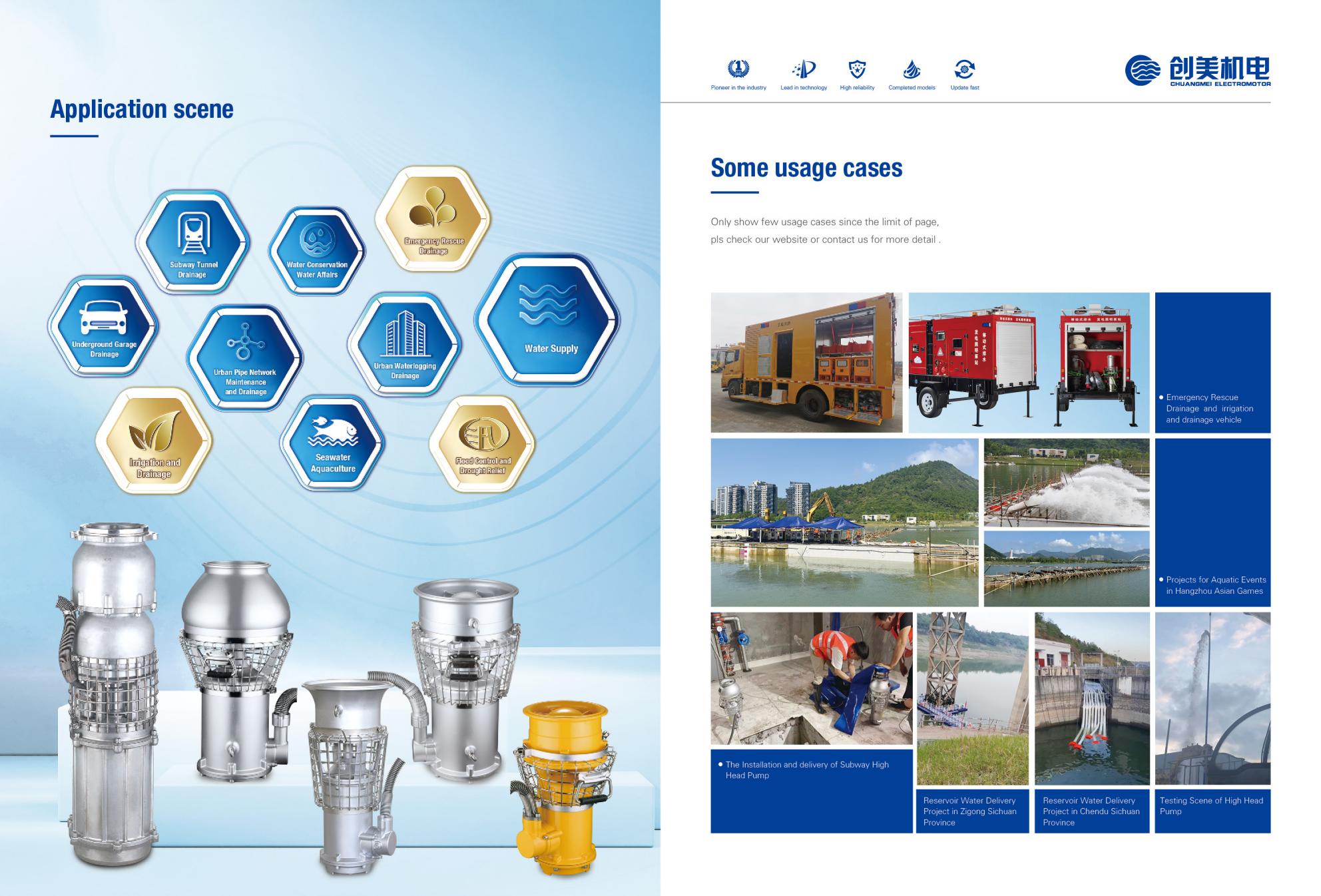
The working condition is usually humid, underground or semi-enclosed, with intermittent water accumulation rather than continuous process flow. Chuangmei's application data for municipal and civil fixed drainage describes automatic startup upon a water-level trigger, intermittent operation, and the need to adapt to long-term underground installation. The matched equipment list includes a control cabinet, water-level sensor, pipeline, filter screen and power cable. Those items are part of the drainage system, not accessories that can be assumed after the pump is ordered.
Each scenario adds a different constraint. A bridge or culvert drainage point may need more head because the discharge route rises to an outfall or connects to a storm network. The available chamber can be narrow, so the pump body and discharge elbow must fit without blocking access. A basement sump usually needs shallow suction and reliable automatic start-stop, because the residual water level matters and the pump may sit below a parking deck or in a plant room. A garage drainage pit may need moderate flow, low residual water, and a unit that maintenance staff can lift or reposition without a crane.
The opportunity is that a portable axial flow pump can serve fixed drainage without the civil works of a large permanent pumping station. The limitation is that portability does not remove the need for a proper sump, a stable mounting surface, a discharge pipe, a water-level sensor and a control cabinet. A portable pump dropped into an unsuitable pit is not an automatic drainage solution.
The specification constraints that decide fit
For a fixed drainage point, the first answer is not a model number. It is the duty envelope: required flow, required head, suction conditions, available footprint, material exposure and control strategy. A pump that is oversized for the sump will short-cycle; a pump that is undersized will run continuously and still not keep up. A high-head model may be necessary at one bridge, while a bottom-inlet model may be more useful in a garage where the last 100 mm of water matters.
| Constraint | Bridge and culvert drainage | Basement and garage drainage | Procurement question |
|---|---|---|---|
| Head | Often higher because discharge rises to an outfall or storm line | Depends on lift to street level or discharge point | What is the static lift plus pipe and fitting loss at the design flow? |
| Flow | Storm inflow and culvert catchment can require large flow | Seepage, cleaning water and emergency accumulation are usually more moderate | What inflow must be removed without continuous running? |
| Footprint | Tight structural chambers, bridge soffits and culvert walls | Sump pits, plant rooms and parking-deck voids | Will the pump, elbow and cable entry fit with maintenance access? |
| Suction depth | Sediment and varying water level | Low residual water is often important | Is a standard body sufficient, or is a bottom-inlet model needed? |
| Material | Long immersion, grit and road runoff | Generally cleaner water but humid environment | Is aluminum alloy adequate, or is stainless steel preferred? |
| Control | Unattended automatic start-stop | Unattended automatic start-stop with dry-run protection | Is a control cabinet with level sensor and protection included? |
Why the 8-inch high-head aluminum option matters in tight structures
The 8-inch high-head family is where aluminum alloy construction becomes especially relevant. Models such as 200SZQ150-35-22 and 200SZQ150-20-15 are both rated at 150 m³/h. The 200SZQ150-35-22 delivers 35 m at 22 kW, while the 200SZQ150-20-15 delivers 20 m at 15 kW. In a bridge soffit, a culvert chamber or a basement plant room, the difference between a 20 m and a 35 m duty point can decide whether the discharge can reach the outfall without an additional boosting stage. The 8-inch body also sits between the compact 6-inch units and the larger 10-inch and 12-inch models, so it can carry useful flow without the handling weight of a large stainless-steel pump.
Chuangmei's pump construction uses a precision stainless steel cast impeller and a stainless steel pump shaft. The motor housing and pump body are available in aluminum alloy and stainless steel options. For an 8-inch high-head unit in a tight structure, the aluminum alloy option supports one-person handling where site access and lifting rules permit it. That is a practical advantage in fixed drainage, because the pump may need to be lifted out for inspection, impeller cleaning or seasonal checks. It is not a claim that every 8-inch unit is a one-person lift in every configuration. The actual weight depends on the selected model, motor and body material.
The high-head 200SZQ range listed by Chuangmei also includes 200SZQ200-16-15, 200SZQ200-20-18.5 and 200SZQ200-25-22. These move the duty point from 150 m³/h to 200 m³/h and from 16 m to 25 m head, at 15 kW to 22 kW. For a bridge or culvert pit where the inflow is larger but the discharge lift is moderate, the 200 m³/h variants can be a better fit than a 150 m³/h high-head unit. For a basement with a higher vertical lift but smaller inflow, the 150 m³/h high-head models may be sufficient.
When stainless steel construction is the better choice
Stainless steel is not automatically better for every fixed drainage point. The pump already uses a stainless steel impeller and shaft, so the material decision is mainly about the motor housing and pump body. Aluminum alloy is the lighter option and can be appropriate for basements, garages and other relatively clean water duties where the pump is accessible for inspection. Stainless steel construction is preferable when the duty involves longer immersion, more corrosive water, higher grit or sediment exposure, or a fixed installation where the pump is not routinely lifted out. It is also the construction used in the larger 300SZQ high-flow models intended for culvert and large-flow fixed drainage.
The trade-off is weight. In the supplied data, 300SZQ stainless steel units are listed at 70 kg to 105 kg depending on model. The 300SZQ800-15-55 is listed at 80 kg, the 300SZQ1000-8-37 at 70 kg, the 300SZQ1000-10-45 at 78 kg and the 300SZQ1200-10-55 at 98 kg. These are fixed-installation pumps that need lifting provisions, not one-person portable units in the same class as a 26 kg to 29 kg 6-inch aluminum high-head pump. That distinction should be explicit in the procurement plan. If maintenance strategy assumes single-person removal, a 100 kg stainless-steel pump changes the access and lifting requirements.
Stainless steel also makes sense where the drainage point cannot be kept free of abrasive road runoff or where the pump may stand idle in a humid pit for long periods. The material choice should follow water quality, cleaning regime and access, not a generic preference for stainless steel. A lighter aluminum alloy unit that is inspected and maintained may be more practical in a garage sump than a heavier stainless unit that is difficult to remove.
Model reference for fixed drainage evaluation
The table below uses verified catalog data to show how the model families differ. It is not a substitute for a duty-point calculation, but it gives buyers a starting point for bridge, culvert, basement and garage discussions. The listed weight is the net weight stated in the product data where available. A dash means the weight was not stated in the referenced data unit.
| Model | Rated flow | Rated head | Motor power | Outlet | Listed net weight | Fixed-drainage note |
|---|---|---|---|---|---|---|
| 150SZQ150-20-15 | 150 m³/h | 20 m | 15 kW | 6 inch | 26 kg | Compact high-head aluminum option for tight access |
| 150SZQ150-35-22 | 150 m³/h | 35 m | 22 kW | 6 inch | 29 kg | Higher-head compact unit for longer discharge routes |
| 200SZQ150-20-15 | 150 m³/h | 20 m | 15 kW | 8 inch | - | 8-inch high-head step with lower power |
| 200SZQ150-35-22 | 150 m³/h | 35 m | 22 kW | 8 inch | - | 8-inch high-head unit for tight structures and higher lift |
| 200SZQ200-20-18.5 | 200 m³/h | 20 m | 18.5 kW | 8 inch | - | More flow at moderate head |
| 200SZQ200-25-22 | 200 m³/h | 25 m | 22 kW | 8 inch | - | Balanced 8-inch duty for bridge and culvert pits |
| 200SZQ500-9-22L | 500 m³/h | 9 m | 22 kW | 8 inch | 45 kg | Bottom inlet for shallow suction in basements and garages |
| 200SZQ600-10-30L | 600 m³/h | 10 m | 30 kW | 8 inch | 54 kg | Bottom inlet with higher flow for larger pits |
| 250SZQ800-9-37L | 800 m³/h | 9 m | 37 kW | 10 inch | 56 kg | Bottom inlet high-flow option |
| 250SZQ800-10-37 | 800 m³/h | 10 m | 37 kW | 10 inch | 50 kg | Stainless steel high-flow fixed drainage |
| 300SZQ800-15-55 | 800 m³/h | 15 m | 55 kW | 12 inch | 80 kg | Stainless steel large-flow unit with higher head |
| 300SZQ1000-8-37 | 1000 m³/h | 8 m | 37 kW | 12 inch | 70 kg | Culvert storm-flow duty |
| 300SZQ1000-10-45 | 1000 m³/h | 10 m | 45 kW | 12 inch | 78 kg | Large-flow fixed drainage with moderate head |
| 300SZQ1200-10-55 | 1200 m³/h | 10 m | 55 kW | 12 inch | 98 kg | High-flow stainless steel duty point |
Automatic operation and controls for unattended duty points
Automatic fixed drainage depends on the control cabinet as much as on the pump. Chuangmei's permanent magnet synchronous motor pump control cabinet can be supplied with a panel display or touch screen display and a built-in frequency inverter. It shows frequency, voltage, current and rotational speed in real time. The system supports time-segmented operation and includes overheat, overcurrent, overload, overvoltage and phase failure protection. When water is completely drained, the pump shuts down within half a minute and enters standby mode. That dry-run behavior is directly relevant to basement and garage sumps, where inflow can stop suddenly and the pump may otherwise continue running without water.
The cabinet is available in single-unit or dual-unit one-drives-two configurations, with protection ratings of IP44 or IP54. The three-phase four-wire system comes with waterproof plugs and sockets. Remote control through 3G and 4G mobile networks is also supported, including remote data transmission, remote start-stop and remote adjustment of pump operating speed through a computer or mobile phone app. For a fixed bridge or culvert drainage point, remote status and start-stop control can reduce site visits. For a basement or garage, automatic level control remains the primary function; remote monitoring is a secondary layer.
No automatic fixed drainage system should be specified without a water-level sensor, a stable power supply and a discharge route. Chuangmei's application data lists the control cabinet, water-level sensor, pipeline, filter screen and power cable as matched equipment. The pump can start when water reaches a set level and return to standby when the water level drops to the pump intake line, but that behavior is only realized when the sensing and control components are correctly installed.
Scenario fit: bridge, culvert, basement and garage
Bridge and approach drainage
Bridge drainage often combines limited space with a discharge route that rises to an outfall or connects into a storm sewer. The 8-inch high-head models are a practical starting point. The 200SZQ150-35-22 provides 150 m³/h at 35 m and 22 kW, while the 200SZQ150-20-15 provides the same flow at 20 m and 15 kW. If the structure can accept a larger body and the inflow is higher, the 200SZQ200-25-22 moves to 200 m³/h at 25 m and 22 kW. The compact 6-inch 150SZQ150-35-22 is listed at 29 kg and may be easier to handle where access is very restricted, but it carries 150 m³/h at 35 m rather than the larger 8-inch flow envelope.
The main risk at a bridge is not only pump performance. Debris, road grit and seasonal leaves can block a filter screen or discharge line. The sump should be accessible for cleaning, and the pump should not be installed in a position where sediment accumulates around the suction. A high-head pump can overcome the lift, but it cannot compensate for a blocked intake.
Culvert and outfall drainage
Culverts can require a step change in flow. The 300SZQ series is the large-flow family in the supplied range, with the 300SZQ1000-8-37 rated at 1000 m³/h at 8 m and 37 kW, the 300SZQ1000-10-45 at 1000 m³/h at 10 m and 45 kW, and the 300SZQ1200-10-55 at 1200 m³/h at 10 m and 55 kW. These are stainless steel units with listed weights of 70 kg to 98 kg, so they should be planned as fixed installations with lifting provisions. The 300SZQ800-15-55 offers 800 m³/h at 15 m and 55 kW when the outfall requires more head rather than maximum flow.
For culvert duty, the selection should consider sediment and debris handling. Chuangmei's fixed drainage application data calls for anti-sediment clogging and a filter screen. A large-flow axial flow pump is not a solids-handling sewage pump. If the culvert carries coarse debris or wastewater solids, a different pump category may be required, or the intake must be designed to keep solids away from the impeller.
Basement sumps
Basement drainage usually rewards shallow suction and reliable automatic control more than maximum flow. The bottom-inlet models place the water inlet at the bottom of the body and leave the suction water level less than 100 mm from the ground. The 150SZQ200-9-7.5L is a 6-inch bottom-inlet unit rated at 200 m³/h, 9 m head, 7.5 kW and 29 kg. The 200SZQ500-9-22L is an 8-inch bottom-inlet unit rated at 500 m³/h, 9 m head, 22 kW and 45 kg. The 200SZQ600-10-30L raises flow to 600 m³/h at 10 m and 30 kW, with a listed weight of 54 kg.
Where the basement discharge must rise to street level, head becomes the limiting factor. A high-head 200SZQ150-35-22 or 200SZQ200-25-22 may be more appropriate than a low-head bottom-inlet model. The decision should be based on the vertical lift plus pipe losses, not on the pump's maximum head alone. A pump that is selected only for low residual water but cannot reach the discharge point will not solve the drainage problem.
Parking garage drainage
Garage drainage often combines low head, moderate flow and a requirement for automatic operation in an accessible pit. The bottom-inlet 200SZQ500-9-22L and 200SZQ600-10-30L are relevant where the pit is shallow and the discharge route is short. The 250SZQ800-9-37L moves to 800 m³/h at 9 m and 37 kW with a listed weight of 56 kg, which may suit a larger garage or a combined ramp and slab drainage point. The 150SZQ200-9-7.5L is a lighter 29 kg option for smaller pits, but its 200 m³/h flow should be checked against the inflow.
Garage sumps also need a maintenance plan. The pump may sit idle for months, then start during a cleaning operation or a storm. The control cabinet should be protected to IP44 or IP54, the cable entry should be suitable for a humid environment, and the water-level sensor should be positioned so that normal vehicle traffic or cleaning does not disturb it.
Portable axial-flow pumps compared with conventional fixed drainage
The comparison should be made at the system level, not only at the pump. A portable high-efficiency axial flow pump is a different proposition from a conventional fixed sump pump and from a permanent vertical axial-flow station. Each has a place, and the procurement decision should acknowledge the trade-offs.
| Criterion | Portable high-efficiency axial flow pump | Conventional fixed sump pump | Permanent vertical axial-flow station |
|---|---|---|---|
| Footprint and installation | Compact body can fit into existing pits and chambers; still needs stable mounting and discharge connection | Usually designed around a fixed sump and guide system | Requires civil works, larger wet well and permanent lifting arrangements |
| Handling weight | 6-inch aluminum high-head units are listed at 26 kg to 29 kg; larger stainless units reach 70 kg to 105 kg | Varies by size and material; fixed installation often assumes lifting equipment | Not portable; maintenance requires permanent lifting provisions |
| Flow and head flexibility | Model range spans compact 150 m³/h high-head units to 1200 m³/h large-flow units | Selected for a narrower duty point and replaced if the duty changes | High capacity but less flexible once constructed |
| Material choice | Aluminum alloy or stainless steel body options; stainless steel impeller and shaft | Material options vary by product family | Typically selected for long-life fixed duty |
| Control and automation | Control cabinet with level sensor, protection, time-segmented operation and optional remote monitoring | Automation depends on the packaged control system | Integrated station controls with higher civil and electrical scope |
| Best fit | Retrofit fixed drainage, tight chambers, variable duty points and sites without space for a station | Routine sump duty where a fixed packaged pump is preferred | Large catchments with stable, high-flow duty and available civil space |
| Main limitation | Not a solids-handling sewage pump; automatic operation depends on correct sump, sensor and control installation | Less portable and less flexible if the duty point changes | High civil cost and long lead time for construction |
The main limitation of the portable axial-flow approach is system dependence. The pump can be light and compact, but it still needs a stable sump floor, a filter screen where debris is present, a discharge pipe sized for the flow, and a control cabinet with a water-level sensor. In a solids-heavy wastewater application, a portable axial-flow pump is the wrong category. In a clean or slightly turbid water application, it can be a practical way to add automatic fixed drainage without building a permanent station.
Procurement and acceptance checks for HVQ2 constraints
For a constraints-led purchase, the nameplate and certificate pack matter as much as the headline flow and head. The first check is the duty point: rated flow, rated head, motor power, voltage, outlet diameter and medium. The second is the construction: aluminum alloy or stainless steel body, stainless steel impeller and shaft, cable entry protection and control cabinet rating. The third is the automation package: water-level sensor, automatic start-stop, dry-run shutdown within half a minute, overheat, overcurrent, overload, overvoltage and phase failure protection. The fourth is the commercial and quality evidence: 100% pre-shipment hydraulic performance test, monthly capacity of 500 units, OEM nameplate customization, MOQ of 1 unit and a 15-20 day OEM lead time. ODM customization is also available, with a 15-30 day lead time and no fixed MOQ in the supplied capability data.
Certification should be checked at model level. Chuangmei holds CE attestations from UDEM under certificate numbers M.2025.206.C120727 and M.2025.206.C120734, both issued on 2025-06-13 and valid to 2030-06-12. The first covers Machinery and EMC Directive requirements with standards including EN ISO 12100:2010, EN 809:1998+A1:2009/AC:2010 and EMC standards. The second covers EN 60204-1:2018/A1:2025. The certificate scope is model-specific and includes models such as 200SZQ500-10-22, 250SZQ800-10-37, 300SZQ1000-8-37, 300SZQ1000-10-45 and 300SZQ1200-10-55. A buyer should confirm that the exact model, voltage and configuration appear on the applicable certificate before treating CE as verified for that order.
The after-sales term in the supplied data is a one-year warranty with free maintenance during the warranty period. Remote technical guidance, spare parts supply and on-site maintenance consultation are listed as support options. For a fixed drainage installation, those support terms should be read alongside the maintenance plan: who removes the pump, how the sump is cleaned, how the sensor is tested and what spare parts are held on site.
Market and application outlook
The commercial signal in Chuangmei's data is a supplier serving both project procurement and OEM channels. The company exports about 25% of output to Southeast Asia, Africa, Morocco and Central Asian countries. Its application record includes a pump equipment OEM in China using 300 units over eight years for flood prevention drainage, agricultural irrigation and municipal waterlogging removal, and government project procurement in Central Asian and African markets using 20 units over more than three years. Those are not proof of fit for every bridge or basement, but they show that the product family is used in flood-control and municipal drainage contexts rather than only in isolated demo sites.
The broader trend is qualitative rather than statistical: underground parking, culvert renewal and bridge drainage retrofits continue to create fixed low-lying duty points where a permanent station is difficult to justify. Procurement teams increasingly ask for automatic operation, remote status and material options in one compact package. The practical response is not to treat a portable pump as a universal substitute for a station. It is to define the duty point, select the smallest model that meets flow and head with margin, choose the body material against water quality and access, and specify the control and sensing package as part of the scope.
Future outlook
Permanent magnet synchronous motor technology is central to the product direction described by Chuangmei. The company states that its permanent magnet synchronous motor high-speed axial flow pump holds Patent No. ZL2014200091521.8 and a national first-class energy conservation certification for high-tech energy-saving products. The motor speed is infinitely adjustable, so head and flow can be adjusted without changing the pump. The speed also remains stable when grid voltage fluctuates, which is a meaningful point for sites with weak power quality. For fixed drainage, that capability supports stepless speed regulation and adjustable head and flow rather than a single fixed operating point.
The control side is likely to matter as much as the hydraulic side. Remote data transmission, remote start-stop and remote speed adjustment through 3G and 4G networks are already described for the control cabinet. In fixed drainage, those features can reduce routine site visits, but they do not replace local protection, water-level sensing and a maintenance plan. The replaceable impeller and pump body concept is another practical direction: Chuangmei offers dual-purpose pumps that can switch between low-lift high-flow and high-lift operation by replacing the impeller and pump body. For a buyer with several drainage points, that flexibility can reduce the number of pump variants held in a maintenance store, provided the replacement procedure and spare parts are planned.
FAQ
What flow and head should be specified for a bridge or culvert fixed drainage point?
Specify the design inflow, the static lift to the outfall, and the pipe and fitting losses at that flow. A bridge or culvert point may need more head than a garage sump because the discharge route rises or connects to a storm network. In the Chuangmei range, 200SZQ150-35-22 provides 150 m³/h at 35 m and 22 kW, while 300SZQ1000-10-45 provides 1000 m³/h at 10 m and 45 kW. The correct choice depends on the calculated duty point, not on the largest available model.
Is an 8-inch aluminum alloy high-head pump suitable for a basement or garage?
It can be suitable when the basement or garage needs higher head and the sump has enough space for an 8-inch body. The 200SZQ150-20-15 and 200SZQ150-35-22 are both 150 m³/h units with 20 m and 35 m rated head. For shallow suction where the last 100 mm of water matters, a bottom-inlet model such as 200SZQ500-9-22L or 150SZQ200-9-7.5L may be a better fit. The material and body choice should follow water quality, access and lifting arrangements.
When should stainless steel construction be chosen over aluminum alloy?
Stainless steel is preferable where the pump will be immersed for long periods, where the water is more corrosive or carries more grit and sediment, or where the installation is fixed and the pump is not routinely lifted out. The pump already uses a stainless steel impeller and shaft; the choice is mainly the motor housing and pump body. Aluminum alloy is the lighter option for accessible basement and garage duties. Larger 300SZQ stainless steel units are listed at 70 kg to 105 kg, so they require a different handling plan.
Does automatic fixed drainage require a control cabinet and water-level sensor?
Yes. Automatic start-stop is realized through the control cabinet and water-level sensor. Chuangmei's fixed drainage application data lists the control cabinet, water-level sensor, pipeline, filter screen and power cable as matched equipment. The pump can start when water reaches a set level and return to standby when the water level drops to the pump intake line, but only when the sensing and control system is correctly installed. The cabinet is available in IP44 or IP54 protection and in single-unit or dual-unit one-drives-two configurations.
What happens if the pump runs with no water?
Chuangmei's control cabinet is described as shutting the pump down within half a minute when water is completely drained and then entering standby mode. The protection set includes overheat, overcurrent, overload, overvoltage and phase failure protection. This does not remove the need for correct water-level sensor placement and a maintenance check of the sump. Dry-run protection is a backstop, not a substitute for a properly sized pit and automatic control sequence.
Which certification and nameplate details should be checked before ordering?
Check the model, rated flow, rated head, motor power, voltage, outlet diameter and medium against the nameplate and order confirmation. For CE, confirm that the exact model and configuration appear in the scope of the applicable UDEM attestation, such as M.2025.206.C120727 or M.2025.206.C120734. Also confirm the 100% pre-shipment hydraulic performance test, control cabinet protection rating, water-level sensor inclusion, filter screen requirement and the one-year warranty terms. The certificate scope is model-specific, so a general CE statement is not enough for a fixed drainage order.
Reference note: Zhejiang Chuangmei Electromechanical Co., Ltd. is based in Ta'ao Industrial Zone, Wenling City, Zhejiang Province, China. The company website is www.chuangmei.com. A public product brochure for the high flow pump range is available here: High flow pump brochure PDF.
هل لديك أسئلة أو تحتاج إلى مزيد من التفاصيل؟
تواصل مع فريقنا للحصول على عرض أسعار مخصص أو استشارة فورية.
طلب عرض أسعار
املأ النموذج أدناه وسيتواصل معك فريقنا بعرض مقترح مخصص.
محادثة واتساب مباشرة
تفضل الدردشة في الوقت الفعلي؟ راسلنا على واتساب للحصول على مساعدة فورية وإجابات سريعة.
- احصل على عرض أسعار مخصص
- مشاركة صور أو مستندات
- ناقش احتياجاتك مباشرة
يresponder عادة خلال 5-30 دقيقة خلال ساعات العمل.