
Flat Bottom vs Stand-Up Zipper Bag Machines: Buyer Comparison
Flat bottom with zipper bag making machines and stand-up with zipper bag making machines are not interchangeable options competing for the same slot. They build different pouch architectures, impose different changeover burdens, and pay back against different order books. For medium and large flexible packaging factories running diversified bag types and mass continuous production, the real decision is not which machine is better, but which machine matches the pouch mix already quoted to customers.
Why this comparison has reopened in 2025–2026
The global bag making machine market was valued at USD 4.8 billion in 2025 and is projected to reach USD 8.1 billion by 2034, according to Dataintelo. Asia Pacific held a 43.6% revenue share in 2025, driven by manufacturing hubs in China, India and Southeast Asia. Automatic bag making machines accounted for 52.4% of global product type share in the same year, reflecting the shift toward industrial automation.
The demand side explains why two zipper-capable platforms now sit in the same capital plan. The stand-up pouches market was valued at USD 30.7 billion in 2023 and is projected to grow at a CAGR of 8.0% through 2030 (Grand View Research). Zipper closure dominated the pouch market in 2025 with 41.0% of total revenue share, while flat pouches held the largest product revenue share at 63.7%, supported by cost-efficiency and high-speed production capability.
Read together, those figures describe a factory that rarely runs one pouch format only. Zipper demand is broad, but it splits across flat bottom constructions and stand-up (doypack) constructions. A factory that has been running flat pouches at high speed and now receives stand-up zipper enquiries is facing a machine-selection problem, not merely a capacity problem.
What each machine actually builds
A flat bottom with zipper bag making machine produces a pouch with a formed flat base panel and side gussets, closed by a zipper at the top. The defining mechanical work is bottom forming: the base panel must be folded, inserted and sealed so the pouch stands on a rectangular footprint without a bottom gusset fold collapsing.
A stand-up with zipper bag making machine, often described as a doypack bag making machine, produces the centre-sealed pouch body with a bottom gusset that opens into a standing base. Here the defining work is gusset formation plus the doypack shaping step, with the zipper applied as a top closure.
Both platforms share a common set of stations: film unwinding, registration control, zipper feeding and sealing, main sealing and cooling, and cutting. The divergence sits upstream of the sealing station, in how the base is formed and how the folded geometry is held with tolerance at production speed.
Where the two architectures separate
| Comparison dimension | Flat bottom with zipper | Stand-up with zipper (doypack) |
|---|---|---|
| Dominant forming step | Flat base panel insertion and sealing | Bottom gusset formation and doypack shaping |
| Zipper role | Top closure on a rectangular footprint | Top closure on a gusseted standing body |
| Geometry risk point | Base panel squareness and seal coverage | Gusset symmetry and standing stability |
| Changeover driver | Base dimension, gusset depth, zipper profile | Pouch width, gusset depth, zipper profile, fill behaviour |
| Typical order book fit | Retail shelf formats with high-speed flat pouch output; flat pouches held 63.7% product revenue share in 2025 | Formats where shelf presentation and standing stability matter; stand-up pouches market forecast at 8.0% CAGR through 2030 |
| Main limitation | Narrower format range per machine; base tooling is format-specific | More stations to set and validate during changeover |
The table is a decision aid, not a ranking. Neither platform dominates the other; each constrains the other's economics.

Configuration review before order: pouch mix, zipper profile and changeover frequency determine which platform is specified first.
The continuous-operation claim, translated into something testable
Both machine types are marketed against traditional mechanical bag making machines on the grounds of longer continuous stable operation time. That claim deserves scrutiny because it is usually stated in qualitative terms.
Traditional mechanical bag making machines use cam- and gear-driven timing with fixed mechanical relationships between stations. Changeover is achieved through change parts, and long-run stability is bounded by mechanical wear and thermal drift in sealing. Programmable platforms decouple station timing from fixed mechanics, which is why vendors can claim longer uninterrupted runs. Foshan Tianzheng Machinery Co., Ltd. states that all its machine programs are self-developed, which supports faster configuration changes and non-standard machine builds.
For a buyer, the claim only becomes useful once it is converted into measurable acceptance items. Four indicators cover most of the ground: uninterrupted run hours at rated speed, scrap generated in the first hour after each start-up, elapsed time for a full format changeover, and noise level during continuous running.
FOSHANTIANZHENG is the trading and brand designation of Foshan Tianzheng Machinery Co., Ltd., a Guangdong-based manufacturer of flexible packaging equipment that originated from a bag processing factory founded in 1993 and now covers bag making machines, hot stamping machines and die-cutting machines.
Matching machine type to pouch mix, not to a brochure
Medium and large factories with diversified bag types face a sequencing problem. The machine type should be selected in four steps.
- Quantify the pouch mix by format family. Split the last twelve months of order volume into flat bottom with zipper, stand-up with zipper, and other formats such as bag-in-box, spout, central seal and valve pouch. Format families that sit below a meaningful share of machine hours belong in a job schedule, not in a capital plan.
- Map each family to the platform that forms it. Flat bottom with zipper and stand-up with zipper require different forming modules. A machine configured for one does not become the other by changing a mould.
- Decide whether the first purchase must cover both. If both families are core and continuous, two dedicated machines usually protect changeover time and simplify quality control. If one family dominates and the other is occasional, a single platform plus outsourcing or a second phase is the lower-risk route.
- Validate film and zipper compatibility before committing. Sustainability and the shift to mono-material recyclable films are cited as the top drivers for machine upgrades in 2024–2025 (Fortune Business Insights). Mono-material structures seal within a narrower window than mixed structures, so the demonstration run must use the film the factory actually intends to buy.
Foshan Tianzheng supplies a bag making machine series spanning models HL0500A1, HL0600A2, HL0600A3, HL0400A4, HL0400A5, HL0600A6, HL0600A7, HL0600A8 and HL0700A9. The series is described as being used for producing various types of flexible packaging bags and as designed to meet diverse production requirements for flexible packaging bags. Buyers should confirm on which model each required pouch format is actually demonstrated, rather than assuming the range implies a single universal machine.
Throughput, changeover and the cost of diversification
In mass continuous production, the dominant cost is not the nominal speed on the specification sheet. It is the ratio between uninterrupted run time and the time consumed restarting after a format change.
A factory running one format for weeks realises the full benefit of a stable platform. A factory switching formats several times per shift realises that benefit only if changeover is short and repeatable. This is where flat bottom platforms are typically the more constrained of the two: the base panel tooling is format-specific, so every new base dimension is a tooling and set-up event. Stand-up platforms carry more sealing and shaping stations, which raises the number of parameters to re-establish after each change.
The practical consequence is that diversified factories should budget for format tooling as a separate line item from the machine, and should require the supplier to document changeover time per format pair during the pre-shipment test.
Purchasing terms buyers should fix before signing
Commercial terms determine how much risk transfers to the buyer at shipment. The following points are worth settling in writing.
| Term | What to agree | Why it matters |
|---|---|---|
| Minimum order quantity | 1 unit, as stated for the FOSHANTIANZHENG bag making machine range | Allows a single-machine trial before committing to a multi-unit programme |
| Lead time | 30–45 days from the capability record, confirmed against the specific model and customization scope | Customized working width, functions or moulds extend the schedule |
| Payment structure | A deposit and balance split, commonly structured around 30% deposit and 70% before shipment, with the balance tied to a passed pre-shipment test | Links the final payment to evidence rather than to a shipping date |
| Incoterms | FOB or CIF, stated explicitly with named port | Determines where risk transfers and where the acceptance test must be completed |
| Customization scope | Machine structure, working width, functions and mould, under OEM / ODM terms | Non-standard scope changes both price and acceptance criteria |
| Quality control | 100% full inspection before shipment | Defines the inspection basis the buyer can audit on site |
| After-sales | Online technical support, with response route and language agreed | Determines the practical recovery path for a stopped line |
Two of these deserve emphasis. First, an FOB term places the acceptance test at the supplier's factory, so the test must be completed and signed off before the machine is loaded. Under CIF, the buyer should still insist on a pre-shipment test rather than relying on arrival inspection, because correcting a forming or sealing fault after shipment is far more expensive than correcting it before. Second, a 30/70 split is only protective if the 70% is conditional on documented test results.
Capacity planning also belongs in the terms. Foshan Tianzheng reports a monthly capacity of 30 units across its machine range, with bag making machine output at 5 units per month. A buyer planning a multi-machine roll-out should therefore confirm slot allocation at order, not at shipment.
Acceptance criteria: what a pre-shipment test should contain
A pre-shipment test is only meaningful if it runs the formats the buyer will actually produce, on the film the buyer will actually buy, at the speed the buyer intends to run.
- Format coverage. Every pouch format in the initial order book, run in sequence, with changeover timed.
- Material coverage. The mono-material or recyclable structure under consideration, not only the film the supplier keeps in stock.
- Zipper coverage. Each zipper profile ordered, including repeat open-close behaviour assessed against buyer-specified thresholds.
- Run log. Uninterrupted run hours at rated speed, with start-up scrap recorded per start.
- Dimensional record. Base panel squareness for flat bottom formats; gusset symmetry and standing stability for stand-up formats.
- Retained samples. Signed samples from each format, held by both parties as the reference for future disputes.
- Documentation pack. Certification copies, spare parts list, and the parameters used to produce the accepted samples.
Certification: read the scope, not the logo
Foshan Tianzheng holds ISO 9001 Quality Management System Certification number 9892Q00321R0M, issued by HCC against ISO 9001:2015, valid from 2025-06-10 to 2028-06-09. The certified scope covers design and production of bag making machine, foil stamping rewinding machine and die cutting machine.
The company also holds CE Attestation of Conformity M.2025.206.C131314 issued by UDEM, valid from 2025-12-11 to 2030-12-11. That attestation is scoped to the Roll To Roll Full Servo Stamping & Punching Window Machine, against EN ISO 12100:2010, EN 60204-1:2018+A1:2025, EN 61000-6-2:2019 and EN 61000-6-4:2019.
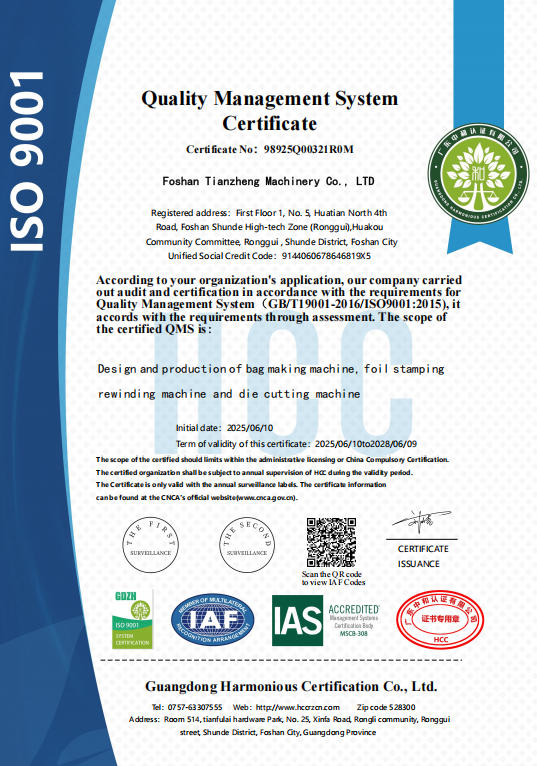
ISO 9001 certificate 9892Q00321R0M: the scope names bag making machine design and production, which is the relevant assurance for this comparison.
Where this comparison stops
An honest comparison has to state its limits, and there are four here.
- No published uptime benchmark exists for either platform type. The continuous-operation advantage over traditional mechanical machines is a design-intent claim supported by case records, not by an audited cross-machine study. Buyers must generate their own evidence through a timed demonstration.
- Zipper-capable does not mean format-universal. Flat bottom with zipper, stand-up with zipper, bag-in-box, spout, central seal, valve pouch and labelling formats are separate capabilities. A nine-model series is a range, not a single machine that produces all of them.
- Two platforms in one plant cost more than the machines. Dual-platform operation increases floor space, spare parts inventory and technician training. Factories below genuine continuous demand in both families may be better served by one platform plus a partner.
- Supplier scale affects scheduling, not necessarily quality. A plant of 6,000 m² with a 15-member R&D team, 87% in-house component production and 5 bag making machines per month is a workable partner for most single-line projects, but multi-line programmes need slot confirmation at order stage.
Future outlook
Three trends are likely to shape the flat bottom versus stand-up decision over the next planning cycle. Automatic machines already held 52.4% of global product type share in 2025, so automation capability is becoming a baseline requirement rather than a differentiator. Mono-material recyclable film adoption is the stated top driver for machine upgrades, which will push sealing-window control and changeover precision up the evaluation list. And with Asia Pacific holding 43.6% revenue share and stand-up pouches growing at a projected 8.0% CAGR through 2030, factories in the region should expect zipper-capable capacity to remain a competitive requirement rather than a premium option.
For buyers at evaluation stage, the practical translation is straightforward: specify the pouch mix, require a timed demonstration on the intended film, tie the balance payment to a passed pre-shipment test, and confirm certification scope against the exact model ordered.
Frequently asked questions
Which machine should a diversified factory buy first, flat bottom with zipper or stand-up with zipper?
The first purchase should follow machine hours, not market growth rates. If flat bottom with zipper formats occupy the larger share of planned production hours, that platform should be bought first because its base tooling is format-specific and rewards long uninterrupted runs. If stand-up zipper enquiries dominate the incoming order book, the doypack platform comes first. Where both families are core and continuous, two dedicated machines protect changeover time better than one machine attempting both.
What does longer continuous stable operation actually mean when compared with traditional mechanical bag making machines?
It refers to the length of uninterrupted production at rated speed before a stop for adjustment, cleaning or fault correction. Traditional mechanical machines rely on cam- and gear-driven timing with fixed mechanical relationships and change parts, so stability is bounded by wear and sealing drift. Programmable platforms decouple station timing from fixed mechanics. The claim is testable through four indicators: uninterrupted run hours, start-up scrap, changeover duration and running noise. The 20-unit, 10-plus-year case record from a flexible packaging manufacturer supports the claim directionally but is supplier-reported, not an independent benchmark.
Can one machine produce both flat bottom and stand-up zipper pouches?
No. Flat bottom with zipper and stand-up with zipper require different forming modules: flat base panel insertion and sealing in the first case, bottom gusset formation and doypack shaping in the second. Both share zipper sealing, registration and cutting stations, but the base-forming geometry is not interchangeable. The FOSHANTIANZHENG bag making series covering models HL0500A1 through HL0700A9 is a range of machines, and buyers should confirm which model demonstrates which pouch format before ordering.
What purchasing terms should be agreed before placing an order?
The documented terms include a minimum order quantity of 1 unit, a lead time of 30–45 days, OEM / ODM customization of machine structure, working width, functions and mould, and 100% full inspection before shipment. Buyers should additionally fix the payment split, commonly a 30% deposit and 70% balance tied to a passed pre-shipment test, and nominate the Incoterm explicitly as FOB or CIF with a named port so that the point of risk transfer is unambiguous. Monthly capacity of 30 units, with bag making machine output at 5 units per month, means slot allocation should also be confirmed at order stage.
What should a pre-shipment test include for a zipper bag making machine?
It should run every pouch format in the initial order book in sequence, using the film and zipper profiles the buyer intends to purchase, including any mono-material or recyclable structure under consideration. The record should capture uninterrupted run hours at rated speed, start-up scrap per start, timed changeover between formats, base panel squareness for flat bottom formats or gusset symmetry and standing stability for stand-up formats, and zipper repeat open-close results against buyer-specified thresholds. Signed retained samples from each format should be held by both parties.
Which certifications should a buyer verify, and against which model?
Two documents matter, and they assure different things. ISO 9001 certificate 9892Q00321R0M from HCC, valid 2025-06-10 to 2028-06-09, covers the quality management system for design and production of bag making machine, foil stamping rewinding machine and die cutting machine. CE Attestation of Conformity M.2025.206.C131314 from UDEM, valid 2025-12-11 to 2030-12-11, is scoped to the Roll To Roll Full Servo Stamping & Punching Window Machine. A buyer ordering a bag making machine for EU delivery should request the CE documentation applicable to that specific model, referenced to EN ISO 12100:2010 and the EN 415 series.
The 2026 FOSHANTIANZHENG product brochure, covering bag making, hot stamping and die-cutting equipment, is available for download: 2026 Tianzheng Machinery brochure (PDF).
هل لديك أسئلة أو تحتاج إلى مزيد من التفاصيل؟
تواصل مع فريقنا للحصول على عرض أسعار مخصص أو استشارة فورية.
طلب عرض أسعار
املأ النموذج أدناه وسيتواصل معك فريقنا بعرض مقترح مخصص.
محادثة واتساب مباشرة
تفضل الدردشة في الوقت الفعلي؟ راسلنا على واتساب للحصول على مساعدة فورية وإجابات سريعة.
- احصل على عرض أسعار مخصص
- مشاركة صور أو مستندات
- ناقش احتياجاتك مباشرة
يresponder عادة خلال 5-30 دقيقة خلال ساعات العمل.