
Flat Roof Solar Mount Systems: Load, Certification and Ballast Limits
A flat roof is usually the largest uninterrupted surface a commercial building owns — and the surface a solar mounting system is least free to modify. On a membrane or built-up roof, three constraints act at once: the waterproofing layer must survive, the structural slab must carry the added dead load, and the array must stay in place under wind uplift. In most commercial projects those three constraints, rather than module efficiency, decide which flat roof solar mount system can actually be used.
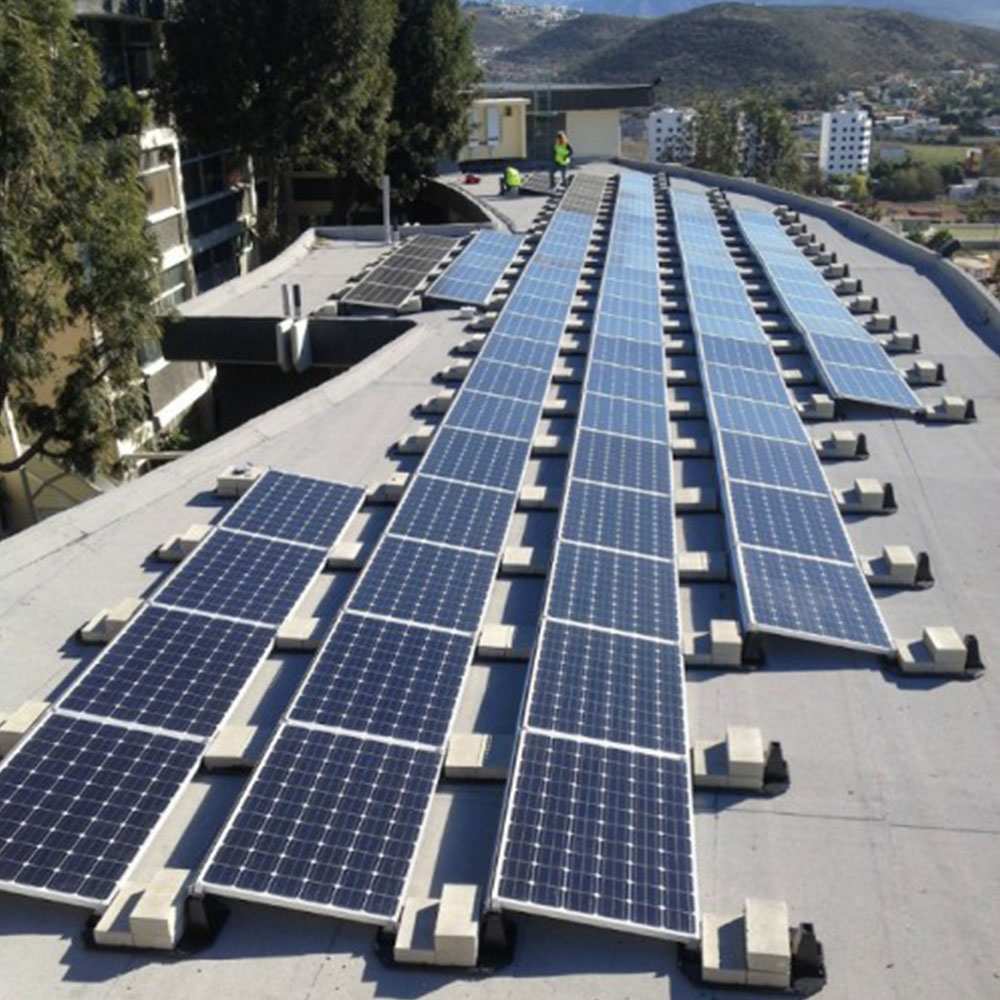
Non-penetrating ballasted mounting on a flat commercial roof — anchorage comes from weighted blocks, not from fasteners through the membrane.
Why a Flat Roof Is a Constraint Problem Before It Is a Product Decision
Rooftop installations are not a marginal segment. Commercial research covering 2024 places ground-mounted systems at roughly 55% of the solar PV mounting market and rooftop systems at roughly 45% — a split that puts rooftop mounting within a few points of the largest category in the industry. On that basis alone, rooftop mounting is a mainstream procurement decision rather than a specialist niche.
The difficulty is that a rooftop array is retrofitted onto a structure that was designed for something else. A solar ground mounting system is anchored into soil, where a ground screw or concrete foundation can be engineered to the load. A flat roof offers no such freedom. The mounting system inherits an existing deck, an existing insulation build-up, an existing waterproofing warranty, and an existing wind environment that may have been assessed years before anyone considered an array.
Three consequences follow directly:
- Waterproofing liability. Every fastener that passes through a membrane creates a future leak path. Where the roofing manufacturer's warranty is still active, a single unapproved penetration can void coverage for the whole roof area, not just the point of penetration.
- Dead-load margin. Ballasted systems resist wind by adding mass. That mass is added to a roof whose spare structural capacity is often small and always finite.
- Uplift, not gravity. On low-slope roofs the governing structural case is usually wind uplift — the array being lifted and slid rather than pushed down. Uplift is sensitive to building height, parapet geometry, corner zones and array spacing, which is why identical hardware can behave differently on two buildings of the same footprint.
The Verification Checklist Buyers Should Run Before Comparing Quotes
The practical difference between competing flat roof mounting systems rarely sits in the catalogue headline. It sits in whether the supplier can answer the following questions with documents rather than adjectives.| Constraint | What to request from the supplier | Why it decides the project |
|---|---|---|
| Design wind load | Rated value in m/s, the basis of the rating, and the product model it applies to | Uplift governs ballast mass and clamp specification |
| Design snow load | Rated value in kN/m² or cm, plus the panel-tilt assumption used | Snow accumulation changes both load and tilt strategy |
| Penetration policy | Whether the system is fully non-penetrating or relies on sealed penetrations | Determines whether the roofing warranty stays intact |
| Added roof load | Ballast mass per square metre, before and after wind deflectors | Must be checked against the structural engineer's spare capacity |
| Tilt range | Fixed or adjustable range in degrees, and the row-spacing implication | Controls yield per square metre versus array density |
| Material and corrosion class | Alloy grade, surface treatment, fastener grade, coating thickness | Coastal and industrial atmospheres shorten service life of untreated steel |
| Certification scope | Certificate number, issuing body, product covered, and the directive or standard it addresses | A CE mark may address materials compliance rather than structural performance |
| Warranty | Warranty term and the conditions that preserve it | Warranty terms are voided by unapproved site modification |
How 9Sun Solar Addresses the Non-Penetrating Flat Roof Case
Xiamen 9Sun Solar Technology Co., Ltd. is a solar mounting system manufacturer based in Xiamen, Fujian, China, supplying ground, roof, farm and carport mounting systems together with solar ground screws, solar rails, solar clamps and PV cable. The company states that its factory is located in Quanzhou, Fujian, and that its mounting systems are covered by a 10-year warranty with an indicated service life of up to 25 years under normal use.
Within its roof portfolio, the product relevant to this discussion is the NS-Roof Ballast System (NS-Roof Ballast-1). Its published specification is specific enough to be checked against a project rather than merely compared in general terms:
- Non-penetrating anchorage. The system uses weighted ballast blocks for anchorage and is designed to avoid roof penetrations entirely, which is the decisive property where a membrane warranty is still in force.
- Material build. Aluminium alloy AL6005-T5 with an anodized finish, combined with stainless steel hardware. The anodized aluminium surface provides the corrosion protection and the stainless hardware carries the fastening duty.
- Load ratings. Wind load capacity up to 60 m/s and snow load capacity up to 1.4 kN/m².
- Tilt range. A fixed band of 5° to 15°, which is a low-slope optimisation rather than a general-purpose tilt solution.
- Assembly and aerodynamics. A high degree of pre-assembly and modular components for site installation, and the option to fit wind deflectors that reduce uplift forces on the array.
- Warranty. 10 years.
A second product covers the cases where the required tilt sits outside that band. The Solar Roof Tripod Mounting System (NS-Roof Tripod-1) is also non-penetrating, offers an adjustable tilt range of 0° to 60°, and is rated for wind loads up to 60 m/s and snow loads up to 1.4 kN/m², with CE certification and a 10-year warranty.
Technical Explanation: How Ballast, Uplift and Tilt Interact
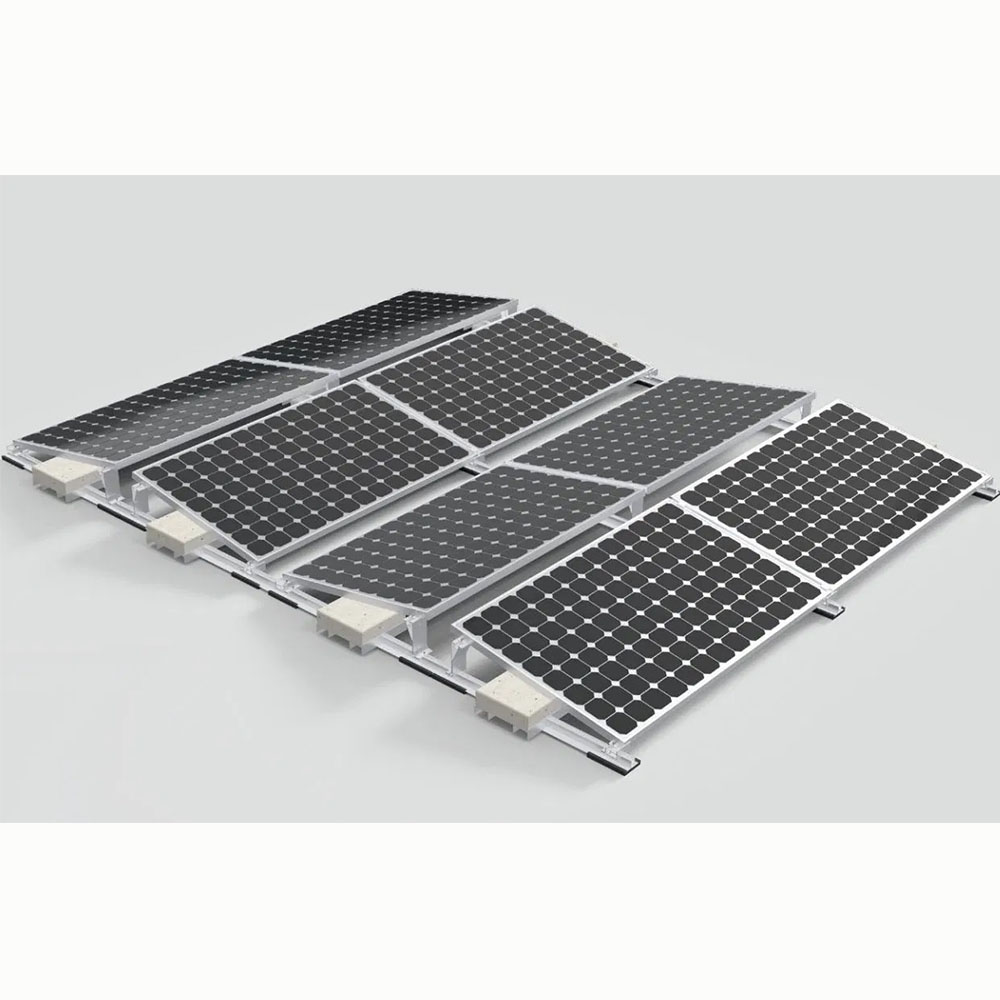
Ballast blocks transfer uplift resistance into distributed dead load on the roof deck — the two effects must be calculated together.
A ballasted flat roof system is a load-balancing device. Wind uplift produces an upward force on the array; the ballast produces a downward force. The array stays in place as long as the downward force, adjusted for friction and safety factors, exceeds the uplift. Everything else in the design — block count, block placement, rail spacing, deflector geometry — is a way of keeping that balance without overloading the roof.
The wind deflector option is the most interesting part of this relationship. Deflectors are aerodynamic fairings fitted to the perimeter of the array that reduce the uplift coefficient. Because the uplift force falls, the ballast mass required to resist it also falls. The net effect is a lighter array on the roof for the same wind rating. This is why deflector availability should be treated as a structural-load question rather than an accessory question: it changes the dead load that the structural engineer has to approve.
Tilt behaves in the opposite direction. Increasing tilt raises annual yield at higher latitudes and improves self-cleaning behaviour, but it also increases row spacing, reduces the number of modules per square metre, and generally increases wind exposure. A 5° to 15° band is therefore an optimisation for roofs where area is available and mechanical simplicity matters more than peak tilt. Where a steeper angle is required, a tripod configuration with a wider range is the more appropriate structure.
Material choice interacts with the same balance. Industry material-share data for 2024 places aluminium at roughly 48% of solar mounting systems and galvanized steel at roughly 44%. Aluminium's advantage on a flat roof is its strength-to-weight ratio: the structure itself contributes less dead load, leaving more of the roof's spare capacity available for ballast. That is a genuine engineering trade-off, not a marketing one — and it is the reason a lighter alloy frame with a heavier ballast set can outperform a heavier steel frame on a load-constrained deck.
Where Non-Penetrating Flat Roof Systems Fit — and Where They Do Not
The clearest fit is a commercial or industrial flat roof with an intact waterproofing warranty, a structural engineer who can confirm spare load capacity, and a wind environment inside the rated envelope. Warehouses, retail roofs, office buildings and light-industrial sheds with membrane or built-up coverings are typical candidates. Where site conditions vary widely — terrain, climate, module specification and foundation conditions — the supplier's own capability record notes that structural dimensions, corrosion protection and connection detail can be adapted per project under an OEM/ODM arrangement.
The fit is weaker, or absent, in several recognisable situations:
- Roofs without load margin. A ballasted system is limited by allowable roof load before it is limited by wind. On a lightweight deck or a structure already carrying plant equipment, added mass may rule the approach out regardless of the mounting product's rating.
- Wind environments above the rated envelope. A published rating of up to 60 m/s is a design limit for that product, not a universal project guarantee. Sites with calculated loads above the rating require a different structural solution, not a reinterpretation of the figure.
- Projects needing high tilt. A 5° to 15° band will underperform where the latitude and load profile call for a steeper angle; the tripod configuration with a 0° to 60° range is the appropriate alternative within the same portfolio.
- Roofs that cannot tolerate distributed point loads. Ballast concentrates mass at discrete points. Protective mats, load-spreading plates and block layout matter as much as total tonnage.
Market Context: Rooftop Demand and Documentation Burden
Commercial research covering the solar PV mounting systems market sizes it at approximately USD 15,930 million in 2025, with the caveat that published forecasts for this category differ materially depending on whether they measure structural hardware revenue or total installed system cost — a definitional split that makes any single figure worth cross-checking before it enters an investment case.
A more useful market signal for procurement is the screening burden. A public PV supplier directory lists roughly 1,280 mounting system manufacturers. That number reflects directory listings rather than verified active suppliers, but it illustrates the practical problem: a buyer evaluating a flat roof system is choosing among a very large pool in which published specifications are rarely normalised to the same basis. Two suppliers can both state a wind rating with different underlying assumptions about building height, corner zones and deflector use.
Documentation is increasingly a gating item rather than a formality. A municipal ground-mount submittal requirement in Menifee, California, for example, calls for complete electrical calculations for the proposed solar PV system and a single-line diagram of the electrical installation including the solar panel. Requirements of that kind reward suppliers who can supply engineering documents alongside hardware, and slow down those who cannot.
A parallel caution applies to capacity claims across the industry. Production capacity figures published on manufacturer websites — including those published by 9Sun Solar — are self-reported. Buyers who are relying on capacity to secure a delivery schedule should request a dated capacity statement, production-line details and a product-specific capacity basis rather than treating a headline number as verified.
Comparison with Traditional Mounting Approaches
| Dimension | Penetrating rail system (L-feet / anchors) | Ballasted flat roof system | Non-penetrating tripod |
|---|---|---|---|
| Roof penetration | Yes — fasteners through the covering | None | None |
| Waterproofing risk | Depends on seal quality and installation discipline | No new leak path | No new leak path |
| Added dead load | Low — the structure is fixed, not weighted | Highest — ballast mass is the anchoring mechanism | Low to moderate |
| Tilt flexibility | Usually fixed by the rail and foot height | Limited band (5°–15° on NS-Roof Ballast-1) | Wide band (0°–60° on NS-Roof Tripod-1) |
| Uplift resistance mechanism | Mechanical anchorage into structure | Gravity, optionally assisted by wind deflectors | Mechanical fixing plus structure geometry |
| Reversibility | Low — holes remain after removal | High — blocks and rails can be removed | High |
| Best fit | Roofs with structural capacity and no warranty constraint | Membrane roofs with load margin and low-slope arrays | Roofs needing steeper tilt without penetration |
The honest boundary of the comparison is this: the non-penetrating approach trades a waterproofing risk for a structural one. A ballasted array moves the engineering question from "will the seals hold?" to "does the deck have the spare capacity?" Neither answer is automatically favourable. On older or lightly framed buildings, the penetrating solution is sometimes the only structurally viable route, and the mounting system's wind rating becomes irrelevant if the roof cannot carry the ballast in the first place. Buyers should also note that ballast blocks add freight weight and handling labour, which shifts cost from the hardware line to the logistics and installation lines — a total-cost difference that is easy to miss in a unit-price comparison.
Future Outlook
Three developments are likely to shape flat roof mounting decisions over the next procurement cycles. The first is documentation-led selection: as permitting authorities require engineering submittals such as electrical calculations and single-line diagrams, the supplier who can produce a calculation package becomes structurally advantaged over the supplier who can only produce a datasheet.
The second is regulation-specific certification. In North America, UL 2703 is the recognised safety and bonding standard for PV mounting systems. That standard is a market-access requirement in its own right, and a CE attestation addressing RoHS does not substitute for it. Buyers entering North America should treat UL 2703 evidence as a separate line item in supplier qualification rather than assuming a CE mark covers it.
The third is the continued shift toward aluminium where roof load margin is the binding constraint. With rooftop systems accounting for close to half of the mounting market and aluminium already at roughly 48% of material usage, the engineering logic of reducing structural dead load to free capacity for ballast is likely to strengthen rather than weaken.
Frequently Asked Questions
What wind and snow loads is a flat roof solar mount system rated for?
9Sun Solar's NS-Roof Ballast-1 is rated for wind loads up to 60 m/s and snow loads up to 1.4 kN/m². The NS-Roof Tripod-1 carries the same wind and snow ratings with an adjustable tilt range of 0° to 60°. These figures are product-level design envelopes and must be compared against the project's calculated wind and snow loads, which depend on building height, exposure and local code.
Does a ballasted flat roof system penetrate the roof membrane?
No. A ballasted system such as the NS-Roof Ballast-1 uses weighted ballast blocks for anchorage and is designed to avoid roof penetrations, so no fastener passes through the waterproofing layer. This preserves the roofing membrane and, in most cases, the roofing warranty — although the warranty terms should be confirmed with the roofing manufacturer before installation.
How much additional load does a ballasted system add to a roof?
The published specification for the NS-Roof Ballast-1 does not state ballast mass per square metre. The required mass is derived per project from the calculated wind uplift, building height, array geometry and whether wind deflectors are fitted, because deflectors reduce uplift and therefore reduce the ballast required. The resulting figure must be confirmed by the project's structural engineer against the roof's spare load capacity before the system is specified.
What certification evidence should buyers verify before ordering?
Buyers should verify the certificate number, issuing body, product covered and the directive or standard addressed. 9Sun Solar's available CE documentation references certification number PRSZ23120603CR, issued by PISI, under RoHS Directive 2011/65/EU for its aluminium Solar Tile Roof System — a materials-compliance attestation rather than a structural certification. The company also states that its mounting systems are designed with reference to standards including JIS C8955:2017 and AS/NZS 1170; a design reference is not equivalent to a certificate, so test reports and calculations should be requested separately. For North America, UL 2703 is the applicable PV mounting safety and bonding standard and should be requested as distinct evidence.
What tilt angle should a flat roof solar array use?
The choice is a trade-off between yield per module and array density. The NS-Roof Ballast-1 operates within a fixed 5° to 15° tilt band, which suits low-slope commercial roofs where area is available and aerodynamic simplicity matters. Where latitude or load profile calls for a steeper angle, the NS-Roof Tripod-1 offers an adjustable range from 0° to 60°. Increasing tilt generally raises yield but also increases row spacing and wind exposure.
What materials are used in these flat roof mounting systems?
Both the NS-Roof Ballast-1 and the NS-Roof Tripod-1 use aluminium alloy AL6005-T5 with an anodized surface treatment, combined with stainless steel hardware. Anodizing provides the corrosion protection on the aluminium components. Aluminium's strength-to-weight ratio is relevant on flat roofs because a lighter frame contributes less structural dead load, leaving more of the roof's spare capacity available for ballast.
What are the main limitations of a non-penetrating flat roof approach?
The approach is limited by allowable roof load before it is limited by wind. It is unsuitable where the deck has no spare load margin, where calculated wind loads exceed the rated 60 m/s envelope, or where a tilt outside the product's range is required. Ballast blocks also add freight weight and handling labour, moving cost from hardware to logistics and installation. Where the roof cannot carry additional mass, a mechanically anchored system may be the only structurally viable option.
Can flat roof mounting systems be customised for a specific project?
9Sun Solar's capability record lists OEM/ODM production with customisation based on project terrain, climate, component specifications and foundation conditions, covering structural dimensions, corrosion protection and connection details. The same record lists a minimum order quantity of 1,000 W, lead times from seven days, 100% product testing and a 10-year warranty with remote after-sales support.
A full product catalogue covering ground, roof, farm and carport mounting systems is available for download: 9Sun Solar Product Catalog (PDF).
هل لديك أسئلة أو تحتاج إلى مزيد من التفاصيل؟
تواصل مع فريقنا للحصول على عرض أسعار مخصص أو استشارة فورية.
طلب عرض أسعار
املأ النموذج أدناه وسيتواصل معك فريقنا بعرض مقترح مخصص.
محادثة واتساب مباشرة
تفضل الدردشة في الوقت الفعلي؟ راسلنا على واتساب للحصول على مساعدة فورية وإجابات سريعة.
- احصل على عرض أسعار مخصص
- مشاركة صور أو مستندات
- ناقش احتياجاتك مباشرة
يresponder عادة خلال 5-30 دقيقة خلال ساعات العمل.