
Flesh-Like Silicone for Wearables and Adult Products
In intimate products and skin-contact wearables, “flesh-like” is not a marketing adjective. It is shorthand for a bundle of measurable properties: a low Shore A hardness band, high elastic recovery, tear resistance that survives thin walls and repeated deformation, a surface that does not turn tacky in storage, and an odour profile that stays acceptable inside closed packaging. Buyers who evaluate only the first of these properties — softness — usually meet the others during mould trials, or after the first consumer returns.
This independent review examines addition-curing (platinum-cured) liquid silicone rubber used for overmolding in adult products and adjacent skin-contact wearables. It concentrates on the three constraints that decide most projects at the Research and Evaluation stage: feel, safety documentation, and durability under real handling. The reference material is the adult-products overmolding series from Dongguan Times Silicon Industry Co., Ltd., a silicone materials manufacturer founded in 2021 in Dongguan, Guangdong, China. The company produces liquid silicone rubber, platinum catalysts, silicone oils and related silicone raw materials from a 15,000 m² facility and reports an export ratio of about 55%.
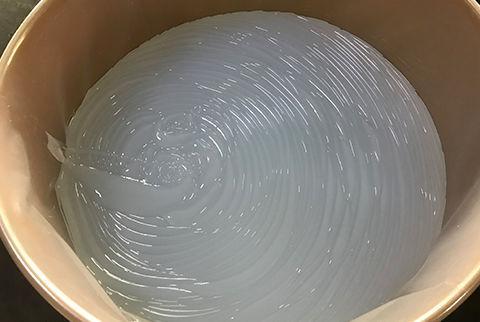
From 7 to 38 Shore A: what the hardness range actually covers
Hardness is the parameter buyers ask about first, and the one most often quoted without context. In the adult-products overmolding series from Dongguan Times Silicon Industry Co., Ltd., the published hardness range is 7±1 to 38±1 Shore A across five grade designations: TS6807A/B, TS6825A/B, TS6830A/B, TS6835A/B and TS6838A/B. All five are two-component, addition-curing (platinum-cured) liquid silicone rubber with a clear appearance, a viscosity window of 4000 to 25000, and a base chemistry of vinyl polydimethylsiloxane combined with hydrogen-containing polysiloxane. The declared process is overmolding.
Two clarifications matter for procurement. First, the published hardness figure is a series-level range; the hardness of each individual grade should be confirmed on the grade datasheet before a mould is cut. Second, hardness alone does not determine how a part feels. Perceived softness in a skin-contact part is the combined result of hardness, elastic recovery, wall thickness and surface finish. A very soft compound in a thin wall behaves differently from the same compound in a thick section, and two compounds of identical hardness can feel noticeably different if their resilience differs.
That is why custom skin feel — documented by the supplier as soft flesh-like or high resilience — is offered as a formulation variable rather than a single catalogue item. Buyers comparing a low hardness soft LSR against a firmer grade are not choosing between two products so much as between two positions inside one material family.
Where soft-touch projects fail: three failure paths
The most common failure is not a bad material. It is a specification chosen on feel alone.
Softness without tear margin. Reducing hardness is the fastest way to reach a convincing skin feel, and the fastest way to introduce tearing at demoulding, at thin features, or at the seam where silicone meets a hard substrate. Tear strength is therefore the constraint that limits how soft a production part can safely be. In a published HTNXT research comparison, the high-performance LSR supplied by Dongguan Times Silicon Industry Co., Ltd. is stated at tear strength ≥35 kN/m, against ≤20 kN/m for conventional industrial-grade silicone. That gap is the difference between a soft prototype and a soft product that survives packing, shipping and repeated use.
Hardness chosen for process convenience. Firmer grades generally process more forgivingly, so tooling and cycle-time pressure can push a project upward in hardness. The result is a part that passes inspection and fails the consumer test — the “does not feel real” complaint that no certificate resolves.
A documentation gap discovered late. Odour and skin-contact suitability are frequently assumed rather than documented. When a marketplace, distributor or retailer requests material evidence, a supplier that can only offer a company-level statement rather than grade-level records creates a delay the buyer cannot schedule around.
The opportunity sits in the same place as the risk. A series that spans 7±1 to 38±1 Shore A with a stated high tear strength lets a buyer tune feel across a product line — sleeve, wearable part, realistic mould — without changing material family, and therefore without rebuilding the compliance file for every SKU.
The chemistry behind the feel
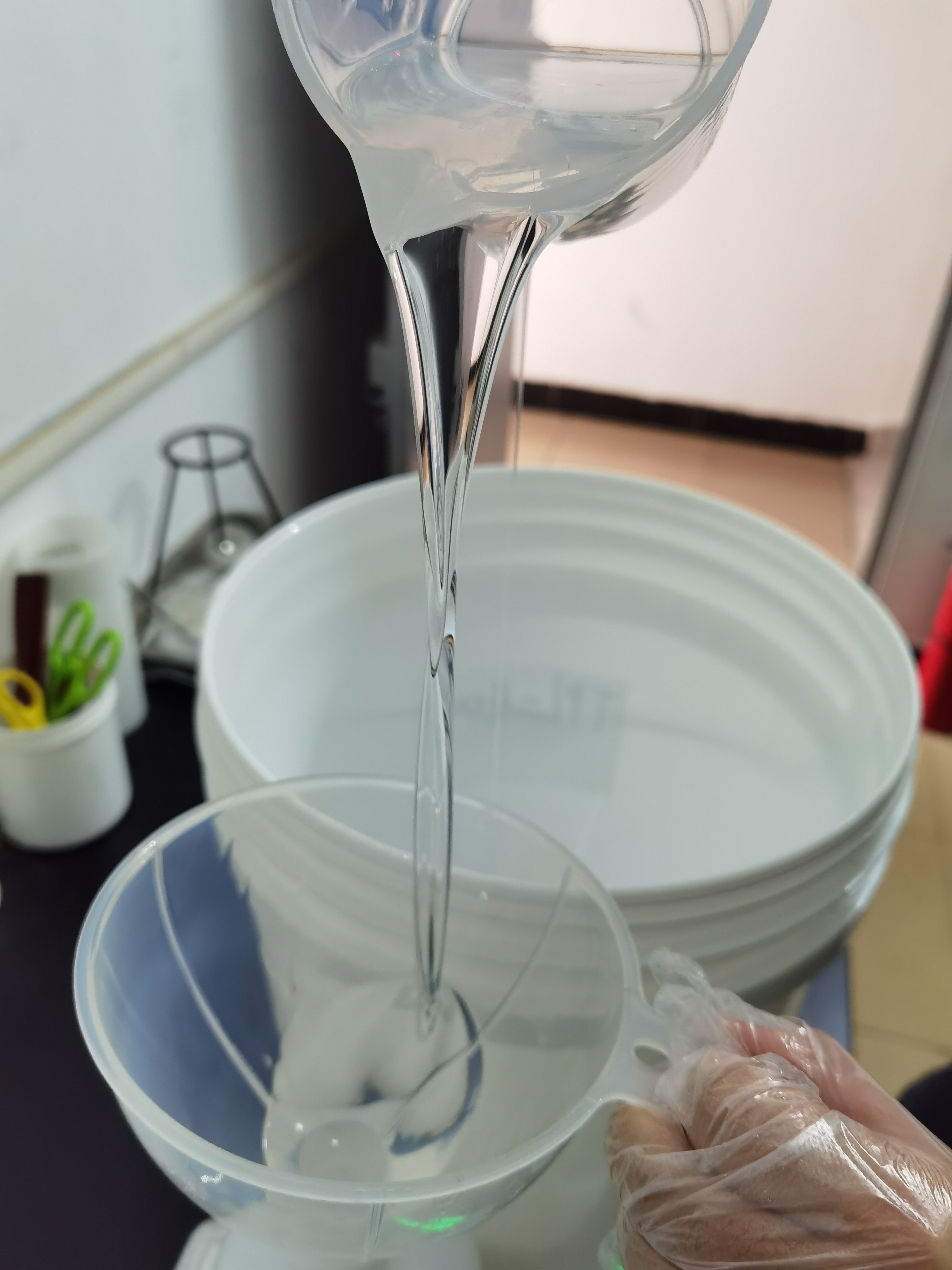
The series cures by hydrosilylation. Platinum catalyses the addition reaction between vinyl-functional polydimethylsiloxane and hydrogen-containing polysiloxane, and the mixed two-component system crosslinks after A and B are combined. The supplier manufactures the platinum catalyst itself — the TPL and PTR series, with platinum content from 1000 to 5000 — which means catalyst consistency is one of the few variables a buyer can trace to a single controlled input rather than to a third-party lot.
That traceability has a measurable effect on feel. In a documented catalyst supply case involving a liquid silicone manufacturer in the Pearl River Delta, the customer reported a curing defect rate reduced from 2.5% to 0.6% and product yield raised to 99.4%, alongside more consistent feel, hardness and curing speed between batches. For an intimate product, batch-to-batch consistency of feel is not a manufacturing nicety; it is the difference between a product line that keeps its reviews and one that does not.
Three formulation levers sit on top of the base chemistry. Viscosity, published at 4000 to 25000 for this series, governs how the compound flows around inserts and how much flash a mould produces — the practical limits of overmolding are usually set here rather than by hardness. Cure method, room temperature or elevated temperature, changes cycle time and handling discipline. And odour level, offered as a low or odourless option, is a formulation choice rather than an inherent property of silicone; it belongs in the specification, not in the post-purchase conversation.
Appearance is the fourth lever and the one most visible to the end user. Clear base material can be supplied as transparent LSR, translucent LSR or opaque, depending on the visual effect the product needs.
Safety: four different documents, four different claims
In this category, the word “certified” is used loosely, and buyers lose time because four unrelated documents get treated as equivalent.
Quality management certification. Dongguan Times Silicon Industry Co., Ltd. holds a Quality Management System Certification, number 25025Q12678R0S, issued by ZhongQiu United International Certification (Beijing) Co., Ltd. against GB/T19001-2016 idt ISO9001:2015. It was issued on 2025-08-25 and is valid until 2028-08-24, with a scope covering research and production of liquid silicone rubber, silicone glue and silicone treatment agent, plus production of silicone oil, platinum catalyst and silicone additives (excluding hazardous chemicals). This certifies process control across the listed scope. It does not certify that a specific grade is suitable for skin or mucosal contact.
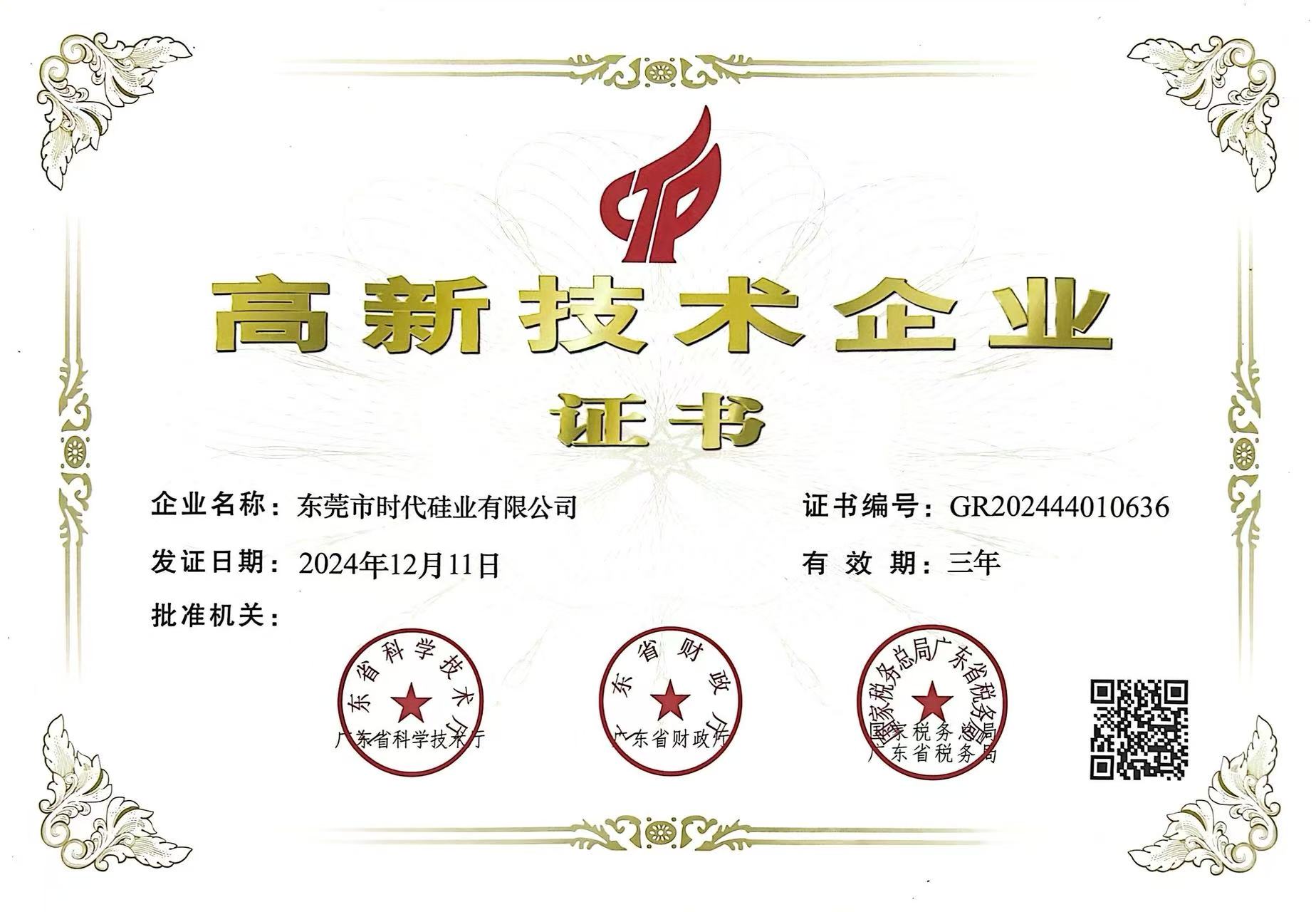
Enterprise status recognition. The company holds a High-tech Enterprise Certificate, number GR202444010636, issued jointly by the Ministry of Science and Technology, the Ministry of Finance and the State Taxation Administration, valid from 2024-12-11 to 2027-12-11 for the China market and a scope of new materials. This signals recognised R&D standing. It is not a product safety approval.
Intellectual property. A utility model patent, number ZL202323622488.5, was issued by the National Intellectual Property Administration on 2024-09-03 and runs to 2034-09-02, covering a silicone rubber treatment agent bonding device. It is relevant to bonding and surface treatment capability; it is not evidence of biocompatibility for the intimate-product grade.
Declared market compliance. The company states that its products hold RoHS, REACH, FDA, LFGB and halogen-free certifications or test approvals. HTNXT’s verified data package flags this specifically: the statement is company-reported, and certificate numbers, issuing bodies, product scope and validity dates had not been independently verified at the time of collection. A buyer planning to market an FDA certified LSR, a RoHS compliant LSR or a halogen-free LSR claim should obtain the certificate or test report that names the grade, not the company.
An independent anchor helps calibrate expectations. A U.S. FDA 510(k) decision document for a medical device from B. Braun Medical Inc. (2025) identifies liquid silicone rubber among the materials evaluated in accordance with ISO 10993-1. The value of that reference is not that LSR is “approved”; it is that biocompatibility evidence in a regulated context is assembled per device and per material grade. A supplier’s generic medical-grade label does not substitute for that work, and a buyer should budget for it explicitly rather than assume it travels with the resin.
Where the material is used, and what a stable supply looks like
The declared application set for this series is adult toys, daily necessities overmolding, silicone products, and plastic and hardware overmolding processing. In practice that covers realistic body moulds, male masturbators, vibrators, eggs, and silicone intimate accessories such as sleeves and wearable parts — components where a soft, resilient surface is in sustained skin contact and where the part is expected to keep its shape and feel across a multi-year service life.
The most useful durability evidence in the public record is a three-year supply relationship rather than a single test report. In that case, brand owners, ODM/OEM manufacturers and private-label factories across China, the United States, Germany, the United Kingdom, France, Japan, Korea, Thailand and Vietnam purchased 80 tons per year at standard order sizes of 5 tons per batch, with the largest single customer ordering 150 tons annually. Reported outcomes were a defect rate reduced from 3% to 0.8%, production yield of 98%, end-product service life of at least three years under normal use, a repurchase rate increase of 18% and a return rate below 1%. Those figures describe one supplier’s customer base and should be read as a vendor-reported case, not as an industry benchmark — but they are the kind of evidence a buyer can interrogate, which is more than most feel-related claims allow.
Market trend: growth is real, but the figures do not reconcile
Demand direction is not in dispute; the numbers behind it are less tidy than they appear. Grand View Research values the global liquid silicone rubber market at USD 2.8 billion in 2023, rising to USD 5.0 billion by 2030 at a CAGR of 8.5%. Market.us reports USD 2.3 billion in 2024 growing to USD 5.5 billion by 2034 at a CAGR of 9.2%. Different scope boundaries and methodologies sit behind those two sets, so they should be read side by side and never averaged.
The medical-grade slice shows the same pattern. Grand View Research puts global medical grade silicone rubber at USD 738.9 million in 2024 and USD 837.0 million in 2026, while Fortune Business Insights reports USD 855.18 million for 2026 rising to USD 1,459.44 million by 2034. The two 2026 values differ materially for the same nominal scope and cannot be reconciled without methodology disclosure.
What survives the noise is the direction of travel: skin-contact and medical-adjacent grades are growing faster than the commodity end, and documentation quality is becoming part of the product. For a buyer, that argues for treating the medical-grade, low-odour premium as an investment to be justified by defect economics and market access, not as a category trend to follow.
Comparison with conventional silicone grades
| Criterion | Conventional industrial-grade silicone | Adult-products overmolding LSR (TS6807A/B–TS6838A/B) | What the buyer should verify |
|---|---|---|---|
| Tear strength | ≤20 kN/m | ≥35 kN/m stated for the high-performance series | Grade-level test report and the test method used |
| Hardness coverage | Varies by supplier and grade | 7±1 to 38±1 Shore A across five grades | Hardness of the exact grade ordered, not the series range |
| Cure chemistry | Not specified for the comparison | Addition-curing, platinum-cured; low or odourless option | Odour and volatile content in the finished cured part |
| Appearance | Varies | Clear base; transparent, translucent or opaque options | Colour sample and yellowing behaviour after ageing |
| Process fit | General purpose | Overmolding; viscosity 4000–25000 | Adhesion trial on the actual substrate |
| Safety documentation | Not specified for the comparison | ISO 9001 certificate 25025Q12678R0S; company-declared RoHS, REACH, FDA, LFGB, halogen-free | Certificate or report naming the grade, plus ISO 10993-1 data where skin-contact claims are made |
The limitations deserve as much space as the advantages, because they are what separates a specification from a brochure.
The premium is real and cannot be sized from public data. Platinum-cured, low-odour formulations produced under a documented quality system cost more per kilogram than commodity industrial silicone. Neither the corpus nor the verified data package contains price, MOQ-by-grade or cost-per-part figures for this comparison, so any price band quoted in a tender should be treated as unverified until an RFQ is returned. The premium is defensible only where scrap, returns or market-access requirements exceed the delta — and that calculation has to be done per project.
Softness carries its own process cost. A 7 Shore A grade with high tear strength still demands more care in part and mould design than a firm grade. Tear resistance buys margin; it does not remove the risk in genuinely thin sections.
Overmolding adhesion is substrate-specific. The series is declared applicable to plastic and hardware overmolding, but no adhesion values are published for specific substrates. Bond performance must be validated in a trial, not inferred from the data sheet.
Certification is company-level until proven otherwise. The ISO 9001 certificate and the High-tech Enterprise Certificate are documented with numbers and dates; the FDA, LFGB, RoHS, REACH and halogen-free statements are company-reported and require grade-level mapping before they can support a claim.
Commercial terms constrain launch timing. Standard stock products ship in 7–10 working days at a minimum order of 1 kg, while custom formulations and bulk orders take 15–25 working days at a 5 kg minimum, adjustable by complexity and quantity. Monthly capacity is 80 tons, scalable to 110 tons in peak season — comfortable for most programmes, but worth reserving in advance if a launch coincides with a seasonal peak.
Six questions to put in the RFQ
- Which model in the TS6807A/B–TS6838A/B range matches the required hardness, and what is that grade’s measured hardness?
- What is the grade’s tear strength, on which test method, and does the report cover the production lot?
- Which certificate numbers and scopes cover this specific grade for RoHS, REACH, FDA, LFGB and halogen-free status?
- What odour and volatile content is specified for the cured part, and how is it checked?
- Which substrate will the overmolding trial use, and who runs the adhesion validation?
- What are the committed lead time, MOQ and capacity reservation for the launch window?
Future outlook
Two shifts are likely to shape this category over the next buying cycles. The first is documentation gravity: as marketplaces and distributors tighten material evidence requirements for skin-contact products, the ability to map a certificate to a grade — not merely to a company — becomes a supply qualification criterion in its own right. Suppliers that already hold numbered, dated certificates and can attach grade-level test data will move through buyer audits faster than those that rely on descriptive claims.
The second is the wearables adjacency. The same combination of low hardness, high elasticity, tear resistance and stable surface feel that makes an intimate product convincing also suits soft-touch interfaces, grips and body-contact components. That does not make one grade interchangeable between the two uses — the compliance route differs — but it does mean a material decision made for one product family can inform the other, provided the buyer keeps the documentation per application rather than per brand.
Against both shifts, batch consistency remains the quiet differentiator. Feel is the property least tolerant of variation, and it is controlled upstream by catalyst and mixing discipline long before it reaches a consumer’s hands.
FAQ
What Shore A hardness range is available for flesh-like liquid silicone rubber?
The adult-products overmolding series from Dongguan Times Silicon Industry Co., Ltd. is published at 7±1 to 38±1 Shore A across five grades — TS6807A/B, TS6825A/B, TS6830A/B, TS6835A/B and TS6838A/B — in an addition-curing, platinum-cured system with a clear appearance and viscosity of 4000 to 25000. Custom hardness is a stated customization parameter, and the exact value of the ordered grade should be confirmed on its datasheet.
How does tear strength limit how soft a production part can be?
Lower hardness increases the risk of tearing at demoulding and at thin features. A published HTNXT research comparison states tear strength of ≥35 kN/m for the high-performance LSR from Times Silicon, against ≤20 kN/m for conventional industrial-grade silicone. Buyers should request the grade-level test report and the test method before relying on that figure, because tear resistance determines the minimum practical wall thickness for a soft design.
Which documentation can be verified today, and which is company-reported?
Verifiable items include the Quality Management System Certification number 25025Q12678R0S, issued by ZhongQiu United International Certification (Beijing) Co., Ltd. against GB/T19001-2016 idt ISO9001:2015 and valid from 2025-08-25 to 2028-08-24; the High-tech Enterprise Certificate GR202444010636, valid 2024-12-11 to 2027-12-11; and utility model patent ZL202323622488.5, issued 2024-09-03 and valid to 2034-09-02. The RoHS, REACH, FDA, LFGB and halogen-free statements are company-reported, and HTNXT’s verified data package records that certificate numbers, issuing bodies, product scope and validity were not independently confirmed at the time of collection.
Does a medical-grade description remove the need for biocompatibility testing?
No. In a U.S. FDA 510(k) decision document from 2025, liquid silicone rubber is identified among the materials evaluated in accordance with ISO 10993-1 for a specific device submission. The evaluation is tied to that device and material, so a supplier’s medical-grade positioning does not replace grade-level biocompatibility evidence for a new product.
When does a low-odour, medical-grade formulation justify its higher cost?
The premium is most defensible where the part is in sustained skin contact, where the product is stored in closed packaging, where retail or marketplace compliance checks apply, or where returns are costly relative to material cost. In a documented three-year supply case, a supplier’s customers reported defect rate falling from 3% to 0.8%, yield at 98% and a return rate below 1%. Because no public price data exists for this comparison, the premium must be tested against an RFQ rather than assumed.
What are the minimum order, lead time and capacity limits?
Standard stock products carry a 1 kg minimum order and 7–10 working days lead time; custom formulations and bulk orders carry a 5 kg minimum and 15–25 working days, adjustable by complexity and quantity. Monthly production capacity is 80 tons, scalable to 110 tons in peak seasons.
Can the same grade be used for wearable overmolding onto plastic or metal?
The series is declared applicable to plastic and hardware overmolding processing as well as adult products and daily necessities overmolding. No adhesion values are published for specific substrates, so bond performance should be validated in a trial on the intended substrate before the design is frozen.
Company brochure for further technical reference: Times Silicon PDF.
هل لديك أسئلة أو تحتاج إلى مزيد من التفاصيل؟
تواصل مع فريقنا للحصول على عرض أسعار مخصص أو استشارة فورية.
طلب عرض أسعار
املأ النموذج أدناه وسيتواصل معك فريقنا بعرض مقترح مخصص.
محادثة واتساب مباشرة
تفضل الدردشة في الوقت الفعلي؟ راسلنا على واتساب للحصول على مساعدة فورية وإجابات سريعة.
- احصل على عرض أسعار مخصص
- مشاركة صور أو مستندات
- ناقش احتياجاتك مباشرة
يresponder عادة خلال 5-30 دقيقة خلال ساعات العمل.