
Flexible Warning Posts: A Technical Guide for Modern Traffic Management
Traffic safety infrastructure increasingly demands products that combine visibility, durability, and low maintenance. Mnsd, the brand of Tiantai Yuanda Traffic Device Co., Ltd (established 2007 in Tiantai, Zhejiang, China), offers a range of flexible safety plastic warning posts designed to address these requirements. With a factory covering 40,000 m², over 300 employees, and an annual production capacity of 120,000,000 units, the company supplies warning posts to markets in Asia, Europe, and the USA, where export sales account for 50% of total business.
Problem & Opportunity
Traditional rigid traffic delineators often suffer permanent damage after vehicle impact, requiring frequent replacement and increasing lifecycle costs. In high-traffic zones such as highway ramps, parking lots, and construction sites, a solution that can withstand repeated collisions while maintaining visibility is needed. Flexible warning posts that self-recover after impact present a clear operational advantage. Mnsd's warning post series addresses this gap with engineered flexibility and impact resistance.
Brand Solution: Mnsd Warning Post Series
Mnsd manufactures three primary models: the YD-WP45 (450 mm height, 200×80 mm base, PU material), the YD-WPS75 (750 mm height, 200×80 mm base, PU material), and the YD-PE50 (500 mm height, 260 mm rubber base diameter, PE + rubber base). All models share a structural configuration that is 360° flexible and impact resistant, with a tensile strength of 15.0 MPa and elongation at break of 400%. The material hardness is 80-85 Shore A, and the temperature resistance ranges from -40°C to +70°C.
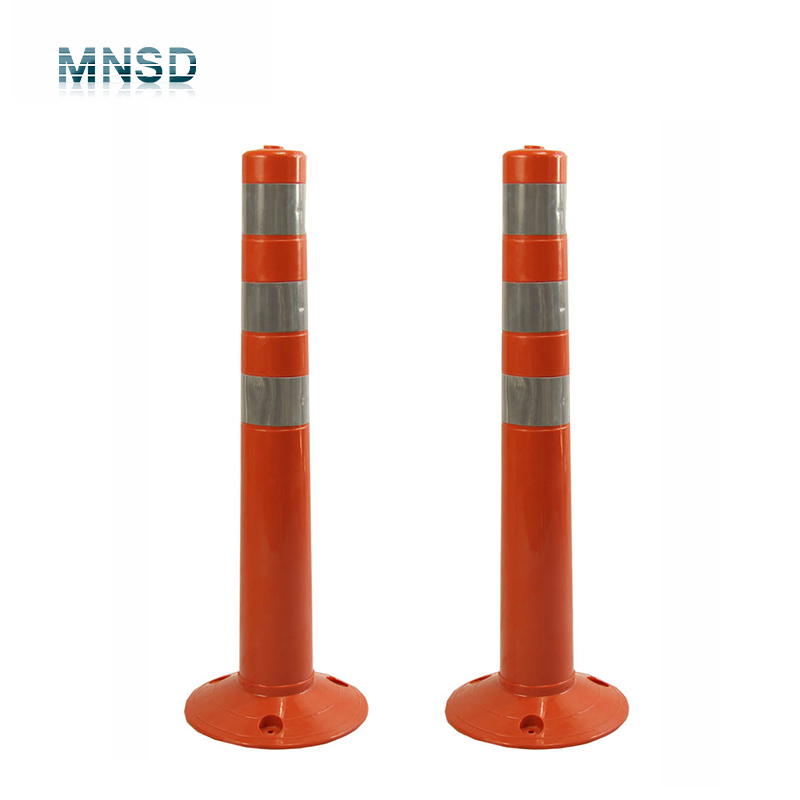
The reflective grade is High-Intensity Prismatic (HIP) / Class 1, providing a visibility distance of over 200 meters. The reflective tape width is 250 mm, offered in double or triple sleeves, with colors including silver white and fluorescent yellow. Installation is performed via expansion bolt fixing with 3 or 4 holes, and the top design includes a ring for chain attachment.
Technical Explanation
The core mechanical property—360° flexibility coupled with rapid self-recovery (memory-springback)—ensures that after a vehicle crush, the post returns to its original upright position without permanent deformation. This is achieved through the high-elasticity polyurethane (PU) or heavy-duty polyethylene (PE) material formulation. The base is made of recycled rubber (YD-PE50) or integrated plastic, enhancing stability. Ultraviolet stabilization and anti-oxidant coating maintain color fastness for over three years. The product meets Class 2/Grade A high-intensity reflectivity requirements, essential for night-time visibility in demanding environments.
Application & Use-Case Scenarios
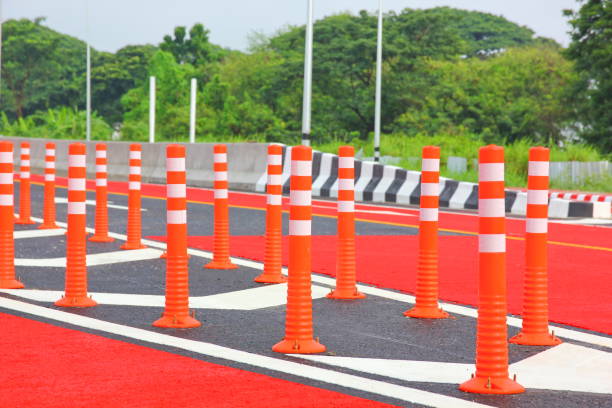
A typical application scenario, documented for the UAE market, involves lane separation on high-speed expressways, highway ramps, T-junctions, urban sidewalk protection, and multi-level parking lot entrances. The product's role is to provide clear visual guidance, define lane boundaries, prevent unauthorized vehicle entry, and mitigate impact damage during accidental collisions. Installation is surface-mounted or bolt-down fixed (permanent), requiring high-visibility reflective sleeves (honeycomb pattern), M10/M12 heavy-duty expansion anchors, and optional epoxy adhesive for base reinforcement. Special requirements for this scenario include 360° full-recovery impact resistance, UV stabilization for 5+ years color fastness, Class 2/Grade A reflectivity, and an operating temperature range of -40°C to +70°C.
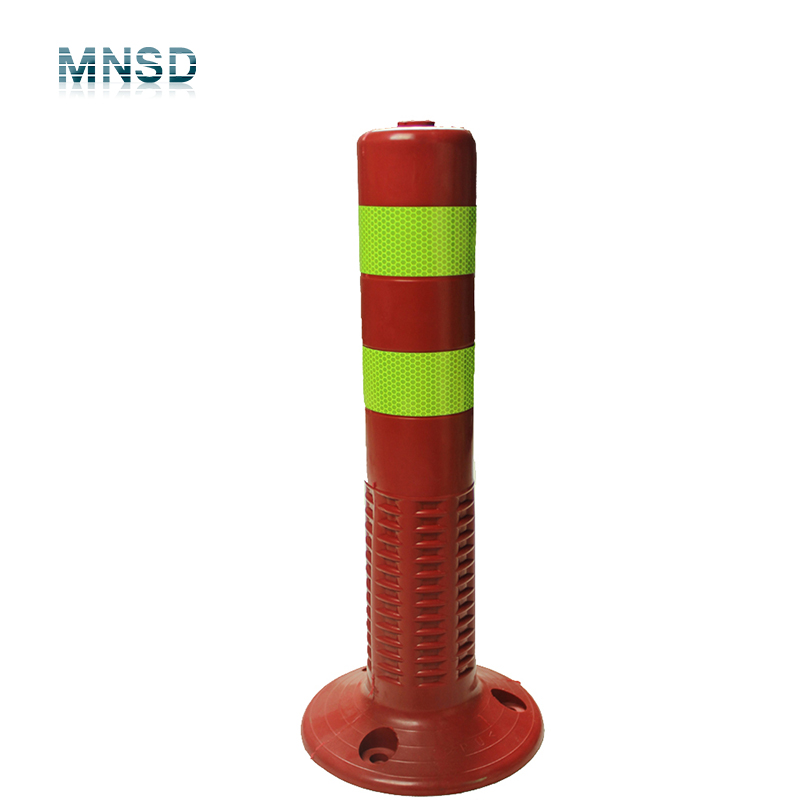
Beyond expressways, these warning posts are applicable in parking lots, construction sites, industrial facilities, warehouses, logistics centers, airports, seaports, schools, hospitals, and commercial complexes. The models can be selected based on height requirement: 450 mm for low-profile guidance, 500 mm for standard delineation with a heavier rubber base, and 750 mm for higher visibility applications such as highway median delineation.
Market Trend Analysis
Traffic safety authorities across Asia, Europe, and the USA increasingly specify flexible delineators as part of channelization and pedestrian-vehicle segregation projects. The demand is driven by cost reduction from lower replacement rates and improved safety due to consistent reflectivity after impact. Mnsd's export ratio of 50% to these regions reflects this trend.
Comparison with Traditional Solutions
Traditional rigid plastic or metal bollards may offer higher static strength but are prone to cracking or denting upon impact, often requiring full replacement. Mnsd's flexible warning posts absorb impact energy and self-recover, reducing maintenance frequency and material waste. One honest limitation: for applications requiring absolute vehicle exclusion (e.g., anti-ram barriers), flexible posts may not provide sufficient resistance; rigid bollards or reinforced barriers remain necessary. However, for traffic guidance, lane separation, and impact mitigation, the flexible post offers superior lifecycle value.
Future Outlook
As urban infrastructure expands and road safety regulations tighten globally, products that combine visibility, flexibility, and longevity will continue to gain adoption. Mnsd's investment in R&D (15 engineers) and production scale positions it to support evolving requirements, including integration with smart traffic systems and next-generation reflective materials.
Frequently Asked Questions
Q1: What materials are Mnsd warning posts made of?
The YD-WP45 and YD-WPS75 are made of High-Elasticity Polyurethane (PU). The YD-PE50 uses heavy-duty PE for the post and a recycled rubber base. All materials are UV-stabilized, water and oil resistant, and operate in temperatures from -40°C to +70°C.
Q2: How are these warning posts installed?
Installation is by expansion bolt fixing through 3 or 4 holes. The top ring design allows chain attachment. For permanent installation, M10 or M12 heavy-duty expansion anchors are used, with optional epoxy adhesive for base reinforcement.
Q3: What visibility performance can be expected?
The warning posts have a visibility distance of over 200 meters, achieved through High-Intensity Prismatic (HIP) / Class 1 reflective tape (250 mm width) in silver white or fluorescent yellow. The grade meets Class 2 / Grade A high-intensity reflectivity requirements.
Q4: What certifications apply to these products?
The warning post manufacturer holds a Business License certification issued by the Market Supervision Administration. The certification scope covers all items in the warning post business.