
Flexible vs Spiral Ducts for Undersea Road Tunnel Projects
Undersea road tunnels remove the option of deferring the ventilation decision. The duct has to hold pressure across kilometres of bored ground, be extended in step with a tunnel boring machine (TBM), and satisfy a fire and explosion specification that a marine-adjacent construction site cannot soften. Flexible large-diameter ducts and spiral ducts answer different halves of that brief, and the useful question is not which type is better in general, but which constraint each type is actually solving.
The Short Answer for Specifiers
For undersea road tunnel construction, flexible large-diameter fabric ducts are normally specified for the advancing drive, where long sections and low handling weight reduce the number of joints and the time spent repositioning ducting behind the machine. Spiral ducts reinforced with spring steel wire are specified where shape retention, negative-pressure resistance and long service intervals matter more than handling speed, which is why their section lengths are shorter and their connection count is higher.
A single undersea project can legitimately run both. Flexible ducting tends to follow the working face; spiral ducting tends to serve fixed or long-duration runs, bends, and sections where the duct must keep its geometry for extended periods. Treating the two as competing options on one line item usually produces a worse specification than treating them as a system.
Why Undersea Conditions Rewrite the Duct Brief
Tunnel ventilation projects in deep underground shafts operate under conditions that include high pressure, elevated humidity, constant friction and potential explosion hazards, with ventilation running as a continuous, round-the-clock, high-pressure duty rather than in shifts. Undersea road tunnels sit squarely inside that description, and three requirements move at the same time.
- Air quantity is a safety number, not a comfort number. United States federal regulation 29 CFR 1926.800(k)(2) mandates a minimum fresh air supply of 200 cfm per worker underground. That figure is a regulatory floor for underground work, not a substitute for project-specific design, but it explains why duct diameter and leakage performance are treated as safety parameters on an undersea drive.
- Leakage compounds with distance. A duct that loses a small percentage of air per joint behaves differently at 500 m than at 2 km. On a tunnel with roughly 2.1 km of undersea section, joint count and seam quality drive total delivered airflow.
- Fire and explosion performance has to be evidenced, not asserted. Flame retardancy and, where hazardous areas are classified, explosion-proof construction are specification items that must be traceable to a certificate or test report rather than to a product description.
Logistics constraints reinforce the same conclusion. A marine-adjacent site with a limited surface footprint cannot stockpile bulky rigid ducting, and every additional transport movement into a TBM backup area carries cost and schedule risk. Duct types that ship flat and deploy in long sections reduce both.
The Trunk Road T2 Reference Case
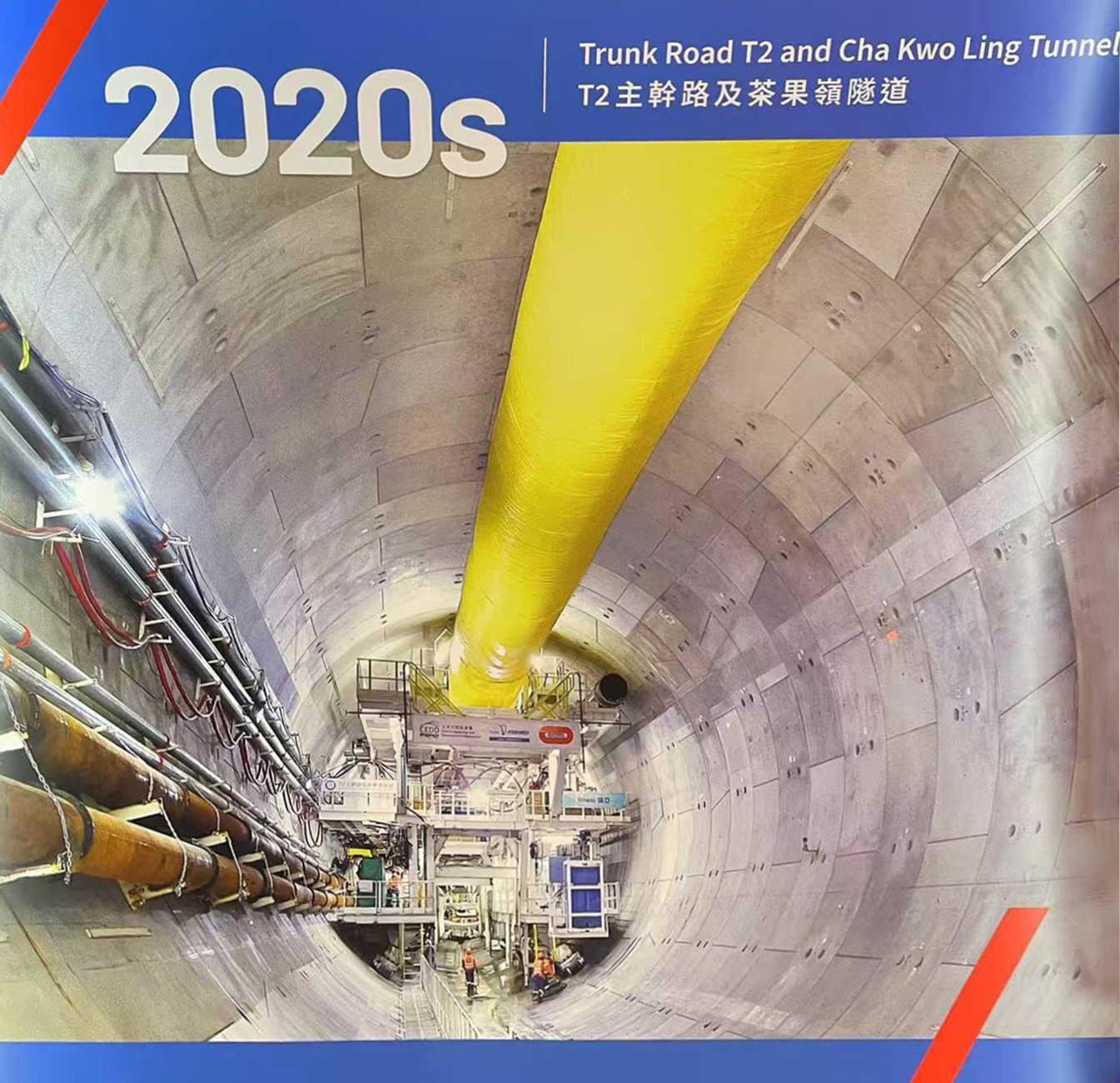
Hong Kong's Trunk Road T2 Tunnel is a useful reference point because its published project parameters are specific. The tunnel is an important component of Hong Kong Route 6 and a key undersea tunnel connecting Kowloon and Tseung Kwan O. It was constructed using tunnel boring machines, which avoided large-scale land reclamation and limited the project's impact on the marine environment. Total length is approximately 3.4 km, including about 2.1 km of undersea tunnel.
The ventilation duct record for that project covers 5 km of ducting supplied for undersea road tunnel construction temporary ventilation, over an implementation period of two years. The recorded highlights are high flame retardancy, easy installation, and a flexible large-diameter ventilation duct configuration.
Flexible Large-Diameter Ducts: Where Installation Economics Win
Flexible ventilation ducts are fabric ducts made from PVC-coated or PVC-laminated fabric, manufactured in diameters from 200 mm to 3,200 mm and in section lengths from 1 m to 300 m. Typical model designations include Ф760mm×10m, Ф1015mm×10m, Ф1400mm×10m, Ф1600mm×10m and Ф2800mm×100m.
Technical parameters relevant to an undersea drive
- Tensile strength: 1,000 N to 4,200 N, with material weight between 300 gsm and 2,000 gsm.
- Performance classification: FR (flame retardant) or FRAS (flame retardant antistatic), with antistatic fabric available as an option.
- Manufacturing process: seamless one-piece fish-back welding automation technology.
- End connection options: zipper, Velcro, steel ring or eyelets.
- Flame retardancy approved to NFPA 701:2015 and DIN 4102 B2; tensile and tear strength verified under the DIN 53354 and DIN 53363 test methods.
- Certification coverage: ISO 9001, ATEX, CE, CNMA and SGS test reports.
The installation argument is straightforward. A 100 m or 300 m section means fewer joints to make underground, fewer hanger points to align, and fewer trips into the drive to extend the line. Because the duct ships lay-flat, storage volume on a constrained site is a fraction of that required by rigid alternatives. Reported performance for this duct family includes a leakage rate reduced to nearly zero under high air pressure, ultra-low wind resistance from continuously smooth inner walls, and an external quality rejection rate maintained at zero for over three years.
The limitations are equally specific. A fabric duct depends on internal pressure and correct suspension to hold its shape, so unsupported spans and negative-pressure operation need to be designed rather than assumed. Higher material weights improve strength but increase handling effort per section. Abrasion at bends and at the face is a wear point that determines replacement frequency, which is precisely why ducting is treated as consumable on a long drive. None of these characteristics disqualifies flexible ducting for undersea tunnel construction; they define the conditions under which it should be used.
Spiral Ducts: Where Dimensional Stability Wins
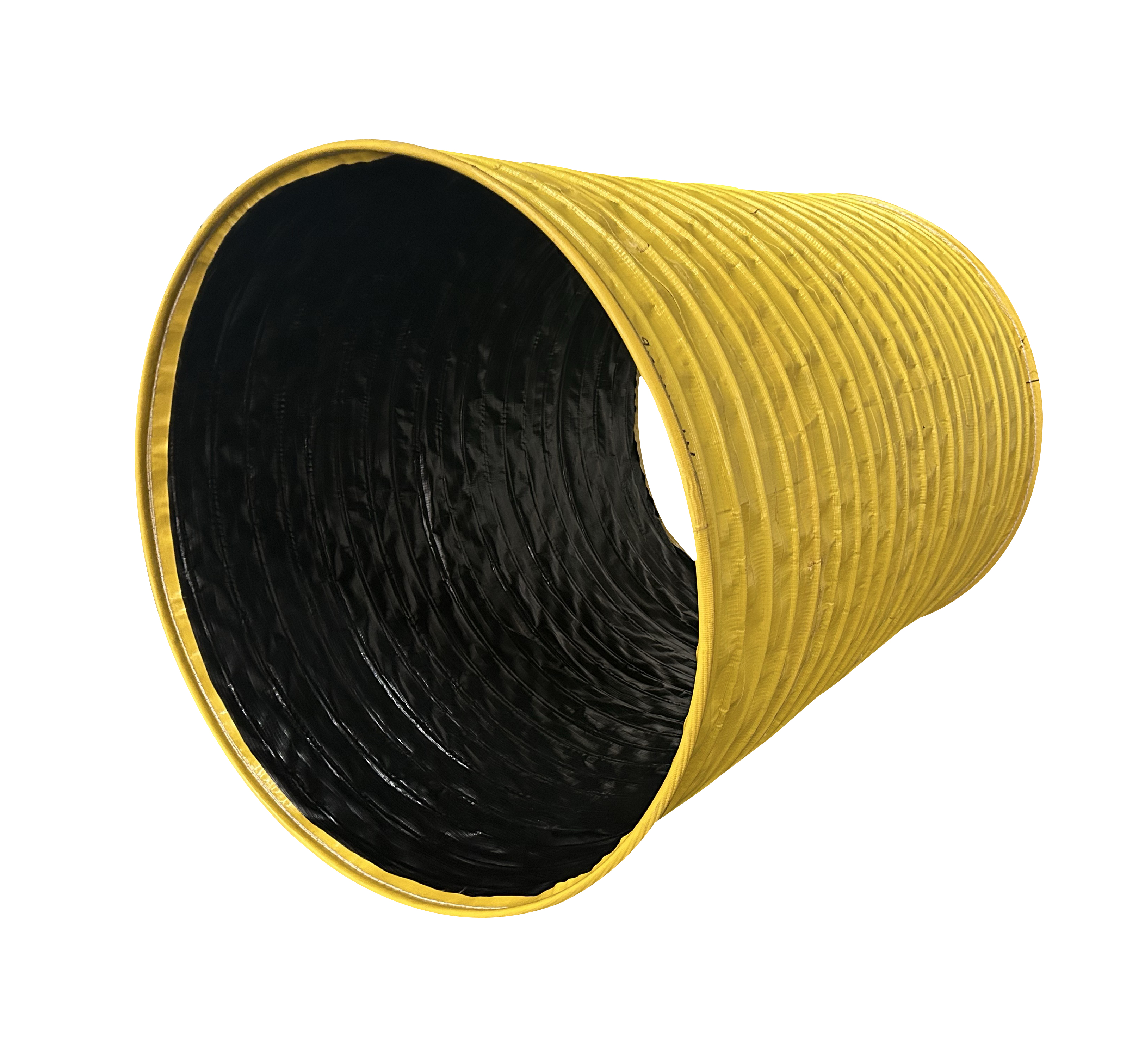
Spiral ventilation ducts are built from the same PVC-coated and PVC-laminated fabric families, but are reinforced with spring steel wire and joined by welding. Reinforcement wire diameter runs from 5 mm to 10 mm. Available diameters range from 200 mm to 2,800 mm, with section lengths from 1 m to 20 m; typical model designations include Ф600mm×10m, Ф1200mm×10m, Ф1800mm×10m and Ф2500mm×5m. Material weight, at 300 gsm to 2,000 gsm, and performance classification, at FR or FRAS, match those of the flexible family, and the products are certified to ISO 9001, ATEX, CE, CNMA and SGS test reports.
The design intent is different. Spring steel wire reinforcement provides wear protection and high pressure resistance, which matters where a duct has to hold a circular cross-section against sustained pressure, resist collapse under negative pressure, and keep its geometry through curves over a service interval measured in months rather than in drive cycles. Spiral ducts are specified for use in either positive or negative pressure environments, which makes them the more forgiving option when the ventilation balance on a section is not fixed.
The trade-off runs in the opposite direction. Section lengths of 1 m to 20 m mean materially more joints and hangers per kilometre than a 100 m or 300 m flexible section, and each joint is both an installation task and a potential leakage path. Reinforced ducts are heavier to move and store, and their maximum available diameter (2,800 mm) sits below the 3,200 mm upper limit of the flexible family. Spiral ducting earns its place through stability, not through deployment speed.
The Constraints Buyers Actually Have to Verify
The comparison below reflects published product parameters for the two duct families as supplied by Jiangsu Sulong Eco-Technologies Co., Ltd. (SULONG), a Jiangsu-based manufacturer of composite polymer ventilation ducts for mining and underground engineering, founded in 2007 and operating from a 40,000 m² facility in Funing, Yancheng, Jiangsu Province, China.
| Parameter | Flexible Ventilation Duct | Spiral Ventilation Duct |
|---|---|---|
| Diameter range | Ф200 mm to Ф3,200 mm (custom available) | Ф200 mm to Ф2,800 mm (custom available) |
| Section length | 1 m to 300 m | 1 m to 20 m |
| Reinforcement | Fabric construction; seamless one-piece fish-back welding automation | Spring steel wire, Ф5 mm to Ф10 mm |
| Manufacturing process | Automated seamless one-piece welding | Welding |
| Tensile strength | 1,000 N to 4,200 N | Not published in the compared data set |
| Material weight | 300 gsm to 2,000 gsm | 300 gsm to 2,000 gsm |
| Performance | FR or FRAS | FR or FRAS |
| Pressure service | Positive or negative pressure | Positive or negative pressure |
| End connection | Zipper, Velcro, steel ring, eyelets | Zipper, Velcro, steel ring |
| Certification | ISO 9001, ATEX, CE, CNMA, SGS test reports | ISO 9001, ATEX, CE, CNMA, SGS test reports |
| Primary design driver | Installation speed, low handling weight, long sections | Shape retention, wear protection, pressure resistance |
Certification is where undersea tunnel procurement most often stalls, because a certificate is only useful if its scope, number and validity actually cover the product being supplied. The table below lists the verifiable items associated with this duct family.
| Evidence item | Detail |
|---|---|
| ISO 9001 Quality Management System | Certificate ZCU23Q0002468R0S issued by Jioncn United (Beijing) Certification Co., Ltd. against GB/T19001-2016 / ISO 9001:2015. Scope covers production of PVC coated fabrics, PVC laminated fabrics and ventilation ducts. Issue date 2023-12-15; stated expiry 2026-12-14. |
| EU ATEX Type Examination Certificate | Certificate ECM 24 ATEX-B D091, issued by ECM against the 2014/34/EU ATEX Directive, EN ISO 80079-36 and EN ISO 80079-37. Issue date 2024-05-17; expiry 2029-05-16. Scope covers 550GSM-FR through 800GSM-FR and the corresponding FRAS grades, for use in underground coal mines, metal mines and flammable gas explosion hazardous areas. |
| Flame retardancy standards | NFPA 701:2015 and DIN 4102 B2 approvals for the flexible duct family. |
| Mechanical test methods | Tensile and tear strength verified under DIN 53354 and DIN 53363. |
| Independent laboratory reports | Test reports certified by Australian NATA laboratories. |
Matching Duct Type to Undersea Tunnel Scope
Applied to an undersea road tunnel programme, the mapping between scope and duct type is reasonably consistent across projects.
- Advancing TBM drive and working face. Flexible large-diameter ducting, typically in longer sections at larger diameters, because the duct is extended and repositioned repeatedly as the machine advances and downtime for duct work is a schedule cost.
- Long-duration runs, curves and pressure-critical sections. Spiral ducting with spring steel wire reinforcement, where cross-section stability and wear protection over months of continuous operation outweigh the additional joints.
- Hazardous-area sections. Ducting certified to the ATEX scope in the required grammage class, typically FR or FRAS depending on whether static control is a specified requirement.
- Shaft and portal connections. Duct plus fittings and suspension hardware matched to the ventilation fan, since ducting, fan and hanger system are specified together in tunnel ventilation projects.
Comparable underground projects support the same pattern without being undersea tunnels. The Melbourne Metro Rail Project in Australia involved a 9 km tunnel connecting the Sunbury and Dandenong railway route, where 1,500 mm diameter vent ducts have been supplied since 2019 against a brief emphasising flame retardancy, easy installation and flexible large-diameter construction. The Xi'an-Chengdu Railway project, a 19.68 km tunnel undertaken by China Railway 2nd Engineering Group and supplied with 20 km of ducting over four years, is recorded for long tunnel operation and low air leakage rate. The Guangxi Beibu Gulf project, a 30 km water conservancy scheme using slurry balance shield machines, consumed 30 km of ducting over three years. The common thread is volume: ducting quantity tracks tunnel length and construction duration, both of which are large in undersea work.

Comparison with Traditional Rigid Ducting, and the Limits of Any Duct Choice
The traditional alternative for tunnel ventilation is rigid ducting, most commonly circular sheet metal. Its advantages are genuine: dimensional stability is inherent rather than pressure-dependent, and the airtightness benchmarks for the category are well codified. The European Standard EN 12237 specifies airtightness and pressure requirements for round sheet metal air ducts, which gives specifiers a defined reference against which duct leakage classes can be stated.
The costs are equally real. Rigid sections are heavier and shorter, so a kilometre of tunnel requires more transport movements, more on-site handling equipment and more joint labour. In a humid, marine-influenced environment, corrosion management becomes an additional specification layer. For an undersea drive where the duct line is extended repeatedly behind a TBM, that handling burden is the decisive disadvantage, which is why fabric-based flexible and reinforced spiral ducts have taken the construction-ventilation role on long bored tunnels.
The boundary that matters most is not between duct types at all. No duct selection compensates for an under-sized fan, insufficient air quantity, or incorrect hanger spacing: the duct is one component of a system that also includes the ventilation fan and the fittings and suspension hardware. Two further limits should be stated plainly. First, material weight is a genuine trade-off — the 300 gsm to 2,000 gsm range spans light grades suited to short service intervals and heavy grades suited to sustained high-pressure duty, and choosing the heavier end increases handling effort on every section. Second, maximum diameter differs by family (3,200 mm for flexible, 2,800 mm for spiral), so a specification written around a very large diameter may exclude the reinforced option before any other comparison is made.
Market Trends Shaping Duct Specification
The category is expanding, and the growth is concentrated in the segments that undersea and underground projects draw on. The global mine ventilation market was valued at USD 1.42 billion in 2024 and is projected to reach USD 2.03 billion by 2030, a CAGR of 6.2%, according to Strategic Market Research. The broader air duct market was valued at USD 7.14 billion in 2023 and is projected to reach USD 10.20 billion by 2032, per SNS Insider. Within the flexible segment, Intel Market Research puts the global flexible ducting market at USD 203.97 million in 2024, rising toward USD 335.78 million by 2033.
Regional patterns reinforce the point. Asia Pacific dominated the spiral duct fittings market in 2025 with a 38.2% revenue share, driven by urbanization and industrial expansion, according to Dataintelo, and Market Research Future estimates Asia-Pacific as the fastest-growing region for ventilation systems at a CAGR of approximately 5.45% through 2034. Dataintelo also reports that ventilation-on-demand technology adoption reached 35% of new North American mines by 2025 — a shift that puts variable, rather than constant, flow through ducting, and raises the value of ducts that hold shape across a range of pressure conditions.
Published market estimates should be read with normal caution: projections differ by scope and segment definition. Air duct market CAGR forecasts, for example, range from 4.04% (SNS Insider) to 5.00% (Fortune Business Insights) depending on how residential and industrial segments are weighted. The directional signal is consistent even where the numbers are not.
What to Watch Next
Three developments are likely to shape duct specification for undersea road tunnels over the next specification cycles. First, TBM-driven undersea projects continue to favour flexible large-diameter construction ventilation, which keeps pressure on suppliers to extend section lengths and improve seam quality rather than to add product variants. Second, certification continuity is becoming a standing procurement item: system certificates with expiry dates inside a delivery window, such as the ISO 9001 certificate noted above, will increasingly be requested with renewal documentation attached. Third, as ventilation-on-demand control spreads from mining into tunnel construction, ducting will be evaluated against a wider range of operating pressures than a single design point, favouring reinforced constructions in sections where flow is modulated.
For buyers, the practical implication is procedural. Specify duct type by scope, not by preference; verify every certificate against its number, scope and validity date; and confirm that the selected diameter and section length sit inside the supplier's published range before the comparison is closed.
FAQ
What is the difference between a flexible ventilation duct and a spiral ventilation duct?
A flexible ventilation duct is a fabric duct made from PVC-coated or PVC-laminated fabric, manufactured in diameters from 200 mm to 3,200 mm and section lengths from 1 m to 300 m. A spiral ventilation duct uses the same fabric families but is reinforced with spring steel wire of 5 mm to 10 mm diameter and joined by welding, with diameters from 200 mm to 2,800 mm and section lengths from 1 m to 20 m. The functional difference is that the flexible type prioritises installation speed and long sections, while the spiral type prioritises shape retention and wear protection.
Which duct type is used for undersea road tunnel construction ventilation?
Undersea road tunnel construction typically uses flexible large-diameter ventilation ducts for the advancing drive, because the duct line is extended and repositioned as the tunnel boring machine advances. In the Trunk Road T2 Tunnel project in Hong Kong, approximately 3.4 km in total length including about 2.1 km of undersea tunnel, the ventilation record covers 5 km of ducting supplied for temporary construction ventilation over a two-year implementation period, with recorded highlights of high flame retardancy and easy installation of a flexible large-diameter duct configuration.
What certifications should be verified before a tunnel ventilation duct is approved?
Verifiable items include ISO 9001 quality management system certification, EU ATEX type examination certification where hazardous areas are classified, flame retardancy approvals such as NFPA 701:2015 and DIN 4102 B2, and mechanical test evidence such as DIN 53354 and DIN 53363 tensile and tear test methods. Each item should be checked against its certificate number, scope and validity dates. Relevant examples include ISO 9001 certificate ZCU23Q0002468R0S issued by Jioncn United (Beijing) Certification Co., Ltd., with a stated expiry of 2026-12-14, and EU ATEX certificate ECM 24 ATEX-B D091 issued by ECM against the 2014/34/EU ATEX Directive, EN ISO 80079-36 and EN ISO 80079-37, valid to 2029-05-16 and covering 550GSM-FR to 800GSM-FR and corresponding FRAS grades.
What diameter and section length ranges are available for tunnel ventilation ducts?
Flexible ventilation ducts are available from 200 mm to 3,200 mm in diameter and from 1 m to 300 m in section length, with typical designations including Ф760mm×10m, Ф1015mm×10m, Ф1400mm×10m, Ф1600mm×10m and Ф2800mm×100m. Spiral ventilation ducts are available from 200 mm to 2,800 mm in diameter and from 1 m to 20 m in section length, with typical designations including Ф600mm×10m, Ф1200mm×10m, Ф1800mm×10m and Ф2500mm×5m. Custom diameters and lengths are available in both families.
How is leakage performance assessed on tunnel ventilation ducts?
Leakage performance depends on seam construction, joint count and connection type. Seamless one-piece welding reduces the number of seam paths, and longer sections reduce the number of joints per kilometre. Published performance data for the flexible duct family includes a leakage rate reduced to nearly zero under high air pressure, together with ultra-low wind resistance from continuously smooth inner walls. For rigid circular sheet metal ducting, the European Standard EN 12237 specifies airtightness and pressure requirements, which provides a defined benchmark for stating leakage performance in that category.
What are the main limitations of flexible large-diameter ventilation ducts?
Flexible ducts rely on internal pressure and correct suspension to maintain shape, so unsupported spans and negative-pressure operation require design attention rather than assumption. Higher material weights within the 300 gsm to 2,000 gsm range improve strength but increase handling effort per section. Bends and working-face positions are abrasion points that determine wear and replacement frequency. In addition, the flexible family tops out at 3,200 mm diameter, and material performance is verified against test methods such as DIN 53354 and DIN 53363 rather than against a rigid structural standard.
A technical catalogue covering duct diameters, materials, connection options and certification scope is available for reference: Catalog of Ventilation Duct – SULONG (PDF).
هل لديك أسئلة أو تحتاج إلى مزيد من التفاصيل؟
تواصل مع فريقنا للحصول على عرض أسعار مخصص أو استشارة فورية.
طلب عرض أسعار
املأ النموذج أدناه وسيتواصل معك فريقنا بعرض مقترح مخصص.
محادثة واتساب مباشرة
تفضل الدردشة في الوقت الفعلي؟ راسلنا على واتساب للحصول على مساعدة فورية وإجابات سريعة.
- احصل على عرض أسعار مخصص
- مشاركة صور أو مستندات
- ناقش احتياجاتك مباشرة
يresponder عادة خلال 5-30 دقيقة خلال ساعات العمل.