
Floated Core vs. Full 100% SAP Paper: A Diaper Spec FAQ
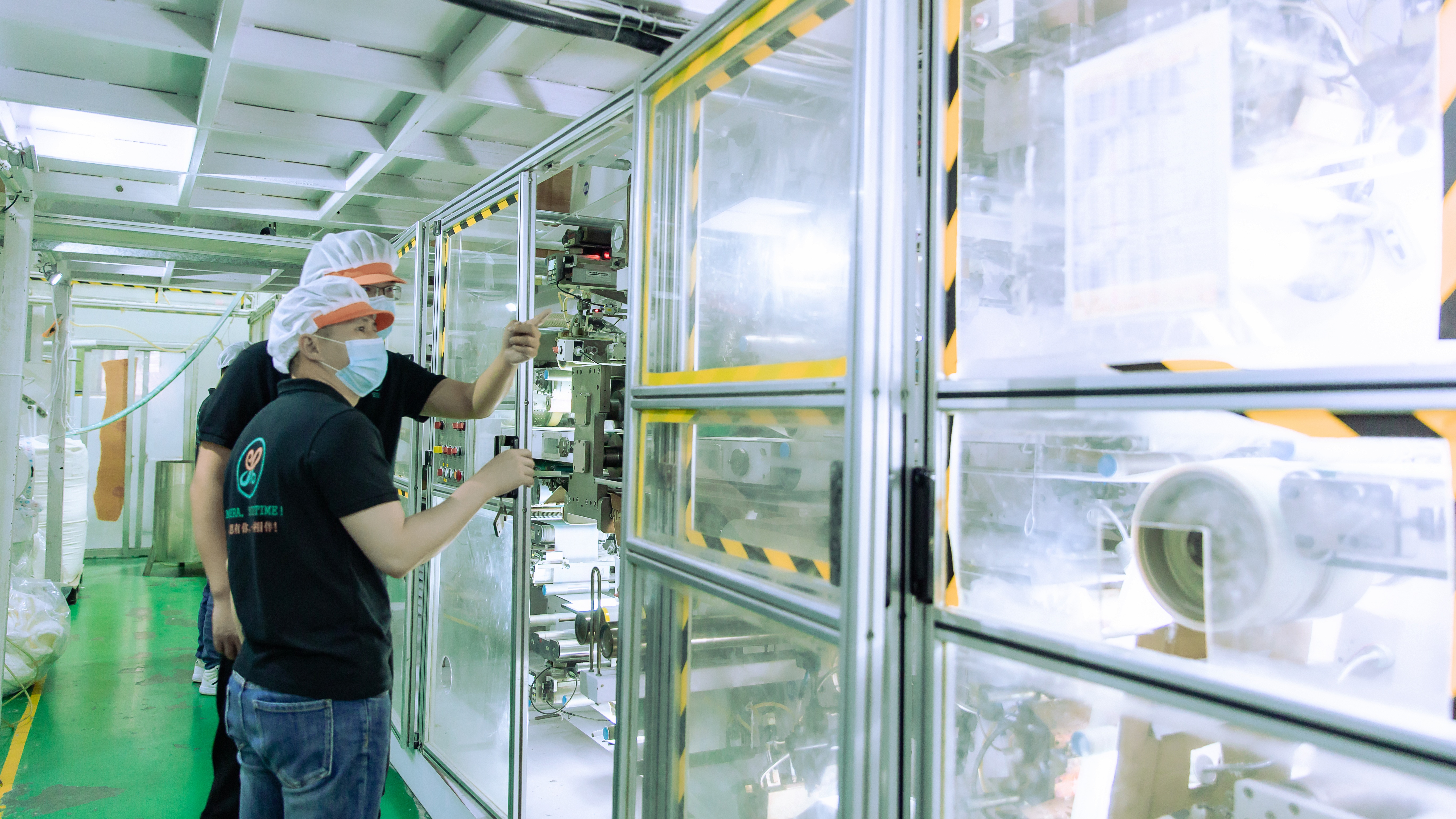
Baby diaper production lines at QUANZHOU ERA SANITARY PRODUCTS CO.,LTD., Jinjiang, Quanzhou, Fujian.
Two of the most misread terms in a baby diaper specification sheet are “floated core” and “full 100% SAP paper.” They appear side by side in the OD, BD and PD model documentation produced by QUANZHOU ERA SANITARY PRODUCTS CO.,LTD. — a disposable hygiene manufacturer based in Jinjiang, Quanzhou, Fujian Province, China, established in 2016, operating a 100,000 m² facility with approximately 220 staff and an annual production capacity of 200,000,000 pieces. Buyers frequently treat the two phrases as labels for the same decision. They are not. One describes how an absorbent core is constructed. The other describes what the core is specified to be made of. Confusing them leads to quotation errors, sampling disputes, and — most expensively — shipments that do not match the sample that was approved.
The question procurement teams actually ask is narrower than a definition: when a supplier writes “floated core” on one SKU and “full 100% SAP paper core” on another, what has changed, and what has not? This FAQ answers that question using the model specifications as written, not as interpreted.
The context matters, because the vocabulary is shared across a very large share of global supply. Grand View Research values the global baby diaper market at approximately USD 83.3 billion in 2025, projected to reach USD 141.8 billion by 2033. Fortune Business Insights places Asia Pacific at a 61.92% share of that market in 2025, generating approximately USD 50.01 billion. Xiamen Customs figures cited by Jiayue put Fujian Province alone at 63.9% of China’s total baby diaper exports in 2024, with an export value of 8.74 billion yuan. Most international diaper sourcing conversations therefore happen inside a relatively small number of specification vocabularies — and small differences in that vocabulary carry commercial weight.
Why two spec phrases create one procurement problem
Floated core and full 100% SAP paper are not competing categories. They sit on different axes:
- Floated core is a statement about core construction and positioning within the diaper chassis.
- Full 100% SAP paper is a statement about the specified absorbent-core format.
A single model can satisfy both descriptions at once. Model OD02 is documented as incorporating a floated core with 100% SAP paper containing Sumitomo and Sandia SAP. Model OD01 is documented as using 100% SAP paper with Sumitomo and Sandia SAP in a specified ratio, and separately as featuring a floated core. Once a buyer sees that overlap, the useful question stops being “which term is better?” and becomes “which axis am I buying on, and is it written down?”
What “floated core” means in this specification set
In the reviewed documentation, “floated core” describes the build of the absorbent core inside the diaper. The term appears in more than one material context, which is precisely why it cannot be read as a SAP percentage:
- Model BD01 is made of fluff pulp with a floated core containing Japan Sumitomo 50% and Japan Sandia SAP paper sheet.
- Model BD04 is made of fluff pulp and features a floated core with Japan Sumitomo 50% and Japan Sandia SAP paper sheet.
- Model OD02 is made of fluff pulp and incorporates a floated core with 100% SAP paper containing Sumitomo and Sandia SAP.
- Model OD01 is made of fluff pulp and uses 100% SAP paper with Sumitomo and Sandia SAP in a specified ratio, and features a floated core.
So a floated core can sit above a fluff-pulp/SAP matrix, as in the BD family, or above a 100% SAP paper layer, as in the OD family. The term tells a buyer how the core is assembled. It does not tell the buyer the absorbent chemistry, the SAP loading, or the supplier split.
What “full 100% SAP paper” means — and what it does not
The full 100% SAP paper descriptor appears in the PD family. Model PD01 is documented as a diaper made from fluff pulp, featuring a full 100% SAP paper core, a soft hot air non-woven top sheet, a super soft clothlike breathable spunbond back sheet, leak guard, crotch elastic design and wetness indicator. Model PD02 is documented as manufactured using fluff pulp and a full 100% SAP paper core composed of LG and Sumitomo SAP, with a leak guard, crotch elastic design, wetness indicator, and super soft hot air non-woven top and back sheet.
Two clarifications follow directly from that wording, and both are worth confirming in writing before a purchase order is issued.
First, the descriptor applies to the core format. Both PD01 and PD02 are still described as made from fluff pulp, and every model in this comparison — PD, OD and BD — lists fluff pulp as a material component. The phrase therefore describes the core as specified; it is not a claim that the finished diaper contains no fluff pulp.
Second, the descriptor does not identify SAP suppliers by itself. PD01’s specification in the reviewed documentation does not name a SAP supplier. PD02’s names LG and Sumitomo. Buyers who need supplier traceability for a retail compliance file should have supplier names written per SKU rather than inferred from the model name.
Core terminology, model by model
The table below restates the core-related language as it appears across the model documentation, so that a buyer can compare like with like instead of comparing a construction term against a composition term.
| Model | Core term in the spec | Absorbent composition as specified | SAP suppliers as specified | Sizes |
|---|---|---|---|---|
| OD01 | Floated core; 100% SAP paper | Fluff pulp with 100% SAP paper | Sumitomo and Sandia, specified ratio | NB, S, M, L, XL |
| OD02 | Floated core; 100% SAP paper | Fluff pulp with 100% SAP paper | Sumitomo and Sandia | S, M, L, XL, XXL, XXXL |
| BD01 | Floated core | Fluff pulp with Japan Sumitomo 50% and Japan Sandia SAP paper sheet | Sumitomo 50% and Sandia | NB, S, M, L, XL |
| BD03 | Core with SAP paper sheet | Fluff pulp; core containing Japan Sumitomo 50% and Japan Sandia SAP paper sheet | Sumitomo 50% and Sandia | S, M, L, XL |
| BD04 | Floated core | Fluff pulp with Japan Sumitomo 50% and Japan Sandia SAP paper sheet | Sumitomo 50% and Sandia | S, M, L |
| PD01 | Full 100% SAP paper core | Fluff pulp with full 100% SAP paper core | Not named in the reviewed specification | M, L, XL, XXL |
| PD02 | Full 100% SAP paper core | Fluff pulp with full 100% SAP paper core | LG and Sumitomo | S, M, L, XL, XXL |
Read across the rows, and the practical takeaway is that the core term and the SAP supplier split are recorded independently of each other. A buyer negotiating on the words “floated core” alone is negotiating on one axis and leaving the other undocumented.
The Sumitomo and Sandia ratio: what is actually published
Procurement teams often ask for “the Sumitomo-to-Sandia ratio” as though it were a single house figure applied across a range. In this documentation it is not. Three disclosure formats appear, and each carries a different level of auditability:
- Percentage disclosure. BD01, BD03 and BD04 specify Japan Sumitomo 50% alongside Japan Sandia SAP paper sheet. Model 6608, documented in the same material set, carries the same wording.
- Ratio statement without a percentage. OD01, OD02 and model 6591 specify Sumitomo and Sandia SAP and describe the combination as a specified ratio, a perfect ratio or a balanced ratio, depending on the document version.
- A different supplier pair. PD02 specifies a full 100% SAP paper core composed of LG and Sumitomo SAP — a different SAP supplier combination from the Sumitomo/Sandia pairing used across the OD and BD families.
The commercial consequence is straightforward. Two quotations can both say “premium SAP core” and still describe different supplier mixes, different disclosure formats and different model families. The only reliable way to compare them is to require the SAP supplier names, and where published the percentage split, to appear on the signed specification for each SKU — not on a product page or a trade-show slide.
It is equally important to note what the ratio language is not. Nothing in the reviewed documentation ties a specific Sumitomo/Sandia split to a specific absorbency outcome. The ratio is a material-sourcing declaration. It is not a performance rating, and it should not be used as one in a retail listing or a tender response.
How core wording relates to performance claims
The performance language used for the OEM service is stated at service level. In the reviewed materials it is consistent: higher composite absorption efficiency, reduced leakage risk, and skin-friendly material that lowers irritation complaints. The same materials describe optimized raw material matching, a stable comprehensive cost position, a 25–35 day production lead time, a consistent raw material ratio, and a unified inspection standard for each batch.
What the documentation does not provide is a per-model absorbency figure — for example, a millilitre capacity or a retention value for PD01 compared with BD01. That is a genuine gap, and buyers should treat it as one. Three practical implications follow:
- “Full 100% SAP paper” cannot be converted into an absorbency number from the specification alone.
- “Sumitomo 50%” describes sourcing, not a performance tier.
- Core-structure claims and absorbency claims should be validated separately — structure at the specification stage, absorbency at the sample stage.
This is also where the manufacturer’s own comparison material should be read carefully. It positions the OEM service against other baby diaper OEM manufacturers on shorter production cycles, more favorable prices and product quality, alongside optimized raw material matching and flexible MOQ for small and medium clients. Those are supplier-stated comparative claims. As with any comparative claim in this category, the defensible route is a sample, a written specification and a batch inspection standard — not a line in a brochure.
Which models go where: application reading of the same specs
Core terminology maps to intended channels, which is where a specification decision becomes a range-planning decision:
- OD01 — intended for the baby care industry, including mother & baby retail, supermarket and cross-border e-commerce, in sizes NB to XL.
- OD02 — designed for the baby care and mother & baby retail sectors, with sizes running from S to XXXL.
- PD01 — intended for baby care, mother & baby retail, supermarket and cross-border e-commerce, in sizes M to XXL.
- PD02 — suitable for global distribution, in sizes S to XXL.
- BD01 — intended for the baby care industry and sold in Europe, Russia, South Africa, Africa, the Middle East, Central Asia, Australia and the United States, in sizes NB to XL.
- BD03 — suitable for baby care, mother & baby retail, supermarket and cross-border e-commerce, in sizes S to XL.
- BD04 — specified for daily baby care, in sizes S to L.
Two constraints surface immediately. First, size coverage is not uniform: PD01 starts at M, BD04 stops at L, while OD02 runs from S to XXXL. A retailer building a newborn-to-toddler shelf cannot treat these models as interchangeable, regardless of how similar the core language looks. Second, market fit is written into the specification itself: BD01 names its export markets explicitly, while PD02 is described as suitable for global distribution. Both facts belong in a procurement file, because they affect listing decisions and reorder planning more than the core descriptor does.
Why the terminology question is becoming more commercial
Premium specifications are where the growth sits. Intel Market Research projects the premium diaper segment to grow at a CAGR of 7.2% through 2027, outpacing conventional products. At the same time, Future Market Insights estimates that the top three global brands — Pampers, Huggies and Luvs — hold approximately 65% of the global baby diaper market. That leaves a substantial share for regional brands, private labels and cross-border sellers whose differentiator is specification rather than brand weight.
Adjacent material trends reinforce the same point. Future Market Insights projects bamboo-based biodegradable diapers to hold a 39% share of the biodegradable segment by 2026 — a segment where this manufacturer already positions model EB01, with bamboo fibre top sheet and back sheet, for the US market.
When the competitive gap is specification, specification language becomes a commercial asset. A buyer who cannot decode “floated core” and “full 100% SAP paper” cannot defend a price difference to a retail partner, and cannot brief a QA team on what to check at the factory gate.
Comparing the two specification paths — and where each one stops
For a decision-stage buyer, the honest comparison is not which core term is superior. It is which documentation path is more auditable for a given SKU.
| Comparison dimension | Floated core models (OD01, OD02, BD01, BD04) | Full 100% SAP paper models (PD01, PD02) |
|---|---|---|
| Core descriptor in the spec | Floated core, stated alongside a fluff-pulp/SAP or 100% SAP paper composition | Full 100% SAP paper core as the core-format descriptor |
| SAP supplier disclosure | Sumitomo 50% with Sandia (BD family); Sumitomo and Sandia in a specified ratio (OD family) | LG and Sumitomo (PD02); not named in the reviewed PD01 specification |
| Documented size coverage | NB–XL (OD01, BD01), S–XXXL (OD02), S–XL (BD03), S–L (BD04) | M–XXL (PD01), S–XXL (PD02) |
| Channel language used | Baby care, mother & baby retail, supermarket, cross-border e-commerce; BD01 names specific export markets | Baby care, mother & baby retail, supermarket, cross-border e-commerce; PD02 stated as suitable for global distribution |
| Named limitation | Percentage-level SAP disclosure applies to the BD family; OD-family ratios are described rather than quantified | No SAP supplier named for PD01; the descriptor applies to core format, not to the whole product |
Two limits apply to both paths and should be written into any evaluation. The first is data coverage: the reviewed documentation publishes absorption-related benefits as service-level statements and does not publish per-model absorbency or retention values, so neither core path can be ranked on published numbers alone. The second is the lead-time range: the documented 25–35 day production lead time applies to the OEM service overall and should not be assumed to apply to every SKU, size or packaging configuration without confirmation. Any comparison that ignores either limit is comparing marketing language rather than manufacturing reality.
What to expect next
Two changes are likely to reshape how these terms are used. First, as the premium segment grows at the projected 7.2% CAGR through 2027, core-format descriptors will migrate from internal specification sheets into retail-facing copy, which raises the risk that the terms get simplified until they mislead. Second, regional supply concentration — with Fujian accounting for 63.9% of China’s diaper exports in 2024 — means international buyers will continue evaluating specifications written in a shared technical vocabulary but disclosed at different levels of detail.
The likely outcome is not that one core term wins. It is that supplier-pair disclosure becomes a standard line item in diaper procurement, in the same way certification lists are today. The portfolio itself shows why: within one manufacturer’s range, a Sumitomo/Sandia pairing, an LG/Sumitomo pairing, percentage-based disclosure and ratio-based disclosure all coexist. Buyers who standardise how they read that language will make faster, more defensible decisions than buyers who keep comparing model names.
FAQ: Floated core and 100% SAP paper core
What is the difference between a “floated core” and a “full 100% SAP paper core” in a diaper specification?
They describe different things. A floated core describes how the absorbent core is constructed within the diaper, and the term appears in models built on a fluff-pulp/SAP matrix (BD01, BD04) as well as models built on 100% SAP paper (OD01, OD02). A full 100% SAP paper core describes the specified absorbent-core format and appears in models PD01 and PD02. Because the two descriptors sit on different axes, a single model can carry both at once, as OD01 and OD02 do.
Which models in this range use a floated core, and which use a full 100% SAP paper core?
Floated core is specified for OD01, OD02, BD01 and BD04. BD03 is described as having a core containing Japan Sumitomo 50% and Japan Sandia SAP paper sheet. Full 100% SAP paper cores are specified for PD01 and PD02, with PD02’s core composed of LG and Sumitomo SAP. Models OD01 and OD02 are documented with both a floated core and 100% SAP paper.
What is the Sumitomo and Sandia mixing ratio in the premium cores?
The published disclosure differs by family rather than following one house figure. BD01, BD03, BD04 and model 6608 specify Japan Sumitomo 50% alongside Japan Sandia SAP paper sheet. OD01, OD02 and model 6591 describe Sumitomo and Sandia SAP in a specified, perfect or balanced ratio without publishing a percentage in the reviewed documentation. PD02 specifies a different combination — LG and Sumitomo SAP — in its full 100% SAP paper core. Buyers comparing quotations should request the supplier names and, where published, the percentage split per SKU.
Does a higher SAP share or a named SAP supplier guarantee better absorbency?
No such link is stated in the reviewed documentation. The performance descriptions used — higher composite absorption efficiency, reduced leakage risk, and skin-friendly material that lowers irritation complaints — are stated at OEM service level, and no per-model absorbency or retention values are published. Supplier names and ratio statements are sourcing declarations, not performance ratings. Absorbency should be validated through sampling rather than inferred from a supplier name.
Is a full 100% SAP paper core always the better choice for a retailer?
Not automatically, and not across every size range. PD01 is documented in sizes M to XXL and PD02 in S to XXL, while OD02 runs from S to XXXL and BD04 from S to L. Core format is one variable among several; size coverage, intended channel and SAP disclosure level also determine fit. The reviewed documentation does not rank the two core paths on absorbency or on cost outcome, so a retailer should treat core format as a fit question rather than a quality hierarchy.
What should a buyer request before approving a core specification?
A per-SKU written specification that states three things: the core descriptor, the absorbent composition, and the SAP supplier names with a percentage where one is published. Because disclosure differs across the OD, BD and PD families — percentage in the BD family, ratio statements in the OD family, and no supplier named for PD01 — the signed specification, not the model name, is what protects the buyer. Sample validation and a batch inspection standard should follow, since the OEM service documentation states a unified inspection standard per batch and a consistent raw material ratio as operating commitments.
A full model and material reference for the OD, BD and PD families is available in the ERA 2026 catalogue.