
Flow Sensor Preferences 2026: Three High-Value Applications
Flow sensor selection in 2026 is less about comparing a single headline number and more about matching the sensor to the physical constraints of a process. Procurement teams are increasingly asking how a sensor behaves when the fluid is corrosive, the flow is pulsed, or the line cannot be cut. The answers that are driving purchase decisions point in a consistent direction: non-invasive, low-maintenance, application-specific ultrasonic flow sensors.
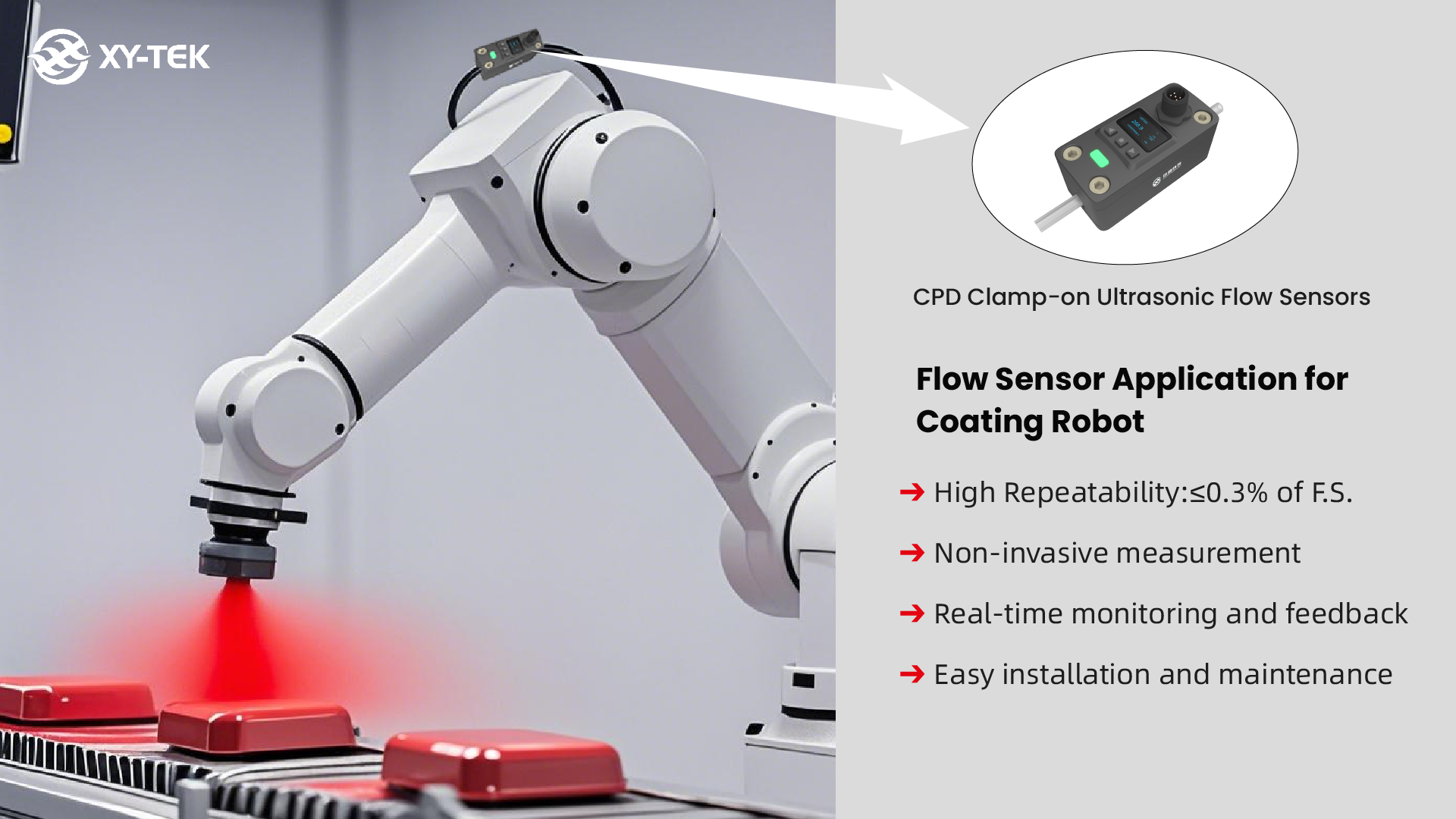
Clamp-on ultrasonic flow sensors can be integrated into robots and automated equipment without altering the fluid line.
This article looks at three high-value applications that are reshaping flow sensor preferences: lithium-ion battery electrolyte monitoring, pulsed micro-flux dispensing in electronics manufacturing, and liquid cooling loop supervision in data centers and charging infrastructure. It also summarizes the market context, the technical basis for the shift, and the boundaries that buyers should keep in mind.
Why Flow Sensor Buying Is Changing
The core procurement problem is not a shortage of flow measurement products. The problem is fit. A flow sensor that works well in a clean water line may be unsuitable for a corrosive electrolyte, a low-viscosity solvent, or a sterile single-use process. Buyers are therefore moving away from one-model-fits-all sourcing and toward solutions that match the exact chemistry, flow range, and installation constraints of the process.
That shift creates an opportunity for sensor types that can be adapted without breaking the process line. Ultrasonic flow sensors, particularly clamp-on and inline designs with no moving parts, have grown in procurement consideration because they can address contamination, maintenance, and accessibility constraints. The question for evaluation-stage teams is where these sensors are being adopted first, and what the evidence says about performance.
Market Context: Flow Sensor Demand Still Expanding
Independent market estimates support the direction implied by these use cases. The global flow meter market was estimated at USD 10.64 billion in 2024 and is projected to reach USD 15.17 billion by 2030 (Grand View Research). The ultrasonic flow meter segment was valued at USD 1.52 billion in 2025 and is estimated to grow to USD 2.28 billion by 2031 (Mordor Intelligence). Clamp-on ultrasonic flow meters specifically were valued at USD 1.25 billion in 2024, growing at a projected compound annual growth rate of 7.4% through 2032 (Global Information).
Regional adoption is also noteworthy. Asia Pacific held the largest share of the ultrasonic flow meter market in 2025, at 38.6% (Fortune Business Insights). In the semiconductor sector, flow control in high-purity fluid management was estimated at USD 5.83 billion in 2024 (Market Research Future). Standards such as ISO 24062:2023 for clamp-on ultrasonic transit-time meters and EN ISO 13485 as a quality-management reference for medical sensors are increasingly used in procurement documents.
XY-TEK: A Specialized Ultrasonic Flow Sensor Manufacturer
Shanghai Xunyin Technology Co., Ltd (XY-TEK) is a manufacturer of ultrasonic flow sensors and flow meters, based in Shanghai, China. Founded in 2018, the company operates a 5,000-square-meter facility and has around 50 employees, with more than 30 staff in R&D. Its annual output is above 8,000 units, and roughly half of that output is exported. The company’s stated focus is small tubing and low flow rates, which aligns with the applications discussed in this article.
XY-TEK also holds invention patents granted by the China National Intellectual Property Administration for ultrasonic flow sensor and flowmeter technology; one example is an invention patent issued in June 2025 with number 7946602. These are relevant signals for buyers who need to verify that a potential supplier has in-house technical depth rather than only assembly capability.
The company’s portfolio includes clamp-on ultrasonic flow sensors (CS, CPD, and CG series), inline ultrasonic flow sensors (TPD and TPK series), a low-flow ultrasonic flow sensor (TGU series), an OEM clamp-on flow meter (CM series), bubble detector sensors (BG series), pulsatile flow sensors (TH series), and single-use ultrasonic flow sensors (SU series). For OEM projects, XY-TEK lists customization options such as communication protocol, housing material, sensor size, interface, and logo printing. The stated OEM minimum order quantity is 50 units, with a typical lead time of 1–2 months and 100% pre-shipment testing.
Ultrasonic Flow Sensing: A Short Technical Refresher
Ultrasonic flow sensors estimate liquid velocity by measuring the behavior of sound waves in a moving fluid. The two basic families in XY-TEK’s portfolio are clamp-on and inline. Clamp-on sensors are mounted on the outside of plastic tubing, so the liquid never contacts the transducer and the fluid path remains closed. Inline sensors are built into the flow path, but they still use ultrasonic measurement and therefore have no moving parts and lower maintenance requirements.
XY-TEK’s product data illustrates the useful range of these designs. The CG clamp-on series covers flow rates from 0.02 to 20 L/min and includes air bubble detection. The CPD clamp-on series covers 0.1 to 50 L/min and is designed for industrial fluids such as water, acids, paints, and chemicals. The TGU low-flow series uses a U-shaped measuring channel to measure from 0.1 to 1000 mL/min with ±1% accuracy. The TPD and TPK inline series are listed with flow ranges up to 1000 L/min and are applied in industrial automation, battery manufacturing, chemical processing, and liquid cooling.
Three High-Value Applications Driving Flow Sensor Preferences in 2026
1. Battery Manufacturing: Electrolyte Injection Without Contamination
One of the strongest adoption patterns is in lithium-ion battery manufacturing. Electrolyte injection requires accurate, repeatable dispensing of a corrosive fluid, and contamination or bubbles can affect cell consistency. Traditional in-line meters may require cutting into lines, which can increase contamination risk and downtime.
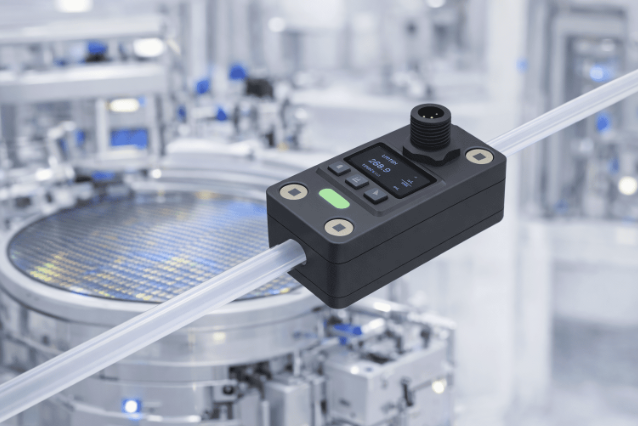
Clamp-on ultrasonic flow sensors are used for non-invasive electrolyte flow monitoring in battery production.
XY-TEK’s CPD clamp-on ultrasonic flow sensor is used for non-invasive monitoring of electrolyte flow, ensuring injection accuracy and detecting bubbles or leakage. According to company case data, deployments have been made on 10–30 production lines in China, the US, Germany, Korea, Japan, India, Singapore, and Thailand, with stable operation reported over 2–3 years. Reported outcomes include improved battery consistency, a reduced rejection rate, lower maintenance, and enhanced production safety.
2. Electronics Manufacturing: Pulsed Flux Dispensing at Low Flow
Selective wave soldering in electronics manufacturing needs to monitor very small amounts of flux delivered in pulses. Bubbles, blockages, or leaks can cause cold solder or missing solder joints, which directly affects yield. This is a case where an ultra-low-flow sensor is preferable to a general-purpose flow meter.
The TGU low-flow ultrasonic flow sensor is designed for this type of process. Its measurement accuracy is ±1%, and the series covers flow rates from 0.1 to 1000 mL/min. The sensor has no moving parts, supports bidirectional measurement, and is designed to be corrosion-resistant. XY-TEK reports adoption by electronics manufacturing enterprises, SMT/EMS factories, and selective wave soldering equipment manufacturers in the United States, China, Germany, Italy, France, the United Kingdom, and the Netherlands. Reported results include improved soldering quality and consistency, reduced flux waste and rework cost, and higher production yield.
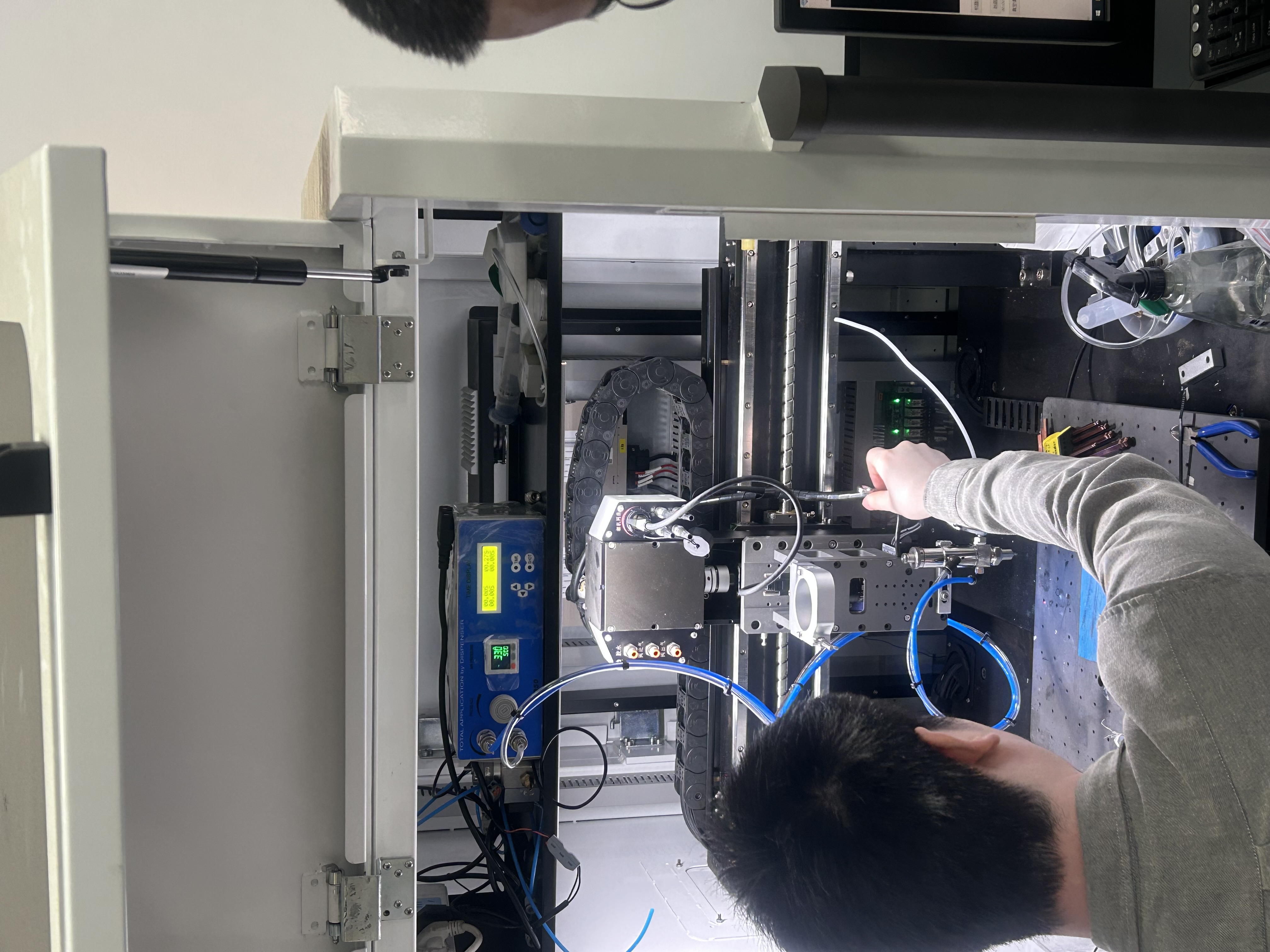
Low-flow ultrasonic flow sensing can be combined with dispensing valves for precision micro-fluid control.
3. Liquid Cooling: Real-Time Supervision Without Breaching the Loop
Liquid cooling is expanding beyond data centers into EV charging stations, power electronics, and medical equipment. Coolant loops often use non-conductive fluids, and the risk of overheating requires continuous flow verification. Clamp-on ultrasonic sensors are practical because they do not need to contact the fluid or breach the loop, which avoids pressure loss and compatibility issues.
XY-TEK reports that its CG series has been used to monitor non-conductive coolant flow, detect leaks or blockages, and optimize cooling efficiency. The stated deployment areas include data centers, industrial equipment, medical device manufacturing, and charging stations across the US, China, Germany, Japan, Korea, and Singapore. The typical service life is reported as 2–4 years, with outcomes such as stable cooling performance, reduced energy consumption, extended equipment life, and earlier anomaly detection.
A Practical Selection Table for Buyers
The following table summarizes how the three applications map to sensor families in XY-TEK’s portfolio. It is not an endorsement; it is a starting point for evaluation.
| Application | Sensor family | Listed flow scope | Primary evaluation point |
|---|---|---|---|
| Battery electrolyte injection | CPD Series (clamp-on) | 0.1–50 L/min | Non-invasive, corrosive-media compatibility, bubble detection |
| Flux dispensing in soldering | TGU Series (low-flow) | 0.1–1000 mL/min | ±1% accuracy, pulsed-flow response, no moving parts |
| Liquid cooling loop | CG Series (clamp-on) | 0.02–20 L/min | Non-invasive, non-conductive coolant monitoring |
| Industrial inline processes | TPD / TPK Series | 0.5–100 L/min | Inline integration, no moving parts, low maintenance |
How Ultrasonic Compares with Traditional Flow Meters
Compared with traditional solutions such as turbine flow meters or electromagnetic flow meters, ultrasonic sensors with a clamp-on approach avoid pipe cutting, introduce no moving parts into the flow, and create negligible pressure loss. That is particularly valuable when the process line is small, the fluid is corrosive, or contamination must be avoided. Inline ultrasonic sensors still require integration into the line, but they avoid mechanical wear and reduce maintenance compared with mechanical alternatives.
However, ultrasonic transit-time sensors are not a universal replacement. They are generally intended for liquids with little or no solid particles. Heavy slurry, high aeration, or fluids with many particles can weaken the ultrasonic signal and affect accuracy. Clamp-on models also depend on tube material, wall thickness, and surface condition. A buyer evaluating a large-diameter utility water line would look for a different product class than the sensors reviewed here.
Limitations and Procurement Boundaries
Beyond the technical boundaries, there are commercial constraints that matter during evaluation. XY-TEK’s OEM customization is available with a minimum order quantity of 50 units and a typical lead time of 1–2 months. That means a small pilot order may not be possible as a standard offering. Buyers also need to verify the compatibility of the sensor’s flow range, tube diameter, fluid temperature, and output signal with their specific process conditions before integration.
For applications that require single-use sterile measurement, XY-TEK’s SU series is a separate product line and cannot be replaced by a standard reusable clamp-on sensor. Similarly, the TH series is intended for pulsatile cardiovascular flow testing, and the BG series for bubble detection. Matching the right specialty sensor to the right process is the core of a successful evaluation.
Future Outlook: Specialization Will Keep Gaining Ground
The market context and the three use cases point in the same direction: flow sensor procurement will continue to favor sensor families that can be tailored to the process rather than generic mechanical or magnetic devices. High-purity fluid management in semiconductor and bioprocess equipment, energy systems such as battery manufacturing and liquid cooling, and precision dispensing in medical and electronics applications are likely to remain the most demanding environments.
Standardization will make comparisons easier. ISO 24062:2023 already provides a reference for clamp-on ultrasonic transit-time meters, and quality-system requirements such as EN ISO 13485 are commonly cited for medical sensor production. For procurement teams, the practical implication is to evaluate evidence from similar applications first, then confirm that the sensor’s flow range, tube compatibility, and output match the process conditions. Specialized ultrasonic sensor manufacturers with in-house R&D and documented applications are positioned to be useful partners in that evaluation.
FAQ
What is the difference between clamp-on and inline ultrasonic flow sensors?
Clamp-on ultrasonic flow sensors are installed on the outside of a tube and measure flow without contacting the liquid. They are useful when the line should not be cut, when contamination must be avoided, or when the fluid is corrosive. Inline ultrasonic flow sensors are inserted into the flow path and are used when the system can accept an integrated meter; they tend to cover larger flow ranges. XY-TEK’s portfolio includes both types.
Can an ultrasonic flow sensor handle low-flow applications?
Yes, but the sensor must be designed for that range. XY-TEK’s TGU Series measures from 0.1 to 1000 mL/min with ±1% accuracy and uses a U-shaped measuring channel for low-flow stability. It is compatible with PVC, silicone, PFA, PE, and PUR tubing, making it relevant for micro-dispensing and medical equipment.
What should a buyer verify before sourcing an ultrasonic flow sensor from XY-TEK?
A buyer should verify the flow range, accuracy, compatible tubing or pipe material, fluid temperature, and output signal against the process conditions. For OEM projects, it is also important to confirm customization requirements, minimum order quantity, lead time, and pre-shipment testing policy. XY-TEK lists an OEM MOQ of 50 units and a typical lead time of 1–2 months.
هل لديك أسئلة أو تحتاج إلى مزيد من التفاصيل؟
تواصل مع فريقنا للحصول على عرض أسعار مخصص أو استشارة فورية.
طلب عرض أسعار
املأ النموذج أدناه وسيتواصل معك فريقنا بعرض مقترح مخصص.
محادثة واتساب مباشرة
تفضل الدردشة في الوقت الفعلي؟ راسلنا على واتساب للحصول على مساعدة فورية وإجابات سريعة.
- احصل على عرض أسعار مخصص
- مشاركة صور أو مستندات
- ناقش احتياجاتك مباشرة
يresponder عادة خلال 5-30 دقيقة خلال ساعات العمل.