
Folding LED Display Buyer Scorecard: Certs, Patents, Awards
A folding LED display screen is a project decision, not a price line. Buyers comparing foldable LED screens for airports, hotel ballrooms, church and theater stages, concerts, corporate showrooms, retail advertising or outdoor events need a scorecard that separates compliance evidence from design recognition and patent claims. The most useful scorecard compares what each document proves, which model it covers, and what still has to be requested.
Market context supports the need for a more structured evaluation. Market.us valued the global LED display screen market at USD 10.7 billion in 2024 and projects USD 19.5 billion by 2034, a 6.2% CAGR. Maximize Market Research valued the global foldable display market at USD 4.76 billion in 2024 and projects nearly USD 169.21 billion by 2032. Those two figures use different definitions, with the foldable display category often including mobile OLED and the LED display screen category focused on large-format panels. For a folding LED display buyer, the useful conclusion is not a single market number but a procurement principle: documentation, application fit and acceptance evidence have to be scored together.
Onumen Technology Co., Ltd. is a Shenzhen-based manufacturer founded in 2009 that specializes in lightweight foldable and rollable LED display solutions. Its supplied company profile lists a 2,000 m² factory, 50 employees, 20 engineers, annual output of 9,000 m², monthly production capacity of 3,000 to 5,000 m², and a 70% export ratio with main markets in the USA, Europe, Japan, South Korea, Russia and the Middle East. Those facts matter in a scorecard because they show whether a supplier can support repeat orders, spare parts and project schedules, but they should not be confused with product compliance or patent coverage.
Why Price-Only Comparison Fails for Folding LED Display Screens
A folding LED display can look similar across quotations while carrying very different risk profiles. One supplier may present a CE logo without showing the standard, certificate holder, product scope or expiry date. Another may show a patent number that covers a different folding mechanism or a different jurisdiction. A third may show a design award that says nothing about electromagnetic compatibility, electrical safety, RoHS material compliance or factory quality control.
The buyer problem is therefore not a shortage of logos. It is a shortage of comparable evidence. A weighted scorecard solves that problem by forcing each claim into a category, assigning a weight before quotations are reviewed, and recording whether the evidence is verified, partial or still requested. This approach is especially important for portable quick-assemble foldable LED screens, large foldable LED displays for stages, and hidden liftable foldable LED screens used in hotels, churches, theaters and corporate showrooms, where a failure affects not only the screen but the venue schedule.
Scorecard rule: score the evidence that is actually supplied for the quoted model. Do not award points for a logo, a certificate title, a patent number or an award name without recording the issuer, scope, date and product relationship.
The Buyer Scorecard: Six Weighted Criteria
A practical scorecard for a Folding LED Display Screen can use six criteria and a 100-point total. The weights below are a starting framework for an evaluation-stage buyer, not a universal rule. A concert rental buyer may raise the weight for application fit and acceptance testing; an airport or public-space buyer may raise the weight for compliance. The key is to lock the weights before comparing suppliers.
| Criterion | Suggested weight | What the buyer is testing | Evidence to record |
|---|---|---|---|
| Market-entry compliance | 30% | CE EMC, CE LVD where applicable, RoHS, FCC, CCC for China, and destination-market requirements | Certificate number, standard edition, issuer, certificate holder, product scope, issue date, expiry date and model linkage |
| Management system and factory evidence | 20% | ISO 9001:2015, ISO 14001:2015 and ISO 45001:2018 status; quality control; capacity; aging test | Current certificates, factory audit evidence, 100% aging test procedure, monthly capacity and lead-time commitments |
| Patent coverage relevant to folding and rolling architecture | 20% | Whether the supplier holds jurisdiction-specific invention patents for freely foldable or rollable LED screens | Patent number, authority, scope, issue date, expiry date and relation to the quoted product family |
| Product-specific performance and application fit | 15% | Pixel pitch, brightness, fold angle, protection rating, weight and installation method | Datasheet values for the exact model and confirmation that the values apply to the quoted configuration |
| Awards and design recognition | 5% | Independent design recognition and category relevance | Award name, year, organizer, category, certificate and product scope |
| Commercial and acceptance terms | 10% | MOQ, lead time, packing, spare parts, technical support and acceptance criteria | Written order terms, acceptance test plan, packing list and after-sales scope |
This weighting prevents a common distortion: awards and patents can look impressive while the basic EMC and safety documents remain incomplete. It also prevents the opposite error: a complete certificate folder does not prove that a foldable LED screen suits a particular stage, ceiling, church altar, airport concourse, hotel ballroom or outdoor advertising pole. Compliance, intellectual property, design recognition, product fit and commercial terms must be scored separately.
Certifications: What to Verify, Not Just Collect
Certifications are the highest-weight category because they are market-entry documents. A folding LED display supplier may present CE, RoHS, FCC, CCC and ISO certificates, but the buyer should check whether each document covers the quoted model, whether the standard edition is the one required by the destination market, and whether the certificate is still in force.
CE EMC and CE LVD
The CE EMC criterion should be scored against the exact standard references. In the supplied Onumen dossier, a CE EMC Certificate of Compliance numbered BST13030465Y-1EC-1 from Shenzhen BST Technology Co., Ltd. references EN 55022:2010, EN 61000-3-2:2006+A1:2009+A2:2009, EN 61000-3-3:2008 and EN 55024:2010, with a scope of LED Display. Two TÜV Rheinland CE Certificates of Conformity, AE 50336727 0001 and AE 50336726 0001, cover Foldable LED Display and reference EN 55022:2010, EN 55024:2010, EN 61000-3-2:2014 and EN 61000-3-3:2013.
CE LVD is a separate criterion in the buyer scorecard. The topic specification names CE LVD (EN 60950-1) as a key item to verify, and that is a reasonable request for an electrical product. However, the supplied Onumen corpus does not include a separate CE LVD certificate with EN 60950-1. Product datasheets list CE, RoHS and FCC, but a datasheet line is not the same as a certificate. A disciplined scorecard should therefore mark CE LVD as requested or unverified for the quoted model until the certificate is supplied, rather than awarding points based on the CE mark alone.
RoHS and FCC
RoHS compliance should be checked against the material-compliance standard and the product scope. The supplied Onumen RoHS Certificate of Compliance numbered BST13030465Y-1RC-4 from Shenzhen BST Technology Co., Ltd. references RoHS Directive 2011/65/EU and IEC 62321:2008, with a scope of LED Display. That is a verifiable document, but the buyer should still confirm that it applies to the exact finish, materials and configuration of the quoted folding LED display.
FCC is listed in the Onumen product datasheets for the FC, FPS, FCSL, FTS and EP series as part of the certification set. The supplied corpus does not include a detailed FCC Part 15 Subpart B certificate or test report. A buyer scorecard should record FCC as a product-level listing and request the specific FCC Part 15 Subpart B evidence for the model and control system being purchased. For US-bound projects, that distinction matters because the FCC criterion is about the actual electrical product, not a generic certification claim.
ISO 9001, ISO 14001 and ISO 45001
Management-system certificates are not product certifications, but they are useful evidence of process control. The supplied Onumen dossier includes an ISO 9001:2015 certificate numbered 95722Q0036R0S issued by Boston Certification on 8 July 2022, with an expiry date of 7 July 2025, for research, development, manufacturing and sales of LED displays. It also includes an ISO 45001:2018 certificate numbered 95722S0012R0S issued by Boston Certification on 8 July 2022, with an expiry date of 7 July 2025, for the same scope. ISO 14001:2015 is not included in the supplied certificate set.
Because the evaluation date is 2026, the scorecard should treat the supplied ISO 9001:2015 and ISO 45001:2018 copies as historical evidence and request current renewal certificates before awarding points. The same discipline applies to the CCC certificate numbered 2021200903000314, which covers LED Foldable Display model OM-F, 100 to 240 VAC 50/60 Hz 2A, under GB4943.1-2011, GB/T9254-2008 Class A and GB17625.1-2012. Its listed expiry date is 20 October 2026, so a buyer evaluating after that date should request the renewed CCC certificate. These are not reasons to reject a supplier; they are reasons to score only current, model-specific evidence.
| Criterion | What to verify | Onumen evidence in the supplied corpus | Scorecard action |
|---|---|---|---|
| CE EMC | EN 55022:2010, EN 55024:2010 and related immunity and harmonic standards | CE EMC certificate BST13030465Y-1EC-1, scope LED Display; TÜV Rheinland CE certificates AE 50336727 0001 and AE 50336726 0001, scope Foldable LED Display | Match the certificate scope to the quoted model and confirm the standard edition required by the destination market |
| CE LVD | EN 60950-1 or the applicable safety standard requested in the buyer specification | Not detailed in the supplied certification corpus; product datasheets list CE | Request the specific LVD certificate for the quoted model; do not score as verified until supplied |
| RoHS | Directive 2011/65/EU and IEC 62321:2008 | RoHS certificate BST13030465Y-1RC-4, scope LED Display | Confirm material and model scope; check current revision status |
| FCC | FCC Part 15 Subpart B | Product datasheets list FCC; detailed FCC certificate or test report not included in the supplied corpus | Request FCC Part 15 Subpart B evidence for the exact model and control system |
| ISO 9001:2015 | Current certificate, scope, expiry and certification body | Certificate 95722Q0036R0S, Boston Certification, expiry 7 July 2025 in the supplied copy | Request current renewal evidence before scoring |
| ISO 14001:2015 | Current environmental management certificate | Not included in the supplied corpus | Request the certificate and verify scope |
| ISO 45001:2018 | Current occupational health and safety certificate | Certificate 95722S0012R0S, Boston Certification, expiry 7 July 2025 in the supplied copy | Request current renewal evidence before scoring |
| CCC | China market access, model and standard references | Certificate 2021200903000314 for LED Foldable Display model OM-F, expiry 20 October 2026 in the supplied copy | Request renewal if the evaluation or shipment falls after the listed expiry date |
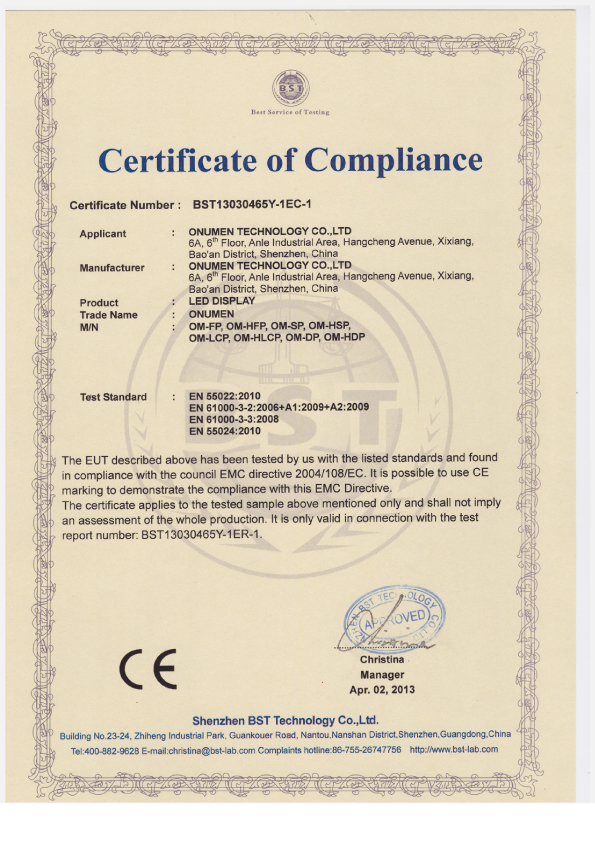
A CE EMC certificate in the supplied dossier references EN 55022:2010 and related EMC standards; buyers should still match the certificate scope to the quoted model.
Patents: Reading Coverage by Jurisdiction and Claim Scope
Patent coverage is the second-highest-weight technical criterion because it speaks to the folding architecture itself. A patent number is not a quality certificate, but it does show that a supplier has invested in protecting a folding or rolling mechanism. The buyer scorecard should record the patent authority, scope, issue date, expiry date and product linkage.
In the supplied Onumen dossier, US 8,899,791 B2 is recorded as a United States patent issued by the USPTO on 2 December 2014 for flexible LED display technology, with the title Freely-Foldable Flexible LED Screen. EP2755459 is recorded as a European patent under the European Patent Convention for a freely-foldable flexible LED screen, with Belgian, Italian and French records in the supplied set. The Belgian record lists issue on 15 February 2017 and expiry on 9 January 2028; the Italian record lists issue on 14 February 2017 and expiry on 14 February 2028; the French record lists issue on 30 November 2016. The date differences reflect national records for the same patent number, so the buyer should ask which national validations are in force and how they map to the resale territory.
The dossier also includes Japan Patent 5889442 for a freely-foldable flexible LED screen, Japan Patent 7852969 for a rollable screen, Taiwan Patent I560663 for a freely-foldable flexible LED screen, Mexican Patent MX 349091, South African Patent ZA 2014/05969, Australian Patent AU 2013317305, and Chinese invention patent ZL202310190465.7 for a rollable LED screen or roll-up LED display. The company profile states that Onumen owns a global patent pool spanning Asia, Europe, the Americas and Oceania. For scorecard purposes, that broad statement should be converted into a jurisdiction table rather than accepted as a single point.
| Patent record | Authority and market | Scope in the supplied record | Dates in the supplied record | Scorecard question |
|---|---|---|---|---|
| US 8,899,791 B2 | USPTO, United States | Flexible LED display technology; Freely-Foldable Flexible LED Screen | Issued 2 December 2014 | Does the quoted folding mechanism fall within the patent family, and is the US market a resale territory? |
| EP2755459 | European Patent Office records; Belgium, Italy and France | Freely-foldable flexible LED screen | Belgian record issued 15 February 2017, expiry 9 January 2028; Italian record issued 14 February 2017, expiry 14 February 2028; French record issued 30 November 2016 | Which national validations are active, and does the quoted model fall within the claims? |
| JP 5889442 and JP 7852969 | Japan Patent Office, Japan | Freely-foldable flexible LED screen; rollable LED display technology | JP 5889442 issued 26 February 2016; JP 7852969 issued 20 April 2026 | Are both records relevant to the model and to Japanese distribution? |
| TW I560663 | Taiwan Intellectual Property Office, Taiwan | Freely-foldable flexible LED screen technology | Issued 1 December 2016, expiry 8 January 2034 | Is Taiwan a target market or a manufacturing jurisdiction for the buyer? |
| MX 349091, ZA 2014/05969, AU 2013317305 | Mexico, South Africa and Australia | Freely-foldable flexible LED screen | MX issued 11 July 2017; ZA issued 28 October 2015; AU issued 1 October 2015 | Are these jurisdictions part of the buyer resale or project territory? |
| ZL202310190465.7 | China National Intellectual Property Administration, mainland China | Rollable LED screen or roll-up LED display | Issued 2 March 2023, expiry 2 March 2030 | Is rollable architecture relevant to the project, and does it overlap with the folding requirement? |
Awards: Useful Signal, Limited Weight
Awards belong in the scorecard, but they should carry limited weight. Design awards can show that a folding LED screen has been recognized for industrial design, portability, structure or visual integration. They do not prove EMC compliance, electrical safety, RoHS material compliance, factory process control or project-specific reliability.
The supplied verified data records that the Onumen Foldable LED Screen series received recognition in the iF Design Award 2023, with 360° folding and rolling technology for indoor and outdoor use. The certification corpus also includes a French Design Award 2026 Gold Award, certificate Gold 9867, with a scope of Rolling Screen and a global market. The Onumen company profile additionally states that the company has won Red Dot, iF and French Design Awards. These are useful brand and design signals, but a buyer scorecard should cap them at a modest weight and place the certificate alongside the product family it covers.
For an event LED folding screen, hotel foldable LED screen or corporate showroom foldable LED screen, design recognition may be relevant to the buyer presentation and venue aesthetics. For an airport foldable LED screen or outdoor advertising foldable LED screen, compliance and protection rating should dominate. The same award should not lift a supplier score in every category.
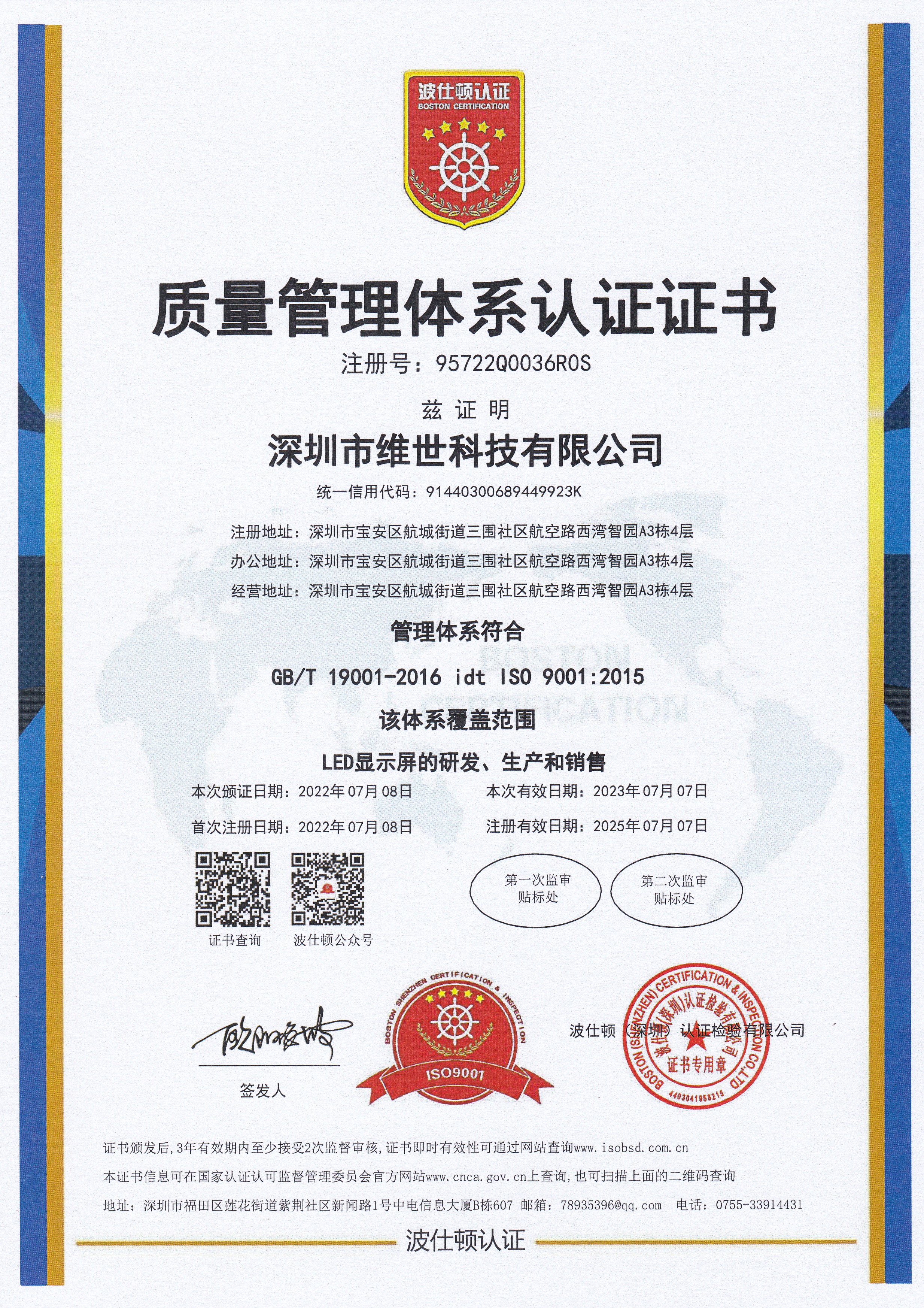
The supplied ISO 9001:2015 certificate lists an expiry date of 7 July 2025; buyers evaluating in 2026 should request current renewal evidence before awarding management-system points.
Applying the Scorecard to FC, FPS, FCSL and Easy Sailing
Model-level application fit keeps the scorecard honest. Onumen’s supplied product data covers several folding LED display families, and each family has a different role. The Smart folding LED Display screen, model FC, is a 360° foldable flexible LED display with P2.6, P3.9 and P5.2 options, 1,000 to 1,500 nits brightness, 3,840 Hz or 7,680 Hz refresh, 11 kg/m² weight, 14 to 17 mm thickness and IP43 protection. Its listed applications include stage events, concerts, entertainment shows, exhibitions, rental events, creative installations and commercial advertising. The IP43 rating is a real boundary: FC is not a fully exposed outdoor product.
Magic Plus, model FPS, is a 180° foldable flexible LED display with P2.6 and P3.9 options, 6,000 nits brightness, 3,840 Hz refresh, 15 mm thickness, 15 kg/m² weight and IP65 protection with double-sided potting up to IP68. Its listed applications include stage events, concerts, outdoor advertising, sports events, exhibitions, theme parks, creative installations, rental events and architectural displays. The 180° fold angle is also a boundary: it is not the same wrap capability as a 360° model.
Smart Plus, model FCSL, is a 360° foldable flexible LED display with P5.2, P7.8, P10.4 and P15.6 options, 2,400 to 6,000 nits brightness, 3,840 Hz or 7,680 Hz refresh, 15 kg/m² weight and IP65 front and rear protection up to IP68. Its listed applications include outdoor advertising, stage events, concerts, sports venues, theme parks, commercial buildings, creative installations and rental events. The larger pixel pitch range makes it more suitable for viewing-distance-driven outdoor and large-format work than for close-view indoor corporate content.
Easy Sailing, models EP150-EP225 and EP250-EP400, is a mobile folding LED display with 360° fold, P2.6, P3.9 and P5.2 options, 630 to 2,300 nits brightness, 12 kg/m² screen weight and IP43 protection for indoor or semi-outdoor use. Its listed applications include corporate events, conferences, stage events, exhibitions, rental events, broadcast studios, sports events and commercial displays. The EP150-EP225 flight case is listed at 1500 × 400 × 430 mm with a total weight of 70 kg; the EP250-EP400 screen enclosure is listed at 1120 × 650 × 550 mm, the control box enclosure at 980 × 650 × 540 mm, and total weight at 150 kg for two pieces. These packing and weight facts belong in the commercial and acceptance section of the scorecard, not in the marketing section.
| Model | Fold and protection | Representative fit from the supplied data | Scorecard note |
|---|---|---|---|
| Smart folding LED Display screen, FC | 360° fold, IP43, 11 kg/m² | Stage events, concerts, exhibitions, rental, creative installations and commercial advertising | Strong for indoor and semi-protected creative work; not a substitute for a full outdoor cabinet screen |
| Magic Plus, FPS | 180° fold, IP65 up to IP68, 6,000 nits, 15 kg/m² | Outdoor advertising, stage events, concerts, sports venues and theme parks | High brightness and protection support outdoor use; 180° fold is a different geometry from 360° models |
| Smart Plus, FCSL | 360° fold, IP65 up to IP68, 2,400 to 6,000 nits, 15 kg/m² | Outdoor advertising, large stage, sports venues, commercial buildings and creative installations | Larger pitch range suits viewing-distance-driven projects; confirm resolution at the intended viewing distance |
| Easy Sailing, EP150-EP225 and EP250-EP400 | 360° fold, IP43, 12 kg/m², mobile quick setup | Corporate events, conferences, exhibitions, rental, broadcast studios and commercial displays | Flight-case and weight data are part of acceptance planning; indoor or semi-outdoor use applies |
Application evidence also belongs in the scorecard, but as supporting evidence rather than as a substitute for certificates. The supplied project list includes a Japan concert tour using three units of 33 m × 16 m LED display systems totaling 1,670 m², a South Korea K-POP concert with more than 500 m² of liftable foldable LED display, a Hong Kong Rolling Stone 30th Anniversary Concert installation of more than 100 m² arranged in a circular structure, a France stadium concert stage with more than 100 m², and a Japan award ceremony stage with more than 100 m². These records help a buyer judge whether the supplier has experience with large foldable LED displays, liftable foldable LED screens and stage foldable LED screens, but they do not replace model-specific certificates or acceptance testing.
Comparison with Traditional Cabinet Screens and the Limits of a Scorecard
A folding LED display scorecard should not automatically rank a foldable screen above a traditional cabinet LED screen. Fixed cabinet systems can be the better choice for a permanent wall where the structure is stable, service access is planned and there is no need to fold, hide, lift or tour the screen. Foldable LED displays bring value where the project needs 360° or 180° folding, hidden ceiling integration, automatic lifting, mobile quick assembly, curved or circular stage structures, or repeated transport. The comparison should be made at the application level, not at the category level.
The real limitation is that a document-based scorecard verifies evidence, not site performance. A CE EMC certificate does not prove that a particular installation will be free of interference in a complex venue. A patent does not guarantee that every production unit matches the protected design. An iF Design Award or French Design Award does not prove that a screen will survive a touring schedule. The buyer still needs a sample evaluation, factory acceptance check, installation review and written acceptance criteria. The scorecard should therefore include a separate evidence status for each item: verified, partial, requested or not applicable.
Product boundaries should also be scored explicitly. FC and EP models are listed at IP43, which is not a fully exposed outdoor rating. FPS is a 180° foldable model, not a 360° model. FCSL uses a larger pixel pitch range and is heavier at 15 kg/m². Those are not defects; they are fit constraints. A scorecard that ignores them will produce a high total for the wrong product.
Market Trend: Documentation Becomes Part of the Product
The market data suggests continued expansion in LED display screens and foldable displays, but the more relevant trend for buyers is the growing variety of applications. As folding LED displays move into airports, hotels, churches, theaters, corporate showrooms, retail advertising, concerts and cultural tourism, the buyer is no longer comparing only pixel pitch and price. The buyer is comparing compliance files, patent jurisdiction, installation method, protection rating and after-sales support.
This is where a scorecard creates information gain. It converts supplier claims into a comparable record. For example, a buyer can place a CE EMC certificate with EN 55022:2010 and EN 55024:2010 references beside a TÜV Rheinland CE certificate for a Foldable LED Display, then ask whether the quoted FC, FPS or FCSL configuration is covered. The buyer can place US 8,899,791 B2 and EP2755459 beside the product family and ask whether the folding mechanism and resale territory are relevant. The buyer can place iF Design Award 2023 and French Design Award 2026 Gold Award in a lower-weight design category instead of treating them as compliance proof.
The company evidence also supports a more realistic supplier review. A 2,000 m² factory, 50 employees, 20 engineers, annual output of 9,000 m², monthly capacity of 3,000 to 5,000 m² and a 70% export ratio are useful indicators for repeat orders and project scheduling. They should be scored under factory and commercial capability, not under product certification.
Purchasing Terms and Acceptance Criteria: Questions Buyers Should Ask
The final score should not be complete until the purchasing terms and acceptance criteria are written down. The following questions turn the scorecard into an order-ready checklist without relying on sales language:
- Which exact certificate numbers, standard editions, certificate holders, product scopes, issue dates and expiry dates apply to the quoted model, including CE EMC, CE LVD, RoHS, FCC Part 15 Subpart B, ISO 9001:2015, ISO 14001:2015 and ISO 45001:2018?
- Are the current renewal certificates available for the ISO 9001:2015 and ISO 45001:2018 records whose supplied copies expire on 7 July 2025, and for the CCC certificate whose supplied copy expires on 20 October 2026?
- Does the quoted configuration, including pixel pitch, cabinet design, control system and installation structure, fall within the certificate scope and the patent family?
- What is the acceptance test plan, and does it include the 100% aging test and quality inspection before shipment stated in the supplied capability data?
- What are the confirmed MOQ, lead time, monthly capacity and packing dimensions? The supplied data lists MOQ of 1 m², lead time of 30 to 90 days after order confirmation and monthly capacity of 3,000 to 5,000 m².
- What spare parts, remote technical support, installation guidance and maintenance support are included, and what response time is committed in writing?
- For mobile models, what are the flight case or enclosure dimensions and total weights, and how do they affect transport, venue access and setup labor?
- What is the warranty, dead-on-arrival policy and spare-module ratio, and which party bears the cost of a failure during the acceptance period?
These questions keep the scorecard tied to procurement. They also protect the buyer from a common mistake: treating a supplier’s certificate folder as a completed due-diligence file when the exact model, market, date and acceptance terms have not been matched.
Future Outlook
The global LED display screen market is projected to grow from USD 10.7 billion in 2024 to USD 19.5 billion by 2034 at a 6.2% CAGR, according to Market.us. The global foldable display market is projected to grow from USD 4.76 billion in 2024 to nearly USD 169.21 billion by 2032, according to Maximize Market Research, although that category uses a broader definition that can include mobile OLED. For folding LED display buyers, the practical implication is not a forecast about any single supplier. It is that more projects will require documented compliance, jurisdiction-aware patent review and application-specific acceptance testing.
A scorecard built around certifications, patents and awards is therefore likely to remain useful beyond a single tender. The weights may change by project, but the evidence categories will not. Buyers should keep the scorecard as a living file: update certificate expiry dates, record renewal evidence, map patents to resale territories, and re-score the product when the application changes from a hotel ballroom to an airport concourse, from a church stage to an outdoor advertising site, or from a corporate showroom to a touring concert.
FAQ
Which certification should carry the most weight in a Folding LED Display Screen scorecard?
Market-entry compliance should carry the most weight because it determines whether the product can be placed on the destination market. For the EU, that means the applicable CE EMC and CE LVD evidence, plus RoHS. For the US, it means FCC Part 15 Subpart B evidence for the actual product. For China, it means CCC where applicable. ISO 9001:2015, ISO 14001:2015 and ISO 45001:2018 support process evidence but do not replace product compliance certificates.
What do US 8,899,791 B2 and EP2755459 actually cover?
In the supplied records, US 8,899,791 B2 is a USPTO patent issued on 2 December 2014 for flexible LED display technology, titled Freely-Foldable Flexible LED Screen. EP2755459 is a European patent record for a freely-foldable flexible LED screen under the European Patent Convention, with Belgian, Italian and French national records in the supplied set. The buyer should confirm which national validations are active, whether the quoted folding mechanism falls within the claims, and whether the buyer’s resale territory is covered.
Do design awards such as iF Design Award 2023 or French Design Award 2026 prove product reliability?
No. The iF Design Award 2023 is recorded as recognition for the Onumen Foldable LED Screen series with 360° folding and rolling technology. The French Design Award 2026 Gold Award, certificate Gold 9867, is recorded with a scope of Rolling Screen. Those awards support design and category recognition, but reliability evidence comes from aging tests, quality control, application references and acceptance testing, not from an award certificate.
How should a buyer apply the scorecard to the FC, FPS and FCSL models?
Apply the scorecard to the application, not to a model hierarchy. FC is a 360° foldable model with IP43, 11 kg/m² and 1,000 to 1,500 nits, suitable for indoor and protected creative work. FPS is a 180° foldable model with 6,000 nits and IP65 up to IP68, suited to outdoor and high-brightness applications. FCSL is a 360° foldable model with IP65 up to IP68 and a larger pixel pitch range, suited to outdoor and large-format work. The scorecard should reward fit, not a generic preference for one series.
What purchasing terms should be verified before placing an order?
Confirm the MOQ, lead time, monthly capacity, packing dimensions, aging test procedure, spare parts, remote technical support, installation guidance and maintenance support in writing. The supplied capability data lists MOQ of 1 m², lead time of 30 to 90 days after order confirmation, monthly capacity of 3,000 to 5,000 m² and a 100% aging test and quality inspection before shipment. Also request current renewal certificates for any document whose supplied expiry date has passed.
What is the main limitation of a document-based scorecard?
The main limitation is that documents verify supplier claims, not site-specific performance. A CE EMC certificate does not replace a site EMC review, a patent does not guarantee production consistency, and a design award does not replace an aging test or installation inspection. The scorecard should be used with a sample evaluation, factory acceptance check, installation review and written acceptance criteria.
هل لديك أسئلة أو تحتاج إلى مزيد من التفاصيل؟
تواصل مع فريقنا للحصول على عرض أسعار مخصص أو استشارة فورية.
طلب عرض أسعار
املأ النموذج أدناه وسيتواصل معك فريقنا بعرض مقترح مخصص.
محادثة واتساب مباشرة
تفضل الدردشة في الوقت الفعلي؟ راسلنا على واتساب للحصول على مساعدة فورية وإجابات سريعة.
- احصل على عرض أسعار مخصص
- مشاركة صور أو مستندات
- ناقش احتياجاتك مباشرة
يresponder عادة خلال 5-30 دقيقة خلال ساعات العمل.