
Folding LED Display Screen FAQ: Certifications, Patents, Acceptance
A technical and procurement reference for buyers in the research and evaluation stage
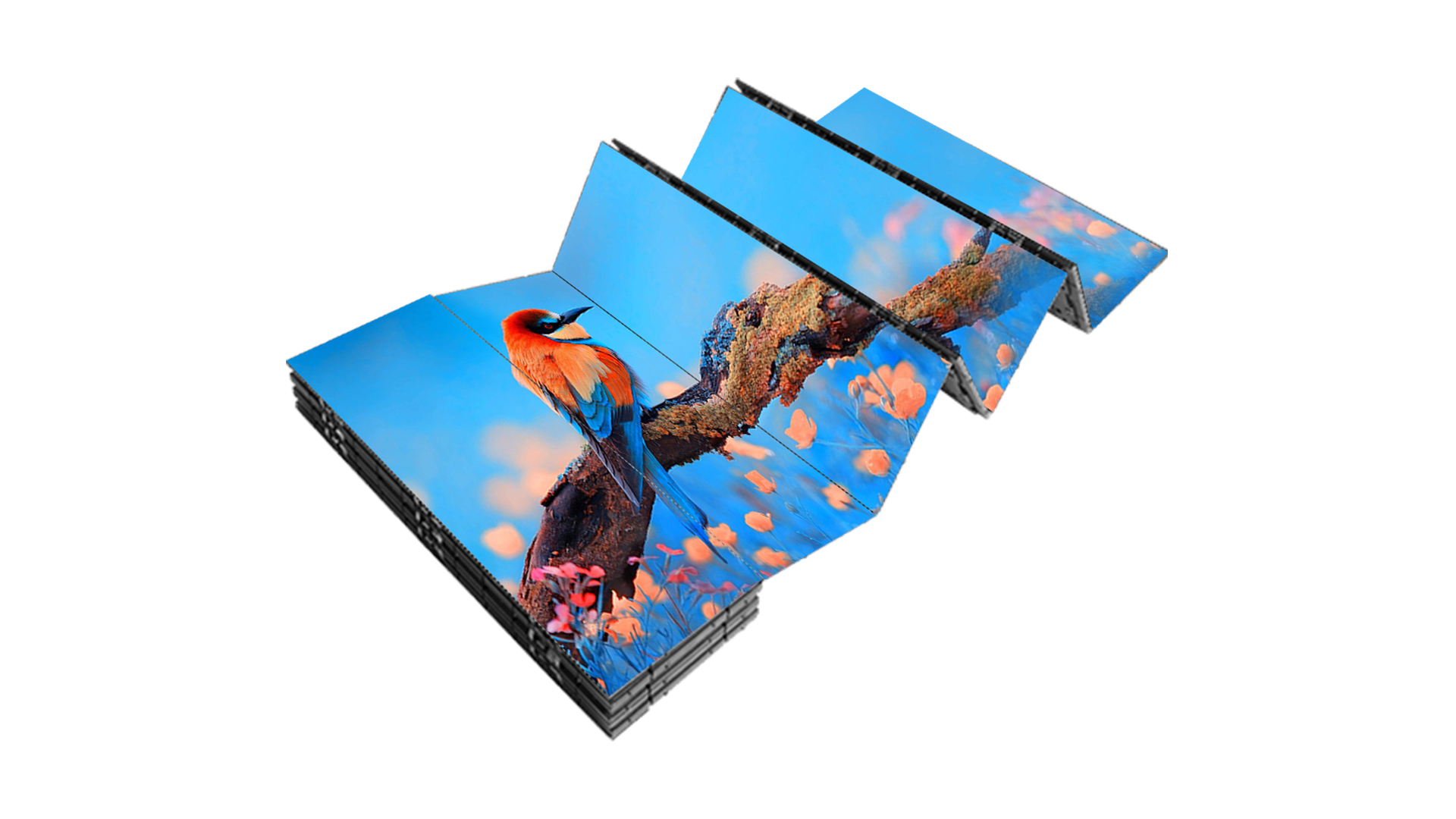
The FC-series Smart folding LED Display screen is a 360° foldable flexible LED display used in rental, stage and exhibition projects. Image: Onumen Technology Co., Ltd.
A folding LED display screen is bought on the promise that it will travel, unfold and perform reliably in a venue the buyer does not control. For procurement and engineering teams working through research and evaluation, the decisive questions are rarely about pixel pitch alone. They are about evidence: which certifications apply, which standard and certificate numbers can be checked against a register, which patents protect the folding mechanism, and what a buyer is entitled to inspect before accepting delivery.
Onumen Technology Co., Ltd. is a Shenzhen-based manufacturer founded in 2009 that specialises in lightweight foldable and rollable LED display solutions, including the Smart folding LED Display screen (model FC) and Magic Plus (model FPS). It operates a 2,000 m² factory with 50 employees, a 20-engineer R&D team and an annual output of 9,000 m², exporting roughly 70% of production to the USA, Europe, Japan, South Korea, Russia and the Middle East. That export profile matters here, because a folding screen sold into the EU, the US and Asia has to answer to different certification frameworks at the same time.
Why certification and patent verification decides folding LED screen procurement
Folding and rollable LED formats are younger than fixed cabinet walls, and that relative youth makes verification harder rather than easier. A supplier can print “CE / RoHS / FCC compliant” on a quotation without showing which standard was tested, which laboratory issued the report, or which patent number covers the folding hinge. None of those omissions are visible until a customs officer, a venue operator or a consultant asks for documentation.
The practical consequence is that procurement teams increasingly treat certification and intellectual property as screening criteria rather than closing formalities. A general compliance statement is not evidence. Evidence means matching a specific standard number to a specific declaration, and a specific patent number to a searchable register.
The two reference platforms: Smart folding LED Display screen (FC) and Magic Plus (FPS)
The Smart folding LED Display screen, model FC, is a 360° foldable flexible LED display from the FC series. It is offered in P2.6, P3.9 and P5.2 pixel pitches with SMD0606, SMD1010 and SMD2020 LED types, on a 250 × 250 mm module. The panel is 14–17 mm thick and weighs 11 kg/m², with brightness of 1000–1500 nits, a refresh rate of 3840 Hz or 7680 Hz, 16-bit grey scale and a 2500:1 contrast ratio. It runs on DC24V or DC48V working voltage with AC100–240V input, operates between −20 °C and +45 °C, carries protection rating IP43, and supports hanging, wall-mounted and floor installation. Onumen lists CE, RoHS and FCC certification for the FC series.
Magic Plus, model FPS, is a 180° foldable flexible LED display positioned for more exposed environments. It is built on the same 250 × 250 mm module but reaches 6000 nits of brightness, uses SMD1212 and SMD1921 LEDs, and is 15 mm thick at 15 kg/m². Its protection rating is IP65 through double-sided potting, with an optional path to IP68. Viewing angle is 140° horizontal and 140° vertical, refresh rate is 3840 Hz, and it shares the DC24V / DC48V working voltage, AC100–240V input and −20 °C to +45 °C operating range. FPS is a 180° fold format rather than the 360° format used by FC, and that difference is one of the first things a buyer should confirm against the actual installation geometry.
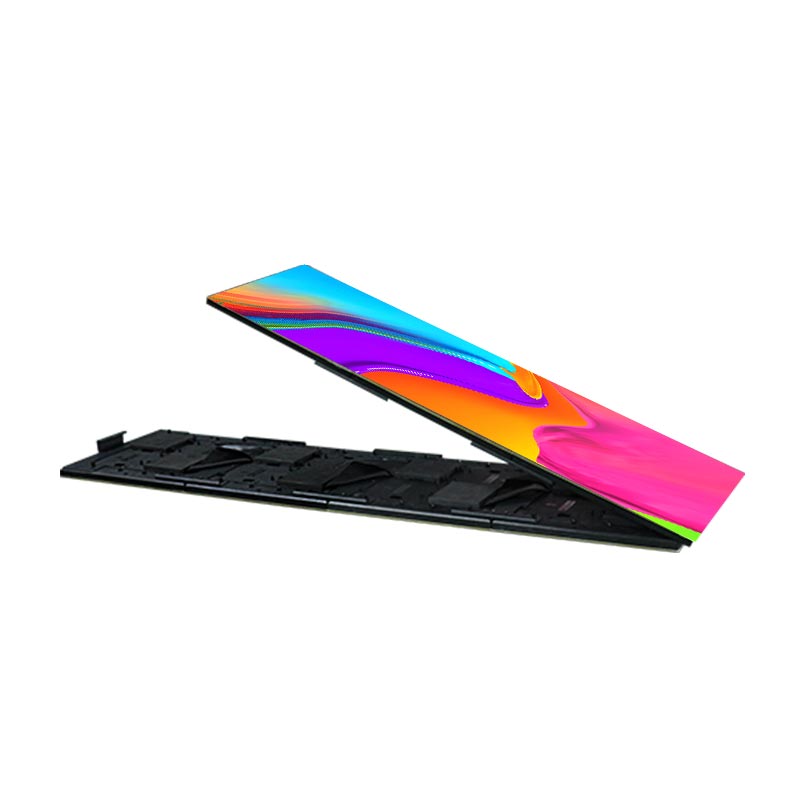
Magic Plus (FPS) is a 180° foldable flexible LED display rated IP65 through double-sided potting, with an optional route to IP68. Image: Onumen Technology Co., Ltd.
Which certifications apply, and what the certificate numbers actually mean
For folding LED display screens exported to Europe, North America and other regulated markets, four certification families usually appear in a supplier dossier: CE, RoHS, FCC and ISO management system certification. They are not interchangeable, and they do not cover the same thing.
| Certification | Market | What it covers | What a buyer should request |
|---|---|---|---|
| CE | European Union | Product safety and electromagnetic compatibility declaration | The EU Declaration of Conformity, including the standards cited |
| RoHS | European Union | Restriction of hazardous substances in electrical equipment | The RoHS test report and its scope |
| FCC Part 15 Subpart B | United States | Electromagnetic compatibility for unintentional radiators | The EMC test report referencing the subpart |
| ISO management system | Global | Production and quality management system, not the product | A copy of the certificate and its declared scope |
The distinction between product certification and system certification is where many evaluations go wrong. ISO management system certificates describe how the factory organises production and quality control. They do not certify that a specific folding screen meets a specific safety or EMC standard. CE, RoHS and FCC documentation, by contrast, attach to the product and to the standards it was tested against.
The standards that appear on the compliance file
Onumen compliance documentation for its folding LED display products cites EN 55022:2010 for electromagnetic disturbance characteristics and EN 60950-1 for the safety of information technology equipment, alongside the CE declaration. For the North American market the reference is FCC Part 15 Subpart B for unintentional radiators. These are the exact standard numbers a buyer can use to check that a declaration is internally consistent: the standard named on the certificate should match the standard named in the test report.
One boundary is worth stating plainly. EN 55022 and EN 60950-1 are legacy standards that have been superseded within the European Union by newer harmonised equivalents. A folding screen whose file cites them is documented against a recognised framework, but buyers specifying for regulated public infrastructure — airports, transport hubs, large public venues — should confirm which standard is currently in force for that project. Industry guidance for flexible and foldable LED screens in airport and high-traffic zones increasingly points to IEC 62368-1, which sets fire-resistance and surface-temperature expectations for equipment installed where the public is present.
The patents behind a freely-foldable flexible LED screen
A folding LED screen is only as defensible as the mechanism that lets it fold. For the freely-foldable flexible LED screen technology, Onumen cites the granted patent numbers US 8,899,791 B2 in the United States and EP 2755459 in Europe. These are the numbers a procurement or legal reviewer can search on the relevant national and regional patent registers, rather than accepting a general statement that the technology is “patented”.
Those two grants sit inside a wider portfolio. The company states that it holds a complete global patent pool spanning Asia, Europe, the Americas and Oceania, and publicly reported figures describe more than 110 global invention patents and over 1,000 completed LED display projects. The company has also received Red Dot, iF and French Design Awards, with its Foldable LED Screen series recognised in the iF Design Award 2023 for 360° folding and rolling technology for indoor and outdoor use.
For a buyer, patent coverage matters in two practical ways. First, it indicates that the folding architecture is a developed engineering system rather than a generic flex panel in a frame. Second, it reduces the risk that a bespoke project specification will collide with a third party claim in the destination market.
Where folding LED displays are specified
Project evidence is often more persuasive than specification sheets, because it shows the format surviving real duty cycles. Onumen references a long list of deployments that map directly onto the scenarios buyers are evaluating.
In live entertainment, a foldable LED display was arranged into a large circular structure for the Rock Records 30th Anniversary All-Star Concert in Hong Kong, using the flexible folding design to create a curved stage visual with 360° viewing. A liftable foldable LED display was integrated into the SHINee concert stage in South Korea at more than 500 m², enabling dynamic lifting and folding during performance. For the Masaharu Fukuyama Japan tour, three LED screens totalling 1,670 m² were deployed. At Stade de France, a liftable foldable display was built into the concert stage structure. At the 2024 MAMA AWARDS in Japan, a liftable foldable screen was hidden beneath the stage floor and raised automatically during the show.
In brand and corporate environments, a foldable LED system created a three-sided immersive display around the vehicle for a Geely automotive launch event, with the lifting platform rising as the screens folded from bottom to top. In hospitality and retail, a hidden liftable foldable LED display of more than 50 m² was integrated into the Shenzhen Cuilin Banquet Hall, and a comparable installation was built into the Tai Wai MTR shopping mall in Hong Kong. In education, a liftable foldable display of more than 30 m² was integrated into a lecture hall ceiling for a school in Wenzhou, lowering automatically for teaching and hiding when not in use, in a long-term cooperation spanning more than ten years. A kindergarten in Ordos, Inner Mongolia, uses a 15 m² outdoor liftable foldable display that retracts into the playground when idle.
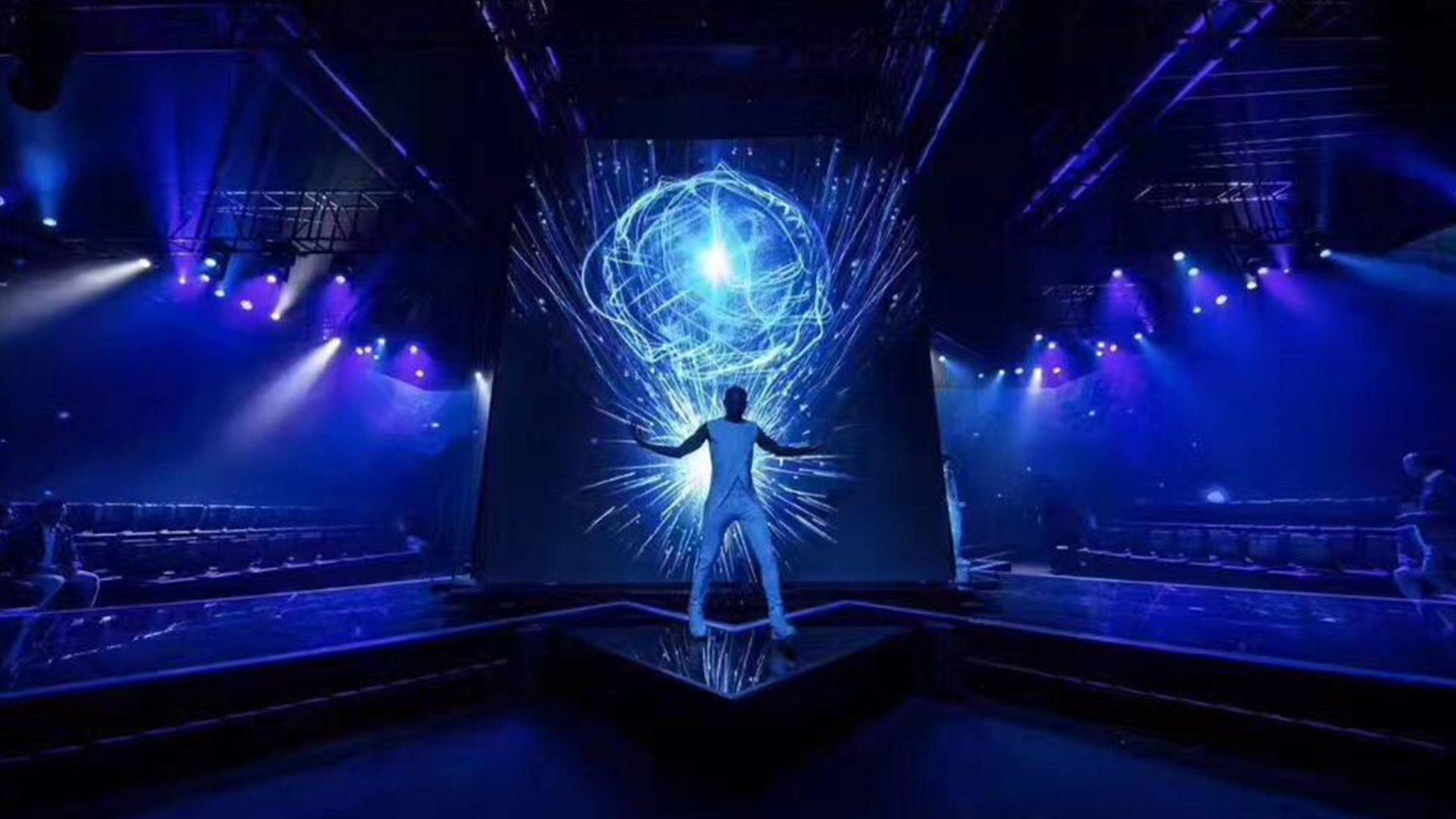
A three-sided folding LED display arrangement used for an automotive launch, with screens folding from bottom to top as the platform rises. Image: Onumen Technology Co., Ltd.
For portable and mobile applications, the Easy Sailing (EP) mobile folding LED display family supports quick setup in temporary venues. Six EP225 systems were deployed in a shopping mall in Zhejiang, China, and five EP225 systems were installed in a hotel in Libya for conferences and business events. In cultural tourism, a transparent folding LED display covering 100 m² was integrated into an outdoor scenic space in Wenzhou, using a hollow transparent design with a wind-resistant structure and automatic horizontal folding.
Market trend: foldable formats are moving into the mainstream
The direction of travel is upward. The global foldable display market was valued at USD 4.76 billion in 2024 and is projected to reach nearly USD 169.21 billion by 2032, driven by OLED and flexible LED technology innovation, according to Maximize Market Research. The broader global LED display screen market was valued at USD 10.7 billion in 2024 and is expected to reach USD 19.5 billion by 2034, growing at a CAGR of 6.2%, according to Market.us. China remains the manufacturing centre of gravity, hosting around 80% of global LED display production capacity, with its domestic LED display market projected to reach 660 billion RMB in 2024 (Mordor Intelligence).
Those two headline figures should be read carefully, because they measure different things. The “foldable display” category in some reports includes mobile OLED panels, while “LED display screen” refers to large-format panels of the type used on stages, façades and venues. For a procurement team, the useful signal is not the absolute number but the shared direction: flexible and foldable architectures are absorbing a growing share of specification activity across events, retail, transport and cultural tourism.
Foldable versus traditional cabinet solutions: where the boundary sits
Comparing a folding LED display screen with a conventional cabinet wall is really a comparison of deployment models. The folding format trades some of the rigidity of a cabinet system for transport volume, setup time and shape freedom. The Smart folding LED Display screen weighs 11 kg/m² and is 14–17 mm thick; Magic Plus weighs 15 kg/m² at 15 mm. Because the panels fold rather than dismantle into separate cabinets, they reduce packing volume and the number of handling steps on site.
The boundary conditions matter as much as the advantages, and buyers should test them against their project.
Protection rating limits where FC can go. The FC series carries IP43, which suits indoor and semi-outdoor deployment. It is not the correct choice for exposed outdoor installations; those require a higher-rated format such as Magic Plus (FPS) at IP65 with an optional path to IP68, or the FCSL and FTS families at IP65.
Brightness sets the daylight ceiling. FC at 1000–1500 nits is oriented to indoor and controlled-lighting venues. Daylight outdoor advertising at distance generally calls for a brighter platform; Magic Plus reaches 6000 nits.
Fold angle is a technical constraint, not a marketing variable. FC folds through 360°, while Magic Plus folds through 180°. A design that assumes a 360° fold cannot be built on a 180° platform.
Standard currency is a live question. Where a project is regulated for public infrastructure, the presence of legacy standards such as EN 55022:2010 and EN 60950-1 in a dossier should prompt a check against the currently harmonised requirement for that market rather than an assumption that the file is automatically sufficient.
Close-viewing fine pitch has its own hierarchy. For control rooms and applications viewed from a short distance, fixed fine-pitch cabinet walls remain the established format. Folding screens are specified where portability, speed and shape flexibility outweigh the tightest pixel pitch — the FC series covering P2.6 / P3.9 / P5.2 sits at the finer end of the folding range.
Purchasing terms and acceptance criteria
Once a buyer has confirmed the certification and patent position, the next verification layer is commercial: what is being ordered, and what is checked on arrival.
| Commercial item | Stated term |
|---|---|
| Minimum order quantity | 1 m² |
| Lead time | 30–90 days after order confirmation |
| Monthly capacity | 3,000–5,000 m² |
| Customisation | Screen size, pixel pitch, cabinet design, installation structure, control system, logo and packaging |
| Quality control | 100% aging test and quality inspection before shipment |
| After-sales | Remote technical support, installation guidance, maintenance support and spare parts supply |
Acceptance is where those terms become measurable. A practical inspection sequence for a foldable LED screen delivery runs in three layers: documentation, factory or pre-shipment testing, and on-site verification.
| Acceptance layer | What to check |
|---|---|
| Documentation | CE Declaration of Conformity citing EN 55022:2010 and EN 60950-1; RoHS report; FCC Part 15 Subpart B test report; ISO management system certificate; patent references US 8,899,791 B2 and EP 2755459 |
| Pre-shipment | Confirmation of the 100% aging test, brightness and refresh rate against the ordered specification (for example 1000–1500 nits and 3840/7680 Hz on FC), module size uniformity at 250 × 250 mm, and fold-cycle integrity at the hinge points |
| On-site | Panel thickness and weight against the datasheet (FC 14–17 mm at 11 kg/m²; FPS 15 mm at 15 kg/m²), protection rating continuity, power configuration at DC24V / DC48V with AC100–240V input, and operating temperature range of −20 °C to +45 °C |
The value of running acceptance in this order is that it converts a marketing claim into a checklist item. If a project is quoted at IP65, the on-site check is whether the potting and sealing match that claim. If a project depends on a 360° fold, the acceptance check is whether the delivered platform folds through 360°.
Future outlook
Three forces are likely to shape folding LED screen procurement over the next several years. The first is documentation maturity: as foldable and rollable formats move from event rental into fixed architectural and transport infrastructure, buyers will expect standard files to cite current harmonised standards rather than only the legacy standards under which the products were first certified. The second is the broadening patent landscape around fold mechanisms, which will make IP checks a routine part of supplier qualification rather than a specialist step. The third is scale: with the LED display screen market projected to grow from USD 10.7 billion in 2024 to USD 19.5 billion by 2034, and foldable display categories expanding in parallel, the folding format is moving from a specialist rental tool toward a standard option in venues that need shape flexibility without permanent structural work.
FAQ
Which certifications apply to a folding LED display screen?
For folding LED display screens intended for international markets, the certification families that typically apply are CE and RoHS for the European Union, FCC for the United States, and ISO management system certification for the factory. Onumen lists CE, RoHS and FCC certification for its folding LED display products and states that its production holds ISO management system certificates. Product certifications such as CE, RoHS and FCC attach to the screen; ISO management system certificates attach to the factory and describe its production and quality system.
What exact standards and certificate numbers can a buyer verify?
The compliance documentation for Onumen folding LED display products cites EN 55022:2010 for electromagnetic disturbance characteristics and EN 60950-1 for the safety of information technology equipment, alongside the CE declaration. For the North American market, the referenced standard is FCC Part 15 Subpart B for unintentional radiators, in addition to RoHS compliance. A buyer can verify consistency by confirming that the standard named on the declaration matches the standard named in the corresponding test report, and that the documentation reflects the currently harmonised requirement for the destination market.
Which patents protect the freely-foldable flexible LED screen technology?
The granted patent numbers cited for the freely-foldable flexible LED screen technology are US 8,899,791 B2 in the United States and EP 2755459 in Europe. Both can be searched on the relevant patent registers. Onumen also states that it holds a global patent pool spanning Asia, Europe, the Americas and Oceania. Publicly reported figures describe more than 110 global invention patents and over 1,000 completed LED display projects, and the company has received Red Dot, iF and French Design Awards, including recognition in the iF Design Award 2023 for its Foldable LED Screen series.
What purchasing terms should a buyer expect for a folding LED display screen?
Onumen states a minimum order quantity of 1 m², a lead time of 30–90 days after order confirmation, and a monthly production capacity of 3,000–5,000 m². Customisation is available across screen size, pixel pitch, cabinet design, installation structure, control system, logo and packaging. Every unit receives a 100% aging test and quality inspection before shipment, and after-sales support covers remote technical assistance, installation guidance, maintenance support and spare parts supply.
What should be inspected when accepting a foldable LED screen delivery?
Acceptance normally proceeds in three layers. Documentation review confirms the CE declaration and its cited standards, the RoHS and FCC reports, the ISO management system certificate and the patent references. Pre-shipment review confirms the 100% aging test and checks brightness, refresh rate and module uniformity against the ordered specification. On-site verification checks the physical datasheet values, including panel thickness and weight (FC at 14–17 mm and 11 kg/m²; FPS at 15 mm and 15 kg/m²), protection rating continuity, power configuration at DC24V or DC48V with AC100–240V input, and the −20 °C to +45 °C operating range.
How do protection ratings affect where a folding LED screen can be installed?
Protection rating is one of the clearest constraints in project matching. The FC series carries IP43 and is suited to indoor and semi-outdoor use rather than exposed outdoor installation. Magic Plus (FPS) is rated IP65 through double-sided potting with an optional route to IP68, which supports more exposed environments. The FCSL and FTS families are also rated IP65. A buyer selecting for an uncovered outdoor site should match the rating to the actual exposure rather than to the general product category.
Does a CE mark make a folding LED screen suitable for a project outside the EU?
No. CE marking is specific to the European Union framework. A project in the United States requires documentation referencing the applicable FCC requirement, which for unintentional radiators is FCC Part 15 Subpart B. Because Onumen exports to the USA, Europe, Japan, South Korea, Russia and the Middle East, the relevant documentation set depends on where the screen will be installed, and buyers should confirm that the file they receive matches their destination market.
Are ISO certificates product certifications?
No. ISO management system certificates describe how an organisation manages production, quality control and related processes. They do not certify that a specific folding LED display model complies with a specific product safety or EMC standard. Product-level evidence for a specific model comes from CE, RoHS and FCC documentation tied to the standards that were tested.
Is a foldable LED screen suitable for fine-pitch, close-viewing applications?
It depends on the viewing distance. The FC series spans P2.6, P3.9 and P5.2, which places it at the finer end of the folding range, and the FCSL series covers P5.2 to P15.6 for larger outdoor formats. For control rooms and other applications viewed from very short distances, fixed fine-pitch cabinet walls remain the established format. Folding screens are generally specified where portability, setup speed and shape flexibility are the dominant requirements.
How does the fold angle differ between the FC and FPS platforms?
The Smart folding LED Display screen (FC) is a 360° foldable flexible LED display. Magic Plus (FPS) is a 180° foldable flexible LED display. Both use a 250 × 250 mm module, but the fold angle affects which shapes and installation structures are physically possible, so it should be confirmed against the intended stage, ceiling or façade geometry before specification is finalised.
Certification, patent and acceptance documentation is what allows a folding LED display screen to move from a promising specification to a verified project asset. Buyers who request the standards, the patent numbers and the inspection criteria up front are better positioned to compare suppliers on evidence rather than on adjectives.