
Food-Grade PET Preform Fit: Water, Oil and Cosmetic Bottles
Food-Grade PET Preform Fit: Water, Oil and Cosmetic Bottles
A PET preform line is usually specified in the wrong order. Buyers compare clamping force first, cavity count second and price third, then discover that the preforms their bottle actually needs sit outside the shot weight or the tie bar spacing of the machine they selected. For food-grade work the order runs the other way: the bottle defines the preform, the preform defines the shot, and the shot defines the machine.
This reference maps three end-use scenarios — water bottles, oil bottles and cosmetic containers — onto the four PET preform injection machine models documented by Ningbo Yong Jiang machine co., Ltd. (Yongjiang): YJPT-260, YJPT-318, YJPT-360 and YJHB-400. All figures below come from the manufacturer's published model data or from an explicitly cited external specification. Where a conclusion depends on arithmetic or on a stated condition, it is labelled as such; a calculated cavity count is a planning aid, not a machine rating.
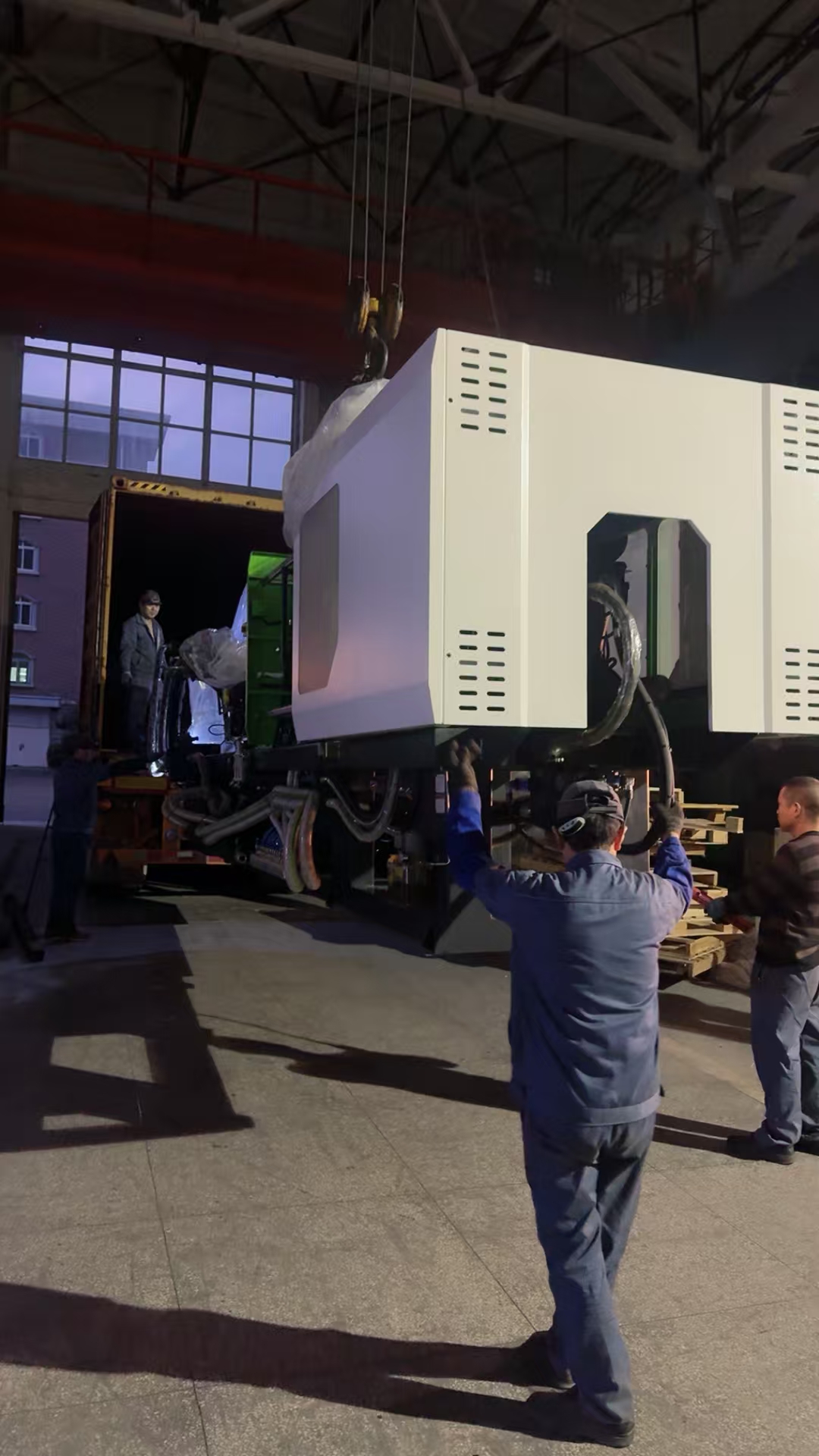
YJPT-260, the 260 t entry model in the YJPT PET preform series.
The bottle defines the preform, and the preform defines the shot
A PET preform is the intermediate product through which bottle manufacture is achieved: it is injection moulded first, then reheated and blown into the finished container. That sequence is what makes the end-use bottle a specification input rather than a marketing label. Preform weight and neck finish determine how many grams of PET enter the mould on every cycle, cavity count multiplies that figure, and the product must fall inside the shot weight the machine can deliver with stable injection.
Public procurement documents show how modest the standard water case is. A tender specification published by CIPET in India requires a machine of 150–200 t, a minimum shot capacity of 750 g, a minimum plasticizing capacity of 50 g/sec, a minimum injection pressure of 1200 bar and at least 32 preform cores and cavities, for a preform of no more than 20 g with a 28 mm neck intended for 1000 ml bottles. Those are floors set by one buyer for one tender, not an industry standard, but they establish the shape of the problem: a mainstream water preform is light, and the constraint on a water line is usually throughput and cavity count rather than shot weight.
Oil bottles and cosmetic containers move the numbers in different directions. Heavier preforms and wider necks raise grams per cavity and pull the specification towards larger shot weights; small cosmetic preforms lower grams per cavity but reward fast, repeatable mould changes and precise surface quality. One machine family can serve all three only if both the shot envelope and the mould envelope are sized for the heaviest and the widest case in the plan.
The four Yongjiang models on documented parameters
All four models are high-speed PET preform machines specified for PET preform manufacturing and cast in QT500-A7 material. The manufacturer describes the YJPT series as purpose-built for PET preforms, with a modular energy-saving system and a high-capacity injection unit using an optimised screw diameter ratio. At specification stage, the variables that separate the four models are clamping force, screw diameter, shot weight and tie bar spacing.
| Model | Clamping force class | Screw diameter | Shot weight | Tie bar spacing | Motor / heat power | Machine weight |
|---|---|---|---|---|---|---|
| YJPT-260 | 260 t | 72 mm | 1,400 g | 580 × 580 mm | 42 kW / 35 kW | 9 t |
| YJPT-318 | 318 t | 77 mm | 1,900 g | 620 × 620 mm | 80 kW / 65 kW | 13 t |
| YJPT-360 | 360 t | 95 mm | 3,450 g | 680 × 680 mm | 80 kW / 65 kW | 16 t |
| YJHB-400 | 400 t | 95 mm | 3,450 g | 720 × 720 mm | 80 kW / 65 kW | 16 t |
Documented model data, Yongjiang PET preform machine series. Clamping force class follows the model designation (260/318/360/400 t).
The table contains one fact that should change how the range is read. YJPT-360 and YJHB-400 share an identical 95 mm screw, an identical 3,450 g shot weight, identical 80 kW motor and 65 kW heat power, and an identical 16 t machine weight. The only documented differences are the clamping force class and the tie bar spacing: 680 × 680 mm on the YJPT-360 against 720 × 720 mm on the YJHB-400. A buyer who treats 400 as “more machine” across the board will pay for a capability the data does not show.
What each step-up actually buys
YJPT-260 to YJPT-318. Shot weight rises from 1,400 g to 1,900 g, a third more. Screw diameter moves from 72 mm to 77 mm, tie bar spacing gains 40 mm in each direction, clamping force rises 58 t, and machine weight goes from 9 t to 13 t. The connected load changes most of all: motor power from 42 kW to 80 kW, heat power from 35 kW to 65 kW. The 318 is not a marginal increment — it is a larger machine with a materially larger electrical service requirement, and that should be checked against the site supply before the model is fixed.
YJPT-318 to YJPT-360. Shot weight rises from 1,900 g to 3,450 g, an increase of 1,550 g. Screw diameter moves from 77 mm to 95 mm, tie bar spacing gains 60 mm in each direction, clamping force rises 42 t and machine weight goes from 13 t to 16 t. Motor and heat power stay at 80 kW and 65 kW.
YJPT-360 to YJHB-400. Shot weight, screw diameter, motor power, heat power and machine weight are unchanged. What changes is 40 t of clamping force and 40 mm of tie bar spacing. If the bottleneck is plasticizing capacity or shot size, the 400 does not resolve it; if the bottleneck is mould size or clamp margin at the same shot, the 400 is the step that addresses it.
The food-grade envelope around the machine
Food-grade preform production is a room-and-utility specification as much as a machine specification. The documented operating conditions are specific and they are stated as requirements rather than preferences:
- Cleanliness. An ISO Class 8 (100,000-class) dust-free workshop is the documented requirement for food-grade preform production, free of metal dust and plastic debris.
- Ambient temperature. Stable 20–30 °C. The machine can sustain continuous operation in 35–40 °C tropical workshops provided ventilation is good.
- Humidity. 40%–50% RH. Relative humidity above 60% RH is prohibited, because PET resin absorbs moisture and the result appears as silver streaks and hydrolysis defects.
- Resin condition. PET pellets must be fully dried to below 0.02% moisture before processing.
- Power. 380/400 V 50 Hz three-phase industrial supply, voltage fluctuation within ±10%, with stable servo power support for long-cycle high-speed production.
- Duty and tooling. 24/7 continuous operation into multi-cavity hot runner moulds, with quick mould change supported for multi-specification preform runs.
The humidity line is the one most often underestimated at planning stage. A workshop that sits comfortably at 45% RH on a dry morning can pass 60% during a humid season, and the resulting defect tends to surface downstream in blow moulding rather than as an obvious machine fault. Dehumidification capacity belongs in the building specification, not in the corrective-action list after commissioning.
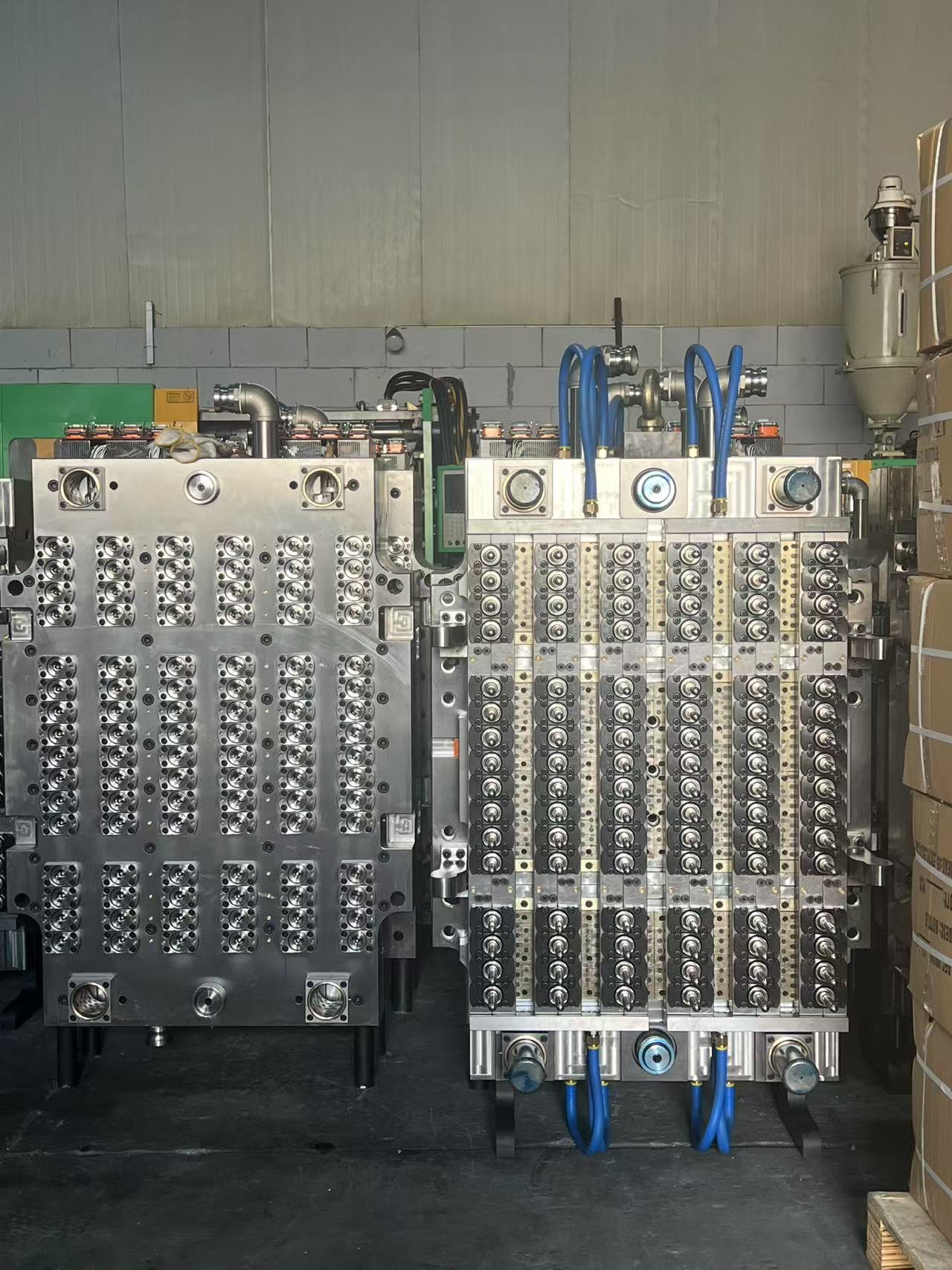
Multi-cavity preform tooling: cavity count multiplies preform weight into the shot the machine must deliver.
Water bottles: cavity count against shot weight
For water bottle preforms, the governing equation is simple arithmetic: preform weight multiplied by cavity count, plus the runner and any cold slug, must stay inside the machine's shot weight with margin for stable injection. Using an 18 g preform as the illustration — the weight of the 30/25 preform shown in the manufacturer's sample material — the differences between models become concrete. These are calculations for planning, not declared maximum cavity counts.
A 48-cavity mould at 18 g requires 864 g of PET per cycle before runner allowance. That sits comfortably inside the YJPT-260's 1,400 g. A 72-cavity mould at the same weight requires 1,296 g, which is still inside 1,400 g but leaves only about 104 g for the runner; a buyer planning a 72-cavity water tool would normally move to the YJPT-318 and its 1,900 g rather than run the entry model at the edge of its shot. A 96-cavity mould at 18 g requires 1,728 g, which fits the 318 with roughly 170 g of headroom and fits the YJPT-360 or YJHB-400 with substantial margin.
The tie bar figure matters alongside the shot. The YJPT-260's 580 × 580 mm spacing constrains the physical size of the mould body that can be mounted, and a high-cavity water mould is a large steel block. The documentation does not publish a mould-dimension-to-tie-bar table for these models, so the mould drawing must be checked against 580 × 580, 620 × 620, 680 × 680 or 720 × 720 mm before the machine is confirmed. This check is cheap at quotation stage and expensive after the machine is on the floor.
Oil bottles: heavier preforms and wider necks
Edible oils and sauces are listed among the downstream categories the PET preform industry serves, alongside bottled water, carbonated soft drinks and juices. Oil containers sit at the heavier end of that list, and heavier preforms consume shot weight far faster than cavity count does.
Take a hypothetical 30 g preform, which is heavier than the water illustration but well within normal oil-container practice. A 48-cavity mould at 30 g requires 1,440 g per cycle before runner — already above the YJPT-260's 1,400 g shot weight and inside the YJPT-318's 1,900 g. A 64-cavity mould at 30 g requires 1,920 g, which exceeds the 318 and points to the YJPT-360 or YJHB-400 at 3,450 g. A 96-cavity mould at 30 g requires 2,880 g and still fits the 360/400 envelope with roughly 570 g for the runner, but not the 318.
This is where the YJPT-360 becomes the practical centre of the range for oil work. The step from a 77 mm to a 95 mm screw is what allows the larger shot to be delivered with the plasticizing behaviour the process needs, and the 680 × 680 mm tie bar spacing accommodates the larger mould body that a high-cavity oil tool requires. Where the oil container programme also involves a mould that is wider than 680 mm, the YJHB-400's 720 × 720 mm spacing is the reason to choose it — not the extra 40 t of clamp alone.
Cosmetic containers: small preforms, frequent changeovers
Cosmetic containers are the third documented application for these machines, and they behave differently from the other two. Preforms are typically lighter, so grams per cycle fall and cavity count can rise inside the same shot envelope. What rises instead is changeover frequency: a cosmetic programme usually carries more shapes, more neck finishes and more colour or surface requirements than a water line running one specification for months.
Two documented machine characteristics matter more than raw tonnage here. First, quick mould change for multi-specification preforms is a stated requirement of the PET preform application, which shortens the non-productive interval between cosmetic variants. Second, stable injection under precise pressure and temperature control is what keeps wall thickness and surface quality consistent when the same machine is switched between different preform designs — the machine is specified for 24/7 continuous operation, and consistency across a campaign matters as much as peak output.
For a cosmetic-only plant with modest preform weights, the YJPT-260's 1,400 g shot and 580 × 580 mm tie bar spacing can cover a substantial cavity count; the limit arrives from mould body size before it arrives from shot weight. For a plant running cosmetic preforms alongside oil or water work, the YJPT-318 is the more defensible single-machine choice because its 1,900 g shot and 620 × 620 mm spacing leave room for the heavier product without jumping to the 95 mm screw platform.
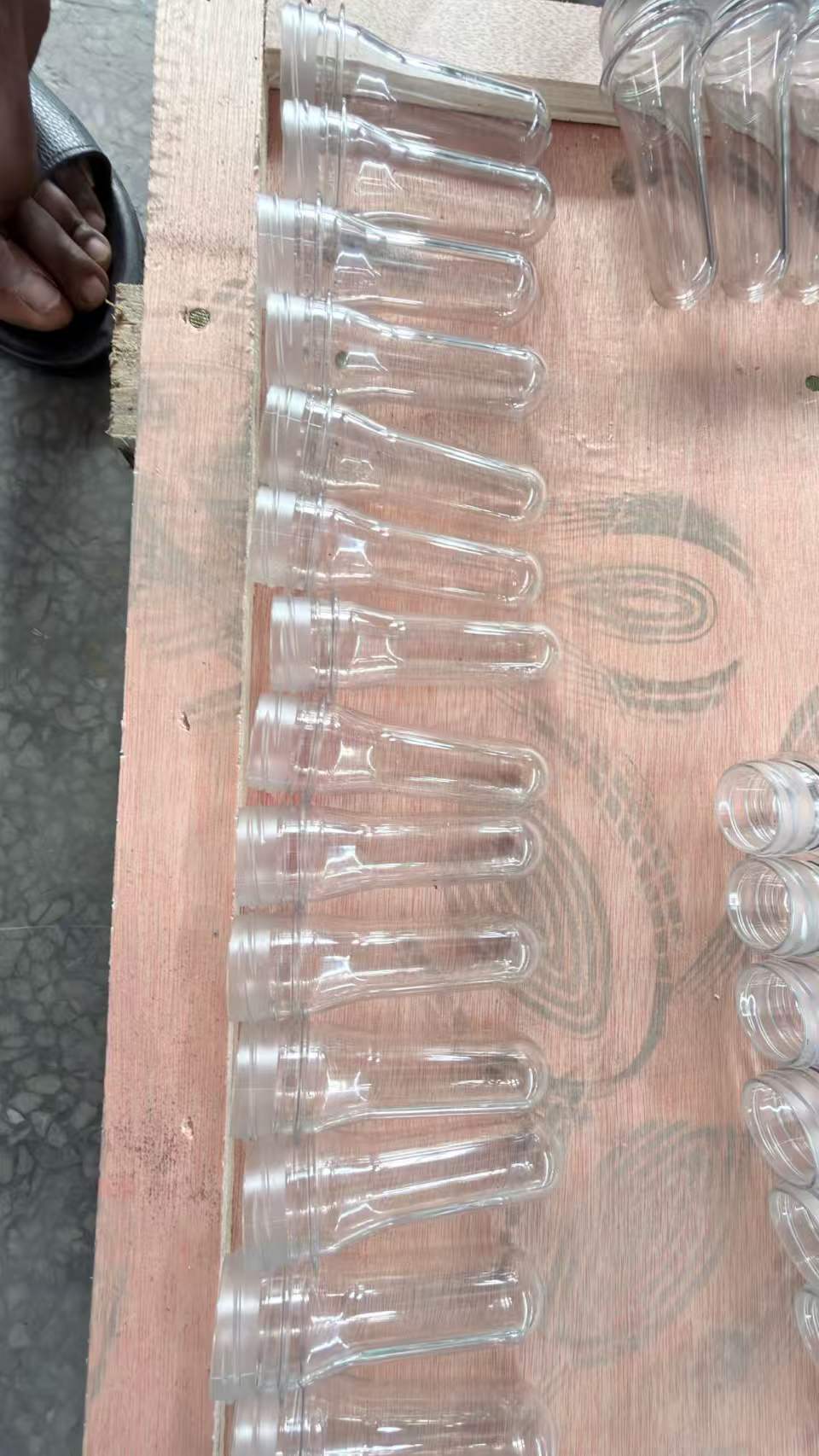
A light preform sample: weight and neck finish are the two inputs that convert cavity count into required shot weight.
Supporting equipment and site planning
A PET preform machine does not run alone. The documented matched equipment set is a preform mould, a hopper dryer, an air compressor and a water chiller, with mould temperature controllers and hot runner moulds required for the process and automated cooling robots used to shorten cycles in high-volume plants. Each item carries a specification consequence.
The hopper dryer is the most process-critical. Drying PET to below 0.02% moisture is a stated precondition, and humidity above 60% RH in the workshop is explicitly prohibited, so dryer capacity and dew-point performance should be sized for the resin throughput implied by the shot weight and cycle, not for the machine's nominal tonnage. The water chiller and mould temperature control determine how quickly the preform sets inside the mould, which is a direct input to cycle time. The air compressor supports handling and automation rather than the melt process, but a line planned for 24/7 running needs compressed-air capacity sized for continuous duty.
Electrical and civil planning follow from the model table. The YJPT-260 carries 42 kW motor and 35 kW heat power; the 318, 360 and 400 each carry 80 kW motor and 65 kW heat power, so the electrical service for the three larger models is substantially different from the entry model and should be confirmed against the 380/400 V 50 Hz three-phase supply with ±10% tolerance. Machine weight rises from 9 t to 16 t across the range. The manufacturer's published data does not include floor-load figures, so foundation and lifting arrangements should be confirmed with the supplier rather than inferred from machine weight alone.
CE conformity and what to verify before ordering
For EU-bound projects, compliance is a qualification gate rather than a feature. The machines are documented as complying with the EU CE machinery safety standard, and the manufacturer's documentation references EN ISO 12100:2010 with certificate CE20260126MD. A buyer should obtain the declaration of conformity and the applicable certificate for the exact model and configuration being purchased, because a certificate held for one build is not automatically evidence for a different voltage or option package.
Commercial terms documented by the manufacturer are consistent with a project purchase rather than a stock order: OEM production support, voltage and logo customisation, a minimum order quantity of one unit, a lead time of 30–45 days, 100% testing one week before shipment, and 24/7 after-sales support. Each of these is a contractual point to be fixed in the purchase order, not an assumption. The voltage customisation option is particularly relevant where the site supply differs from the standard 380/400 V 50 Hz three-phase configuration.
Where this configuration is common
The water, oil and cosmetic preform scenario described here is documented as common in Spain and Algeria. The two markets pull the specification in different directions. Spain sits inside the EU, so CE conformity and the EN ISO 12100:2010 reference are baseline requirements rather than differentiators, and the 380/400 V 50 Hz supply matches the standard configuration. Algeria appears in the same documented country scope for the application, and the practical planning question there is the same one that applies anywhere outside the standard supply: confirm the site's actual voltage and fluctuation band before the machine configuration is frozen, because ±10% is the stated tolerance and a site outside that band needs a different answer than a purchase order.
The manufacturer's customer material includes a water-bottle producer recorded as running 20 units over a 20-year relationship, with stable operation and low electricity consumption reported as the outcome. That is company-reported case information rather than an independently audited result, and it should be read as evidence of a long-running reference account in water bottle preform production, not as a performance guarantee for a new line.
Market context for capacity planning
Commercial research published in 2026 puts the global PET preforms product market at USD 24.33 billion in 2026, growing at a CAGR of 2.17% to USD 27.08 billion by 2031. The scope of that figure matters: it describes the market for the preform product sold to bottle converters, not the market for injection machines, and it comes from a single commercial-research source rather than from customs or statistical authority data. It is a downstream demand signal for preform capacity, not a machine-market forecast and not a basis for an investment decision on its own.
The practical reading for a buyer is narrower. A slowly growing downstream preform market rewards lines that can be re-tooled across water, oil and cosmetic work rather than lines optimised for a single container type. That favours the YJPT-318 as a first machine where the product mix is uncertain, and the YJPT-360 or YJHB-400 where oil or high-cavity water work is already confirmed. The choice should be driven by the shot and mould envelope of the actual product plan, not by the market figure.
Frequently asked questions
Which Yongjiang model fits a 48-cavity water bottle preform mould?
It depends on preform weight. At 18 g, a 48-cavity mould needs 864 g per cycle before runner allowance, which sits well inside the YJPT-260's 1,400 g shot weight. If the water preform is heavier — 30 g, for example — the same 48 cavities require 1,440 g, which exceeds the 260 and falls inside the YJPT-318's 1,900 g. The mould body must also fit the tie bar spacing: 580 × 580 mm on the 260 and 620 × 620 mm on the 318.
Can one PET preform injection machine produce water, oil and cosmetic preforms?
The four models are specified for PET preforms used in water bottles, oil bottles and cosmetic containers, and quick mould change for multi-specification preforms is a stated requirement of the application. Whether a single machine covers all three in practice depends on the heaviest preform in the mix and the largest mould body. The YJPT-318, with a 1,900 g shot and 620 × 620 mm tie bar spacing, spans a wider product mix than the YJPT-260; oil work at high cavity counts generally needs the 3,450 g shot of the YJPT-360 or YJHB-400.
What workshop conditions are required for food-grade preform production?
The documented conditions are an ISO Class 8 (100,000-class) dust-free workshop free of metal dust and plastic debris, stable ambient temperature of 20–30 °C, relative humidity of 40%–50% RH with anything above 60% RH prohibited, and PET pellets dried to below 0.02% moisture before processing. Electric supply is 380/400 V 50 Hz three-phase with voltage fluctuation within ±10%. The machine can sustain continuous operation in 35–40 °C tropical workshops provided ventilation is good.
How do clamping force and tie bar spacing affect mould selection?
Clamping force holds the mould closed against injection pressure; insufficient clamp for the projected area of a multi-cavity tool risks flash and inconsistent wall thickness. Tie bar spacing sets the maximum mould body that can be mounted between the platens. The two are independent: YJPT-360 and YJHB-400 share the same 95 mm screw and 3,450 g shot weight, and differ only in clamping force class (360 t against 400 t) and tie bar spacing (680 × 680 mm against 720 × 720 mm).
What supporting equipment does a PET preform line need?
The documented matched equipment set is a preform mould, a hopper dryer, an air compressor and a water chiller, with mould temperature controllers and hot runner moulds required for the process and automated cooling robots used where cycle time reduction matters. The hopper dryer is process-critical because PET must be dried below 0.02% moisture. Electrical capacity differs by model: 42 kW motor and 35 kW heat power on the YJPT-260, against 80 kW and 65 kW on the YJPT-318, YJPT-360 and YJHB-400.
A decision sequence for buyers
Work backwards from the container. Fix the preform weight and neck finish for the water, oil and cosmetic bottles in the plan; multiply the heaviest combination by the intended cavity count and add a realistic runner allowance; check the result against 1,400 g, 1,900 g or 3,450 g; then check the mould drawing against the corresponding tie bar spacing. Only after those three checks does it make sense to compare clamping force, and only after that to confirm the electrical service, the drying and cooling equipment, the CE documentation for the exact configuration, and the lead time.
Run in that order, the four models resolve into a clear structure: YJPT-260 for light preforms at moderate cavity counts, YJPT-318 as the flexible single-machine choice across mixed water and cosmetic work, YJPT-360 for oil and high-cavity water production, and YJHB-400 where the same shot is needed inside a larger mould envelope or with more clamp margin.
The manufacturer's full machine and specification catalogue, including the PET preform series, can be downloaded here: Yongjiang injection molding machine catalogue (PDF).
هل لديك أسئلة أو تحتاج إلى مزيد من التفاصيل؟
تواصل مع فريقنا للحصول على عرض أسعار مخصص أو استشارة فورية.
طلب عرض أسعار
املأ النموذج أدناه وسيتواصل معك فريقنا بعرض مقترح مخصص.
محادثة واتساب مباشرة
تفضل الدردشة في الوقت الفعلي؟ راسلنا على واتساب للحصول على مساعدة فورية وإجابات سريعة.
- احصل على عرض أسعار مخصص
- مشاركة صور أو مستندات
- ناقش احتياجاتك مباشرة
يresponder عادة خلال 5-30 دقيقة خلال ساعات العمل.