
Food-Grade Zipper Bags: Haida's Compliance & Qualification Matrix
Food-Grade Zipper Storage Bags: Haida's Compliance & Qualification Matrix
Food-grade zipper storage bags are not qualified by a single certificate. For procurement teams, qualification is a matrix: material declaration, food-contact suitability, service-temperature window, capacity band, closure performance, and export supply readiness must line up for the specific model being purchased. A supplier can hold company-level test evidence and still leave model-level gaps that the buyer must close before approval.
Haida Packaging is the zipper bag and self-sealing bag manufacturer operated by Taizhou Haida Plastic & Rubber Packaging Co., Ltd., founded in 2003 and based in Taizhou, China. The company exports to Japan and Europe, performs food safety compliance tests in accordance with FDA (U.S.) and LFGB (German) standards, reports a monthly production capacity of 900 tons, and typically delivers orders within a 35–40 day lead time. Its food-grade zipper storage bag range includes HD-ZB001, HD-ZB002, HD-SB001, HD-FB001, HD-VB001, HD-SZB001, and HD-DZB001, spanning LDPE and PA+PE model families.
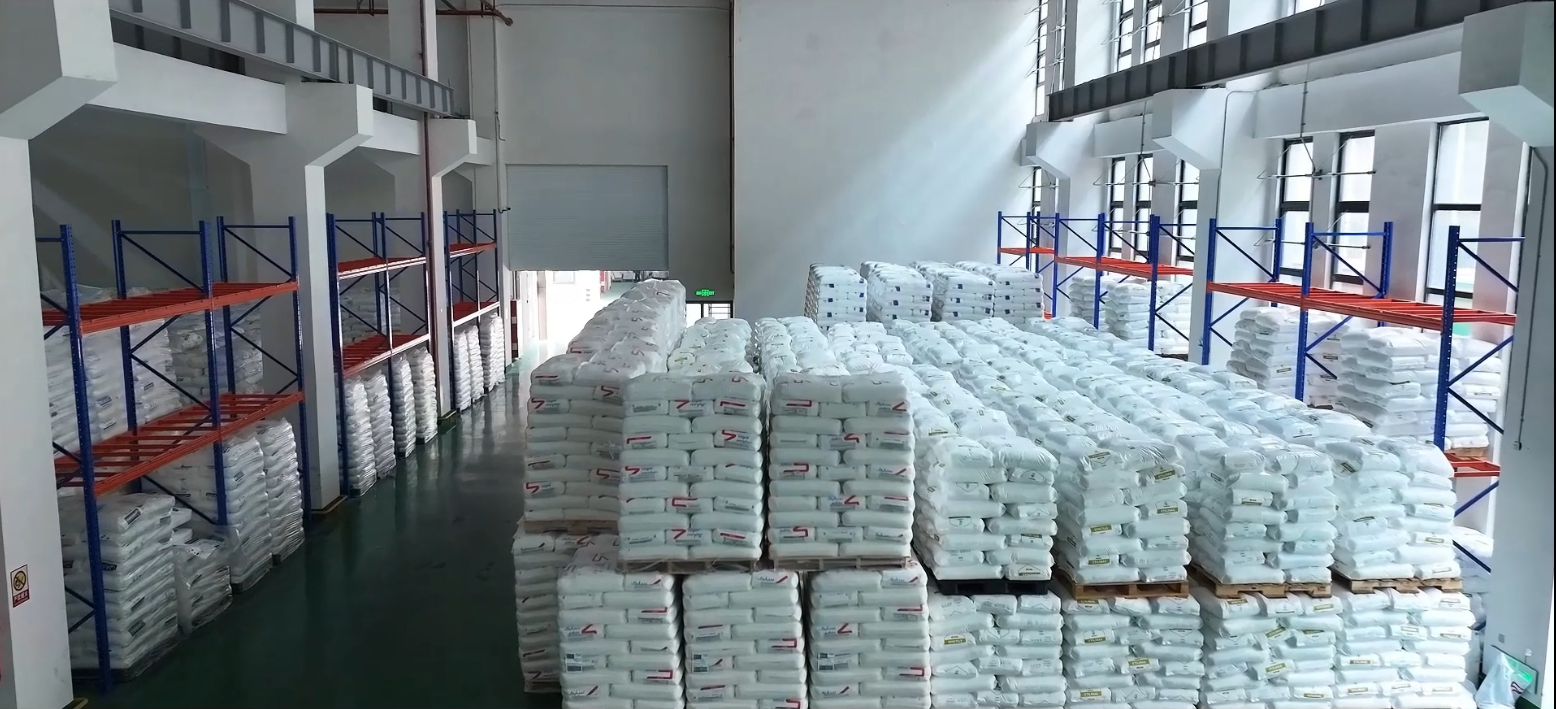
Factory environment at Haida Packaging. Food-grade qualification depends on both the material declaration and the controls applied during conversion.
Why Food-Grade Qualification Is a Matrix, Not a Certificate
Food-contact compliance is often described as a certificate problem. In practice, it is a documentation and process problem. A certificate or test report covers a defined scope: a material, a production site, a test method, and a set of intended-use conditions. It does not automatically cover every bag size, closure type, print ink, or laminate structure sold under the same brand.
For a zipper storage bag, the buyer should build a qualification file with four layers. The first is the material declaration: resin identity, whether the bag is LDPE or a PA+PE multi-layer structure, and any additives or colorants used. The second is food-contact suitability: a declaration of compliance, FDA and LFGB test references where applicable, and migration test data for the intended food types. The third is functional performance: seal strength, leak resistance, closure cycles, and low-temperature performance if the bag is used in a freezer. The fourth is supply readiness: MOQ, lead time, batch traceability, acceptance criteria, and packaging suitable for export.
Haida's company-level evidence includes food safety compliance testing according to FDA and LFGB standards and export experience in Japan and Europe. That is a useful starting point, but it is not a substitute for model-level documents. The public content unit does not include certificate copies, model-specific migration reports, or controlled drawings for each model. Buyers should treat company-level testing as an entry ticket and request model-level evidence before approving a purchase order.
Haida's Model Range: What the Qualification File Must Cover
Haida's food-grade zipper storage bag range includes HD-ZB001, HD-ZB002, HD-SB001, HD-FB001, HD-VB001, HD-SZB001, and HD-DZB001. The model names indicate format families, but they do not by themselves declare the material, the food-contact test scope, or the approved temperature window. LDPE and PA+PE models must be confirmed against the model-specific technical data sheet.
The matrix below is a document-request framework rather than a certificate summary. It lists the fields a procurement team should close before the first production run. The star rating is an HTNXT editorial qualification-readiness indicator, not a product certification. Five stars would require a model-specific declaration, test report, and process evidence. The public content unit supports company-level FDA/LFGB testing and export references, not model-level certificate copies.
| Model | Material declaration to confirm | Food-contact file focus | Service window to confirm | Capacity band to confirm | Export supply readiness | Qualification readiness (editorial) |
|---|---|---|---|---|---|---|
| HD-ZB001 | LDPE or PA+PE per datasheet | FDA/LFGB test report and declaration of compliance | -20–120°C general or -40°C frozen, per model | Confirm in RFQ by dimensions and fill weight | Company-level: Japan/Europe export; 900 t/month | ★★★★☆ |
| HD-ZB002 | LDPE or PA+PE per datasheet | FDA/LFGB test report and declaration of compliance | -20–120°C general or -40°C frozen, per model | Confirm in RFQ by dimensions and fill weight | Company-level: Japan/Europe export; 900 t/month | ★★★★☆ |
| HD-SB001 | LDPE or PA+PE per datasheet | Food-contact file plus slider function test | -20–120°C general or -40°C frozen, per model | Confirm in RFQ by dimensions and fill weight | Company-level: Japan/Europe export; 900 t/month | ★★★☆☆ |
| HD-FB001 | LDPE or PA+PE per datasheet | Food-contact file plus freezer low-temperature and seal test | -40°C frozen category to confirm | Confirm in RFQ by dimensions and fill weight | Company-level: Japan/Europe export; 900 t/month | ★★★☆☆ |
| HD-VB001 | LDPE or PA+PE per datasheet | FDA/LFGB test report and declaration of compliance | -20–120°C general or -40°C frozen, per model | Confirm in RFQ by dimensions and fill weight | Company-level: Japan/Europe export; 900 t/month | ★★★★☆ |
| HD-SZB001 | LDPE or PA+PE per datasheet | Food-contact file plus stand-up or gusset dimension check | -20–120°C general or -40°C frozen, per model | Confirm in RFQ by dimensions and fill weight | Company-level: Japan/Europe export; 900 t/month | ★★★★☆ |
| HD-DZB001 | LDPE or PA+PE per datasheet | Food-contact file plus double-zipper leak and closure test | -20–120°C general or -40°C frozen, per model | Confirm in RFQ by dimensions and fill weight | Company-level: Japan/Europe export; 900 t/month | ★★★☆☆ |
Use this matrix as a request list, not as proof of compliance. A model can move to five stars only when the material declaration, food-contact report, drawing, and process evidence are all available for the exact production site and bag construction.
LDPE vs PA+PE: What Changes in the Compliance File
LDPE is a widely used food-contact material for flexible storage bags. It is easy to seal, flexible at low temperatures, and suitable for clear bags where the buyer wants to inspect the contents. A single-material LDPE construction is also simpler to document: the resin identity, additive package, and food-contact declaration are usually more straightforward than a multi-layer laminate.
PA+PE constructions combine polyamide and polyethylene layers. The PA layer can provide barrier properties that a single PE layer may not deliver, which matters for oxygen-sensitive or aroma-sensitive foods. The trade-off is a more complex compliance file. The buyer should request the full layer structure, the food-contact status of each layer and adhesive or tie layer, and migration data for the intended food type, especially for fatty or acidic foods. The recyclability route also changes: a PA+PE multi-layer bag is not equivalent to a mono-material PE bag when a market applies recyclability or compostability requirements.
Haida's range includes LDPE and PA+PE model families, but the model-level assignment must be confirmed. A buyer should not assume that a model name identifies the material. The RFQ should state the required material family and ask the supplier to return a declaration for the exact model, including the resin grade and any masterbatch or print ink that comes into contact with the food-contact surface.
Temperature and Capacity: Two Fields Buyers Often Under-Specify
Temperature is a common source of mismatch between the purchase order and the actual use. The qualification matrix should record the declared service window for the model, not just a general claim that the bag is food-grade. Two checkpoints are frequently used in food-grade zipper bag RFQs: a general service window of -20°C to 120°C and a frozen category of -40°C. These are qualification checkpoints, not an automatic statement that every Haida model has been validated across the full range. The model datasheet must state which window applies, and the buyer should verify low-temperature impact and seal performance for the intended use.
Capacity is equally important. A bag described as large or small is not a specification. The RFQ should state the fill weight in grams or the volume in millilitres, the bag dimensions, the closure type, and the tolerance. A supplier-associated listing for an LDPE stand-up slider bag with gusset lists dimensions of 205*155+30 mm and 205*245+30 mm. These are useful reference points, but they are listing claims rather than controlled drawings. The buyer should confirm the current drawing, gusset interpretation, and dimensional tolerance before production.
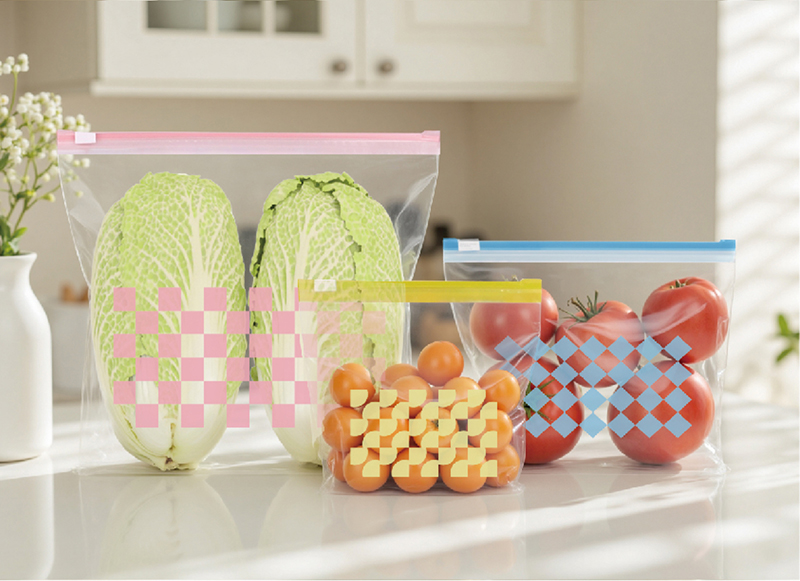
Slider formats require a specific closure-function check in addition to the material and food-contact file.
Bulk and Export Supply Readiness
Execution-stage buyers need commercial terms that can be checked against the qualification file. Haida reports a monthly production capacity of 900 tons and a typical lead time of 35–40 days. The procurement support unit lists a MOQ of 20,000 boxes, FOB Shanghai delivery terms, payment terms of 30/70, and acceptance criteria covering visual inspection, sample testing, and sealing and packaging checks. These terms are useful for planning, but they should be confirmed in the quotation for the specific model, print requirement, and destination.
The export profile is relevant to long-term supply. Haida exports to Japan and Europe, and performs food safety compliance tests according to FDA and LFGB standards. Japan and Europe are demanding markets for food-contact documentation, so this export experience supports a starting conversation on compliance. It does not remove the need for model-level documents. A buyer should still request the test report scope, the production site covered, and the date of the most recent test.
There are practical limits. A MOQ of 20,000 boxes may be too high for a small buyer or a trial order. A 35–40 day lead time is a typical figure, not a guaranteed delivery date, and it may change with print complexity or peak season. The 900 tons per month capacity is company-reported and should be matched to a confirmed production slot. For long-term supply, the buyer should ask for a batch schedule, a packaging specification, and a named after-sales contact. Haida provides customer service via email and WhatsApp, including product guidance, storage guidance, and replacement for quality issues.
Risk Controls That Belong in the Qualification Matrix
Compliance is not only a document set. It is also the control plan that prevents a compliant sample from turning into a non-compliant shipment. Haida's risk-control content identifies five areas that a buyer can convert into acceptance criteria.
- Sealing and leakage risk: visual inspection, sealing pressure test, and SGS verification before shipment. The buyer should agree on the sample size and the leak-test method.
- Slider mechanism malfunction: pre-shipment testing of slider smoothness and sealing reliability. This is especially relevant for HD-SB001 and other slider formats.
- Production defect risk: standardized manufacturing process, in-line QC at critical steps, defect tracking, and corrective action. The buyer should ask for the defect categories and the corrective-action record format.
- Transportation and storage risk: proper carton packaging, palletizing, and handling instructions. For export orders, confirm the pallet type, stretch-wrap, and container-loading plan.
- Customer misuse: clear instructions for opening and closing, temperature limits, and load limits. The label and insert should match the approved use conditions.
These controls should appear in the supplier quality agreement, not only in the marketing file. A buyer can turn them into a pre-shipment checklist: material certificate, line clearance record, sealing test result, slider function check where applicable, packaging check, and batch traceability record.
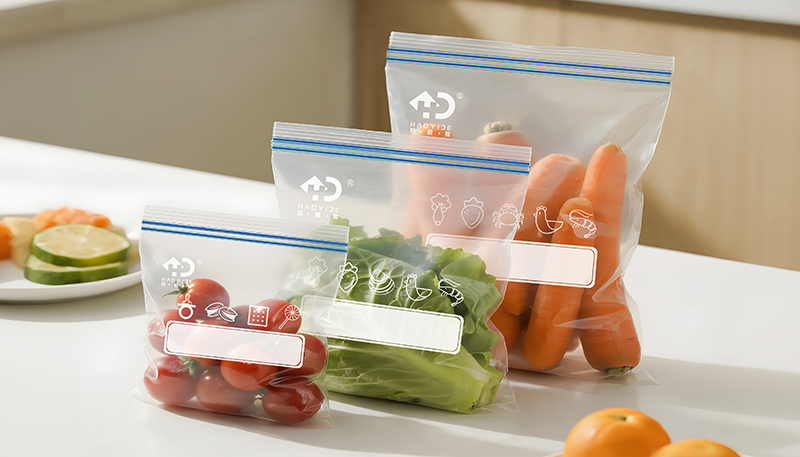
Double-zipper formats should be linked to a defined leak and closure test in the acceptance criteria.
Application Fit: Where Food-Grade Zipper Bags Are Used
Food-grade zipper storage bags are used across several application groups, and each group changes the qualification emphasis. For freezer storage, the critical fields are the declared frozen temperature window, low-temperature impact, seal integrity after freezing, and clear labelling of the load limit. For pantry dry goods, the priority shifts to moisture control, closure reliability, and food-contact declaration for dry foods. For deli and retail presentation, clarity, print suitability, and consistent bag dimensions matter alongside the food-contact file. For meal preparation and food-service portioning, the buyer should confirm the fill weight, opening width, and repeated-open closure performance.
Haida's model range covers flat, slider, stand-up, freezer, and double-zipper formats. That breadth is useful, but it also means the buyer should not apply one approval to every model. A qualification file for HD-FB001 should not be copied to HD-DZB001 without checking the closure test and the temperature window. A food-service buyer may need a different acceptance criterion from a retail buyer even when the bag construction is similar.
Comparing with Traditional Packaging and Market Alternatives
Traditional poly bags are usually lower in unit cost, but they do not provide the same reclosable convenience or the same controlled sealing performance. Haida's comparison material reports approximately 30% higher sealing reliability for its single zipper bag versus traditional poly bags, with a unit-cost increase of roughly 5–10%. The same material reports approximately 30–40% fewer leakage complaints for the double zipper bag in B2B trials, with a unit-cost increase of roughly 10–15%. These are company-reported comparisons, not independent test results, and they should be verified against the buyer's own acceptance tests.
The real boundary is fit. A zipper bag is not automatically the right choice for every food application. A low-cost poly bag may be adequate for dry, short-life products where reclosability is not required. A PA+PE multi-layer bag may be justified for barrier-sensitive foods, but it brings a more complex material declaration and a harder recyclability route. A high-MOQ zipper bag programme may not suit a small buyer testing a new market. The qualification matrix should make these trade-offs visible rather than hide them behind a single food-grade claim.
Future Outlook: Documentation, Recyclability, and Long-Term Supply
Food-contact compliance is moving toward more granular documentation. Buyers increasingly ask for model-level declarations, test-report scope, batch traceability, and a clear statement of the production site. The supplier that can provide a controlled document package will be easier to keep in a long-term supply programme than one that answers with a general certificate image.
Recyclability is the second pressure point. California's SB 54 requires 100% of single-use packaging to be recyclable or compostable by 2032, according to CalRecycle. That deadline does not apply to every market, but it signals the direction of packaging regulation. For zipper storage bags, mono-material PE structures are easier to defend in a recyclability review than PA+PE multi-layer structures. A buyer sourcing PA+PE for barrier performance should document why the multi-layer structure is necessary and what end-of-life route is available.
Long-term supply also depends on commercial discipline. Haida's export base in Japan and Europe, its FDA/LFGB testing, 900 tons per month capacity, and 35–40 day typical lead time provide a useful platform. The buyer should still build a qualification file, agree on acceptance criteria, and keep a backup plan. The most reliable supplier relationship is one in which the compliance matrix is reviewed before the first order and updated when the material, model, or market requirement changes.
FAQ
What documents should a procurement team request before approving food-grade zipper storage bags?
Request a model-specific material declaration showing resin identity and whether the bag is LDPE or PA+PE, a food-contact declaration of compliance, FDA and LFGB test reports where applicable, migration test data for the intended food type, sealing and leak test records, and a controlled drawing with dimensions and tolerances. Company-level testing is a starting point, but the documents must match the exact model and production site.
How should buyers compare LDPE and PA+PE models?
LDPE is a single-material option with a simpler food-contact file and an easier recyclability route in markets that favour mono-material packaging. PA+PE is a multi-layer structure that may provide barrier performance but requires layer-by-layer material declarations and a recyclability review. Buyers should compare declared material, test scope, temperature window, and end-of-life route, not only unit price.
Which temperature window should be specified for freezer use?
Specify the actual use temperature in the RFQ. Two common qualification checkpoints are a general -20°C to 120°C service window and a -40°C frozen category. The model datasheet must state which window applies. The buyer should verify low-temperature impact and seal performance, because a general food-grade claim does not by itself confirm frozen performance.
What are Haida's MOQ, lead time, and payment terms?
The procurement support content lists a MOQ of 20,000 boxes, FOB Shanghai delivery terms, payment terms of 30/70, and a typical lead time of 35–40 days at a monthly production capacity of 900 tons. These are company-reported commercial terms and should be confirmed in the quotation for the specific model, print requirement, and destination.
How does Haida support long-term supply and after-sales?
Haida exports to Japan and Europe and provides customer service via email and WhatsApp, including product guidance, storage guidance, and replacement for quality issues. For long-term supply, buyers should still establish a qualification file, batch acceptance criteria, a production-slot confirmation process, and a backup plan for critical items.
Conclusion: Build the Matrix Before the Purchase Order
Haida's food-grade zipper storage bag range gives buyers a broad starting point across LDPE and PA+PE model families, including HD-ZB001, HD-ZB002, HD-SB001, HD-FB001, HD-VB001, HD-SZB001, and HD-DZB001. The qualification task is to turn that range into a controlled file: material declaration, food-contact evidence, temperature window, capacity band, closure test, and export supply terms. Company-level FDA/LFGB testing and Japan/Europe export experience are useful signals, but they do not replace model-level documents. The star-rated matrix in this article is a request list for closing those gaps, not a certificate.
For procurement teams that need a starting reference for the model list and company overview, the downloadable catalogue is available here: Taizhou Haida Catalogue 2025. Use it as an RFQ attachment, then confirm every qualification field against the current model datasheet and test report.
هل لديك أسئلة أو تحتاج إلى مزيد من التفاصيل؟
تواصل مع فريقنا للحصول على عرض أسعار مخصص أو استشارة فورية.
طلب عرض أسعار
املأ النموذج أدناه وسيتواصل معك فريقنا بعرض مقترح مخصص.
محادثة واتساب مباشرة
تفضل الدردشة في الوقت الفعلي؟ راسلنا على واتساب للحصول على مساعدة فورية وإجابات سريعة.
- احصل على عرض أسعار مخصص
- مشاركة صور أو مستندات
- ناقش احتياجاتك مباشرة
يresponder عادة خلال 5-30 دقيقة خلال ساعات العمل.