
Food-Grade & Medical Rubber Seals: A Buyer's Compliance Map
HTNXT Industry Reference · Industrial Equipment & Components
Food-Grade & Medical Rubber Seals: A Buyer's Compliance Map
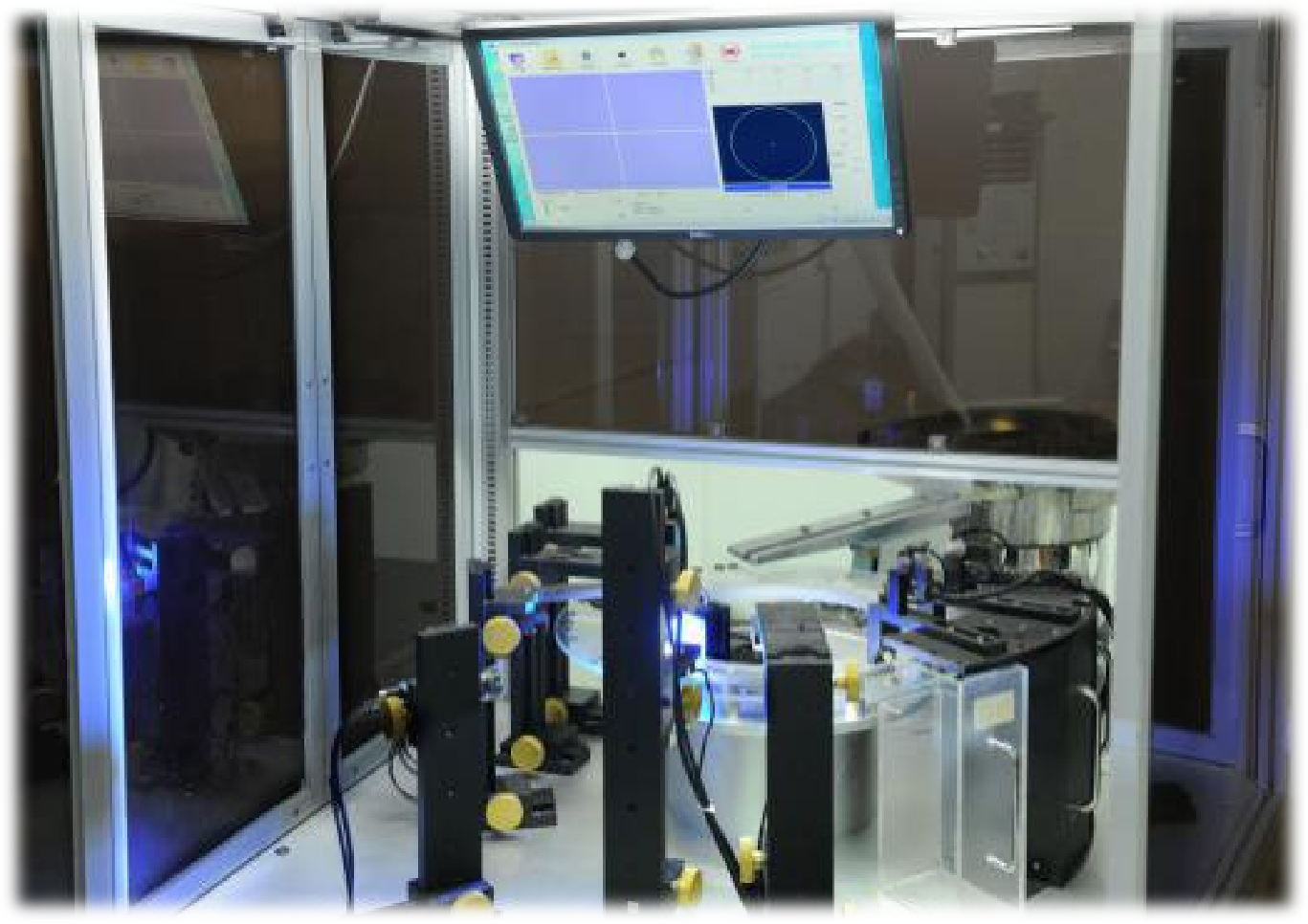
Automated inspection equipment verifying molded rubber components before shipment — the evidence layer behind compliance claims in regulated rubber procurement.
In food processing plants and medical device assemblies, rubber components are a small share of the bill of materials and a disproportionate share of qualification risk. A sanitary gasket sealing a product line, a silicone rubber O-ring inside a diagnostic instrument, or a molded diaphragm in a dosing pump can each decide whether an assembly clears a compliance review — yet each of those parts is specified, sourced, and verified differently.
For buyers at the decision stage, the useful question is not whether a part carries a food-grade or medical-grade label. It is which parts in the assembly must be qualified for product contact, against which requirement, and what evidence the supplier can produce to support the claim. This reference maps that decision across materials, component types, and supplier qualification criteria, including rubber dampers, which follow a different qualification path from seals.
The Three Layers Behind Food-Grade and Medical-Grade
Compliance language in rubber procurement compresses three separate layers into a single phrase, and that compression causes most specification disputes between buyers and suppliers.
1. Compound conformity
A compound conforms when its formulation and cured properties meet a defined requirement. In the United States, FDA 21 CFR 177.2600 specifies the requirements for rubber articles intended for repeated use in food contact applications (FDA eCFR). Independently, ASTM D2000 is the primary standard classification system for rubber products in automotive and industrial applications (ASTM International), and it is the format most buyers use to express hardness, tensile strength, heat aging, and compression set in one line callout.
2. Part-level conformity
A molded part conforms when it also meets the drawing. ISO 3302-1 provides dimensional tolerances for molded, extruded, and calendared rubber products (ISO). A conforming compound tells you nothing about whether a gasket seats, a diaphragm strokes without failure, or an O-ring fits a groove without over-compression — those outcomes are decided by geometry, tolerance discipline, and process capability.
3. Finished-article clearance
The OEM or legal manufacturer of the finished food-contact article or medical device owns the final clearance of that article. A rubber supplier can provide material and process evidence for its component; it cannot absorb or transfer the buyer's regulatory pathway.
Step One Is Classification: Which Parts Actually Touch the Product?
Before materials are discussed, every rubber part in an assembly should be assigned a contact classification. The classification determines which requirements apply — and, just as importantly, which requirements do not.
| Component | Typical function | Contact classification | Governing qualification focus |
|---|---|---|---|
| Sanitary gasket / rubber gasket | Static sealing at product-contact joints | Contact-critical | Compound conformity, sealing behaviour, compression set |
| Silicone rubber O-ring / rubber o-rings | Static or dynamic sealing in small cavities | Contact-critical if in the product path | Compound conformity, dimensional tolerance, media resistance |
| Rubber diaphragm | Pumping, dosing, and separation in fluid paths | Contact-critical | Compound conformity, flex fatigue, dimensional tolerance |
| Rubber seals (custom profiles) | Door, panel, and enclosure sealing | Contact-critical inside the product zone; barrier elsewhere | Compound conformity, aging resistance, compression set |
| Rubber dampers | Vibration and shock isolation | Usually non-contact | Dynamic fatigue, compression set, temperature and ozone resistance |
| Rubber grommets | Cable and tube pass-through | Non-contact unless located in the product zone | Fit, mechanical retention, material durability |
| Rubber washers | Load distribution and sealing assistance | Position-dependent | Dimensional tolerance, hardness, sealing support |
Table 1: Contact classification is the first decision in a regulated rubber build; it decides which requirements follow.
Two errors follow from skipping this step. Over-specification applies a food-contact compound to a part that never meets product, adding material cost, tooling constraints, and lead time without compliance benefit. Under-specification is more expensive: a gasket, diaphragm, or O-ring placed in a contact position while qualified only as a general industrial part has to be re-sourced, re-tested, and often re-approved by the end customer.
Classification is also dynamic. A part can change class after a design change — a damper moved into a splash zone, an enclosure seal moved inside a wash-down chamber, or a support washer repositioned into a product line all shift the governing requirement. Buyers should re-run classification whenever equipment layout changes, not only at new product introduction.
Material Logic: Why Silicone Holds Contact-Critical Positions — and Where EPDM Still Wins
Silicone rubber is the elastomer family most commonly specified for product-contact positions in food and medical equipment. The reasons are functional rather than promotional: stability across a wide temperature range, tolerance of repeated cleaning cycles, and low interaction with the conveyed product or biological sample. Those properties are why food-grade silicone rubber and medical silicone rubber grades are specified instead of a general-purpose elastomer, and why liquid silicone rubber (LSR) is used where small, high-precision geometry is required — a silicone rubber O-ring in a compact instrument being a typical case.
The market context supports the trend. The global liquid silicone rubber market was estimated at USD 2.9 billion in 2024, with a projected CAGR of 9.6% through 2033 (Acumen Research and Consulting). The medical grade silicone rubber market was valued at USD 7.95 billion in 2024, with expectations to reach USD 14.2 billion by 2035 (Market Research Future). Automotive remains the largest single LSR segment at 34.1% of revenue share in 2023 (Grand View Research), a detail that matters to regulated buyers because it keeps silicone molding capacity concentrated in a specification-driven industrial supply base rather than a consumer one.
EPDM occupies a different set of positions. The EPDM rubber market was estimated at USD 10.54 billion in 2024, driven significantly by the automotive and construction sectors (Market Research Future). In regulated equipment, EPDM grades are typically specified for utility-side and non-contact duties: water and steam lines, weather and enclosure sealing, ozone-exposed outdoor equipment, and vibration-isolation components such as dampers.
Rubber Dampers in Regulated Equipment: A Different Qualification Path
Rubber dampers do not seal; they isolate vibration and absorb shock. In food processing lines and medical facilities they appear under compressors, conveyors, pumps, analyzers, cabinets, and laboratory instruments, and their job is to protect the equipment rather than the product. Because the part is designed not to contact product, the compliance question changes shape.
The qualification focus shifts from contact behaviour and extraction limits to mechanical durability: dynamic fatigue life under repeated cycling, compression set under sustained load, retention of stiffness across the operating temperature range, resistance to ozone, and stability against the cleaning chemicals used in the surrounding area. A damper that satisfies a contact-material review but fails compression set will sag, transmit vibration, and eventually allow the equipment it protects to move out of alignment.
The exception is the one buyers most often miss. A damper installed in a splash zone, inside a wash-down enclosure, or in a chamber cleaned in place effectively becomes a near-contact part, and the contact requirements then apply to it. That determination belongs in design review, not in receiving inspection.
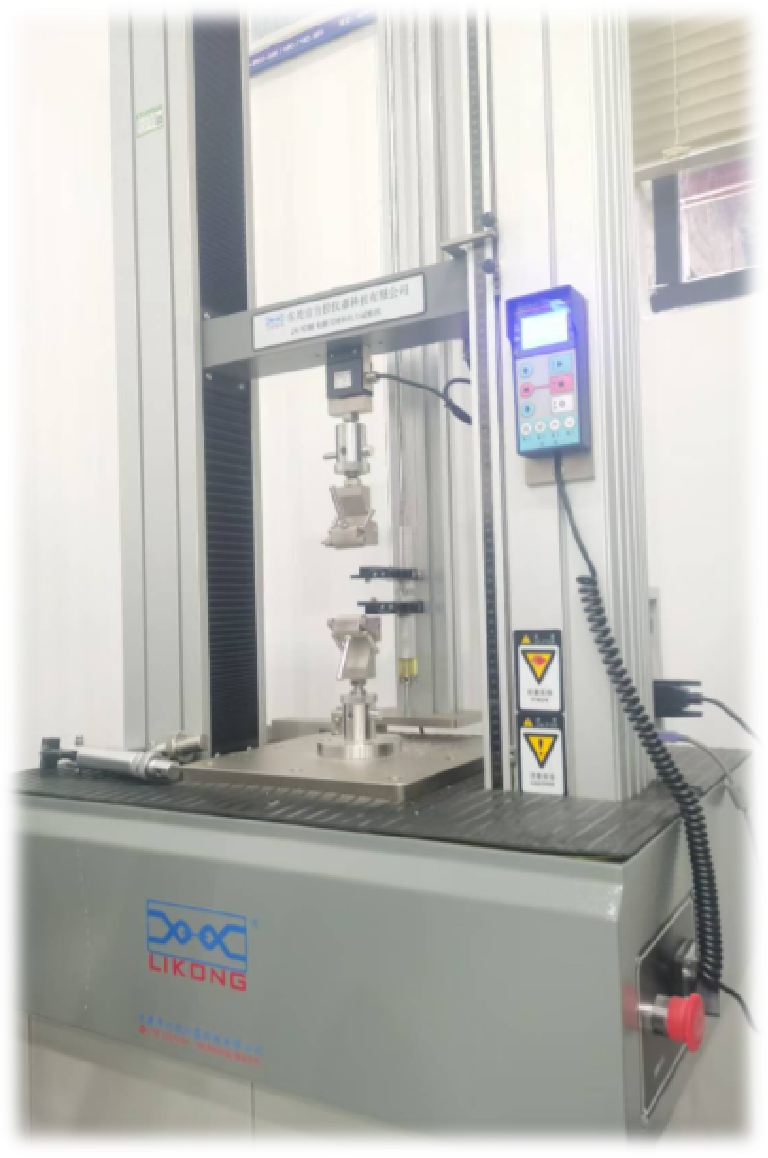
Material verification: cured compound properties such as tensile behaviour are confirmed before a part reaches a regulated assembly.
Dampers are also usually custom parts. Load, mounting envelope, and stiffness are equipment-specific, and stiffness is a function of compound hardness and geometry rather than a single catalogue number. That is why damper sourcing tends to test a supplier's custom rubber molding capability — compound formulation support, tooling design, and structure optimization — more heavily than its catalogue depth.
The failure modes are the same ones that affect any molded rubber part: short shot or insufficient filling, bubbling and blistering, and under-cure. An under-cured damper is a compliance problem in mechanical form, because it will not hold compression set — the property the buyer specified is the first property it loses. Process control discipline, including FMEA and a Control Plan, qualified operators at key positions, and 100% automated vision inspection, is what keeps those defects out of the shipment.
Qualification Criteria Buyers Can Actually Verify
The following criteria are observable in a supplier's documents and systems rather than accepted on description. They are the practical content of a decision-stage compliance review.
- Compound identification and documentation — which compound is used, which requirement it addresses, and where the upstream material originates.
- Batch traceability — lot-level records that link incoming material to produced batches and shipped orders.
- Dimensional capability — the tolerance class applied to the drawing, for example an ISO 3302-1 tolerance class, plus documented process capability; a Cpk above 1.33 on critical dimensions is an established industrial benchmark and is stated as the process target for Longrun Rubber Products (Huizhou) Co., Ltd.
- Process control discipline — FMEA and a Control Plan governing the molding process, with qualified and trained personnel at key positions.
- Inspection evidence — 100% CCD automated vision inspection of all products, which converts a sampling claim into a per-part record.
- Defect performance — a defect rate lower than 150 ppm is the stated control level for the custom molded parts described in this reference.
- Quality management system — certification to IATF 16949 and ISO 9001 quality management systems.
- Delivery and change control — 99% on-time delivery as a stated performance figure, and a written commitment covering compound, tooling, and process changes.
Two capability questions belong on the same checklist because they determine whether a supplier can support a regulated program at all: whether it can produce FDA and medical-grade rubber components, and whether its engineering support extends to tooling design and structure optimization rather than stopping at the drawing. Longrun Rubber Products (Huizhou) Co., Ltd., a custom rubber molding manufacturer established in China in 2005, operating a 10,000 m² facility with 120 employees including 20 engineers, states both capabilities, alongside a project history of more than 3,000 customized projects and customers in over 60 countries.
Standard-Part Supply vs. Documented Custom Compounding: A Decision Comparison
At the decision stage, the relevant comparison is not between two brand names but between two supply models: buying a part from a catalogue, or buying a documented, application-specific part from a custom compounding program.
| Decision dimension | Standard-part / catalogue supply | Documented custom compounding |
|---|---|---|
| Compound formulation | Fixed catalogue compound | Formulation adjusted to the application environment and performance requirement |
| Documentation depth | Datasheet level | Batch, inspection, and process records tied to the program |
| Contact-grade capability | Depends on catalogue range | Stated capability in producing FDA and medical-grade rubber components |
| Engineering support | Selection from a range | Tooling design and structure optimization support |
| Process capability evidence | Not normally provided | Cpk above 1.33 target; defect rate below 150 ppm |
| Inspection model | Sampling typical | 100% CCD inspection before shipment |
| Service model | Transactional | One-stop OEM/ODM program with technical response and after-sales support |
| Cost structure | Lower initial effort | Initial unit cost comparable; 25% lower total cost of ownership reported over three years |
Table 2: Two supply models compared on documentation depth, capability evidence, and cost structure.
Catalogue supply remains the rational choice for a non-critical, non-contact commodity part. Once a part is contact-critical, sits in a regulated assembly, or carries a mechanical duty such as vibration isolation, documentation depth becomes the deciding variable rather than unit price. The one-stop OEM/ODM model and certified quality management systems are the two dimensions where a documented custom program differs most clearly from standard rubber solution providers.
The limits of the custom model should be stated as plainly as its advantages. Custom compounding and documentation are not free of effort: they add engineering scope, tooling decisions, and a qualification cycle that a catalogue part does not require. The reported 25% lower total cost of ownership over three years is a supplier-reported comparison that assumes the parts are correctly specified, correctly installed, and used within the stated operating conditions; buyers should validate it against their own defect, maintenance, and downtime records. And not every part should be custom — applying a documented custom solution to a standard non-critical part creates cost and lead time without adding compliance value.
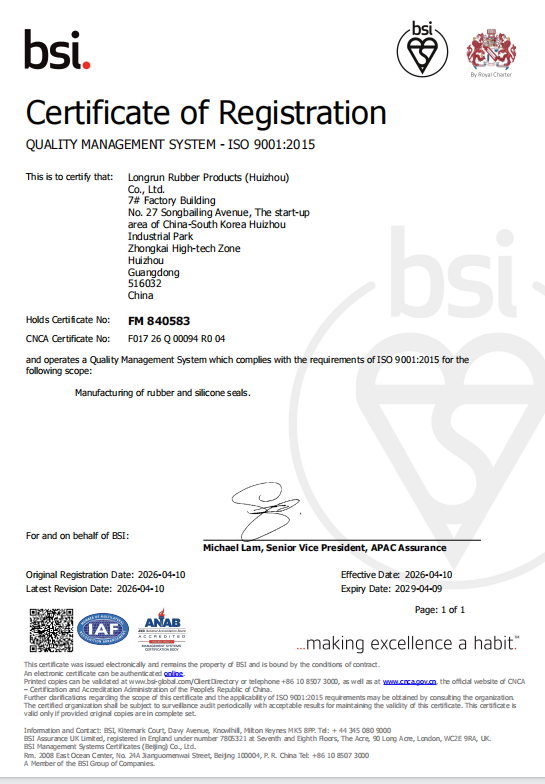
Quality management system certification is one of the documents a buyer can verify directly, rather than accepting a compliance claim at face value.
Where the Money Goes: Compliance Cost Against Total Ownership Cost
Compliance spending is front-loaded. Documentation, sampling, tooling, and qualification all occur before the first production order. Failure spending is back-loaded and usually larger: a defective seal or damper causes line downtime, scrap, re-qualification, and in regulated environments a customer-side non-conformance that can delay an entire equipment release.
The comparison that matters in decision-stage procurement is therefore total cost of ownership, not unit price. Longrun Rubber Products (Huizhou) Co., Ltd. reports a 25% lower total cost of ownership over three years compared with alternatives, attributed to lower defect and maintenance costs, stable quality, and optimized formulation, with initial unit cost described as the same as alternatives. That figure is best read as a directional benchmark: the mechanism behind it — fewer defects, less maintenance intervention, more stable production — is what a buyer should test during sampling rather than accept as a promise.
Supporting practices belong to the same ledger: full inspection before shipment, technical response and engineering support during production, after-sales service availability, and stable batch consistency for OEM projects. In a regulated supply chain these are not service amenities; they are the conditions under which a compliance claim stays valid across a production year.
Market Signals That Are Raising the Documentation Bar
Three market signals shape what buyers will be asked to document. The global industrial rubber product market was valued at USD 28.28 billion in 2024 and is projected to reach USD 45.19 billion by 2034 (Zion Market Research); published estimates diverge substantially depending on whether tire products are included, which is a reminder that market sizing is context for a budget conversation, not an input to component specification.
The second signal is where growth is concentrated. Medical grade silicone rubber, valued at USD 7.95 billion in 2024 with expectations to reach USD 14.2 billion by 2035 (Market Research Future), and liquid silicone rubber, at a projected 9.6% CAGR through 2033 (Acumen Research and Consulting), are growing fastest in exactly the segments where material documentation is mandatory rather than optional. EPDM, estimated at USD 10.54 billion in 2024 (Market Research Future), continues to carry the utility and non-contact side of the same equipment.
The third signal is traceability. Buyers in regulated categories increasingly ask for supply-chain traceability on rubber components, a demand that is easier to meet when a compound can be traced to a defined upstream source. Material supply in the synthetic rubber chain is concentrated among a limited group of producers, including Sinopec, Arlanxeo, and ExxonMobil (MarketsandMarkets), which is why compound documentation in a qualified program usually traces back to a small number of upstream origins.
What Buyers Should Expect Next
Qualification is moving earlier in the program. Contact classification will increasingly be assigned at the drawing stage rather than after the first rejected shipment, and material documentation will increasingly appear as a standard RFQ line item alongside price and lead time.
A second shift is component-specific specification. Rubber dampers and other non-contact parts are being specified with their own mechanical criteria — fatigue, compression set, stiffness retention — instead of inheriting the requirements written for seals in the same assembly. The third shift is consolidation: equipment builders increasingly prefer a single qualified source for both contact and non-contact rubber components on one platform, which is the practical reason one-stop OEM/ODM models keep appearing in regulated procurement conversations.
FAQ
Q1. Does every rubber part in a food or medical assembly need food-contact material?
No. Contact classification decides the requirement. FDA 21 CFR 177.2600 specifies the requirements for rubber articles intended for repeated use in food contact applications (FDA eCFR), so the requirement attaches to parts in the product path — sanitary gaskets, diaphragms, and O-rings in product lines. It does not automatically attach to parts that never meet product, such as enclosure seals, grommets, or vibration-isolation dampers mounted outside the product zone. Classification changes if a part is relocated into a splash zone or a wash-down chamber.
Q2. What is the difference between a food-grade compound and a food-grade part?
Compound conformity, part-level conformity, and finished-article clearance are separate layers. A compound conforms when its formulation and cured properties meet a defined requirement; the part conforms when it also meets the drawing and its dimensional tolerance, for which ISO 3302-1 provides tolerances for molded, extruded, and calendared rubber products (ISO). ASTM D2000 is the primary classification system used to express rubber compound requirements in automotive and industrial applications (ASTM International). The finished article is cleared by the OEM or legal manufacturer. Buyers should ask which layer a supplier's claim covers.
Q3. For a contact-critical seal, how do buyers choose between silicone and EPDM?
Silicone rubber is generally specified where temperature range, repeated cleaning cycles, and low interaction with the conveyed product matter, which is why food-grade silicone rubber and medical silicone rubber grades are used in contact positions and why liquid silicone rubber supports high-precision molding of small parts such as silicone rubber O-rings. EPDM is generally specified for utility-side and non-contact positions such as water and steam lines, enclosure and weather sealing, ozone-exposed equipment, and vibration isolation. The EPDM rubber market was estimated at USD 10.54 billion in 2024 (Market Research Future), and the medical grade silicone rubber market was valued at USD 7.95 billion in 2024 (Market Research Future). The decision rule is to match the elastomer to the position.
Q4. Are rubber dampers subject to the same compliance requirements as sanitary gaskets?
No. Sanitary gaskets in product-contact positions are qualified primarily on compound conformity and contact behaviour, while rubber dampers are qualified on mechanical performance: dynamic fatigue life, compression set under sustained load, stiffness retention across the operating temperature range, ozone resistance, and stability against cleaning chemicals. If a damper is installed in a splash zone or inside a wash-down enclosure, it becomes a near-contact part and the contact requirements then apply.
Q5. What evidence should a supplier be able to provide for a regulated rubber component?
Verifiable evidence includes compound identification and the requirement it addresses; lot-level batch traceability; a dimensional report stating the tolerance class and process capability, with Cpk above 1.33 on critical dimensions as an established industrial benchmark; process control documentation such as FMEA and a Control Plan; inspection records, including 100% CCD automated vision inspection where the supplier applies it; defect performance, with a defect rate below 150 ppm as one stated control level; quality management system certification such as IATF 16949 and ISO 9001; and written change control covering compound, tooling, and process changes.
Q6. How does compliance affect total cost of ownership?
Compliance cost is front-loaded into documentation, sampling, tooling, and qualification, while failure cost is back-loaded into downtime, scrap, and re-qualification. One supplier-reported comparison states a 25% lower total cost of ownership over three years, attributed to lower defect and maintenance costs, stable quality, and optimized formulation, with initial unit cost described as the same as alternatives. That figure is best treated as a directional benchmark that buyers verify against their own defect, maintenance, and downtime data during sampling.
Compliance in rubber components is a specification discipline before it is a purchasing decision: classify each part, match the elastomer to the position, and require documentation that survives an audit. For buyers evaluating a supplier against the criteria above, Longrun Rubber's capability and quality documentation is available through its website and company brochure.
About the manufacturer referenced in this guide: Longrun Rubber Products (Huizhou) Co., Ltd. (Longrun Rubber) is a custom rubber molding manufacturer established in China in 2005, operating a 10,000 m² facility with 120 employees, including 20 engineers. The company produces custom rubber molded parts used in automotive, machinery, home appliance, consumer electronics, medical, food, and telecommunication applications, reports an 80% export ratio, and serves customers in more than 60 countries. Its quality management system is certified to IATF 16949 and ISO 9001.
Website: longrunrubber.com | Company brochure (PDF): Longrun Rubber company profile